High Frequency Trading
and
NoSQL
Peter Lawrey
CEO, Principal Consultant
Higher Frequency Trading
Agenda
Who are we?
Brief introduction to OpenHFT.
What does a typical trading system look like
What requirements do these systems have
OpenHFT performance.
Who are we
Higher Frequency Trading is a small consulting
and software development house specialising
in

Low latency, high throughput software

8 developers in Europe and USA.

Sponsor HFT related open source projects

Core Java engineering
Who am I?
Peter Lawrey
- CEO and Principal Consultant
- 3rd on Stackoverflow for Java,
most Java Performance answers.
- Founder of the Performance Java User's Group
- An Australian, based in the U.K.
What is our OSS
Key OpenHFT projects

Chronicle, low latency logging, event store and
IPC. (record / log everything)

HugeCollections, cross process embedded
persisted data stores. (only need the latest)
Millions of operations per second.
Micro-second latency.
With other NoSQL databases
Uses with NoSQL

Off heap cache of data from a DB.

Low latency queue for persisting to a DB

Map which replicates only the latest values.
Supports very high update rates by only
replicating the latest value.
What is HFT?

No standard definition.

Trading faster than a human can see.

Being fast can make the difference between
making and losing money.

For different systems this means typical
latencies of between
− 10 micro-seconds and
− 10 milli-second.
(Latencies external to the provider)
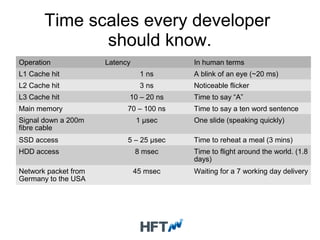
Time scales every developer
should know.
Operation Latency In human terms
L1 Cache hit 1 ns A blink of an eye (~20 ms)
L2 Cache hit 3 ns Noticeable flicker
L3 Cache hit 10 – 20 ns Time to say “A”
Main memory 70 – 100 ns Time to say a ten word sentence
Signal down a 200m
fibre cable
1 μsec One slide (speaking quickly)
SSD access 5 – 25 μsec Time to reheat a meal (3 mins)
HDD access 8 msec Time to flight around the world. (1.8
days)
Network packet from
Germany to the USA
45 msec Waiting for a 7 working day delivery
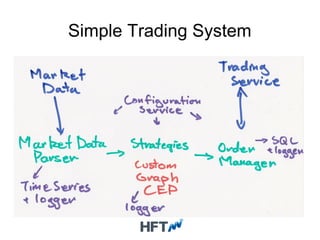
Simple Trading System
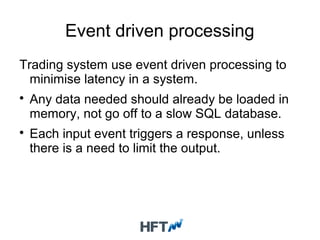
Event driven processing
Trading system use event driven processing to
minimise latency in a system.

Any data needed should already be loaded in
memory, not go off to a slow SQL database.

Each input event triggers a response, unless
there is a need to limit the output.
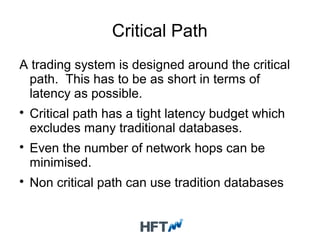
Critical Path
A trading system is designed around the critical
path. This has to be as short in terms of
latency as possible.

Critical path has a tight latency budget which
excludes many traditional databases.

Even the number of network hops can be
minimised.

Non critical path can use tradition databases
Critical Path databases

Time Series databases
− Kdb, kona
− InfluxDB
− OpenTSDB
Designed for millions of writes per second.
Column based database => 100 Million
operations per second e.g. sum a column.
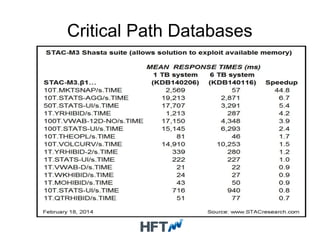
Critical Path Databases
Critical Path data store
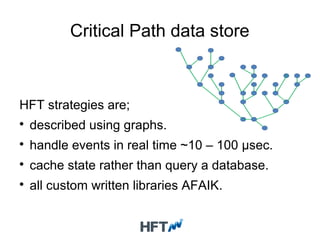
HFT strategies are;

described using graphs.

handle events in real time ~10 – 100 μsec.

cache state rather than query a database.

all custom written libraries AFAIK.
Critical Path data store
Logging is performed by appending to memory
mapped files.
OpenHFT's Java Chronicle makes this easier to
do in Java in a GC-free, off heap, lock less
way.
Such low level coding is relatively easy in C or
C++.
Non-critical Datastore
Configuration management

ZooKeeper, etcd

Plain files with Version control

LDAP

Any distributed key-value store. e.g. MongoDB
Big Data
Back testing a HFT system is critical and a
number of solutions are available

Hadoop

Matlab

Time series

R
Operational Infrastructure
Control and management infrastructure

JMS, JMX

Tibco RV, LBM

Terracotta

MongoDB
Reliable persistence
Trades and Orders are high value data and less
voluminous than Market data or strategy
results.

Typically SQL Database.

Sometimes multiple databases for different
applications.
Why use more exotic database?

Mostly for high throughput.
− Million per second in one node.

Often for low latency.
− Latencies well below a milli-second.
Why wouldn't you use exotic DB

Not easy to learn, high knowledge investment.
(!R)@&{&/x!/:2_!x}'!R

Often harder to use.
− Less management tools.
− Not designed to work with web applications.

More sensitive to the details of the hardware
and what else is running on the same
machine.
Low latency at high throughput
Java Chronicle is designed as a low latency
logger and IPC.
At one million small messages per second

Almost zero garbage

Latency between processes around 1 micro-
second

Concurrent readers and writers
Supports bursts of 10 million messages/sec.
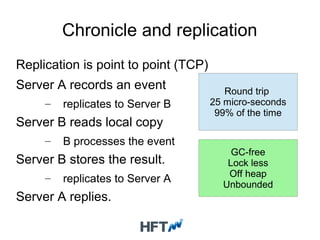
Chronicle and replication
Replication is point to point (TCP)
Server A records an event
– replicates to Server B
Server B reads local copy
– B processes the event
Server B stores the result.
– replicates to Server A
Server A replies.
Round trip
25 micro-seconds
99% of the time
GC-free
Lock less
Off heap
Unbounded
HugeCollections
HugeCollections provides key-value storage.

Persisted (by the OS)

Embedded in multiple processes

Concurrent reads and writes

Off heap accessible without serialization.
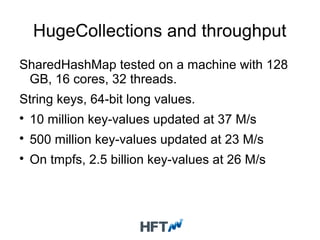
HugeCollections and throughput
SharedHashMap tested on a machine with 128
GB, 16 cores, 32 threads.
String keys, 64-bit long values.

10 million key-values updated at 37 M/s

500 million key-values updated at 23 M/s

On tmpfs, 2.5 billion key-values at 26 M/s
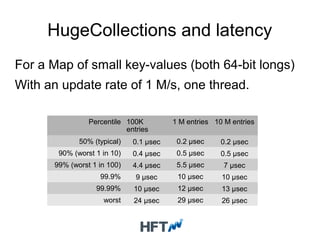
HugeCollections and latency
For a Map of small key-values (both 64-bit longs)
With an update rate of 1 M/s, one thread.
Percentile 100K
entries
1 M entries 10 M entries
50% (typical) 0.1 μsec 0.2 μsec 0.2 μsec
90% (worst 1 in 10) 0.4 μsec 0.5 μsec 0.5 μsec
99% (worst 1 in 100) 4.4 μsec 5.5 μsec 7 μsec
99.9% 9 μsec 10 μsec 10 μsec
99.99% 10 μsec 12 μsec 13 μsec
worst 24 μsec 29 μsec 26 μsec
Bonus topic: Units
A peak times an application writes 49 “mb/s” to a
disk which supports 50 “mb/s” and is replicated
over a 100 “mb/s” network.
What units were probably intended and where
would you expect buffering if any?
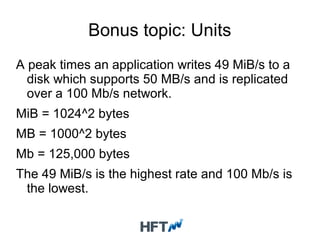
Bonus topic: Units
A peak times an application writes 49 MiB/s to a
disk which supports 50 MB/s and is replicated
over a 100 Mb/s network.
MiB = 1024^2 bytes
MB = 1000^2 bytes
Mb = 125,000 bytes
The 49 MiB/s is the highest rate and 100 Mb/s is
the lowest.
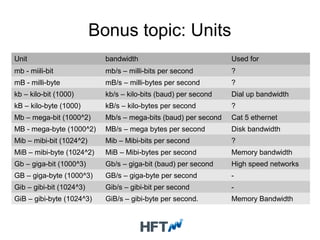
Bonus topic: Units
Unit bandwidth Used for
mb - miili-bit mb/s – milli-bits per second ?
mB - milli-byte mB/s – milli-bytes per second ?
kb – kilo-bit (1000) kb/s – kilo-bits (baud) per second Dial up bandwidth
kB – kilo-byte (1000) kB/s – kilo-bytes per second ?
Mb – mega-bit (1000^2) Mb/s – mega-bits (baud) per second Cat 5 ethernet
MB - mega-byte (1000^2) MB/s – mega bytes per second Disk bandwidth
Mib – mibi-bit (1024^2) Mib – Mibi-bits per second ?
MiB – mibi-byte (1024^2) MiB – Mibi-bytes per second Memory bandwidth
Gb – giga-bit (1000^3) Gb/s – giga-bit (baud) per second High speed networks
GB – giga-byte (1000^3) GB/s – giga-byte per second -
Gib – gibi-bit (1024^3) Gib/s – gibi-bit per second -
GiB – gibi-byte (1024^3) GiB/s – gibi-byte per second. Memory Bandwidth
Q & A
https://github.com/OpenHFT/OpenHFT
@PeterLawrey
peter.lawrey@higherfrequencytrading.com

High Frequency Trading and NoSQL database

  • 1.
    High Frequency Trading and NoSQL PeterLawrey CEO, Principal Consultant Higher Frequency Trading
  • 2.
    Agenda Who are we? Briefintroduction to OpenHFT. What does a typical trading system look like What requirements do these systems have OpenHFT performance.
  • 3.
    Who are we HigherFrequency Trading is a small consulting and software development house specialising in  Low latency, high throughput software  8 developers in Europe and USA.  Sponsor HFT related open source projects  Core Java engineering
  • 4.
    Who am I? PeterLawrey - CEO and Principal Consultant - 3rd on Stackoverflow for Java, most Java Performance answers. - Founder of the Performance Java User's Group - An Australian, based in the U.K.
  • 5.
    What is ourOSS Key OpenHFT projects  Chronicle, low latency logging, event store and IPC. (record / log everything)  HugeCollections, cross process embedded persisted data stores. (only need the latest) Millions of operations per second. Micro-second latency.
  • 6.
    With other NoSQLdatabases Uses with NoSQL  Off heap cache of data from a DB.  Low latency queue for persisting to a DB  Map which replicates only the latest values. Supports very high update rates by only replicating the latest value.
  • 7.
    What is HFT?  Nostandard definition.  Trading faster than a human can see.  Being fast can make the difference between making and losing money.  For different systems this means typical latencies of between − 10 micro-seconds and − 10 milli-second. (Latencies external to the provider)
  • 8.
    Time scales everydeveloper should know. Operation Latency In human terms L1 Cache hit 1 ns A blink of an eye (~20 ms) L2 Cache hit 3 ns Noticeable flicker L3 Cache hit 10 – 20 ns Time to say “A” Main memory 70 – 100 ns Time to say a ten word sentence Signal down a 200m fibre cable 1 μsec One slide (speaking quickly) SSD access 5 – 25 μsec Time to reheat a meal (3 mins) HDD access 8 msec Time to flight around the world. (1.8 days) Network packet from Germany to the USA 45 msec Waiting for a 7 working day delivery
  • 9.
  • 10.
    Event driven processing Tradingsystem use event driven processing to minimise latency in a system.  Any data needed should already be loaded in memory, not go off to a slow SQL database.  Each input event triggers a response, unless there is a need to limit the output.
  • 11.
    Critical Path A tradingsystem is designed around the critical path. This has to be as short in terms of latency as possible.  Critical path has a tight latency budget which excludes many traditional databases.  Even the number of network hops can be minimised.  Non critical path can use tradition databases
  • 12.
    Critical Path databases  TimeSeries databases − Kdb, kona − InfluxDB − OpenTSDB Designed for millions of writes per second. Column based database => 100 Million operations per second e.g. sum a column.
  • 13.
  • 14.
    Critical Path datastore HFT strategies are;  described using graphs.  handle events in real time ~10 – 100 μsec.  cache state rather than query a database.  all custom written libraries AFAIK.
  • 15.
    Critical Path datastore Logging is performed by appending to memory mapped files. OpenHFT's Java Chronicle makes this easier to do in Java in a GC-free, off heap, lock less way. Such low level coding is relatively easy in C or C++.
  • 16.
    Non-critical Datastore Configuration management  ZooKeeper,etcd  Plain files with Version control  LDAP  Any distributed key-value store. e.g. MongoDB
  • 17.
    Big Data Back testinga HFT system is critical and a number of solutions are available  Hadoop  Matlab  Time series  R
  • 18.
    Operational Infrastructure Control andmanagement infrastructure  JMS, JMX  Tibco RV, LBM  Terracotta  MongoDB
  • 19.
    Reliable persistence Trades andOrders are high value data and less voluminous than Market data or strategy results.  Typically SQL Database.  Sometimes multiple databases for different applications.
  • 20.
    Why use moreexotic database?  Mostly for high throughput. − Million per second in one node.  Often for low latency. − Latencies well below a milli-second.
  • 21.
    Why wouldn't youuse exotic DB  Not easy to learn, high knowledge investment. (!R)@&{&/x!/:2_!x}'!R  Often harder to use. − Less management tools. − Not designed to work with web applications.  More sensitive to the details of the hardware and what else is running on the same machine.
  • 22.
    Low latency athigh throughput Java Chronicle is designed as a low latency logger and IPC. At one million small messages per second  Almost zero garbage  Latency between processes around 1 micro- second  Concurrent readers and writers Supports bursts of 10 million messages/sec.
  • 23.
    Chronicle and replication Replicationis point to point (TCP) Server A records an event – replicates to Server B Server B reads local copy – B processes the event Server B stores the result. – replicates to Server A Server A replies. Round trip 25 micro-seconds 99% of the time GC-free Lock less Off heap Unbounded
  • 24.
    HugeCollections HugeCollections provides key-valuestorage.  Persisted (by the OS)  Embedded in multiple processes  Concurrent reads and writes  Off heap accessible without serialization.
  • 25.
    HugeCollections and throughput SharedHashMaptested on a machine with 128 GB, 16 cores, 32 threads. String keys, 64-bit long values.  10 million key-values updated at 37 M/s  500 million key-values updated at 23 M/s  On tmpfs, 2.5 billion key-values at 26 M/s
  • 26.
    HugeCollections and latency Fora Map of small key-values (both 64-bit longs) With an update rate of 1 M/s, one thread. Percentile 100K entries 1 M entries 10 M entries 50% (typical) 0.1 μsec 0.2 μsec 0.2 μsec 90% (worst 1 in 10) 0.4 μsec 0.5 μsec 0.5 μsec 99% (worst 1 in 100) 4.4 μsec 5.5 μsec 7 μsec 99.9% 9 μsec 10 μsec 10 μsec 99.99% 10 μsec 12 μsec 13 μsec worst 24 μsec 29 μsec 26 μsec
  • 27.
    Bonus topic: Units Apeak times an application writes 49 “mb/s” to a disk which supports 50 “mb/s” and is replicated over a 100 “mb/s” network. What units were probably intended and where would you expect buffering if any?
  • 28.
    Bonus topic: Units Apeak times an application writes 49 MiB/s to a disk which supports 50 MB/s and is replicated over a 100 Mb/s network. MiB = 1024^2 bytes MB = 1000^2 bytes Mb = 125,000 bytes The 49 MiB/s is the highest rate and 100 Mb/s is the lowest.
  • 29.
    Bonus topic: Units Unitbandwidth Used for mb - miili-bit mb/s – milli-bits per second ? mB - milli-byte mB/s – milli-bytes per second ? kb – kilo-bit (1000) kb/s – kilo-bits (baud) per second Dial up bandwidth kB – kilo-byte (1000) kB/s – kilo-bytes per second ? Mb – mega-bit (1000^2) Mb/s – mega-bits (baud) per second Cat 5 ethernet MB - mega-byte (1000^2) MB/s – mega bytes per second Disk bandwidth Mib – mibi-bit (1024^2) Mib – Mibi-bits per second ? MiB – mibi-byte (1024^2) MiB – Mibi-bytes per second Memory bandwidth Gb – giga-bit (1000^3) Gb/s – giga-bit (baud) per second High speed networks GB – giga-byte (1000^3) GB/s – giga-byte per second - Gib – gibi-bit (1024^3) Gib/s – gibi-bit per second - GiB – gibi-byte (1024^3) GiB/s – gibi-byte per second. Memory Bandwidth
  • 30.