Build Large-Scale
Data Analytics and AI
Pipeline Using RayDP
Carson Wang, Xianyang Liu
Intel
Agenda
▪ Carson Wang
▪ Big Data & AI Background
▪ Ray & RayDP Overview
▪ Xianyang Liu
▪ RayDP Deep Dive
▪ RayDP Examples
Big Data & AI Background
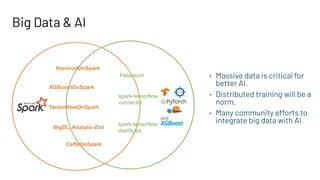
Big Data & AI
HorovodOnSpark
TensorflowOnSpark
BigDL, Analytic-Zoo
CaffeOnSpark
Petastorm
XGBoostOnSpark
• Massive data is critical for
better AI.
• Distributed training will be a
norm.
• Many community efforts to
integrate big data with AI.
spark-tensorflow
distributor
spark-tensorflow
connector
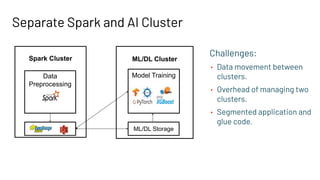
Separate Spark and AI Cluster
Challenges:
• Data movement between
clusters.
• Overhead of managing two
clusters.
• Segmented application and
glue code.
Spark Cluster
Data
Preprocessing
ML/DL Cluster
Model Training
ML/DL Storage
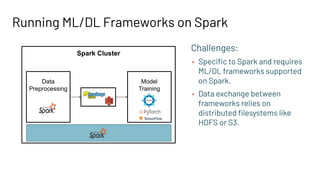
Running ML/DL Frameworks on Spark
Challenges:
• Specific to Spark and requires
ML/DL frameworks supported
on Spark.
• Data exchange between
frameworks relies on
distributed filesystems like
HDFS or S3.
Spark Cluster
Data
Preprocessing
Model
Training
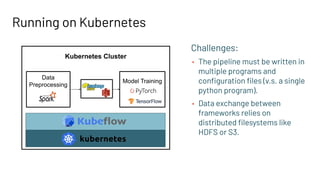
Running on Kubernetes
Kubernetes Cluster
Challenges:
• The pipeline must be written in
multiple programs and
configuration files (v.s. a single
python program).
• Data exchange between
frameworks relies on
distributed filesystems like
HDFS or S3.
Data
Preprocessing
Model Training
Ray & RayDP Overview
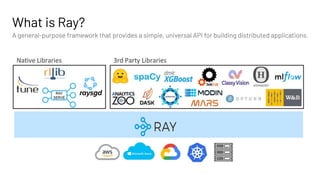
What is Ray?
A general-purpose framework that provides a simple, universal API for building distributed applications.
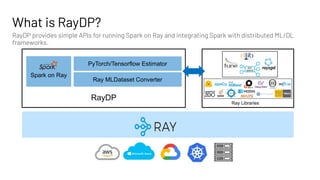
What is RayDP?
RayDP provides simple APIs for running Spark on Ray and integrating Spark with distributed ML/DL
frameworks.
RayDP
PyTorch/Tensorflow Estimator
Ray MLDataset Converter
Spark on Ray
Ray Libraries
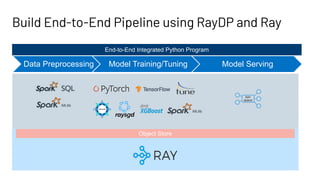
Build End-to-End Pipeline using RayDP and Ray
Data Preprocessing Model Training/Tuning Model Serving
End-to-End Integrated Python Program
Object Store
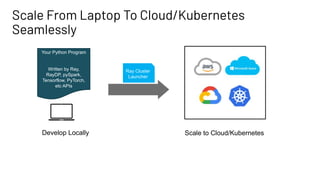
Scale From Laptop To Cloud/Kubernetes
Seamlessly
Your Python Program
Written by Ray,
RayDP, pySpark,
Tensorflow, PyTorch,
etc APIs
Develop Locally Scale to Cloud/Kubernetes
Ray Cluster
Launcher
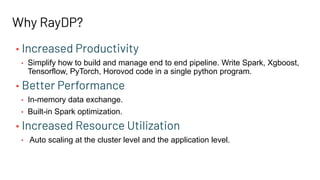
Why RayDP?
• Increased Productivity
• Simplify how to build and manage end to end pipeline. Write Spark, Xgboost,
Tensorflow, PyTorch, Horovod code in a single python program.
• Better Performance
• In-memory data exchange.
• Built-in Spark optimization.
• Increased Resource Utilization
• Auto scaling at the cluster level and the application level.
RayDP Deep Dive
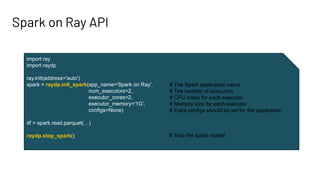
Spark on Ray API
import ray
import raydp
ray.init(address='auto')
spark = raydp.init_spark(app_name='Spark on Ray',
num_executors=2,
executor_cores=2,
executor_memory='1G’,
configs=None)
df = spark.read.parquet(…)
raydp.stop_spark()
# The Spark application name
# The number of executors
# CPU cores for each executor
# Memory size for each executor
# Extra configs should be set for the application
# Stop the spark cluster
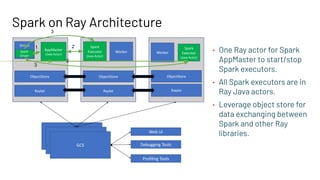
Spark on Ray Architecture
AppMaster
(Java Actor)
ObjectStore
Raylet
GCS
GCS
GCS
Web UI
Debugging Tools
Profiling Tools
Spark
Executor
(Java Actor)
Worker
ObjectStore
Raylet
Worker
ObjectStore
Raylet
Spark
Executor
(Java Actor)
Driver
Spark
Driver
1 2
3
3
2
• One Ray actor for Spark
AppMaster to start/stop
Spark executors.
• All Spark executors are in
Ray Java actors.
• Leverage object store for
data exchanging between
Spark and other Ray
libraries.
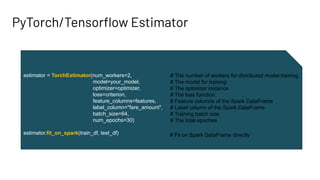
PyTorch/Tensorflow Estimator
estimator = TorchEstimator(num_workers=2,
model=your_model,
optimizer=optimizer,
loss=criterion,
feature_columns=features,
label_column="fare_amount",
batch_size=64,
num_epochs=30)
estimator.fit_on_spark(train_df, test_df)
# The number of workers for distributed model training
# The model for training
# The optimizer instance
# The loss function
# Feature columns of the Spark DataFrame
# Label column of the Spark DataFrame
# Training batch size
# The total epoches
# Fit on Spark DataFrame directly
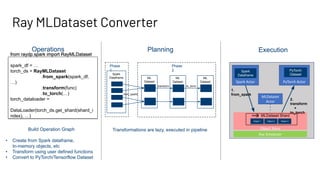
Ray MLDataset Converter
from raydp.spark import RayMLDataset
spark_df = …
torch_ds = RayMLDataset
.from_spark(spark_df,
…)
.transform(func)
.to_torch(…)
torch_dataloader =
DataLoader(torch_ds.get_shard(shard_i
ndex), …)
Operations Execution
Planning
Object Store
Ray Scheduler
Spark Actor
MLDataset
Actor
Object 1
MLDataset Shard
Spark
Dataframe
PyTorch Actor
PyTorch
Dataset
1.
from_spark
2.
transform
+
to_torch
Object 2 Object 3
Spark
Dataframe ML
Dataset
ML
Dataset
ML
Dataset
from_sparkt
transform to_torch
Build Operation Graph
• Create from Spark dataframe,
In-memory objects, etc
• Transform using user defined functions
• Convert to PyTorch/Tensorflow Dataset
Transformations are lazy, executed in pipeline
Phase
1
Phase
2
RayDP Examples
Spark + XGBoost on Ray
import ray
import raydp
ray.init(address='auto')
spark = raydp.init_spark('Spark + XGBoost',
num_executors=2,
executor_cores=4,
executor_memory='8G')
df = spark.read.csv(...)
...
train_df, test_df = random_split(df, [0.9, 0.1])
train_dataset = RayMLDataset.from_spark(train_df, ...)
test_dataset = RayMLDataset.from_spark(test_df, ...)
from xgboost_ray import RayDMatrix, train, RayParams
dtrain = RayDMatrix(train_dataset, label='fare_amount')
dtest = RayDMatrix(test_dataset, label='fare_amount’)
…
bst = train(
config,
dtrain,
evals=[(dtest, "eval")],
evals_result=evals_result,
ray_params=RayParams(…)
num_boost_round=10)
Data Preprocessing Model Training
End-to-End Integrated Python Program
RayD
P
RayD
P
Spark + Horovod on Ray
import ray
import raydp
ray.init(address='auto')
spark = raydp.init_spark('Spark + Horovod',
num_executors=2,
executor_cores=4,
executor_memory=‘8G’)
df = spark.read.csv(...)
...
torch_ds= RayMLDataset.from_spark(df, …)
.to_torch(...)
#PyTorch Model
class My_Model(nn.Module):
…
#Horovod on Ray
def train_fn(dataset, num_features):
hvd.init()
rank = hvd.rank()
train_data = dataset.get_shard(rank)
...
from horovod.ray import RayExecutor
executor = RayExecutor(settings, num_hosts=1,
num_slots=1, cpus_per_slot=1)
executor.start()
executor.run(train_fn, args=[torch_ds, num_features])
Data Preprocessing Model Training
End-to-End Integrated Python Program
RayD
P
RayD
P
Spark + Horovod + RayTune on Ray
import ray
import raydp
ray.init(address='auto')
spark = raydp.init_spark(‘Spark + Horovod',
num_executors=2,
executor_cores=4,
executor_memory=‘8G’)
df = spark.read.csv(...)
...
torch_ds= RayMLDataset.from_spark(df, …)
.to_torch(...)
#PyTorch Model
class My_Model(nn.Module):
…
#Horovod on Ray + Ray Tune
def train_fn(config: Dict):
...
trainable = DistributedTrainableCreator(
train_fn, num_slots=2, use_gpu=use_gpu)
analysis = tune.run(
trainable,
num_samples=2,
config={
"epochs": tune.grid_search([1, 2, 3]),
"lr": tune.grid_search([0.1, 0.2, 0.3]),
}
)
print(analysis.best_config)
Data Preprocessing Model Training/Tuning
End-to-End Integrated Python Program
RayD
P
RayD
P
Summary
• Ray is a general-purpose framework that can be used
as a single substrate for end-to-end data analytics
and AI pipelines.
• RayDP provides simple APIs for running Spark on Ray
and integrating Spark with distributed ML/DL
frameworks.
• For more information, please visit
https://github.com/oap-project/raydp 
Feedback
Your feedback is important to us.
Don’t forget to rate and review the sessions.

Build Large-Scale Data Analytics and AI Pipeline Using RayDP

  • 1.
    Build Large-Scale Data Analyticsand AI Pipeline Using RayDP Carson Wang, Xianyang Liu Intel
  • 2.
    Agenda ▪ Carson Wang ▪Big Data & AI Background ▪ Ray & RayDP Overview ▪ Xianyang Liu ▪ RayDP Deep Dive ▪ RayDP Examples
  • 3.
    Big Data &AI Background
  • 4.
    Big Data &AI HorovodOnSpark TensorflowOnSpark BigDL, Analytic-Zoo CaffeOnSpark Petastorm XGBoostOnSpark • Massive data is critical for better AI. • Distributed training will be a norm. • Many community efforts to integrate big data with AI. spark-tensorflow distributor spark-tensorflow connector
  • 5.
    Separate Spark andAI Cluster Challenges: • Data movement between clusters. • Overhead of managing two clusters. • Segmented application and glue code. Spark Cluster Data Preprocessing ML/DL Cluster Model Training ML/DL Storage
  • 6.
    Running ML/DL Frameworkson Spark Challenges: • Specific to Spark and requires ML/DL frameworks supported on Spark. • Data exchange between frameworks relies on distributed filesystems like HDFS or S3. Spark Cluster Data Preprocessing Model Training
  • 7.
    Running on Kubernetes KubernetesCluster Challenges: • The pipeline must be written in multiple programs and configuration files (v.s. a single python program). • Data exchange between frameworks relies on distributed filesystems like HDFS or S3. Data Preprocessing Model Training
  • 8.
    Ray & RayDPOverview
  • 9.
    What is Ray? Ageneral-purpose framework that provides a simple, universal API for building distributed applications.
  • 10.
    What is RayDP? RayDPprovides simple APIs for running Spark on Ray and integrating Spark with distributed ML/DL frameworks. RayDP PyTorch/Tensorflow Estimator Ray MLDataset Converter Spark on Ray Ray Libraries
  • 11.
    Build End-to-End Pipelineusing RayDP and Ray Data Preprocessing Model Training/Tuning Model Serving End-to-End Integrated Python Program Object Store
  • 12.
    Scale From LaptopTo Cloud/Kubernetes Seamlessly Your Python Program Written by Ray, RayDP, pySpark, Tensorflow, PyTorch, etc APIs Develop Locally Scale to Cloud/Kubernetes Ray Cluster Launcher
  • 13.
    Why RayDP? • IncreasedProductivity • Simplify how to build and manage end to end pipeline. Write Spark, Xgboost, Tensorflow, PyTorch, Horovod code in a single python program. • Better Performance • In-memory data exchange. • Built-in Spark optimization. • Increased Resource Utilization • Auto scaling at the cluster level and the application level.
  • 14.
  • 15.
    Spark on RayAPI import ray import raydp ray.init(address='auto') spark = raydp.init_spark(app_name='Spark on Ray', num_executors=2, executor_cores=2, executor_memory='1G’, configs=None) df = spark.read.parquet(…) raydp.stop_spark() # The Spark application name # The number of executors # CPU cores for each executor # Memory size for each executor # Extra configs should be set for the application # Stop the spark cluster
  • 16.
    Spark on RayArchitecture AppMaster (Java Actor) ObjectStore Raylet GCS GCS GCS Web UI Debugging Tools Profiling Tools Spark Executor (Java Actor) Worker ObjectStore Raylet Worker ObjectStore Raylet Spark Executor (Java Actor) Driver Spark Driver 1 2 3 3 2 • One Ray actor for Spark AppMaster to start/stop Spark executors. • All Spark executors are in Ray Java actors. • Leverage object store for data exchanging between Spark and other Ray libraries.
  • 17.
    PyTorch/Tensorflow Estimator estimator =TorchEstimator(num_workers=2, model=your_model, optimizer=optimizer, loss=criterion, feature_columns=features, label_column="fare_amount", batch_size=64, num_epochs=30) estimator.fit_on_spark(train_df, test_df) # The number of workers for distributed model training # The model for training # The optimizer instance # The loss function # Feature columns of the Spark DataFrame # Label column of the Spark DataFrame # Training batch size # The total epoches # Fit on Spark DataFrame directly
  • 18.
    Ray MLDataset Converter fromraydp.spark import RayMLDataset spark_df = … torch_ds = RayMLDataset .from_spark(spark_df, …) .transform(func) .to_torch(…) torch_dataloader = DataLoader(torch_ds.get_shard(shard_i ndex), …) Operations Execution Planning Object Store Ray Scheduler Spark Actor MLDataset Actor Object 1 MLDataset Shard Spark Dataframe PyTorch Actor PyTorch Dataset 1. from_spark 2. transform + to_torch Object 2 Object 3 Spark Dataframe ML Dataset ML Dataset ML Dataset from_sparkt transform to_torch Build Operation Graph • Create from Spark dataframe, In-memory objects, etc • Transform using user defined functions • Convert to PyTorch/Tensorflow Dataset Transformations are lazy, executed in pipeline Phase 1 Phase 2
  • 19.
  • 20.
    Spark + XGBooston Ray import ray import raydp ray.init(address='auto') spark = raydp.init_spark('Spark + XGBoost', num_executors=2, executor_cores=4, executor_memory='8G') df = spark.read.csv(...) ... train_df, test_df = random_split(df, [0.9, 0.1]) train_dataset = RayMLDataset.from_spark(train_df, ...) test_dataset = RayMLDataset.from_spark(test_df, ...) from xgboost_ray import RayDMatrix, train, RayParams dtrain = RayDMatrix(train_dataset, label='fare_amount') dtest = RayDMatrix(test_dataset, label='fare_amount’) … bst = train( config, dtrain, evals=[(dtest, "eval")], evals_result=evals_result, ray_params=RayParams(…) num_boost_round=10) Data Preprocessing Model Training End-to-End Integrated Python Program RayD P RayD P
  • 21.
    Spark + Horovodon Ray import ray import raydp ray.init(address='auto') spark = raydp.init_spark('Spark + Horovod', num_executors=2, executor_cores=4, executor_memory=‘8G’) df = spark.read.csv(...) ... torch_ds= RayMLDataset.from_spark(df, …) .to_torch(...) #PyTorch Model class My_Model(nn.Module): … #Horovod on Ray def train_fn(dataset, num_features): hvd.init() rank = hvd.rank() train_data = dataset.get_shard(rank) ... from horovod.ray import RayExecutor executor = RayExecutor(settings, num_hosts=1, num_slots=1, cpus_per_slot=1) executor.start() executor.run(train_fn, args=[torch_ds, num_features]) Data Preprocessing Model Training End-to-End Integrated Python Program RayD P RayD P
  • 22.
    Spark + Horovod+ RayTune on Ray import ray import raydp ray.init(address='auto') spark = raydp.init_spark(‘Spark + Horovod', num_executors=2, executor_cores=4, executor_memory=‘8G’) df = spark.read.csv(...) ... torch_ds= RayMLDataset.from_spark(df, …) .to_torch(...) #PyTorch Model class My_Model(nn.Module): … #Horovod on Ray + Ray Tune def train_fn(config: Dict): ... trainable = DistributedTrainableCreator( train_fn, num_slots=2, use_gpu=use_gpu) analysis = tune.run( trainable, num_samples=2, config={ "epochs": tune.grid_search([1, 2, 3]), "lr": tune.grid_search([0.1, 0.2, 0.3]), } ) print(analysis.best_config) Data Preprocessing Model Training/Tuning End-to-End Integrated Python Program RayD P RayD P
  • 23.
    Summary • Ray isa general-purpose framework that can be used as a single substrate for end-to-end data analytics and AI pipelines. • RayDP provides simple APIs for running Spark on Ray and integrating Spark with distributed ML/DL frameworks. • For more information, please visit https://github.com/oap-project/raydp 
  • 24.
    Feedback Your feedback isimportant to us. Don’t forget to rate and review the sessions.