EXTREME TRANSACTION PROCESSING IN A
MEMORY-ORIENTED WORLD
GIRISH MUTREJA
See all the presentations from the In-Memory Computing
Summit at http://imcsummit.org
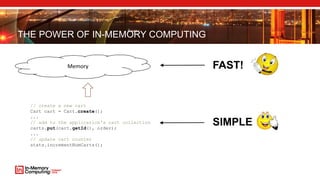
THE POWER OF IN-MEMORY COMPUTING
FAST!
SIMPLE
// create a new cart
Cart cart = Cart.create();
...
// add to the application's cart collection
carts.put(cart.getId(), order);
...
// update cart counter
stats.incrementNumCarts();
Memory
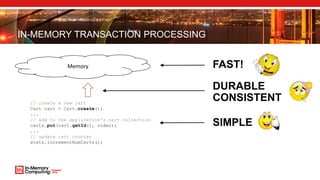
IN-MEMORY TRANSACTION PROCESSING
FAST!
SIMPLE
// create a new cart
Cart cart = Cart.create();
...
// add to the application's cart collection
carts.put(cart.getId(), order);
...
// update cart counter
stats.incrementNumCarts();
Memory
DURABLE
CONSISTENT
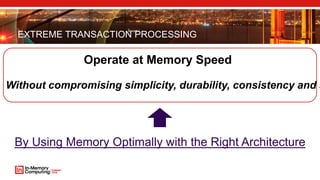
EXTREME TRANSACTION PROCESSING
Operate at Memory Speed
Without compromising simplicity, durability, consistency and s
By Using Memory Optimally with the Right Architecture
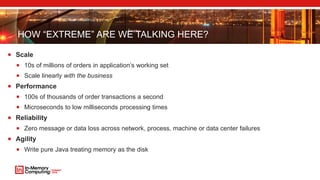
HOW “EXTREME” ARE WE TALKING HERE?
 Scale
 10s of millions of orders in application’s working set
 Scale linearly with the business
 Performance
 100s of thousands of order transactions a second
 Microseconds to low milliseconds processing times
 Reliability
 Zero message or data loss across network, process, machine or data center failures
 Agility
 Write pure Java treating memory as the disk
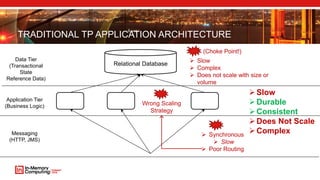
TRADITIONAL TP APPLICATION ARCHITECTURE
Relational Database
Data Tier
(Transactional
State
Reference Data)
Application Tier
(Business Logic)
Messaging
(HTTP, JMS)
 Slow
 Complex
 Does not scale with size or
volume
 Synchronous
 Slow
 Poor Routing
(Choke Point!)
Wrong Scaling
Strategy
Slow
Durable
Consistent
Does Not Scale
Complex
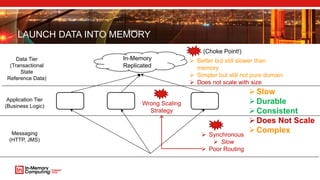
LAUNCH DATA INTO MEMORY
Data Tier
(Transactional
State
Reference Data)
Application Tier
(Business Logic)
Messaging
(HTTP, JMS)
 Better but still slower than
memory
 Simpler but still not pure domain
 Does not scale with size
 Synchronous
 Slow
 Poor Routing
(Choke Point!)
Wrong Scaling
Strategy
Slow
Durable
Consistent
Does Not Scale
Complex
In-Memory
Replicated
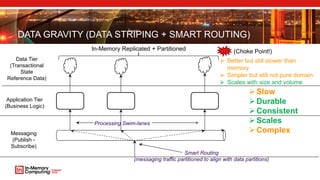
DATA GRAVITY (DATA STRIPING + SMART ROUTING)
Data Tier
(Transactional
State
Reference Data)
Application Tier
(Business Logic)
Messaging
(Publish -
Subscribe)
 Better but still slower than
memory
 Simpler but still not pure domain
 Scales with size and volume
(Choke Point!)
Slow
Durable
Consistent
Scales
Complex
In-Memory Replicated + Partitioned
Smart Routing
(messaging traffic partitioned to align with data partitions)
Processing Swim-lanes
WHY STILL SLOW AND COMPLEX
 How Slow?
 Latency
 100s of milliseconds
 Throughput
 Very low with single pipe
 Few 1000s per second with high concurrency
 Why Still Slow?
 Remoting out of process
 Synchronous data management and stabilization
 Concurrent transactions are not cheap!
 Why Complex?
 Transaction Management still in business logic
 Thread management for concurrency (only way to scale)
 Data transformations due to lack of structured data models
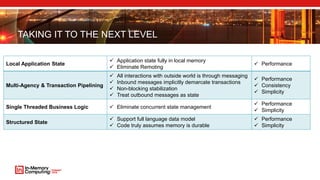
TAKING IT TO THE NEXT LEVEL
Local Application State
 Application state fully in local memory
 Eliminate Remoting
 Performance
Multi-Agency & Transaction Pipelining
 All interactions with outside world is through messaging
 Inbound messages implicitly demarcate transactions
 Non-blocking stabilization
 Treat outbound messages as state
 Performance
 Consistency
 Simplicity
Single Threaded Business Logic  Eliminate concurrent state management
 Performance
 Simplicity
Structured State
 Support full language data model
 Code truly assumes memory is durable
 Performance
 Simplicity
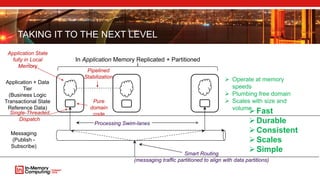
TAKING IT TO THE NEXT LEVEL
Application + Data
Tier
(Business Logic
Transactional State
Reference Data)
Messaging
(Publish -
Subscribe)
Fast
Durable
Consistent
Scales
Simple
In Application Memory Replicated + Partitioned
Smart Routing
(messaging traffic partitioned to align with data partitions)
Processing Swim-lanes
 Operate at memory
speeds
 Plumbing free domain
 Scales with size and
volume
Application State
fully in Local
Memory
Single-Threaded
Dispatch
Pipelined
Stabilization
Pure
domain
code
NOW WHAT IS THE PERFORMANCE?
 How Fast?
 Latency
 100s of microseconds to low milliseconds
 Throughput
 100s of thousands of transactions per second
 Any issues?
 Jittery due to GC
 Still some work is needed for ultra-low latency
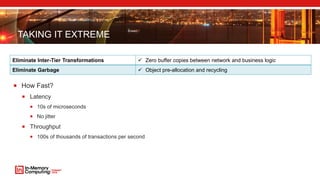
TAKING IT EXTREME
Eliminate Inter-Tier Transformations  Zero buffer copies between network and business logic
Eliminate Garbage  Object pre-allocation and recycling
 How Fast?
 Latency
 10s of microseconds
 No jitter
 Throughput
 100s of thousands of transactions per second
REAL LIFE USE CASES
 MGM Resorts International
 eCommerce Engine is authored on the X Platform
 10 services/26 agents comprise the eCommerce service suite
 Key metrics
 All state, reference and transactional fully in-memory: ~1TB of in-memory state
 Low 10s of millisecond catalogue/pricing update latency
 500ms (max) full 14 month dynamic pricing response time to website at upwards of 20tps
 Sub-second rate update to partner
 SSO storage engine authored on the X Platform
 Authored as a distributed, persistent, partitioned hash map
 Authored on X in 3 hours!
 <10ms response times @ 20k updates per second
 Bottleneck in messaging bus, X has plenty of more capacity
REAL LIFE USE CASES
 Tier 1 Investment Bank Wall Street
 X Platform foundation for all equities applications
 Key Metrics
 Application 1: 50-100k/sec sustained throughput
 Application 2: <100us client-market latency
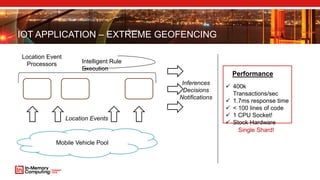
IOT APPLICATION – EXTREME GEOFENCING
Location Event
Processors Intelligent Rule
Execution
Location Events
Mobile Vehicle Pool
Inferences
Decisions
Notifications
Performance
 400k
Transactions/sec
 1.7ms response time
 < 100 lines of code
 1 CPU Socket!
 Stock Hardware
Single Shard!
QUESTIONS
?

IMC Summit 2016 Breakout - Girish Mutreja - Extreme Transaction Processing in a Memory-Oriented World

  • 1.
    EXTREME TRANSACTION PROCESSINGIN A MEMORY-ORIENTED WORLD GIRISH MUTREJA See all the presentations from the In-Memory Computing Summit at http://imcsummit.org
  • 2.
    THE POWER OFIN-MEMORY COMPUTING FAST! SIMPLE // create a new cart Cart cart = Cart.create(); ... // add to the application's cart collection carts.put(cart.getId(), order); ... // update cart counter stats.incrementNumCarts(); Memory
  • 3.
    IN-MEMORY TRANSACTION PROCESSING FAST! SIMPLE //create a new cart Cart cart = Cart.create(); ... // add to the application's cart collection carts.put(cart.getId(), order); ... // update cart counter stats.incrementNumCarts(); Memory DURABLE CONSISTENT
  • 4.
    EXTREME TRANSACTION PROCESSING Operateat Memory Speed Without compromising simplicity, durability, consistency and s By Using Memory Optimally with the Right Architecture
  • 5.
    HOW “EXTREME” AREWE TALKING HERE?  Scale  10s of millions of orders in application’s working set  Scale linearly with the business  Performance  100s of thousands of order transactions a second  Microseconds to low milliseconds processing times  Reliability  Zero message or data loss across network, process, machine or data center failures  Agility  Write pure Java treating memory as the disk
  • 6.
    TRADITIONAL TP APPLICATIONARCHITECTURE Relational Database Data Tier (Transactional State Reference Data) Application Tier (Business Logic) Messaging (HTTP, JMS)  Slow  Complex  Does not scale with size or volume  Synchronous  Slow  Poor Routing (Choke Point!) Wrong Scaling Strategy Slow Durable Consistent Does Not Scale Complex
  • 7.
    LAUNCH DATA INTOMEMORY Data Tier (Transactional State Reference Data) Application Tier (Business Logic) Messaging (HTTP, JMS)  Better but still slower than memory  Simpler but still not pure domain  Does not scale with size  Synchronous  Slow  Poor Routing (Choke Point!) Wrong Scaling Strategy Slow Durable Consistent Does Not Scale Complex In-Memory Replicated
  • 8.
    DATA GRAVITY (DATASTRIPING + SMART ROUTING) Data Tier (Transactional State Reference Data) Application Tier (Business Logic) Messaging (Publish - Subscribe)  Better but still slower than memory  Simpler but still not pure domain  Scales with size and volume (Choke Point!) Slow Durable Consistent Scales Complex In-Memory Replicated + Partitioned Smart Routing (messaging traffic partitioned to align with data partitions) Processing Swim-lanes
  • 9.
    WHY STILL SLOWAND COMPLEX  How Slow?  Latency  100s of milliseconds  Throughput  Very low with single pipe  Few 1000s per second with high concurrency  Why Still Slow?  Remoting out of process  Synchronous data management and stabilization  Concurrent transactions are not cheap!  Why Complex?  Transaction Management still in business logic  Thread management for concurrency (only way to scale)  Data transformations due to lack of structured data models
  • 10.
    TAKING IT TOTHE NEXT LEVEL Local Application State  Application state fully in local memory  Eliminate Remoting  Performance Multi-Agency & Transaction Pipelining  All interactions with outside world is through messaging  Inbound messages implicitly demarcate transactions  Non-blocking stabilization  Treat outbound messages as state  Performance  Consistency  Simplicity Single Threaded Business Logic  Eliminate concurrent state management  Performance  Simplicity Structured State  Support full language data model  Code truly assumes memory is durable  Performance  Simplicity
  • 11.
    TAKING IT TOTHE NEXT LEVEL Application + Data Tier (Business Logic Transactional State Reference Data) Messaging (Publish - Subscribe) Fast Durable Consistent Scales Simple In Application Memory Replicated + Partitioned Smart Routing (messaging traffic partitioned to align with data partitions) Processing Swim-lanes  Operate at memory speeds  Plumbing free domain  Scales with size and volume Application State fully in Local Memory Single-Threaded Dispatch Pipelined Stabilization Pure domain code
  • 12.
    NOW WHAT ISTHE PERFORMANCE?  How Fast?  Latency  100s of microseconds to low milliseconds  Throughput  100s of thousands of transactions per second  Any issues?  Jittery due to GC  Still some work is needed for ultra-low latency
  • 13.
    TAKING IT EXTREME EliminateInter-Tier Transformations  Zero buffer copies between network and business logic Eliminate Garbage  Object pre-allocation and recycling  How Fast?  Latency  10s of microseconds  No jitter  Throughput  100s of thousands of transactions per second
  • 14.
    REAL LIFE USECASES  MGM Resorts International  eCommerce Engine is authored on the X Platform  10 services/26 agents comprise the eCommerce service suite  Key metrics  All state, reference and transactional fully in-memory: ~1TB of in-memory state  Low 10s of millisecond catalogue/pricing update latency  500ms (max) full 14 month dynamic pricing response time to website at upwards of 20tps  Sub-second rate update to partner  SSO storage engine authored on the X Platform  Authored as a distributed, persistent, partitioned hash map  Authored on X in 3 hours!  <10ms response times @ 20k updates per second  Bottleneck in messaging bus, X has plenty of more capacity
  • 15.
    REAL LIFE USECASES  Tier 1 Investment Bank Wall Street  X Platform foundation for all equities applications  Key Metrics  Application 1: 50-100k/sec sustained throughput  Application 2: <100us client-market latency
  • 16.
    IOT APPLICATION –EXTREME GEOFENCING Location Event Processors Intelligent Rule Execution Location Events Mobile Vehicle Pool Inferences Decisions Notifications Performance  400k Transactions/sec  1.7ms response time  < 100 lines of code  1 CPU Socket!  Stock Hardware Single Shard!
  • 17.