In-Memory Databases
Trends and Technologies

Vilho Raatikka
solidDB Development
IBM Helsinki Lab
March 2012
© 2012 IBM Corporation
Author
Vilho Raatikka, Software Engineer, IBM solidDB core development,
Vilho.Raatikka@fi.ibm.com, +358 50 372 0394
Background in research at University of Helsinki
RODAIN : in-memory database indexing
SeCo : database migration, RDF(S) databases
Joined Solid Information Technology in 2004, IBM acquired
Solid in 2008.
Started as a performance tester, and technical writer on Solid.
Since 2005 concentrated mostly design & implementing inmemory indexing, high-availability (HA) technologies, and
improving the use of multi-core processors.
2

© 2012 IBM Corporation
Overview
Motivation behind in-memory databases (imdb).
What makes imdb faster?
Where is it used best?
Is imdb suitable for Big Data?

3

© 2012 IBM Corporation
Disk-based databases
For decades, databases have provided robust, and popular set
of features for applications.
Disk-based databases utilize cheap, and large storage.
They provide large volume, but long disk latency is hard to
overcome.
Even with large page buffers, disk access causes
unpredictable long response times.
Therefore:
➢ Shortening response time is difficult
➢ Even page cache access is relatively slow

4

© 2012 IBM Corporation
In services user expectation matters
Amazon reported that every 100ms delay costs 1% of sales (Greg
Linden)
Google increased the number of search results from 10 to 30.
Additional 500ms caused a 20% drop in traffic. Half a second
delay killed user satisfaction. (Marissa Mayer in Web 2.0)
Stock Traders Find Speed Pays, in Milliseconds (Charles Duhiagg,
The New York Times)
Sometimes I/O stalls, or blocking operations are not tolerated
HLR operations in TelCo
Stock trading SW
Medical devices

Making more throughput is easy, but once you have bad latency
you're stuck with it. Stuart Cheshire, May 1996
5

© 2012 IBM Corporation
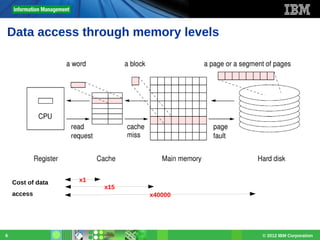
Data access through memory levels

Cost of data
access

6

x1
x15
x40000

© 2012 IBM Corporation
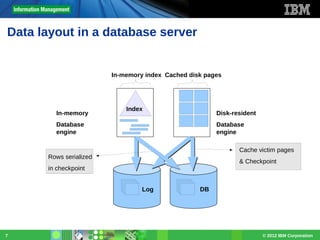
Data layout in a database server

In-memory index Cached disk pages

In-memory

Index

Disk-resident

Database
engine

Database
engine
Cache victim pages

Rows serialized

& Checkpoint

in checkpoint
Log

7

DB

© 2012 IBM Corporation
Why in-memory database is faster?
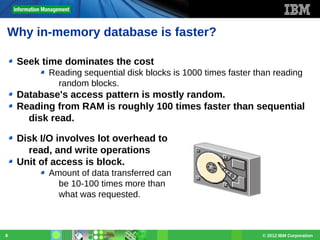
Seek time dominates the cost
Reading sequential disk blocks is 1000 times faster than reading
random blocks.

Database's access pattern is mostly random.
Reading from RAM is roughly 100 times faster than sequential
disk read.
Disk I/O involves lot overhead to
read, and write operations
Unit of access is block.
Amount of data transferred can
be 10-100 times more than
what was requested.

8

© 2012 IBM Corporation
Why in-memory database is faster also in
memory?
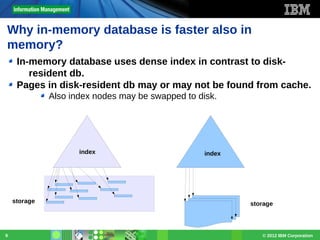
In-memory database uses dense index in contrast to diskresident db.
Pages in disk-resident db may or may not be found from cache.
Also index nodes may be swapped to disk.

index

storage

9

index

storage

© 2012 IBM Corporation
Main challenges in in-memory databases
Maximize parallel processing in one machine
Maintain ACID but avoid storage/network bottleneck
Provide low latencies consistently
Scale out (generic requirement)

10

© 2012 IBM Corporation
Vertical scaling
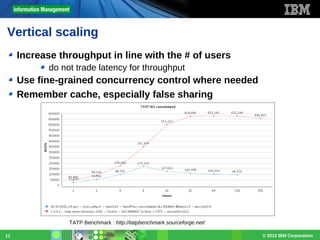
Increase throughput in line with the # of users
do not trade latency for throughput

Use fine-grained concurrency control where needed
Remember cache, especially false sharing

TATP Benchmark : http://tatpbenchmark.sourceforge.net/
11

© 2012 IBM Corporation
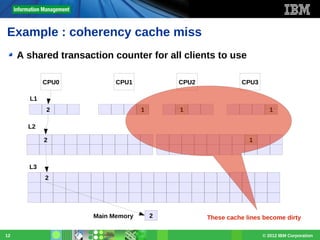
Example : coherency cache miss
A shared transaction counter for all clients to use
CPU0

CPU1

CPU2

CPU3

L1
2

1

1

1

L2
2

1

L3
2

Main Memory
12

2

These cache lines become dirty
© 2012 IBM Corporation
Example : false sharing
Independent data share a cache line
Remember spatial locality, avoid false sharing

Update t1 set name='fo' where id=1

Select * from t1 where id=2
CPU1

CPU0
L1
[1, 'foo'],[2,'bar']
[1, 'fo'],[2,'bar']

[1, 'foo'],[2,'bar']

Whole cache line becomes dirty
Main Memory

[1, 'foo'],[2,'bar']
[1, 'fo'],[2,'bar']
Cache line – unit of transfer

13

© 2012 IBM Corporation
Tuning log writing
Synchronized log writing (WAL) doesn't leave much to do
Buy faster hardware

With asynchronous logging, there is time window to be used
Typically at least 1-5 seconds
Clients are provided with several pre-allocated (recycled) log entry
buckets
Every now and then, a leaving client is requested to
allocate/recycle buckets – share the load
Client adds filled buckets to a circular buffer
Log writer thread flushes every full buffer maintaining transaction
sequence number ordering

Sequential file write is fast enough, problem is to prevent the
swarm of clients from colliding with each other

14

© 2012 IBM Corporation
Unobtrusive checkpoint writing
Consistent, or fuzzy
Fuzzy spreads write load evenly over time but it's not consistent
Consistent doesn't need log for restoring

Every checkpoint starts with synchronization point – freeze
Chekpoint counter is increased, and dirty data is marked

The rest is sequence of non-blocking operations
Techniques:
Shadow copying
versioning

Write only dirty pages, write fast, but don't block disk IO
Write everything, or data only
Latter is trading faster checkpoint to slower restore

15

© 2012 IBM Corporation
Low latencies make services possible
Database often sits on the bottom of sw stack of the service
Service's response time includes application and transaction
processing altogether
Assume that transaction execution shortens to 1/10th – how
would you spend the free extra time?
Execute more transactions?
Add business logic to application layer?
Meet the deadlines?

Low latencies enable deplying more intelligent applications
and services without violating Service-Level Agreements
(SLA).

16

© 2012 IBM Corporation
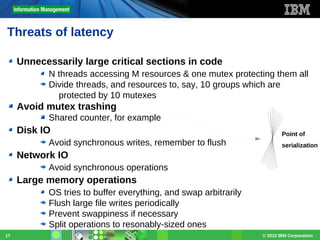
Threats of latency
Unnecessarily large critical sections in code
N threads accessing M resources & one mutex protecting them all
Divide threads, and resources to, say, 10 groups which are
protected by 10 mutexes

Avoid mutex trashing
Shared counter, for example

Disk IO
Avoid synchronous writes, remember to flush

Point of
serialization

Network IO
Avoid synchronous operations

Large memory operations
OS tries to buffer everything, and swap arbitrarily
Flush large file writes periodically
Prevent swappiness if necessary
Split operations to resonably-sized ones
17

© 2012 IBM Corporation
Massive data, and parallelism
Why to scale out ?
In some cases, multiple cheap boxes provide more than a few
bigger and more expensive servers
Adding soap boxes one by one provides flexible, low-risk solution
If the solution meets the needs, it is better to ask, why not?

How to make tens or hundreds of servers constitute a service?
Distribute requests transparently to nodes where data is stored
Make server and network failures invisible to users
Make administrative tasks transparent to users
Relax consistency (from C) when acceptable
Make conflict resolution when data is read
Emphasis on local operations
Avoid or prevent inter-node operations
Avoid range queries in row storage
Avoid joins
Avoid select * 's in column storages
18

© 2012 IBM Corporation
Distributing load
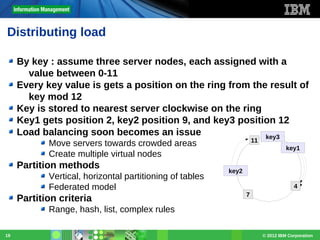
By key : assume three server nodes, each assigned with a
value between 0-11
Every key value is gets a position on the ring from the result of
key mod 12
Key is stored to nearest server clockwise on the ring
Key1 gets position 2, key2 position 9, and key3 position 12
Load balancing soon becomes an issue
key3
11

Move servers towards crowded areas
Create multiple virtual nodes

Partition methods
Vertical, horizontal partitioning of tables
Federated model

Partition criteria

key1

key2
4
7

Range, hash, list, complex rules
19

© 2012 IBM Corporation
Miscellaneous readings
IBM solidDB RedBook http://www.redbooks.ibm.com/abstracts/sg247887.html
Google : olfit concurrency-control, cache-conscious database, cacheconscious trie, Dynamo, Cassandra, project Voldemort
Some interesting new products:
SQLFire
http://pubs.vmware.com/vfabric5/index.jsp?topic=/com.vmware.vfabric.sqlfire.1.0/getting_started/book_intro.html

NuoDB
http://www.odbms.org/blog/2011/12/re-thinking-relational-database-technology-interview-with-barry-morris-founder-ceo-nuodb/

Blogs:
Daniel Abadi's blog http://dbmsmusings.blogspot.com/
and more about CAP http://dbmsmusings.blogspot.com/2010/04/problems-with-cap-and-yahoos-little.html
DBMS2 blogs http://www.dbms2.com
ODBMS http://www.odbms.org/blog/

20

© 2012 IBM Corporation

In-Memory Databases, Trends and Technologies (2012)

  • 1.
    In-Memory Databases Trends andTechnologies Vilho Raatikka solidDB Development IBM Helsinki Lab March 2012 © 2012 IBM Corporation
  • 2.
    Author Vilho Raatikka, SoftwareEngineer, IBM solidDB core development, Vilho.Raatikka@fi.ibm.com, +358 50 372 0394 Background in research at University of Helsinki RODAIN : in-memory database indexing SeCo : database migration, RDF(S) databases Joined Solid Information Technology in 2004, IBM acquired Solid in 2008. Started as a performance tester, and technical writer on Solid. Since 2005 concentrated mostly design & implementing inmemory indexing, high-availability (HA) technologies, and improving the use of multi-core processors. 2 © 2012 IBM Corporation
  • 3.
    Overview Motivation behind in-memorydatabases (imdb). What makes imdb faster? Where is it used best? Is imdb suitable for Big Data? 3 © 2012 IBM Corporation
  • 4.
    Disk-based databases For decades,databases have provided robust, and popular set of features for applications. Disk-based databases utilize cheap, and large storage. They provide large volume, but long disk latency is hard to overcome. Even with large page buffers, disk access causes unpredictable long response times. Therefore: ➢ Shortening response time is difficult ➢ Even page cache access is relatively slow 4 © 2012 IBM Corporation
  • 5.
    In services userexpectation matters Amazon reported that every 100ms delay costs 1% of sales (Greg Linden) Google increased the number of search results from 10 to 30. Additional 500ms caused a 20% drop in traffic. Half a second delay killed user satisfaction. (Marissa Mayer in Web 2.0) Stock Traders Find Speed Pays, in Milliseconds (Charles Duhiagg, The New York Times) Sometimes I/O stalls, or blocking operations are not tolerated HLR operations in TelCo Stock trading SW Medical devices Making more throughput is easy, but once you have bad latency you're stuck with it. Stuart Cheshire, May 1996 5 © 2012 IBM Corporation
  • 6.
    Data access throughmemory levels Cost of data access 6 x1 x15 x40000 © 2012 IBM Corporation
  • 7.
    Data layout ina database server In-memory index Cached disk pages In-memory Index Disk-resident Database engine Database engine Cache victim pages Rows serialized & Checkpoint in checkpoint Log 7 DB © 2012 IBM Corporation
  • 8.
    Why in-memory databaseis faster? Seek time dominates the cost Reading sequential disk blocks is 1000 times faster than reading random blocks. Database's access pattern is mostly random. Reading from RAM is roughly 100 times faster than sequential disk read. Disk I/O involves lot overhead to read, and write operations Unit of access is block. Amount of data transferred can be 10-100 times more than what was requested. 8 © 2012 IBM Corporation
  • 9.
    Why in-memory databaseis faster also in memory? In-memory database uses dense index in contrast to diskresident db. Pages in disk-resident db may or may not be found from cache. Also index nodes may be swapped to disk. index storage 9 index storage © 2012 IBM Corporation
  • 10.
    Main challenges inin-memory databases Maximize parallel processing in one machine Maintain ACID but avoid storage/network bottleneck Provide low latencies consistently Scale out (generic requirement) 10 © 2012 IBM Corporation
  • 11.
    Vertical scaling Increase throughputin line with the # of users do not trade latency for throughput Use fine-grained concurrency control where needed Remember cache, especially false sharing TATP Benchmark : http://tatpbenchmark.sourceforge.net/ 11 © 2012 IBM Corporation
  • 12.
    Example : coherencycache miss A shared transaction counter for all clients to use CPU0 CPU1 CPU2 CPU3 L1 2 1 1 1 L2 2 1 L3 2 Main Memory 12 2 These cache lines become dirty © 2012 IBM Corporation
  • 13.
    Example : falsesharing Independent data share a cache line Remember spatial locality, avoid false sharing Update t1 set name='fo' where id=1 Select * from t1 where id=2 CPU1 CPU0 L1 [1, 'foo'],[2,'bar'] [1, 'fo'],[2,'bar'] [1, 'foo'],[2,'bar'] Whole cache line becomes dirty Main Memory [1, 'foo'],[2,'bar'] [1, 'fo'],[2,'bar'] Cache line – unit of transfer 13 © 2012 IBM Corporation
  • 14.
    Tuning log writing Synchronizedlog writing (WAL) doesn't leave much to do Buy faster hardware With asynchronous logging, there is time window to be used Typically at least 1-5 seconds Clients are provided with several pre-allocated (recycled) log entry buckets Every now and then, a leaving client is requested to allocate/recycle buckets – share the load Client adds filled buckets to a circular buffer Log writer thread flushes every full buffer maintaining transaction sequence number ordering Sequential file write is fast enough, problem is to prevent the swarm of clients from colliding with each other 14 © 2012 IBM Corporation
  • 15.
    Unobtrusive checkpoint writing Consistent,or fuzzy Fuzzy spreads write load evenly over time but it's not consistent Consistent doesn't need log for restoring Every checkpoint starts with synchronization point – freeze Chekpoint counter is increased, and dirty data is marked The rest is sequence of non-blocking operations Techniques: Shadow copying versioning Write only dirty pages, write fast, but don't block disk IO Write everything, or data only Latter is trading faster checkpoint to slower restore 15 © 2012 IBM Corporation
  • 16.
    Low latencies makeservices possible Database often sits on the bottom of sw stack of the service Service's response time includes application and transaction processing altogether Assume that transaction execution shortens to 1/10th – how would you spend the free extra time? Execute more transactions? Add business logic to application layer? Meet the deadlines? Low latencies enable deplying more intelligent applications and services without violating Service-Level Agreements (SLA). 16 © 2012 IBM Corporation
  • 17.
    Threats of latency Unnecessarilylarge critical sections in code N threads accessing M resources & one mutex protecting them all Divide threads, and resources to, say, 10 groups which are protected by 10 mutexes Avoid mutex trashing Shared counter, for example Disk IO Avoid synchronous writes, remember to flush Point of serialization Network IO Avoid synchronous operations Large memory operations OS tries to buffer everything, and swap arbitrarily Flush large file writes periodically Prevent swappiness if necessary Split operations to resonably-sized ones 17 © 2012 IBM Corporation
  • 18.
    Massive data, andparallelism Why to scale out ? In some cases, multiple cheap boxes provide more than a few bigger and more expensive servers Adding soap boxes one by one provides flexible, low-risk solution If the solution meets the needs, it is better to ask, why not? How to make tens or hundreds of servers constitute a service? Distribute requests transparently to nodes where data is stored Make server and network failures invisible to users Make administrative tasks transparent to users Relax consistency (from C) when acceptable Make conflict resolution when data is read Emphasis on local operations Avoid or prevent inter-node operations Avoid range queries in row storage Avoid joins Avoid select * 's in column storages 18 © 2012 IBM Corporation
  • 19.
    Distributing load By key: assume three server nodes, each assigned with a value between 0-11 Every key value is gets a position on the ring from the result of key mod 12 Key is stored to nearest server clockwise on the ring Key1 gets position 2, key2 position 9, and key3 position 12 Load balancing soon becomes an issue key3 11 Move servers towards crowded areas Create multiple virtual nodes Partition methods Vertical, horizontal partitioning of tables Federated model Partition criteria key1 key2 4 7 Range, hash, list, complex rules 19 © 2012 IBM Corporation
  • 20.
    Miscellaneous readings IBM solidDBRedBook http://www.redbooks.ibm.com/abstracts/sg247887.html Google : olfit concurrency-control, cache-conscious database, cacheconscious trie, Dynamo, Cassandra, project Voldemort Some interesting new products: SQLFire http://pubs.vmware.com/vfabric5/index.jsp?topic=/com.vmware.vfabric.sqlfire.1.0/getting_started/book_intro.html NuoDB http://www.odbms.org/blog/2011/12/re-thinking-relational-database-technology-interview-with-barry-morris-founder-ceo-nuodb/ Blogs: Daniel Abadi's blog http://dbmsmusings.blogspot.com/ and more about CAP http://dbmsmusings.blogspot.com/2010/04/problems-with-cap-and-yahoos-little.html DBMS2 blogs http://www.dbms2.com ODBMS http://www.odbms.org/blog/ 20 © 2012 IBM Corporation