Module
          12
Machine Learning
        Version 2 CSE IIT, Kharagpur
Lesson
               39
Neural Networks - III
            Version 2 CSE IIT, Kharagpur
12.4.4 Multi-Layer Perceptrons

In contrast to perceptrons, multilayer networks can learn not only multiple decision
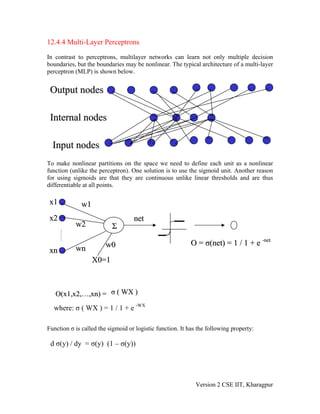
boundaries, but the boundaries may be nonlinear. The typical architecture of a multi-layer
perceptron (MLP) is shown below.


 Output nodes

 Internal nodes

  Input nodes
To make nonlinear partitions on the space we need to define each unit as a nonlinear
function (unlike the perceptron). One solution is to use the sigmoid unit. Another reason
for using sigmoids are that they are continuous unlike linear thresholds and are thus
differentiable at all points.

x1            w1
x2                                 net
           w2             Σ

                        w0                                 O = σ(net) = 1 / 1 + e -net
xn         wn
                   X0=1


   O(x1,x2,…,xn) = σ ( WX )
  where: σ ( WX ) = 1 / 1 + e -WX

Function σ is called the sigmoid or logistic function. It has the following property:

 d σ(y) / dy = σ(y) (1 – σ(y))


                                                             Version 2 CSE IIT, Kharagpur
12.4.4.1 Back-Propagation Algorithm

Multi-layered perceptrons can be trained using the back-propagation algorithm described
next.

Goal: To learn the weights for all links in an interconnected multilayer network.

We begin by defining our measure of error:

E(W) = ½ Σd Σk (tkd – okd) 2

k varies along the output nodes and d over the training examples.

The idea is to use again a gradient descent over the space of weights to find a global
minimum (no guarantee).

Algorithm:

   1. Create a network with nin input nodes, nhidden internal nodes, and nout output
      nodes.
   2. Initialize all weights to small random numbers.
   3. Until error is small do:
               For each example X do
                   • Propagate example X forward through the network
                   • Propagate errors backward through the network


Forward Propagation

Given example X, compute the output of every node until we reach the output nodes:

Output

Internal                                                            Compute sigmoid
                                                                      function

 Input


           Example


                                                            Version 2 CSE IIT, Kharagpur
Backward Propagation

A. For each output node k compute the error:
    δk = Ok (1-Ok)(tk – Ok)

B. For each hidden unit h, calculate the error:
    δh = Oh (1-Oh) Σk Wkh δk

C. Update each network weight:

C. Wji = Wji + ΔWji
   where ΔWji = η δj Xji       (Wji and Xji are the input and weight of node i to node j)

A momentum term, depending on the weight value at last iteration, may also be added to
the update rule as follows. At iteration n we have the following:

ΔWji (n) = η δj Xji + αΔWji (n)

Where α ( 0 <= α <= 1) is a constant called the momentum.

   1. It increases the speed along a local minimum.
   2. It increases the speed along flat regions.

Remarks on Back-propagation

   1.   It implements a gradient descent search over the weight space.
   2.   It may become trapped in local minima.
   3.   In practice, it is very effective.
   4.   How to avoid local minima?
            a) Add momentum.
            b) Use stochastic gradient descent.
            c) Use different networks with different initial values for the weights.


Multi-layered perceptrons have high representational power. They can represent the
following:

   1. Boolean functions. Every boolean function can be represented with a network
      having two layers of units.

   2. Continuous functions. All bounded continuous functions can also be
      approximated with a network having two layers of units.

   3. Arbitrary functions. Any arbitrary function can be approximated with a network
      with three layers of units.


                                                            Version 2 CSE IIT, Kharagpur
Generalization and overfitting:

   One obvious stopping point for backpropagation is to continue iterating until the error is
   below some threshold; this can lead to overfitting.


                                                                    Validation set
Error

                                                                    Training set

                                           Number of weight
   Overfitting can be avoided using the following strategies.

        •   Use a validation set and stop until the error is small in this set.

        •   Use 10 fold cross validation.

        •   Use weight decay; the weights are decreased slowly on each iteration.


   Applications of Neural Networks

   Neural networks have broad applicability to real world business problems. They have
   already been successfully applied in many industries.

   Since neural networks are best at identifying patterns or trends in data, they are well
   suited for prediction or forecasting needs including:

        •   sales forecasting
        •   industrial process control
        •   customer research
        •   data validation
        •   risk management
        •   target marketing


                                                                   Version 2 CSE IIT, Kharagpur
Because of their adaptive and non-linear nature they have also been used in a number of
control system application domains like,

   •    process control in chemical plants
   •    unmanned vehicles
   •    robotics
   •    consumer electronics

Neural networks are also used a number of other applications which are too hard to
model using classical techniques. These include, computer vision, path planning and user
modeling.

Questions
1. Assume a learning problem where each example is represented by four attributes. Each
attribute can take two values in the set {a,b}. Run the candidate elimination algorithm on
the following examples and indicate the resulting version space. What is the size of the
space?
                  ((a, b, b, a), +)
                  ((b, b, b, b), +)
                  ((a, b, b, b), +)
                  ((a, b, a, a), -)


2. Decision Trees

The following table contains training examples that help a robot janitor predict whether
or not an office contains a recycling bin.

          STATUS DEPT. OFFICE SIZE RECYCLING BIN?
       1. faculty ee   large       no
       2. staff   ee   small       no
       3. faculty cs   medium      yes
       4. student ee   large       yes
       5. staff   cs   medium      no
       6. faculty cs   large       yes
       7. student ee   small       yes
       8. staff   cs   medium      no

Use entropy splitting function to construct a minimal decision tree that predicts whether
or not an office contains a recycling bin. Show each step of the computation.

3. Translate the above decision tree into a collection of decision rules.

4. Neural networks: Consider the following function of two variables:

                                                             Version 2 CSE IIT, Kharagpur
A      B   Desired Output
          0      0     1
          1      0     0
          0      1     0
          1      1     1

Prove that this function cannot be learned by a single perceptron that uses the step
function as its activation function.

   4. Construct by hand a perceptron that can calculate the logic function implies (=>).
      Assume that 1 = true and 0 = false for all inputs and outputs.

Solution
1. The general and specific boundaries of the version space are as follows:

S: {(?,b,b,?)}
G: {(?,?,b,?)}

The size of the version space is 2.

2. The solution steps are as follows:

1. Selecting the attribute for the root node:

                                            YES                        NO

       Status:

                     Faculty:    (3/8)*[ -(2/3)*log_2(2/3) - (1/3)*log_2(1/3)]

                     Staff:     + (3/8)*[ -(0/3)*log_2(0/3) - (3/3)*log_2(3/3)]

                     Student:   + (2/8)*[ -(2/2)*log_2(2/2) - (0/2)*log_2(0/2)]

                     TOTAL:     = 0.35 + 0 + 0 = 0.35

       Size:

                     Large:      (3/8)*[ -(2/3)*log_2(2/3) - (1/3)*log_2(1/3)]

                     Medium:    + (3/8)*[ -(1/3)*log_2(1/3) - (2/3)*log_2(2/3)]

                     Small:     + (2/8)*[ -(1/2)*log_2(1/2) - (1/2)*log_2(1/2)]

                     TOTAL:     = 0.35 + 0.35 + 2/8 = 0.95


                                                           Version 2 CSE IIT, Kharagpur
Dept:

              ee:              (4/8)*[ -(2/4)*log_2(2/4) - (2/4)*log_2(2/4)]

              cs:           + (4/8)*[ -(2/4)*log_2(2/4) - (2/4)*log_2(2/4)]

              TOTAL:        = 0.5 + 0.5 = 1

Since status is the attribute with the lowest entropy, it is selected
as the root node:


                         Status

                    /      |       

      Faculty    /         | staff  student

                /          |           

        1-,3+,6+        2-,5-,8-    4+,7+

         BIN=?           BIN=NO    BIN=YES

Only the branch corresponding to Status=Faculty needs further
processing.

Selecting the attribute to split the branch Status=Faculty:

                                   YES                   NO

      Dept:

       ee:              (1/3)*[ -(0/1)*log_2(0/1) - (1/1)*log_2(1/1)]

       cs:          + (2/3)*[ -(2/2)*log_2(2/2) - (0/2)*log_2(0/2)]

       TOTAL:       = 0 + 0 = 0


                                                     Version 2 CSE IIT, Kharagpur
Since the minimum possible entropy is 0 and dept has that minimum
possible entropy, it is selected as the best attribute to split the
branch Status=Faculty. Note that we don't even have to calculate the
entropy of the attribute size since it cannot possibly be better than
0.

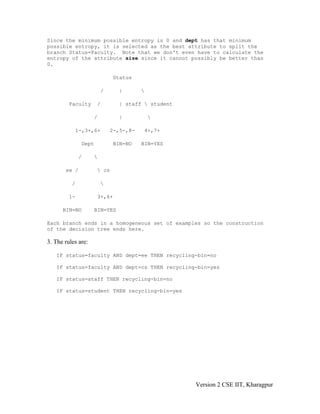
                            Status

                        /     |        

         Faculty     /        | staff  student

                    /         |            

           1-,3+,6+         2-,5-,8-   4+,7+

              Dept          BIN=NO     BIN=YES

              /     

       ee /           cs

          /             

         1-          3+,6+

      BIN=NO        BIN=YES

Each branch ends in a homogeneous set of examples so the construction
of the decision tree ends here.

3. The rules are:

   IF status=faculty AND dept=ee THEN recycling-bin=no

   IF status=faculty AND dept=cs THEN recycling-bin=yes

   IF status=staff THEN recycling-bin=no

   IF status=student THEN recycling-bin=yes


                                                  Version 2 CSE IIT, Kharagpur
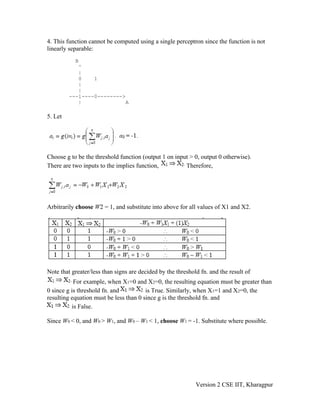
4. This function cannot be computed using a single perceptron since the function is not
linearly separable:
           B
            ^
            |
            0    1
            |
            |
         ---1----0-------->
            |              A

5. Let


Choose g to be the threshold function (output 1 on input > 0, output 0 otherwise).
There are two inputs to the implies function,          Therefore,


Arbitrarily choose W2 = 1, and substitute into above for all values of X1 and X2.


Note that greater/less than signs are decided by the threshold fn. and the result of
           For example, when X1=0 and X2=0, the resulting equation must be greater than
0 since g is threshold fn. and          is True. Similarly, when X1=1 and X2=0, the
resulting equation must be less than 0 since g is the threshold fn. and
          is False.

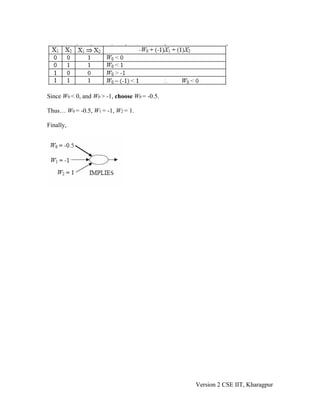
Since W0 < 0, and W0 > W1, and W0 – W1 < 1, choose W1 = -1. Substitute where possible.


                                                             Version 2 CSE IIT, Kharagpur
Since W0 < 0, and W0 > -1, choose W0 = -0.5.

Thus… W0 = -0.5, W1 = -1, W2 = 1.

Finally,


                                               Version 2 CSE IIT, Kharagpur

Lesson 39

  • 1.
    Module 12 Machine Learning Version 2 CSE IIT, Kharagpur
  • 2.
    Lesson 39 Neural Networks - III Version 2 CSE IIT, Kharagpur
  • 3.
    12.4.4 Multi-Layer Perceptrons Incontrast to perceptrons, multilayer networks can learn not only multiple decision boundaries, but the boundaries may be nonlinear. The typical architecture of a multi-layer perceptron (MLP) is shown below. Output nodes Internal nodes Input nodes To make nonlinear partitions on the space we need to define each unit as a nonlinear function (unlike the perceptron). One solution is to use the sigmoid unit. Another reason for using sigmoids are that they are continuous unlike linear thresholds and are thus differentiable at all points. x1 w1 x2 net w2 Σ w0 O = σ(net) = 1 / 1 + e -net xn wn X0=1 O(x1,x2,…,xn) = σ ( WX ) where: σ ( WX ) = 1 / 1 + e -WX Function σ is called the sigmoid or logistic function. It has the following property: d σ(y) / dy = σ(y) (1 – σ(y)) Version 2 CSE IIT, Kharagpur
  • 4.
    12.4.4.1 Back-Propagation Algorithm Multi-layeredperceptrons can be trained using the back-propagation algorithm described next. Goal: To learn the weights for all links in an interconnected multilayer network. We begin by defining our measure of error: E(W) = ½ Σd Σk (tkd – okd) 2 k varies along the output nodes and d over the training examples. The idea is to use again a gradient descent over the space of weights to find a global minimum (no guarantee). Algorithm: 1. Create a network with nin input nodes, nhidden internal nodes, and nout output nodes. 2. Initialize all weights to small random numbers. 3. Until error is small do: For each example X do • Propagate example X forward through the network • Propagate errors backward through the network Forward Propagation Given example X, compute the output of every node until we reach the output nodes: Output Internal Compute sigmoid function Input Example Version 2 CSE IIT, Kharagpur
  • 5.
    Backward Propagation A. Foreach output node k compute the error: δk = Ok (1-Ok)(tk – Ok) B. For each hidden unit h, calculate the error: δh = Oh (1-Oh) Σk Wkh δk C. Update each network weight: C. Wji = Wji + ΔWji where ΔWji = η δj Xji (Wji and Xji are the input and weight of node i to node j) A momentum term, depending on the weight value at last iteration, may also be added to the update rule as follows. At iteration n we have the following: ΔWji (n) = η δj Xji + αΔWji (n) Where α ( 0 <= α <= 1) is a constant called the momentum. 1. It increases the speed along a local minimum. 2. It increases the speed along flat regions. Remarks on Back-propagation 1. It implements a gradient descent search over the weight space. 2. It may become trapped in local minima. 3. In practice, it is very effective. 4. How to avoid local minima? a) Add momentum. b) Use stochastic gradient descent. c) Use different networks with different initial values for the weights. Multi-layered perceptrons have high representational power. They can represent the following: 1. Boolean functions. Every boolean function can be represented with a network having two layers of units. 2. Continuous functions. All bounded continuous functions can also be approximated with a network having two layers of units. 3. Arbitrary functions. Any arbitrary function can be approximated with a network with three layers of units. Version 2 CSE IIT, Kharagpur
  • 6.
    Generalization and overfitting: One obvious stopping point for backpropagation is to continue iterating until the error is below some threshold; this can lead to overfitting. Validation set Error Training set Number of weight Overfitting can be avoided using the following strategies. • Use a validation set and stop until the error is small in this set. • Use 10 fold cross validation. • Use weight decay; the weights are decreased slowly on each iteration. Applications of Neural Networks Neural networks have broad applicability to real world business problems. They have already been successfully applied in many industries. Since neural networks are best at identifying patterns or trends in data, they are well suited for prediction or forecasting needs including: • sales forecasting • industrial process control • customer research • data validation • risk management • target marketing Version 2 CSE IIT, Kharagpur
  • 7.
    Because of theiradaptive and non-linear nature they have also been used in a number of control system application domains like, • process control in chemical plants • unmanned vehicles • robotics • consumer electronics Neural networks are also used a number of other applications which are too hard to model using classical techniques. These include, computer vision, path planning and user modeling. Questions 1. Assume a learning problem where each example is represented by four attributes. Each attribute can take two values in the set {a,b}. Run the candidate elimination algorithm on the following examples and indicate the resulting version space. What is the size of the space? ((a, b, b, a), +) ((b, b, b, b), +) ((a, b, b, b), +) ((a, b, a, a), -) 2. Decision Trees The following table contains training examples that help a robot janitor predict whether or not an office contains a recycling bin. STATUS DEPT. OFFICE SIZE RECYCLING BIN? 1. faculty ee large no 2. staff ee small no 3. faculty cs medium yes 4. student ee large yes 5. staff cs medium no 6. faculty cs large yes 7. student ee small yes 8. staff cs medium no Use entropy splitting function to construct a minimal decision tree that predicts whether or not an office contains a recycling bin. Show each step of the computation. 3. Translate the above decision tree into a collection of decision rules. 4. Neural networks: Consider the following function of two variables: Version 2 CSE IIT, Kharagpur
  • 8.
    A B Desired Output 0 0 1 1 0 0 0 1 0 1 1 1 Prove that this function cannot be learned by a single perceptron that uses the step function as its activation function. 4. Construct by hand a perceptron that can calculate the logic function implies (=>). Assume that 1 = true and 0 = false for all inputs and outputs. Solution 1. The general and specific boundaries of the version space are as follows: S: {(?,b,b,?)} G: {(?,?,b,?)} The size of the version space is 2. 2. The solution steps are as follows: 1. Selecting the attribute for the root node: YES NO Status: Faculty: (3/8)*[ -(2/3)*log_2(2/3) - (1/3)*log_2(1/3)] Staff: + (3/8)*[ -(0/3)*log_2(0/3) - (3/3)*log_2(3/3)] Student: + (2/8)*[ -(2/2)*log_2(2/2) - (0/2)*log_2(0/2)] TOTAL: = 0.35 + 0 + 0 = 0.35 Size: Large: (3/8)*[ -(2/3)*log_2(2/3) - (1/3)*log_2(1/3)] Medium: + (3/8)*[ -(1/3)*log_2(1/3) - (2/3)*log_2(2/3)] Small: + (2/8)*[ -(1/2)*log_2(1/2) - (1/2)*log_2(1/2)] TOTAL: = 0.35 + 0.35 + 2/8 = 0.95 Version 2 CSE IIT, Kharagpur
  • 9.
    Dept: ee: (4/8)*[ -(2/4)*log_2(2/4) - (2/4)*log_2(2/4)] cs: + (4/8)*[ -(2/4)*log_2(2/4) - (2/4)*log_2(2/4)] TOTAL: = 0.5 + 0.5 = 1 Since status is the attribute with the lowest entropy, it is selected as the root node: Status / | Faculty / | staff student / | 1-,3+,6+ 2-,5-,8- 4+,7+ BIN=? BIN=NO BIN=YES Only the branch corresponding to Status=Faculty needs further processing. Selecting the attribute to split the branch Status=Faculty: YES NO Dept: ee: (1/3)*[ -(0/1)*log_2(0/1) - (1/1)*log_2(1/1)] cs: + (2/3)*[ -(2/2)*log_2(2/2) - (0/2)*log_2(0/2)] TOTAL: = 0 + 0 = 0 Version 2 CSE IIT, Kharagpur
  • 10.
    Since the minimumpossible entropy is 0 and dept has that minimum possible entropy, it is selected as the best attribute to split the branch Status=Faculty. Note that we don't even have to calculate the entropy of the attribute size since it cannot possibly be better than 0. Status / | Faculty / | staff student / | 1-,3+,6+ 2-,5-,8- 4+,7+ Dept BIN=NO BIN=YES / ee / cs / 1- 3+,6+ BIN=NO BIN=YES Each branch ends in a homogeneous set of examples so the construction of the decision tree ends here. 3. The rules are: IF status=faculty AND dept=ee THEN recycling-bin=no IF status=faculty AND dept=cs THEN recycling-bin=yes IF status=staff THEN recycling-bin=no IF status=student THEN recycling-bin=yes Version 2 CSE IIT, Kharagpur
  • 11.
    4. This functioncannot be computed using a single perceptron since the function is not linearly separable: B ^ | 0 1 | | ---1----0--------> | A 5. Let Choose g to be the threshold function (output 1 on input > 0, output 0 otherwise). There are two inputs to the implies function, Therefore, Arbitrarily choose W2 = 1, and substitute into above for all values of X1 and X2. Note that greater/less than signs are decided by the threshold fn. and the result of For example, when X1=0 and X2=0, the resulting equation must be greater than 0 since g is threshold fn. and is True. Similarly, when X1=1 and X2=0, the resulting equation must be less than 0 since g is the threshold fn. and is False. Since W0 < 0, and W0 > W1, and W0 – W1 < 1, choose W1 = -1. Substitute where possible. Version 2 CSE IIT, Kharagpur
  • 12.
    Since W0 <0, and W0 > -1, choose W0 = -0.5. Thus… W0 = -0.5, W1 = -1, W2 = 1. Finally, Version 2 CSE IIT, Kharagpur