Equivalence
Point
References:
1-https://chemdictionary.org
2-https://byjus.com
Table Of Contents
What is Equivalence Point
Difference Between Equivalence
point And End Point
Methods of Determining
The Equivalence Point
I-pH indicator
II-Conductance III-Color Change
IV-Precipitation V-Isothermal calorimetry
VI-Amperometry VII-Spectroscopy
VIII-Thermometric Titrimetry References
What is Equivalence Point?
an equivalence point is a term that is used while performing titration. It
applies to any acid-base or neutralization reaction technically. The
equivalence point of a chemical reaction is the point at which equal
quantities of reactants are mixed chemically.In other words, while
titrating, it is a point where the amount of added titrant is enough to
neutralize the analyte solution completely. The number of moles of titrant
standard solution is equal to the moles of a solution having an unknown
concentration. It is also known as the stoichiometric point because it is a
point where the moles of acid is equal to the moles of the base that are
needed to neutralize the solution. The equivalence point cannot be taken
the same as the endpoint of a titration.The endpoint is referred to as the
point at which the used indicator changes its color.These color changes
appear after reaching the equivalence point. If we use the endpoint to
determine equivalence, it will induce an error.
Difference Between Equivalence point
And End Point
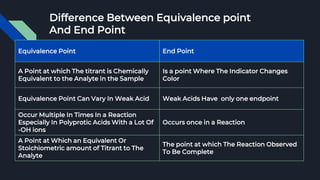
Equivalence Point End Point
A Point at which The titrant is Chemically
Equivalent to the Analyte in the Sample
Is a point Where The Indicator Changes
Color
Equivalence Point Can Vary In Weak Acid Weak Acids Have only one endpoint
Occur Multiple In Times In a Reaction
Especially In Polyprotic Acids With a Lot Of
-OH ions
Occurs once in a Reaction
A Point at Which an Equivalent Or
Stoichiometric amount of Titrant to The
Analyte
The point at which The Reaction Observed
To Be Complete
Methods of Determining The
Equivalence Point:
I-pH indicator
II-Conductance
III-Color Change
IV-Precipitation
V-Isothermal calorimetry
VI-Amperometry
VII-Spectroscopy
VIII-Thermometric Titrimetry
I-PH indicator
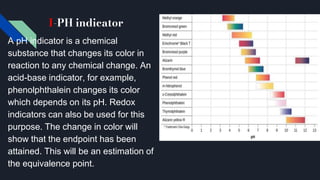
A pH indicator is a chemical
substance that changes its color in
reaction to any chemical change. An
acid-base indicator, for example,
phenolphthalein changes its color
which depends on its pH. Redox
indicators can also be used for this
purpose. The change in color will
show that the endpoint has been
attained. This will be an estimation of
the equivalence point.
II-Conductance
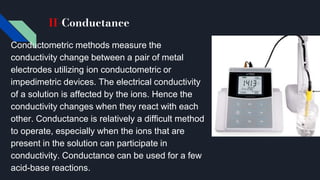
Conductometric methods measure the
conductivity change between a pair of metal
electrodes utilizing ion conductometric or
impedimetric devices. The electrical conductivity
of a solution is affected by the ions. Hence the
conductivity changes when they react with each
other. Conductance is relatively a difficult method
to operate, especially when the ions that are
present in the solution can participate in
conductivity. Conductance can be used for a few
acid-base reactions.
III-Color change
At the equivalence point, the solution will
change its color naturally without any
addition of an indicator in some reactions.
This may be observed in transition metals
where the oxidation state consists of
different colors.
IV-Precipitation
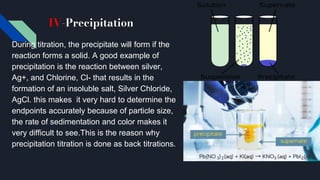
During titration, the precipitate will form if the
reaction forms a solid. A good example of
precipitation is the reaction between silver,
Ag+, and Chlorine, Cl- that results in the
formation of an insoluble salt, Silver Chloride,
AgCl. this makes it very hard to determine the
endpoints accurately because of particle size,
the rate of sedimentation and color makes it
very difficult to see.This is the reason why
precipitation titration is done as back titrations.
V-Isothermal Calorimetry
one of the physical techniques that directly measures
the heat discharged or consumed all along a
bimolecular reaction The determination of the
equivalence point is done by calculating the amount of
heat that is produced or absorbed by using a device
known as an isothermal titration calorimeter.This type
is usually used in titrations that involve biochemical
reactions.
VI-Amperometry
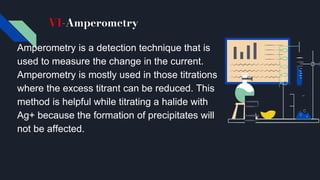
Amperometry is a detection technique that is
used to measure the change in the current.
Amperometry is mostly used in those titrations
where the excess titrant can be reduced. This
method is helpful while titrating a halide with
Ag+ because the formation of precipitates will
not be affected.
VII-Spectroscopy
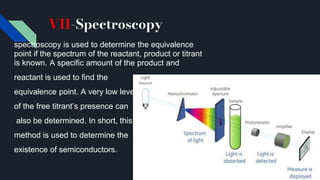
spectroscopy is used to determine the equivalence
point if the spectrum of the reactant, product or titrant
is known. A specific amount of the product and
reactant is used to find the
equivalence point. A very low level
of the free titrant’s presence can
also be determined. In short, this
method is used to determine the
existence of semiconductors.
VIII-Thermometric Titrimetry
The equivalence point is determined by measuring the rate
of temperature change produced by a chemical reaction.
This property differentiates it from calorimetric titrimetry.
Because thermometric titrimetry is a relative technique, it is
not necessary to perform the titration under isothermal
conditions. To prevent stray draughts, these vessels are
usually enclosed by causing any noise that disturbs the
endpoint. Because of the ability of this type of titration to be
conducted under ambient conditions.depending on whether
the reaction taking place between the titrant and analyte is
exothermic or endothermic. rate of temperature changes an
increase or decrease determines the equivalence point and
inflection in the temperature curve can be observed.

Equivalence Poin.pptx...................

  • 1.
  • 2.
    Table Of Contents Whatis Equivalence Point Difference Between Equivalence point And End Point Methods of Determining The Equivalence Point I-pH indicator II-Conductance III-Color Change IV-Precipitation V-Isothermal calorimetry VI-Amperometry VII-Spectroscopy VIII-Thermometric Titrimetry References
  • 3.
    What is EquivalencePoint? an equivalence point is a term that is used while performing titration. It applies to any acid-base or neutralization reaction technically. The equivalence point of a chemical reaction is the point at which equal quantities of reactants are mixed chemically.In other words, while titrating, it is a point where the amount of added titrant is enough to neutralize the analyte solution completely. The number of moles of titrant standard solution is equal to the moles of a solution having an unknown concentration. It is also known as the stoichiometric point because it is a point where the moles of acid is equal to the moles of the base that are needed to neutralize the solution. The equivalence point cannot be taken the same as the endpoint of a titration.The endpoint is referred to as the point at which the used indicator changes its color.These color changes appear after reaching the equivalence point. If we use the endpoint to determine equivalence, it will induce an error.
  • 4.
    Difference Between Equivalencepoint And End Point Equivalence Point End Point A Point at which The titrant is Chemically Equivalent to the Analyte in the Sample Is a point Where The Indicator Changes Color Equivalence Point Can Vary In Weak Acid Weak Acids Have only one endpoint Occur Multiple In Times In a Reaction Especially In Polyprotic Acids With a Lot Of -OH ions Occurs once in a Reaction A Point at Which an Equivalent Or Stoichiometric amount of Titrant to The Analyte The point at which The Reaction Observed To Be Complete
  • 5.
    Methods of DeterminingThe Equivalence Point: I-pH indicator II-Conductance III-Color Change IV-Precipitation V-Isothermal calorimetry VI-Amperometry VII-Spectroscopy VIII-Thermometric Titrimetry
  • 6.
    I-PH indicator A pHindicator is a chemical substance that changes its color in reaction to any chemical change. An acid-base indicator, for example, phenolphthalein changes its color which depends on its pH. Redox indicators can also be used for this purpose. The change in color will show that the endpoint has been attained. This will be an estimation of the equivalence point.
  • 7.
    II-Conductance Conductometric methods measurethe conductivity change between a pair of metal electrodes utilizing ion conductometric or impedimetric devices. The electrical conductivity of a solution is affected by the ions. Hence the conductivity changes when they react with each other. Conductance is relatively a difficult method to operate, especially when the ions that are present in the solution can participate in conductivity. Conductance can be used for a few acid-base reactions.
  • 8.
    III-Color change At theequivalence point, the solution will change its color naturally without any addition of an indicator in some reactions. This may be observed in transition metals where the oxidation state consists of different colors.
  • 9.
    IV-Precipitation During titration, theprecipitate will form if the reaction forms a solid. A good example of precipitation is the reaction between silver, Ag+, and Chlorine, Cl- that results in the formation of an insoluble salt, Silver Chloride, AgCl. this makes it very hard to determine the endpoints accurately because of particle size, the rate of sedimentation and color makes it very difficult to see.This is the reason why precipitation titration is done as back titrations.
  • 10.
    V-Isothermal Calorimetry one ofthe physical techniques that directly measures the heat discharged or consumed all along a bimolecular reaction The determination of the equivalence point is done by calculating the amount of heat that is produced or absorbed by using a device known as an isothermal titration calorimeter.This type is usually used in titrations that involve biochemical reactions.
  • 11.
    VI-Amperometry Amperometry is adetection technique that is used to measure the change in the current. Amperometry is mostly used in those titrations where the excess titrant can be reduced. This method is helpful while titrating a halide with Ag+ because the formation of precipitates will not be affected.
  • 12.
    VII-Spectroscopy spectroscopy is usedto determine the equivalence point if the spectrum of the reactant, product or titrant is known. A specific amount of the product and reactant is used to find the equivalence point. A very low level of the free titrant’s presence can also be determined. In short, this method is used to determine the existence of semiconductors.
  • 13.
    VIII-Thermometric Titrimetry The equivalencepoint is determined by measuring the rate of temperature change produced by a chemical reaction. This property differentiates it from calorimetric titrimetry. Because thermometric titrimetry is a relative technique, it is not necessary to perform the titration under isothermal conditions. To prevent stray draughts, these vessels are usually enclosed by causing any noise that disturbs the endpoint. Because of the ability of this type of titration to be conducted under ambient conditions.depending on whether the reaction taking place between the titrant and analyte is exothermic or endothermic. rate of temperature changes an increase or decrease determines the equivalence point and inflection in the temperature curve can be observed.