Nitrogen cycle
Biology Discussion
5 Stages of Nitrogen Cycle (With Diagram)
Article Shared by Sonali Priyadarshini
ADVERTISEMENTS:
Nitrogen being 79 per cent of the atmosphere, the atmospheric phase is predominant in the
global nitrogen cycle. It is required by organisms in the synthesis of proteins, nucleic acids,
and other nitrogenous compounds.
Atmospheric nitrogen serves as the ultimate source. But aerial nitrogen, the most abundant
component of air, is rather inert chemically and actually cannot be used as such by the
majority of organisms.
It must first be ā€œfixedā€ by specialized organisms or by industrial processes.
ADVERTISEMENTS:
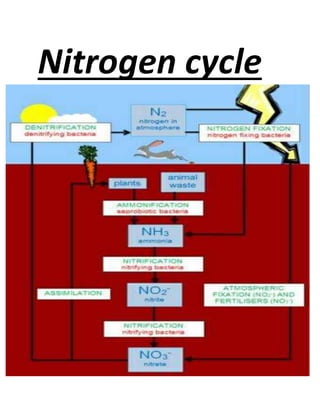
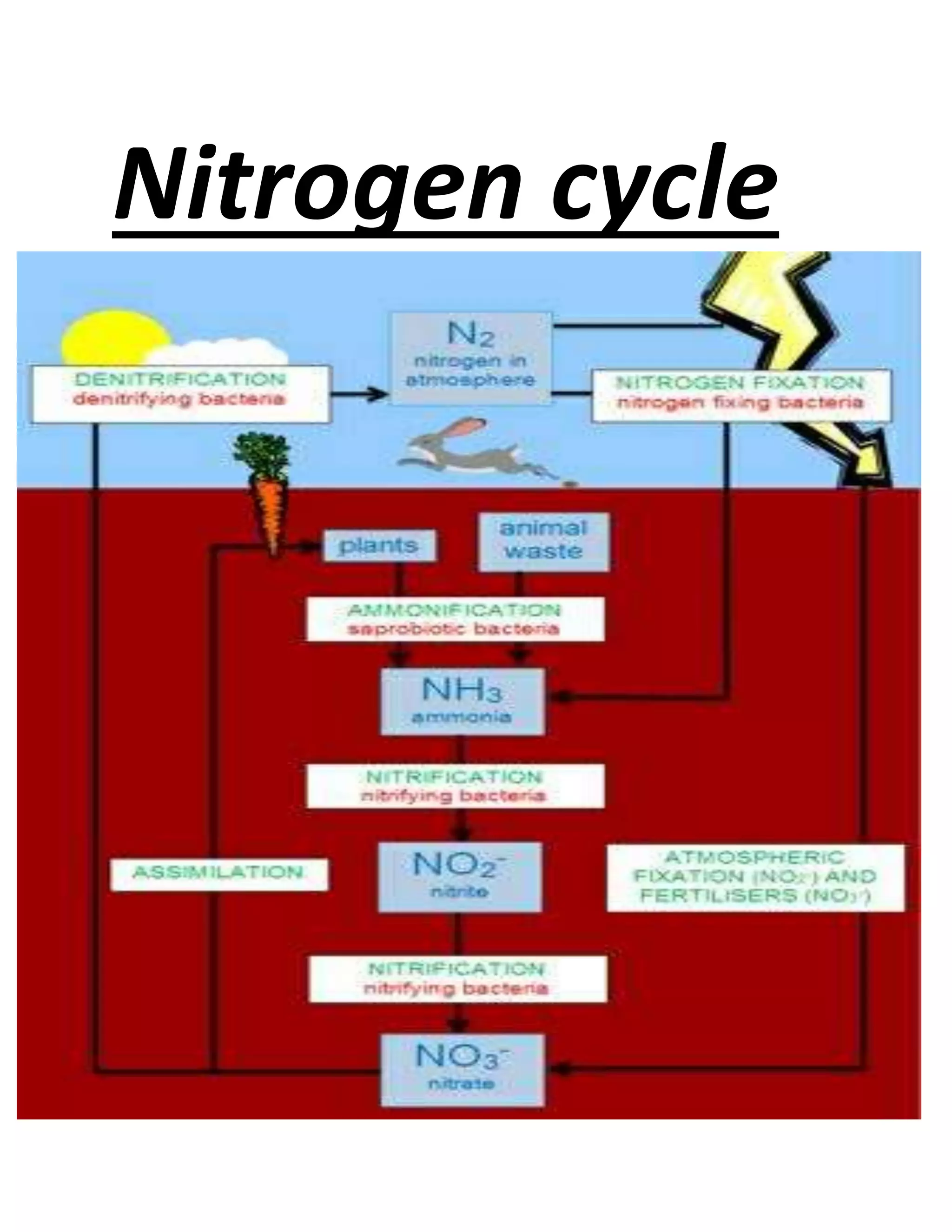
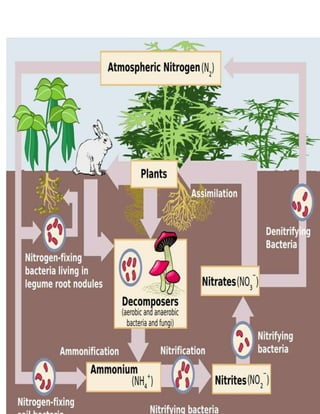
From an ecological perspective, the nitrogen cycle consists of the following
stages:
(i) Ammonification
(ii) Nitrification,
(iii) Nitrogen uptake by plants,
ADVERTISEMENTS:
(iv) Fixation of Nitrogen, and
(v) Denitrification
Ammonification:
Ammonification is a process in which the organic nitrogen of plants and animals after their
death is converted to ammonium ions (NH4) by the action of saprotrophic fungi and
bacteria. The saprotrophs use the ammonia (NH3) to synthesize their own proteins and
other nitrogen-containing organic compounds.
Nitrification:
Ammonium ions added to the soil by ammonification, are soon oxidized by a process known
as nitrification. It takes place in two stages. In the first stage, ammonium (NH4
+) is
converted to nitrite (NO2-). This reaction involves the addition of oxygen to ammonia, giving
rise to hydroxylamine (NH2OH), which is further oxidized to nitrite. This reaction is
completed by the bacteria such as Nitrosomonas, Nitrosospira, Nitrosolobus and
Nitrosococcus (Hamilton, 1988).
The second stage of nitrification involves the oxidation of nitrite (NO2) to nitrate (NO3) by
bacteria of the genera Nitrobacter, Nitrospira and Nitrococcus. The reaction proceeds by the
addition of water followed by the removal of hydrogen (Hamilton, 1988). The bacteria
responsible for these reactions occur in the same soil. The association between
Nitwsomonus and Nitrobacter has been described as one of commensalism (Gooday, 1988).
Nitrogen uptake by Plants:
Nitrate (NO3
–) formed in the process of nitrification is used by most plants as a mineral
metabolite and may be converted by them into amino groups and other nitrogen- containing
compounds. Nitrates are also added to the soil through rock dissolution and combination of
atmospheric nitrogen with oxygen by lightning (nitrates so formed reach the soil by rain).
However, many plants also absorb ammonium from the soil.
ADVERTISEMENTS:
Fixation of Nitrogen:
The reduction of atmospheric nitrogen (N2) to the ammonium ion (NH+
4) is called nitrogen
fixation. This process can only be carried out by certain species of bacteria and
cyanobacteria (Postgate, 1988). Some of these bacteria are free-living, occurring in soil or
water (saprophytic bacteria like Azotobacter and Clostridium ; others exist in symbiotic
relationship with plants of the Family Legxuninosae, e.g., nodule bacteria Rhizobium
leguminosarum).
Species of the genus Rhizobium occur in the soil until they infect a damaged epidermal cell
or root hair. The plant responds to this infection by producing root nodules, about 1 to 3
mm in diameter. These root nodules contain leg hemoglobin, which functioning like
hemoglobin, transports oxygen.
As these bacteria are aerobic, some oxygen is required for the bacteria to survive, but too
much oxygen inactivates the enzyme nitrogenase that catalyses nitrogen fixation. The
nitrogen molecule (N2) is very stable and 16 molecules of ATP are needed for each molecule
of nitrogen that is fixed. In the soil microorganism Klebsiella pneumoniae a total of 17
genes, called ā€˜nif’ genes are known to be responsible in nitrogen fixation.
Researches in biotechnology are now attempting transfer of ā€˜nif’ genes from prokaryotes to
crop plants so that yield of crops like rice and wheat may be increased. However, scientists
have not yet succeeded in this attempt.
Denitrification:
It is a process in which the nitrate ion (NO3) is reduced to nitrogen dioxide (NO2), di-
nitrogen oxide (N2O), nitrogen monoxide (NO) or nitrogen (N2) by certain soil bacteria like
Pseudomonas denitrificans. Thus, nitrogen is liberated into the atmosphere. Plants also lose
small amounts of nitrogen to the atmosphere as gaseous ammonia, N2O, NO2 and NO
especially when well fertilized with nitrogen (Wetselaar and Farquhar, 1980).
Thus, nitrogen cycle (Fig. 5.8) depends upon at least four different kinds of bacteria known
as the decay causers, the nitrifiers, the denitrifiers, and the nitrogen-fixers and there is a
regular circulation of nitrogen through the air, soil, plants and animals.
Home ››
Welcome to BiologyDiscussion! Our mission is to provide an online platform to help students to
share notes in Biology. Thiswebsite includes study notes, researchpapers, essays, articlesand other
allied information submitted by visitorslike YOU.
Before sharing your knowledge on this site, please read the following pages:
1. Content Guidelines
2. Privacy Policy
3. TOS
4. Disclaimer Copyright
Share Your Knowledge
ADVERTISEM ENT
QUESTIONS
Explain the theory of mass flow. 1 Answer
Can cockroaches be fused together with their Brain Juice? 0 Answers
what are sporophyte plants? 0 Answers
What is plasmolysis? 0 Answers
Write a note on facilitated diffusion. 0 Answers
Describe the Thistle funnel experiment of osmosis. 0 Answers
Explain symplast pathway of water movement 0 Answers
What is the significance of transpiration? 0 Answers
Explain the transpiration pull theory. 0 Answers
Explain active transport 0 Answers
Explain apoplast pathway of water movement 0 Answers
Mention the external factors which affect the process of transpiration. 0 Answers
Explain root pressure theory. 0 Answers
What causes the opening and closing of guard cells of stomata during transpiration? 0 Answers
Mention aspects by which process of osmosis is affected. 0 Answers
ABOUT US
ļ‚· Share Your Knowledge
ļ‚· Content Guidelines
ļ‚· Privacy Policy
ļ‚· ToS
ļ‚· Disclaimer
SUGGESTIONS
ļ‚· Report Spelling and Grammatical Errors
ļ‚· Suggest Us
CATEGORIES
ļ‚· Respiration
ļ‚· Mineral Nutrition
ļ‚· Photosynthesis
ļ‚· Plant Growth and Development
ļ‚· Nutrition
ļ‚· T ransport in Plants
Copyright Ā© 2017 BiologyDiscussion.com, All rights reserved.
Nitrogen cycle

Nitrogen cycle

  • 1.
  • 2.
    Biology Discussion 5 Stagesof Nitrogen Cycle (With Diagram) Article Shared by Sonali Priyadarshini ADVERTISEMENTS: Nitrogen being 79 per cent of the atmosphere, the atmospheric phase is predominant in the global nitrogen cycle. It is required by organisms in the synthesis of proteins, nucleic acids, and other nitrogenous compounds. Atmospheric nitrogen serves as the ultimate source. But aerial nitrogen, the most abundant component of air, is rather inert chemically and actually cannot be used as such by the majority of organisms. It must first be ā€œfixedā€ by specialized organisms or by industrial processes. ADVERTISEMENTS: From an ecological perspective, the nitrogen cycle consists of the following stages: (i) Ammonification (ii) Nitrification, (iii) Nitrogen uptake by plants, ADVERTISEMENTS: (iv) Fixation of Nitrogen, and (v) Denitrification Ammonification: Ammonification is a process in which the organic nitrogen of plants and animals after their death is converted to ammonium ions (NH4) by the action of saprotrophic fungi and bacteria. The saprotrophs use the ammonia (NH3) to synthesize their own proteins and other nitrogen-containing organic compounds. Nitrification:
  • 3.
    Ammonium ions addedto the soil by ammonification, are soon oxidized by a process known as nitrification. It takes place in two stages. In the first stage, ammonium (NH4 +) is converted to nitrite (NO2-). This reaction involves the addition of oxygen to ammonia, giving rise to hydroxylamine (NH2OH), which is further oxidized to nitrite. This reaction is completed by the bacteria such as Nitrosomonas, Nitrosospira, Nitrosolobus and Nitrosococcus (Hamilton, 1988). The second stage of nitrification involves the oxidation of nitrite (NO2) to nitrate (NO3) by bacteria of the genera Nitrobacter, Nitrospira and Nitrococcus. The reaction proceeds by the addition of water followed by the removal of hydrogen (Hamilton, 1988). The bacteria responsible for these reactions occur in the same soil. The association between Nitwsomonus and Nitrobacter has been described as one of commensalism (Gooday, 1988). Nitrogen uptake by Plants: Nitrate (NO3 –) formed in the process of nitrification is used by most plants as a mineral metabolite and may be converted by them into amino groups and other nitrogen- containing compounds. Nitrates are also added to the soil through rock dissolution and combination of atmospheric nitrogen with oxygen by lightning (nitrates so formed reach the soil by rain). However, many plants also absorb ammonium from the soil. ADVERTISEMENTS: Fixation of Nitrogen: The reduction of atmospheric nitrogen (N2) to the ammonium ion (NH+ 4) is called nitrogen fixation. This process can only be carried out by certain species of bacteria and cyanobacteria (Postgate, 1988). Some of these bacteria are free-living, occurring in soil or water (saprophytic bacteria like Azotobacter and Clostridium ; others exist in symbiotic relationship with plants of the Family Legxuninosae, e.g., nodule bacteria Rhizobium leguminosarum). Species of the genus Rhizobium occur in the soil until they infect a damaged epidermal cell or root hair. The plant responds to this infection by producing root nodules, about 1 to 3 mm in diameter. These root nodules contain leg hemoglobin, which functioning like hemoglobin, transports oxygen. As these bacteria are aerobic, some oxygen is required for the bacteria to survive, but too much oxygen inactivates the enzyme nitrogenase that catalyses nitrogen fixation. The nitrogen molecule (N2) is very stable and 16 molecules of ATP are needed for each molecule of nitrogen that is fixed. In the soil microorganism Klebsiella pneumoniae a total of 17 genes, called ā€˜nif’ genes are known to be responsible in nitrogen fixation.
  • 4.
    Researches in biotechnologyare now attempting transfer of ā€˜nif’ genes from prokaryotes to crop plants so that yield of crops like rice and wheat may be increased. However, scientists have not yet succeeded in this attempt. Denitrification: It is a process in which the nitrate ion (NO3) is reduced to nitrogen dioxide (NO2), di- nitrogen oxide (N2O), nitrogen monoxide (NO) or nitrogen (N2) by certain soil bacteria like Pseudomonas denitrificans. Thus, nitrogen is liberated into the atmosphere. Plants also lose small amounts of nitrogen to the atmosphere as gaseous ammonia, N2O, NO2 and NO especially when well fertilized with nitrogen (Wetselaar and Farquhar, 1980). Thus, nitrogen cycle (Fig. 5.8) depends upon at least four different kinds of bacteria known as the decay causers, the nitrifiers, the denitrifiers, and the nitrogen-fixers and there is a regular circulation of nitrogen through the air, soil, plants and animals. Home ››
  • 5.
    Welcome to BiologyDiscussion!Our mission is to provide an online platform to help students to share notes in Biology. Thiswebsite includes study notes, researchpapers, essays, articlesand other allied information submitted by visitorslike YOU. Before sharing your knowledge on this site, please read the following pages: 1. Content Guidelines 2. Privacy Policy 3. TOS 4. Disclaimer Copyright Share Your Knowledge ADVERTISEM ENT QUESTIONS Explain the theory of mass flow. 1 Answer Can cockroaches be fused together with their Brain Juice? 0 Answers what are sporophyte plants? 0 Answers What is plasmolysis? 0 Answers Write a note on facilitated diffusion. 0 Answers Describe the Thistle funnel experiment of osmosis. 0 Answers Explain symplast pathway of water movement 0 Answers What is the significance of transpiration? 0 Answers
  • 6.
    Explain the transpirationpull theory. 0 Answers Explain active transport 0 Answers Explain apoplast pathway of water movement 0 Answers Mention the external factors which affect the process of transpiration. 0 Answers Explain root pressure theory. 0 Answers What causes the opening and closing of guard cells of stomata during transpiration? 0 Answers Mention aspects by which process of osmosis is affected. 0 Answers ABOUT US ļ‚· Share Your Knowledge ļ‚· Content Guidelines ļ‚· Privacy Policy ļ‚· ToS ļ‚· Disclaimer SUGGESTIONS ļ‚· Report Spelling and Grammatical Errors ļ‚· Suggest Us CATEGORIES ļ‚· Respiration ļ‚· Mineral Nutrition
  • 7.
    ļ‚· Photosynthesis ļ‚· PlantGrowth and Development ļ‚· Nutrition ļ‚· T ransport in Plants Copyright Ā© 2017 BiologyDiscussion.com, All rights reserved.