Niosome
Guided by : Dr. Dharmik Mehta
Associate professor,
School of Pharmacy,
RK University
Prepared by : Sojitra Kishan Vithalbhai
2nd Sem M. pharm
School of Pharmacy ,
RK university
Table of content
Preparation and application of Niosomes,
Aquasomes, Phytosomes, Electrosomes.
Preparation and application of niosome
• Niosomes are colloidal particles formed from the self
assembly of non-ionic surfactants in aqueous medium resulting in
closed bilayer structures.
Advantage
• Niosomes are osmotically active, chemically stable and have long storage time compared
to liposomes
• Their surface formation and modification is very easy because of the functional groups on
their hydrophilic heads
• They have high compatibility with biological systems and low toxicity because of their
non-ionic nature
• They are biodegradable and non-immunogenic
• They can entrap lipophilic drugs into vesicular bilayer membranes and hydrophilic drugs
in aqueous compartments
• They can improve the therapeutic performance of the drug molecules by protecting the
drug from biological environment, resulting in better availability and controlled drug
delivery by restricting the drug effects to target cells in targeted carriers and delaying
clearance from the circulation in sustained drug delivery
• Access to raw materials is convenient
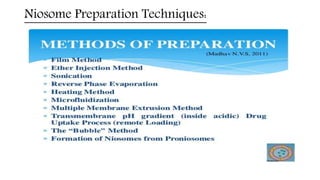
Niosome Preparation Techniques:
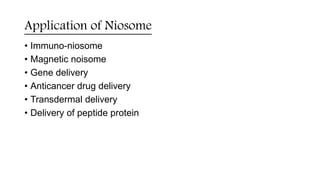
Application of Niosome
• Immuno-niosome
• Magnetic noisome
• Gene delivery
• Anticancer drug delivery
• Transdermal delivery
• Delivery of peptide protein
Aquasome
• Aquasomes are nanoparticulate carrier system but instead of
being simple nanoparticle these are three layered self
assembled structures, comprised of a solid phase
nanocrystalline core coated with oligomeric film on which
biochemically active molecules are adsorbed with or without
modification.
Principle of self assembly
• I- Interaction between charged groups
• II- Hydrogen bonding and dehydration effect
• III- Structural stability
Composition of aquasomes
• I- Core material
• II- Coating material
• III- Bioactive
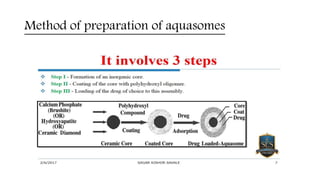
Method of preparation of aquasomes
Characterition of aquasomes
• Drug payload
• In vitro drug release studies
• In-process stability studies
Applications of aquasomes
• I- Insulin delivery
• II- Oral delivery of acid labile enzyme
• III- As oxygen carrier
• V- Antigen delivery
• - Delivery of drug
• VI- For delivery of gene
• I- For delivery of enzymes
Phytosome
• The term “phyto” means plant and “some” means cell like. It is
also mentioned as herbosomes. This is a new patented
technology, where standardized plant extracts or water soluble
phytoconstituents are complexed with phospholipids to produce
lipid compatible molecular complexes, there by greatly
increasing absorption and bioavailability.
Advantage
• Greater therapeutic benefits, as absorption of lipid insoluble
polar botanical extracts through oral and topical route is
enhanced markedly
• Small dose is required, as absorption is increased manifolds.
• Phytosomes possess better drug entrapment efficiency.
• Phosphatidylcholine is not merely a carrier; it is also having
hepatoprotective activity and nutritional value. Due to formation
of chemical bonds, phytosomes show better stability profile
Preparation
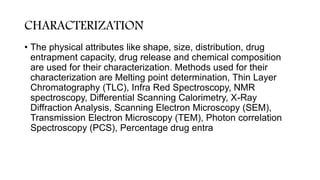
CHARACTERIZATION
• The physical attributes like shape, size, distribution, drug
entrapment capacity, drug release and chemical composition
are used for their characterization. Methods used for their
characterization are Melting point determination, Thin Layer
Chromatography (TLC), Infra Red Spectroscopy, NMR
spectroscopy, Differential Scanning Calorimetry, X-Ray
Diffraction Analysis, Scanning Electron Microscopy (SEM),
Transmission Electron Microscopy (TEM), Photon correlation
Spectroscopy (PCS), Percentage drug entra
Application
• Enhancing Bioavailability
• Antioxidant properties
• Hepato-Protective:
• Cancer treatment:
• Transdermal application
• Wound healing
• https://en.wikipedia.org/wiki/Niosome 10 5 2018

Niosome

  • 1.
    Niosome Guided by :Dr. Dharmik Mehta Associate professor, School of Pharmacy, RK University Prepared by : Sojitra Kishan Vithalbhai 2nd Sem M. pharm School of Pharmacy , RK university
  • 2.
    Table of content Preparationand application of Niosomes, Aquasomes, Phytosomes, Electrosomes.
  • 3.
    Preparation and applicationof niosome • Niosomes are colloidal particles formed from the self assembly of non-ionic surfactants in aqueous medium resulting in closed bilayer structures.
  • 4.
    Advantage • Niosomes areosmotically active, chemically stable and have long storage time compared to liposomes • Their surface formation and modification is very easy because of the functional groups on their hydrophilic heads • They have high compatibility with biological systems and low toxicity because of their non-ionic nature • They are biodegradable and non-immunogenic • They can entrap lipophilic drugs into vesicular bilayer membranes and hydrophilic drugs in aqueous compartments • They can improve the therapeutic performance of the drug molecules by protecting the drug from biological environment, resulting in better availability and controlled drug delivery by restricting the drug effects to target cells in targeted carriers and delaying clearance from the circulation in sustained drug delivery • Access to raw materials is convenient
  • 5.
  • 9.
    Application of Niosome •Immuno-niosome • Magnetic noisome • Gene delivery • Anticancer drug delivery • Transdermal delivery • Delivery of peptide protein
  • 10.
    Aquasome • Aquasomes arenanoparticulate carrier system but instead of being simple nanoparticle these are three layered self assembled structures, comprised of a solid phase nanocrystalline core coated with oligomeric film on which biochemically active molecules are adsorbed with or without modification.
  • 11.
    Principle of selfassembly • I- Interaction between charged groups • II- Hydrogen bonding and dehydration effect • III- Structural stability
  • 12.
    Composition of aquasomes •I- Core material • II- Coating material • III- Bioactive
  • 13.
  • 14.
    Characterition of aquasomes •Drug payload • In vitro drug release studies • In-process stability studies
  • 15.
    Applications of aquasomes •I- Insulin delivery • II- Oral delivery of acid labile enzyme • III- As oxygen carrier • V- Antigen delivery • - Delivery of drug • VI- For delivery of gene • I- For delivery of enzymes
  • 16.
    Phytosome • The term“phyto” means plant and “some” means cell like. It is also mentioned as herbosomes. This is a new patented technology, where standardized plant extracts or water soluble phytoconstituents are complexed with phospholipids to produce lipid compatible molecular complexes, there by greatly increasing absorption and bioavailability.
  • 17.
    Advantage • Greater therapeuticbenefits, as absorption of lipid insoluble polar botanical extracts through oral and topical route is enhanced markedly • Small dose is required, as absorption is increased manifolds. • Phytosomes possess better drug entrapment efficiency. • Phosphatidylcholine is not merely a carrier; it is also having hepatoprotective activity and nutritional value. Due to formation of chemical bonds, phytosomes show better stability profile
  • 18.
  • 19.
    CHARACTERIZATION • The physicalattributes like shape, size, distribution, drug entrapment capacity, drug release and chemical composition are used for their characterization. Methods used for their characterization are Melting point determination, Thin Layer Chromatography (TLC), Infra Red Spectroscopy, NMR spectroscopy, Differential Scanning Calorimetry, X-Ray Diffraction Analysis, Scanning Electron Microscopy (SEM), Transmission Electron Microscopy (TEM), Photon correlation Spectroscopy (PCS), Percentage drug entra
  • 20.
    Application • Enhancing Bioavailability •Antioxidant properties • Hepato-Protective: • Cancer treatment: • Transdermal application • Wound healing
  • 21.