AQUASOMES
PREPARRED BY: U.sai kumar
Roll no:170219886013
M.Pharmacy
Branch : pharmaceutics
SUBMITTED TO:
DR. N.Mounica Nihajan
Department of pharmaceutics
CONTENTS:
 Definition
 Introduction
 Principle of self assembly of macromolecule
 Method of preparation
 Applications
DEFINITION:
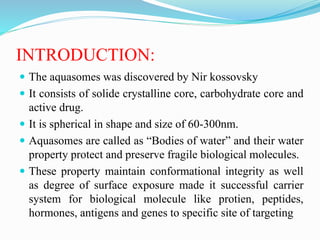
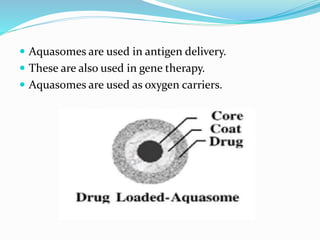
 Aquasomes are nano particulate carrier system but instead
of simple nanoparticles these are layered self assembled
structures comprised of a solid phase nanocrystalline core
coated with oligomeric film to which biochemically active
molecules are absorbed with or without modification.
INTRODUCTION:
 The aquasomes was discovered by Nir kossovsky
 It consists of solide crystalline core, carbohydrate core and
active drug.
 It is spherical in shape and size of 60-300nm.
 Aquasomes are called as “Bodies of water” and their water
property protect and preserve fragile biological molecules.
 These property maintain conformational integrity as well
as degree of surface exposure made it successful carrier
system for biological molecule like protien, peptides,
hormones, antigens and genes to specific site of targeting
PRINCIPLE OF SELF ASSEMBLY OF
MACROMOLECULE:
 Principle of self assembly of macromolecule is governed
by three physicochemical process. they are:
1. Interactions between charged molecule
2. Hydrogen bonding and dehydration effect
3. Structural stability
INTERACTION BETWEEN CARGED
GROUP:
 Intractions of charged group facilitates long range
approach of self assembly sub units charged group.
 It also plays a major role in stabilizing teritary structure of
folded protiens.
HYDROGEN BONDING AND
DEHYDRATION EFFECT:
 Hydrogen bonding helps in base pair matching and
stabilization of secondary protien structure .such as alpha
helices and beta sheets.
 In case of hydrophobic molecules due to dehydration
effect they can self assembled.
STRUCTURAL STABILITY:
 Structural stability of protein in biological environement
determined by interaction between charged group and
hydrogen bonds largely external to molecule and by vander
waals forces largely internal to molecules.
 Vander wall forces are largely responsible for hardness or
softness of molecule, vander wall interaction with hydrophilic
side chain promotes stability of compact helical structures.
METHOD OF PREPARATION:
 By using principle of assembly aquasomes can be
prepared by three methods. They are:
1. Preparation of core
2. Coating of core
3. Immobilizaion of drug molecule
PREPARATION OF CORE:
 This stage depends upon selection of material for and its
physical and chemical properties.
 This can be fabricated by sonication and collodial precipitation.
 For the core material, creamic material widely used,as they are
structurally known.
 commonly used creamic core are Tin oxide, calicum
phosphate.
 example: synthesis of nano crystalline tin oxide core material.
 This can be prepared by direct current reactive method and
magnetron souttering.
Synthesis of nano crystalline brushite:
 This can be prepared by collodial dispertion, sonication by
reaction of disodium hydrogen phosphate and calicum
phosphate.
Common features includes:
 Crystalline nature.
 They measure between 50-150nm.
 Exhibit clean and reactive surface.
CARBOHYDRATE COATING:
 It is second step involved in coating by carbohydrate on
surface of creamic cores.
 Process of generall entail:
Addition of polyhydroxy oligomer
To a dispersion of core in ultra pure water
Lyophilization
excess of carbohydrates is removed by stir cell ultra
filtration
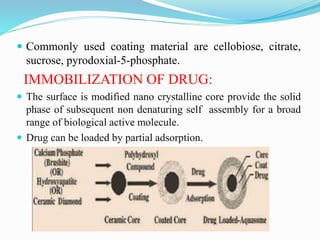
 Commonly used coating material are cellobiose, citrate,
sucrose, pyrodoxial-5-phosphate.
IMMOBILIZATION OF DRUG:
 The surface is modified nano crystalline core provide the solid
phase of subsequent non denaturing self assembly for a broad
range of biological active molecule.
 Drug can be loaded by partial adsorption.
APPLICATIONS:
 Used as vaccines for delivery of viral antigen.
 Aquasomes as red blood cells substitutes can effectively
delivery the large, complex labile molecule, haemoglobin.
 Aquasomes for pharmaceutical delivery of insuline
developed because drug activity is conformationally
specific. bioactivity is preserved and activity increases to
60% compared to I.V adminstration and toxicity is not
reported.
 Aquasomes are used for oral delivery of acid labile
enzymes, serratiopeptidase.enzyme loaded aquasomes
further protect by encapsulating in alginate gel.
 Aquasomes are used in antigen delivery.
 These are also used in gene therapy.
 Aquasomes are used as oxygen carriers.
CONCLUSION:
 Aquasomes appears to be promissing carriers for delivery
of broad range of conformational sensitive molecule better
biological activity as it contain carbohydrate coating over
creamic core. Molecular plasticizers, carbohydrate prevent
destructive carrier interaction and helps to preserve spatial
qualities and the crystalline natural core provide structural
stability and overall integrity. This strategy may
benificially extended to novel drug delivery of other
bioactive molecule.
REFERENCES:
 Aquasomes: a novel nano carrier for drug delivery
S.U wani*, U.yarawara avilable through International journal of
pharmacy.
 Aquasomes: a novel carrier system.
Sethi.pooja,Sharma.ankith, Patel shiv narayan and singhai
a.k.l.n.c.p avilable through international journal of pharmacy
and life sciences.2017
 An overall veiw of nano carrier technology
Shahabade gurraj.s, bhoshale ashok.v, muhthi swathi,
s.bhoshale nilesh, r.khade prasanth.h, bhadane nishant.p
Shinde sagar avilable on international journal of
reasearch.2013
 Aquasomes: an review by svarnalatha saraf, shiprof saraf,
kav srivastava, pharmainfo.net, 2015.
Aquasomes

Aquasomes

  • 1.
    AQUASOMES PREPARRED BY: U.saikumar Roll no:170219886013 M.Pharmacy Branch : pharmaceutics SUBMITTED TO: DR. N.Mounica Nihajan Department of pharmaceutics
  • 2.
    CONTENTS:  Definition  Introduction Principle of self assembly of macromolecule  Method of preparation  Applications
  • 3.
    DEFINITION:  Aquasomes arenano particulate carrier system but instead of simple nanoparticles these are layered self assembled structures comprised of a solid phase nanocrystalline core coated with oligomeric film to which biochemically active molecules are absorbed with or without modification.
  • 4.
    INTRODUCTION:  The aquasomeswas discovered by Nir kossovsky  It consists of solide crystalline core, carbohydrate core and active drug.  It is spherical in shape and size of 60-300nm.  Aquasomes are called as “Bodies of water” and their water property protect and preserve fragile biological molecules.  These property maintain conformational integrity as well as degree of surface exposure made it successful carrier system for biological molecule like protien, peptides, hormones, antigens and genes to specific site of targeting
  • 5.
    PRINCIPLE OF SELFASSEMBLY OF MACROMOLECULE:  Principle of self assembly of macromolecule is governed by three physicochemical process. they are: 1. Interactions between charged molecule 2. Hydrogen bonding and dehydration effect 3. Structural stability
  • 6.
    INTERACTION BETWEEN CARGED GROUP: Intractions of charged group facilitates long range approach of self assembly sub units charged group.  It also plays a major role in stabilizing teritary structure of folded protiens. HYDROGEN BONDING AND DEHYDRATION EFFECT:  Hydrogen bonding helps in base pair matching and stabilization of secondary protien structure .such as alpha helices and beta sheets.
  • 7.
     In caseof hydrophobic molecules due to dehydration effect they can self assembled. STRUCTURAL STABILITY:  Structural stability of protein in biological environement determined by interaction between charged group and hydrogen bonds largely external to molecule and by vander waals forces largely internal to molecules.  Vander wall forces are largely responsible for hardness or softness of molecule, vander wall interaction with hydrophilic side chain promotes stability of compact helical structures.
  • 8.
    METHOD OF PREPARATION: By using principle of assembly aquasomes can be prepared by three methods. They are: 1. Preparation of core 2. Coating of core 3. Immobilizaion of drug molecule
  • 9.
    PREPARATION OF CORE: This stage depends upon selection of material for and its physical and chemical properties.  This can be fabricated by sonication and collodial precipitation.  For the core material, creamic material widely used,as they are structurally known.  commonly used creamic core are Tin oxide, calicum phosphate.  example: synthesis of nano crystalline tin oxide core material.  This can be prepared by direct current reactive method and magnetron souttering.
  • 10.
    Synthesis of nanocrystalline brushite:  This can be prepared by collodial dispertion, sonication by reaction of disodium hydrogen phosphate and calicum phosphate. Common features includes:  Crystalline nature.  They measure between 50-150nm.  Exhibit clean and reactive surface.
  • 11.
    CARBOHYDRATE COATING:  Itis second step involved in coating by carbohydrate on surface of creamic cores.  Process of generall entail: Addition of polyhydroxy oligomer To a dispersion of core in ultra pure water Lyophilization excess of carbohydrates is removed by stir cell ultra filtration
  • 12.
     Commonly usedcoating material are cellobiose, citrate, sucrose, pyrodoxial-5-phosphate. IMMOBILIZATION OF DRUG:  The surface is modified nano crystalline core provide the solid phase of subsequent non denaturing self assembly for a broad range of biological active molecule.  Drug can be loaded by partial adsorption.
  • 13.
    APPLICATIONS:  Used asvaccines for delivery of viral antigen.  Aquasomes as red blood cells substitutes can effectively delivery the large, complex labile molecule, haemoglobin.  Aquasomes for pharmaceutical delivery of insuline developed because drug activity is conformationally specific. bioactivity is preserved and activity increases to 60% compared to I.V adminstration and toxicity is not reported.  Aquasomes are used for oral delivery of acid labile enzymes, serratiopeptidase.enzyme loaded aquasomes further protect by encapsulating in alginate gel.
  • 14.
     Aquasomes areused in antigen delivery.  These are also used in gene therapy.  Aquasomes are used as oxygen carriers.
  • 15.
    CONCLUSION:  Aquasomes appearsto be promissing carriers for delivery of broad range of conformational sensitive molecule better biological activity as it contain carbohydrate coating over creamic core. Molecular plasticizers, carbohydrate prevent destructive carrier interaction and helps to preserve spatial qualities and the crystalline natural core provide structural stability and overall integrity. This strategy may benificially extended to novel drug delivery of other bioactive molecule.
  • 16.
    REFERENCES:  Aquasomes: anovel nano carrier for drug delivery S.U wani*, U.yarawara avilable through International journal of pharmacy.  Aquasomes: a novel carrier system. Sethi.pooja,Sharma.ankith, Patel shiv narayan and singhai a.k.l.n.c.p avilable through international journal of pharmacy and life sciences.2017  An overall veiw of nano carrier technology Shahabade gurraj.s, bhoshale ashok.v, muhthi swathi, s.bhoshale nilesh, r.khade prasanth.h, bhadane nishant.p Shinde sagar avilable on international journal of reasearch.2013
  • 17.
     Aquasomes: anreview by svarnalatha saraf, shiprof saraf, kav srivastava, pharmainfo.net, 2015.