01
Presented by:- NIKHIL MANOHARAN
Submitted to:- Dr. KETKI R DESAI
Roll No:- 8; SEMESTER - II
BMTC.
Date:- 20th February,2018
•Testing Route of administration
•Absorption &
•Excretion
..
Routes of Administration
Routes of administration
ORAL DERMAL INHALATION
02
Oral administration
• Compounds/toxicants can be administered by:-
• mixing in the diet
• dissolving in drinking water
• capsules
03
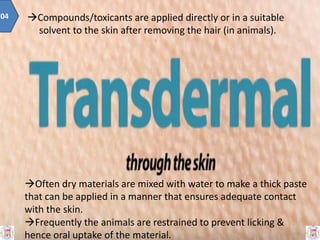
Compounds/toxicants are applied directly or in a suitable
solvent to the skin after removing the hair (in animals).
04
Often dry materials are mixed with water to make a thick paste
that can be applied in a manner that ensures adequate contact
with the skin.
Frequently the animals are restrained to prevent licking &
hence oral uptake of the material.
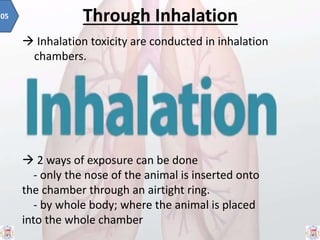
Through Inhalation
 Inhalation toxicity are conducted in inhalation
chambers.
05
 2 ways of exposure can be done
- only the nose of the animal is inserted onto
the chamber through an airtight ring.
- by whole body; where the animal is placed
into the whole chamber
Injection
• Compounds/toxicants may be administered by direct
injection.
• Injection does not correspond to any of the expected
modes of exposure.
• Injection may be useful to bypass absorption and/or
permit rapid action.
• Different methods of injection includes
 Intravascular (I.V.)
 Intramuscular (I.M.)
 Intraperitoneal (I.P.)
Subcutaneous (S.C.)
06
..
ABSORPTION
Absorption
• Absorption is necessary for the chemical to exert a
toxic effect and involves crossing membranes.
• Membranes are semi permeable phospholipids/protein
bilayers and are of variable sizes and the membrane is
selectively permeable.
• The absorption rate differs according to the
psychochemical characteristics of foreign molecules
such as:-
size/shape,
lipid solubility,
 structure,
 charge/polarity.
07
Absorption
There are 5 ways of transport across membranes:-
• Filtration
• Passive diffusion
• Active transport
• Facilitated diffusion
• Endocytosis (Phagocytosis/pinocytosis)
08
Passive Transport09
no energy required; Lipid soluble; non-charged molecules; operates with conc. gradient
no energy required; Specific carrier; operates with conc. Gradient;.
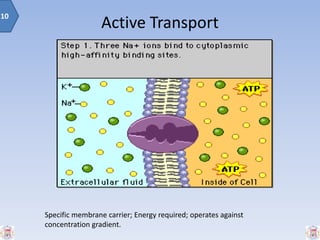
Active Transport
10
Specific membrane carrier; Energy required; operates against
concentration gradient.
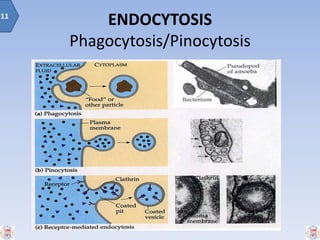
ENDOCYTOSIS
Phagocytosis/Pinocytosis
11
12
Sites of Absorption
a) Skin
b) Gastrointestinal Tract
c) Lungs/ gills
d) Intraperitoneal (i.p.)
e) Intramuscular (i.m.)
f) Subcutaneous (s.c.)
g) Intravenous (i.v.)
13
Skin
Absorption through hair follicle, sweat glands or sebaceous gland
Percutaneous layer (Epidermis & Dermis)
Epidermis (stratum corneum) -1st phase & dermis – 2nd phase.
Through paste
Through bandages/patches (Nicotine)
and is absorbed into the blood stream.
14
Gastrointestinal Tract15
• Absorption can take place along the entire G.I track.
• Stomach- highly absorptive for weak acids, which
will exist in the diffusible, non ionised, lipid soluble
form and whereas weak bases will be highly ionized
in gastric juice & not readily absorbable.
• Intestine- weak acid are present in ionized form and
hence not readily absorbed but weak bases are in
non-ionized form and are readily absorbed.
• However weak acids are ionized as it enters the
blood and doesn’t readily diffuses back.
Lungs
• The rate of absorption is dependent on the
solubility of the gas in the blood: the more
soluble it is, the faster the absorption.
• In general,
10m (large particles) -- disposed of by wiping,
blowing & sneezing
0.01m (V small particles)– are exhaled back
0.01-10m – deposited in various part of the
respiratory tract.
16
Intraperitoneal (i.p.)
17
Intramuscular (i.m.)
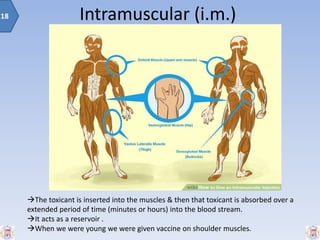
The toxicant is inserted into the muscles & then that toxicant is absorbed over a
extended period of time (minutes or hours) into the blood stream.
It acts as a reservoir .
When we were young we were given vaccine on shoulder muscles.
18
Subcutaneous (s.c.)
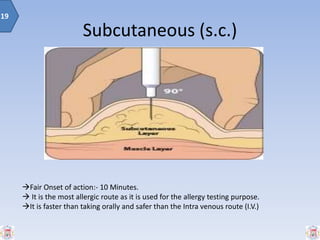
Fair Onset of action:- 10 Minutes.
 It is the most allergic route as it is used for the allergy testing purpose.
It is faster than taking orally and safer than the Intra venous route (I.V.)
19
Intravenous (I.V.)
Onset of action:- Very rapid
Can know exact amount of dosage given.
If wrong dose given then there is no way out as it is mixed with the
blood and the 1st organ to be affected is the Heart.
20
..
EXCRETION
Excretion
• Excretion is the removal of toxicants from the
blood and their return to the external
environment via urine, faeces, exhalation, etc.
• Toxicants must again pass through membranes in
order to leave the body, and the same chemical
and physical properties that governed passage
across other membranes applies to
excretory organs as well.
21
Different routes of Excretion
• Urinary excretion
• Biliary excretion
• Excretion via the lungs
• Other routes
22
Urinary Excretion
• Elimination of substances by the kidneys into
the urine is the primary route of excretion of
toxicants.
• Three processes are involved in urinary
excretion: filtration, secretion, and
reabsorption.
• Filtration occours in the glomerulus
• Secretion occours in the Proximal CT.
• Reabsorption takes place in the Distal CT.
23
• Kidneys, which have been damaged by toxins,
infectious diseases, or as a consequence of age,
have diminished ability to eliminate toxicants
thus making those individuals more susceptible
to toxins that enter the body.
• The presence of albumin in the urine indicates
that the glomerulus filtering system is damaged
letting large molecules pass through.
• The presence of glucose in the urine is an
indication that tubular reabsorption has been
impaired.
24
Biliary Excretion
• Compounds which are excreted into the bile
are usually eliminated in the faeces.
• Hepatocytes (Liver)  Bile  into the
canaliculi flows into the bile duct Stored
(Gall Bladder) into the intestine  out
through faeces.
25
Excretion via the lungs
• Substances that exist in the gaseous phase at
body temperature are excreted mainly by the
lungs.
• Volatile liquids are also readily excreted via the
expired air.
• Highly soluble liquids such as chloroform &
holathane are excreted slowly because of their
storage in the adipose tissue & the limited
ventilation volume.
• Excretion of toxicants from lungs is accomplished
by simple diffusion through cell membrane.
26
Other routes
Gastrointestinal tract
Milk
Sweat gland
Saliva
Semen
27
Summary
1) Routes of administration
Oral, Dermal, Inhalation & Injection.
2) Absorption
Different types of transport across membranes
(Filter, passive, active transport & endocytosis.)
Sites of absorption
(skin, GI, lungs, I.V, I.M, S.C & I.P)
3) Excretion
Different routes of excretion.
(Urine, faeces, lungs, G.I, milk, sweat glad, saliva & semen)
28
..
Q & A time....!!
..
THANK YOU......!!

Nikhil

  • 1.
    01 Presented by:- NIKHILMANOHARAN Submitted to:- Dr. KETKI R DESAI Roll No:- 8; SEMESTER - II BMTC. Date:- 20th February,2018 •Testing Route of administration •Absorption & •Excretion
  • 2.
  • 3.
    Routes of administration ORALDERMAL INHALATION 02
  • 4.
    Oral administration • Compounds/toxicantscan be administered by:- • mixing in the diet • dissolving in drinking water • capsules 03
  • 5.
    Compounds/toxicants are applieddirectly or in a suitable solvent to the skin after removing the hair (in animals). 04 Often dry materials are mixed with water to make a thick paste that can be applied in a manner that ensures adequate contact with the skin. Frequently the animals are restrained to prevent licking & hence oral uptake of the material.
  • 6.
    Through Inhalation  Inhalationtoxicity are conducted in inhalation chambers. 05  2 ways of exposure can be done - only the nose of the animal is inserted onto the chamber through an airtight ring. - by whole body; where the animal is placed into the whole chamber
  • 7.
    Injection • Compounds/toxicants maybe administered by direct injection. • Injection does not correspond to any of the expected modes of exposure. • Injection may be useful to bypass absorption and/or permit rapid action. • Different methods of injection includes  Intravascular (I.V.)  Intramuscular (I.M.)  Intraperitoneal (I.P.) Subcutaneous (S.C.) 06
  • 8.
  • 9.
    Absorption • Absorption isnecessary for the chemical to exert a toxic effect and involves crossing membranes. • Membranes are semi permeable phospholipids/protein bilayers and are of variable sizes and the membrane is selectively permeable. • The absorption rate differs according to the psychochemical characteristics of foreign molecules such as:- size/shape, lipid solubility,  structure,  charge/polarity. 07
  • 10.
    Absorption There are 5ways of transport across membranes:- • Filtration • Passive diffusion • Active transport • Facilitated diffusion • Endocytosis (Phagocytosis/pinocytosis) 08
  • 11.
    Passive Transport09 no energyrequired; Lipid soluble; non-charged molecules; operates with conc. gradient no energy required; Specific carrier; operates with conc. Gradient;.
  • 12.
    Active Transport 10 Specific membranecarrier; Energy required; operates against concentration gradient.
  • 13.
  • 14.
  • 15.
    Sites of Absorption a)Skin b) Gastrointestinal Tract c) Lungs/ gills d) Intraperitoneal (i.p.) e) Intramuscular (i.m.) f) Subcutaneous (s.c.) g) Intravenous (i.v.) 13
  • 16.
    Skin Absorption through hairfollicle, sweat glands or sebaceous gland Percutaneous layer (Epidermis & Dermis) Epidermis (stratum corneum) -1st phase & dermis – 2nd phase. Through paste Through bandages/patches (Nicotine) and is absorbed into the blood stream. 14
  • 17.
    Gastrointestinal Tract15 • Absorptioncan take place along the entire G.I track. • Stomach- highly absorptive for weak acids, which will exist in the diffusible, non ionised, lipid soluble form and whereas weak bases will be highly ionized in gastric juice & not readily absorbable. • Intestine- weak acid are present in ionized form and hence not readily absorbed but weak bases are in non-ionized form and are readily absorbed. • However weak acids are ionized as it enters the blood and doesn’t readily diffuses back.
  • 18.
    Lungs • The rateof absorption is dependent on the solubility of the gas in the blood: the more soluble it is, the faster the absorption. • In general, 10m (large particles) -- disposed of by wiping, blowing & sneezing 0.01m (V small particles)– are exhaled back 0.01-10m – deposited in various part of the respiratory tract. 16
  • 19.
  • 20.
    Intramuscular (i.m.) The toxicantis inserted into the muscles & then that toxicant is absorbed over a extended period of time (minutes or hours) into the blood stream. It acts as a reservoir . When we were young we were given vaccine on shoulder muscles. 18
  • 21.
    Subcutaneous (s.c.) Fair Onsetof action:- 10 Minutes.  It is the most allergic route as it is used for the allergy testing purpose. It is faster than taking orally and safer than the Intra venous route (I.V.) 19
  • 22.
    Intravenous (I.V.) Onset ofaction:- Very rapid Can know exact amount of dosage given. If wrong dose given then there is no way out as it is mixed with the blood and the 1st organ to be affected is the Heart. 20
  • 23.
  • 24.
    Excretion • Excretion isthe removal of toxicants from the blood and their return to the external environment via urine, faeces, exhalation, etc. • Toxicants must again pass through membranes in order to leave the body, and the same chemical and physical properties that governed passage across other membranes applies to excretory organs as well. 21
  • 25.
    Different routes ofExcretion • Urinary excretion • Biliary excretion • Excretion via the lungs • Other routes 22
  • 26.
    Urinary Excretion • Eliminationof substances by the kidneys into the urine is the primary route of excretion of toxicants. • Three processes are involved in urinary excretion: filtration, secretion, and reabsorption. • Filtration occours in the glomerulus • Secretion occours in the Proximal CT. • Reabsorption takes place in the Distal CT. 23
  • 27.
    • Kidneys, whichhave been damaged by toxins, infectious diseases, or as a consequence of age, have diminished ability to eliminate toxicants thus making those individuals more susceptible to toxins that enter the body. • The presence of albumin in the urine indicates that the glomerulus filtering system is damaged letting large molecules pass through. • The presence of glucose in the urine is an indication that tubular reabsorption has been impaired. 24
  • 28.
    Biliary Excretion • Compoundswhich are excreted into the bile are usually eliminated in the faeces. • Hepatocytes (Liver)  Bile  into the canaliculi flows into the bile duct Stored (Gall Bladder) into the intestine  out through faeces. 25
  • 29.
    Excretion via thelungs • Substances that exist in the gaseous phase at body temperature are excreted mainly by the lungs. • Volatile liquids are also readily excreted via the expired air. • Highly soluble liquids such as chloroform & holathane are excreted slowly because of their storage in the adipose tissue & the limited ventilation volume. • Excretion of toxicants from lungs is accomplished by simple diffusion through cell membrane. 26
  • 30.
  • 31.
    Summary 1) Routes ofadministration Oral, Dermal, Inhalation & Injection. 2) Absorption Different types of transport across membranes (Filter, passive, active transport & endocytosis.) Sites of absorption (skin, GI, lungs, I.V, I.M, S.C & I.P) 3) Excretion Different routes of excretion. (Urine, faeces, lungs, G.I, milk, sweat glad, saliva & semen) 28
  • 32.
    .. Q & Atime....!!
  • 33.

Editor's Notes

  • #8 Explain by keeping only images and describe later on.
  • #17 Stratum corneum consists of several layers of thin, cohesive, dead cells that contain chemically resistant material (protein filament)
  • #18 Sublingual & suppositories to be absorbed in the mouth and rectum.
  • #19 Very large surface area Well vascularised Readily permeable
  • #20 This site of injection is more likely given to animals rather than humans.
  • #25 Toxicants or their metabolites can be eliminated from the body by several routes. The main routes of excretion are via urine, feces, and exhaled air. Thus, the primary organ systems involved in excretion are the urinary system, gastrointestinal system and respiratory system. A few other avenues for elimination exist but they are relatively unimportant, except in exceptional circumstances.