What body does to
drug..
Definition:
What the body does to drug.
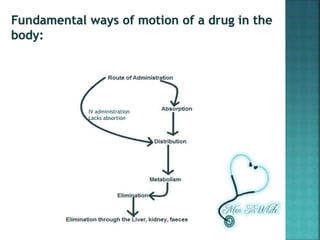
1.Route of drug administration
2.Absorption
3.Distribution
4.Metabolism
5.Elimination
IV administration
Lacks absortion
Enteral:
Oral:
 Safest & most common
route of administration
Food may affect the
absorption
Patient’s complaince is
required
Available in enteric coatted
and extended release forms
Sublingual/Buccal:
 Placed under the tongue
or between the gums &
cheeks
 Directly enters into the
systemic circulation
 Limited to certain drugs
 dose may be lost if
swallowed
Parenteral:
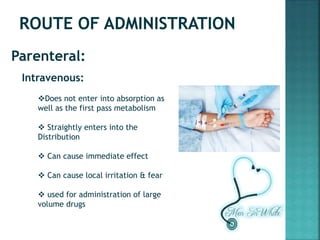
Intravenous:
Does not enter into absorption as
well as the first pass metabolism
 Straightly enters into the
Distribution
 Can cause immediate effect
 Can cause local irritation & fear
 used for administration of large
volume drugs
Intramuscular:
 Aqueous solution prompt
 Can be used moderate drugs
 Can be more painful
 suitable for oily substances
 Can cause intramuscular hemorrhage
Subcutaneous:
 suitable for slow release
drugs
 Can cause pain & necrosis if
irritated
 Some other routes of drugs include the transdermal patch, rectal,
as well inhalation
Transdermal is one of the safest mode of administration
Rectal is used if the patient is already vomiting or if the drug
causes vomitting
Inhalation is used for avoidance of systemic side effects while it is
straightly focusing on respiratory system
Definition
Transfer of drug from the site of administration into the
plasma
Mechanism of absorption of drugs:
The important mechanisms which are involved in the drugs
are
Passive diffusion
Facilitated diffusion
Active transport
Exocytosis/endocytosis
Passive diffusion:
Movement towards the concernteration gradient
Its unsaturable does not require ATP, carrier protein
Lipophilic drugs can readily pass through the lipid bilayer
Hydrophilic drugs dissolve in water & transfer through the aqueous
pores present in the membrane
Facilitated diffusion:
Movement towards the concernteration gradient
It is saturable, requires carrier protein but does not require ATP
Drugs bind to carrier proteins & carrier protein undergoes
cnformational changes& allows the passage of drugs inside the
membrane
Active transport:
 Movement against the concernteration gradient
Saturable, requires carrier proteins ,require ATP
 Transport occurs through the carrier proteinsWith the
hydrolysis of ATP
Exocytosis/Endocytosis:
 Useful for drugs with high molecular weight
 Engulfment of drug by the membrane
 Engulfed drug is incorporated into the vesicle &
transported into the cell interior

Pharmacokinetics-Part 1

  • 1.
    What body doesto drug..
  • 2.
    Definition: What the bodydoes to drug. 1.Route of drug administration 2.Absorption 3.Distribution 4.Metabolism 5.Elimination
  • 3.
  • 5.
    Enteral: Oral:  Safest &most common route of administration Food may affect the absorption Patient’s complaince is required Available in enteric coatted and extended release forms Sublingual/Buccal:  Placed under the tongue or between the gums & cheeks  Directly enters into the systemic circulation  Limited to certain drugs  dose may be lost if swallowed
  • 6.
    Parenteral: Intravenous: Does not enterinto absorption as well as the first pass metabolism  Straightly enters into the Distribution  Can cause immediate effect  Can cause local irritation & fear  used for administration of large volume drugs
  • 7.
    Intramuscular:  Aqueous solutionprompt  Can be used moderate drugs  Can be more painful  suitable for oily substances  Can cause intramuscular hemorrhage Subcutaneous:  suitable for slow release drugs  Can cause pain & necrosis if irritated
  • 8.
     Some otherroutes of drugs include the transdermal patch, rectal, as well inhalation Transdermal is one of the safest mode of administration Rectal is used if the patient is already vomiting or if the drug causes vomitting Inhalation is used for avoidance of systemic side effects while it is straightly focusing on respiratory system
  • 9.
    Definition Transfer of drugfrom the site of administration into the plasma Mechanism of absorption of drugs: The important mechanisms which are involved in the drugs are Passive diffusion Facilitated diffusion Active transport Exocytosis/endocytosis
  • 10.
    Passive diffusion: Movement towardsthe concernteration gradient Its unsaturable does not require ATP, carrier protein Lipophilic drugs can readily pass through the lipid bilayer Hydrophilic drugs dissolve in water & transfer through the aqueous pores present in the membrane Facilitated diffusion: Movement towards the concernteration gradient It is saturable, requires carrier protein but does not require ATP Drugs bind to carrier proteins & carrier protein undergoes cnformational changes& allows the passage of drugs inside the membrane
  • 11.
    Active transport:  Movementagainst the concernteration gradient Saturable, requires carrier proteins ,require ATP  Transport occurs through the carrier proteinsWith the hydrolysis of ATP Exocytosis/Endocytosis:  Useful for drugs with high molecular weight  Engulfment of drug by the membrane  Engulfed drug is incorporated into the vesicle & transported into the cell interior