Deprt. Of Electrical and Electronics Engineering
INTRODUCTION
TYPES OF NIGHT VISION
WORKING PRINCIPLE
IMAGE INTENSIFIER
THERMAL IMAGING
NIGHT VISION DEVICES
GENERATIONS
APPLICATIONS
CONCLUSION
 Night vision technology allows one to see in darkness.
 It is mainly developed for military surveillance.
 We can see a person standing over 180 m distance in a
moonless and cloudy night.
 It plays a key role in search and rescue operations.
Biological night vision:
 Molecules in the rods of the eye undergo a change in shape
according to the light.
 Molecules in the human rods is insensitive to the light
Technical night vision:
 Image intensifier
 Thermal Imaging
Image Intensifier:
Night vision amplifies light to a better vision.
A convention lens will capture completely envelops the surrounding
light.
The gathered light is sent to the image intensifier-tube.
In each channel there release thousands of electrons.
Electrons collide with each other and produce more.
The new atoms again collide and creates a chain.
These electrons after hitting a screen will produce photons and crea
a green image.
This green phosphor image is viewed through lens
 In order to understand thermal imaging, it is important to
understand something about light.
Three Types of IR rays:
Near Infrared:
Closest to visible light, near – IR has wavelengths
that range from 0.7 to 1.3 microns.
Mid Infrared:
Mid – IR has wavelengths ranging from 1.3 to 3 microns.
Thermal Infrared:
Thermal infrared the largest part of the infrared spectrum,
thermal – IR has wavelengths ranging from 3 microns to over 30
microns.
All objects emit infrared energy a function as a
function of their temperature
All objects emit infrared energy a function as a function of their
temperature
A lens will focuses the infrared light.
The focused light is scanned and create temperature pattern
The pattern is translated into electric impulses.
The impulses sent to an electrical circuit board that translates the
information into the data to display
The signal processing unit sends the information and it appears in
different colors.
Generally thermal images are black and white in nature.
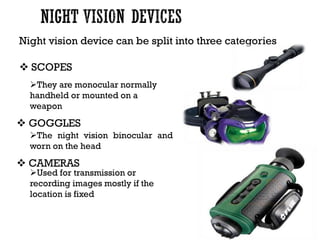
Night vision device can be split into three categories
 SCOPES
They are monocular normally
handheld or mounted on a
weapon
 GOGGLES
The night vision binocular and
worn on the head
 CAMERAS
Used for transmission or
recording images mostly if the
location is fixed
 Generation 1:
In 1950’s devices based on vacuum tube technology are
available.
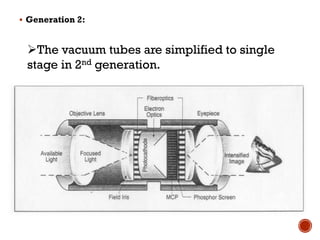
 Generation 2:
The vacuum tubes are simplified to single
stage in 2nd generation.
 Generation 3:
 The third generation night vision devices advanced in using small
electronic circuits
 Generation 4:
In present generation the researches are being made to bring it
into the micro electron chips.
Military
surveillance
Wild life
observation
Hidden Object
Detection
Property
management-Security
surveillance
 In present scenario night vision the applications of night vision
technology is very essential to combat terrorism which is the major
problem faced by the mankind.
 After a long journey from 1950’s we have much developed night
vision technology but it is limited in use.
 It will yield good results in future if we use it in every field for
defensive purpose.
Night vision technology rajesh

Night vision technology rajesh

  • 1.
    Deprt. Of Electricaland Electronics Engineering
  • 2.
    INTRODUCTION TYPES OF NIGHTVISION WORKING PRINCIPLE IMAGE INTENSIFIER THERMAL IMAGING NIGHT VISION DEVICES GENERATIONS APPLICATIONS CONCLUSION
  • 3.
     Night visiontechnology allows one to see in darkness.  It is mainly developed for military surveillance.  We can see a person standing over 180 m distance in a moonless and cloudy night.  It plays a key role in search and rescue operations.
  • 4.
    Biological night vision: Molecules in the rods of the eye undergo a change in shape according to the light.  Molecules in the human rods is insensitive to the light Technical night vision:  Image intensifier  Thermal Imaging
  • 5.
  • 6.
    Night vision amplifieslight to a better vision. A convention lens will capture completely envelops the surrounding light. The gathered light is sent to the image intensifier-tube. In each channel there release thousands of electrons. Electrons collide with each other and produce more. The new atoms again collide and creates a chain. These electrons after hitting a screen will produce photons and crea a green image. This green phosphor image is viewed through lens
  • 7.
     In orderto understand thermal imaging, it is important to understand something about light.
  • 8.
    Three Types ofIR rays: Near Infrared: Closest to visible light, near – IR has wavelengths that range from 0.7 to 1.3 microns. Mid Infrared: Mid – IR has wavelengths ranging from 1.3 to 3 microns. Thermal Infrared: Thermal infrared the largest part of the infrared spectrum, thermal – IR has wavelengths ranging from 3 microns to over 30 microns.
  • 9.
    All objects emitinfrared energy a function as a function of their temperature
  • 10.
    All objects emitinfrared energy a function as a function of their temperature A lens will focuses the infrared light. The focused light is scanned and create temperature pattern The pattern is translated into electric impulses. The impulses sent to an electrical circuit board that translates the information into the data to display The signal processing unit sends the information and it appears in different colors. Generally thermal images are black and white in nature.
  • 11.
    Night vision devicecan be split into three categories  SCOPES They are monocular normally handheld or mounted on a weapon  GOGGLES The night vision binocular and worn on the head  CAMERAS Used for transmission or recording images mostly if the location is fixed
  • 12.
     Generation 1: In1950’s devices based on vacuum tube technology are available.
  • 13.
     Generation 2: Thevacuum tubes are simplified to single stage in 2nd generation.
  • 14.
     Generation 3: The third generation night vision devices advanced in using small electronic circuits
  • 15.
     Generation 4: Inpresent generation the researches are being made to bring it into the micro electron chips.
  • 16.
  • 17.
  • 18.
     In presentscenario night vision the applications of night vision technology is very essential to combat terrorism which is the major problem faced by the mankind.  After a long journey from 1950’s we have much developed night vision technology but it is limited in use.  It will yield good results in future if we use it in every field for defensive purpose.