DAV INSTITUTE OF ENGINEERING AND
TECHNOLOGY
SEMINAR ON
NIGHT VISION TECHNOLOGY
ASHUTOSH 306/17
BY-ASHUTOSH PARBHAKAR
DEPARTMENT OF
ELELCTRICAL ENGG
306/17
1704506
• The word ‘Night vision’ itself means the
ability to see in low light conditions.
• Humans have poor night vision compared
to many other animals.
• So we all might have a question in our
mind that is this really possible to see in the
dark night?
• The answer is……..YES, we can see in
the dark night using the proper equipment
made by using this technology.
• We can see a person standing over 183m
away in the dark night.
.
ASHUTOSH 306/17
HOW DOES IT WORK?
•The night vision is possible because of
two approaches:
(1)Sufficient spectral range
(2) (2) Sufficient intensity range
•Two technologies are used for night
vision:
(1)Thermal Imaging
(2)Image Enhancement
ASHUTOSH 306/17
•Infrared light is used to visualize the
things in the dark.
•The amount of energy in a light wave is
related to its wavelength: Shorter
wavelengths have higher energy.
•Of visible light, violet has the most
energy, and red has the least.
•Just next to the visible light spectrum is
the infrared spectrum
ASHUTOSH 306/17
Infrared light can be split into three categories:
1-Near-infrared
2- Mid-infrared
3- Thermal-infrared
ASHUTOSH 306/17
Near-infrared (near-IR) – Closest to visible light,
near-IR has wavelengths that range 0.7 to 1.3
micron.
•Mid-infrared (mid-IR) – Mid-IR has wavelengths
ranging from 1.3 to 3 microns. Both near-IR and
mid-IR are used by a variety of electronic devices,
including remote controls. ASHUTOSH 306/17
•Thermal-infrared (thermal-IR) – Occupying the
largest part of the infrared spectrum, thermal-IR has
wavelengths ranging from 3 microns to over 30
microns.
ASHUTOSH 306/17
THERMAL IMAGING
•A special lens focuses the infrared light
emitted by all of the objects in view.
•The focused light is scanned by a phased
array of infrared-detector elements.
•The detector elements create a very detailed
temperature pattern called a thermogram.
•It only takes about one-thirtieth of a second for
the detector array to obtain the temperature
information to make the thermogram
ASHUTOSH 306/17
ASHUTOSH 306/17
•This information is obtained from several
thousand points in the field of view of the
detector array.
•The thermogram created by the detector
elements is translated into electric impulses.
•The impulses are sent to a signal-processing
unit, a circuit board with a dedicated chip that
translates the information from the elements
into data for the display.
ASHUTOSH 306/17
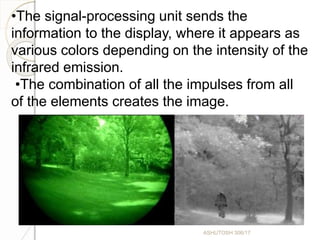
•The signal-processing unit sends the
information to the display, where it appears as
various colors depending on the intensity of the
infrared emission.
•The combination of all the impulses from all
of the elements creates the image.
ASHUTOSH 306/17
IMAGE ENHANCEMENT
ASHUTOSH 306/17
• An image-intensifier tube is used to collect and
amplify infrared and visible light.
•A conventional lens, called the objective lens,
captures ambient light and some near-infrared
light.
•The gathered light is sent to the image-
intensifier tube.
•The image-intensifier tube has a photocathode,
which is used to convert the photons of light
energy into electrons
ASHUTOSH 306/17
•A Microscopic plate(MCP) is a tiny glass disk
that has millions of microscopic holes in it.
•The MCP is contained in a vacuum and has
metal electrodes on either side of the disc.
•When the electrons from the photo cathode hit
the first electrode of the MCP, they are
accelerated into the glass micro-channels by
the 5,000-V bursts being sent between the
electrode pair.
•As electrons pass through the micro channels,
they cause thousands of other electrons to be
released in each channel using a process
called cascaded secondary emission.ASHUTOSH 306/17
•At the end of the image-intensifier tube, the electrons
hit a screen coated with phosphors. •These electrons
maintain their position in relation to the channel they
passed through, which provides a perfect image since
the electrons stay in the same alignment as the
original photons.
•The energy of the electrons causes the phosphors to
reach an excited state and release photons.
•These photons create the image on the screen.
•The green phosphor image is viewed through
another lens, called the ocular lens, which allows you
to magnify and focus the image.
•The NVD may be connected to a monitor to display
the image.
ASHUTOSH 306/17
ASHUTOSH 306/17
GENERATIONS
•NVDs have been around for more than
50 years. They are categorized by
generation.
•Each substantial change in NVD
technology establishes a new generation.
•Night vision devices are categorised in 5
generations
ASHUTOSH 306/17
GENERATION-0
•Created by US Army.
•Uses active infrared.
•A projection unit called IR illuminator is
attached with NVD.
•Use anode in conjunction with cathode to
accelerate the electrons.
•Problems : acceleration causes distortion of
image and reduction of the life of the tube.
•Duplicated by the hostile nations.
ASHUTOSH 306/17
GENERATION-1
•Uses passive infrared.
•Uses ambient light provided by the moon and
the stars.
•Doesn’t require a source of projected infrared
light.
•Doesn’t work well on cloudy or moonless
nights.
•Uses same image-intensifier tube technology
as Generation-0.
•Same problems as faced by the Generation-0.
ASHUTOSH 306/17
GENERATION-2
•Offer improved resolution and performance
over Generation-1 devices.
•Considerably more reliable.
•Able to see in extreme low light conditions due
to the addition of microchannelplate(MCP) to
the image-intensifier tube.
•The images are less distorted and brighter.
ASHUTOSH 306/17
GENERATION-3
•Currently used by the US Army.
•Better resolution and sensitivity.
•Photocathode is made up of Gallium Arsenide
efficient of converting photons to electrons.
•MCP is coated with an ion barrier.
•Tube life is increased
ASHUTOSH 306/17
GENERATION-4
•Known as filmless and gated technology.
•Shows significant improvement in both high-
and low-level light environments.
•No ion barrier in MCP.
•Reduced background noise.
•Enhances signal to noise ratio.
•Images are less distorted and brighter.
ASHUTOSH 306/17
NIGHT VISION DEVICES
It can be splitted in three broad categories:
I. Scopes
II. Goggles
III. Cameras
ASHUTOSH 306/17
APPLICATIONS
•Military
•Hunting
•Wildlife observation
•Surveillance
•Security
•Navigation
•Hidden-object detection
•Entertainment
ASHUTOSH 306/17
https://youtu.be/WIaEY2d5YNE

night vision technology DAVIET

  • 1.
    DAV INSTITUTE OFENGINEERING AND TECHNOLOGY SEMINAR ON NIGHT VISION TECHNOLOGY ASHUTOSH 306/17 BY-ASHUTOSH PARBHAKAR DEPARTMENT OF ELELCTRICAL ENGG 306/17 1704506
  • 2.
    • The word‘Night vision’ itself means the ability to see in low light conditions. • Humans have poor night vision compared to many other animals. • So we all might have a question in our mind that is this really possible to see in the dark night? • The answer is……..YES, we can see in the dark night using the proper equipment made by using this technology. • We can see a person standing over 183m away in the dark night. . ASHUTOSH 306/17
  • 3.
    HOW DOES ITWORK? •The night vision is possible because of two approaches: (1)Sufficient spectral range (2) (2) Sufficient intensity range •Two technologies are used for night vision: (1)Thermal Imaging (2)Image Enhancement ASHUTOSH 306/17
  • 4.
    •Infrared light isused to visualize the things in the dark. •The amount of energy in a light wave is related to its wavelength: Shorter wavelengths have higher energy. •Of visible light, violet has the most energy, and red has the least. •Just next to the visible light spectrum is the infrared spectrum ASHUTOSH 306/17
  • 5.
    Infrared light canbe split into three categories: 1-Near-infrared 2- Mid-infrared 3- Thermal-infrared ASHUTOSH 306/17
  • 6.
    Near-infrared (near-IR) –Closest to visible light, near-IR has wavelengths that range 0.7 to 1.3 micron. •Mid-infrared (mid-IR) – Mid-IR has wavelengths ranging from 1.3 to 3 microns. Both near-IR and mid-IR are used by a variety of electronic devices, including remote controls. ASHUTOSH 306/17
  • 7.
    •Thermal-infrared (thermal-IR) –Occupying the largest part of the infrared spectrum, thermal-IR has wavelengths ranging from 3 microns to over 30 microns. ASHUTOSH 306/17
  • 8.
    THERMAL IMAGING •A speciallens focuses the infrared light emitted by all of the objects in view. •The focused light is scanned by a phased array of infrared-detector elements. •The detector elements create a very detailed temperature pattern called a thermogram. •It only takes about one-thirtieth of a second for the detector array to obtain the temperature information to make the thermogram ASHUTOSH 306/17
  • 9.
  • 10.
    •This information isobtained from several thousand points in the field of view of the detector array. •The thermogram created by the detector elements is translated into electric impulses. •The impulses are sent to a signal-processing unit, a circuit board with a dedicated chip that translates the information from the elements into data for the display. ASHUTOSH 306/17
  • 11.
    •The signal-processing unitsends the information to the display, where it appears as various colors depending on the intensity of the infrared emission. •The combination of all the impulses from all of the elements creates the image. ASHUTOSH 306/17
  • 12.
  • 13.
    • An image-intensifiertube is used to collect and amplify infrared and visible light. •A conventional lens, called the objective lens, captures ambient light and some near-infrared light. •The gathered light is sent to the image- intensifier tube. •The image-intensifier tube has a photocathode, which is used to convert the photons of light energy into electrons ASHUTOSH 306/17
  • 14.
    •A Microscopic plate(MCP)is a tiny glass disk that has millions of microscopic holes in it. •The MCP is contained in a vacuum and has metal electrodes on either side of the disc. •When the electrons from the photo cathode hit the first electrode of the MCP, they are accelerated into the glass micro-channels by the 5,000-V bursts being sent between the electrode pair. •As electrons pass through the micro channels, they cause thousands of other electrons to be released in each channel using a process called cascaded secondary emission.ASHUTOSH 306/17
  • 15.
    •At the endof the image-intensifier tube, the electrons hit a screen coated with phosphors. •These electrons maintain their position in relation to the channel they passed through, which provides a perfect image since the electrons stay in the same alignment as the original photons. •The energy of the electrons causes the phosphors to reach an excited state and release photons. •These photons create the image on the screen. •The green phosphor image is viewed through another lens, called the ocular lens, which allows you to magnify and focus the image. •The NVD may be connected to a monitor to display the image. ASHUTOSH 306/17
  • 16.
    ASHUTOSH 306/17 GENERATIONS •NVDs havebeen around for more than 50 years. They are categorized by generation. •Each substantial change in NVD technology establishes a new generation. •Night vision devices are categorised in 5 generations
  • 17.
    ASHUTOSH 306/17 GENERATION-0 •Created byUS Army. •Uses active infrared. •A projection unit called IR illuminator is attached with NVD. •Use anode in conjunction with cathode to accelerate the electrons. •Problems : acceleration causes distortion of image and reduction of the life of the tube. •Duplicated by the hostile nations.
  • 18.
    ASHUTOSH 306/17 GENERATION-1 •Uses passiveinfrared. •Uses ambient light provided by the moon and the stars. •Doesn’t require a source of projected infrared light. •Doesn’t work well on cloudy or moonless nights. •Uses same image-intensifier tube technology as Generation-0. •Same problems as faced by the Generation-0.
  • 19.
    ASHUTOSH 306/17 GENERATION-2 •Offer improvedresolution and performance over Generation-1 devices. •Considerably more reliable. •Able to see in extreme low light conditions due to the addition of microchannelplate(MCP) to the image-intensifier tube. •The images are less distorted and brighter.
  • 20.
    ASHUTOSH 306/17 GENERATION-3 •Currently usedby the US Army. •Better resolution and sensitivity. •Photocathode is made up of Gallium Arsenide efficient of converting photons to electrons. •MCP is coated with an ion barrier. •Tube life is increased
  • 21.
    ASHUTOSH 306/17 GENERATION-4 •Known asfilmless and gated technology. •Shows significant improvement in both high- and low-level light environments. •No ion barrier in MCP. •Reduced background noise. •Enhances signal to noise ratio. •Images are less distorted and brighter.
  • 22.
    ASHUTOSH 306/17 NIGHT VISIONDEVICES It can be splitted in three broad categories: I. Scopes II. Goggles III. Cameras
  • 23.
  • 24.