Science behind Night Vision
Camera
Introduction:
• Night Vision is the ability to see in low light conditions. Whether by
biological or technological.
• Humans have poor night vision compare to many animals because the
human eye lacks a tapetum lucidum.
• Now there are so many technologies which makes humans to see in
night time.
How animals see in Dark:
• Humans are bult for living in day time and sleeping in the dark.
• The Retina has cells called cones and rods.
• We have 20 times more rods than cones.(120M rods and 6M cones)
• So we can not see in dark but animals have more cones than us
• Animals also have tapetum lucidum in their eyes. So they can see in
dark
Whats makes humans enable to view objects:
• When a light projects on any object reflects the light. this reflected
light by the object enables humans to view the object.
• With this humans are able to distinguish the objecs from others
with respect to it's properties like colour,size,shape,etc.,
How it works:
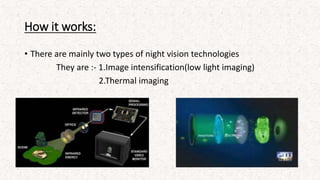
• There are mainly two types of night vision technologies
They are :- 1.Image intensification(low light imaging)
2.Thermal imaging
1.Image intensification(low light imaging):
• Today the most popular and well known method for performing night
vision is based on the use of image intensifiers
• In this image is in green colour because usage of phosphorus
• There are 3 lenses in the intensifier
• An objective lens focuses available light on the photocathode of an
image intensifier
• The light energy causes electrons to be released from cathode which
are accelerated by an electric field to increase their speed
• These electrons will hit phosphorus screen, the energy of electrons
makes the phosphorus glow
• A green phosphor is used in this applications because humans
eyes can differentiate more shades of green than any colour
Advantages:
• Excellent low light level sensitivity
• high resolution
• low power and cost
• ability to identify people
Disdvantages:
• this meyhod is not useful when there is essentially no
light
• Possibilty of blooming and damaging when observing
bright sourses under low light conditions
Thermal Imaging:
• This night vision method do not require any ambient light at all
• They operate on the principle that all objects emit infrared energy as
a function of thier temperature
• in general the hotter an object is the more radiation it emits
• The thermal imager is a product that collects the infrared radiation
from objects in the scene and creates an electronic image
• in addition they are also able to penetrate obstracts such as smoke,
fogg and haze
• There are two types of thermal imageing detectors. cooled and Uncooled
• Cooled IR detector camera require cryogenic cooling and uncooled IR
detecor camera are normally either temperature stabilised or entirely
unstabilised
Advantages:
• Highest possible thermal sensitivity
• Ability detect people and vehicle at great distances
• Not effected by bright light sources
• Able to perform high speed IR imaging
Disdvantages:
• Expensive to purchase and to opperate
• limited cooler operating life time
• Bulky
• These night visions technologies are using by our army to find
enemies in boarders and wars
• It's also used in CC TV's
• Hunting and wild life observation
• Now these are also used in cars for navigation
USES:
THANK YOU

Science behind night vision camera

  • 1.
    Science behind NightVision Camera
  • 2.
    Introduction: • Night Visionis the ability to see in low light conditions. Whether by biological or technological. • Humans have poor night vision compare to many animals because the human eye lacks a tapetum lucidum. • Now there are so many technologies which makes humans to see in night time.
  • 3.
    How animals seein Dark: • Humans are bult for living in day time and sleeping in the dark. • The Retina has cells called cones and rods. • We have 20 times more rods than cones.(120M rods and 6M cones) • So we can not see in dark but animals have more cones than us • Animals also have tapetum lucidum in their eyes. So they can see in dark
  • 4.
    Whats makes humansenable to view objects: • When a light projects on any object reflects the light. this reflected light by the object enables humans to view the object. • With this humans are able to distinguish the objecs from others with respect to it's properties like colour,size,shape,etc.,
  • 5.
    How it works: •There are mainly two types of night vision technologies They are :- 1.Image intensification(low light imaging) 2.Thermal imaging
  • 6.
    1.Image intensification(low lightimaging): • Today the most popular and well known method for performing night vision is based on the use of image intensifiers • In this image is in green colour because usage of phosphorus • There are 3 lenses in the intensifier • An objective lens focuses available light on the photocathode of an image intensifier • The light energy causes electrons to be released from cathode which are accelerated by an electric field to increase their speed • These electrons will hit phosphorus screen, the energy of electrons makes the phosphorus glow
  • 7.
    • A greenphosphor is used in this applications because humans eyes can differentiate more shades of green than any colour
  • 8.
    Advantages: • Excellent lowlight level sensitivity • high resolution • low power and cost • ability to identify people Disdvantages: • this meyhod is not useful when there is essentially no light • Possibilty of blooming and damaging when observing bright sourses under low light conditions
  • 9.
    Thermal Imaging: • Thisnight vision method do not require any ambient light at all • They operate on the principle that all objects emit infrared energy as a function of thier temperature • in general the hotter an object is the more radiation it emits • The thermal imager is a product that collects the infrared radiation from objects in the scene and creates an electronic image • in addition they are also able to penetrate obstracts such as smoke, fogg and haze
  • 10.
    • There aretwo types of thermal imageing detectors. cooled and Uncooled • Cooled IR detector camera require cryogenic cooling and uncooled IR detecor camera are normally either temperature stabilised or entirely unstabilised
  • 11.
    Advantages: • Highest possiblethermal sensitivity • Ability detect people and vehicle at great distances • Not effected by bright light sources • Able to perform high speed IR imaging Disdvantages: • Expensive to purchase and to opperate • limited cooler operating life time • Bulky
  • 12.
    • These nightvisions technologies are using by our army to find enemies in boarders and wars • It's also used in CC TV's • Hunting and wild life observation • Now these are also used in cars for navigation USES:
  • 13.