1
CHAPTER 1
INTRODUCTION
This thesis is to investigate the use of Cold Metal Transfer (CMT) – Cladding in producing
wear and corrosion resistant coatings. The goal is to study and investigate this relatively cost
effective process in overlay welding and to optimize the operating parameters of the cladding
to a certain base and filler wire materials. CMT welding is considered to be a novel joining
method that satisfies in caressingly stringent demands, some of the most important of which
are process stability, reproducibility and cost-effectiveness. Commonly, for welding thin
sheets dip arc or short circuiting arc is used. The CMT process is based on controlled pulsed
welding current and voltage and is basically a derivate of the well-known MIG/MAG process.
Transfer of the filler metal to the welding pool takes place without applied voltage and
current as shown in Fig. 1. The filler wire is constantly retracted at very short intervals. The
precisely defined retraction of the wire facilitates controlled droplet detachment and gives a
clean, spatter-free material l transfer. The wire movement occurs with high frequency. About
70 drop lets per second are detaching. Particularly noteworthy is the highly dynamic wire
feeder mounted directly on the welding torch. The moment the power source detects a short
circuit, the welding current drops and the filler wire starts to retract. One droplet is detached,
with no or a few spatters. The filler wire then moves forward again and the cycle is repeated.
High frequency and precise control over movements are the basic requirements for controlled
material transfer. The wire drive on the welding torch is designed for speed, not for high
tractive forces. The wire is therefore fed by a more powerful, but due to abovementioned
facts, slower main wire feeder. A wire buffer on the wire feeding hose is used to convert the
superimposed, high-frequency wire movement into a linear wire feed The experiment data of
the CMT cladding are collected from Centria University of Applied Science. This thesis is a
part of collaboration project called Interreg involving UIT, Norway, LTU, Sweden, Centria,
Finland, Tampere, Finland, and companies from northern Europe and Scandinavia.
2
CHAPTER 2
LITERATURE SURVEY
This section of the thesis provides a brief description of the research methodology,
approaches and method for data collection and data analysis which assist in achieving our
optimum research objectives. Research has been defined in many ways but the like of martyn
Shuttle worth – ‘’In the broadest senseof the word, the definition of research includes any
gathering of data , information and facts for the advancement of knowledge’’(Shuttleworth,
2008). Creswell (2013) gave another definition of researchwhich states that - ‘’Research is a
process of step used to collect and analyse information to increaseto increase our
understanding on a topic or issue’’ it consist of three steps pose a question, collect datato
answer the question and present answer to the question (Creswell, 2013). Sumser (2001)
referred to research methodology as the link between thinking and evidence.
Research can be classified into applied research and basic research. Basic research is carried
out to understand the fundamental nature of a subject or topic, that can create new idea and
fundamental knowledge (Young and Schmid, 1966).
The methodology that was employed, in this thesis, are both descriptive and exploratory.
Moreover, in this thesis both deductive and inductive research approaches will also be
applied. The research started as a deductive approach with a literature review to gain a deeper
understanding about traditional surfacing and additive manufacturing techniques, pros and
cons of conventional welding process and CMT, etc. Furthermore, both qualitative and
quantitative research methodologies will be employed in this research. Quantitative research
deals with calculation of failure analysis for investigating various degradation and failure
modes. Qualitative analysis deals with collection of experiment data, from Centria University
of Applied Sciences and, evaluation of conventional surfacing and additive manufacturing
techniques and, the importance of CMT technique. In addition, for this research study, case
study research strategy will also be used, for understanding the application of CMT products
for industries in the northern Norway, Sweden and Finland.
3
CHAPTER 3
THEORETICAL FRAMEWORK
This section of the literation review is to give a brief description of various conventional
welding processes and the CMT process which is the basic interest for this thesis.
3.1 WELDING PROCESSES
3.1.1 Gas Metal Arc Welding – GMAW
Gas metal arc welding (GMAW) also came into existence at the beginning of 20th
century,
1920. During 1948 the first commercially available system was produce, which was tag as a
high current density with just metal electrode used, using an inert shielding gas. Just as
GTAW, this process was also used to weld aluminum. GMAW is one of the most industrial
welding technique use due to its development regimes from low density current, the used of
active gas as the shielding gas and also its application in different metals.
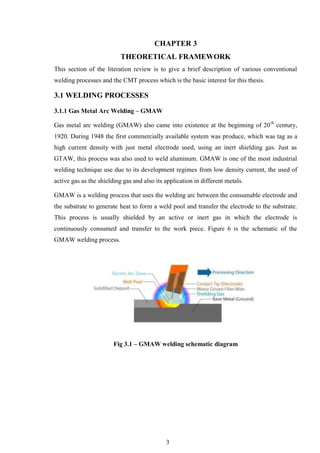
GMAW is a welding process that uses the welding arc between the consumable electrode and
the substrate to generate heat to form a weld pool and transfer the electrode to the substrate.
This process is usually shielded by an active or inert gas in which the electrode is
continuously consumed and transfer to the work piece. Figure 6 is the schematic of the
GMAW welding process.
Fig 3.1 – GMAW welding schematic diagram
4
GMAW has different kind of transfer modes this depends on the objectives for a particular
welding procedure and the kind of metal. These modes can be described as metal transfer
mechanism and can be described as the way in which the molten electrode is deposited on
the work piece.
- Short Circuiting transfer
- Globular transfer
- Spray transfer
- Short Circuiting Transfer
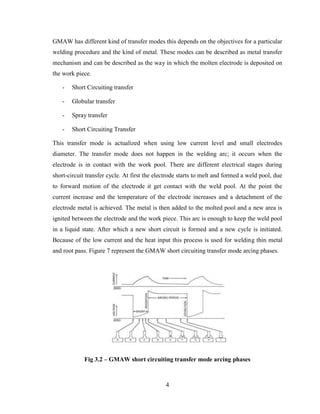
This transfer mode is actualized when using low current level and small electrodes
diameter. The transfer mode does not happen in the welding arc; it occurs when the
electrode is in contact with the work pool. There are different electrical stages during
short-circuit transfer cycle. At first the electrode starts to melt and formed a weld pool, due
to forward motion of the electrode it get contact with the weld pool. At the point the
current increase and the temperature of the electrode increases and a detachment of the
electrode metal is achieved. The metal is then added to the molted pool and a new area is
ignited between the electrode and the work piece. This arc is enough to keep the weld pool
in a liquid state. After which a new short circuit is formed and a new cycle is initiated.
Because of the low current and the heat input this process is used for welding thin metal
and root pass. Figure 7 represent the GMAW short circuiting transfer mode arcing phases.
Fig 3.2 – GMAW short circuiting transfer mode arcing phases
5
 Globular Transfer
Globular transfer mode is characterized by an electrode detachment with a large radius
than the electrode diameter. This transfer occurs for a relatively low current using reverse
polarity regardless of the shielding gas used. For shielding gas like Helium and carbon
dioxide this can be applied with usable levels of current. For average currents, slightly
higher than short circuiting transfer it is possible to have globular transfer. Though, for low
arc length (low voltage), the high dimension droplet can short circuit and form spatter.
That means the arc length needs to be long enough to allow detachment avoiding short
circuit.
 Spray Transfer
Spray transfer mode occurs mostly in Argon rich atmosphere shielding and it is
characterized as spatter free metal transfer. This mode is used for reversed current mode,
for current higher than the transition current, for lower current it is expected to have
globular transfer. The droplets formed are small and they are accelerated by an arc forces.
Smaller dimensions of current prevent the occurrence of short circuit. This welding
transfer mode is difficult to apply on thin substrate due to high heat input and distortion
and the high arc force which can penetrate through the thin substrate.
3.1.2. CMT– Cold Metal Transfer
CMT has a long history, fronius began the possibility of arc welding of steel and aluminum
in 1991, it became obvious that the possibility is by reducing the heat inputs (Lorenzin and
Rutili, 2009). Furthermore, the idea came from a customer that needs optimized welding
solution with a few drops of molten metal on some extremely thin sheet. In 2002, the idea
became obvious and well-studied, which the developmental work for an optimized solution
for industrial work began in intensely.
This process mostly works in short circuit (dip transfer) transfer mode which is defined by
low current and voltage which signifies low heat input. The important difference of CMT
from the conventional GMAW is the full digital control of the welding process. The
microcontroller controls the feeding of the wire for the CMT process through the feed
motors, no longer dependent on the electrical characteristics. An initial high pulse of
current is formed which formed an arc between the advancing electrode and the substrate
that melt the electrode tip. The current is reduced following the pulse, as soon as a short
6
circuit is indicated, the voltage reduces, the current is further reducing to a low background
value and the wire is retracted, which leads to detachment of the molten droplet. Thus, this
process is named CMT due to the metal transfer takes place when the current is very low.
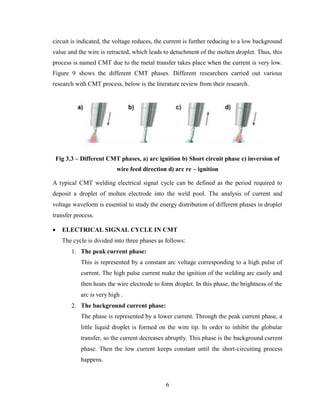
Figure 9 shows the different CMT phases. Different researchers carried out various
research with CMT process, below is the literature review from their research.
Fig 3.3 – Different CMT phases, a) arc ignition b) Short circuit phase c) inversion of
wire feed direction d) arc re – ignition
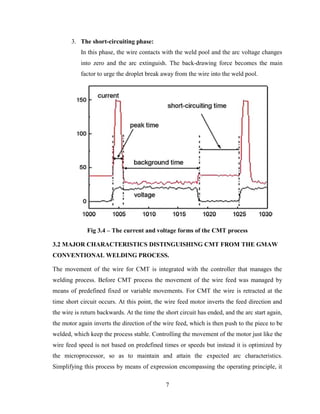
A typical CMT welding electrical signal cycle can be defined as the period required to
deposit a droplet of molten electrode into the weld pool. The analysis of current and
voltage waveform is essential to study the energy distribution of different phases in droplet
transfer process.
 ELECTRICAL SIGNAL CYCLE IN CMT
The cycle is divided into three phases as follows:
1. The peak current phase:
This is represented by a constant arc voltage corresponding to a high pulse of
current. The high pulse current make the ignition of the welding arc easily and
then heats the wire electrode to form droplet. In this phase, the brightness of the
arc is very high .
2. The background current phase:
The phase is represented by a lower current. Through the peak current phase, a
little liquid droplet is formed on the wire tip. In order to inhibit the globular
transfer, so the current decreases abruptly. This phase is the background current
phase. Then the low current keeps constant until the short-circuiting process
happens.
7
3. The short-circuiting phase:
In this phase, the wire contacts with the weld pool and the arc voltage changes
into zero and the arc extinguish. The back-drawing force becomes the main
factor to urge the droplet break away from the wire into the weld pool.
Fig 3.4 – The current and voltage forms of the CMT process
3.2 MAJOR CHARACTERISTICS DISTINGUISHING CMT FROM THE GMAW
CONVENTIONAL WELDING PROCESS.
The movement of the wire for CMT is integrated with the controller that manages the
welding process. Before CMT process the movement of the wire feed was managed by
means of predefined fixed or variable movements. For CMT the wire is retracted at the
time short circuit occurs. At this point, the wire feed motor inverts the feed direction and
the wire is return backwards. At the time the short circuit has ended, and the arc start again,
the motor again inverts the direction of the wire feed, which is then push to the piece to be
welded, which keep the process stable. Controlling the movement of the motor just like the
wire feed speed is not based on predefined times or speeds but instead it is optimized by
the microprocessor, so as to maintain and attain the expected arc characteristics.
Simplifying this process by means of expression encompassing the operating principle, it
8
shows that the movement of the wire define what happen in the welding bath and what
happen in the bath explains the movement of the wire. Thus, this is the reason why it is
important to talk of the oscillation of the motor, for instance if the short circuit occur
earlier, that means the wire will be recall earlier, should the short circuit be delay slightly,
and that means the recall of the wire will be delay. That is the reason why the frequency of
variation of the motor movement varies with time, the mean frequency is approximately
70Hz.
The second discrepancy of CMT is that the transfer of the molten material occurs at almost
no current, whilst for the conventional short arc process it occurs at the circuit phase which
means at high thermal energy. For CMT process it is not high current intensity that is
responsible for igniting the arc resulting to the short circuit phase, but instead the
movement of the wire that is retracted. The movement of the wire assist in transfer of the
metal that occurs due to surface tension created in the melting phase. Thus, during the
metal transfer phase the current is kept very low, then apparently reduces the thermal input
to the work piece.
9
CHAPTER 4
CONCLUSIONS
During welding process the wire retraction during the short circuiting phase plays a
significant role, as it leads to avoidance of spatter creation and also produces better weld
bead aesthetics.
The CMT with Laser hybrid welding process produces welds with improved mechanical
properties and aesthetics than the Laser welding and Laser-MIG hybrid welding. The base
material used for this thesis is mild steel, because of some of the basic cons of mild steel
compare to stainless steel.
10
REFERENCES
[1]. S. Selvi, A. Vishvaksenan, E. Rajasekar – “Cold metal transfer (CMT) technology -
An overview”, Defence Technology 14 (2018) 28e44.
[2]. Turhan KURŞUN, Sivas, TÜRKİYE – “Cold Metal Transfer (CMT) Welding
Technology ”, The Online Journal of Science and Technology - January 2018, Volume 8,
Issue 1.
[3]. Robert Talalaeva, Renno Veinthala, Andres Laansooa and Martinš Sarkansb – “Cold
metal transfer (CMT) welding of thin sheet metal products”, Estonian Journal of
Engineering, 2012, 18, 3, 243–250.

Report cold metal transfer

  • 1.
    1 CHAPTER 1 INTRODUCTION This thesisis to investigate the use of Cold Metal Transfer (CMT) – Cladding in producing wear and corrosion resistant coatings. The goal is to study and investigate this relatively cost effective process in overlay welding and to optimize the operating parameters of the cladding to a certain base and filler wire materials. CMT welding is considered to be a novel joining method that satisfies in caressingly stringent demands, some of the most important of which are process stability, reproducibility and cost-effectiveness. Commonly, for welding thin sheets dip arc or short circuiting arc is used. The CMT process is based on controlled pulsed welding current and voltage and is basically a derivate of the well-known MIG/MAG process. Transfer of the filler metal to the welding pool takes place without applied voltage and current as shown in Fig. 1. The filler wire is constantly retracted at very short intervals. The precisely defined retraction of the wire facilitates controlled droplet detachment and gives a clean, spatter-free material l transfer. The wire movement occurs with high frequency. About 70 drop lets per second are detaching. Particularly noteworthy is the highly dynamic wire feeder mounted directly on the welding torch. The moment the power source detects a short circuit, the welding current drops and the filler wire starts to retract. One droplet is detached, with no or a few spatters. The filler wire then moves forward again and the cycle is repeated. High frequency and precise control over movements are the basic requirements for controlled material transfer. The wire drive on the welding torch is designed for speed, not for high tractive forces. The wire is therefore fed by a more powerful, but due to abovementioned facts, slower main wire feeder. A wire buffer on the wire feeding hose is used to convert the superimposed, high-frequency wire movement into a linear wire feed The experiment data of the CMT cladding are collected from Centria University of Applied Science. This thesis is a part of collaboration project called Interreg involving UIT, Norway, LTU, Sweden, Centria, Finland, Tampere, Finland, and companies from northern Europe and Scandinavia.
  • 2.
    2 CHAPTER 2 LITERATURE SURVEY Thissection of the thesis provides a brief description of the research methodology, approaches and method for data collection and data analysis which assist in achieving our optimum research objectives. Research has been defined in many ways but the like of martyn Shuttle worth – ‘’In the broadest senseof the word, the definition of research includes any gathering of data , information and facts for the advancement of knowledge’’(Shuttleworth, 2008). Creswell (2013) gave another definition of researchwhich states that - ‘’Research is a process of step used to collect and analyse information to increaseto increase our understanding on a topic or issue’’ it consist of three steps pose a question, collect datato answer the question and present answer to the question (Creswell, 2013). Sumser (2001) referred to research methodology as the link between thinking and evidence. Research can be classified into applied research and basic research. Basic research is carried out to understand the fundamental nature of a subject or topic, that can create new idea and fundamental knowledge (Young and Schmid, 1966). The methodology that was employed, in this thesis, are both descriptive and exploratory. Moreover, in this thesis both deductive and inductive research approaches will also be applied. The research started as a deductive approach with a literature review to gain a deeper understanding about traditional surfacing and additive manufacturing techniques, pros and cons of conventional welding process and CMT, etc. Furthermore, both qualitative and quantitative research methodologies will be employed in this research. Quantitative research deals with calculation of failure analysis for investigating various degradation and failure modes. Qualitative analysis deals with collection of experiment data, from Centria University of Applied Sciences and, evaluation of conventional surfacing and additive manufacturing techniques and, the importance of CMT technique. In addition, for this research study, case study research strategy will also be used, for understanding the application of CMT products for industries in the northern Norway, Sweden and Finland.
  • 3.
    3 CHAPTER 3 THEORETICAL FRAMEWORK Thissection of the literation review is to give a brief description of various conventional welding processes and the CMT process which is the basic interest for this thesis. 3.1 WELDING PROCESSES 3.1.1 Gas Metal Arc Welding – GMAW Gas metal arc welding (GMAW) also came into existence at the beginning of 20th century, 1920. During 1948 the first commercially available system was produce, which was tag as a high current density with just metal electrode used, using an inert shielding gas. Just as GTAW, this process was also used to weld aluminum. GMAW is one of the most industrial welding technique use due to its development regimes from low density current, the used of active gas as the shielding gas and also its application in different metals. GMAW is a welding process that uses the welding arc between the consumable electrode and the substrate to generate heat to form a weld pool and transfer the electrode to the substrate. This process is usually shielded by an active or inert gas in which the electrode is continuously consumed and transfer to the work piece. Figure 6 is the schematic of the GMAW welding process. Fig 3.1 – GMAW welding schematic diagram
  • 4.
    4 GMAW has differentkind of transfer modes this depends on the objectives for a particular welding procedure and the kind of metal. These modes can be described as metal transfer mechanism and can be described as the way in which the molten electrode is deposited on the work piece. - Short Circuiting transfer - Globular transfer - Spray transfer - Short Circuiting Transfer This transfer mode is actualized when using low current level and small electrodes diameter. The transfer mode does not happen in the welding arc; it occurs when the electrode is in contact with the work pool. There are different electrical stages during short-circuit transfer cycle. At first the electrode starts to melt and formed a weld pool, due to forward motion of the electrode it get contact with the weld pool. At the point the current increase and the temperature of the electrode increases and a detachment of the electrode metal is achieved. The metal is then added to the molted pool and a new area is ignited between the electrode and the work piece. This arc is enough to keep the weld pool in a liquid state. After which a new short circuit is formed and a new cycle is initiated. Because of the low current and the heat input this process is used for welding thin metal and root pass. Figure 7 represent the GMAW short circuiting transfer mode arcing phases. Fig 3.2 – GMAW short circuiting transfer mode arcing phases
  • 5.
    5  Globular Transfer Globulartransfer mode is characterized by an electrode detachment with a large radius than the electrode diameter. This transfer occurs for a relatively low current using reverse polarity regardless of the shielding gas used. For shielding gas like Helium and carbon dioxide this can be applied with usable levels of current. For average currents, slightly higher than short circuiting transfer it is possible to have globular transfer. Though, for low arc length (low voltage), the high dimension droplet can short circuit and form spatter. That means the arc length needs to be long enough to allow detachment avoiding short circuit.  Spray Transfer Spray transfer mode occurs mostly in Argon rich atmosphere shielding and it is characterized as spatter free metal transfer. This mode is used for reversed current mode, for current higher than the transition current, for lower current it is expected to have globular transfer. The droplets formed are small and they are accelerated by an arc forces. Smaller dimensions of current prevent the occurrence of short circuit. This welding transfer mode is difficult to apply on thin substrate due to high heat input and distortion and the high arc force which can penetrate through the thin substrate. 3.1.2. CMT– Cold Metal Transfer CMT has a long history, fronius began the possibility of arc welding of steel and aluminum in 1991, it became obvious that the possibility is by reducing the heat inputs (Lorenzin and Rutili, 2009). Furthermore, the idea came from a customer that needs optimized welding solution with a few drops of molten metal on some extremely thin sheet. In 2002, the idea became obvious and well-studied, which the developmental work for an optimized solution for industrial work began in intensely. This process mostly works in short circuit (dip transfer) transfer mode which is defined by low current and voltage which signifies low heat input. The important difference of CMT from the conventional GMAW is the full digital control of the welding process. The microcontroller controls the feeding of the wire for the CMT process through the feed motors, no longer dependent on the electrical characteristics. An initial high pulse of current is formed which formed an arc between the advancing electrode and the substrate that melt the electrode tip. The current is reduced following the pulse, as soon as a short
  • 6.
    6 circuit is indicated,the voltage reduces, the current is further reducing to a low background value and the wire is retracted, which leads to detachment of the molten droplet. Thus, this process is named CMT due to the metal transfer takes place when the current is very low. Figure 9 shows the different CMT phases. Different researchers carried out various research with CMT process, below is the literature review from their research. Fig 3.3 – Different CMT phases, a) arc ignition b) Short circuit phase c) inversion of wire feed direction d) arc re – ignition A typical CMT welding electrical signal cycle can be defined as the period required to deposit a droplet of molten electrode into the weld pool. The analysis of current and voltage waveform is essential to study the energy distribution of different phases in droplet transfer process.  ELECTRICAL SIGNAL CYCLE IN CMT The cycle is divided into three phases as follows: 1. The peak current phase: This is represented by a constant arc voltage corresponding to a high pulse of current. The high pulse current make the ignition of the welding arc easily and then heats the wire electrode to form droplet. In this phase, the brightness of the arc is very high . 2. The background current phase: The phase is represented by a lower current. Through the peak current phase, a little liquid droplet is formed on the wire tip. In order to inhibit the globular transfer, so the current decreases abruptly. This phase is the background current phase. Then the low current keeps constant until the short-circuiting process happens.
  • 7.
    7 3. The short-circuitingphase: In this phase, the wire contacts with the weld pool and the arc voltage changes into zero and the arc extinguish. The back-drawing force becomes the main factor to urge the droplet break away from the wire into the weld pool. Fig 3.4 – The current and voltage forms of the CMT process 3.2 MAJOR CHARACTERISTICS DISTINGUISHING CMT FROM THE GMAW CONVENTIONAL WELDING PROCESS. The movement of the wire for CMT is integrated with the controller that manages the welding process. Before CMT process the movement of the wire feed was managed by means of predefined fixed or variable movements. For CMT the wire is retracted at the time short circuit occurs. At this point, the wire feed motor inverts the feed direction and the wire is return backwards. At the time the short circuit has ended, and the arc start again, the motor again inverts the direction of the wire feed, which is then push to the piece to be welded, which keep the process stable. Controlling the movement of the motor just like the wire feed speed is not based on predefined times or speeds but instead it is optimized by the microprocessor, so as to maintain and attain the expected arc characteristics. Simplifying this process by means of expression encompassing the operating principle, it
  • 8.
    8 shows that themovement of the wire define what happen in the welding bath and what happen in the bath explains the movement of the wire. Thus, this is the reason why it is important to talk of the oscillation of the motor, for instance if the short circuit occur earlier, that means the wire will be recall earlier, should the short circuit be delay slightly, and that means the recall of the wire will be delay. That is the reason why the frequency of variation of the motor movement varies with time, the mean frequency is approximately 70Hz. The second discrepancy of CMT is that the transfer of the molten material occurs at almost no current, whilst for the conventional short arc process it occurs at the circuit phase which means at high thermal energy. For CMT process it is not high current intensity that is responsible for igniting the arc resulting to the short circuit phase, but instead the movement of the wire that is retracted. The movement of the wire assist in transfer of the metal that occurs due to surface tension created in the melting phase. Thus, during the metal transfer phase the current is kept very low, then apparently reduces the thermal input to the work piece.
  • 9.
    9 CHAPTER 4 CONCLUSIONS During weldingprocess the wire retraction during the short circuiting phase plays a significant role, as it leads to avoidance of spatter creation and also produces better weld bead aesthetics. The CMT with Laser hybrid welding process produces welds with improved mechanical properties and aesthetics than the Laser welding and Laser-MIG hybrid welding. The base material used for this thesis is mild steel, because of some of the basic cons of mild steel compare to stainless steel.
  • 10.
    10 REFERENCES [1]. S. Selvi,A. Vishvaksenan, E. Rajasekar – “Cold metal transfer (CMT) technology - An overview”, Defence Technology 14 (2018) 28e44. [2]. Turhan KURŞUN, Sivas, TÜRKİYE – “Cold Metal Transfer (CMT) Welding Technology ”, The Online Journal of Science and Technology - January 2018, Volume 8, Issue 1. [3]. Robert Talalaeva, Renno Veinthala, Andres Laansooa and Martinš Sarkansb – “Cold metal transfer (CMT) welding of thin sheet metal products”, Estonian Journal of Engineering, 2012, 18, 3, 243–250.