Setting the Scene:
A Health Economics Perspective
Adrian Towse
Generating a NICE Assessment for Stratified Medicines
Event Sponsored by BIVDA1 and ABPI2
London • 20 January 2014

1British

In Vitro Diagnostics Association

2Association

of the British Pharmaceutical Industry
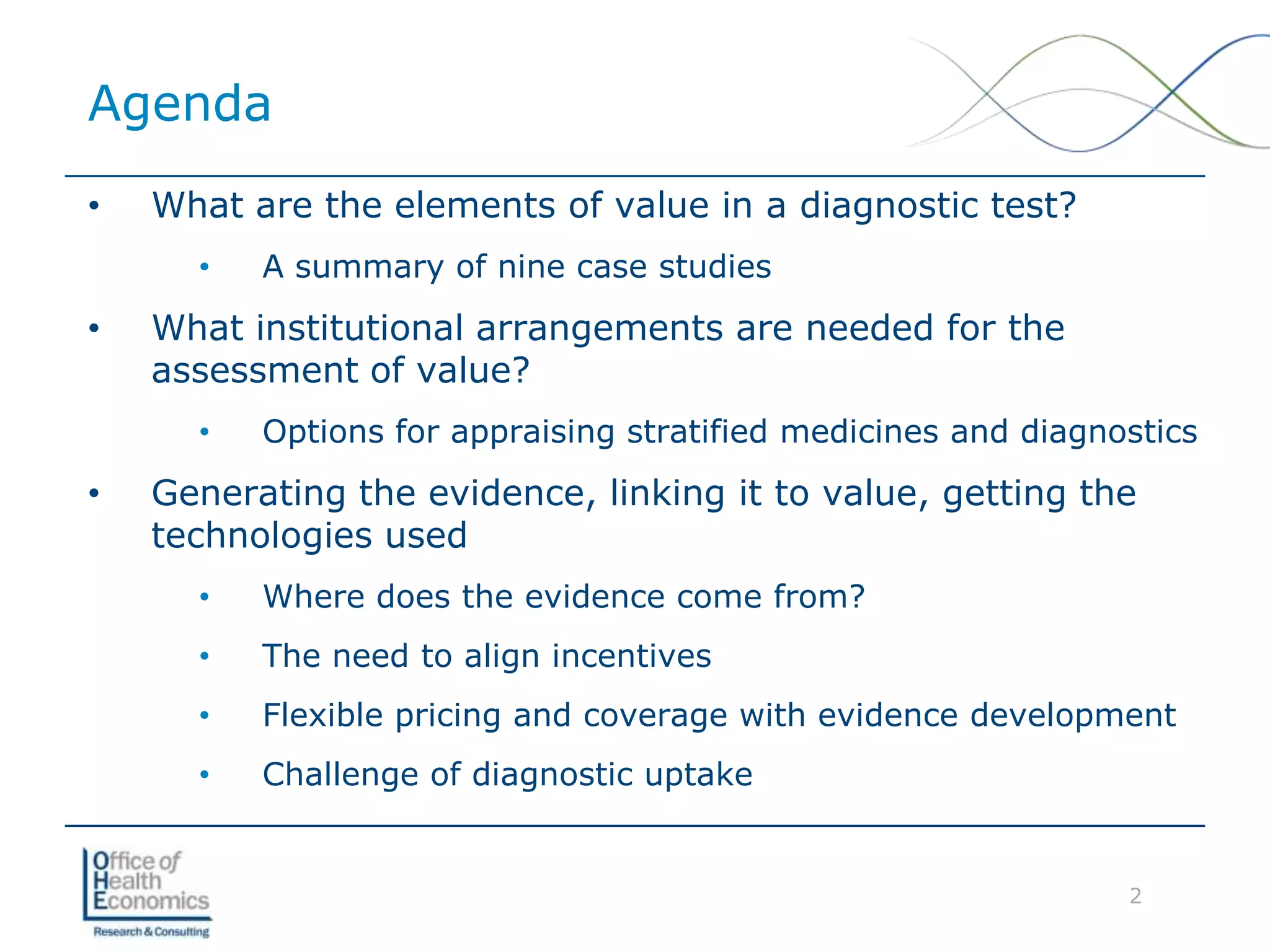
Agenda
•

What are the elements of value in a diagnostic test?
•

•

What institutional arrangements are needed for the
assessment of value?
•

•

A summary of nine case studies

Options for appraising stratified medicines and diagnostics

Generating the evidence, linking it to value, getting the
technologies used
•

Where does the evidence come from?

•

The need to align incentives

•

Flexible pricing and coverage with evidence development

•

Challenge of diagnostic uptake

2
Framework to assess value of diagnostic test
technologies in the context of treatment
1. Reducing
drug
adverse
effects

5.Reducing
uncertainty
about value

Value
4. Enabling Tx
effective in a
small fraction
to be made
available

2. Reducing
time delays
in selecting
optimal Tx

3.Increasing
adherence
or
willingness
to start Tx

Source: Garau et al. (2013)

3
Pathways for value of molecular diagnostics and key
examples

Source: Garau et al. (2013)

4
Agenda
•

What are the elements of value in a diagnostic test?
•

•

What institutional arrangements are needed for the
assessment of value?
•

•

A summary of nine case studies

Options for appraising stratified medicines and diagnostics

Generating the evidence, linking it to value, getting the
technologies used
•

Where does the evidence come from?

•

The need to align incentives

•

Flexible pricing and coverage with evidence development

5
Institutional processes for the value
assessment of new diagnostics
Dx-Tx pair launched
simultaneously

New Dx

Dx not linked to a Tx

Single Dx launched
separately

Dx assessed via
Diagnostic-dedicated
process

Multiple Dx with same
clinical use

Dx linked to a Tx
(companion Dx,
personalised medicine)

Dx-Tx joint assessment
via Drug process

Dx assessed via
Diagnostic-dedicated
process

Dx assessed via
Diagnostic-dedicated
process

Source: Garau et al. (2013)

6
Agenda
•

What are the elements of value in a diagnostic test?
•

•

What institutional arrangements are needed for the
assessment of value?
•

•

A summary of nine case studies

Options for appraising stratified medicines and diagnostics

Generating the evidence, linking it to value, getting
the technologies used
•

Where does the evidence come from?

•

The need to align incentives

•

Flexible pricing and coverage with evidence development

•

Challenge of diagnostic uptake

7
Molecular diagnostic tests: the
evidence hurdle
Marker

Main study design

Study size (patient
numbers)

Sponsor

KRAS mutations (Anti-EGFR
monoclonal antibodies in
CRC)

Retrospective cohort
analysis of an RCT

1198

Drug developer & public
research body

(a) Oncotype DX® &
(b) MammaPrint®
(Prognostic/predictive in
BrCa)

Retrospective RCT cohorts

(a) 688, 651, 895
(b) Prognostic:
117, 295, 307, 123
Predictive: 241

Diagnostic manufacturer

RCTs

(a)
(b)

Public research bodies

Retrospective RCT cohort+
Healthy volunteers

1477, 162

Public research body

Prospective cohort study

4471 (Terminated early)

Payer

Proof-of concept RCT

187

Diagnostic manufacturer

CYP2C19
(Clopidogrel in ACS)

11248
6600

Public research body

Source: Adapted from Towse et al. (2013)

8
Aligning incentives
• Greater willingness on the part of payers to accept prices that reflect
value
• Will involve a need for price flexibility for drugs as evidence of their
value for different groups of patients emerges over time
• Consideration of some form of intellectual property protection (e.g.
data exclusivity) for diagnostics to cover evidence of clinical utility
• Realistic expectations about standards for evidence. This involves the
use of CED and real-world evidence collection for both drugs and
diagnostics
• Public investment to complement the efforts of payers and
manufacturers, recognising the limitations on the incentives for both
to invest in evidence collection on all the questions that matter.

Source: Towse and Garrison (2013)

9
Need for flexible pricing and more
outcomes-based PAS

Garrison et al (2013)

Academy of Medical Sciences (2013)

10
France (INCa) – An approach to
clinical implementation

•

28 regional platforms
• Partnerships between several laboratories located in university hospitals and cancer
centres
• Cooperation between pathologists and biologists

•

Compensate local pathologists for sample shipment

•

Free of charge to patients and hospitals

•

Public/private partnerships for molecular testing

•

Early phase network of 16 early-phase clinical trial centers (CLIP2)

Source: Buzyn (2013)

11
France – estimates of economic
impact of molecular testing

PFS = progression free survival

•

Focus on cost-offset arising from not treating nonresponder patient subgroups identified through testing.

•

May explain willingness to fund the INCa initiative

Source: Calvo (2011)

12
Sources
Academy of Medical Sciences. (2013) Realising the potential of stratified medicines. London: Academy of
Medical Sciences.
Buzyn, A. (2013) How INCa is supporting the development of personalized medicine. Presentation at the
2013 WIN symposium. Paris. 10-11 July 2013. Available at: http://www.winsymposium.org/wpcontent/uploads/2013/07/WIN2013_Agnes-Buzyn-REVISED.190713.pdf
Calvo, F. (2011) Personalized medicine: A nationwide initiative for an equal access to cancer treatment
in France. 20 May. Available at: http://ec.europa.eu/research/health/pdf/event06/13052011/fabiencalvo_en.pdf
Garau, M., Towse, A., Garrison, L., Housman, L. and Ossa, D. (2013) Can and should value-based
pricing be applied to molecular diagnostics? Personalized Medicine. 10(1), 61-72.
Garrison, L.P., Towse, A.T., Briggs, A., de Pouvourville, G., Grueger, J., Mohr, P.E., Severens, J.L.,
Siviero, P. and Sleeper, M. (2013) Performance-based risk-sharing--Good practices for design,
implementation, and evaluation: Report of the ISPOR Good Practices for Performance-based Risksharing Task Force. Value in Health. 16(5), 703-719.
Towse, A., Ossa, D., Veenstra, D., Carlson, J. and Garrison, L. (2013) Understanding the economic value
of molecular diagnostic tests: Case studies and lessons learned. Journal of Personalized Medicine. 3(4),
288-305. doi: 10.339/jpm3040288.
Towse, A. and Garrison, L.P. (2013) Economic incentives for evidence generation: promoting an efficient
path to personalized medicine. Value in Health. 16(6Suppl), S39-S43. doi: 10.1016/j.jval.2013.06.003.

13
About OHE
To enquire about additional information and analyses, please contact Professor Adrian Towse at
atowse@ohe.org.
To keep up with the latest news and research, subscribe to our blog, OHE News.
Follow us on Twitter @OHENews, LinkedIn and SlideShare.
The Office of Health Economics is a research and consulting organisation that has been providing
specialised research, analysis and expertise on a range of health care and life sciences issues and
topics for 50 years.
OHE’s publications may be downloaded free of charge for registered users of its website.
Office of Health Economics
Southside, 7th Floor
105 Victoria Street
London SW1E 6QT
United Kingdom
+44 20 7747 8850
www.ohe.org
©2014 OHE

14

A Health Economics Perspective on NICE and Stratified Medicine Towse Jan 2014

  • 1.
    Setting the Scene: AHealth Economics Perspective Adrian Towse Generating a NICE Assessment for Stratified Medicines Event Sponsored by BIVDA1 and ABPI2 London • 20 January 2014 1British In Vitro Diagnostics Association 2Association of the British Pharmaceutical Industry
  • 2.
    Agenda • What are theelements of value in a diagnostic test? • • What institutional arrangements are needed for the assessment of value? • • A summary of nine case studies Options for appraising stratified medicines and diagnostics Generating the evidence, linking it to value, getting the technologies used • Where does the evidence come from? • The need to align incentives • Flexible pricing and coverage with evidence development • Challenge of diagnostic uptake 2
  • 3.
    Framework to assessvalue of diagnostic test technologies in the context of treatment 1. Reducing drug adverse effects 5.Reducing uncertainty about value Value 4. Enabling Tx effective in a small fraction to be made available 2. Reducing time delays in selecting optimal Tx 3.Increasing adherence or willingness to start Tx Source: Garau et al. (2013) 3
  • 4.
    Pathways for valueof molecular diagnostics and key examples Source: Garau et al. (2013) 4
  • 5.
    Agenda • What are theelements of value in a diagnostic test? • • What institutional arrangements are needed for the assessment of value? • • A summary of nine case studies Options for appraising stratified medicines and diagnostics Generating the evidence, linking it to value, getting the technologies used • Where does the evidence come from? • The need to align incentives • Flexible pricing and coverage with evidence development 5
  • 6.
    Institutional processes forthe value assessment of new diagnostics Dx-Tx pair launched simultaneously New Dx Dx not linked to a Tx Single Dx launched separately Dx assessed via Diagnostic-dedicated process Multiple Dx with same clinical use Dx linked to a Tx (companion Dx, personalised medicine) Dx-Tx joint assessment via Drug process Dx assessed via Diagnostic-dedicated process Dx assessed via Diagnostic-dedicated process Source: Garau et al. (2013) 6
  • 7.
    Agenda • What are theelements of value in a diagnostic test? • • What institutional arrangements are needed for the assessment of value? • • A summary of nine case studies Options for appraising stratified medicines and diagnostics Generating the evidence, linking it to value, getting the technologies used • Where does the evidence come from? • The need to align incentives • Flexible pricing and coverage with evidence development • Challenge of diagnostic uptake 7
  • 8.
    Molecular diagnostic tests:the evidence hurdle Marker Main study design Study size (patient numbers) Sponsor KRAS mutations (Anti-EGFR monoclonal antibodies in CRC) Retrospective cohort analysis of an RCT 1198 Drug developer & public research body (a) Oncotype DX® & (b) MammaPrint® (Prognostic/predictive in BrCa) Retrospective RCT cohorts (a) 688, 651, 895 (b) Prognostic: 117, 295, 307, 123 Predictive: 241 Diagnostic manufacturer RCTs (a) (b) Public research bodies Retrospective RCT cohort+ Healthy volunteers 1477, 162 Public research body Prospective cohort study 4471 (Terminated early) Payer Proof-of concept RCT 187 Diagnostic manufacturer CYP2C19 (Clopidogrel in ACS) 11248 6600 Public research body Source: Adapted from Towse et al. (2013) 8
  • 9.
    Aligning incentives • Greaterwillingness on the part of payers to accept prices that reflect value • Will involve a need for price flexibility for drugs as evidence of their value for different groups of patients emerges over time • Consideration of some form of intellectual property protection (e.g. data exclusivity) for diagnostics to cover evidence of clinical utility • Realistic expectations about standards for evidence. This involves the use of CED and real-world evidence collection for both drugs and diagnostics • Public investment to complement the efforts of payers and manufacturers, recognising the limitations on the incentives for both to invest in evidence collection on all the questions that matter. Source: Towse and Garrison (2013) 9
  • 10.
    Need for flexiblepricing and more outcomes-based PAS Garrison et al (2013) Academy of Medical Sciences (2013) 10
  • 11.
    France (INCa) –An approach to clinical implementation • 28 regional platforms • Partnerships between several laboratories located in university hospitals and cancer centres • Cooperation between pathologists and biologists • Compensate local pathologists for sample shipment • Free of charge to patients and hospitals • Public/private partnerships for molecular testing • Early phase network of 16 early-phase clinical trial centers (CLIP2) Source: Buzyn (2013) 11
  • 12.
    France – estimatesof economic impact of molecular testing PFS = progression free survival • Focus on cost-offset arising from not treating nonresponder patient subgroups identified through testing. • May explain willingness to fund the INCa initiative Source: Calvo (2011) 12
  • 13.
    Sources Academy of MedicalSciences. (2013) Realising the potential of stratified medicines. London: Academy of Medical Sciences. Buzyn, A. (2013) How INCa is supporting the development of personalized medicine. Presentation at the 2013 WIN symposium. Paris. 10-11 July 2013. Available at: http://www.winsymposium.org/wpcontent/uploads/2013/07/WIN2013_Agnes-Buzyn-REVISED.190713.pdf Calvo, F. (2011) Personalized medicine: A nationwide initiative for an equal access to cancer treatment in France. 20 May. Available at: http://ec.europa.eu/research/health/pdf/event06/13052011/fabiencalvo_en.pdf Garau, M., Towse, A., Garrison, L., Housman, L. and Ossa, D. (2013) Can and should value-based pricing be applied to molecular diagnostics? Personalized Medicine. 10(1), 61-72. Garrison, L.P., Towse, A.T., Briggs, A., de Pouvourville, G., Grueger, J., Mohr, P.E., Severens, J.L., Siviero, P. and Sleeper, M. (2013) Performance-based risk-sharing--Good practices for design, implementation, and evaluation: Report of the ISPOR Good Practices for Performance-based Risksharing Task Force. Value in Health. 16(5), 703-719. Towse, A., Ossa, D., Veenstra, D., Carlson, J. and Garrison, L. (2013) Understanding the economic value of molecular diagnostic tests: Case studies and lessons learned. Journal of Personalized Medicine. 3(4), 288-305. doi: 10.339/jpm3040288. Towse, A. and Garrison, L.P. (2013) Economic incentives for evidence generation: promoting an efficient path to personalized medicine. Value in Health. 16(6Suppl), S39-S43. doi: 10.1016/j.jval.2013.06.003. 13
  • 14.
    About OHE To enquireabout additional information and analyses, please contact Professor Adrian Towse at atowse@ohe.org. To keep up with the latest news and research, subscribe to our blog, OHE News. Follow us on Twitter @OHENews, LinkedIn and SlideShare. The Office of Health Economics is a research and consulting organisation that has been providing specialised research, analysis and expertise on a range of health care and life sciences issues and topics for 50 years. OHE’s publications may be downloaded free of charge for registered users of its website. Office of Health Economics Southside, 7th Floor 105 Victoria Street London SW1E 6QT United Kingdom +44 20 7747 8850 www.ohe.org ©2014 OHE 14