ABRUPTIO PLACENTA
Moderator : Dr Kushla Pathania
Presented by :Dr Anil Kumar
ABRUPTIO PLACENTA
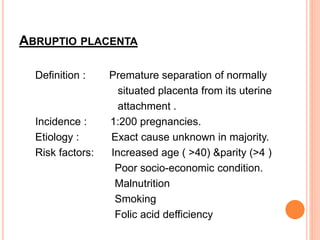
Definition : Premature separation of normally
situated placenta from its uterine
attachment .
Incidence : 1:200 pregnancies.
Etiology : Exact cause unknown in majority.
Risk factors: Increased age ( >40) &parity (>4 )
Poor socio-economic condition.
Malnutrition
Smoking
Folic acid defficiency
ABRUPTIO PLACENTA
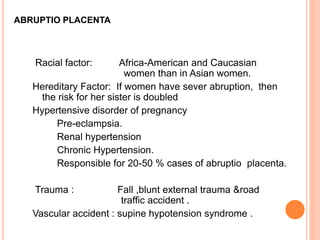
Racial factor: Africa-American and Caucasian
women than in Asian women.
Hereditary Factor: If women have sever abruption, then
the risk for her sister is doubled
Hypertensive disorder of pregnancy
Pre-eclampsia.
Renal hypertension
Chronic Hypertension.
Responsible for 20-50 % cases of abruptio placenta.
Trauma : Fall ,blunt external trauma &road
traffic accident .
Vascular accident : supine hypotension syndrome .
ABRUPTIO PLACENTA
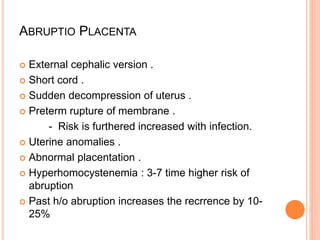
 External cephalic version .
 Short cord .
 Sudden decompression of uterus .
 Preterm rupture of membrane .
- Risk is furthered increased with infection.
 Uterine anomalies .
 Abnormal placentation .
 Hyperhomocystenemia : 3-7 time higher risk of
abruption
 Past h/o abruption increases the recrrence by 10-
25%
ABRUPTIO PLACENTA
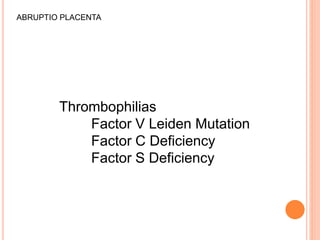
Thrombophilias
Factor V Leiden Mutation
Factor C Deficiency
Factor S Deficiency
ABRUPTIO PLACENTA
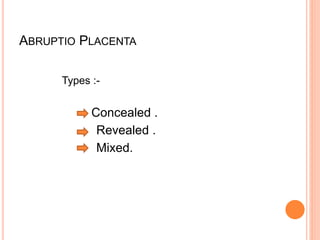
Types :-
Concealed .
Revealed .
Mixed.
ABRUPTIA PLACENTA
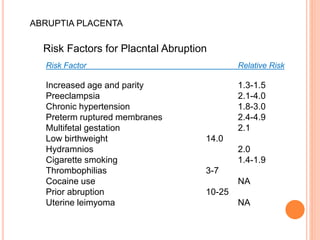
Risk Factors for Placntal Abruption
Risk Factor Relative Risk
Increased age and parity 1.3-1.5
Preeclampsia 2.1-4.0
Chronic hypertension 1.8-3.0
Preterm ruptured membranes 2.4-4.9
Multifetal gestation 2.1
Low birthweight 14.0
Hydramnios 2.0
Cigarette smoking 1.4-1.9
Thrombophilias 3-7
Cocaine use NA
Prior abruption 10-25
Uterine leimyoma NA
ABRUPTIO PLACENTA
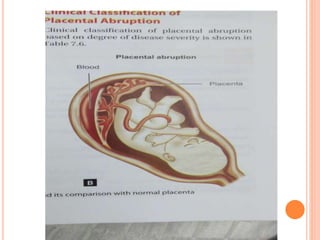
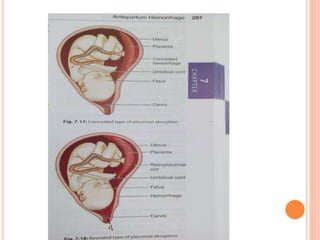
Concealed : Blood may accumulate behind the
placenta when it is totally separated
from uterine wall except at margin.
Rare &severe type, shock being out of
proportion to visible blood loss (20-35%) .
Revealed type :Blood may dissect downwards in b/n
membrane and uterine wall escape out
through cx. Most common &mild type,
general condition being proportionate to
bleeding (65-80%) .
Mixed type: It is a combination of revealed and
concealed type .It is quite common .
Usually one variety predominates over
other .
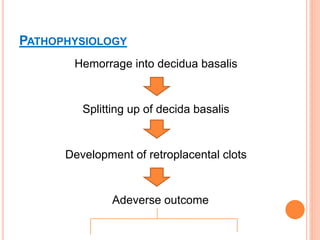
PATHOPHYSIOLOGY
Hemorrage into decidua basalis
Splitting up of decida basalis
Development of retroplacental clots
Adeverse outcome
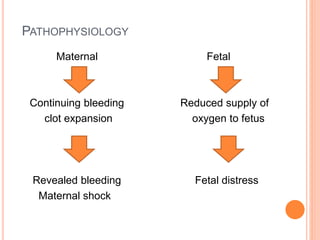
PATHOPHYSIOLOGY
Maternal Fetal
Continuing bleeding Reduced supply of
clot expansion oxygen to fetus
Revealed bleeding Fetal distress
Maternal shock
CLINICAL GRADING OF ABRUPTIO PLACENTAE
Grade 0 : Diagnosed on examination of placenta
after delivery .
Grade 1: External bleeding is slight .
Ut irritable tender .
Shock absent.
Fetal heart is good.
Grade 2 :External bleeding mild to moderate .
Ut tenderness is marked .
Shock absent .
Fetal distress or death
Associated coagulation defect or anuria.
CLINICAL GRADING OF ABRUPTIO PLACENTAE
Grade 3 : Maternal shock or coagulopathy with
fetal death.
ABRUPTIO PLACENTA
Clinical presentation :
Depends upon the degree of placental separation.
Speed at which separation occurs .
Clinical evidence of abruption may sometimes
appear 24 hrs or more after trauma.
Asymptomatic women giving H/o trauma or road
traffic accident must be observed atleast for 6 hrs
prior to discharge .
ABRUPTIO PLACENTA
CLINICAL PRESENTATION -
Pt giving h/o bleeding or uterine contractions
must be observed for at least 24 hrs.
Vaginal bleeding :most common symptom . dark red
vaginal bleeding with pain . Bleeding is maternal
origin .
Abdominal pain : Ac agonizing pain or some
discomfort. Some women may experience faintness,
collapse nausea ,thirst and reduced fetal movement .
CLENICAL PRESENTATION-
If placenta present post –severe
backache, abdominal palpation
worsen the pain.
There may be sign & symptom of
haemodynamic compromise .
ABRUPTIO PLACENTA
ABRUPTIO PLACENTA
 GPE
Sign of shock (tachycardia, low BP).
Sign and symptom of pre eclampsia( increase
BP, Proteinurea).
Often pt’ s clinical condition is
dispropotionate to amount of blood loss.
ABRUPTIO PLACENTA
Specific systemic examination .
Uterine hypertonicity & frequent uterine
contraction is common.
Difficulty in feeling the fetal part .
Uterus may be tense tender on palpation.
Wood hard due to persistant hypertonus .
Absent or slow FHR.
ABRUPTIO PLACENTA
Vaginal examination : Abruptio placenta
is not a contraindication for vaginal
examination .
Vagina examination should ideally not be
performed in pt with h/o APH .
In pt with abruptio placenta ,ARM result in
release of blood stained amniotic fluid .
Investigation
CHG, platelet count, leucocyte count and peripheral blood
smear.
Serum fibrinogen level, PT, PTT, Fibrin degradation product
levels ,bleeding time ,clotting time and D-dimer levels .
Serum electrolytes ,blood urea & liver function tests .
Investigation of PIH .
Arterial blood gas analysis .
Blood group &crossmatching .
ABRUPTIO PLACENTA
Utrasonography :
To rule out placenta previa .
To reveal the state of the fetus .
Retroplacental clot at previous placental site
(as seen on earlier usg) is helpful .
Jello sign : Placenta jiggle when pressure is
applied by trasducer.
Negative finding with ultrasound examination
do not exclude placental abruption .
ABRUPTIO PLACENTA
Ultrasonography
Ultrasonography has sensitivity of 24%
and specificity of 96% for diagnosing
abruptio placenta.
ABRUPTIO PLACENTA
Cardiotocographic examination :
Variable &late deceleration,
poor variability,
prolonged bradycardia and
sinusoidal pattern .
DIFFERENTIAL DIAGNOSIS
Revealed type :
Placenta previa
Concealed type :
Rupture uterus
Rectus sheath haemetoma
Appendicular or Intestinal perforation
Ac hydromnios
Tonic uterine contraction
Red degeneration of fibroid
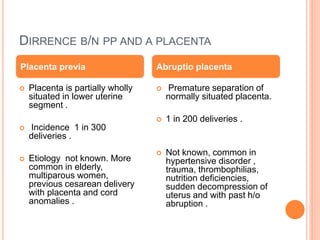
DIRRENCE B/N PP AND A PLACENTA
 Placenta is partially wholly
situated in lower uterine
segment .
 Incidence 1 in 300
deliveries .
 Etiology not known. More
common in elderly,
multiparous women,
previous cesarean delivery
with placenta and cord
anomalies .
 Premature separation of
normally situated placenta.
 1 in 200 deliveries .
 Not known, common in
hypertensive disorder ,
trauma, thrombophilias,
nutrition deficiencies,
sudden decompression of
uterus and with past h/o
abruption .
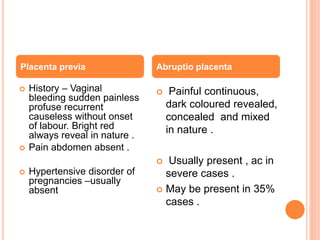
Placenta previa Abruptio placenta
 History – Vaginal
bleeding sudden painless
profuse recurrent
causeless without onset
of labour. Bright red
always reveal in nature .
 Pain abdomen absent .
 Hypertensive disorder of
pregnancies –usually
absent
 Painful continuous,
dark coloured revealed,
concealed and mixed
in nature .
 Usually present , ac in
severe cases .
 May be present in 35%
cases .
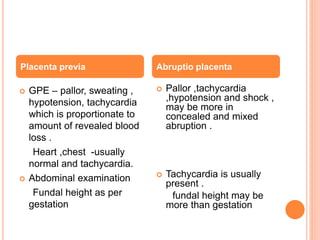
Placenta previa Abruptio placenta
 GPE – pallor, sweating ,
hypotension, tachycardia
which is proportionate to
amount of revealed blood
loss .
Heart ,chest -usually
normal and tachycardia.
 Abdominal examination
Fundal height as per
gestation
 Pallor ,tachycardia
,hypotension and shock ,
may be more in
concealed and mixed
abruption .
 Tachycardia is usually
present .
fundal height may be
more than gestation
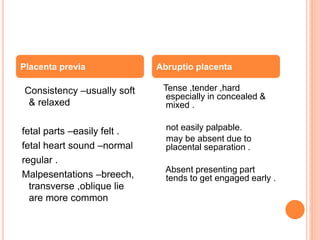
Placenta previa Abruptio placenta
Consistency –usually soft
& relaxed
fetal parts –easily felt .
fetal heart sound –normal
regular .
Malpesentations –breech,
transverse ,oblique lie
are more common
Tense ,tender ,hard
especially in concealed &
mixed .
not easily palpable.
may be absent due to
placental separation .
Absent presenting part
tends to get engaged early .
Placenta previa Abruptio placenta
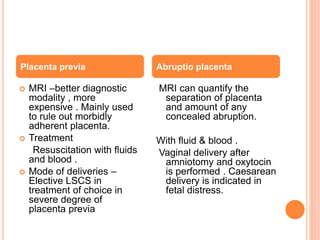
 MRI –better diagnostic
modality , more
expensive . Mainly used
to rule out morbidly
adherent placenta.
 Treatment
Resuscitation with fluids
and blood .
 Mode of deliveries –
Elective LSCS in
treatment of choice in
severe degree of
placenta previa
MRI can quantify the
separation of placenta
and amount of any
concealed abruption.
With fluid & blood .
Vaginal delivery after
amniotomy and oxytocin
is performed . Caesarean
delivery is indicated in
fetal distress.
Placenta previa Abruptio placenta
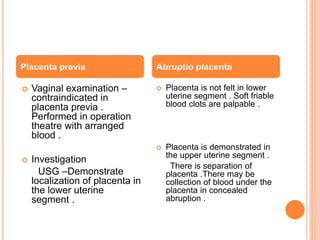
 Vaginal examination –
contraindicated in
placenta previa .
Performed in operation
theatre with arranged
blood .
 Investigation
USG –Demonstrate
localization of placenta in
the lower uterine
segment .
 Placenta is not felt in lower
uterine segment . Soft friable
blood clots are palpable .
 Placenta is demonstrated in
the upper uterine segment .
There is separation of
placenta .There may be
collection of blood under the
placenta in concealed
abruption .
Placenta previa Abruptio placenta
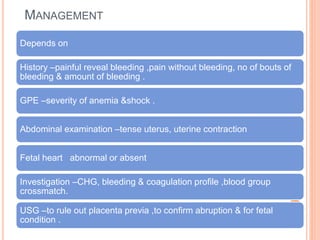
MANAGEMENT
Depends on
History –painful reveal bleeding ,pain without bleeding, no of bouts of
bleeding & amount of bleeding .
GPE –severity of anemia &shock .
Abdominal examination –tense uterus, uterine contraction
Fetal heart abnormal or absent
Investigation –CHG, bleeding & coagulation profile ,blood group
crossmatch.
USG –to rule out placenta previa ,to confirm abruption & for fetal
condition .
ABRIPTIO PLACENTA
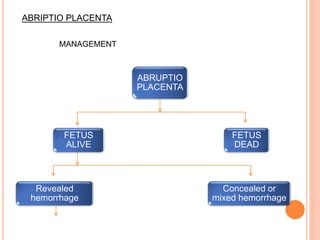
MANAGEMENT
ABRUPTIO
PLACENTA
FETUS
ALIVE
FETUS
DEAD
Revealed
hemorrhage
Concealed or
mixed hemorrhage
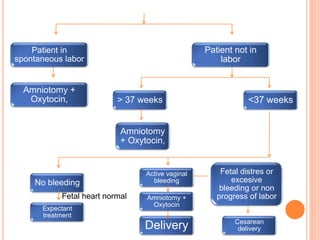
Patient in
spontaneous labor
Patient not in
labor
Amniotomy +
Oxytocin, <37 weeks
> 37 weeks
Amniotomy
+ Oxytocin,
Expectant
treatment
No bleeding
Fetal heart normal
Active vaginal
bleeding
Amniotomy +
Oxytocin
Delivery Cesarean
delivery
Fetal distres or
excesive
bleeding or non
progress of labor
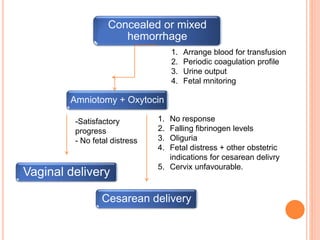
Concealed or mixed
hemorrhage
1. Arrange blood for transfusion
2. Periodic coagulation profile
3. Urine output
4. Fetal mnitoring
Amniotomy + Oxytocin
-Satisfactory
progress
- No fetal distress
1. No response
2. Falling fibrinogen levels
3. Oliguria
4. Fetal distress + other obstetric
indications for cesarean delivry
5. Cervix unfavourable.
Vaginal delivery
Cesarean delivery
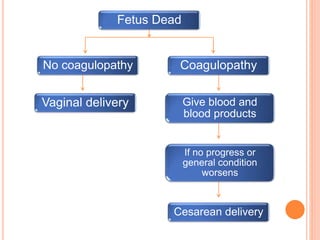
Fetus Dead
No coagulopathy Coagulopathy
Vaginal delivery Give blood and
blood products
If no progress or
general condition
worsens
Cesarean delivery
MANAGEMENT
Delivery in all patients >37 weeks
Patient in labor – ARM synto .
Pt not in labour
pregnancy >37 weeks
ARM Synto cont CTG monitoring
Pregnancy < 37 weeks
Bleeding moderate to severe and continue
ARM Synto . Labour usually start soon .
Cesarean delivery is often indicated .
ABRUPTIO PLACENTA
ABRUPTIO PLACENTA
Bleeding slight or has stoped :
conservative treatment
close observation of mother & careful fetal
monitoring by CTG .
betamethasone
blood sample for blood group cross match
blood transfusion
ABRUPTIO PLACENTA
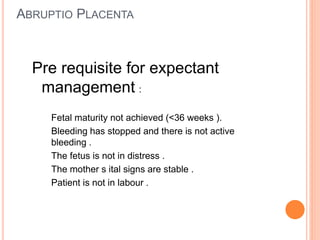
Pre requisite for expectant
management :
Fetal maturity not achieved (<36 weeks ).
Bleeding has stopped and there is not active
bleeding .
The fetus is not in distress .
The mother s ital signs are stable .
Patient is not in labour .
ABRUPTIO PLACENTA
Steps of expectant management:
Admission to hospital.
Bed rest .
Avoid sexual intercourse .
Blood group , cross matching , hematocrit and
coagulation profile .
USG for placental lacalisation .
Fetal monitoring with daily fetal movement count
,USG measurement of fetal growth and NST .
Once the active bleeding has stopped ,cervix
need to be inspected with a speculum .
MANAGEMENT
 Caesarean delivery
Indication –significant abruption where fetus is alive
sufficiently mature to alive .
Uncontrolled bleeding .
Fetal distress .
Failure to progress in labour .
Maternal condition unstable not responding to
resuscitative measures.
Evidence of DIC
ABRUPTIO PLACENTA
MANAGEMENT
Haemodynamic stability with normal blood pressure
,pulse rate &good urine output are sign of well
resuscitated patient .
Coagulation profile should be done as there
increase risk of coagulopathy
ABRUPTIO PLACENTA
MANAGEMENT
Bed site test ;
Bleeding time –normal 2-6 minutes .
prolonged in thrombocytopenia .
hypofibrinogenemia.
Whole blood clotting time- normal 5-10
minutes
affected mainly by defect in intrinsic pathway ,by
defect in fibrin & fibrinogen.
prolonged in impaired coagulation
ABRUPTIO PLACENTA
ABRUPTIO PLACENTA
Clot retraction – normal 30-60 minutes
prolonged in thrombocytopenia .
weak friable clot indicates hypofibrinogenamia .
early dissolution indicate enhanced fibrinolysis
COMPLICATION
Maternal : Hemorrhagic shock
Post partum hemorrhage
Disseminated intravascular coagulation
Oliguria & anuria
Puerperal sepsis
Sheehan syndrome
Recurrence
Death
ABRUPTIO PLACENTA
Fetal :
Perinatal death occurs in 25-30 % cases of
revealed ,50-100 % of concealed variety.
The causes of death are prematurity, asphyxia due
to placental abruption ,small for gestational age and
congenital anomalies( 2-5 times higher )
PREVENTION
Elimination of known risk factor for placental
abruotion .
Correction of anaemia
Routine administration of folic acid from early
pregnancy
Early diagnosis & treatment minimize serious
complication
Appropriate treatment of hypertensive disorder of
pregnancy
PREVENTION
Avoidance of physical trauma
To avoid sudden decompression of uterus
To avoid supine hypotension
ABRUPTIO PLACENTA

Aph, abruptio placenta

  • 1.
    ABRUPTIO PLACENTA Moderator :Dr Kushla Pathania Presented by :Dr Anil Kumar
  • 2.
    ABRUPTIO PLACENTA Definition :Premature separation of normally situated placenta from its uterine attachment . Incidence : 1:200 pregnancies. Etiology : Exact cause unknown in majority. Risk factors: Increased age ( >40) &parity (>4 ) Poor socio-economic condition. Malnutrition Smoking Folic acid defficiency
  • 3.
    ABRUPTIO PLACENTA Racial factor:Africa-American and Caucasian women than in Asian women. Hereditary Factor: If women have sever abruption, then the risk for her sister is doubled Hypertensive disorder of pregnancy Pre-eclampsia. Renal hypertension Chronic Hypertension. Responsible for 20-50 % cases of abruptio placenta. Trauma : Fall ,blunt external trauma &road traffic accident . Vascular accident : supine hypotension syndrome .
  • 4.
    ABRUPTIO PLACENTA  Externalcephalic version .  Short cord .  Sudden decompression of uterus .  Preterm rupture of membrane . - Risk is furthered increased with infection.  Uterine anomalies .  Abnormal placentation .  Hyperhomocystenemia : 3-7 time higher risk of abruption  Past h/o abruption increases the recrrence by 10- 25%
  • 5.
    ABRUPTIO PLACENTA Thrombophilias Factor VLeiden Mutation Factor C Deficiency Factor S Deficiency
  • 6.
  • 7.
    ABRUPTIA PLACENTA Risk Factorsfor Placntal Abruption Risk Factor Relative Risk Increased age and parity 1.3-1.5 Preeclampsia 2.1-4.0 Chronic hypertension 1.8-3.0 Preterm ruptured membranes 2.4-4.9 Multifetal gestation 2.1 Low birthweight 14.0 Hydramnios 2.0 Cigarette smoking 1.4-1.9 Thrombophilias 3-7 Cocaine use NA Prior abruption 10-25 Uterine leimyoma NA
  • 10.
    ABRUPTIO PLACENTA Concealed :Blood may accumulate behind the placenta when it is totally separated from uterine wall except at margin. Rare &severe type, shock being out of proportion to visible blood loss (20-35%) . Revealed type :Blood may dissect downwards in b/n membrane and uterine wall escape out through cx. Most common &mild type, general condition being proportionate to bleeding (65-80%) . Mixed type: It is a combination of revealed and concealed type .It is quite common . Usually one variety predominates over other .
  • 11.
    PATHOPHYSIOLOGY Hemorrage into deciduabasalis Splitting up of decida basalis Development of retroplacental clots Adeverse outcome
  • 12.
    PATHOPHYSIOLOGY Maternal Fetal Continuing bleedingReduced supply of clot expansion oxygen to fetus Revealed bleeding Fetal distress Maternal shock
  • 13.
    CLINICAL GRADING OFABRUPTIO PLACENTAE Grade 0 : Diagnosed on examination of placenta after delivery . Grade 1: External bleeding is slight . Ut irritable tender . Shock absent. Fetal heart is good. Grade 2 :External bleeding mild to moderate . Ut tenderness is marked . Shock absent . Fetal distress or death Associated coagulation defect or anuria.
  • 14.
    CLINICAL GRADING OFABRUPTIO PLACENTAE Grade 3 : Maternal shock or coagulopathy with fetal death.
  • 15.
    ABRUPTIO PLACENTA Clinical presentation: Depends upon the degree of placental separation. Speed at which separation occurs . Clinical evidence of abruption may sometimes appear 24 hrs or more after trauma. Asymptomatic women giving H/o trauma or road traffic accident must be observed atleast for 6 hrs prior to discharge .
  • 16.
    ABRUPTIO PLACENTA CLINICAL PRESENTATION- Pt giving h/o bleeding or uterine contractions must be observed for at least 24 hrs. Vaginal bleeding :most common symptom . dark red vaginal bleeding with pain . Bleeding is maternal origin . Abdominal pain : Ac agonizing pain or some discomfort. Some women may experience faintness, collapse nausea ,thirst and reduced fetal movement .
  • 17.
    CLENICAL PRESENTATION- If placentapresent post –severe backache, abdominal palpation worsen the pain. There may be sign & symptom of haemodynamic compromise . ABRUPTIO PLACENTA
  • 18.
    ABRUPTIO PLACENTA  GPE Signof shock (tachycardia, low BP). Sign and symptom of pre eclampsia( increase BP, Proteinurea). Often pt’ s clinical condition is dispropotionate to amount of blood loss.
  • 19.
    ABRUPTIO PLACENTA Specific systemicexamination . Uterine hypertonicity & frequent uterine contraction is common. Difficulty in feeling the fetal part . Uterus may be tense tender on palpation. Wood hard due to persistant hypertonus . Absent or slow FHR.
  • 20.
    ABRUPTIO PLACENTA Vaginal examination: Abruptio placenta is not a contraindication for vaginal examination . Vagina examination should ideally not be performed in pt with h/o APH . In pt with abruptio placenta ,ARM result in release of blood stained amniotic fluid .
  • 21.
    Investigation CHG, platelet count,leucocyte count and peripheral blood smear. Serum fibrinogen level, PT, PTT, Fibrin degradation product levels ,bleeding time ,clotting time and D-dimer levels . Serum electrolytes ,blood urea & liver function tests . Investigation of PIH . Arterial blood gas analysis . Blood group &crossmatching .
  • 22.
    ABRUPTIO PLACENTA Utrasonography : Torule out placenta previa . To reveal the state of the fetus . Retroplacental clot at previous placental site (as seen on earlier usg) is helpful . Jello sign : Placenta jiggle when pressure is applied by trasducer. Negative finding with ultrasound examination do not exclude placental abruption .
  • 23.
    ABRUPTIO PLACENTA Ultrasonography Ultrasonography hassensitivity of 24% and specificity of 96% for diagnosing abruptio placenta.
  • 24.
    ABRUPTIO PLACENTA Cardiotocographic examination: Variable &late deceleration, poor variability, prolonged bradycardia and sinusoidal pattern .
  • 25.
    DIFFERENTIAL DIAGNOSIS Revealed type: Placenta previa Concealed type : Rupture uterus Rectus sheath haemetoma Appendicular or Intestinal perforation Ac hydromnios Tonic uterine contraction Red degeneration of fibroid
  • 26.
    DIRRENCE B/N PPAND A PLACENTA  Placenta is partially wholly situated in lower uterine segment .  Incidence 1 in 300 deliveries .  Etiology not known. More common in elderly, multiparous women, previous cesarean delivery with placenta and cord anomalies .  Premature separation of normally situated placenta.  1 in 200 deliveries .  Not known, common in hypertensive disorder , trauma, thrombophilias, nutrition deficiencies, sudden decompression of uterus and with past h/o abruption . Placenta previa Abruptio placenta
  • 27.
     History –Vaginal bleeding sudden painless profuse recurrent causeless without onset of labour. Bright red always reveal in nature .  Pain abdomen absent .  Hypertensive disorder of pregnancies –usually absent  Painful continuous, dark coloured revealed, concealed and mixed in nature .  Usually present , ac in severe cases .  May be present in 35% cases . Placenta previa Abruptio placenta
  • 28.
     GPE –pallor, sweating , hypotension, tachycardia which is proportionate to amount of revealed blood loss . Heart ,chest -usually normal and tachycardia.  Abdominal examination Fundal height as per gestation  Pallor ,tachycardia ,hypotension and shock , may be more in concealed and mixed abruption .  Tachycardia is usually present . fundal height may be more than gestation Placenta previa Abruptio placenta
  • 29.
    Consistency –usually soft &relaxed fetal parts –easily felt . fetal heart sound –normal regular . Malpesentations –breech, transverse ,oblique lie are more common Tense ,tender ,hard especially in concealed & mixed . not easily palpable. may be absent due to placental separation . Absent presenting part tends to get engaged early . Placenta previa Abruptio placenta
  • 30.
     MRI –betterdiagnostic modality , more expensive . Mainly used to rule out morbidly adherent placenta.  Treatment Resuscitation with fluids and blood .  Mode of deliveries – Elective LSCS in treatment of choice in severe degree of placenta previa MRI can quantify the separation of placenta and amount of any concealed abruption. With fluid & blood . Vaginal delivery after amniotomy and oxytocin is performed . Caesarean delivery is indicated in fetal distress. Placenta previa Abruptio placenta
  • 31.
     Vaginal examination– contraindicated in placenta previa . Performed in operation theatre with arranged blood .  Investigation USG –Demonstrate localization of placenta in the lower uterine segment .  Placenta is not felt in lower uterine segment . Soft friable blood clots are palpable .  Placenta is demonstrated in the upper uterine segment . There is separation of placenta .There may be collection of blood under the placenta in concealed abruption . Placenta previa Abruptio placenta
  • 32.
    MANAGEMENT Depends on History –painfulreveal bleeding ,pain without bleeding, no of bouts of bleeding & amount of bleeding . GPE –severity of anemia &shock . Abdominal examination –tense uterus, uterine contraction Fetal heart abnormal or absent Investigation –CHG, bleeding & coagulation profile ,blood group crossmatch. USG –to rule out placenta previa ,to confirm abruption & for fetal condition .
  • 33.
  • 34.
    Patient in spontaneous labor Patientnot in labor Amniotomy + Oxytocin, <37 weeks > 37 weeks Amniotomy + Oxytocin, Expectant treatment No bleeding Fetal heart normal Active vaginal bleeding Amniotomy + Oxytocin Delivery Cesarean delivery Fetal distres or excesive bleeding or non progress of labor
  • 35.
    Concealed or mixed hemorrhage 1.Arrange blood for transfusion 2. Periodic coagulation profile 3. Urine output 4. Fetal mnitoring Amniotomy + Oxytocin -Satisfactory progress - No fetal distress 1. No response 2. Falling fibrinogen levels 3. Oliguria 4. Fetal distress + other obstetric indications for cesarean delivry 5. Cervix unfavourable. Vaginal delivery Cesarean delivery
  • 36.
    Fetus Dead No coagulopathyCoagulopathy Vaginal delivery Give blood and blood products If no progress or general condition worsens Cesarean delivery
  • 37.
    MANAGEMENT Delivery in allpatients >37 weeks Patient in labor – ARM synto . Pt not in labour pregnancy >37 weeks ARM Synto cont CTG monitoring Pregnancy < 37 weeks Bleeding moderate to severe and continue ARM Synto . Labour usually start soon . Cesarean delivery is often indicated . ABRUPTIO PLACENTA
  • 38.
    ABRUPTIO PLACENTA Bleeding slightor has stoped : conservative treatment close observation of mother & careful fetal monitoring by CTG . betamethasone blood sample for blood group cross match blood transfusion
  • 39.
    ABRUPTIO PLACENTA Pre requisitefor expectant management : Fetal maturity not achieved (<36 weeks ). Bleeding has stopped and there is not active bleeding . The fetus is not in distress . The mother s ital signs are stable . Patient is not in labour .
  • 40.
    ABRUPTIO PLACENTA Steps ofexpectant management: Admission to hospital. Bed rest . Avoid sexual intercourse . Blood group , cross matching , hematocrit and coagulation profile . USG for placental lacalisation . Fetal monitoring with daily fetal movement count ,USG measurement of fetal growth and NST . Once the active bleeding has stopped ,cervix need to be inspected with a speculum .
  • 41.
    MANAGEMENT  Caesarean delivery Indication–significant abruption where fetus is alive sufficiently mature to alive . Uncontrolled bleeding . Fetal distress . Failure to progress in labour . Maternal condition unstable not responding to resuscitative measures. Evidence of DIC ABRUPTIO PLACENTA
  • 42.
    MANAGEMENT Haemodynamic stability withnormal blood pressure ,pulse rate &good urine output are sign of well resuscitated patient . Coagulation profile should be done as there increase risk of coagulopathy ABRUPTIO PLACENTA
  • 43.
    MANAGEMENT Bed site test; Bleeding time –normal 2-6 minutes . prolonged in thrombocytopenia . hypofibrinogenemia. Whole blood clotting time- normal 5-10 minutes affected mainly by defect in intrinsic pathway ,by defect in fibrin & fibrinogen. prolonged in impaired coagulation ABRUPTIO PLACENTA
  • 44.
    ABRUPTIO PLACENTA Clot retraction– normal 30-60 minutes prolonged in thrombocytopenia . weak friable clot indicates hypofibrinogenamia . early dissolution indicate enhanced fibrinolysis
  • 45.
    COMPLICATION Maternal : Hemorrhagicshock Post partum hemorrhage Disseminated intravascular coagulation Oliguria & anuria Puerperal sepsis Sheehan syndrome Recurrence Death
  • 46.
    ABRUPTIO PLACENTA Fetal : Perinataldeath occurs in 25-30 % cases of revealed ,50-100 % of concealed variety. The causes of death are prematurity, asphyxia due to placental abruption ,small for gestational age and congenital anomalies( 2-5 times higher )
  • 47.
    PREVENTION Elimination of knownrisk factor for placental abruotion . Correction of anaemia Routine administration of folic acid from early pregnancy Early diagnosis & treatment minimize serious complication Appropriate treatment of hypertensive disorder of pregnancy
  • 48.
    PREVENTION Avoidance of physicaltrauma To avoid sudden decompression of uterus To avoid supine hypotension ABRUPTIO PLACENTA

Editor's Notes