Mobile Learning: Enhanced
Collaboration through Mobile
Devices in K-12 Science
Classrooms
Sylvia Suh-Ngounou
Idaho State University
WyTECC Conference
Rock Springs, April 26th
, 2014
Raise your hand if….
• Live with aor K-12 learner(s)?
• Teach or know someone who teaches science
classes?
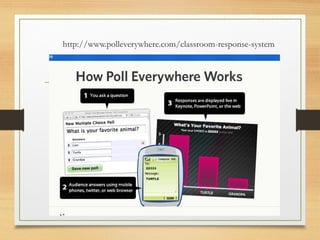
• If you own a mobile device? Have it with you
right now?
• Had more than 5 mobile gadgets (mobile
phones, laptops, iPads, iPods, ...) in your house
last night ?
• Have ever used a mobile device in teaching or
learning?
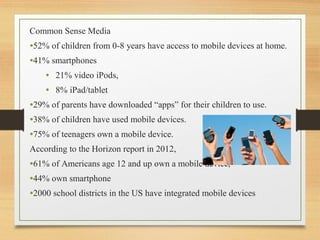
Common Sense Media
•52% of children from 0-8 years have access to mobile devices at home.
•41% smartphones
• 21% video iPods,
• 8% iPad/tablet
•29% of parents have downloaded “apps” for their children to use.
•38% of children have used mobile devices.
•75% of teenagers own a mobile device.
According to the Horizon report in 2012,
•61% of Americans age 12 and up own a mobile device,
•44% own smartphone
•2000 school districts in the US have integrated mobile devices
What is Mobile Learning?
Any sort of learning that happens when the learner is not at a
fixed predetermined location, or learning that happens when
the learner takes advantage of the learning opportunities
offered by mobile technologies.
O'Malley et al (2003)
Why do I want to take advantage of
mobile learning to teach science?
Possible reasons:
You like (=LOVE) technology.
You want to try out something new with your learners
You have seen your learners all have smart phones or
iPods/iTouches/ iPads already. Why not get them to use
these for learning?
A few of your learners have asked you to recommend
apps, games and other mobile-friendly content they can use
out of class.
You’ve read/heard about the benefits of informal learning.
Why Use a Mobile Device?
• It personalizes the learning process
• It enhances social interactions
• Independence
• Anytime and Anywhere learning,
• For easy communication (peers, teachers, other devices).
• Instant notification
• Learning takes place “at” and “around” the mobile device.
• Almost everyone has one
Why Enhance Collaboration?
When students work in groups toward a common academic
goal (Dooly, 2008).
• Attain higher level thinking
• Preserve information for longer times than students
working individually.
Why?
•Students are actively exchanging, debating and negotiating
ideas within their groups increases students’ interest in
learning.
•There is an age old proverb that says “two heads are better
than one”.
K-12 Science Teachers and MobileK-12 Science Teachers and Mobile
DevicesDevices
K-12 science teachers are finding out that mobile devices offer many
exciting options for their professional lives (Lucking, Christmann, &
Wighting, 2010).
1. Audience Response Systems
2. Camera: Stills/Videos
3. Voice Recorders: Podcasts, etc.
4. Applications
5. Research via the internet (Google, Wiki’s, blogs, discussion
boards etc.)
6. Alert Systems
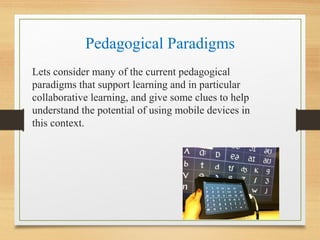
Pedagogical Paradigms
Lets consider many of the current pedagogical
paradigms that support learning and in particular
collaborative learning, and give some clues to help
understand the potential of using mobile devices in
this context.
Constructivism
Constructivist’s central idea is that human learning is
constructed rather than received, that learners build new
knowledge upon the foundation of previous learning
(Bruner,1996).
•Discover
•Build new knowledge
•Using appropriate tools
Mobile devices provide this unique opportunity.
Considering a Collaborative
Science Project?
 Have students use their Smartphones/iPad/tablets
to access discussion boards and wikis to elaborate
the activity being performed.
 Exchange of ideas
 Justify and refine own contributions
 Acquire new knowledge
 iPads for simulations where the learners play an
active role in the simulation of a dynamic system
or process.
 Apps
Behaviorism
Within the behaviorism paradigm, learning is thought to be
best facilitated through the reinforcement of an association
between a particular stimulus and a response (Caballé,
Xhafa,& Barolli, 2010).
• Use it to reward or punish student behaviors
• Stimulate students with the presentation of engaging
teaching materials and tasks, obtaining responses from
learners, and providing appropriate feedback
(reinforcement)
Considering a Collaborative
Science Project?
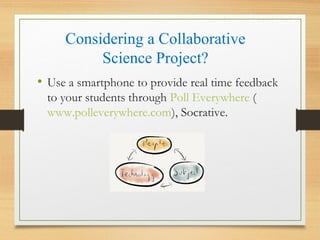
• Use a smartphone to provide real time feedback
to your students through Poll Everywhere (
www.polleverywhere.com), Socrative.
Situated Learning
Learning takes place through the relationships
between people and connecting prior knowledge
with authentic, informal, and often unintended
related learning.
•It encourages cognitive apprenticeship where
teachers (the experts) work alongside students (the
apprentices) to create situations where the students
can begin to work on problems even before they
fully understand them.
Considering a Collaborative
Science Project?
• Use a smartphone/tablet/iPad to take observational
notes, pictures, compare data about animals and plants,
etc.
• Use an iPod to support field-based activities, like:
Listening to pre-loaded instructions, observational
notes, reflections, in a podcast.
Explanation of key concepts/ terminologies,
background information about the subject,
questions students should be thinking about before
the class, etc.
Social-cultural Learning
The sociocultural theory of learning views
that learning takes place in a social context
(Rogers, 2002).
•collaborative group work and sharing with
peers (and others).
The mobile environment can make a
significant contribution to this process.
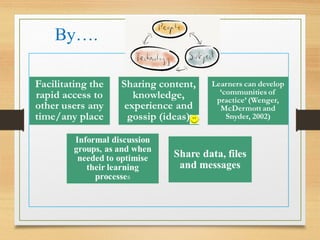
By….
Effective Mobile Collaborative
Strategies in the Science Classroom
• Establish a group goal
• Establish flexible group rules
• Manageable amount of data
• Use real world problems
• Use a collaboration script with assigned tasks, roles, and groups
• problem solving and critical thinking skills
• Incorporate free savvy tools (Socrative, Voicethread, Zoho,
google docs, Zotero etc)
http://www.missiontolearn.com/2009/08/free-online-collaboration/
• Have a back up plan
Science should be taught in whatever way is most likely to
engage the active involvement of learners and make them feel
willing to take on the serious intellectual work of
reconstructing meaning.
(Millar et al., 2001, p 289)
Ideally science instruction will ensure that students learn
complex science in the context of inquiry and have an
experience of mastering new topics or technologies relevant
to their personal needs or goals
(Linn, 2004, p 9)
Contact Information
Sylvia Suh-Ngounou
Student Advising Center
College of Education
Idaho State University
Phone: 208 282 5887
Fax: 208 282 3791
References
Caballé, S., Xhafa, F., & Barolli, L. (2010). Using mobile devices to
support online collaborative learning. Mobile Information Systems,
6(1), 27-47.
Common Sense Media, retrieved March 24th, 2014 from
http://www.commonsensemedia.org/
Lucking, B., Christmann, E., & Wighting, M. (2010). Hang up and
learn: Cell phones in the science classroom. Science Scope, 33(9), 82-
85.
Scanlon,E., Jones, A. & Waycott, J. (2005). Mobile technologies:
prospects for their use in learning in informal science settings.
Traxler, J. (2009). The evolution of mobile learning. The evolution of
mobile teaching and learning, 1-14.
http://www.polleverywhere.com/classroom-response-system
New wy tecc

New wy tecc

  • 1.
    Mobile Learning: Enhanced Collaborationthrough Mobile Devices in K-12 Science Classrooms Sylvia Suh-Ngounou Idaho State University WyTECC Conference Rock Springs, April 26th , 2014
  • 2.
    Raise your handif…. • Live with aor K-12 learner(s)? • Teach or know someone who teaches science classes? • If you own a mobile device? Have it with you right now? • Had more than 5 mobile gadgets (mobile phones, laptops, iPads, iPods, ...) in your house last night ? • Have ever used a mobile device in teaching or learning?
  • 3.
    Common Sense Media •52%of children from 0-8 years have access to mobile devices at home. •41% smartphones • 21% video iPods, • 8% iPad/tablet •29% of parents have downloaded “apps” for their children to use. •38% of children have used mobile devices. •75% of teenagers own a mobile device. According to the Horizon report in 2012, •61% of Americans age 12 and up own a mobile device, •44% own smartphone •2000 school districts in the US have integrated mobile devices
  • 4.
    What is MobileLearning? Any sort of learning that happens when the learner is not at a fixed predetermined location, or learning that happens when the learner takes advantage of the learning opportunities offered by mobile technologies. O'Malley et al (2003)
  • 5.
    Why do Iwant to take advantage of mobile learning to teach science? Possible reasons: You like (=LOVE) technology. You want to try out something new with your learners You have seen your learners all have smart phones or iPods/iTouches/ iPads already. Why not get them to use these for learning? A few of your learners have asked you to recommend apps, games and other mobile-friendly content they can use out of class. You’ve read/heard about the benefits of informal learning.
  • 6.
    Why Use aMobile Device? • It personalizes the learning process • It enhances social interactions • Independence • Anytime and Anywhere learning, • For easy communication (peers, teachers, other devices). • Instant notification • Learning takes place “at” and “around” the mobile device. • Almost everyone has one
  • 7.
    Why Enhance Collaboration? Whenstudents work in groups toward a common academic goal (Dooly, 2008). • Attain higher level thinking • Preserve information for longer times than students working individually. Why? •Students are actively exchanging, debating and negotiating ideas within their groups increases students’ interest in learning. •There is an age old proverb that says “two heads are better than one”.
  • 8.
    K-12 Science Teachersand MobileK-12 Science Teachers and Mobile DevicesDevices K-12 science teachers are finding out that mobile devices offer many exciting options for their professional lives (Lucking, Christmann, & Wighting, 2010). 1. Audience Response Systems 2. Camera: Stills/Videos 3. Voice Recorders: Podcasts, etc. 4. Applications 5. Research via the internet (Google, Wiki’s, blogs, discussion boards etc.) 6. Alert Systems
  • 9.
    Pedagogical Paradigms Lets considermany of the current pedagogical paradigms that support learning and in particular collaborative learning, and give some clues to help understand the potential of using mobile devices in this context.
  • 10.
    Constructivism Constructivist’s central ideais that human learning is constructed rather than received, that learners build new knowledge upon the foundation of previous learning (Bruner,1996). •Discover •Build new knowledge •Using appropriate tools Mobile devices provide this unique opportunity.
  • 11.
    Considering a Collaborative ScienceProject?  Have students use their Smartphones/iPad/tablets to access discussion boards and wikis to elaborate the activity being performed.  Exchange of ideas  Justify and refine own contributions  Acquire new knowledge  iPads for simulations where the learners play an active role in the simulation of a dynamic system or process.  Apps
  • 12.
    Behaviorism Within the behaviorismparadigm, learning is thought to be best facilitated through the reinforcement of an association between a particular stimulus and a response (Caballé, Xhafa,& Barolli, 2010). • Use it to reward or punish student behaviors • Stimulate students with the presentation of engaging teaching materials and tasks, obtaining responses from learners, and providing appropriate feedback (reinforcement)
  • 13.
    Considering a Collaborative ScienceProject? • Use a smartphone to provide real time feedback to your students through Poll Everywhere ( www.polleverywhere.com), Socrative.
  • 14.
    Situated Learning Learning takesplace through the relationships between people and connecting prior knowledge with authentic, informal, and often unintended related learning. •It encourages cognitive apprenticeship where teachers (the experts) work alongside students (the apprentices) to create situations where the students can begin to work on problems even before they fully understand them.
  • 15.
    Considering a Collaborative ScienceProject? • Use a smartphone/tablet/iPad to take observational notes, pictures, compare data about animals and plants, etc. • Use an iPod to support field-based activities, like: Listening to pre-loaded instructions, observational notes, reflections, in a podcast. Explanation of key concepts/ terminologies, background information about the subject, questions students should be thinking about before the class, etc.
  • 16.
    Social-cultural Learning The socioculturaltheory of learning views that learning takes place in a social context (Rogers, 2002). •collaborative group work and sharing with peers (and others). The mobile environment can make a significant contribution to this process.
  • 17.
  • 18.
    Effective Mobile Collaborative Strategiesin the Science Classroom • Establish a group goal • Establish flexible group rules • Manageable amount of data • Use real world problems • Use a collaboration script with assigned tasks, roles, and groups • problem solving and critical thinking skills • Incorporate free savvy tools (Socrative, Voicethread, Zoho, google docs, Zotero etc) http://www.missiontolearn.com/2009/08/free-online-collaboration/ • Have a back up plan
  • 19.
    Science should betaught in whatever way is most likely to engage the active involvement of learners and make them feel willing to take on the serious intellectual work of reconstructing meaning. (Millar et al., 2001, p 289) Ideally science instruction will ensure that students learn complex science in the context of inquiry and have an experience of mastering new topics or technologies relevant to their personal needs or goals (Linn, 2004, p 9)
  • 20.
    Contact Information Sylvia Suh-Ngounou StudentAdvising Center College of Education Idaho State University Phone: 208 282 5887 Fax: 208 282 3791
  • 21.
    References Caballé, S., Xhafa,F., & Barolli, L. (2010). Using mobile devices to support online collaborative learning. Mobile Information Systems, 6(1), 27-47. Common Sense Media, retrieved March 24th, 2014 from http://www.commonsensemedia.org/ Lucking, B., Christmann, E., & Wighting, M. (2010). Hang up and learn: Cell phones in the science classroom. Science Scope, 33(9), 82- 85. Scanlon,E., Jones, A. & Waycott, J. (2005). Mobile technologies: prospects for their use in learning in informal science settings. Traxler, J. (2009). The evolution of mobile learning. The evolution of mobile teaching and learning, 1-14.
  • 22.

Editor's Notes

  • #2 Wyoming Technology-Engagement-Curriculum Connection  
  • #5 (a) technocentric –mobile learning is primarily seen as learning supported by mobile devices, and the focus is on the technology; (b) mobile learning is seen as an extension or a subset of e-learning , and mobile learning research is primarily part of e-learning research ; (c) mobile devices are used just to complement and augment formal education ; and (d) mobile learning is student -centered and it is about mobility and context .
  • #8 Demonstrate ability to work effectively and respectfully with diverse teams. Exercise flexibility and willingness to be helpful in making necessary compromises to accomplish a common goal. Assume shared responsibility for collaborative work, and value the individual contributions made by each team member
  • #13 Focus is on observatble behavior
  • #15 Situated learning essentially is a matter of creating meaning from the real activities of daily living. Gordin, and Pea (1999) stated that inquiry experiences can provide valuable opportunities for students to improve their understanding of both science content and scientific practices.
  • #18 . A community of practice is, according to cognitive anthropologists Jean Lave and Etienne Wenger, a group of people who share a craft and/or a profession. .
  • #19 Gordin, and Pea (1999) stated that inquiry experiences can provide valuable opportunities for students to improve their understanding of both science content and scientific practices.