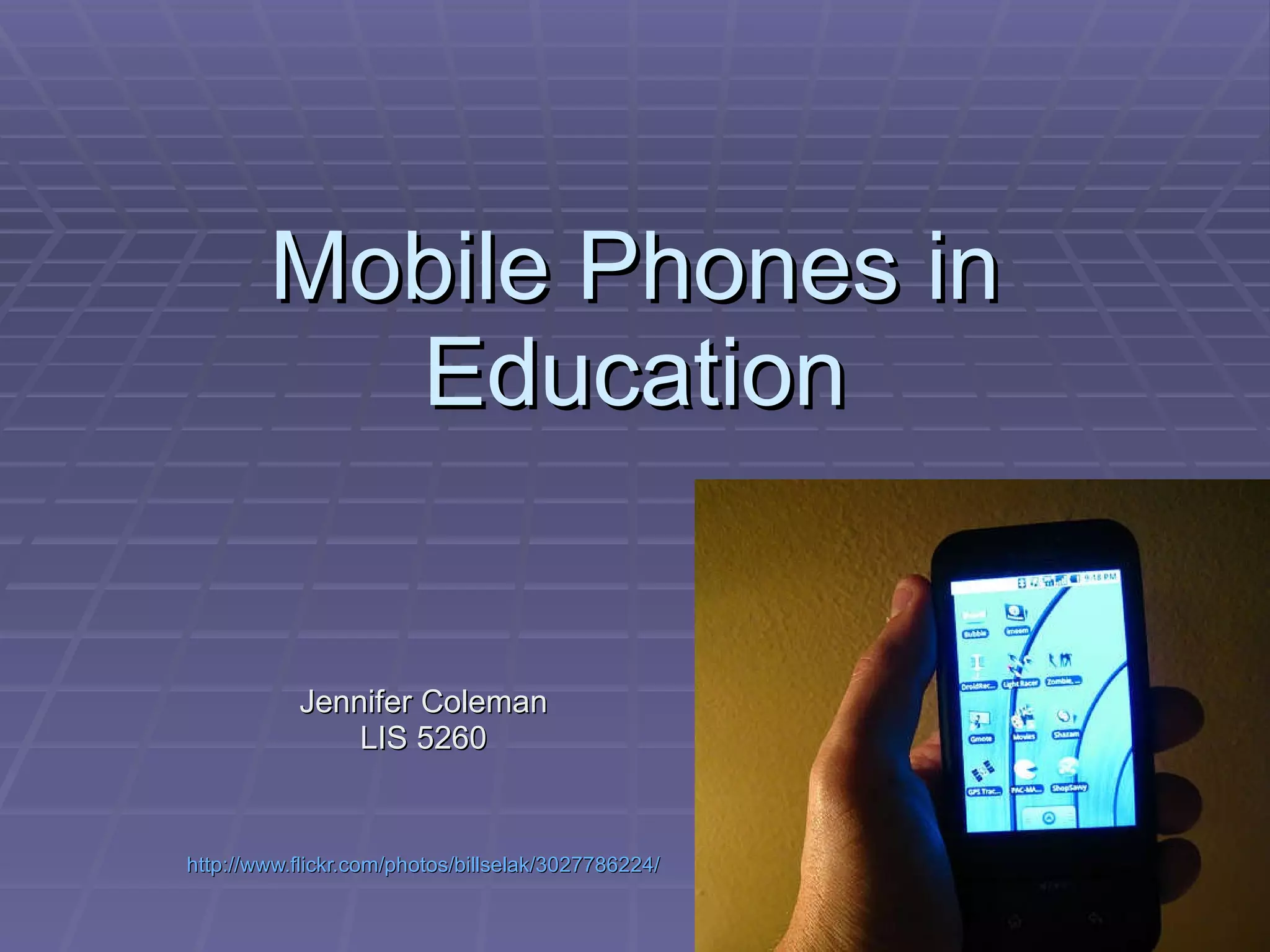
Mobile Phones in Education Jennifer Coleman LIS 5260 http://www.flickr.com/photos/billselak/3027786224/
Using your mobile phone, please find the following….. 1.  the general form of a quadratic equation 2.  the chemical properties of chlorine 3.  an image of the Battle of the Bulge 4.  a map of Missouri’s congressional districts 5.  the sheet music for Mozart’s Clarinet Concerto
The Data For every baby born,  30  Android phones are activated.   (Google CEO Eric Schmidt – 2011 Mobile World Congress) Internet-capable mobile devices will outnumber PCs by the year  2013 .   (Gartner Research) http://www.flickr.com/photos/yum9me/2943167751/sizes/m/in/photostream/ http://www.flickr.com/photos/marklincoln/5255361533/sizes/m/in/photostream/
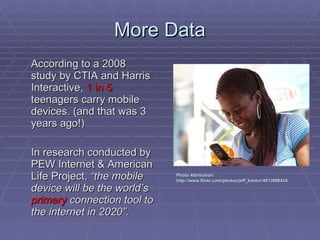
More Data According to a 2008 study by CTIA and Harris Interactive,  1 in 5  teenagers carry mobile devices. (and that was 3 years ago!) In research conducted by PEW Internet & American Life Project,  “the mobile device will be the world’s  primary  connection tool to the internet in 2020”. Photo Attribution: http://www.flickr.com/photos/jeff_kontur/4013998424/
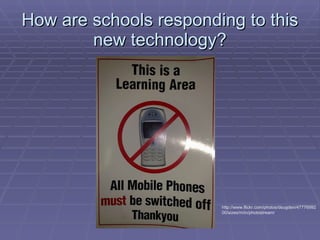
How are schools responding to this new technology? http://www.flickr.com/photos/dsugden/4777699200/sizes/m/in/photostream/
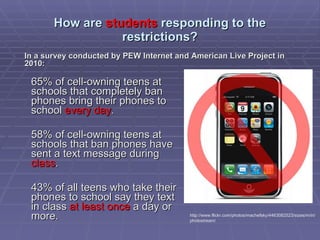
How are  students  responding to the restrictions? 65% of cell-owning teens at schools that completely ban phones bring their phones to school  every day .  58% of cell-owning teens at schools that ban phones have sent a text message during  class .  43% of all teens who take their phones to school say they text in class  at least once  a day or more.  http://www.flickr.com/photos/machefsky/4463082523/sizes/m/in/photostream/ In a survey conducted by PEW Internet and American Live Project in 2010:
Do cell phones have a place in education? What have you or someone you know done to incorporate cell phones into the classroom or library setting? http://www.flickr.com/photos/denverjeffrey/304220561/sizes/m/in/photostream/
How can we work together across the curriculum to incorporate this technology into our school so that we can help prepare our students for their future? Image Attribution:  http:// sghsweb.wikispaces.com /
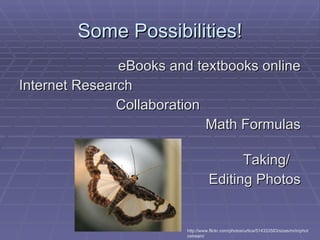
Some Possibilities! eBooks and textbooks online Internet Research Collaboration  Math Formulas Taking/ Editing Photos http://www.flickr.com/photos/urtica/514333583/sizes/m/in/photostream/
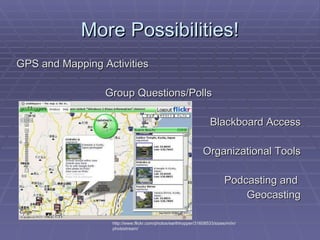
More Possibilities! GPS and Mapping Activities Group Questions/Polls Blackboard Access Organizational Tools Podcasting and  Geocasting http://www.flickr.com/photos/earthhopper/31608533/sizes/m/in/photostream/
Twitter Discussions Dr. Monica Rankin, History Professor at UT Dallas, started the “Twitter Experiment” with her students to encourage more discussion and participation. “ Overall, I think the twitter experiment was successful primarily because it encouraged students to engage who otherwise would not.”   Dr. Rankin http://farm4.static.flickr.com/3566/3460113739_9177b7370d.jpg
Using their phones, students can watch videos like these that support the learning environment… You Tube Video Uploaded by  xplanevisualthinking  on  Sep 14, 2009   If video does not play, follow this link:  http://youtu.be/6ILQrUrEWe8
Some Helpful Applications MathFormulary  - This application contains most of the math formulas that students would use in high school or college.  Algeo  - A graphing calculator application for the smart phone.  gFlash  - This application can help students create flash cards for studying on their phone.  Stanza  - This application is at the top of the free ebook applications list.  Star Walk  –  helps students identify constellations Sight Read Music Quiz 4 Piano  – helps students practice reading music
More Helpful Applications iStudiezPro  – Helps students stay organized.  Evernote  - take notes, photos, create voice recordings and more with this app.  Gabcast  - This easy to use podcasting tool would be great for student projects.  World Lens  – Language translator using the phone’s camera. Molecules  – lets students view and manipulate 3D images. eClicker  – teachers can get instant feedback from students! Twitter  – for class discussions.
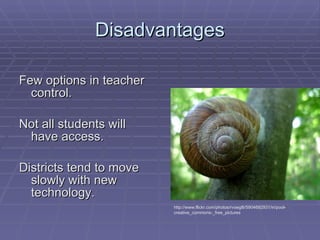
Disadvantages Few options in teacher control. Not all students will have access. Districts tend to move slowly with new technology. http://www.flickr.com/photos/rvoegtli/5904692931/in/pool-creative_commons-_free_pictures
Advantages Mobile devices are less expensive than laptop or desktop computers. Helping students to prepare for future technology. Mobile devices are easier to support than laptop or desktop computers. Student engagement level has the potential to be very high. http://www.flickr.com/photos/17084757@N00/106512202/sizes/m/in/photostream/
Resources Pew Internet and American Life Project  http://pewresearch.org/pubs/1572/teens-cell-phones-text-messages http://www.marketingcharts.com/interactive/cell-phones-key-to-teens-social-lives-47-can-text-with-eyes-closed-6126/ www.pewinternet.org Johnson, L., Adams, S., and Haywood, K., (2011).  The NMC Horizon Report: 2011 K-12 Edition . Austin, Texas: The New Media Consortium. Rankin, Monica.  Some general comments on the “Twitter Experiment” .  http ://www.utdallas.edu/~mar046000/usweb/twitterconclusions.htm You Tube Video: http://www.youtube.com/watch?v=6ILQrUrEWe8 Zwang, Jenna. &quot;10 of the best apps for education | Mobile and Handheld Technologies | eSchoolNews.com.&quot;  eSchool News, School Technology News and Resources for Today's K-12 and Higher-Ed Educators . N.p., n.d. Web. 10 July 2011. <http://www.eschoolnews.com/2011/01/07/10-of-the-best-apps-for-education/?>.

Mobile Phones in Education

  • 1.
    Mobile Phones inEducation Jennifer Coleman LIS 5260 http://www.flickr.com/photos/billselak/3027786224/
  • 2.
    Using your mobilephone, please find the following….. 1. the general form of a quadratic equation 2. the chemical properties of chlorine 3. an image of the Battle of the Bulge 4. a map of Missouri’s congressional districts 5. the sheet music for Mozart’s Clarinet Concerto
  • 3.
    The Data Forevery baby born, 30 Android phones are activated. (Google CEO Eric Schmidt – 2011 Mobile World Congress) Internet-capable mobile devices will outnumber PCs by the year 2013 . (Gartner Research) http://www.flickr.com/photos/yum9me/2943167751/sizes/m/in/photostream/ http://www.flickr.com/photos/marklincoln/5255361533/sizes/m/in/photostream/
  • 4.
    More Data Accordingto a 2008 study by CTIA and Harris Interactive, 1 in 5 teenagers carry mobile devices. (and that was 3 years ago!) In research conducted by PEW Internet & American Life Project, “the mobile device will be the world’s primary connection tool to the internet in 2020”. Photo Attribution: http://www.flickr.com/photos/jeff_kontur/4013998424/
  • 5.
    How are schoolsresponding to this new technology? http://www.flickr.com/photos/dsugden/4777699200/sizes/m/in/photostream/
  • 6.
    How are students responding to the restrictions? 65% of cell-owning teens at schools that completely ban phones bring their phones to school every day . 58% of cell-owning teens at schools that ban phones have sent a text message during class . 43% of all teens who take their phones to school say they text in class at least once a day or more. http://www.flickr.com/photos/machefsky/4463082523/sizes/m/in/photostream/ In a survey conducted by PEW Internet and American Live Project in 2010:
  • 7.
    Do cell phoneshave a place in education? What have you or someone you know done to incorporate cell phones into the classroom or library setting? http://www.flickr.com/photos/denverjeffrey/304220561/sizes/m/in/photostream/
  • 8.
    How can wework together across the curriculum to incorporate this technology into our school so that we can help prepare our students for their future? Image Attribution: http:// sghsweb.wikispaces.com /
  • 9.
    Some Possibilities! eBooksand textbooks online Internet Research Collaboration Math Formulas Taking/ Editing Photos http://www.flickr.com/photos/urtica/514333583/sizes/m/in/photostream/
  • 10.
    More Possibilities! GPSand Mapping Activities Group Questions/Polls Blackboard Access Organizational Tools Podcasting and Geocasting http://www.flickr.com/photos/earthhopper/31608533/sizes/m/in/photostream/
  • 11.
    Twitter Discussions Dr.Monica Rankin, History Professor at UT Dallas, started the “Twitter Experiment” with her students to encourage more discussion and participation. “ Overall, I think the twitter experiment was successful primarily because it encouraged students to engage who otherwise would not.” Dr. Rankin http://farm4.static.flickr.com/3566/3460113739_9177b7370d.jpg
  • 12.
    Using their phones,students can watch videos like these that support the learning environment… You Tube Video Uploaded by xplanevisualthinking on Sep 14, 2009 If video does not play, follow this link: http://youtu.be/6ILQrUrEWe8
  • 13.
    Some Helpful ApplicationsMathFormulary - This application contains most of the math formulas that students would use in high school or college. Algeo - A graphing calculator application for the smart phone. gFlash - This application can help students create flash cards for studying on their phone. Stanza - This application is at the top of the free ebook applications list. Star Walk – helps students identify constellations Sight Read Music Quiz 4 Piano – helps students practice reading music
  • 14.
    More Helpful ApplicationsiStudiezPro – Helps students stay organized. Evernote - take notes, photos, create voice recordings and more with this app. Gabcast - This easy to use podcasting tool would be great for student projects. World Lens – Language translator using the phone’s camera. Molecules – lets students view and manipulate 3D images. eClicker – teachers can get instant feedback from students! Twitter – for class discussions.
  • 15.
    Disadvantages Few optionsin teacher control. Not all students will have access. Districts tend to move slowly with new technology. http://www.flickr.com/photos/rvoegtli/5904692931/in/pool-creative_commons-_free_pictures
  • 16.
    Advantages Mobile devicesare less expensive than laptop or desktop computers. Helping students to prepare for future technology. Mobile devices are easier to support than laptop or desktop computers. Student engagement level has the potential to be very high. http://www.flickr.com/photos/17084757@N00/106512202/sizes/m/in/photostream/
  • 17.
    Resources Pew Internetand American Life Project http://pewresearch.org/pubs/1572/teens-cell-phones-text-messages http://www.marketingcharts.com/interactive/cell-phones-key-to-teens-social-lives-47-can-text-with-eyes-closed-6126/ www.pewinternet.org Johnson, L., Adams, S., and Haywood, K., (2011). The NMC Horizon Report: 2011 K-12 Edition . Austin, Texas: The New Media Consortium. Rankin, Monica. Some general comments on the “Twitter Experiment” . http ://www.utdallas.edu/~mar046000/usweb/twitterconclusions.htm You Tube Video: http://www.youtube.com/watch?v=6ILQrUrEWe8 Zwang, Jenna. &quot;10 of the best apps for education | Mobile and Handheld Technologies | eSchoolNews.com.&quot; eSchool News, School Technology News and Resources for Today's K-12 and Higher-Ed Educators . N.p., n.d. Web. 10 July 2011. <http://www.eschoolnews.com/2011/01/07/10-of-the-best-apps-for-education/?>.