
Vikas Ashwani Markanda
Auckland University of Technology
Presented by:
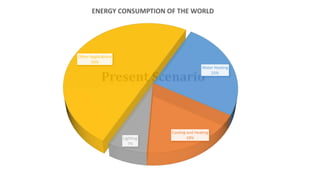
Water Heating
25%
Cooling and Heating
18%Lighting
7%
Other Applications
50%
ENERGY CONSUMPTION OF THE WORLD
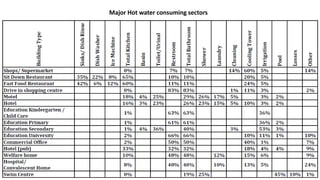
Major Hot water consuming sectors
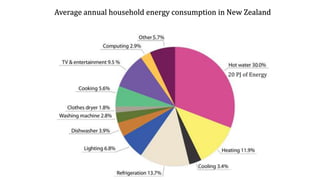
Average annual household energy consumption in New Zealand
20 PJ of Energy
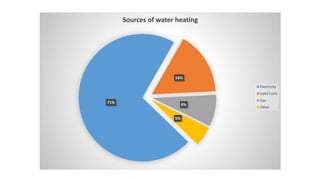
71%
16%
8%
5%
Sources of water heating
Electricity
Solid Fuels
Gas
Other
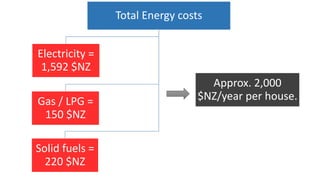
Total Energy costs
Electricity =
1,592 $NZ
Gas / LPG =
150 $NZ
Solid fuels =
220 $NZ
Approx. 2,000
$NZ/year per house.
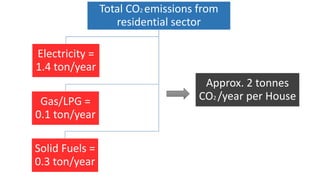
Total CO2 emissions from
residential sector
Electricity =
1.4 ton/year
Gas/LPG =
0.1 ton/year
Solid Fuels =
0.3 ton/year
Approx. 2 tonnes
CO2 /year per House
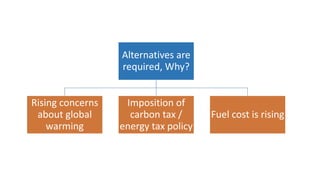
Alternatives are
required, Why?
Rising concerns
about global
warming
Imposition of
carbon tax /
energy tax policy
Fuel cost is rising
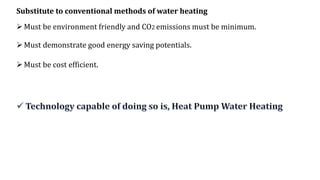
Substitute to conventional methods of water heating
Must be environment friendly and CO2 emissions must be minimum.
Must demonstrate good energy saving potentials.
Must be cost efficient.
What is a Heat Pump Water Heater ?
o Heat pump water heater is a device used to supply hot water for
commercial and residential use.
o Heat pumps use the same technology to heat water as is used to heat
rooms.
o Heat pump systems use electrical energy to ‘move' the heat - they don't
actually ‘make' heat. This makes heat pump systems much more efficient
than traditional electric or gas water heaters.
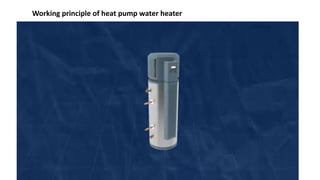
Working principle of heat pump water heater
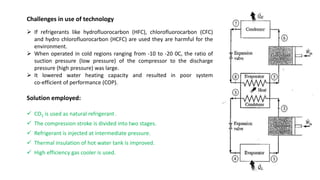
Challenges in use of technology
 If refrigerants like hydrofluorocarbon (HFC), chlorofluorocarbon (CFC)
and hydro chlorofluorocarbon (HCFC) are used they are harmful for the
environment.
 When operated in cold regions ranging from ‐10 to ‐20 0C, the ratio of
suction pressure (low pressure) of the compressor to the discharge
pressure (high pressure) was large.
 It lowered water heating capacity and resulted in poor system
co‐efficient of performance (COP).
Solution employed:
 The compression stroke is divided into two stages.
 Refrigerant is injected at intermediate pressure.
 Thermal insulation of hot water tank is improved.
 High efficiency gas cooler is used.
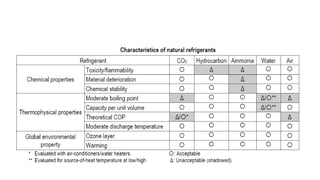
 CO2 is used as natural refrigerant .
 A favourable system with improved COP when serviced in
extreme cold conditions.
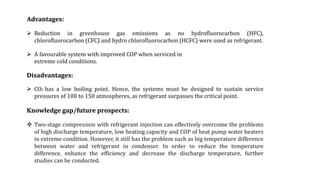
Advantages:
 Reduction in greenhouse gas emissions as no hydrofluorocarbon (HFC),
chlorofluorocarbon (CFC) and hydro chlorofluorocarbon (HCFC) were used as refrigerant.
 CO2 has a low boiling point. Hence, the systems must be designed to sustain service
pressures of 100 to 150 atmospheres, as refrigerant surpasses the critical point.
Disadvantages:
Knowledge gap/future prospects:
 Two‐stage compression with refrigerant injection can effectively overcome the problems
of high discharge temperature, low heating capacity and COP of heat pump water heaters
in extreme condition. However, it still has the problem such as big temperature difference
between water and refrigerant in condenser. In order to reduce the temperature
difference, enhance the efficiency and decrease the discharge temperature, further
studies can be conducted.
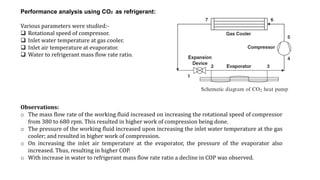
Performance analysis using CO2 as refrigerant:
Various parameters were studied:‐
 Rotational speed of compressor.
 Inlet water temperature at gas cooler.
 Inlet air temperature at evaporator.
 Water to refrigerant mass flow rate ratio.
Observations:
o The mass flow rate of the working fluid increased on increasing the rotational speed of compressor
from 380 to 680 rpm. This resulted in higher work of compression being done.
o The pressure of the working fluid increased upon increasing the inlet water temperature at the gas
cooler; and resulted in higher work of compression.
o On increasing the inlet air temperature at the evaporator, the pressure of the evaporator also
increased. Thus, resulting in higher COP.
o With increase in water to refrigerant mass flow rate ratio a decline in COP was observed.
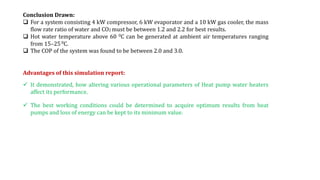
Conclusion Drawn:
 For a system consisting 4 kW compressor, 6 kW evaporator and a 10 kW gas cooler, the mass
flow rate ratio of water and CO2 must be between 1.2 and 2.2 for best results.
 Hot water temperature above 60 0C can be generated at ambient air temperatures ranging
from 15–25 0C.
 The COP of the system was found to be between 2.0 and 3.0.
Advantages of this simulation report:
 It demonstrated, how altering various operational parameters of Heat pump water heaters
affect its performance.
 The best working conditions could be determined to acquire optimum results from heat
pumps and loss of energy can be kept to its minimum value.
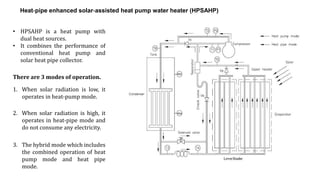
Heat‐pipe enhanced solar‐assisted heat pump water heater (HPSAHP)
• HPSAHP is a heat pump with
dual heat sources.
• It combines the performance of
conventional heat pump and
solar heat pipe collector.
There are 3 modes of operation.
1. When solar radiation is low, it
operates in heat‐pump mode.
2. When solar radiation is high, it
operates in heat‐pipe mode and
do not consume any electricity.
3. The hybrid mode which includes
the combined operation of heat
pump mode and heat pipe
mode.
Observations:
 Heat‐pipe mode is better suited when water temperature < 30 0C and heat input density > 400 W/m2.
 COP decreases when water temperature exceeds 30 0C. Hence, switching the system to heat‐pump
mode of operation is advisable when the water temperature exceeds 30 0C.
Advantages:
 COP of the hybrid‐mode operation is 3.32, which is fairly high enough compared to 2.58 of heat‐pump
mode of operation.
 An increase of 28.7% is observed in COP of hybrid mode as compared to the COP of heat‐pump mode.
 The hybrid system operates without consuming electricity when solar radiations are high. Thus,
minimising conventional energy consumption cost.
Disadvantages:
 It requires more space as compared to traditional HPWH because additional solar panel is added to
the system.
 The system must be installed such that sunlight is incident on the solar heating system. It cannot be
kept in a closed dark room where access to sunlight is negligible.
Future prospects:
 Further improvement in modelling of system is possible making the system more compact and
portable, such that freedom of operation and movement is possible as per the convenience of the
user.
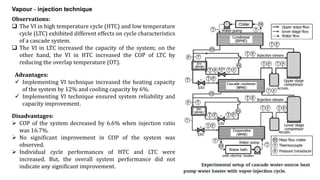
Vapour ‐ injection technique
Observations:
 The VI in high temperature cycle (HTC) and low temperature
cycle (LTC) exhibited different effects on cycle characteristics
of a cascade system.
 The VI in LTC increased the capacity of the system; on the
other hand, the VI in HTC increased the COP of LTC by
reducing the overlap temperature (OT).
Advantages:
 Implementing VI technique increased the heating capacity
of the system by 12% and cooling capacity by 6%.
 Implementing VI technique ensured system reliability and
capacity improvement.
Disadvantages:
 COP of the system decreased by 6.6% when injection ratio
was 16.7%.
 No significant improvement in COP of the system was
observed.
 Individual cycle performances of HTC and LTC were
increased. But, the overall system performance did not
indicate any significant improvement.
Knowledge gap/ future prospects:
 Cascade cycle system are difficult to investigate because of their complexity. The number of
variables in a cascade system are twice to that of single cycle, and their interrelations were
vague. Because of this, irreversibility increases. This difficulty of work recommends that
further studies on the cascade cycle as well as VI technique should be carried out to improve
the performance and understanding of various heat pump systems.
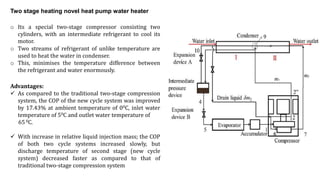
Two stage heating novel heat pump water heater
o Its a special two‐stage compressor consisting two
cylinders, with an intermediate refrigerant to cool its
motor.
o Two streams of refrigerant of unlike temperature are
used to heat the water in condenser.
o This, minimises the temperature difference between
the refrigerant and water enormously.
Advantages:
 As compared to the traditional two‐stage compression
system, the COP of the new cycle system was improved
by 17.43% at ambient temperature of 00C, inlet water
temperature of 50C and outlet water temperature of
65 0C.
 With increase in relative liquid injection mass; the COP
of both two cycle systems increased slowly, but
discharge temperature of second stage (new cycle
system) decreased faster as compared to that of
traditional two‐stage compression system
System Optimization
• The system optimization of air source HPWH, which including calculations and testing was conducted.
• It began with absorption of air energy at the evaporator which was then pumped to the storage tank.
• The condensing heat of the refrigerant was released by the coil pipe to the water side.
• A rotary compressor was used to heat the water from initial temperature to the set temperature 55 0C.
Observations:
o If refrigerant filling quantity is too much, it will descend the heating efficiency.
o If refrigerant is not enough, the suction and discharge pressure will be low; resulting
o in weak heat flow.
o If condenser coil pipe is short, compressor suction/discharge temperature will be
higher than rated.
o If pipe is too long, some length will be unused.
o In high ambient temperature, a stubby capillary performed better
o In low ambient temperature, a slender capillary is better.
Advantages:
 The importance of refrigerant filling quantity and its effects on the COP of the system
was demonstrated in this report.
 The importance of ideal length of the condenser coil pipe and its effects on HPWH
system was revealed.
 Changing refrigerant filling quantity and other variables as per seasonal changes (i.e.
variations in atmospheric conditions like temperature, pressure, etc.); improves the
efficiency and performance of the HPWH.
Knowledge gap/ future prospects:
This report did not use any mathematical approach to derive above results. This
methodology can be engaged with an additional mathematical approach to derive more
empirical and precise results
Heat pump water heaters