COMMERCIAL CONDENSING
BOILER OPTIMIZATION
Russ Landry, PE, LEED®AP
Senior Mechanical Engineer
Welcome
Conservation Applied Research & Development (CARD)
Webinar
Mary Sue Lobenstein, R&D Program Administrator
Marysue.Lobenstein@state.mn.us
Minnesota Applied Research &
Development Fund
Purpose to help Minnesota utilities achieve 1.5
% energy savings goal by:
• Identifying new technologies or strategies to
maximize energy savings;
• Improving effectiveness of energy conservation
programs;
• Documenting CO2 reductions from energy
conservation programs.
Minnesota Statutes §216B.241, Subd. 1e.
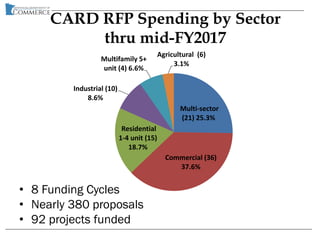
CARD RFP Spending by Sector
thru mid-FY2017
• 8 Funding Cycles
• Nearly 380 proposals
• 92 projects funded
Multi-sector
(21) 25.3%
Commercial (36)
37.6%
Residential
1-4 unit (15)
18.7%
Industrial (10)
8.6%
Multifamily 5+
unit (4) 6.6%
Agricultural (6)
3.1%
Pg. 5
Research
Financing Policy
Programs
Discover + Deploy
the most effective solutions for a healthy, low-carbon economy
Planning &
Consulting
Pg. 6
Commercial Condensing Boiler
Optimization
PRESENTER
Russ Landry, P.E. LEED® AP
Senior Mechanical Engineer
Center for Energy & Environment
Pg. 7
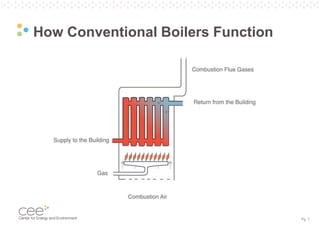
How Conventional Boilers Function
Pg. 8
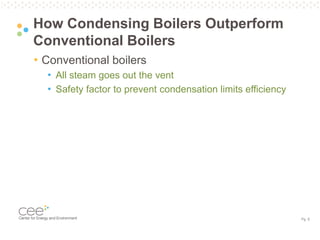
• Conventional boilers
• All steam goes out the vent
• Safety factor to prevent condensation limits efficiency
How Condensing Boilers Outperform
Conventional Boilers
Pg. 9
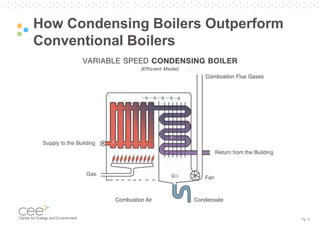
How Condensing Boilers Outperform
Conventional Boilers
Pg. 10
• Conventional boilers
• All steam goes out the vent
• Safety factor to prevent condensation limits efficiency
• Condensing boilers
• A portion of the steam is used for heating
• No safety factor
How Condensing Boilers Outperform
Conventional Boilers
Pg. 11
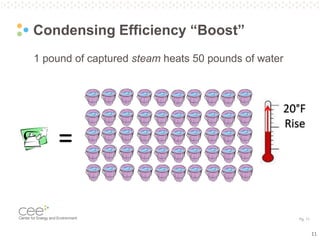
Condensing Efficiency “Boost”
1 pound of captured steam heats 50 pounds of water
11
=
20°F
Rise
Pg. 12
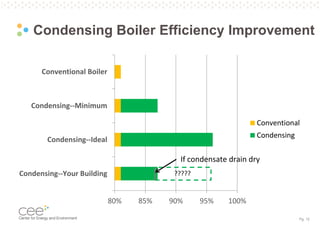
Condensing Boiler Efficiency Improvement
80% 85% 90% 95% 100%
Condensing--Your Building
Condensing--Ideal
Condensing--Minimum
Conventional Boiler
Conventional
Condensing
?????
If condensate drain dry
Pg. 13
3 Rules for...
“Energy Value” of Condensing Boiler System
1) Low Return Water Temperature!
2) Low Return Water Temperature!
3) Low Return Water Temperature!
Pg. 14
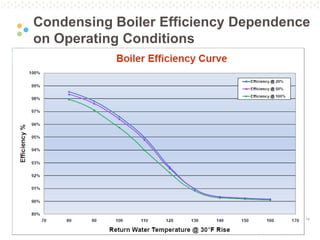
Condensing Boiler Efficiency Dependence
on Operating Conditions
Pg. 15
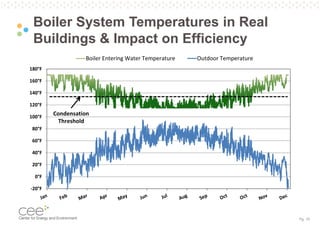
Boiler System Temperatures in Real
Buildings & Impact on Efficiency
-20°F
0°F
20°F
40°F
60°F
80°F
100°F
120°F
140°F
160°F
180°F
Boiler Entering Water Temperature Outdoor Temperature
Condensation
Threshold
Pg. 16
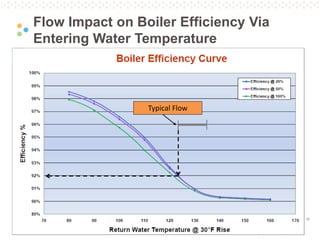
Flow Impact on Boiler Efficiency Via
Entering Water Temperature
Typical Flow
Pg. 17
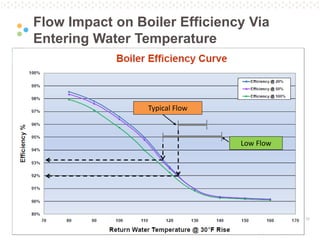
Flow Impact on Boiler Efficiency Via
Entering Water Temperature
Typical Flow
Low Flow
Pg. 18
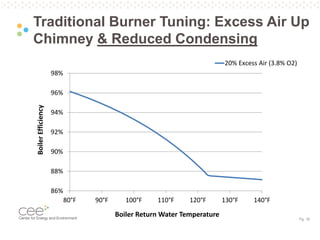
Traditional Burner Tuning: Excess Air Up
Chimney & Reduced Condensing
86%
88%
90%
92%
94%
96%
98%
80°F 90°F 100°F 110°F 120°F 130°F 140°F
BoilerEfficiency
Boiler Return Water Temperature
20% Excess Air (3.8% O2)
Pg. 19
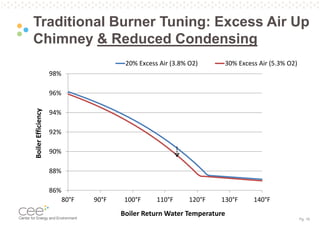
Traditional Burner Tuning: Excess Air Up
Chimney & Reduced Condensing
86%
88%
90%
92%
94%
96%
98%
80°F 90°F 100°F 110°F 120°F 130°F 140°F
BoilerEfficiency
Boiler Return Water Temperature
20% Excess Air (3.8% O2) 30% Excess Air (5.3% O2)
Pg. 20
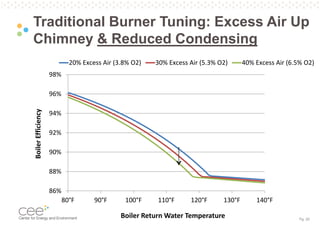
Traditional Burner Tuning: Excess Air Up
Chimney & Reduced Condensing
86%
88%
90%
92%
94%
96%
98%
80°F 90°F 100°F 110°F 120°F 130°F 140°F
BoilerEfficiency
Boiler Return Water Temperature
20% Excess Air (3.8% O2) 30% Excess Air (5.3% O2) 40% Excess Air (6.5% O2)
Pg. 21
Project Overview: Condensing Boiler
Optimization
• Preliminary Market Study & Site Selection
• Monitoring & Analysis of 12 Buildings
• 4 Education
• 4 Multifamily
• 4 Government/Office
• Industry Survey
• Dissemination
Pg. 22
Minnesota’s Condensing Boiler Market
Study Findings
• Market Dominance of Condensing Boilers
• Condensing boilers have become the default choice
• Used in all building types that have space heating boilers
• Efficiency Concerns Noted
• Manufacturer’s reps acknowledge often suboptimal situations
• Part-load efficiency improvements may be significantly
overstated in some cases per tuning recommendations
Pg. 23
Project Overview: Condensing Boiler
Optimization
• Preliminary Market Study & Site Selection
• Monitoring & Analysis of 12 Buildings
• 4 Education
• 4 Multifamily
• 4 Government/Office
• Industry Survey
• Dissemination
Pg. 24
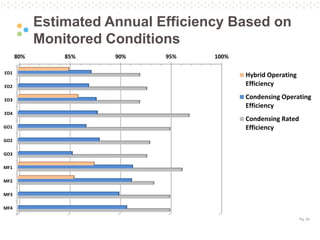
Estimated Annual Efficiency Based on
Monitored Conditions
80% 85% 90% 95% 100%
ED1
ED2
ED3
ED4
GO1
GO2
GO3
MF1
MF2
MF3
MF4
Hybrid Operating
Efficiency
Condensing Operating
Efficiency
Condensing Rated
Efficiency
Pg. 25
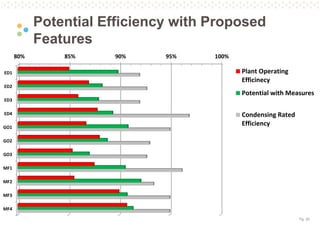
Potential Efficiency with Proposed
Features
80% 85% 90% 95% 100%
ED1
ED2
ED3
ED4
GO1
GO2
GO3
MF1
MF2
MF3
MF4
Plant Operating
Efficinecy
Potential with Measures
Condensing Rated
Efficiency
Pg. 26
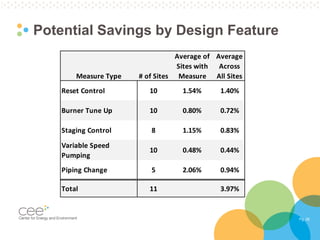
Potential Savings by Design Feature
Measure Type # of Sites
Average of
Sites with
Measure
Average
Across
All Sites
Reset Control 10 1.54% 1.40%
Burner Tune Up 10 0.80% 0.72%
Staging Control 8 1.15% 0.83%
Variable Speed
Pumping
10 0.48% 0.44%
Piping Change 5 2.06% 0.94%
Total 11 3.97%
Pg. 27
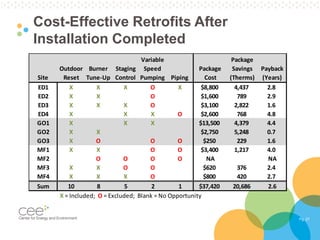
Cost-Effective Retrofits After
Installation Completed
Site
Outdoor
Reset
Burner
Tune-Up
Staging
Control
Variable
Speed
Pumping Piping
Package
Cost
Package
Savings
(Therms)
Payback
(Years)
ED1 X X X O X $8,800 4,437 2.8
ED2 X X O $1,600 789 2.9
ED3 X X X O $3,100 2,822 1.6
ED4 X X X O $2,600 768 4.8
GO1 X X X $13,500 4,379 4.4
GO2 X X $2,750 5,248 0.7
GO3 X O O O $250 229 1.6
MF1 X X O O $3,400 1,217 4.0
MF2 O O O O NA NA
MF3 X X O O $620 376 2.4
MF4 X X X O $800 420 2.7
Sum 10 8 5 2 1 $37,420 20,686 2.6
X = Included; O = Excluded; Blank = No Opportunity
Pg. 28
Project Overview: Condensing Boiler
Optimization
• Preliminary Market Study & Site Selection
• Monitoring & Analysis of 12 Buildings
• 4 Education
• 4 Multifamily
• 4 Government/Office
• Industry Survey
• Dissemination
Pg. 29
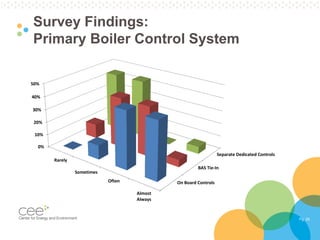
Survey Findings:
Primary Boiler Control System
On Board Controls
BAS Tie-In
Separate Dedicated Controls
0%
10%
20%
30%
40%
50%
Rarely
Sometimes
Often
Almost
Always
Pg. 30
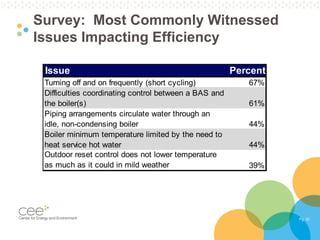
Survey: Most Commonly Witnessed
Issues Impacting Efficiency
Issue Percent
Turning off and on frequently (short cycling) 67%
Difficulties coordinating control between a BAS and
the boiler(s) 61%
Piping arrangements circulate water through an
idle, non-condensing boiler 44%
Boiler minimum temperature limited by the need to
heat service hot water 44%
Outdoor reset control does not lower temperature
as much as it could in mild weather 39%
Pg. 31
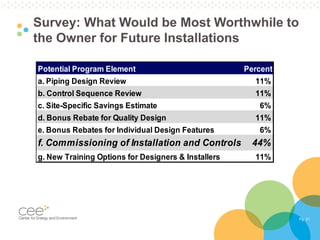
Survey: What Would be Most Worthwhile to
the Owner for Future Installations
Potential Program Element Percent
a. Piping Design Review 11%
b. Control Sequence Review 11%
c. Site-Specific Savings Estimate 6%
d. Bonus Rebate for Quality Design 11%
e. Bonus Rebates for Individual Design Features 6%
f. Commissioning of Installation and Controls 44%
g. New Training Options for Designers & Installers 11%
Pg. 32
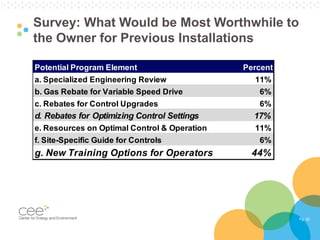
Survey: What Would be Most Worthwhile to
the Owner for Previous Installations
Potential Program Element Percent
a. Specialized Engineering Review 11%
b. Gas Rebate for Variable Speed Drive 6%
c. Rebates for Control Upgrades 6%
d. Rebates for Optimizing Control Settings 17%
e. Resources on Optimal Control & Operation 11%
f. Site-Specific Guide for Controls 6%
g. New Training Options for Operators 44%
Pg. 33
Project Overview: Condensing Boiler
Optimization
• Preliminary Market Study & Site Selection
• Monitoring & Analysis of 12 Buildings
• 4 Education
• 4 Multifamily
• 4 Government/Office
• Industry Survey
• Dissemination
Pg. 34
Dissemination of Project Findings
• Presentations:
• 2014 CenterPoint Energy Technology Conference
• 2015 AEE/ASHRAE Twin Cities Energy Expo
• 2016 Minnesota Blue Flame Gas Association’s Natural Gas
Conservation Conference
• Today’s webinar
• Detailed final report--available now
Pg. 35
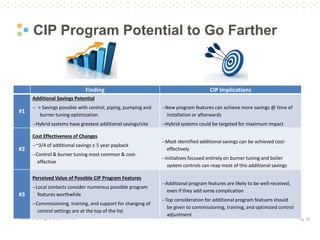
CIP Program Potential to Go Farther
Finding CIP Implications
#1
Additional Savings Potential
-- > Savings possible with control, piping, pumping and
burner tuning optimization
--Hybrid systems have greatest additional savings/site
--New program features can achieve more savings @ time of
installation or afterwards
--Hybrid systems could be targeted for maximum impact
#2
Cost Effectiveness of Changes
--~3/4 of additional savings ≤ 5 year payback
--Control & burner tuning most common & cost-
effective
--Most identified additional savings can be achieved cost-
effectively
--Initiatives focused entirely on burner tuning and boiler
system controls can reap most of this additional savings
#3
Perceived Value of Possible CIP Program Features
--Local contacts consider numerous possible program
features worthwhile
--Commissioning, training, and support for changing of
control settings are at the top of the list
--Additional program features are likely to be well-received,
even if they add some complication
--Top consideration for additional program featuers should
be given to commissioning, training, and optimized control
adjustment
Pg. 36
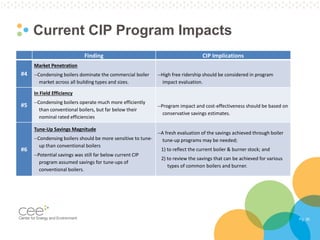
Current CIP Program Impacts
Finding CIP Implications
#4
Market Penetration
--Condensing boilers dominate the commercial boiler
market across all building types and sizes.
--High free ridership should be considered in program
impact evaluation.
#5
In Field Efficiency
--Condensing boilers operate much more efficiently
than conventional boilers, but far below their
nominal rated efficiencies
--Program impact and cost-effectiveness should be based on
conservative savings estimates.
#6
Tune-Up Savings Magnitude
--Condensing boilers should be more sensitive to tune-
up than conventional boilers
--Potential savings was still far below current CIP
program assumed savings for tune-ups of
conventional boilers.
--A fresh evaluation of the savings achieved through boiler
tune-up programs may be needed;
1) to reflect the current boiler & burner stock; and
2) to review the savings that can be achieved for various
types of common boilers and burner.
Pg. 37
Resources
• Commercial Condensing Boiler project page
https://www.mncee.org/resources/projects/condensing-boiler-
optimization/
• Final Report
http://bit.ly/2pzgO3d
Pg. 38
Audience
Question & Answer
CARD Webinar
Thanks for Participating
Upcoming Webinars:
• May 18 – Duct Leakage in Large C&I Buildings
• May 24 – T12 Lighting Saturation Study
• June 14 – Reducing Envelope Leakage in MF Buildings Using Aerosol Sealant
• June 22 – Improving Effectiveness of Commercial Energy Recovery Ventilation
If you have questions or feedback on the CARD program contact:
Mary Sue Lobenstein
marysue.lobenstein@state.mn.us
651-539-1872
Pg. 40
Pg. 41
Pg. 42
Russ Landry, P.E.
rlandry@mncee.org
Mary Sue Lobenstein
MarySue.Lobenstein@state.mn.us

Commercial Condensing Boiler Optimization

  • 1.
    COMMERCIAL CONDENSING BOILER OPTIMIZATION RussLandry, PE, LEED®AP Senior Mechanical Engineer
  • 2.
    Welcome Conservation Applied Research& Development (CARD) Webinar Mary Sue Lobenstein, R&D Program Administrator Marysue.Lobenstein@state.mn.us
  • 3.
    Minnesota Applied Research& Development Fund Purpose to help Minnesota utilities achieve 1.5 % energy savings goal by: • Identifying new technologies or strategies to maximize energy savings; • Improving effectiveness of energy conservation programs; • Documenting CO2 reductions from energy conservation programs. Minnesota Statutes §216B.241, Subd. 1e.
  • 4.
    CARD RFP Spendingby Sector thru mid-FY2017 • 8 Funding Cycles • Nearly 380 proposals • 92 projects funded Multi-sector (21) 25.3% Commercial (36) 37.6% Residential 1-4 unit (15) 18.7% Industrial (10) 8.6% Multifamily 5+ unit (4) 6.6% Agricultural (6) 3.1%
  • 5.
    Pg. 5 Research Financing Policy Programs Discover+ Deploy the most effective solutions for a healthy, low-carbon economy Planning & Consulting
  • 6.
    Pg. 6 Commercial CondensingBoiler Optimization PRESENTER Russ Landry, P.E. LEED® AP Senior Mechanical Engineer Center for Energy & Environment
  • 7.
    Pg. 7 How ConventionalBoilers Function
  • 8.
    Pg. 8 • Conventionalboilers • All steam goes out the vent • Safety factor to prevent condensation limits efficiency How Condensing Boilers Outperform Conventional Boilers
  • 9.
    Pg. 9 How CondensingBoilers Outperform Conventional Boilers
  • 10.
    Pg. 10 • Conventionalboilers • All steam goes out the vent • Safety factor to prevent condensation limits efficiency • Condensing boilers • A portion of the steam is used for heating • No safety factor How Condensing Boilers Outperform Conventional Boilers
  • 11.
    Pg. 11 Condensing Efficiency“Boost” 1 pound of captured steam heats 50 pounds of water 11 = 20°F Rise
  • 12.
    Pg. 12 Condensing BoilerEfficiency Improvement 80% 85% 90% 95% 100% Condensing--Your Building Condensing--Ideal Condensing--Minimum Conventional Boiler Conventional Condensing ????? If condensate drain dry
  • 13.
    Pg. 13 3 Rulesfor... “Energy Value” of Condensing Boiler System 1) Low Return Water Temperature! 2) Low Return Water Temperature! 3) Low Return Water Temperature!
  • 14.
    Pg. 14 Condensing BoilerEfficiency Dependence on Operating Conditions
  • 15.
    Pg. 15 Boiler SystemTemperatures in Real Buildings & Impact on Efficiency -20°F 0°F 20°F 40°F 60°F 80°F 100°F 120°F 140°F 160°F 180°F Boiler Entering Water Temperature Outdoor Temperature Condensation Threshold
  • 16.
    Pg. 16 Flow Impacton Boiler Efficiency Via Entering Water Temperature Typical Flow
  • 17.
    Pg. 17 Flow Impacton Boiler Efficiency Via Entering Water Temperature Typical Flow Low Flow
  • 18.
    Pg. 18 Traditional BurnerTuning: Excess Air Up Chimney & Reduced Condensing 86% 88% 90% 92% 94% 96% 98% 80°F 90°F 100°F 110°F 120°F 130°F 140°F BoilerEfficiency Boiler Return Water Temperature 20% Excess Air (3.8% O2)
  • 19.
    Pg. 19 Traditional BurnerTuning: Excess Air Up Chimney & Reduced Condensing 86% 88% 90% 92% 94% 96% 98% 80°F 90°F 100°F 110°F 120°F 130°F 140°F BoilerEfficiency Boiler Return Water Temperature 20% Excess Air (3.8% O2) 30% Excess Air (5.3% O2)
  • 20.
    Pg. 20 Traditional BurnerTuning: Excess Air Up Chimney & Reduced Condensing 86% 88% 90% 92% 94% 96% 98% 80°F 90°F 100°F 110°F 120°F 130°F 140°F BoilerEfficiency Boiler Return Water Temperature 20% Excess Air (3.8% O2) 30% Excess Air (5.3% O2) 40% Excess Air (6.5% O2)
  • 21.
    Pg. 21 Project Overview:Condensing Boiler Optimization • Preliminary Market Study & Site Selection • Monitoring & Analysis of 12 Buildings • 4 Education • 4 Multifamily • 4 Government/Office • Industry Survey • Dissemination
  • 22.
    Pg. 22 Minnesota’s CondensingBoiler Market Study Findings • Market Dominance of Condensing Boilers • Condensing boilers have become the default choice • Used in all building types that have space heating boilers • Efficiency Concerns Noted • Manufacturer’s reps acknowledge often suboptimal situations • Part-load efficiency improvements may be significantly overstated in some cases per tuning recommendations
  • 23.
    Pg. 23 Project Overview:Condensing Boiler Optimization • Preliminary Market Study & Site Selection • Monitoring & Analysis of 12 Buildings • 4 Education • 4 Multifamily • 4 Government/Office • Industry Survey • Dissemination
  • 24.
    Pg. 24 Estimated AnnualEfficiency Based on Monitored Conditions 80% 85% 90% 95% 100% ED1 ED2 ED3 ED4 GO1 GO2 GO3 MF1 MF2 MF3 MF4 Hybrid Operating Efficiency Condensing Operating Efficiency Condensing Rated Efficiency
  • 25.
    Pg. 25 Potential Efficiencywith Proposed Features 80% 85% 90% 95% 100% ED1 ED2 ED3 ED4 GO1 GO2 GO3 MF1 MF2 MF3 MF4 Plant Operating Efficinecy Potential with Measures Condensing Rated Efficiency
  • 26.
    Pg. 26 Potential Savingsby Design Feature Measure Type # of Sites Average of Sites with Measure Average Across All Sites Reset Control 10 1.54% 1.40% Burner Tune Up 10 0.80% 0.72% Staging Control 8 1.15% 0.83% Variable Speed Pumping 10 0.48% 0.44% Piping Change 5 2.06% 0.94% Total 11 3.97%
  • 27.
    Pg. 27 Cost-Effective RetrofitsAfter Installation Completed Site Outdoor Reset Burner Tune-Up Staging Control Variable Speed Pumping Piping Package Cost Package Savings (Therms) Payback (Years) ED1 X X X O X $8,800 4,437 2.8 ED2 X X O $1,600 789 2.9 ED3 X X X O $3,100 2,822 1.6 ED4 X X X O $2,600 768 4.8 GO1 X X X $13,500 4,379 4.4 GO2 X X $2,750 5,248 0.7 GO3 X O O O $250 229 1.6 MF1 X X O O $3,400 1,217 4.0 MF2 O O O O NA NA MF3 X X O O $620 376 2.4 MF4 X X X O $800 420 2.7 Sum 10 8 5 2 1 $37,420 20,686 2.6 X = Included; O = Excluded; Blank = No Opportunity
  • 28.
    Pg. 28 Project Overview:Condensing Boiler Optimization • Preliminary Market Study & Site Selection • Monitoring & Analysis of 12 Buildings • 4 Education • 4 Multifamily • 4 Government/Office • Industry Survey • Dissemination
  • 29.
    Pg. 29 Survey Findings: PrimaryBoiler Control System On Board Controls BAS Tie-In Separate Dedicated Controls 0% 10% 20% 30% 40% 50% Rarely Sometimes Often Almost Always
  • 30.
    Pg. 30 Survey: MostCommonly Witnessed Issues Impacting Efficiency Issue Percent Turning off and on frequently (short cycling) 67% Difficulties coordinating control between a BAS and the boiler(s) 61% Piping arrangements circulate water through an idle, non-condensing boiler 44% Boiler minimum temperature limited by the need to heat service hot water 44% Outdoor reset control does not lower temperature as much as it could in mild weather 39%
  • 31.
    Pg. 31 Survey: WhatWould be Most Worthwhile to the Owner for Future Installations Potential Program Element Percent a. Piping Design Review 11% b. Control Sequence Review 11% c. Site-Specific Savings Estimate 6% d. Bonus Rebate for Quality Design 11% e. Bonus Rebates for Individual Design Features 6% f. Commissioning of Installation and Controls 44% g. New Training Options for Designers & Installers 11%
  • 32.
    Pg. 32 Survey: WhatWould be Most Worthwhile to the Owner for Previous Installations Potential Program Element Percent a. Specialized Engineering Review 11% b. Gas Rebate for Variable Speed Drive 6% c. Rebates for Control Upgrades 6% d. Rebates for Optimizing Control Settings 17% e. Resources on Optimal Control & Operation 11% f. Site-Specific Guide for Controls 6% g. New Training Options for Operators 44%
  • 33.
    Pg. 33 Project Overview:Condensing Boiler Optimization • Preliminary Market Study & Site Selection • Monitoring & Analysis of 12 Buildings • 4 Education • 4 Multifamily • 4 Government/Office • Industry Survey • Dissemination
  • 34.
    Pg. 34 Dissemination ofProject Findings • Presentations: • 2014 CenterPoint Energy Technology Conference • 2015 AEE/ASHRAE Twin Cities Energy Expo • 2016 Minnesota Blue Flame Gas Association’s Natural Gas Conservation Conference • Today’s webinar • Detailed final report--available now
  • 35.
    Pg. 35 CIP ProgramPotential to Go Farther Finding CIP Implications #1 Additional Savings Potential -- > Savings possible with control, piping, pumping and burner tuning optimization --Hybrid systems have greatest additional savings/site --New program features can achieve more savings @ time of installation or afterwards --Hybrid systems could be targeted for maximum impact #2 Cost Effectiveness of Changes --~3/4 of additional savings ≤ 5 year payback --Control & burner tuning most common & cost- effective --Most identified additional savings can be achieved cost- effectively --Initiatives focused entirely on burner tuning and boiler system controls can reap most of this additional savings #3 Perceived Value of Possible CIP Program Features --Local contacts consider numerous possible program features worthwhile --Commissioning, training, and support for changing of control settings are at the top of the list --Additional program features are likely to be well-received, even if they add some complication --Top consideration for additional program featuers should be given to commissioning, training, and optimized control adjustment
  • 36.
    Pg. 36 Current CIPProgram Impacts Finding CIP Implications #4 Market Penetration --Condensing boilers dominate the commercial boiler market across all building types and sizes. --High free ridership should be considered in program impact evaluation. #5 In Field Efficiency --Condensing boilers operate much more efficiently than conventional boilers, but far below their nominal rated efficiencies --Program impact and cost-effectiveness should be based on conservative savings estimates. #6 Tune-Up Savings Magnitude --Condensing boilers should be more sensitive to tune- up than conventional boilers --Potential savings was still far below current CIP program assumed savings for tune-ups of conventional boilers. --A fresh evaluation of the savings achieved through boiler tune-up programs may be needed; 1) to reflect the current boiler & burner stock; and 2) to review the savings that can be achieved for various types of common boilers and burner.
  • 37.
    Pg. 37 Resources • CommercialCondensing Boiler project page https://www.mncee.org/resources/projects/condensing-boiler- optimization/ • Final Report http://bit.ly/2pzgO3d
  • 38.
  • 39.
    CARD Webinar Thanks forParticipating Upcoming Webinars: • May 18 – Duct Leakage in Large C&I Buildings • May 24 – T12 Lighting Saturation Study • June 14 – Reducing Envelope Leakage in MF Buildings Using Aerosol Sealant • June 22 – Improving Effectiveness of Commercial Energy Recovery Ventilation If you have questions or feedback on the CARD program contact: Mary Sue Lobenstein marysue.lobenstein@state.mn.us 651-539-1872
  • 40.
  • 41.
  • 42.
  • 43.
    Russ Landry, P.E. rlandry@mncee.org MarySue Lobenstein MarySue.Lobenstein@state.mn.us