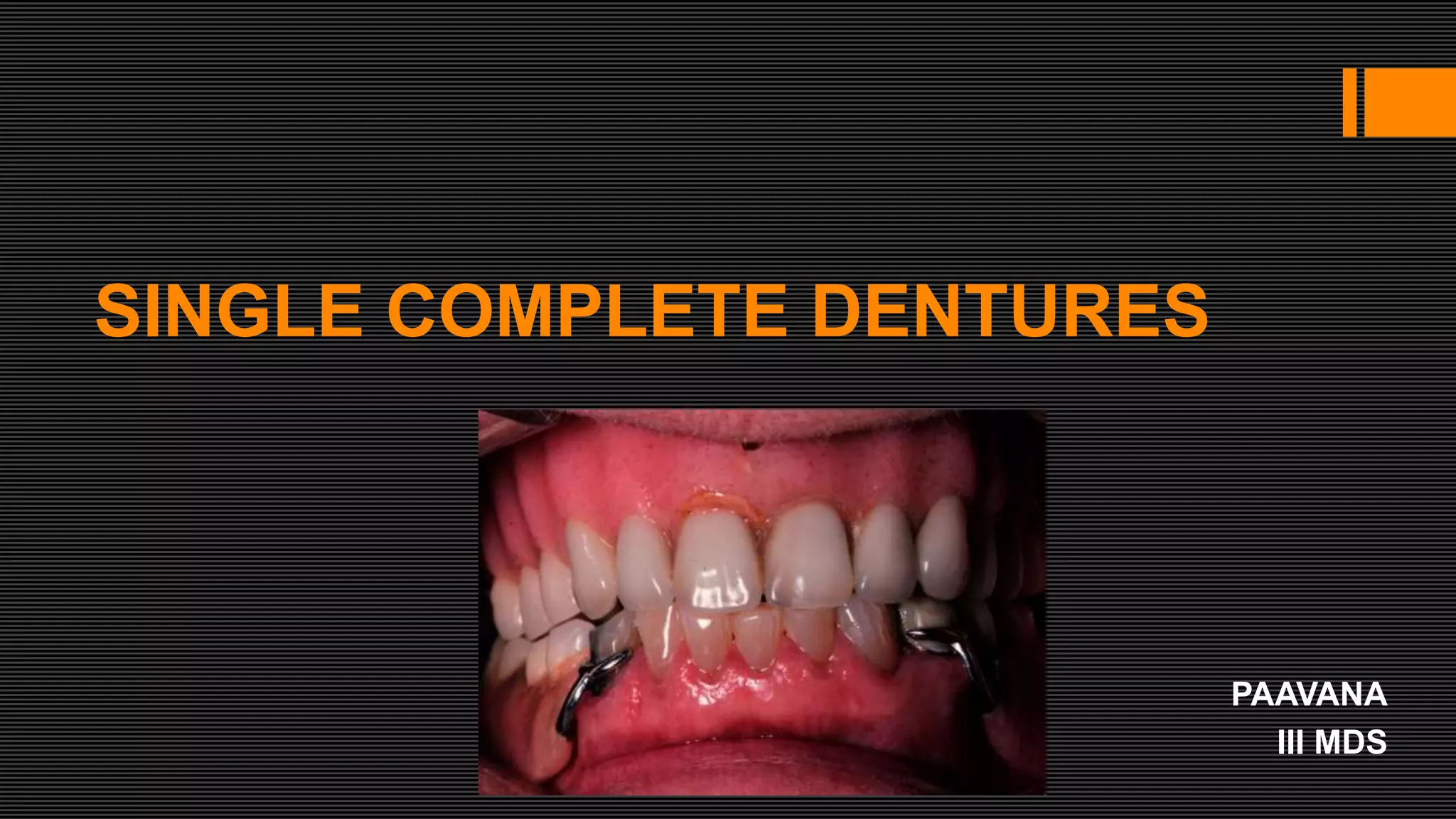
SINGLE COMPLETE DENTURES
PAAVANA
III MDS
CONTENTS
INTRODUCTION
DEFINITION
INDICATIONS
DIAGNOSIS AND TREATMENT PLANNING
PROBLEMS ASSOCIATED WITH SINGLE COMPLETE DENTURE
COMMON OCCLUSAL DISHARMONIES AND WAYS TO CORRECT THEM
MODIFYING OCCLUSAL PATTERNS
CLASSIFICATION FOR IDENTIFICATION AND TREATMENT OF PATIENTS
TREATMENT PLANNING BASED ON CLINICAL SITUATIONS
2
CONTENTS
METHODS USED TO ACHIEVE HARMONIOUS BALANCED OCCLUSION
TEETH SELECTION
OCCLUSAL MATERIALS
ADVERSE SEQUELE TO SCD TREATMENT
REVIEW OF LITERATURE
CONCLUSION
REFERENCES
3
INTRODUCTION
The prevalence of the condition in which one arch is edentulous
opposing a natural or restored dentition is common.
This situation occurs most often when the maxillary teeth are lost and
the mandibular arch is maintained with some or all natural teeth.
4
Prosthodontic treatment for edentulous patients – Boucher 12th edition .Pg-427
DEFINITION
Single complete denture is a prosthesis which replaces the lost
natural teeth and its associated structures functionally and
esthetically as a single unit which opposes all or some of the natural
teeth.
The making of a maxillary or mandibular denture as distinguished
from a set of complete dentures (GPT-9).
5
INDICATIONS
A single complete denture may be desirable when it is to oppose any
one of the following
6
Textbook of complete
denture – Heartwell
5th edition.pg 481
Natural teeth sufficient in numbers which do not necessitate a fixed
or removable partial denture.
A partially edentulous arch in which the missing teeth have been
or will be replaced by the fixed partial denture.
A partially edentulous arch in which the missing teeth have been
or will be replaced by a removable partial denture
An existing complete denture or Implant supported complete
denture.
DIAGNOSIS AND TREATMENT PLANNING
 Diagnosis consists of planned observations to determine and evaluate the existing
conditions, which lead to decision making based on the condition observed.
 The commonly sited long term goal in Prosthodontics is the Preservation of that
which remains.
7
Prosthodontic treatment for edentulous patients – Boucher 12th edition .page-298
DIAGNOSIS AND TREATMENT PLANNING
 For proper diagnosis and treatment planning - evaluate
 Edentulous arch - frenii, sulcus, palate, mucosa, ridge, undercuts, tongue,
lips, TMJ, mouth opening.
 Dentulous arch - number of teeth present, position of teeth, condition of
teeth, endodontic considerations, restorative consideration, condition of
existing restoration and periodontal condition
 Deciding whether to extract remaining teeth depends on
oGeneral health of the patient
oAge of the patient
oTooth mobility
oPresence of infection
8
Prosthodontic treatment for edentulous patients – Boucher 12th edition .page 57-74
PROBLEMS
9
Essentials of complete denture
Prosthodontics – 2nd edition.
Sheldon Winkler .page-417
Malposed, tipped or
supraerupted teeth
Presence of lower
anteriors in a fixed
position
Occlusal forces Occlusal wear
Occlusal form of the
natural teeth
Support for the
denture base
Occlual plane
Intermaxillary
relations
A mandibular single
complete denture
opposing upper
natural teeth
The upper single
complete denture
opposing lower
natural anterior
teeth.
Fracture of the
single complete
denture
COMMON OCCLUSAL DISHARMONIES AND
WAYS TO ADJUST THEM
 Tilted molars with distal halves supraerupted
 Steeply inclined occlusal surfaces tend to drive denture forward when brought into
centric occlusion.
 Only contact is on the distal half of lower molar in protrusive and lateral movement.
Denture easily dislodged during functional movements.
10
Essentials of complete denture Prosthodontics – 2nd edition. Sheldon Winkler .page-419
 ADJUSTMENT:
oIf molars are not severely tilted it can be reshaped by
selective grinding.
oStephen’s recommends that in this situation the distal half
of the occlusal surface should be ground flat and the
denture teeth set to occlude only with that area leaving the
mesial cusps out of contact.
oIf more tooth structure is needed to be removed -Restore
with crown or FPD. Described by Behrend.
11
Essentials of complete denture Prosthodontics – 2nd edition. Sheldon Winkler .page-420
oIf large space exist mesial to tilted molar - RPD restoring the mesial half of the
molars, by lowering the distal cusps and restoring mesial cusps using an onlay
mesial rest.
oOrthodontic repositioning of tilted molar
oIf severely tilted and supraerupted- Extraction
12
Essentials of complete denture Prosthodontics – 2nd edition. Sheldon Winkler .page-420
Natural lower cuspids and incisors are supraerupted- Selective grinding.
Cuspid region, occlusal adjustment should aim at providing a definite distal slope on
the lower cuspid so as to allow space for free passage of the upper artificial cuspid
between the lower cuspid and first premolar in lateral movements.
13
Schneider RL. Diagnosing functional complete
denture fractures. J Prosthet Dent . 1985 Dec
1;54(6):810
MODIFYING OCCLUSAL PATTERNS
 Several techniques to modify the existing occlusal pattern prior to denture
construction have been suggested:
1. Swenson’s technique
2. Yurkstas method
3. Bruce method
4. Boucher method
5. Han Kuang Tan’s technique
6. L. Klirk Gardner’s technique
7. Broadrick occlusal plane analyser
8. Custom made occlusal plane template
14
SWENSON’S TECHNIQUE (1964)
 The maxillary and mandibular cast are mounted on articulator using provisional
centric record and maxillary denture teeth are set.
 Lower interfering teeth are adjusted on the cast and area is marked with a pencil.
15
Essentials of complete denture Prosthodontics – 2nd edition. Sheldon Winkler .page-417
SWENSON’S TECHNIQUE
 The natural teeth are modified using marked diagnostic cast as a guide.
 After the occlusal modifications new impressions are made of the lower arch and
mounted on the articulator.
 The artificial teeth are then checked and modifications done for the final try in.
Disadvantages:
Time consuming if it needs several impressions and mountings before the occlusion
is finalized
16
Essentials of complete denture Prosthodontics – 2nd edition. Sheldon Winkler .page-417
YURKSTA’S METHOD (1968)
 Method involves the use of a metal U-shaped occlusal template which is slightly
convex on the lower side.
 The template is placed on the lower cast and the cusps to be adjusted are
identified.
 The stone cast is modified to an acceptable occlusal relationship and the areas are
marked with a pencil.
 This cast is then used as a guide to modify natural teeth
17
Essentials of complete denture Prosthodontics – 2nd edition. Sheldon Winkler .page-
418
18
Complete denture Prosthodontics – Sharry 3rd edition.pg 274-275
BRUCE METHOD (1971)
 Areas to be modified are marked with a pencil
on the cast.
19
Essentials of complete denture Prosthodontics – 2nd edition. Sheldon Winkler .page-418
Bruce RW. Complete dentures opposing natural teeth. J Prosthet Dent . 1971 Nov 1;26(5):448-
55
 Clear acrylic resin template is formed over the
corrected cast
 Template coated with pressure indicating paste and
placed over patients teeth.
20
Essentials of complete denture Prosthodontics – 2nd edition. Sheldon Winkler .page-418
Bruce RW. Complete dentures opposing natural teeth. J Prosthet Dent . 1971 Nov 1;26(5):448-
55
BRUCE’S METHOD
 Interferences can be seen through the clear template and can be removed
accordingly.
 Process repeated till template fits the teeth perfectly
Advantage:
Produces accurate results.
21
Essentials of complete denture Prosthodontics – 2nd edition. Sheldon Winkler .page-418
Bruce RW. Complete dentures opposing natural teeth. J Prosthet Dent . 1971 Nov 1;26(5):448-
55
 His technique involves making the natural teeth fit to the
established plane and inclines of the maxillary porcelain teeth.
 First, the cast are mounted and the artificial teeth are arranged to
the best possible balancing contacts.
 If the natural teeth prevent balancing, the interferences are
removed by movement of maxillary porcelain teeth over the
mandibular stone teeth.
22
Essentials of complete denture Prosthodontics – 2nd edition. Sheldon Winkler .page-418
 The denture is processed and area to be reshaped are noted on the cast.
 The natural teeth are ground at the areas marked on the cast.
 The occlusion is refined in the right and left lateral excursive movements until a
harmonious balance is achieved.
23
Essentials of complete denture Prosthodontics – 2nd edition. Sheldon Winkler .page-418
HAN-KUANG TAN (1997)
24
Tan, H.-K. . A preparation guide for modifying the mandibular teeth before making a maxillary single complete denture. (J Prosthet Dent 1997;77:321-2.
25
Tan, H.-K. . A preparation guide for modifying the mandibular teeth before making a maxillary single complete denture. (J Prosthet Dent 1997;77:321-2.
26
Tan, H.-K. . A preparation guide for modifying the mandibular teeth before making a
maxillary single complete denture. (J Prosthet Dent 1997;77:321-2.
L. Klirk Gardner’s technique
27
Gardner, L. K., Rahn, A. O., Parr,
G. R., & Richardson, D. W.
(1990). Using a tooth-reduction
guide for modifying natural teeth. J
PROSTHET DENT 1990; 63: 637-
9.)
28
Gardner, L. K., Rahn, A. O.,
Parr, G. R., & Richardson,
D. W. (1990). Using a tooth-
reduction guide for
modifying natural teeth. J
PROSTHET DENT 1990;
63: 637-9.)
BROADRICK OCCLUSAL PLANE ANALYSER
Hanau™ Broadrick Occlusal Plane Analyzer
Customised broadwick occlusal plane analyser
Manvi S, Miglani S, Rajeswari CL, Srivatsa G, Arora S. Occlusal plane determination using custom made broadrick occlusal plane analyser: A case control study. ISRN dentistry.
2012;2012.
Gupta R, Luthra RP, Sheth HH. Broadrick’s occlusal plane analyzer: A review. Int. J. Appl. Dent. Sci.. 2019;5(1):95-8.
Manvi S, Miglani S, Rajeswari CL, Srivatsa G, Arora S. Occlusal plane determination using custom made broadrick occlusal plane analyser: A case control study. ISRN
dentistry. 2012;2012.
Gupta R, Luthra RP, Sheth HH. Broadrick’s occlusal plane analyzer: A review. Int. J. Appl. Dent. Sci.. 2019;5(1):95-8.
Custom made occlusal plane template
35
Polymer ball of 8 inches diameter with poured Type III
gypsum material
Concave stone-form
Muley BY, Patil PG, Khalikar AN, Puri SB. A simple technique to fabricate custom made occlusal plane template. J Indian Prosthodont Soc. 2014 Dec 1;14(1):334-6
36
Concave stone-form placed in heat and
pressure molding machine
Adapted PMMA plate on concave stone-form
Muley BY, Patil PG, Khalikar AN, Puri SB. A simple technique to fabricate custom made occlusal plane template. J Indian Prosthodont Soc. 2014 Dec 1;14(1):334-6
37
Finished occlusal plane template (OPT) on concave
stoneform.
OPT in use
Muley BY, Patil PG, Khalikar AN, Puri SB. A simple technique to fabricate custom made occlusal plane template. J Indian Prosthodont Soc. 2014 Dec 1;14(1):334-6
TREATMENT PLANNING
Classification for identification and treatment of patients
requiring single dentures
Class 1
• Patients for whom minor, or no, tooth reduction is all that is needed to obtain balance
Class 2
• Patients for whom minor additions to the height of the teeth are needed to obtain balance
Class 3
• Patients for whom both reductions and additions to the teeth are required to obtain balance. The treatment of
these patients usually involves a change in vertical dimension of occlusion
Class 4:
• Patients who present with occlusal discrepancies that require addition to the width of the occluding surface
Class 5
• Patients who present with combination syndrome as described by Kelly
39
Proposed by Carl F. Driscoll and Radi M. Masri
Driscoll, C. F., & Masri, R. M. (2004). Single maxillary complete denture. Dent Clin N Am, 48(3), 567–583
 Treatment planning for the patient depends upon the clinical situation he/she
presents. It may be:
1. Upper single complete denture opposing complete set of lower natural
teeth.
2. Lower single complete denture opposing complete set of upper natural
teeth.
3. Single complete denture opposing natural teeth with a removable partial
denture.
4. A single complete denture opposing natural teeth with a fixed partial
denture.
5. A single complete denture opposing an already existing complete denture
6. Single complete denture opposing implant supported prosthesis
40
Ellinger CW, Rayson JH, Henderson D. Single complete dentures. J Prosthet Dent . 1971 Jul 1;26(1):4-10
Single complete denture (Maxillary) to oppose
natural mandibular teeth:
 More frequently encountered
 The diagnostic procedures should determine that there are sufficient teeth in the mandibular
arch, periodontal health is acceptable, and there are no missing teeth to be replaced.
 The occlusal forms of the natural teeth usually act as the guide in selecting the occlusal form
for the maxillary posterior
41
Textbook of complete denture – Heartwell 5th edition.pg-484-486
 The mandibular arch may present two planes of occlusion,
An anterior plane from canine to canine and
A much lower posterior plane
 If the posterior teeth are extruded the inter ridge space would be less.
 To prepare this mouth it requires extensive restorative procedures in mandibular
arch.
 To proceed with complete maxillary denture procedures without first preparing the
environment into which the artificial teeth will be placed is to invite trouble.
42
Textbook of complete denture – Heartwell 5th edition.pg-484-486
This problem may be solved as follows.
oReposition of the natural teeth with orthodontic procedures
oAlter the clinical crowns of the teeth by grinding or with restoration.
oAccept balanced occlusion with the jaws in the terminal relation and not in the
eccentric position
43
Textbook of complete denture – Heartwell 5th edition.pg-484-486
Mandibular complete denture to oppose maxillary
natural teeth:
 Although the mandibular arch is seldom the edentulous one, this condition does
occur.
 It usually happens as a result of either surgical or accidental trauma i.e. irradiation
or accident or gunshot
44
Ellinger CW, Rayson JH, Henderson D. Single complete dentures. J Prosthet Dent .
1971 Jul 1;26(1):5
Textbook of complete denture – Heartwell 5th edition.pg-482-484
 Three factors in particular must be carefully evaluated.
45
Textbook of complete denture – Heartwell 5th edition.pg-482-484
Preservation
of the
residual
alveolar
ridge
Necessity
for retaining
maxillary
teeth
Mental
trauma
Preservation of residual alveolar ridge
 Force of jaw closure is greater with opposing natural teeth than with complete
denture. Greater the force, the more the pressure, and pressure contributes to
bone resorption.
 Stability of mandibular denture is very difficult due to tongue movements, denture
movement will increase the pressure and stress on the mucosa and bone, which is
detrimental to comfort and preservation
 Minimal availability of mucosa with tightly attached submucosa will lead to stress
concentration. So ultimately tissues become not tolerable to dentures.
46
Textbook of complete denture – Heartwell 5th edition.pg-482-484
Necessity of retaining maxillary teeth
 The maxillary dentition may be needed to retain prosthesis.
 This situation is usually associated with congenital defects such as cleft palate or
stoma resulting from surgical or accidental trauma.
 The primary considerations for these patients are:
oTo speak clearly
oTo swallow food and fluids without passing in to nasal cavity.
47
Textbook of complete denture – Heartwell 5th edition.pg-482-484
Mental trauma
 The loss of teeth is such a traumatic mental experience for some persons that they
become depressed. Their depression may lead to more complicated psychological
problems.
 If this mental state exists when the patient losses his mandibular teeth, the removal
of the remaining maxillary teeth may be more than he or she can endure mentally.
48
Textbook of complete denture – Heartwell 5th edition.pg-482-484
Complete maxillary denture to oppose a
partially edentulous mandibular arch with
fixed prosthesis
 The following points must be evaluated for the proper diagnosis and
treatment planning:
oIt must be determined whether fixed restorations are acceptable, can be
made acceptable or should be rejected.
oIf any fixed partial denture is acceptable,
1. Then the same principles of occlusion that are applied to complete
dentures should be applied to single complete dentures.
2. The teeth in a single complete denture are on a movable base and even
though they function against natural teeth they will function as a unit.
3. Composition of the artificial teeth to be used.
49
Textbook of complete denture – Heartwell 5th edition.pg-487-488
oIf the fixed partial dentures have
1. Porcelain occlusals then  porcelain / acrylic resin teeth
2. Mixed enamel and gold or gold alone gold / acrylic resin teeth
50
Textbook of complete denture – Heartwell 5th edition.pg-482-484
Complete maxillary denture to oppose a partially
edentulous mandibular arch with a removable partial
denture
 The most common single denture situation
 Replacement of missing posterior teeth in the lower arch will almost always
improve the prognosis for the upper denture.
 However, a removable partial denture is not always indicated to oppose the
complete denture even when some or all of the molars are missing.
51
Ellinger CW, Rayson JH, Henderson D. Single complete dentures. J Prosthet Dent . 1971 Jul 1;26(1):6
 Sharry’ states that in a Class II jaw relationship a complete upper denture often
may be constructed against lower anterior teeth and the premolars without
replacing the molars. In this situation, the lower premolars are far enough posterior
in relation to the maxillary residual ridge that the forces of occlusion are directed to
the middle-posterior part of the upper denture.

52
Ellinger CW, Rayson JH, Henderson D. Single complete dentures. J Prosthet Dent . 1971 Jul 1;26(1):6
 If this same patient presented a similar condition but in a Class III jaw relation, the
clinical situation would be different because the mandibular prcmolars would apply
occlusal forces against he anterior part of the maxillary residual ridge.
53
Ellinger CW, Rayson JH, Henderson D. Single complete dentures. J Prosthet Dent . 1971 Jul 1;26(1):6
 A lower removable partial denture is usually indicated in all situations when all
molars arc missing.
 When the removable partial denture is to be supplied, there should be no particular
problem related to the complete denture construction, since the treatment plan is or
should be formulated for both arches at the same time
54
Textbook of complete denture – Heartwell 5th edition.pg-489
Ellinger CW, Rayson JH, Henderson D. Single complete dentures. J Prosthet Dent . 1971 Jul 1;26(1):6
Single complete denture to oppose an
existing complete denture:
 The decision to construct a single complete denture against an existing complete
denture can be approached in a systematic manner by answering and analyzing
the following five questions
55
Textbook of complete denture – Heartwell 5th edition.pg-489-490
1.long has the existing denture
been in use?
2 . Was the denture an immediate
insertion
at the time of tooth removal?
3.Does the denture meet the
requirements
of an acceptable denture?
4. Has the denture opposed
another complete denture, a
partially edentulous arch that
supported a removable partial
denture, restored natural teeth, a
fixed partial denture or natural
teeth in which no restorations
have been placed?
5. Is the operator satisfied to
institute complete denture
procedures utilizing the existing
denture?
Single complete denture opposing implant
supported prosthesis
With the use of implants we have
 Preservation of the existing tissues especially bone
 Better stress distribution pattern
 Enhanced Stability
It prevents
 Bone resorption in mandibular posterior region
 Settling of denture base and loss of posterior contacts
 Upward rotation of anterior mandibular denture
 More forces on anterior maxilla supporting the maxillary denture.
56
METHODS USED TO ACHIEVE
HARMONIOUS BALANCED OCCLUSION:
 The techniques to achieve this are broadly divided into two categories.
1. Those that dynamically equilibrate the occlusion by use of functionally
generated path i.e. Functional chew in techniques.
2. Those that statistically equilibrate the occlusion by using an articulator
programmed to simulate patients jaw movements. i.e Articulated
equilibriation technique.
57
Essentials of complete denture Prosthodontics – 2nd edition. Sheldon Winkler.pg-420
FUNCTIONAL CHEW IN TECHNIQUE
 Most accurate method of recording occlusal patterns
 To obtain functional chew in technique
Record bases should have good stability.
Patient should have good neuro-muscular control
Mental competence to effectively co-operate
58
Essentials of complete denture Prosthodontics – 2nd edition. Sheldon Winkler.pg-420
Stansbury (1928)
 First functional chew in technique for upper complete denture opposing lower
natural teeth.
 .
59
• Compound maxillary rim trimmed buccally and lingually.
• Carding wax is then added to the compound rim, and the patient is instructed to
perform eccentric chewing movement.
• The carding wax is slowly molded to the functional movements, while the
compound in the central fossa acts as a guide to preserve the vertical dimension
Essentials of complete denture Prosthodontics – 2nd edition. Sheldon Winkler.pg-420 -421
60
61
• The generated occlusion rim is now removed from the mouth, and stone
is vibrated into the wax paths of the cusps.
• The upper cast is again fastened to the articulator with the generated
occlusion rim and the stone cusp path record is secured to the lower
member of the articulator with plaster. .
• We now have the upper cast mounted on the articulator and two lower
casts. One is a duplicate of the lower teeth and the other is a replica of
the generated path.
• The denture teeth are first set to the lower cast of the patient’s teeth. After
the esthetics have been approved at the try-in, the lower cast is removed
and the lower chew-in cast record is then secured to the articulator
Essentials of complete denture Prosthodontics – 2nd edition. Sheldon Winkler.pg-420 -421
Vig’s technique
 By Robert G. Vig
 Modified functional chew-in.
 Similar technique to Stansbury
 The use of a fin of resin placed into the central grooves of the
lower posterior teeth, instead of using compound as mentioned
by Stansbury .
 In eccentric movements the lower cusp tips are ground until
equal contact occurs between the teeth and resin.
 The fin is then built up using a soft wax, and a functional path is
recorded
62
Essentials of complete denture Prosthodontics – 2nd edition. Sheldon Winkler.pg-421
Sharry’s technique
 Simple technique of using a maxillary rim of softened wax.
 Lateral and protrusive chewing movements are made so that wax is abraded
generating the final paths of the lower cusps.
 Continued until the correct vertical dimension is achieved.
63
Essentials of complete denture
Prosthodontics – 2nd edition. Sheldon
Winkler.pg-421
Rudd’s Technique
 Suggests a technique similar to Stansbury's.
 A compound maxillary rim is formed much the same way.
 A thickness of recording matrix, made up of three sheets of medium-hard pink
baseplate wax and two sheets of red counter wax, is added to the buccal and
 lingual surfaces of the compound rim
 Suggests using two maxillary bases, one for recording the generated path and the
other for setting the teeth.
 Advantage –
oDecreases the number of appointments necessary for the construction of the upper
denture.
64
Essentials of complete denture Prosthodontics – 2nd edition. Sheldon Winkler.pg-421
ARTICULATOR EQUILIBRATION
TECHNIQUE
 Indications-
oWhen denture bases are not stable
oNeuro-muscular control of the patient is poor
65
Essentials of complete denture Prosthodontics – 2nd edition. Sheldon Winkler.pg-421-423
 Procedure-
oFirst the upper cast is mounted on the articulator using a face bow with an orbital
pointer
oThe lower cast is related to the upper cast by a centric interocclusal record at an
acceptable vertical dimension.
oIf the denture teeth appear to be placed too far buccally when articulated with the
lower buccal cusp, they are reset to oppose the lower lingual cusps.
oIf the denture teeth appear to be placed too far lingually when articulated with the
lower lingual cusps, they are reset to oppose the lower buccal cusps.
oOnce the holding cusps have been selected, the inclines of the remaining cusps
are reduced and vice-versa.
oThis allows for a cusp to fossa relationship between the upper and lower teeth in
centric.
oAt the time of wax try in, eccentric records are made and the condylar inclinations
are set on the articulator.
66
Essentials of complete denture Prosthodontics – 2nd edition. Sheldon Winkler.pg-421-423
67
Essentials of complete denture Prosthodontics – 2nd edition. Sheldon Winkler.pg-421-423
68
Essentials of complete denture Prosthodontics – 2nd edition. Sheldon Winkler.pg-421-423
TEETH SELECTION FOR SINGLE
COMPLETE DENTURE
 Selecting the right material for the teeth is important because of the peculiar nature
of the single complete denture. The occlusal surface should not wear too fast nor
should it damage the natural teeth. The most important aspects are to transmit the
occlusal forces vertically.
 Types of teeth:
Non – anatomic teeth
Anatomic teeth
69
Teeth selection
 Non-anatomic teeth:
oIf the cusps of the natural teeth have been reduced either naturally or artificially to
such a degree that their occlusal surface are fairly flat, then non anatomic teeth
maybe used on the denture.
oThese teeth have flat occlusal surfaces with fissures and spillways carved into
them which help to provide an effective masticating surface.
70
Teeth selection
 Anatomic teeth:
oIf the cuspal form of the lower teeth has been retained anatomic teeth can be used
oThese should be arranged with a cusp to fossa relation.
oA small space distal to the cuspid looks quite natural in an upper denture, spaces
between the posterior teeth provide extra channel for the escape of food from the
occlusal surfaces.
71
30
°
OCCLUSAL MATERIALS FOR SINGLE
COMPLETE DENTURES
The materials available for occlusal posterior tooth forms are:-
 Porcelain teeth
 Acrylic resin teeth
 Gold occlusals
 Acrylic resin teeth with amalgam stops
 IPN (interpenetrating polymer network) resin
72
Essentials of complete denture Prosthodontics – 2nd edition. Sheldon Winkler.pg-424
Porcelain
73
Advantage:
Porcelain teeth wear slowly therefore the
vertical dimension is maintained.
Disadvantage:
They are predisposed to fracture and
chipping when opposed by natural teeth
and are difficult to equilibrate.
Can cause rapid wear of natural teeth
If Occlusal adjustment of artificial teeth
are needed porcelain becomes weak.
Cannot be used in decreased inter-
occlusal distance.
They are difficult to grind and polish.
Essentials of complete denture Prosthodontics – 2nd edition. Sheldon Winkler.pg-424
Acrylic resin 74
Advantage:
Since acrylic resin teeth cause no
wear of the opposing natural teeth
they are the easiest to equilibrate.
Easy to do occlusal adjustments. Disadvantage:
Resin teeth wear which result in loss of
vertical dimension and change in centric
occlusion.
Essentials of complete denture Prosthodontics – 2nd edition. Sheldon Winkler.pg-424
Gold occlusals
 The best material for an artificial occlusion opposing the natural teeth is gold
 A technique described by Wallace in 1964
 The occlusal surfaces of the posterior acrylic denture teeth are reduced by about
1mm and a central channel is cut posteriorly along them
 The wax patterns are cast in gold and cemented with self cure acrylic resin.
 Disadvantages-Although gold occlusals are considered the best material to oppose
natural teeth, their expense and the time involved in their fabrication make them
impractical for most patients.
75
Essentials of complete denture Prosthodontics – 2nd edition. Sheldon Winkler.pg-424
Acrylic resin teeth with
amalgam stops
 This method was established by Frank R. Lauciello.
 After the acrylic teeth have been balanced, occlusal preparation are made in the
acrylic teeth, extending it include as much of the articulating paper tracing as is
possible.
 Amalgam is condensed into the preparation and the articulator is gently closed,
going side to side and back and forth until the incisal guide pin is again flush with
the guide table.
76
Essentials of complete denture Prosthodontics – 2nd edition. Sheldon Winkler.pg-424
 Advantage:
oReduces occlusal wear of resin teeth.
oLess expensive than gold
oFacilitates the final stages of occlusal adjustment.
oLess time consuming
77
Essentials of complete denture Prosthodontics – 2nd edition. Sheldon Winkler.pg-424
Inter penetrating polymer network (IPN)
 Developed to minimize the disadvantages of acrylic resin and porcelain teeth and
enhance certain qualities in each.
 This material consist of an unfilled, highly cross linked inter penetrating polymer
network.
 A three year clinical study by Ogle et al, has determined the wear of this material to
be significantly less when compared to acrylic resin teeth.
78
Essentials of complete denture Prosthodontics – 2nd edition. Sheldon Winkler.pg-424
ADVERSE SEQUELE TO SCD TREATMENT
79
POTENTIAL
ADVERSE
TREATMENT
OUTCOMES
. Kelly’s
combination
syndrome
. Denture
fracture
Tooth wear
Combination syndrome
 It was identified by Kelly in 1972 in patients wearing a maxillary complete denture
opposing a mandibular distal extension prosthesis.
80
Textbook of prosthodontics – Deepak Nallaswamy. 2nd edition.pg-324
DEFINITION
 A series of destructive changes occurring in the jaws of the patients wearing a
complete maxillary denture opposed by mandibular natural teeth as well as distal
extension partial denture (Kennedy Class I).
 “The characteristic features that occur when an edentulous maxilla is opposed by
natural mandibular anterior teeth, includes loss of bone from the anterior portion of the
maxillary ridge, overgrowth of the tuberosities, papillary hyperplasia of the hard palate’s
mucosa, extrusion of the lower anterior teeth, loss of alveolar bone and ridge height
beneath the mandibular RPD bases. It is also called ‘Anterior Hyperfunction Syndrome’
GPT - 9
81
Kelly et al put forward 5 features of
combination syndrome:
82
Palmqvist S, Carlsson GE. The combination
syndrome: a literature review. J Prosthet Dent .
2003 Sep 1;90(3):270-5
Saunders et al later described six additional
signs associated with the syndrome
83
Saunders TR, Gillis RE, Desjardins
RP. The maxillary complete denture
opposing the mandibular bilateral
distal-extension partial denture:
treatment considerations. J Prosthet
Dent . 1979 Feb 1;41(2):124-8
Pathogenesis
oIt progresses in a sequential manner. The group of complications which represent
as a syndrome are interlinked to one another. The progress of the disease can
occur in any one of the sequences.
84
Textbook of prosthodontics – Deepak Nallaswamy. 2nd edition.pg-325
 Sequence 1
85
Textbook of prosthodontics –
Deepak Nallaswamy. 2nd
edition.pg-326
 Sequence 2
86
Textbook of prosthodontics –
Deepak Nallaswamy. 2nd
edition.pg-327
Systemic and dental considerations
 Review medical, dental history.
 Thorough clinical and radiographic evaluation of both hard and soft tissues associated
with prosthesis wear.
 Resolution of any inflammation, if present.
 Evaluation of patient’s caries susceptibility, periodontal status and oral hygiene.
 Factors to be considered in tooth to be used as abutment. (Tooth vitality, morphologic
changes, number of roots, bony support, mobility, crown-root ratio, presence and
position of existing restorations, position of teeth in the arch, the availability of
retention and guide planes.)
87
Madan N, Datta K. Combination syndrome. J Indian Prosthodont So. 2006 Jan 1;6(1):10
 Kelly said that before proceeding with the prosthetic treatment, gross changes that
have already taken place should be surgically treated. These include conditions
like:
 Flabby (hyperplastic) tissue
 Papillary hyperplasia
 Enlarged tuberosities
 Lower partial denture base should be fully extended and shouldcover retromolar
pad and buccal shelf area
88
Madan N, Datta K. Combination syndrome. J Indian Prosthodont So. 2006 Jan 1;6(1):10
Rationale
oPrevention of rapid resorption of the bone under the removable prosthesis.
oPrevention of excessive load in the anterior region
oProviding stable occlusal scheme
oAllowing anterior teeth only for phonetics and esthetics
oEducate the patient.
89
Madan N, Datta K. Combination syndrome. J Indian Prosthodont So. 2006 Jan 1;6(1):10
Treatment
planning
Prevention Management
90
Madan N, Datta K. Combination syndrome. J Indian Prosthodont So. 2006 Jan 1;6(1):10
Prevention
oRetain weaker posterior teeth by using combined endodontic and periodontal
techniques.
oEndosseous implants are used in the posterior mandibular region
oAn overlay denture on the lower may avoid the combination syndrome
91
Madan N, Datta K. Combination syndrome. J Indian Prosthodont So. 2006 Jan 1;6(1):10
Mangement
1.. Modifications in
removable partial
denture and complete
dentures
• Kelly - advocated
covering of retromolar
pad to have stability of
the lower removable
partial denture.
• Schumitt - advocated
construction of lower
removable partial
denture first and then to
construct the upper
complete denture.
2. Choice of occlusion
• Anterior teeth only for
esthetics and phonetics.
• Posterior occlusion free
of supra contacts during
centric and all eccentric
positions.
• During protrusive
movement, there should
be minimum contact in
the anterior region, when
posterior teeth are in
contact
3 .Overdentures
• Lower anterior teeth are
treated endodontically
and their height is
reduced.
• This can be used for
proprioceptive sensation
of the lower jaw and
prevents resorption of
the underlying bone.
92
Madan N, Datta K.
Combination
syndrome. J Indian
Prosthodont So.
2006 Jan 1;6(1):10
4. Implant - supported prosthesis
• Implants in the posterior region of the
mandible to decrease the residual ridge
resorption
5.Surgical consideration
• Kelly advocated - surgical excision of the
maxillary tuberosity fibrous growth to
establish proper occlusion.
• Treating the combination syndrome
requires recognition of the factors
involved.
• Frequent recalls visits and check ups
with frequent relining to compensate for
the resorption especially in the lower
distal extension prosthesis.
• Educating the patient about the possible
outcome of the treatment and better
understanding of the syndrome so that
patient cooperates with the dentist.
93
Madan N, Datta K. Combination syndrome. J Indian Prosthodont So. 2006 Jan 1;6(1):10
Denture fracture
 Denture fracture is common in cases with single complete
dentures because the denture will receive excessive load
from the natural teeth.
 Precepitating factors:
Uneven or deflective occlusal contacts will deform the
denture base and create lines of fatigue that result in
complete denture base fracture.
Improper occlusal plane.
Excessive anterior occlusal load
Broad labial frenal notches
Soft and hard tissue undercuts.
94
Schneider RL. Diagnosing functional complete denture fractures. J Prosthet Dent . 1985 Dec 1;54(6):809-14
 Precautions:
oCheck for the occlusion
oMaintain adequate thickness of the denture base
oNever deepen the labial notch
oFor cases with high fracture potential, use a cast metal
denture base. The metal used can be Type IV gold
alloy or base metal alloy.
95
Schneider RL. Diagnosing functional complete denture fractures. J Prosthet Dent . 1985 Dec 1;54(6):809-14
Wear of the natural teeth
 Use of porcelain material opposing the natural teeth will wear away the tooth
structure.
 Hence proper selection of the tooth material is very important.
 Care should be taken to avoid any occlusal discrepancies.
96
REVIEW OF LITERATURE
Single complete denture - A corrective
prosthodontics : A clinical report
SHROFF S, VIKHE DM, LAGDIVE S, LAGDIVE S. International J. of Healthcare and Biomedical
Research. 2016 Jul;4(04):104-7.
98
This case report shows the removal of interferences in Single maxillary complete
denture by Han-Kuang Tan technique.
CASE REPORT
pre-operative extraoral
Master cast
Master cast
99
lower cast with vacuum formed sheet occlusion on right side.
100
interferences marked on cast
interferences removed on the sheet
vacuum formed sheet placed on
natural teeth to remove interferences
intraorally
101
Final characterized upper denture
Prosthesis intraorally.
Try - In of waxed and carved dentures.
102
Fabrication of Single Complete Denture Using
Customized BOPA
Vijender et al., J Oral Hyg Health 2017,
 Proper occlusal plane is an essential consideration to fabricate single complete maxillary
denture.
 This case report aims to determine the appropriate occlusal curve for individual patients
and to compare the deviation of the clinical occlusal curve with the ideal ones, using
fabricated customized BOPA (Broadrick occlusal plane analyzer).
103
CASE REPORT
104
An arc was scribed on the flag.
105
Line was scribed on other side of the cast.
Fabrication of vacuum form sheet template was done by adapting
over mandibular cast.
106
After that it was trimmed with a sharp knife
up to the marked plane.
Dentures processed.
Dentures inserted in patient’s mouth.
107
CONCLUSION
 Fabrication of complete denture is easier than fabrication of single complete denture.
 This article describes use of customized Broderick Flag and a vacuum form sheet template. Use
of these two devices helped to achieve following goals:
1. Establishing of occlusal plane.
2. Proper reduction of natural teeth.
3. Allows guided intraoral reduction.
4. It eliminates arbitrary grinding.
5. Thus the procedure minimizes guesswork and it provides more favorable occlusal plane.
108
Modified Functionally Generated Path
Technique to Develop Occlusal Scheme in
Single Complete Denture
Agarwal A, Nair C, Singhal MK, Upadhyay P. 2019 Mar 1;30(2):310.
 The current article represents a technique for a patient who was rehabilitated with a
maxillary complete denture, and a harmonious occlusion was achieved between the
complete denture and the mandibular natural dentition.
109
CASE REPORT
A 42-year-old male patient reported to the Department of Prosthodontics,
Institute of Dental Sciences, Bareilly, seeking replacement of missing
upper teeth.
110
Primary impression made with impression compound Functional chew in record
PROCEDURE 111
Postoperative view of inserted denture
Denture remounted against stone core
112
Functionally generated path prosthesis in occlusion (right side) Functionally generated path prosthesis in occlusion (left side)
113
CONCLUSION
 The FGP technique is indicated for complete denture opposed by natural or
reconstructed teeth.
 Harmoniously balanced occlusion between the maxillary complete denture and the
mandibular natural dentition by modifying Meyer’s FGP technique can be easily
attained.
 If the FGP technique is carefully recorded, only minimal occlusal adjustments will
be required during denture insertion, which is a major advantage over the
conventional technique.
114
Functionally generated amalgam stops for
single complete denture: a case report
 Prasad T, Lahari M, Chalapathi M, Harika Y. Annals & Essences of Dentistry. 2014
Jul 1;6(3).
115
116
completely edentulous maxillary arch
and partially dentulous mandibular arch
A balanced occlusion was achieved using
semi-adjustable articulator
117
Remounting the processed SCD on the
semiadjustable articulator
Marked intraorally with the help of articulating
paper
118
Occlusal preparations
Amalgam was then condensed into theocclusal
preparations
Denture was placed into patient’s mouth
Centric and all eccentric
movements arecarved in
the condensed amalgam
119
The denture was delivered Extraoral Photograph of the patient
CONCLUSION
 The decision to make a single complete denture cannot be considered lightly.
 The procedure is not one that takes half as much time and effort as one would
devote to complete dentures.
 Careful observation and recording of all diagnostic information must be considered
before a decision is reached to construct a single complete denture.
120
REFERENCES
 Prosthodontic treatment for edentulous patients – Boucher 12th edition
 Essentials of complete denture Prosthodontics – 2nd edition. Sheldon Winkler
 Textbook of complete denture – Heartwell 5th edition
 Complete denture Prosthodontics – Sharry 3rd edition
 Textbook of prosthodontics – Deepak Nallaswamy. 2nd edition
 Ellinger CW, Rayson JH, Henderson D. Single complete dentures. J Prosthet Dent
. 1971 Jul 1;26(1):4-10.
 Schneider RL. Diagnosing functional complete denture fractures. J Prosthet Dent .
1985 Dec 1;54(6):809-14.
 Bruce RW. Complete dentures opposing natural teeth. J Prosthet Dent . 1971 Nov
1;26(5):448-55
 Tan, H.-K. . A preparation guide for modifying the mandibular teeth before making a
maxillary single complete denture. J Prosthet Dent 1997;77:321-2.
 Gardner, L. K., Rahn, A. O., Parr, G. R., & Richardson, D. W. (1990). Using a tooth-
reduction guide for modifying natural teeth. J Prosthet Dent 1990; 63: 637-9.
121
REFERENCES
 Gupta R, Luthra RP, Sheth HH. Broadrick’s occlusal plane analyzer: A review. Int. J.
Appl. Dent. Sci.. 2019;5(1):95-8.
 Manvi S, Miglani S, Rajeswari CL, Srivatsa G, Arora S. Occlusal plane determination
using custom made broadrick occlusal plane analyser: A case control study. ISRN
dentistry. 2012;
 Muley BY, Patil PG, Khalikar AN, Puri SB. A simple technique to fabricate custom made
occlusal plane template. J Indian Prosthodont Soc. 2014 Dec 1;14(1):334-6.
 Driscoll, C. F., & Masri, R. M. (2004). Single maxillary complete denture. Dent Clin N
Am, 48(3), 567–583.
 Saunders TR, Gillis RE, Desjardins RP. The maxillary complete denture opposing the
mandibular bilateral distal-extension partial denture: treatment considerations. J
Prosthet Dent . 1979 Feb 1;41(2):124-8.
 Palmqvist S, Carlsson GE. The combination syndrome: a literature review. J Prosthet
Dent . 2003 Sep 1;90(3):270-5
 Madan N, Datta K. Combination syndrome. J Indian Prosthodont So. 2006 Jan
1;6(1):10.
122
123

Single complete dentures

  • 1.
  • 2.
    CONTENTS INTRODUCTION DEFINITION INDICATIONS DIAGNOSIS AND TREATMENTPLANNING PROBLEMS ASSOCIATED WITH SINGLE COMPLETE DENTURE COMMON OCCLUSAL DISHARMONIES AND WAYS TO CORRECT THEM MODIFYING OCCLUSAL PATTERNS CLASSIFICATION FOR IDENTIFICATION AND TREATMENT OF PATIENTS TREATMENT PLANNING BASED ON CLINICAL SITUATIONS 2
  • 3.
    CONTENTS METHODS USED TOACHIEVE HARMONIOUS BALANCED OCCLUSION TEETH SELECTION OCCLUSAL MATERIALS ADVERSE SEQUELE TO SCD TREATMENT REVIEW OF LITERATURE CONCLUSION REFERENCES 3
  • 4.
    INTRODUCTION The prevalence ofthe condition in which one arch is edentulous opposing a natural or restored dentition is common. This situation occurs most often when the maxillary teeth are lost and the mandibular arch is maintained with some or all natural teeth. 4 Prosthodontic treatment for edentulous patients – Boucher 12th edition .Pg-427
  • 5.
    DEFINITION Single complete dentureis a prosthesis which replaces the lost natural teeth and its associated structures functionally and esthetically as a single unit which opposes all or some of the natural teeth. The making of a maxillary or mandibular denture as distinguished from a set of complete dentures (GPT-9). 5
  • 6.
    INDICATIONS A single completedenture may be desirable when it is to oppose any one of the following 6 Textbook of complete denture – Heartwell 5th edition.pg 481 Natural teeth sufficient in numbers which do not necessitate a fixed or removable partial denture. A partially edentulous arch in which the missing teeth have been or will be replaced by the fixed partial denture. A partially edentulous arch in which the missing teeth have been or will be replaced by a removable partial denture An existing complete denture or Implant supported complete denture.
  • 7.
    DIAGNOSIS AND TREATMENTPLANNING  Diagnosis consists of planned observations to determine and evaluate the existing conditions, which lead to decision making based on the condition observed.  The commonly sited long term goal in Prosthodontics is the Preservation of that which remains. 7 Prosthodontic treatment for edentulous patients – Boucher 12th edition .page-298
  • 8.
    DIAGNOSIS AND TREATMENTPLANNING  For proper diagnosis and treatment planning - evaluate  Edentulous arch - frenii, sulcus, palate, mucosa, ridge, undercuts, tongue, lips, TMJ, mouth opening.  Dentulous arch - number of teeth present, position of teeth, condition of teeth, endodontic considerations, restorative consideration, condition of existing restoration and periodontal condition  Deciding whether to extract remaining teeth depends on oGeneral health of the patient oAge of the patient oTooth mobility oPresence of infection 8 Prosthodontic treatment for edentulous patients – Boucher 12th edition .page 57-74
  • 9.
    PROBLEMS 9 Essentials of completedenture Prosthodontics – 2nd edition. Sheldon Winkler .page-417 Malposed, tipped or supraerupted teeth Presence of lower anteriors in a fixed position Occlusal forces Occlusal wear Occlusal form of the natural teeth Support for the denture base Occlual plane Intermaxillary relations A mandibular single complete denture opposing upper natural teeth The upper single complete denture opposing lower natural anterior teeth. Fracture of the single complete denture
  • 10.
    COMMON OCCLUSAL DISHARMONIESAND WAYS TO ADJUST THEM  Tilted molars with distal halves supraerupted  Steeply inclined occlusal surfaces tend to drive denture forward when brought into centric occlusion.  Only contact is on the distal half of lower molar in protrusive and lateral movement. Denture easily dislodged during functional movements. 10 Essentials of complete denture Prosthodontics – 2nd edition. Sheldon Winkler .page-419
  • 11.
     ADJUSTMENT: oIf molarsare not severely tilted it can be reshaped by selective grinding. oStephen’s recommends that in this situation the distal half of the occlusal surface should be ground flat and the denture teeth set to occlude only with that area leaving the mesial cusps out of contact. oIf more tooth structure is needed to be removed -Restore with crown or FPD. Described by Behrend. 11 Essentials of complete denture Prosthodontics – 2nd edition. Sheldon Winkler .page-420
  • 12.
    oIf large spaceexist mesial to tilted molar - RPD restoring the mesial half of the molars, by lowering the distal cusps and restoring mesial cusps using an onlay mesial rest. oOrthodontic repositioning of tilted molar oIf severely tilted and supraerupted- Extraction 12 Essentials of complete denture Prosthodontics – 2nd edition. Sheldon Winkler .page-420
  • 13.
    Natural lower cuspidsand incisors are supraerupted- Selective grinding. Cuspid region, occlusal adjustment should aim at providing a definite distal slope on the lower cuspid so as to allow space for free passage of the upper artificial cuspid between the lower cuspid and first premolar in lateral movements. 13 Schneider RL. Diagnosing functional complete denture fractures. J Prosthet Dent . 1985 Dec 1;54(6):810
  • 14.
    MODIFYING OCCLUSAL PATTERNS Several techniques to modify the existing occlusal pattern prior to denture construction have been suggested: 1. Swenson’s technique 2. Yurkstas method 3. Bruce method 4. Boucher method 5. Han Kuang Tan’s technique 6. L. Klirk Gardner’s technique 7. Broadrick occlusal plane analyser 8. Custom made occlusal plane template 14
  • 15.
    SWENSON’S TECHNIQUE (1964) The maxillary and mandibular cast are mounted on articulator using provisional centric record and maxillary denture teeth are set.  Lower interfering teeth are adjusted on the cast and area is marked with a pencil. 15 Essentials of complete denture Prosthodontics – 2nd edition. Sheldon Winkler .page-417
  • 16.
    SWENSON’S TECHNIQUE  Thenatural teeth are modified using marked diagnostic cast as a guide.  After the occlusal modifications new impressions are made of the lower arch and mounted on the articulator.  The artificial teeth are then checked and modifications done for the final try in. Disadvantages: Time consuming if it needs several impressions and mountings before the occlusion is finalized 16 Essentials of complete denture Prosthodontics – 2nd edition. Sheldon Winkler .page-417
  • 17.
    YURKSTA’S METHOD (1968) Method involves the use of a metal U-shaped occlusal template which is slightly convex on the lower side.  The template is placed on the lower cast and the cusps to be adjusted are identified.  The stone cast is modified to an acceptable occlusal relationship and the areas are marked with a pencil.  This cast is then used as a guide to modify natural teeth 17 Essentials of complete denture Prosthodontics – 2nd edition. Sheldon Winkler .page- 418
  • 18.
    18 Complete denture Prosthodontics– Sharry 3rd edition.pg 274-275
  • 19.
    BRUCE METHOD (1971) Areas to be modified are marked with a pencil on the cast. 19 Essentials of complete denture Prosthodontics – 2nd edition. Sheldon Winkler .page-418 Bruce RW. Complete dentures opposing natural teeth. J Prosthet Dent . 1971 Nov 1;26(5):448- 55
  • 20.
     Clear acrylicresin template is formed over the corrected cast  Template coated with pressure indicating paste and placed over patients teeth. 20 Essentials of complete denture Prosthodontics – 2nd edition. Sheldon Winkler .page-418 Bruce RW. Complete dentures opposing natural teeth. J Prosthet Dent . 1971 Nov 1;26(5):448- 55
  • 21.
    BRUCE’S METHOD  Interferencescan be seen through the clear template and can be removed accordingly.  Process repeated till template fits the teeth perfectly Advantage: Produces accurate results. 21 Essentials of complete denture Prosthodontics – 2nd edition. Sheldon Winkler .page-418 Bruce RW. Complete dentures opposing natural teeth. J Prosthet Dent . 1971 Nov 1;26(5):448- 55
  • 22.
     His techniqueinvolves making the natural teeth fit to the established plane and inclines of the maxillary porcelain teeth.  First, the cast are mounted and the artificial teeth are arranged to the best possible balancing contacts.  If the natural teeth prevent balancing, the interferences are removed by movement of maxillary porcelain teeth over the mandibular stone teeth. 22 Essentials of complete denture Prosthodontics – 2nd edition. Sheldon Winkler .page-418
  • 23.
     The dentureis processed and area to be reshaped are noted on the cast.  The natural teeth are ground at the areas marked on the cast.  The occlusion is refined in the right and left lateral excursive movements until a harmonious balance is achieved. 23 Essentials of complete denture Prosthodontics – 2nd edition. Sheldon Winkler .page-418
  • 24.
    HAN-KUANG TAN (1997) 24 Tan,H.-K. . A preparation guide for modifying the mandibular teeth before making a maxillary single complete denture. (J Prosthet Dent 1997;77:321-2.
  • 25.
    25 Tan, H.-K. .A preparation guide for modifying the mandibular teeth before making a maxillary single complete denture. (J Prosthet Dent 1997;77:321-2.
  • 26.
    26 Tan, H.-K. .A preparation guide for modifying the mandibular teeth before making a maxillary single complete denture. (J Prosthet Dent 1997;77:321-2.
  • 27.
    L. Klirk Gardner’stechnique 27 Gardner, L. K., Rahn, A. O., Parr, G. R., & Richardson, D. W. (1990). Using a tooth-reduction guide for modifying natural teeth. J PROSTHET DENT 1990; 63: 637- 9.)
  • 28.
    28 Gardner, L. K.,Rahn, A. O., Parr, G. R., & Richardson, D. W. (1990). Using a tooth- reduction guide for modifying natural teeth. J PROSTHET DENT 1990; 63: 637-9.)
  • 29.
    BROADRICK OCCLUSAL PLANEANALYSER Hanau™ Broadrick Occlusal Plane Analyzer
  • 30.
    Customised broadwick occlusalplane analyser Manvi S, Miglani S, Rajeswari CL, Srivatsa G, Arora S. Occlusal plane determination using custom made broadrick occlusal plane analyser: A case control study. ISRN dentistry. 2012;2012.
  • 31.
    Gupta R, LuthraRP, Sheth HH. Broadrick’s occlusal plane analyzer: A review. Int. J. Appl. Dent. Sci.. 2019;5(1):95-8.
  • 32.
    Gupta R, LuthraRP, Sheth HH. Broadrick’s occlusal plane analyzer: A review. Int. J. Appl. Dent. Sci.. 2019;5(1):95-8.
  • 33.
    Manvi S, MiglaniS, Rajeswari CL, Srivatsa G, Arora S. Occlusal plane determination using custom made broadrick occlusal plane analyser: A case control study. ISRN dentistry. 2012;2012.
  • 34.
    Gupta R, LuthraRP, Sheth HH. Broadrick’s occlusal plane analyzer: A review. Int. J. Appl. Dent. Sci.. 2019;5(1):95-8.
  • 35.
    Custom made occlusalplane template 35 Polymer ball of 8 inches diameter with poured Type III gypsum material Concave stone-form Muley BY, Patil PG, Khalikar AN, Puri SB. A simple technique to fabricate custom made occlusal plane template. J Indian Prosthodont Soc. 2014 Dec 1;14(1):334-6
  • 36.
    36 Concave stone-form placedin heat and pressure molding machine Adapted PMMA plate on concave stone-form Muley BY, Patil PG, Khalikar AN, Puri SB. A simple technique to fabricate custom made occlusal plane template. J Indian Prosthodont Soc. 2014 Dec 1;14(1):334-6
  • 37.
    37 Finished occlusal planetemplate (OPT) on concave stoneform. OPT in use Muley BY, Patil PG, Khalikar AN, Puri SB. A simple technique to fabricate custom made occlusal plane template. J Indian Prosthodont Soc. 2014 Dec 1;14(1):334-6
  • 38.
  • 39.
    Classification for identificationand treatment of patients requiring single dentures Class 1 • Patients for whom minor, or no, tooth reduction is all that is needed to obtain balance Class 2 • Patients for whom minor additions to the height of the teeth are needed to obtain balance Class 3 • Patients for whom both reductions and additions to the teeth are required to obtain balance. The treatment of these patients usually involves a change in vertical dimension of occlusion Class 4: • Patients who present with occlusal discrepancies that require addition to the width of the occluding surface Class 5 • Patients who present with combination syndrome as described by Kelly 39 Proposed by Carl F. Driscoll and Radi M. Masri Driscoll, C. F., & Masri, R. M. (2004). Single maxillary complete denture. Dent Clin N Am, 48(3), 567–583
  • 40.
     Treatment planningfor the patient depends upon the clinical situation he/she presents. It may be: 1. Upper single complete denture opposing complete set of lower natural teeth. 2. Lower single complete denture opposing complete set of upper natural teeth. 3. Single complete denture opposing natural teeth with a removable partial denture. 4. A single complete denture opposing natural teeth with a fixed partial denture. 5. A single complete denture opposing an already existing complete denture 6. Single complete denture opposing implant supported prosthesis 40 Ellinger CW, Rayson JH, Henderson D. Single complete dentures. J Prosthet Dent . 1971 Jul 1;26(1):4-10
  • 41.
    Single complete denture(Maxillary) to oppose natural mandibular teeth:  More frequently encountered  The diagnostic procedures should determine that there are sufficient teeth in the mandibular arch, periodontal health is acceptable, and there are no missing teeth to be replaced.  The occlusal forms of the natural teeth usually act as the guide in selecting the occlusal form for the maxillary posterior 41 Textbook of complete denture – Heartwell 5th edition.pg-484-486
  • 42.
     The mandibulararch may present two planes of occlusion, An anterior plane from canine to canine and A much lower posterior plane  If the posterior teeth are extruded the inter ridge space would be less.  To prepare this mouth it requires extensive restorative procedures in mandibular arch.  To proceed with complete maxillary denture procedures without first preparing the environment into which the artificial teeth will be placed is to invite trouble. 42 Textbook of complete denture – Heartwell 5th edition.pg-484-486
  • 43.
    This problem maybe solved as follows. oReposition of the natural teeth with orthodontic procedures oAlter the clinical crowns of the teeth by grinding or with restoration. oAccept balanced occlusion with the jaws in the terminal relation and not in the eccentric position 43 Textbook of complete denture – Heartwell 5th edition.pg-484-486
  • 44.
    Mandibular complete dentureto oppose maxillary natural teeth:  Although the mandibular arch is seldom the edentulous one, this condition does occur.  It usually happens as a result of either surgical or accidental trauma i.e. irradiation or accident or gunshot 44 Ellinger CW, Rayson JH, Henderson D. Single complete dentures. J Prosthet Dent . 1971 Jul 1;26(1):5 Textbook of complete denture – Heartwell 5th edition.pg-482-484
  • 45.
     Three factorsin particular must be carefully evaluated. 45 Textbook of complete denture – Heartwell 5th edition.pg-482-484 Preservation of the residual alveolar ridge Necessity for retaining maxillary teeth Mental trauma
  • 46.
    Preservation of residualalveolar ridge  Force of jaw closure is greater with opposing natural teeth than with complete denture. Greater the force, the more the pressure, and pressure contributes to bone resorption.  Stability of mandibular denture is very difficult due to tongue movements, denture movement will increase the pressure and stress on the mucosa and bone, which is detrimental to comfort and preservation  Minimal availability of mucosa with tightly attached submucosa will lead to stress concentration. So ultimately tissues become not tolerable to dentures. 46 Textbook of complete denture – Heartwell 5th edition.pg-482-484
  • 47.
    Necessity of retainingmaxillary teeth  The maxillary dentition may be needed to retain prosthesis.  This situation is usually associated with congenital defects such as cleft palate or stoma resulting from surgical or accidental trauma.  The primary considerations for these patients are: oTo speak clearly oTo swallow food and fluids without passing in to nasal cavity. 47 Textbook of complete denture – Heartwell 5th edition.pg-482-484
  • 48.
    Mental trauma  Theloss of teeth is such a traumatic mental experience for some persons that they become depressed. Their depression may lead to more complicated psychological problems.  If this mental state exists when the patient losses his mandibular teeth, the removal of the remaining maxillary teeth may be more than he or she can endure mentally. 48 Textbook of complete denture – Heartwell 5th edition.pg-482-484
  • 49.
    Complete maxillary dentureto oppose a partially edentulous mandibular arch with fixed prosthesis  The following points must be evaluated for the proper diagnosis and treatment planning: oIt must be determined whether fixed restorations are acceptable, can be made acceptable or should be rejected. oIf any fixed partial denture is acceptable, 1. Then the same principles of occlusion that are applied to complete dentures should be applied to single complete dentures. 2. The teeth in a single complete denture are on a movable base and even though they function against natural teeth they will function as a unit. 3. Composition of the artificial teeth to be used. 49 Textbook of complete denture – Heartwell 5th edition.pg-487-488
  • 50.
    oIf the fixedpartial dentures have 1. Porcelain occlusals then  porcelain / acrylic resin teeth 2. Mixed enamel and gold or gold alone gold / acrylic resin teeth 50 Textbook of complete denture – Heartwell 5th edition.pg-482-484
  • 51.
    Complete maxillary dentureto oppose a partially edentulous mandibular arch with a removable partial denture  The most common single denture situation  Replacement of missing posterior teeth in the lower arch will almost always improve the prognosis for the upper denture.  However, a removable partial denture is not always indicated to oppose the complete denture even when some or all of the molars are missing. 51 Ellinger CW, Rayson JH, Henderson D. Single complete dentures. J Prosthet Dent . 1971 Jul 1;26(1):6
  • 52.
     Sharry’ statesthat in a Class II jaw relationship a complete upper denture often may be constructed against lower anterior teeth and the premolars without replacing the molars. In this situation, the lower premolars are far enough posterior in relation to the maxillary residual ridge that the forces of occlusion are directed to the middle-posterior part of the upper denture.  52 Ellinger CW, Rayson JH, Henderson D. Single complete dentures. J Prosthet Dent . 1971 Jul 1;26(1):6
  • 53.
     If thissame patient presented a similar condition but in a Class III jaw relation, the clinical situation would be different because the mandibular prcmolars would apply occlusal forces against he anterior part of the maxillary residual ridge. 53 Ellinger CW, Rayson JH, Henderson D. Single complete dentures. J Prosthet Dent . 1971 Jul 1;26(1):6
  • 54.
     A lowerremovable partial denture is usually indicated in all situations when all molars arc missing.  When the removable partial denture is to be supplied, there should be no particular problem related to the complete denture construction, since the treatment plan is or should be formulated for both arches at the same time 54 Textbook of complete denture – Heartwell 5th edition.pg-489 Ellinger CW, Rayson JH, Henderson D. Single complete dentures. J Prosthet Dent . 1971 Jul 1;26(1):6
  • 55.
    Single complete dentureto oppose an existing complete denture:  The decision to construct a single complete denture against an existing complete denture can be approached in a systematic manner by answering and analyzing the following five questions 55 Textbook of complete denture – Heartwell 5th edition.pg-489-490 1.long has the existing denture been in use? 2 . Was the denture an immediate insertion at the time of tooth removal? 3.Does the denture meet the requirements of an acceptable denture? 4. Has the denture opposed another complete denture, a partially edentulous arch that supported a removable partial denture, restored natural teeth, a fixed partial denture or natural teeth in which no restorations have been placed? 5. Is the operator satisfied to institute complete denture procedures utilizing the existing denture?
  • 56.
    Single complete dentureopposing implant supported prosthesis With the use of implants we have  Preservation of the existing tissues especially bone  Better stress distribution pattern  Enhanced Stability It prevents  Bone resorption in mandibular posterior region  Settling of denture base and loss of posterior contacts  Upward rotation of anterior mandibular denture  More forces on anterior maxilla supporting the maxillary denture. 56
  • 57.
    METHODS USED TOACHIEVE HARMONIOUS BALANCED OCCLUSION:  The techniques to achieve this are broadly divided into two categories. 1. Those that dynamically equilibrate the occlusion by use of functionally generated path i.e. Functional chew in techniques. 2. Those that statistically equilibrate the occlusion by using an articulator programmed to simulate patients jaw movements. i.e Articulated equilibriation technique. 57 Essentials of complete denture Prosthodontics – 2nd edition. Sheldon Winkler.pg-420
  • 58.
    FUNCTIONAL CHEW INTECHNIQUE  Most accurate method of recording occlusal patterns  To obtain functional chew in technique Record bases should have good stability. Patient should have good neuro-muscular control Mental competence to effectively co-operate 58 Essentials of complete denture Prosthodontics – 2nd edition. Sheldon Winkler.pg-420
  • 59.
    Stansbury (1928)  Firstfunctional chew in technique for upper complete denture opposing lower natural teeth.  . 59 • Compound maxillary rim trimmed buccally and lingually. • Carding wax is then added to the compound rim, and the patient is instructed to perform eccentric chewing movement. • The carding wax is slowly molded to the functional movements, while the compound in the central fossa acts as a guide to preserve the vertical dimension Essentials of complete denture Prosthodontics – 2nd edition. Sheldon Winkler.pg-420 -421
  • 60.
  • 61.
    61 • The generatedocclusion rim is now removed from the mouth, and stone is vibrated into the wax paths of the cusps. • The upper cast is again fastened to the articulator with the generated occlusion rim and the stone cusp path record is secured to the lower member of the articulator with plaster. . • We now have the upper cast mounted on the articulator and two lower casts. One is a duplicate of the lower teeth and the other is a replica of the generated path. • The denture teeth are first set to the lower cast of the patient’s teeth. After the esthetics have been approved at the try-in, the lower cast is removed and the lower chew-in cast record is then secured to the articulator Essentials of complete denture Prosthodontics – 2nd edition. Sheldon Winkler.pg-420 -421
  • 62.
    Vig’s technique  ByRobert G. Vig  Modified functional chew-in.  Similar technique to Stansbury  The use of a fin of resin placed into the central grooves of the lower posterior teeth, instead of using compound as mentioned by Stansbury .  In eccentric movements the lower cusp tips are ground until equal contact occurs between the teeth and resin.  The fin is then built up using a soft wax, and a functional path is recorded 62 Essentials of complete denture Prosthodontics – 2nd edition. Sheldon Winkler.pg-421
  • 63.
    Sharry’s technique  Simpletechnique of using a maxillary rim of softened wax.  Lateral and protrusive chewing movements are made so that wax is abraded generating the final paths of the lower cusps.  Continued until the correct vertical dimension is achieved. 63 Essentials of complete denture Prosthodontics – 2nd edition. Sheldon Winkler.pg-421
  • 64.
    Rudd’s Technique  Suggestsa technique similar to Stansbury's.  A compound maxillary rim is formed much the same way.  A thickness of recording matrix, made up of three sheets of medium-hard pink baseplate wax and two sheets of red counter wax, is added to the buccal and  lingual surfaces of the compound rim  Suggests using two maxillary bases, one for recording the generated path and the other for setting the teeth.  Advantage – oDecreases the number of appointments necessary for the construction of the upper denture. 64 Essentials of complete denture Prosthodontics – 2nd edition. Sheldon Winkler.pg-421
  • 65.
    ARTICULATOR EQUILIBRATION TECHNIQUE  Indications- oWhendenture bases are not stable oNeuro-muscular control of the patient is poor 65 Essentials of complete denture Prosthodontics – 2nd edition. Sheldon Winkler.pg-421-423
  • 66.
     Procedure- oFirst theupper cast is mounted on the articulator using a face bow with an orbital pointer oThe lower cast is related to the upper cast by a centric interocclusal record at an acceptable vertical dimension. oIf the denture teeth appear to be placed too far buccally when articulated with the lower buccal cusp, they are reset to oppose the lower lingual cusps. oIf the denture teeth appear to be placed too far lingually when articulated with the lower lingual cusps, they are reset to oppose the lower buccal cusps. oOnce the holding cusps have been selected, the inclines of the remaining cusps are reduced and vice-versa. oThis allows for a cusp to fossa relationship between the upper and lower teeth in centric. oAt the time of wax try in, eccentric records are made and the condylar inclinations are set on the articulator. 66 Essentials of complete denture Prosthodontics – 2nd edition. Sheldon Winkler.pg-421-423
  • 67.
    67 Essentials of completedenture Prosthodontics – 2nd edition. Sheldon Winkler.pg-421-423
  • 68.
    68 Essentials of completedenture Prosthodontics – 2nd edition. Sheldon Winkler.pg-421-423
  • 69.
    TEETH SELECTION FORSINGLE COMPLETE DENTURE  Selecting the right material for the teeth is important because of the peculiar nature of the single complete denture. The occlusal surface should not wear too fast nor should it damage the natural teeth. The most important aspects are to transmit the occlusal forces vertically.  Types of teeth: Non – anatomic teeth Anatomic teeth 69
  • 70.
    Teeth selection  Non-anatomicteeth: oIf the cusps of the natural teeth have been reduced either naturally or artificially to such a degree that their occlusal surface are fairly flat, then non anatomic teeth maybe used on the denture. oThese teeth have flat occlusal surfaces with fissures and spillways carved into them which help to provide an effective masticating surface. 70
  • 71.
    Teeth selection  Anatomicteeth: oIf the cuspal form of the lower teeth has been retained anatomic teeth can be used oThese should be arranged with a cusp to fossa relation. oA small space distal to the cuspid looks quite natural in an upper denture, spaces between the posterior teeth provide extra channel for the escape of food from the occlusal surfaces. 71 30 °
  • 72.
    OCCLUSAL MATERIALS FORSINGLE COMPLETE DENTURES The materials available for occlusal posterior tooth forms are:-  Porcelain teeth  Acrylic resin teeth  Gold occlusals  Acrylic resin teeth with amalgam stops  IPN (interpenetrating polymer network) resin 72 Essentials of complete denture Prosthodontics – 2nd edition. Sheldon Winkler.pg-424
  • 73.
    Porcelain 73 Advantage: Porcelain teeth wearslowly therefore the vertical dimension is maintained. Disadvantage: They are predisposed to fracture and chipping when opposed by natural teeth and are difficult to equilibrate. Can cause rapid wear of natural teeth If Occlusal adjustment of artificial teeth are needed porcelain becomes weak. Cannot be used in decreased inter- occlusal distance. They are difficult to grind and polish. Essentials of complete denture Prosthodontics – 2nd edition. Sheldon Winkler.pg-424
  • 74.
    Acrylic resin 74 Advantage: Sinceacrylic resin teeth cause no wear of the opposing natural teeth they are the easiest to equilibrate. Easy to do occlusal adjustments. Disadvantage: Resin teeth wear which result in loss of vertical dimension and change in centric occlusion. Essentials of complete denture Prosthodontics – 2nd edition. Sheldon Winkler.pg-424
  • 75.
    Gold occlusals  Thebest material for an artificial occlusion opposing the natural teeth is gold  A technique described by Wallace in 1964  The occlusal surfaces of the posterior acrylic denture teeth are reduced by about 1mm and a central channel is cut posteriorly along them  The wax patterns are cast in gold and cemented with self cure acrylic resin.  Disadvantages-Although gold occlusals are considered the best material to oppose natural teeth, their expense and the time involved in their fabrication make them impractical for most patients. 75 Essentials of complete denture Prosthodontics – 2nd edition. Sheldon Winkler.pg-424
  • 76.
    Acrylic resin teethwith amalgam stops  This method was established by Frank R. Lauciello.  After the acrylic teeth have been balanced, occlusal preparation are made in the acrylic teeth, extending it include as much of the articulating paper tracing as is possible.  Amalgam is condensed into the preparation and the articulator is gently closed, going side to side and back and forth until the incisal guide pin is again flush with the guide table. 76 Essentials of complete denture Prosthodontics – 2nd edition. Sheldon Winkler.pg-424
  • 77.
     Advantage: oReduces occlusalwear of resin teeth. oLess expensive than gold oFacilitates the final stages of occlusal adjustment. oLess time consuming 77 Essentials of complete denture Prosthodontics – 2nd edition. Sheldon Winkler.pg-424
  • 78.
    Inter penetrating polymernetwork (IPN)  Developed to minimize the disadvantages of acrylic resin and porcelain teeth and enhance certain qualities in each.  This material consist of an unfilled, highly cross linked inter penetrating polymer network.  A three year clinical study by Ogle et al, has determined the wear of this material to be significantly less when compared to acrylic resin teeth. 78 Essentials of complete denture Prosthodontics – 2nd edition. Sheldon Winkler.pg-424
  • 79.
    ADVERSE SEQUELE TOSCD TREATMENT 79 POTENTIAL ADVERSE TREATMENT OUTCOMES . Kelly’s combination syndrome . Denture fracture Tooth wear
  • 80.
    Combination syndrome  Itwas identified by Kelly in 1972 in patients wearing a maxillary complete denture opposing a mandibular distal extension prosthesis. 80 Textbook of prosthodontics – Deepak Nallaswamy. 2nd edition.pg-324
  • 81.
    DEFINITION  A seriesof destructive changes occurring in the jaws of the patients wearing a complete maxillary denture opposed by mandibular natural teeth as well as distal extension partial denture (Kennedy Class I).  “The characteristic features that occur when an edentulous maxilla is opposed by natural mandibular anterior teeth, includes loss of bone from the anterior portion of the maxillary ridge, overgrowth of the tuberosities, papillary hyperplasia of the hard palate’s mucosa, extrusion of the lower anterior teeth, loss of alveolar bone and ridge height beneath the mandibular RPD bases. It is also called ‘Anterior Hyperfunction Syndrome’ GPT - 9 81
  • 82.
    Kelly et alput forward 5 features of combination syndrome: 82 Palmqvist S, Carlsson GE. The combination syndrome: a literature review. J Prosthet Dent . 2003 Sep 1;90(3):270-5
  • 83.
    Saunders et allater described six additional signs associated with the syndrome 83 Saunders TR, Gillis RE, Desjardins RP. The maxillary complete denture opposing the mandibular bilateral distal-extension partial denture: treatment considerations. J Prosthet Dent . 1979 Feb 1;41(2):124-8
  • 84.
    Pathogenesis oIt progresses ina sequential manner. The group of complications which represent as a syndrome are interlinked to one another. The progress of the disease can occur in any one of the sequences. 84 Textbook of prosthodontics – Deepak Nallaswamy. 2nd edition.pg-325
  • 85.
     Sequence 1 85 Textbookof prosthodontics – Deepak Nallaswamy. 2nd edition.pg-326
  • 86.
     Sequence 2 86 Textbookof prosthodontics – Deepak Nallaswamy. 2nd edition.pg-327
  • 87.
    Systemic and dentalconsiderations  Review medical, dental history.  Thorough clinical and radiographic evaluation of both hard and soft tissues associated with prosthesis wear.  Resolution of any inflammation, if present.  Evaluation of patient’s caries susceptibility, periodontal status and oral hygiene.  Factors to be considered in tooth to be used as abutment. (Tooth vitality, morphologic changes, number of roots, bony support, mobility, crown-root ratio, presence and position of existing restorations, position of teeth in the arch, the availability of retention and guide planes.) 87 Madan N, Datta K. Combination syndrome. J Indian Prosthodont So. 2006 Jan 1;6(1):10
  • 88.
     Kelly saidthat before proceeding with the prosthetic treatment, gross changes that have already taken place should be surgically treated. These include conditions like:  Flabby (hyperplastic) tissue  Papillary hyperplasia  Enlarged tuberosities  Lower partial denture base should be fully extended and shouldcover retromolar pad and buccal shelf area 88 Madan N, Datta K. Combination syndrome. J Indian Prosthodont So. 2006 Jan 1;6(1):10
  • 89.
    Rationale oPrevention of rapidresorption of the bone under the removable prosthesis. oPrevention of excessive load in the anterior region oProviding stable occlusal scheme oAllowing anterior teeth only for phonetics and esthetics oEducate the patient. 89 Madan N, Datta K. Combination syndrome. J Indian Prosthodont So. 2006 Jan 1;6(1):10
  • 90.
    Treatment planning Prevention Management 90 Madan N,Datta K. Combination syndrome. J Indian Prosthodont So. 2006 Jan 1;6(1):10
  • 91.
    Prevention oRetain weaker posteriorteeth by using combined endodontic and periodontal techniques. oEndosseous implants are used in the posterior mandibular region oAn overlay denture on the lower may avoid the combination syndrome 91 Madan N, Datta K. Combination syndrome. J Indian Prosthodont So. 2006 Jan 1;6(1):10
  • 92.
    Mangement 1.. Modifications in removablepartial denture and complete dentures • Kelly - advocated covering of retromolar pad to have stability of the lower removable partial denture. • Schumitt - advocated construction of lower removable partial denture first and then to construct the upper complete denture. 2. Choice of occlusion • Anterior teeth only for esthetics and phonetics. • Posterior occlusion free of supra contacts during centric and all eccentric positions. • During protrusive movement, there should be minimum contact in the anterior region, when posterior teeth are in contact 3 .Overdentures • Lower anterior teeth are treated endodontically and their height is reduced. • This can be used for proprioceptive sensation of the lower jaw and prevents resorption of the underlying bone. 92 Madan N, Datta K. Combination syndrome. J Indian Prosthodont So. 2006 Jan 1;6(1):10
  • 93.
    4. Implant -supported prosthesis • Implants in the posterior region of the mandible to decrease the residual ridge resorption 5.Surgical consideration • Kelly advocated - surgical excision of the maxillary tuberosity fibrous growth to establish proper occlusion. • Treating the combination syndrome requires recognition of the factors involved. • Frequent recalls visits and check ups with frequent relining to compensate for the resorption especially in the lower distal extension prosthesis. • Educating the patient about the possible outcome of the treatment and better understanding of the syndrome so that patient cooperates with the dentist. 93 Madan N, Datta K. Combination syndrome. J Indian Prosthodont So. 2006 Jan 1;6(1):10
  • 94.
    Denture fracture  Denturefracture is common in cases with single complete dentures because the denture will receive excessive load from the natural teeth.  Precepitating factors: Uneven or deflective occlusal contacts will deform the denture base and create lines of fatigue that result in complete denture base fracture. Improper occlusal plane. Excessive anterior occlusal load Broad labial frenal notches Soft and hard tissue undercuts. 94 Schneider RL. Diagnosing functional complete denture fractures. J Prosthet Dent . 1985 Dec 1;54(6):809-14
  • 95.
     Precautions: oCheck forthe occlusion oMaintain adequate thickness of the denture base oNever deepen the labial notch oFor cases with high fracture potential, use a cast metal denture base. The metal used can be Type IV gold alloy or base metal alloy. 95 Schneider RL. Diagnosing functional complete denture fractures. J Prosthet Dent . 1985 Dec 1;54(6):809-14
  • 96.
    Wear of thenatural teeth  Use of porcelain material opposing the natural teeth will wear away the tooth structure.  Hence proper selection of the tooth material is very important.  Care should be taken to avoid any occlusal discrepancies. 96
  • 97.
  • 98.
    Single complete denture- A corrective prosthodontics : A clinical report SHROFF S, VIKHE DM, LAGDIVE S, LAGDIVE S. International J. of Healthcare and Biomedical Research. 2016 Jul;4(04):104-7. 98 This case report shows the removal of interferences in Single maxillary complete denture by Han-Kuang Tan technique.
  • 99.
  • 100.
    lower cast withvacuum formed sheet occlusion on right side. 100
  • 101.
    interferences marked oncast interferences removed on the sheet vacuum formed sheet placed on natural teeth to remove interferences intraorally 101
  • 102.
    Final characterized upperdenture Prosthesis intraorally. Try - In of waxed and carved dentures. 102
  • 103.
    Fabrication of SingleComplete Denture Using Customized BOPA Vijender et al., J Oral Hyg Health 2017,  Proper occlusal plane is an essential consideration to fabricate single complete maxillary denture.  This case report aims to determine the appropriate occlusal curve for individual patients and to compare the deviation of the clinical occlusal curve with the ideal ones, using fabricated customized BOPA (Broadrick occlusal plane analyzer). 103
  • 104.
  • 105.
    An arc wasscribed on the flag. 105
  • 106.
    Line was scribedon other side of the cast. Fabrication of vacuum form sheet template was done by adapting over mandibular cast. 106
  • 107.
    After that itwas trimmed with a sharp knife up to the marked plane. Dentures processed. Dentures inserted in patient’s mouth. 107
  • 108.
    CONCLUSION  Fabrication ofcomplete denture is easier than fabrication of single complete denture.  This article describes use of customized Broderick Flag and a vacuum form sheet template. Use of these two devices helped to achieve following goals: 1. Establishing of occlusal plane. 2. Proper reduction of natural teeth. 3. Allows guided intraoral reduction. 4. It eliminates arbitrary grinding. 5. Thus the procedure minimizes guesswork and it provides more favorable occlusal plane. 108
  • 109.
    Modified Functionally GeneratedPath Technique to Develop Occlusal Scheme in Single Complete Denture Agarwal A, Nair C, Singhal MK, Upadhyay P. 2019 Mar 1;30(2):310.  The current article represents a technique for a patient who was rehabilitated with a maxillary complete denture, and a harmonious occlusion was achieved between the complete denture and the mandibular natural dentition. 109
  • 110.
    CASE REPORT A 42-year-oldmale patient reported to the Department of Prosthodontics, Institute of Dental Sciences, Bareilly, seeking replacement of missing upper teeth. 110
  • 111.
    Primary impression madewith impression compound Functional chew in record PROCEDURE 111
  • 112.
    Postoperative view ofinserted denture Denture remounted against stone core 112
  • 113.
    Functionally generated pathprosthesis in occlusion (right side) Functionally generated path prosthesis in occlusion (left side) 113
  • 114.
    CONCLUSION  The FGPtechnique is indicated for complete denture opposed by natural or reconstructed teeth.  Harmoniously balanced occlusion between the maxillary complete denture and the mandibular natural dentition by modifying Meyer’s FGP technique can be easily attained.  If the FGP technique is carefully recorded, only minimal occlusal adjustments will be required during denture insertion, which is a major advantage over the conventional technique. 114
  • 115.
    Functionally generated amalgamstops for single complete denture: a case report  Prasad T, Lahari M, Chalapathi M, Harika Y. Annals & Essences of Dentistry. 2014 Jul 1;6(3). 115
  • 116.
    116 completely edentulous maxillaryarch and partially dentulous mandibular arch A balanced occlusion was achieved using semi-adjustable articulator
  • 117.
    117 Remounting the processedSCD on the semiadjustable articulator Marked intraorally with the help of articulating paper
  • 118.
    118 Occlusal preparations Amalgam wasthen condensed into theocclusal preparations Denture was placed into patient’s mouth Centric and all eccentric movements arecarved in the condensed amalgam
  • 119.
    119 The denture wasdelivered Extraoral Photograph of the patient
  • 120.
    CONCLUSION  The decisionto make a single complete denture cannot be considered lightly.  The procedure is not one that takes half as much time and effort as one would devote to complete dentures.  Careful observation and recording of all diagnostic information must be considered before a decision is reached to construct a single complete denture. 120
  • 121.
    REFERENCES  Prosthodontic treatmentfor edentulous patients – Boucher 12th edition  Essentials of complete denture Prosthodontics – 2nd edition. Sheldon Winkler  Textbook of complete denture – Heartwell 5th edition  Complete denture Prosthodontics – Sharry 3rd edition  Textbook of prosthodontics – Deepak Nallaswamy. 2nd edition  Ellinger CW, Rayson JH, Henderson D. Single complete dentures. J Prosthet Dent . 1971 Jul 1;26(1):4-10.  Schneider RL. Diagnosing functional complete denture fractures. J Prosthet Dent . 1985 Dec 1;54(6):809-14.  Bruce RW. Complete dentures opposing natural teeth. J Prosthet Dent . 1971 Nov 1;26(5):448-55  Tan, H.-K. . A preparation guide for modifying the mandibular teeth before making a maxillary single complete denture. J Prosthet Dent 1997;77:321-2.  Gardner, L. K., Rahn, A. O., Parr, G. R., & Richardson, D. W. (1990). Using a tooth- reduction guide for modifying natural teeth. J Prosthet Dent 1990; 63: 637-9. 121
  • 122.
    REFERENCES  Gupta R,Luthra RP, Sheth HH. Broadrick’s occlusal plane analyzer: A review. Int. J. Appl. Dent. Sci.. 2019;5(1):95-8.  Manvi S, Miglani S, Rajeswari CL, Srivatsa G, Arora S. Occlusal plane determination using custom made broadrick occlusal plane analyser: A case control study. ISRN dentistry. 2012;  Muley BY, Patil PG, Khalikar AN, Puri SB. A simple technique to fabricate custom made occlusal plane template. J Indian Prosthodont Soc. 2014 Dec 1;14(1):334-6.  Driscoll, C. F., & Masri, R. M. (2004). Single maxillary complete denture. Dent Clin N Am, 48(3), 567–583.  Saunders TR, Gillis RE, Desjardins RP. The maxillary complete denture opposing the mandibular bilateral distal-extension partial denture: treatment considerations. J Prosthet Dent . 1979 Feb 1;41(2):124-8.  Palmqvist S, Carlsson GE. The combination syndrome: a literature review. J Prosthet Dent . 2003 Sep 1;90(3):270-5  Madan N, Datta K. Combination syndrome. J Indian Prosthodont So. 2006 Jan 1;6(1):10. 122
  • 123.

Editor's Notes

  • #7 Clinical situations where fabrication of a single cd is considered Natural teeth – good periodontal health overdenture
  • #8 This is the most critical and important step in single CD construction. Patient is studied to determine his physiologic, anatomic and psychologic makeup. Oral radiographs, diagnostic casts, dental and medical history are completed. Patient’s physician is consulted.
  • #10 Malposed, tipped or supraerupted teeth. . .
  • #15 1.Schwitzer (1947)- Reconstructed the opposing natural teeth to achieve an acceptable occlusion. 2.Myer and Stansburry (1951) Corrected the denture to harmonize with the remaining natural teeth.
  • #25 Make a vacuum formed clear template over the cast with Sta-Vac sheet 0.02 inch thick The casts are mounted on the articulator and the maxillary teeth are arranged. Judicious grinding of the denture teeth and the natural stone teeth on the cast should be carried out. The modified cusps are marked and the template is re-seated. Voids are seen at the prepared areas. The template is cut over the prepared areas which will create openings in the prepared areas when it is seated in the patients mouth.
  • #30 Used for analyzing the Curve of Spee and Curve of Wilson, and developing an acceptable curve of occlusion. Can be used with most Hanau™ and Denar® articulators.
  • #42 The occlusal forms of the natural teeth act as a guide in selecting the occlusal form for the maxillary posterior teeth However if the natural teeth are abraded monoplane form may be the choice Some times the position of mandibular teeth will not allow the maxillary anterior teeth to be positioned in an esthetically acceptable manner or for balanced occlusion
  • #43 When there is a loss of maxillary posterior teeth and remaining anterior maxillary teeth are not restorable, mandibular teeth are not lost and are restorable, the mandiblular arch will then present in 2 planes of ccclusion.
  • #47 Amount of force is unknown. The mandible is a moveable member of the stomatognathic system.
  • #55 Remaining mandibular teeth should be in an acceptable state of dental health. The partial denture should meet the requirements of an acceptable prosthesis. The occlusal plane, tooth arrangement for occlusion, esthetics and the material composition of the removable partial denture should be suitable to be opposed by a complete denture. These dentures are clinically significant due to their complications: Combination syndrome Wear of the natural teeth Fracture of the denture
  • #56 The ans to these 2 questions are directly related to the extent of bone resorption. The loss of bone determines the accuracy of adaptation of the denture base to basal seat. The 1st factor can be investigated by the use of pressure disclosing pastes and disclosing waxes. The 2nd may require the dentures to be left out of the mouth for a period of 12 – 24 hrs.
  • #58 The functional chew-in techniques are performed intraorally whereas, other techniques are performed on a programmed articulator. These techniques reveal the pathways for the cusps during excursive movements and help us to shape the cusps accordingly.
  • #59 Stansbury,vig sharry rudd
  • #60 1. so that the occlusion is free in lateral excursions
  • #62 All interfering spots are carefully ground until the incisal guide pin prevents further closure. Thus, in centric and in eccentric movements maximum bilateral balanced occlusion will have been established
  • #63 The resin fin maintains the vertical dimension and also helps to diagnostically locate the interfering lower cusps
  • #67 A decision whether to articulate the central fossa of the denture teeth to the lower buccal cusp or to lower lingual cusp must be made.
  • #71 Severly attrited natural teeth Lower arch not enf ridge support
  • #88 Systemic considerations Like diabetes, osteoporosis increases the rate of resorption of the bone. Dental considerations In case of class III jaw relationships, there will be increased pressure in the anterior maxilla. When lower anteriors are retained for a long time, the patient is accustomed to bite in the anterior region. Presence of parafunctional habits increases bone resorption.
  • #93   .
  • #94 .
  • #111 dental history - extraction of mandibular teeth due to periodontitis 2 years ago. Generalized attrition of the mandibular teeth. The mandibular occlusal plane was satisfactory without any supraeruption.
  • #112 In the 1st appointment, impressions of both the arches were made. Irreversible hydrocolloid impression material for making an impression of the mandibular natural dentition. The preliminary impression of the maxillary arch was made with an impression compound. The impression was boxed and the cast was made with type III dental stone. An autopolymerizing acrylic resin record base and a modeling wax occlusal rim was made on the maxillary cast. An additional record base was constructed on the same cast and impression compound was used to fabricate another maxillary occlusal rim. Modeling wax occlusal rim was adjusted for desired lip support and to establish desired vertical dimension of occlusion. Carding wax was added to the full width and length of the impression compound occlusal rim. The patient was then instructed to open the mouth and slowly move the jaw to either left or right (about 5 mm) and then slide the jaw back into the centric position. This assembly was inserted in the patient’s mouth and thepatient was guided to first close into centric occlusion. Indentations of the patient’s mandibular teeth were recorded in the carding wax [Figure 3]. These indentations served as the future centric stops. The wax indentations of the mandibular teeth acted as a guide to close it in the centric position. This was done for both left and right lateralexcursions. Similarly, the protrusive movement was also recorded.
  • #113 The completed wax‑path record was placed on the master cast, and the mandibular cast was removed from the articulator. Laboratory remount was done of the processed dentures against the stone core. the denture was inserted in the patient’s mouth