
Recent advances in
Prosthodontics
Presented By: Dr. J. Koshy Joseph
Contents
1. COMPLETE DENTURE PROTHESIS
2. FIXED PARTIAL DENTURE PROSTHESIS
3. REMOVABLE PARTIAL DENTURE PROSTHESIS
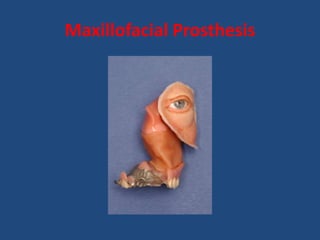
4. MAXILLO-FACIAL PROSTHESIS
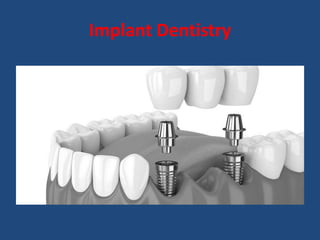
5. ORAL IMPLANTOLOGY
6. MATERIALS AND INSTRUMENTATION
7. GENERAL
8. CONCLUSION
INTRODUCTION
• The only thing in life that is constant is change, and
development and the development is the essence of any
change.
• Dentistry has come a long way from just replacing missing
teeth to replacing lost alveolus supporting facial structures,
recreating esthetics, reestablishing phonetics and many other
major developments.
• Most of all we can say that in prosthetics by using all the
artificial materials as well as technologies we can give a
natural appearance of an individual at the best of mankind.
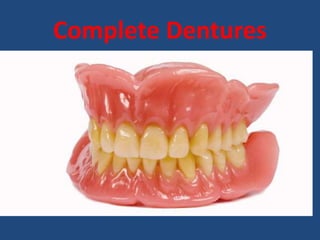
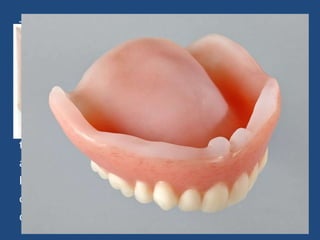
Complete Dentures
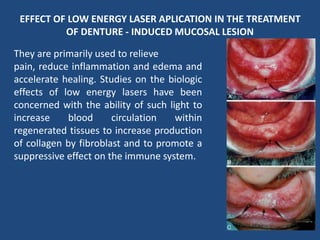
EFFECT OF LOW ENERGY LASER APLICATION IN THE TREATMENT
OF DENTURE - INDUCED MUCOSAL LESION
They are primarily used to relieve
pain, reduce inflammation and edema and
accelerate healing. Studies on the biologic
effects of low energy lasers have been
concerned with the ability of such light to
increase blood circulation within
regenerated tissues to increase production
of collagen by fibroblast and to promote a
suppressive effect on the immune system.
A CAD/CAM SYSTEM FOR FABRICATION OF COMPLETE
DENTURES
UP Vol 7 No 1 1994
Methods of recording and measuring 3D
morphology have been greatly improved with
recent advancementof optoelectronic measuring
unit CAD software.
PROCEDURE:
Involve three major steps
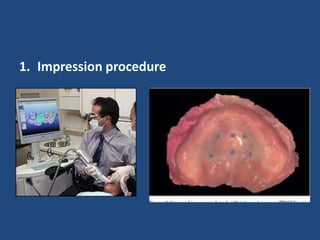
• (1) Impression procedure
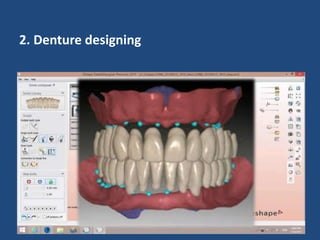
• (2) Denture designing
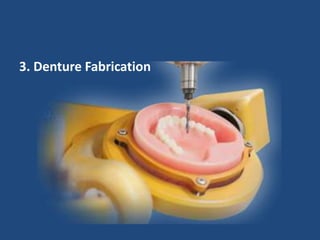
• (3) Denture fabrication
1. Impression procedure
2. Denture designing
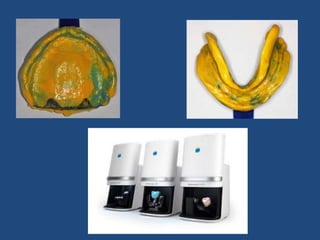
3. Denture Fabrication
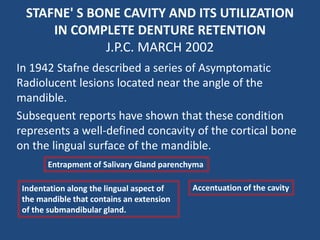
STAFNE' S BONE CAVITY AND ITS UTILIZATION
IN COMPLETE DENTURE RETENTION
J.P.C. MARCH 2002
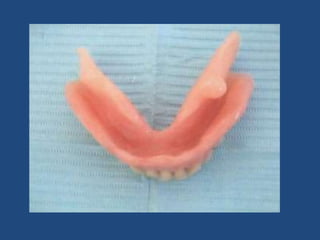
In 1942 Stafne described a series of Asymptomatic
Radiolucent lesions located near the angle of the
mandible.
Subsequent reports have shown that these condition
represents a well-defined concavity of the cortical bone
on the lingual surface of the mandible.
Entrapment of Salivary Gland parenchyma
Accentuation of the cavityIndentation along the lingual aspect of
the mandible that contains an extension
of the submandibular gland.
MAGNETS IN PROSTHETIC DENTISTRY
J.P.D. AUG 2001 Vol 86 No 2.
• The reason for their popularity is related to their
small size and strong attractive forces allow them to
be placed in prosthesis without being obtrusive
within the mouth.
SURFACE CONDITIONS AND VISCOELASTIC
PROPERTIES OF DENTURE LINER PERMAFLEX
IJP Vol 8 No 3 1995
• When patients suffer from fragile supporting
mucosa, excessive residual ridge resorption,
substantial undercuts and/or Traumatic or pathologic
tissue, less, the clinician may opt for the use of a soft
lining material between the intaglio surface of a
prosthesis and the supporting tissues.
The selected material must
a) minimize bone resorption
b) protect supporting gingival tissues
c) provides good surface condition that is can enable to
clinical adjustment.
Materials include in this family of Denture liners are
those in the family of Acrylic Resins.
a) Dentimex BV
b) Perform
c) Dimethyl polysiloxanes (DMPS-Flexor)
d) Ethylene Vinyl Acetate Copolymers
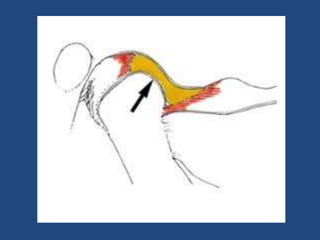
CENTRIC RELATION A NEW CONCEPT
• A new concept of Centric Relation is defined
as "A clinically determined position of the
mandible both condyles into their anterior
uppermost position.
• This definition defines the old definition is the
centric relation is the relationship of the
mandible to maxilla when the condyles are at
the most posterior portion of the glenoid
fossa.
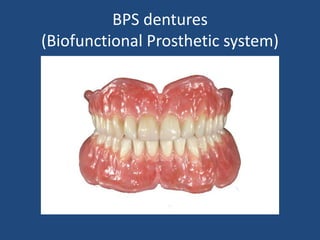
BPS dentures
(Biofunctional Prosthetic system)
Fixed Partial Dentures
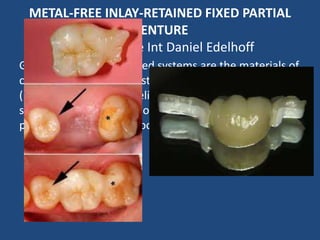
METAL-FREE INLAY-RETAINED FIXED PARTIAL
DENTURE
Quintessence Int Daniel Edelhoff
Generally metal-reinforced systems are the materials of
choice for fabricating posterior fixed partial denture
(FPD) because of their reliability and durability, but this
system facilitate the periodontal assessment and
preserving the healthy tooth structure.
Disadvantages of Metal alloy framework
1. Base metal components have negative effects on adjacent
soft tissues.
2. Opaque darkish appearance.
Pre requisites for metal free FPD:
1. Good oral hygiene
2. Low susceptibility to caries
3. Parallel alignment of abutment teeth
4. Min height >5mm
5. Max mesiodistal width extension of interdental gap of 9mm if
pressed ceramic is used or 12mm for fibre reinforced
composites are used.
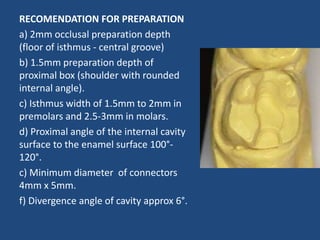
RECOMENDATION FOR PREPARATION
a) 2mm occlusal preparation depth
(floor of isthmus - central groove)
b) 1.5mm preparation depth of
proximal box (shoulder with rounded
internal angle).
c) Isthmus width of 1.5mm to 2mm in
premolars and 2.5-3mm in molars.
d) Proximal angle of the internal cavity
surface to the enamel surface 100°-
120°.
c) Minimum diameter of connectors
4mm x 5mm.
f) Divergence angle of cavity approx 6°.
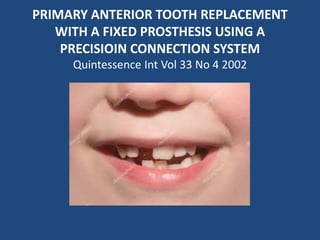
PRIMARY ANTERIOR TOOTH REPLACEMENT
WITH A FIXED PROSTHESIS USING A
PRECISIOIN CONNECTION SYSTEM
Quintessence Int Vol 33 No 4 2002
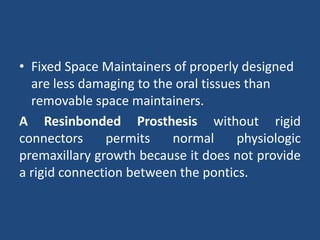
• Fixed Space Maintainers of properly designed
are less damaging to the oral tissues than
removable space maintainers.
A Resinbonded Prosthesis without rigid
connectors permits normal physiologic
premaxillary growth because it does not provide
a rigid connection between the pontics.
The Crownless Bridge Works System (CBW Co)
was developed in by Nijwegen University as an
advancement of Universal Dental Anchorage
(UDA) Plus System.
With this system it is possible to replace both
anterior and posterior teeth with a strong
prosthesis of single or multiple pontics and at
the same time to preserve abutment teeth.
Advantages:
1. Minimally invasive abutment preparation.
2. Improved distribution of loads compared to that
with adhesive prosthesis.
3. Few periodontal problems because of absence of
margins.
4. Reversible and easily repairable system.
5. No alternation in occlusion.
6. Minimal stress to patients.
CHAIR SIDE PRE FABRICATED FIBRE
REINFORCED RESIN COMPOSITE FIXED PARTIAL
DENTURE
Indications of this FRC FPD
l. Emergency replacement of Tooth lost due to
Trauma.
2. Ant Tooth extracted due to failed Endodontic
procedure.
3. Fixed space maintainer, after Orthodontic
Treatment.
4. Prior to loading of Implants
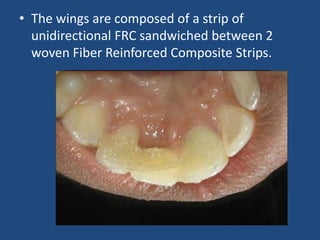
• The wings are composed of a strip of
unidirectional FRC sandwiched between 2
woven Fiber Reinforced Composite Strips.
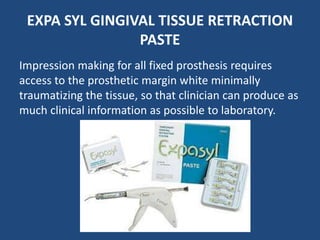
EXPA SYL GINGIVAL TISSUE RETRACTION
PASTE
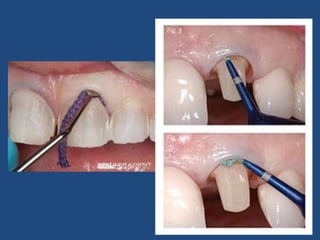
Impression making for all fixed prosthesis requires
access to the prosthetic margin white minimally
traumatizing the tissue, so that clinician can produce as
much clinical information as possible to laboratory.
• Expa-syl is injected into the sulcus left in space for approx 1
to 2 mins and then thoroughly rinsed with air/water spray.
The sulcus is left open and dry ready for impression
making.
• Expasyl composed mainly of two materials Kaolin and A12
Cl, act as an haemostatic agent, Kaolin is a clay like material
responsible for the body or rigidity of the material.
• Expasyl is an water soluble paste so it should be used
without salivary contamination.
• Clinician should be aware of potential interaction between
Expasyl and Impression material especially Alginates and
Polyether with Aluminium chloride. Ideally Expasyl should
be used with polyvinyl siloxane impression
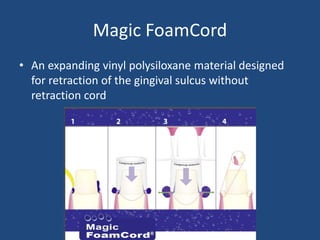
Magic FoamCord
• An expanding vinyl polysiloxane material designed
for retraction of the gingival sulcus without
retraction cord
ADVANTAGES:
+ Less traumatic to tissues than retraction cord
+ Color of foam makes it easy to see during use
+ Easy to remove material from preparation and sulcus
+ Adequate working time
+ Lot number and expiration date provided on foam cartridges
DISADVANTAGES:
- Limited clinical indications
- No hemostasis provided
- Relatively expensive compared with retraction cord
- No improvement in speed or quality of retraction compared with
cord
- Less effective on subgingival margins
- Intraoral tips may be too large to adequately inject material into
sulcus
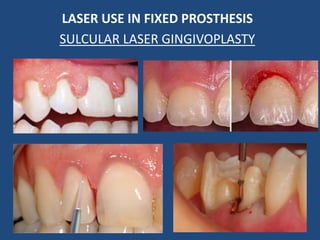
LASER APPLICATION IN PROSTHETIC DENTISTRY
DCNA Vol 44 No 4, Oct 2000
• The current use of Lasers in Reconstructive Dentistry
encompasses a wide variety of soft tissue procedures
but the future may hold promise for hard tissue
procedures too.
LASER USE IN FIXED PROSTHESIS
SULCULAR LASER GINGIVOPLASTY
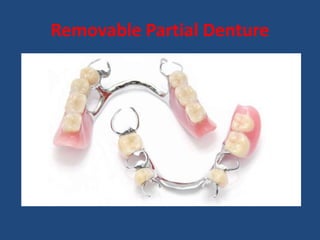
Removable Partial Denture
Flexible / Semi- Flexible RPDs
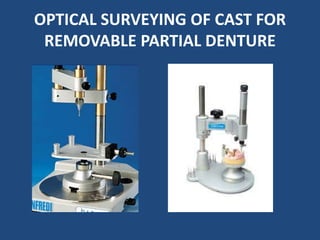
OPTICAL SURVEYING OF CAST FOR
REMOVABLE PARTIAL DENTURE
• The cast is placed on a movable table and surveyed in a
dark room using parallel light beams.
• The survey line is the border of the light and dark zone.
• The geometric location of a conventional lead marker
survey line and the one created by light beams are in
the same location.
• After securing most favorable path of insertion for
design of RPD the table of the surveyor is fixed in
position and survey lines are marked with lead marker.
Advantages
• Change of survey lines and undercuts can be easily
inspected for different position of the cast.
• Slight undercut that cannot be measured by lead
marker can be observed by optical surveying.
Maxillofacial Prosthesis
A TITANIUM AND VISIBLE LIGHT POLYMERIZED RESIN
OBTURATOR
JPD APRIL 2002 Vol 87 No 4
BENITO RILO URBANA SANTANA
• When natural teeth are available as abutment, a metal frame work
is indicated typically made up of (Co-Cr).
• But commercially pure titanium has been in use for more than a
decade approx. weighs 40% lighter than (Co - Cr) frame work.
Because the tissue surrounding the defect change rapidly after surgery
as well as during or after radiotherapy, repeated adjustment is
necessary.
The use of visible light polymerized Resin (VLP) not only reduces the
weight but also improves oral hygiene since these resins demonstrate
a much lower porosities than conventional auto polymerized.
Advantages : 1. decrease weight
2. Easy to Fabricate
3. Easy to Adjust.
OROFACIAL PROSTHESIS DESIGN AND
FABRICATION USING STEREOLITHOGRAPHY
Aust Dent Journal 2000 45:4
• The use of stereolithography for the manufacture of
implantable prosthesis is relatively new aspects of
this dentistry.
• Data extracted from Computed Tomography (CT )
scan can be used to produce computer models of
three dimensional (3D) anatomical structures. Using
sterolithography, a rapid prototyping technique these
computer models can be made into solid physical
models.
These models are then used for diagnosis and treatment planning of various cases.
Implant Dentistry
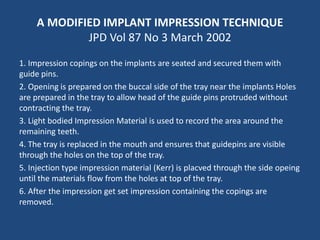
A MODIFIED IMPLANT IMPRESSION TECHNIQUE
JPD Vol 87 No 3 March 2002
1. Impression copings on the implants are seated and secured them with
guide pins.
2. Opening is prepared on the buccal side of the tray near the implants Holes
are prepared in the tray to allow head of the guide pins protruded without
contracting the tray.
3. Light bodied Impression Material is used to record the area around the
remaining teeth.
4. The tray is replaced in the mouth and ensures that guidepins are visible
through the holes on the top of the tray.
5. Injection type impression material (Kerr) is placved through the side opeing
until the materials flow from the holes at top of the tray.
6. After the impression get set impression containing the copings are
removed.
RETRIEVAL TECHNIQUE FOR FRACTURED IMPLANT-
SCREW
JPD Nov 2001 Vol 86 No 5 Russell, T. Williamson Fonda.
G. Robinson
• In implant prosthodontics abutment screws and prosthetic retaining
screws both have the potential for fracture.
• Screw loosening and Retightening may lead to subsequent # of
abutment screws or prosthetic retaining screws.
• If an abutment screw # above the head of the implant, haemostat
may be useful to grasp the broken screw but if the screw # below
the head of the implant then other method is applicable.
• After the prosthesis or abutment is removed the screw hole is
vigourously flushed with an air/water spray from a 3-way syringe.
• An airstream is used to dry the screw hole.
• A sharp 1/4th round bur in a high speed handpiece is activated, and
lightly touched to the exposed site of # screw.
• The objective is to have spinning bur blades contract the metal
surface of the screw so the screw will spin out of the screw hole.
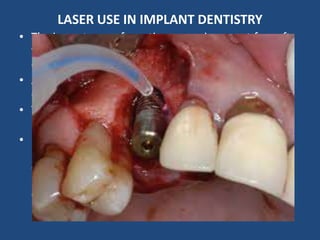
LASER USE IN IMPLANT DENTISTRY
• The importance of creating an environment for soft
tissues around perimucosal portion of the implants
cannot be over stated.
• All implants must pass through the submucosa and
overlying stratified Squamous Epithelium.
• The gingival epithelium or biologic seal become an
important factor in implant longevity.
• If a biological seal is created from the beginning of
implant uncovering using laser technology vs.
conventional surgery, the attached gingiva would
heal directly around the implant, forming an
epithelial cuff.
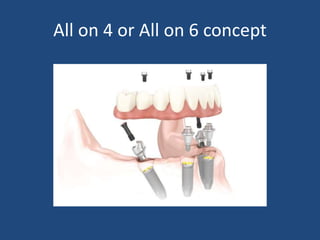
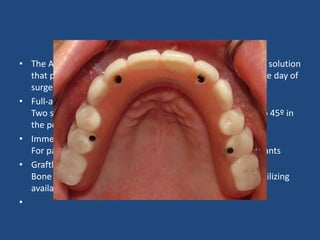
All on 4 or All on 6 concept
• The All-on-4® treatment concept is a cost-efficient, graftless solution
that provides patients with a fixed full-arch prosthesis on the day of
surgery.
• Full-arch rehabilitation with only four implants
Two straight anterior implants and two implants tilted up to 45º in
the posterior
• Immediate Function (fixed provisional bridge)
For patients meeting criteria for immediate loading of implants
• Graftless procedure
Bone grafting is avoided by tilting the posterior implants, utilizing
available bone
•
Advantages:
• Rapid improvement in quality of life.
A fixed full-arch prosthesis on the day of surgery quickly leads to
improved patient satisfaction – with regards to function, esthetics,
sense, speech and self-esteem.
• Shorter treatment times
Tilting of the posterior implants avoids the
need for time-consuming bone grafting procedures, while immediate
l loading shortens time-to-teeth.
• Lower costs
The concept is the least costly in comparison with conventional
implant treatment modalities of the edentulous and soon-to-be
edentulous jaw.
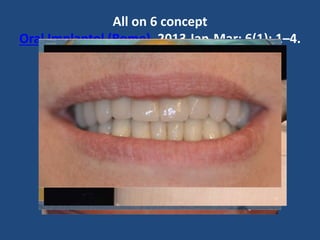
All on 6 concept
Oral Implantol (Rome). 2013 Jan-Mar; 6(1): 1–4.
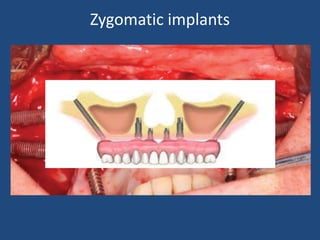
Zygomatic implants
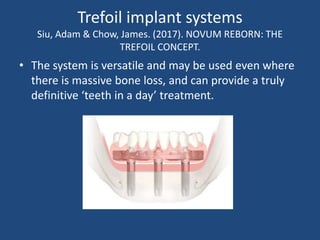
Trefoil implant systems
Siu, Adam & Chow, James. (2017). NOVUM REBORN: THE
TREFOIL CONCEPT.
• The system is versatile and may be used even where
there is massive bone loss, and can provide a truly
definitive ‘teeth in a day’ treatment.
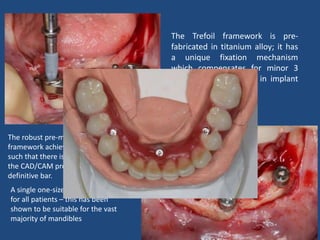
• With meticulous radiographic planning, surgery takes place
using Brånemark’s original guided surgery protocol in which a
series of cleverly constructed surgical guides are used to
incrementally prepare sites for, and then to fully guide the
positioning of three specially designed implants into
predetermined positions in the anterior mandible.
The Trefoil framework is pre-
fabricated in titanium alloy; it has
a unique fixation mechanism
which compensates for minor 3
dimensional deviations in implant
placement.
The robust pre-manufactured
framework achieves a passive fit,
such that there is then no need for
the CAD/CAM production of a
definitive bar.
A single one-size framework is used
for all patients – this has been
shown to be suitable for the vast
majority of mandibles
Malo Bridge
Dental Materials
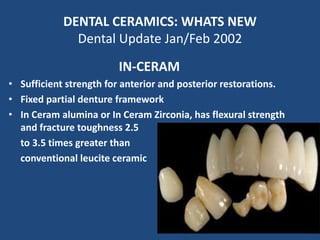
DENTAL CERAMICS: WHATS NEW
Dental Update Jan/Feb 2002
IN-CERAM
• Sufficient strength for anterior and posterior restorations.
• Fixed partial denture framework
• In Ceram alumina or In Ceram Zirconia, has flexural strength
and fracture toughness 2.5
to 3.5 times greater than
conventional leucite ceramic
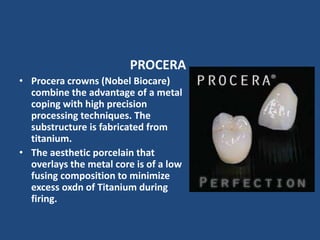
PROCERA
• Procera crowns (Nobel Biocare)
combine the advantage of a metal
coping with high precision
processing techniques. The
substructure is fabricated from
titanium.
• The aesthetic porcelain that
overlays the metal core is of a low
fusing composition to minimize
excess oxdn of Titanium during
firing.
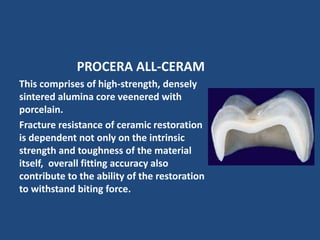
PROCERA ALL-CERAM
This comprises of high-strength, densely
sintered alumina core veenered with
porcelain.
Fracture resistance of ceramic restoration
is dependent not only on the intrinsic
strength and toughness of the material
itself, overall fitting accuracy also
contribute to the ability of the restoration
to withstand biting force.
IPS EMPRESS 2 (INVOCLAR VIVADENT)
• Hot-pressed leucite-reinforced ceramic
were introduced serving to reinforce
the glossy matrix and prevent crack
propagation
• the strength of the resultant material is
reported to be 3 times that of original
Empress.
• While 1.5mm of axial reduction is
usually recommended for metal
ceramics only I mm is needed for IPS
Empress 2.
CAD-CAM
• The first chair side produced ceramic inlay based on a CAD
CAM unit. (Cerec, Siemens Germany) was placed in 1985 since
when there have been several related developments including
introduction of second generation in 1994 and in 2000
Cerec3.
• Cerec 3 comprises both an acquisition and a milling unit which
enables concurrent designs and production of restoration.
• The softwares can be supplemented with Cerec 3 crown
which contains a tooth library and is said to be suitable for the
manufacture of all posterior restoration and anterior crowns.
• The Cerec 3 milling unit has been separated from the
acquisition unit to enable simultaneous design and milling.
The milling wheel had been replaced with tapered diamond
bur reducing the machining process time by 3-5 mins.
• The milling element is designed to accommodate the future
option of fabricating three unit Bridges.
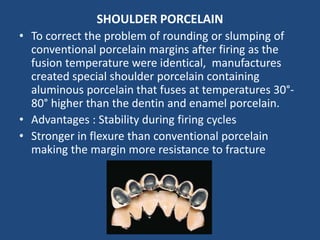
SHOULDER PORCELAIN
• To correct the problem of rounding or slumping of
conventional porcelain margins after firing as the
fusion temperature were identical, manufactures
created special shoulder porcelain containing
aluminous porcelain that fuses at temperatures 30°-
80° higher than the dentin and enamel porcelain.
• Advantages : Stability during firing cycles
• Stronger in flexure than conventional porcelain
making the margin more resistance to fracture
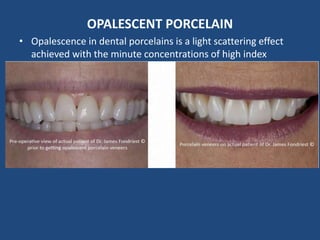
OPALESCENT PORCELAIN
• Opalescence in dental porcelains is a light scattering effect
achieved with the minute concentrations of high index
refraction oxides in a size range near the wavelength of visible
light.
• Opalescent porcelain is a specific type of porcelain that offers
more brightness, compared to traditional porcelain. This
porcelain also allows the lab technician to add intrinsic stains
commonly found in natural teeth. The subtle stains and incisal
translucency added, are what make an opalescent porcelain
veneer look believably natural.
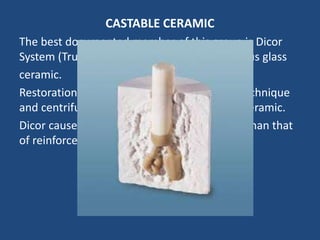
CASTABLE CERAMIC
The best documented member of this group is Dicor
System (Trubyte Dentsply) which is a micaceous glass
ceramic.
Restoration are produced with the lost wax technique
and centrifugal casting of heat-treated glass ceramic.
Dicor causes less wear of opposing dentition than that
of reinforced conventional porcelain.
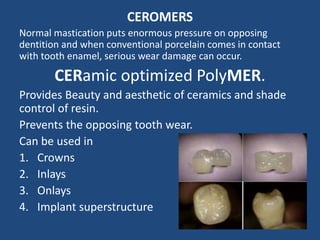
CEROMERS
Normal mastication puts enormous pressure on opposing
dentition and when conventional porcelain comes in contact
with tooth enamel, serious wear damage can occur.
CERamic optimized PolyMER.
Provides Beauty and aesthetic of ceramics and shade
control of resin.
Prevents the opposing tooth wear.
Can be used in
1. Crowns
2. Inlays
3. Onlays
4. Implant superstructure
LITHIUM ION STRENGTHENING OF DENTAL
PORCELAIN
UP Vol 8 No 3 1995
Disadvantages of Ceramic materials is the low tensile
strength when unsupported and subjected to occlusal
loading there is a tendency to fracture.
Thermal tempering and ion exchange have been used
to improve the mechanical properties of existing dental
porcelain.
A low thermal expansion surface
layer that is placed in
compression on cooling, thus
increases resistance to tensile
strengths
The replacement of
monovalent ions at the surface
of the
glass with larger ions.
Advantages:
Compressive strength is generated in the surface
layer and decrease the tendency towards crack
propagation.
EVALUATION OF A NEW OPAQUE SYSTEM FOR METAL
CERAMIC RESTORATION
UP Vol 8 No 2 1995
Vita VMK-Paint-On 88 opaque and Opaque P are two
conventional opaque systems. Recently a new opaque
system called BIOPAQUE become commercially
available. This opaque system can be directly applied to
metal surface without mining and condensing. It offers
easy application and decrease working time.
Advantage: uniform thickness and excellent opacity
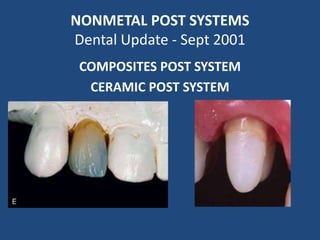
NONMETAL POST SYSTEMS
Dental Update - Sept 2001
COMPOSITES POST SYSTEM
CERAMIC POST SYSTEM
COMPOSITE POST SYSTEM
Composed of fibers of carbon or silica surrounded by
matrix of polymer resin.
The philosophy behind the use of these materials lies in
the belief that a post should mimic the dentin of the
root in its physical properties, distribute the stresses
imposed in the root in most favorable ways to reduce
chances of root fracture.
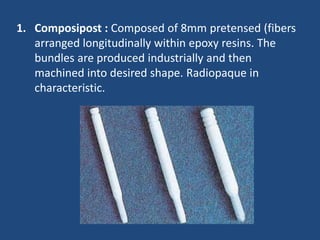
1. Composipost : Composed of 8mm pretensed (fibers
arranged longitudinally within epoxy resins. The
bundles are produced industrially and then
machined into desired shape. Radiopaque in
characteristic.
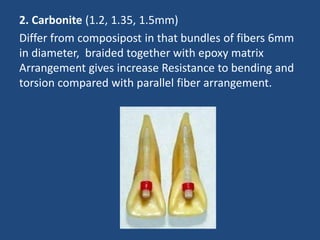
2. Carbonite (1.2, 1.35, 1.5mm)
Differ from composipost in that bundles of fibers 6mm
in diameter, braided together with epoxy matrix
Arrangement gives increase Resistance to bending and
torsion compared with parallel fiber arrangement.
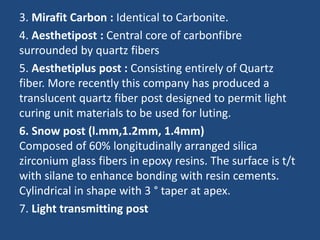
3. Mirafit Carbon : Identical to Carbonite.
4. Aesthetipost : Central core of carbonfibre
surrounded by quartz fibers
5. Aesthetiplus post : Consisting entirely of Quartz
fiber. More recently this company has produced a
translucent quartz fiber post designed to permit light
curing unit materials to be used for luting.
6. Snow post (l.mm,1.2mm, 1.4mm)
Composed of 60% longitudinally arranged silica
zirconium glass fibers in epoxy resins. The surface is t/t
with silane to enhance bonding with resin cements.
Cylindrical in shape with 3 ° taper at apex.
7. Light transmitting post
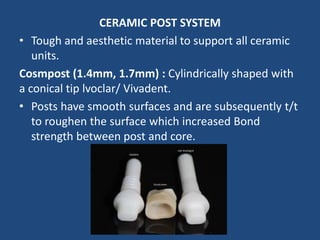
CERAMIC POST SYSTEM
• Tough and aesthetic material to support all ceramic
units.
Cosmpost (1.4mm, 1.7mm) : Cylindrically shaped with
a conical tip lvoclar/ Vivadent.
• Posts have smooth surfaces and are subsequently t/t
to roughen the surface which increased Bond
strength between post and core.
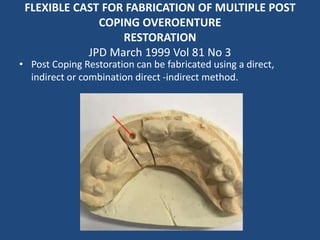
FLEXIBLE CAST FOR FABRICATION OF MULTIPLE POST
COPING OVEROENTURE
RESTORATION
JPD March 1999 Vol 81 No 3
• Post Coping Restoration can be fabricated using a direct,
indirect or combination direct -indirect method.
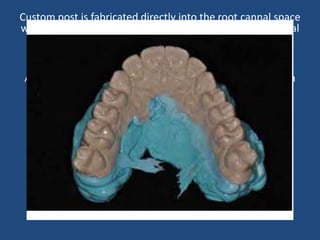
Custom post is fabricated directly into the root cannal space
with pattern resin (Duralay). Core is also fabricated minimal
Retentive grooves are placed in resin pattern core to look
the post into the impression material.
After placing the gingival retraction cord around the teeth
to provide access to intracrevicular margins,
an impression is made with Polyether Elastomeric
Impression Material.
Lightly lubricate the posts with petrolleum jelly and a
flexible working cast is poured with Mach 2 die system
using 2 stage pouring Technique.
After 6mins the flexible cast is seperated and die is made
new fabrication of coping is done on the cast
using an indirect method
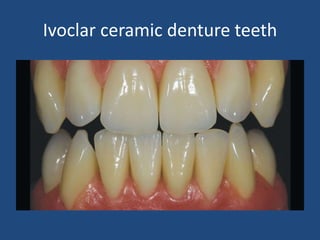
Ivoclar ceramic denture teeth
IMPROVEMENTS IN ALGINATES
1. Flavour Added - Spearmint / Mango / Mint
2. Rapid Set - Hydrogum Normal Set - Neocolloid
3. Dust free - Aliginoplast
4. Chromatic Alginate - TRIALGIN / KROMALGIN
5. Paste form - (Catalyst + Base)
6. Alginate Containing Microbials
1) Chlorhexidine
2) Quantanary Aluminium (Components
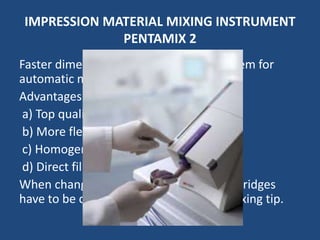
IMPRESSION MATERIAL MIXING INSTRUMENT
PENTAMIX 2
Faster dimension for perfect mixing. System for
automatic mixing and dispensing.
Advantages :
a) Top quality mix in less time
b) More flexible mix
c) Homogenous void free mix
d) Direct filling of syringes and Trays
When changing impression materials cartridges
have to be changed and change penta mixing tip.
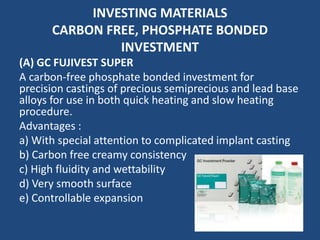
INVESTING MATERIALS
CARBON FREE, PHOSPHATE BONDED
INVESTMENT
(A) GC FUJIVEST SUPER
A carbon-free phosphate bonded investment for
precision castings of precious semiprecious and lead base
alloys for use in both quick heating and slow heating
procedure.
Advantages :
a) With special attention to complicated implant casting
b) Carbon free creamy consistency
c) High fluidity and wettability
d) Very smooth surface
e) Controllable expansion
B) GC FUJIVEST II
A carbon free phosphate bonded investment for precision
crowns and bridge castings of all dental alloys for use in both
quick and slow heating process.
Advantages :
a) Carbon free
b) High fluidity + Wettability
c) Controlled setting + Thermal Expansion
d) Smooth surface
e) Detailed Reproduction
f) Ringless Technique possible in both slow and quick heating
process
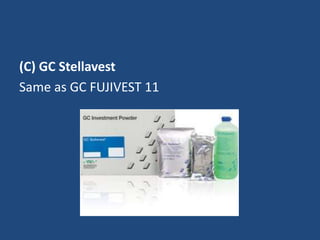
(C) GC Stellavest
Same as GC FUJIVEST 11
BITE REGISTRATION MATERIAL
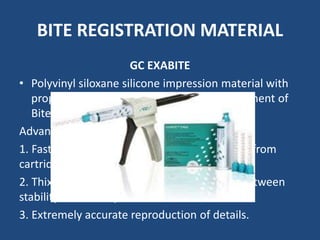
GC EXABITE
• Polyvinyl siloxane silicone impression material with
properties specially adjusted to the requirement of
Bite Registration.
Advantages
1. Fast reliable mixing and application directly from
cartridges.
2. Thixotropic properties with ideal balance between
stability and fluidity.
3. Extremely accurate reproduction of details.
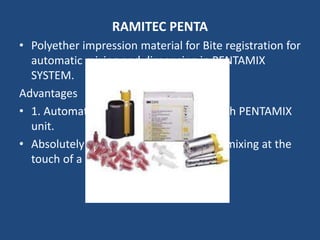
RAMITEC PENTA
• Polyether impression material for Bite registration for
automatic mixing and dispensing in PENTAMIX
SYSTEM.
Advantages
• 1. Automatic mixing and dispensing with PENTAMIX
unit.
• Absolutely homogenous and void free mixing at the
touch of a button.
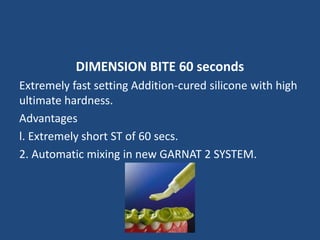
DIMENSION BITE 60 seconds
Extremely fast setting Addition-cured silicone with high
ultimate hardness.
Advantages
l. Extremely short ST of 60 secs.
2. Automatic mixing in new GARNAT 2 SYSTEM.
MAXILLOFACIAL MATERIAL
• Series of Co-polymers for methylmethacrylate have been
introduced. Another is Ter polymer for the use as a synthetic
acrylic latex to form a skin over elastomer scaffolding.
Polydimethylsiloxane and various proprietary silicones are
premost in clinical usage, particularly where flexible tissue
anatomic reconstructing is needed.
There are two basic types
(A) RTV - Room Temperature Vulcanizing
(B) HTV - Heat Vulcanizing.
Some new structural polymers
1. Silphenylene Elastomers
2. Chlorinated Polyethylene.
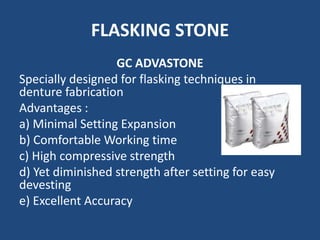
FLASKING STONE
GC ADVASTONE
Specially designed for flasking techniques in
denture fabrication
Advantages :
a) Minimal Setting Expansion
b) Comfortable Working time
c) High compressive strength
d) Yet diminished strength after setting for easy
devesting
e) Excellent Accuracy
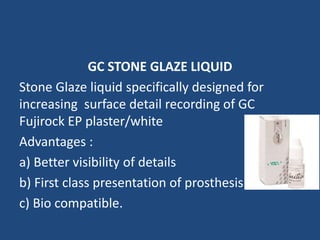
GC STONE GLAZE LIQUID
Stone Glaze liquid specifically designed for
increasing surface detail recording of GC
Fujirock EP plaster/white
Advantages :
a) Better visibility of details
b) First class presentation of prosthesis
c) Bio compatible.
RESIN REINFORCED GLASS-IONOMER
LUITING CEMENT
Due to complication of Resin + GIC this material provide wide variety
of application possibilities.
Indicated for luting all kinds of metal and Acrylic/Resin crowns, inlays,
onlays and bridges as well as luting of Porcelain ceramic inlays.
Advantages :
Easy mixing and handling like conventional cement.
Similar mechanical properties to Resin cement
Elimination of complex and moisture sensitive bonding procedure.
Good adhesion to metal, resin and silanated porcelain.
No post operative sensitivity.
Optimal Marginal Seal.
Radiopacity.
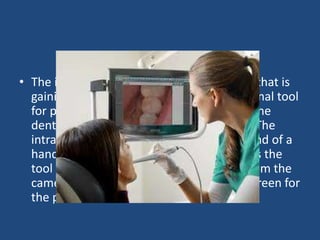
Intraoral Camera
• The intraoral camera is a new technology that is
gaining popularity as not only an educational tool
for patients, but as an additional way for the
dentist to detect dental problems earlier. The
intraoral camera is a tiny camera on the end of a
hand-held tool. As the dentist manipulates the
tool in the patient’s mouth, the images from the
camera are projected on to a computer screen for
the patient to watch.
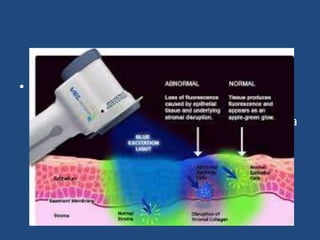
Velscope for Detection of Oral Cancer
• The Velscope shines a blue light from a hand-
held device on the tissue of the mouth.
Normal tissue absorbs the light and re-emits a
pale green light. Abnormal tissue appears to
be dark or a dark brown color.
Waterlase MD
• For those that hate the dentist’s drill (and who doesn’t),
there is an alternative called Waterlase MD. Unlike the drill,
which generates heat and can induce pain, Waterlase MD
uses a laser with a high pressure air/water spray.
• According to BIOLASE, the company that developed it, this
new technology is more precise and generates less blood
than a scalpel. Even better, a joint study by BIOLASE and
Temple University, found that Waterlase MD was “capable
of reducing the level of infection in root canals and
adjacent infected dentin by up to 99.7 percent.”
Nanotechnology
• Nanotechnologies are increasingly used for
surface modifications of dental implants.
Another approach to enhance osseointegration
is the application of thin calcium phosphate
(CaP) coatings. Bioactive CaP nanocrystals
deposited on titanium implants are resorbable
and stimulate bone apposition and healing.
Future nanometer controlled surfaces may
ultimately direct the nature of peri-implant
tissues and improve their clinical success rate.
Bone replacement materials
• It is this natural nanostructure that
nanotechnology aims to emulate for
orthopedic and dental applications. The
smaller the particle is, the larger the surface
area is in volume. Nano-Bone® uses this
principle.
Composites:
Nanosized particle fillers increases the property
of the material.
More esthetic results and lustrous.
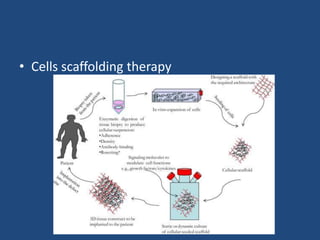
Tissue engineering
• Tissue loss due to trauma, disease or congenital abnormalities
is a major health care problem worldwide. When this occurs
in the craniofacial region, it induces serious physiological and
psychological consequences on patients.
• In this approach of tissue reconstruction, the native totipotent
un differentiated stem cells are harvested and stored in
cryostorage and then used for our disposal in case of
unfortunate events.
• Cell injection therapy:
Embryonic stem cells having great potential in
regenerative medicine is used.
These cells are implanted into the area of defect
and exposed to cell initiating factors, to which
these cells starts to differentiate and regenerate
the lost tissues.
• Cell induction therapy:
The totipotent cells are shifted or recruited from
the circulating body cells to regenerate the tissues.
Example of factors - fibroblasts growth factors-2
and 9 (FGFs-2 and -9), transforming growth factors
β1 (TGF-β1), vascular endothelial growth factors
(VEGFs), recombinant human
growth/differentiation factor-5 (rhGDF-5)13 and
bone morphogenetic protein.
• Cells scaffolding therapy
Conclusion
• Dentistry has come a long way since the days
of manual tools and chemical-laden x-rays.
Now there is state-of the- art technology to
diagnose oral cancer better, reduce possible
infection, and catch dental problems faster
than in the past. Patients also can experience
less discomfort, less numbness downtime, less
exposure to radiation–as well as be better
informed regarding their dental work in real
time.
Thank You

Recent advances in prosthdontics

  • 1.
  • 2.
    Contents 1. COMPLETE DENTUREPROTHESIS 2. FIXED PARTIAL DENTURE PROSTHESIS 3. REMOVABLE PARTIAL DENTURE PROSTHESIS 4. MAXILLO-FACIAL PROSTHESIS 5. ORAL IMPLANTOLOGY 6. MATERIALS AND INSTRUMENTATION 7. GENERAL 8. CONCLUSION
  • 3.
    INTRODUCTION • The onlything in life that is constant is change, and development and the development is the essence of any change. • Dentistry has come a long way from just replacing missing teeth to replacing lost alveolus supporting facial structures, recreating esthetics, reestablishing phonetics and many other major developments. • Most of all we can say that in prosthetics by using all the artificial materials as well as technologies we can give a natural appearance of an individual at the best of mankind.
  • 4.
  • 5.
    EFFECT OF LOWENERGY LASER APLICATION IN THE TREATMENT OF DENTURE - INDUCED MUCOSAL LESION They are primarily used to relieve pain, reduce inflammation and edema and accelerate healing. Studies on the biologic effects of low energy lasers have been concerned with the ability of such light to increase blood circulation within regenerated tissues to increase production of collagen by fibroblast and to promote a suppressive effect on the immune system.
  • 6.
    A CAD/CAM SYSTEMFOR FABRICATION OF COMPLETE DENTURES UP Vol 7 No 1 1994 Methods of recording and measuring 3D morphology have been greatly improved with recent advancementof optoelectronic measuring unit CAD software. PROCEDURE: Involve three major steps • (1) Impression procedure • (2) Denture designing • (3) Denture fabrication
  • 7.
  • 9.
  • 10.
  • 11.
    STAFNE' S BONECAVITY AND ITS UTILIZATION IN COMPLETE DENTURE RETENTION J.P.C. MARCH 2002 In 1942 Stafne described a series of Asymptomatic Radiolucent lesions located near the angle of the mandible. Subsequent reports have shown that these condition represents a well-defined concavity of the cortical bone on the lingual surface of the mandible. Entrapment of Salivary Gland parenchyma Accentuation of the cavityIndentation along the lingual aspect of the mandible that contains an extension of the submandibular gland.
  • 13.
    MAGNETS IN PROSTHETICDENTISTRY J.P.D. AUG 2001 Vol 86 No 2. • The reason for their popularity is related to their small size and strong attractive forces allow them to be placed in prosthesis without being obtrusive within the mouth.
  • 14.
    SURFACE CONDITIONS ANDVISCOELASTIC PROPERTIES OF DENTURE LINER PERMAFLEX IJP Vol 8 No 3 1995 • When patients suffer from fragile supporting mucosa, excessive residual ridge resorption, substantial undercuts and/or Traumatic or pathologic tissue, less, the clinician may opt for the use of a soft lining material between the intaglio surface of a prosthesis and the supporting tissues.
  • 15.
    The selected materialmust a) minimize bone resorption b) protect supporting gingival tissues c) provides good surface condition that is can enable to clinical adjustment. Materials include in this family of Denture liners are those in the family of Acrylic Resins. a) Dentimex BV b) Perform c) Dimethyl polysiloxanes (DMPS-Flexor) d) Ethylene Vinyl Acetate Copolymers
  • 16.
    CENTRIC RELATION ANEW CONCEPT • A new concept of Centric Relation is defined as "A clinically determined position of the mandible both condyles into their anterior uppermost position. • This definition defines the old definition is the centric relation is the relationship of the mandible to maxilla when the condyles are at the most posterior portion of the glenoid fossa.
  • 18.
  • 19.
  • 20.
    METAL-FREE INLAY-RETAINED FIXEDPARTIAL DENTURE Quintessence Int Daniel Edelhoff Generally metal-reinforced systems are the materials of choice for fabricating posterior fixed partial denture (FPD) because of their reliability and durability, but this system facilitate the periodontal assessment and preserving the healthy tooth structure.
  • 21.
    Disadvantages of Metalalloy framework 1. Base metal components have negative effects on adjacent soft tissues. 2. Opaque darkish appearance. Pre requisites for metal free FPD: 1. Good oral hygiene 2. Low susceptibility to caries 3. Parallel alignment of abutment teeth 4. Min height >5mm 5. Max mesiodistal width extension of interdental gap of 9mm if pressed ceramic is used or 12mm for fibre reinforced composites are used.
  • 22.
    RECOMENDATION FOR PREPARATION a)2mm occlusal preparation depth (floor of isthmus - central groove) b) 1.5mm preparation depth of proximal box (shoulder with rounded internal angle). c) Isthmus width of 1.5mm to 2mm in premolars and 2.5-3mm in molars. d) Proximal angle of the internal cavity surface to the enamel surface 100°- 120°. c) Minimum diameter of connectors 4mm x 5mm. f) Divergence angle of cavity approx 6°.
  • 23.
    PRIMARY ANTERIOR TOOTHREPLACEMENT WITH A FIXED PROSTHESIS USING A PRECISIOIN CONNECTION SYSTEM Quintessence Int Vol 33 No 4 2002
  • 24.
    • Fixed SpaceMaintainers of properly designed are less damaging to the oral tissues than removable space maintainers. A Resinbonded Prosthesis without rigid connectors permits normal physiologic premaxillary growth because it does not provide a rigid connection between the pontics.
  • 25.
    The Crownless BridgeWorks System (CBW Co) was developed in by Nijwegen University as an advancement of Universal Dental Anchorage (UDA) Plus System. With this system it is possible to replace both anterior and posterior teeth with a strong prosthesis of single or multiple pontics and at the same time to preserve abutment teeth.
  • 26.
    Advantages: 1. Minimally invasiveabutment preparation. 2. Improved distribution of loads compared to that with adhesive prosthesis. 3. Few periodontal problems because of absence of margins. 4. Reversible and easily repairable system. 5. No alternation in occlusion. 6. Minimal stress to patients.
  • 27.
    CHAIR SIDE PREFABRICATED FIBRE REINFORCED RESIN COMPOSITE FIXED PARTIAL DENTURE Indications of this FRC FPD l. Emergency replacement of Tooth lost due to Trauma. 2. Ant Tooth extracted due to failed Endodontic procedure. 3. Fixed space maintainer, after Orthodontic Treatment. 4. Prior to loading of Implants
  • 28.
    • The wingsare composed of a strip of unidirectional FRC sandwiched between 2 woven Fiber Reinforced Composite Strips.
  • 29.
    EXPA SYL GINGIVALTISSUE RETRACTION PASTE Impression making for all fixed prosthesis requires access to the prosthetic margin white minimally traumatizing the tissue, so that clinician can produce as much clinical information as possible to laboratory.
  • 31.
    • Expa-syl isinjected into the sulcus left in space for approx 1 to 2 mins and then thoroughly rinsed with air/water spray. The sulcus is left open and dry ready for impression making. • Expasyl composed mainly of two materials Kaolin and A12 Cl, act as an haemostatic agent, Kaolin is a clay like material responsible for the body or rigidity of the material. • Expasyl is an water soluble paste so it should be used without salivary contamination. • Clinician should be aware of potential interaction between Expasyl and Impression material especially Alginates and Polyether with Aluminium chloride. Ideally Expasyl should be used with polyvinyl siloxane impression
  • 32.
    Magic FoamCord • Anexpanding vinyl polysiloxane material designed for retraction of the gingival sulcus without retraction cord
  • 33.
    ADVANTAGES: + Less traumaticto tissues than retraction cord + Color of foam makes it easy to see during use + Easy to remove material from preparation and sulcus + Adequate working time + Lot number and expiration date provided on foam cartridges DISADVANTAGES: - Limited clinical indications - No hemostasis provided - Relatively expensive compared with retraction cord - No improvement in speed or quality of retraction compared with cord - Less effective on subgingival margins - Intraoral tips may be too large to adequately inject material into sulcus
  • 34.
    LASER APPLICATION INPROSTHETIC DENTISTRY DCNA Vol 44 No 4, Oct 2000 • The current use of Lasers in Reconstructive Dentistry encompasses a wide variety of soft tissue procedures but the future may hold promise for hard tissue procedures too.
  • 35.
    LASER USE INFIXED PROSTHESIS SULCULAR LASER GINGIVOPLASTY
  • 36.
  • 37.
    Flexible / Semi-Flexible RPDs
  • 38.
    OPTICAL SURVEYING OFCAST FOR REMOVABLE PARTIAL DENTURE
  • 39.
    • The castis placed on a movable table and surveyed in a dark room using parallel light beams. • The survey line is the border of the light and dark zone. • The geometric location of a conventional lead marker survey line and the one created by light beams are in the same location. • After securing most favorable path of insertion for design of RPD the table of the surveyor is fixed in position and survey lines are marked with lead marker. Advantages • Change of survey lines and undercuts can be easily inspected for different position of the cast. • Slight undercut that cannot be measured by lead marker can be observed by optical surveying.
  • 40.
  • 41.
    A TITANIUM ANDVISIBLE LIGHT POLYMERIZED RESIN OBTURATOR JPD APRIL 2002 Vol 87 No 4 BENITO RILO URBANA SANTANA • When natural teeth are available as abutment, a metal frame work is indicated typically made up of (Co-Cr). • But commercially pure titanium has been in use for more than a decade approx. weighs 40% lighter than (Co - Cr) frame work. Because the tissue surrounding the defect change rapidly after surgery as well as during or after radiotherapy, repeated adjustment is necessary. The use of visible light polymerized Resin (VLP) not only reduces the weight but also improves oral hygiene since these resins demonstrate a much lower porosities than conventional auto polymerized. Advantages : 1. decrease weight 2. Easy to Fabricate 3. Easy to Adjust.
  • 42.
    OROFACIAL PROSTHESIS DESIGNAND FABRICATION USING STEREOLITHOGRAPHY Aust Dent Journal 2000 45:4 • The use of stereolithography for the manufacture of implantable prosthesis is relatively new aspects of this dentistry. • Data extracted from Computed Tomography (CT ) scan can be used to produce computer models of three dimensional (3D) anatomical structures. Using sterolithography, a rapid prototyping technique these computer models can be made into solid physical models.
  • 43.
    These models arethen used for diagnosis and treatment planning of various cases.
  • 44.
  • 45.
    A MODIFIED IMPLANTIMPRESSION TECHNIQUE JPD Vol 87 No 3 March 2002 1. Impression copings on the implants are seated and secured them with guide pins. 2. Opening is prepared on the buccal side of the tray near the implants Holes are prepared in the tray to allow head of the guide pins protruded without contracting the tray. 3. Light bodied Impression Material is used to record the area around the remaining teeth. 4. The tray is replaced in the mouth and ensures that guidepins are visible through the holes on the top of the tray. 5. Injection type impression material (Kerr) is placved through the side opeing until the materials flow from the holes at top of the tray. 6. After the impression get set impression containing the copings are removed.
  • 46.
    RETRIEVAL TECHNIQUE FORFRACTURED IMPLANT- SCREW JPD Nov 2001 Vol 86 No 5 Russell, T. Williamson Fonda. G. Robinson • In implant prosthodontics abutment screws and prosthetic retaining screws both have the potential for fracture. • Screw loosening and Retightening may lead to subsequent # of abutment screws or prosthetic retaining screws. • If an abutment screw # above the head of the implant, haemostat may be useful to grasp the broken screw but if the screw # below the head of the implant then other method is applicable. • After the prosthesis or abutment is removed the screw hole is vigourously flushed with an air/water spray from a 3-way syringe. • An airstream is used to dry the screw hole. • A sharp 1/4th round bur in a high speed handpiece is activated, and lightly touched to the exposed site of # screw. • The objective is to have spinning bur blades contract the metal surface of the screw so the screw will spin out of the screw hole.
  • 47.
    LASER USE INIMPLANT DENTISTRY • The importance of creating an environment for soft tissues around perimucosal portion of the implants cannot be over stated. • All implants must pass through the submucosa and overlying stratified Squamous Epithelium. • The gingival epithelium or biologic seal become an important factor in implant longevity. • If a biological seal is created from the beginning of implant uncovering using laser technology vs. conventional surgery, the attached gingiva would heal directly around the implant, forming an epithelial cuff.
  • 48.
    All on 4or All on 6 concept
  • 49.
    • The All-on-4®treatment concept is a cost-efficient, graftless solution that provides patients with a fixed full-arch prosthesis on the day of surgery. • Full-arch rehabilitation with only four implants Two straight anterior implants and two implants tilted up to 45º in the posterior • Immediate Function (fixed provisional bridge) For patients meeting criteria for immediate loading of implants • Graftless procedure Bone grafting is avoided by tilting the posterior implants, utilizing available bone •
  • 50.
    Advantages: • Rapid improvementin quality of life. A fixed full-arch prosthesis on the day of surgery quickly leads to improved patient satisfaction – with regards to function, esthetics, sense, speech and self-esteem. • Shorter treatment times Tilting of the posterior implants avoids the need for time-consuming bone grafting procedures, while immediate l loading shortens time-to-teeth. • Lower costs The concept is the least costly in comparison with conventional implant treatment modalities of the edentulous and soon-to-be edentulous jaw.
  • 51.
    All on 6concept Oral Implantol (Rome). 2013 Jan-Mar; 6(1): 1–4.
  • 52.
  • 53.
    Trefoil implant systems Siu,Adam & Chow, James. (2017). NOVUM REBORN: THE TREFOIL CONCEPT. • The system is versatile and may be used even where there is massive bone loss, and can provide a truly definitive ‘teeth in a day’ treatment.
  • 54.
    • With meticulousradiographic planning, surgery takes place using Brånemark’s original guided surgery protocol in which a series of cleverly constructed surgical guides are used to incrementally prepare sites for, and then to fully guide the positioning of three specially designed implants into predetermined positions in the anterior mandible.
  • 55.
    The Trefoil frameworkis pre- fabricated in titanium alloy; it has a unique fixation mechanism which compensates for minor 3 dimensional deviations in implant placement. The robust pre-manufactured framework achieves a passive fit, such that there is then no need for the CAD/CAM production of a definitive bar. A single one-size framework is used for all patients – this has been shown to be suitable for the vast majority of mandibles
  • 56.
  • 57.
  • 58.
    DENTAL CERAMICS: WHATSNEW Dental Update Jan/Feb 2002 IN-CERAM • Sufficient strength for anterior and posterior restorations. • Fixed partial denture framework • In Ceram alumina or In Ceram Zirconia, has flexural strength and fracture toughness 2.5 to 3.5 times greater than conventional leucite ceramic
  • 59.
    PROCERA • Procera crowns(Nobel Biocare) combine the advantage of a metal coping with high precision processing techniques. The substructure is fabricated from titanium. • The aesthetic porcelain that overlays the metal core is of a low fusing composition to minimize excess oxdn of Titanium during firing.
  • 60.
    PROCERA ALL-CERAM This comprisesof high-strength, densely sintered alumina core veenered with porcelain. Fracture resistance of ceramic restoration is dependent not only on the intrinsic strength and toughness of the material itself, overall fitting accuracy also contribute to the ability of the restoration to withstand biting force.
  • 61.
    IPS EMPRESS 2(INVOCLAR VIVADENT) • Hot-pressed leucite-reinforced ceramic were introduced serving to reinforce the glossy matrix and prevent crack propagation • the strength of the resultant material is reported to be 3 times that of original Empress. • While 1.5mm of axial reduction is usually recommended for metal ceramics only I mm is needed for IPS Empress 2.
  • 62.
    CAD-CAM • The firstchair side produced ceramic inlay based on a CAD CAM unit. (Cerec, Siemens Germany) was placed in 1985 since when there have been several related developments including introduction of second generation in 1994 and in 2000 Cerec3. • Cerec 3 comprises both an acquisition and a milling unit which enables concurrent designs and production of restoration. • The softwares can be supplemented with Cerec 3 crown which contains a tooth library and is said to be suitable for the manufacture of all posterior restoration and anterior crowns.
  • 63.
    • The Cerec3 milling unit has been separated from the acquisition unit to enable simultaneous design and milling. The milling wheel had been replaced with tapered diamond bur reducing the machining process time by 3-5 mins. • The milling element is designed to accommodate the future option of fabricating three unit Bridges.
  • 64.
    SHOULDER PORCELAIN • Tocorrect the problem of rounding or slumping of conventional porcelain margins after firing as the fusion temperature were identical, manufactures created special shoulder porcelain containing aluminous porcelain that fuses at temperatures 30°- 80° higher than the dentin and enamel porcelain. • Advantages : Stability during firing cycles • Stronger in flexure than conventional porcelain making the margin more resistance to fracture
  • 65.
    OPALESCENT PORCELAIN • Opalescencein dental porcelains is a light scattering effect achieved with the minute concentrations of high index refraction oxides in a size range near the wavelength of visible light. • Opalescent porcelain is a specific type of porcelain that offers more brightness, compared to traditional porcelain. This porcelain also allows the lab technician to add intrinsic stains commonly found in natural teeth. The subtle stains and incisal translucency added, are what make an opalescent porcelain veneer look believably natural.
  • 66.
    CASTABLE CERAMIC The bestdocumented member of this group is Dicor System (Trubyte Dentsply) which is a micaceous glass ceramic. Restoration are produced with the lost wax technique and centrifugal casting of heat-treated glass ceramic. Dicor causes less wear of opposing dentition than that of reinforced conventional porcelain.
  • 67.
    CEROMERS Normal mastication putsenormous pressure on opposing dentition and when conventional porcelain comes in contact with tooth enamel, serious wear damage can occur. CERamic optimized PolyMER. Provides Beauty and aesthetic of ceramics and shade control of resin. Prevents the opposing tooth wear. Can be used in 1. Crowns 2. Inlays 3. Onlays 4. Implant superstructure
  • 68.
    LITHIUM ION STRENGTHENINGOF DENTAL PORCELAIN UP Vol 8 No 3 1995 Disadvantages of Ceramic materials is the low tensile strength when unsupported and subjected to occlusal loading there is a tendency to fracture. Thermal tempering and ion exchange have been used to improve the mechanical properties of existing dental porcelain. A low thermal expansion surface layer that is placed in compression on cooling, thus increases resistance to tensile strengths The replacement of monovalent ions at the surface of the glass with larger ions.
  • 69.
    Advantages: Compressive strength isgenerated in the surface layer and decrease the tendency towards crack propagation.
  • 70.
    EVALUATION OF ANEW OPAQUE SYSTEM FOR METAL CERAMIC RESTORATION UP Vol 8 No 2 1995 Vita VMK-Paint-On 88 opaque and Opaque P are two conventional opaque systems. Recently a new opaque system called BIOPAQUE become commercially available. This opaque system can be directly applied to metal surface without mining and condensing. It offers easy application and decrease working time. Advantage: uniform thickness and excellent opacity
  • 71.
    NONMETAL POST SYSTEMS DentalUpdate - Sept 2001 COMPOSITES POST SYSTEM CERAMIC POST SYSTEM
  • 72.
    COMPOSITE POST SYSTEM Composedof fibers of carbon or silica surrounded by matrix of polymer resin. The philosophy behind the use of these materials lies in the belief that a post should mimic the dentin of the root in its physical properties, distribute the stresses imposed in the root in most favorable ways to reduce chances of root fracture.
  • 73.
    1. Composipost :Composed of 8mm pretensed (fibers arranged longitudinally within epoxy resins. The bundles are produced industrially and then machined into desired shape. Radiopaque in characteristic.
  • 74.
    2. Carbonite (1.2,1.35, 1.5mm) Differ from composipost in that bundles of fibers 6mm in diameter, braided together with epoxy matrix Arrangement gives increase Resistance to bending and torsion compared with parallel fiber arrangement.
  • 75.
    3. Mirafit Carbon: Identical to Carbonite. 4. Aesthetipost : Central core of carbonfibre surrounded by quartz fibers 5. Aesthetiplus post : Consisting entirely of Quartz fiber. More recently this company has produced a translucent quartz fiber post designed to permit light curing unit materials to be used for luting. 6. Snow post (l.mm,1.2mm, 1.4mm) Composed of 60% longitudinally arranged silica zirconium glass fibers in epoxy resins. The surface is t/t with silane to enhance bonding with resin cements. Cylindrical in shape with 3 ° taper at apex. 7. Light transmitting post
  • 76.
    CERAMIC POST SYSTEM •Tough and aesthetic material to support all ceramic units. Cosmpost (1.4mm, 1.7mm) : Cylindrically shaped with a conical tip lvoclar/ Vivadent. • Posts have smooth surfaces and are subsequently t/t to roughen the surface which increased Bond strength between post and core.
  • 77.
    FLEXIBLE CAST FORFABRICATION OF MULTIPLE POST COPING OVEROENTURE RESTORATION JPD March 1999 Vol 81 No 3 • Post Coping Restoration can be fabricated using a direct, indirect or combination direct -indirect method.
  • 78.
    Custom post isfabricated directly into the root cannal space with pattern resin (Duralay). Core is also fabricated minimal Retentive grooves are placed in resin pattern core to look the post into the impression material. After placing the gingival retraction cord around the teeth to provide access to intracrevicular margins, an impression is made with Polyether Elastomeric Impression Material. Lightly lubricate the posts with petrolleum jelly and a flexible working cast is poured with Mach 2 die system using 2 stage pouring Technique. After 6mins the flexible cast is seperated and die is made new fabrication of coping is done on the cast using an indirect method
  • 79.
  • 80.
    IMPROVEMENTS IN ALGINATES 1.Flavour Added - Spearmint / Mango / Mint 2. Rapid Set - Hydrogum Normal Set - Neocolloid 3. Dust free - Aliginoplast 4. Chromatic Alginate - TRIALGIN / KROMALGIN 5. Paste form - (Catalyst + Base) 6. Alginate Containing Microbials 1) Chlorhexidine 2) Quantanary Aluminium (Components
  • 81.
    IMPRESSION MATERIAL MIXINGINSTRUMENT PENTAMIX 2 Faster dimension for perfect mixing. System for automatic mixing and dispensing. Advantages : a) Top quality mix in less time b) More flexible mix c) Homogenous void free mix d) Direct filling of syringes and Trays When changing impression materials cartridges have to be changed and change penta mixing tip.
  • 82.
    INVESTING MATERIALS CARBON FREE,PHOSPHATE BONDED INVESTMENT (A) GC FUJIVEST SUPER A carbon-free phosphate bonded investment for precision castings of precious semiprecious and lead base alloys for use in both quick heating and slow heating procedure. Advantages : a) With special attention to complicated implant casting b) Carbon free creamy consistency c) High fluidity and wettability d) Very smooth surface e) Controllable expansion
  • 83.
    B) GC FUJIVESTII A carbon free phosphate bonded investment for precision crowns and bridge castings of all dental alloys for use in both quick and slow heating process. Advantages : a) Carbon free b) High fluidity + Wettability c) Controlled setting + Thermal Expansion d) Smooth surface e) Detailed Reproduction f) Ringless Technique possible in both slow and quick heating process
  • 84.
    (C) GC Stellavest Sameas GC FUJIVEST 11
  • 85.
    BITE REGISTRATION MATERIAL GCEXABITE • Polyvinyl siloxane silicone impression material with properties specially adjusted to the requirement of Bite Registration. Advantages 1. Fast reliable mixing and application directly from cartridges. 2. Thixotropic properties with ideal balance between stability and fluidity. 3. Extremely accurate reproduction of details.
  • 86.
    RAMITEC PENTA • Polyetherimpression material for Bite registration for automatic mixing and dispensing in PENTAMIX SYSTEM. Advantages • 1. Automatic mixing and dispensing with PENTAMIX unit. • Absolutely homogenous and void free mixing at the touch of a button.
  • 87.
    DIMENSION BITE 60seconds Extremely fast setting Addition-cured silicone with high ultimate hardness. Advantages l. Extremely short ST of 60 secs. 2. Automatic mixing in new GARNAT 2 SYSTEM.
  • 88.
    MAXILLOFACIAL MATERIAL • Seriesof Co-polymers for methylmethacrylate have been introduced. Another is Ter polymer for the use as a synthetic acrylic latex to form a skin over elastomer scaffolding. Polydimethylsiloxane and various proprietary silicones are premost in clinical usage, particularly where flexible tissue anatomic reconstructing is needed. There are two basic types (A) RTV - Room Temperature Vulcanizing (B) HTV - Heat Vulcanizing. Some new structural polymers 1. Silphenylene Elastomers 2. Chlorinated Polyethylene.
  • 89.
    FLASKING STONE GC ADVASTONE Speciallydesigned for flasking techniques in denture fabrication Advantages : a) Minimal Setting Expansion b) Comfortable Working time c) High compressive strength d) Yet diminished strength after setting for easy devesting e) Excellent Accuracy
  • 90.
    GC STONE GLAZELIQUID Stone Glaze liquid specifically designed for increasing surface detail recording of GC Fujirock EP plaster/white Advantages : a) Better visibility of details b) First class presentation of prosthesis c) Bio compatible.
  • 91.
    RESIN REINFORCED GLASS-IONOMER LUITINGCEMENT Due to complication of Resin + GIC this material provide wide variety of application possibilities. Indicated for luting all kinds of metal and Acrylic/Resin crowns, inlays, onlays and bridges as well as luting of Porcelain ceramic inlays. Advantages : Easy mixing and handling like conventional cement. Similar mechanical properties to Resin cement Elimination of complex and moisture sensitive bonding procedure. Good adhesion to metal, resin and silanated porcelain. No post operative sensitivity. Optimal Marginal Seal. Radiopacity.
  • 92.
    Intraoral Camera • Theintraoral camera is a new technology that is gaining popularity as not only an educational tool for patients, but as an additional way for the dentist to detect dental problems earlier. The intraoral camera is a tiny camera on the end of a hand-held tool. As the dentist manipulates the tool in the patient’s mouth, the images from the camera are projected on to a computer screen for the patient to watch.
  • 93.
    Velscope for Detectionof Oral Cancer • The Velscope shines a blue light from a hand- held device on the tissue of the mouth. Normal tissue absorbs the light and re-emits a pale green light. Abnormal tissue appears to be dark or a dark brown color.
  • 94.
    Waterlase MD • Forthose that hate the dentist’s drill (and who doesn’t), there is an alternative called Waterlase MD. Unlike the drill, which generates heat and can induce pain, Waterlase MD uses a laser with a high pressure air/water spray. • According to BIOLASE, the company that developed it, this new technology is more precise and generates less blood than a scalpel. Even better, a joint study by BIOLASE and Temple University, found that Waterlase MD was “capable of reducing the level of infection in root canals and adjacent infected dentin by up to 99.7 percent.”
  • 95.
    Nanotechnology • Nanotechnologies areincreasingly used for surface modifications of dental implants. Another approach to enhance osseointegration is the application of thin calcium phosphate (CaP) coatings. Bioactive CaP nanocrystals deposited on titanium implants are resorbable and stimulate bone apposition and healing. Future nanometer controlled surfaces may ultimately direct the nature of peri-implant tissues and improve their clinical success rate.
  • 96.
    Bone replacement materials •It is this natural nanostructure that nanotechnology aims to emulate for orthopedic and dental applications. The smaller the particle is, the larger the surface area is in volume. Nano-Bone® uses this principle.
  • 97.
    Composites: Nanosized particle fillersincreases the property of the material. More esthetic results and lustrous.
  • 98.
    Tissue engineering • Tissueloss due to trauma, disease or congenital abnormalities is a major health care problem worldwide. When this occurs in the craniofacial region, it induces serious physiological and psychological consequences on patients. • In this approach of tissue reconstruction, the native totipotent un differentiated stem cells are harvested and stored in cryostorage and then used for our disposal in case of unfortunate events.
  • 99.
    • Cell injectiontherapy: Embryonic stem cells having great potential in regenerative medicine is used. These cells are implanted into the area of defect and exposed to cell initiating factors, to which these cells starts to differentiate and regenerate the lost tissues.
  • 100.
    • Cell inductiontherapy: The totipotent cells are shifted or recruited from the circulating body cells to regenerate the tissues. Example of factors - fibroblasts growth factors-2 and 9 (FGFs-2 and -9), transforming growth factors β1 (TGF-β1), vascular endothelial growth factors (VEGFs), recombinant human growth/differentiation factor-5 (rhGDF-5)13 and bone morphogenetic protein.
  • 101.
  • 102.
    Conclusion • Dentistry hascome a long way since the days of manual tools and chemical-laden x-rays. Now there is state-of the- art technology to diagnose oral cancer better, reduce possible infection, and catch dental problems faster than in the past. Patients also can experience less discomfort, less numbness downtime, less exposure to radiation–as well as be better informed regarding their dental work in real time.
  • 103.

Editor's Notes

  • #6 The effect of therapeutic laser treatment on both soft tissues and bone with subsequent improvement of denture foundation after t/t of denture induced mucosal lesions
  • #12 Although the defects are thought to be developemental, they do not appear to be present at Birth. Occasionally the defects appears bilaterally.
  • #13 Stafen's Bone Cavity ranges from 1 to 3 cm in diameter and they often present below the inferior Alveolar cannal. Engagement of a mandibular denture in bilateral Stafen's Bone cavity aid in retention and stability of mandibular dentures.
  • #18 Recently it has been found that there is evidence of nerve and blood vessels in this posterior aspect which can get compressed causing pain to the individuals. But such pains are not noted in the patient thereby suspecting the actual position of this condylar head in the joint cavity. So recently authors have suggested their position to be anterior uppermost position of joint cavity
  • #19 Biofunctional Prosthetic System (BPS) The BPS system is a standardized system for the fabrication of high quality removable / complete dentures. It outstandingly fulfils the functional and aesthetic demands of patients.
  • #24 Anterior primary tooth loss frequently occurs in young children (ages 6 to 36 months) despite all the routine preventive measures used in paediatric dentistry. Particularly susceptible to this phenomenon is Maxillary Central Incisors. Use of Removable Functional. Space Maintainers is recomended as a therapeutic approach to treatment.
  • #31 that ensure seperation of the gingival margin and drying of the sulcus.
  • #36 Frequently cases are encountered in which gingival tissues need to be altered because of area of inflammation, previous subgingival restoration or subgingival caries. 3. The finish line need to be placed near epithelial attachment making it impossible to retract the gingiva without stripping the attachment, bruising the periodontal ligament and creating uncontrolled bleeding. 4 Recurrent Bleeding in gingival sulcus can make impression making impossible.
  • #39 Basically surveyor consist of a mobile platform, on which cast is placed and titled in different directions respect vertical marking red. Because of this position the marker is always parallel to its previous position as it move from one part of the cast to other. Using same principle cast can be surveyed by parallel light beams instead of the vertical rod.
  • #42 Proposed approaches for reducing the weight of these components have included the use of alternative materials.
  • #48 Implants may be uncovered protectively with laser energy. Soft tissues > then 3mm thick should be reduced with laser to create an ideal pocket depth around the implant.
  • #71 The traditional application of opaque porcelain begins with the mixing of porcelain powder with a liquid binder that commonly consisted of distilled water, alcohol and glycerin. The creamy opaque paste is applied to the metal substructure in a minimum of two layers. The first layer acts as a wetting layer and the subsequent layers fill in the irregularities and mask the metal.
  • #76 allow the use of light cured luiting agent, facilitate cement placement and evaluation of post seating prior to cement setting.
  • #78 Setting time, fracture while retriving. cast that is available chairside within mins of impression making would save valuable chairside time and improve the accuracy of coping margins.
  • #89 An ideal material for Maxillofacial Restoration is ideally yet to be achieved despite the research expended in the post few years
  • #93 An additional benefit of the intraoral camera is the camera enables the dentist to see some dental conditions, such as gum disease, which may not be obvious on x-rays.