GOOD
MORNING
A CONTEMPORARY REVIEW OF
THE FACTORS INVOLVED IN
COMPLETE DENTURE .
PART II:STABILITY
T.E.JACOBSON,DDS.,*and A.J.KROL,DDS**
Presented by
Dr.Sethumadhav
First Year MDS,PROSTHODONTICS
Narayana dental college
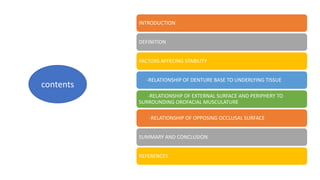
CONTENTS
INTRODUCTION
DEFINITION
FACTORS AFFECING STABILITY
-RELATIONSHIP OF DENTURE BASE TO UNDERLYING TISSUE
-RELATIONSHIP OF EXTERNAL SURFACE AND PERIPHERY TO
SURROUNDING OROFACIAL MUSCULATURE
-RELATIONSHIP OF OPPOSING OCCLUSAL SURFACE
SUMMARY AND CONCLUSION
REFERENCES
contents
INTRODUCTION
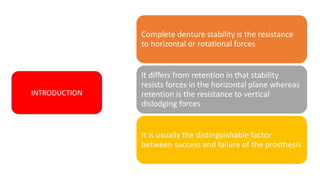
Complete denture stability is the resistance
to horizontal or rotational forces
It differs from retention in that stability
resists forces in the horizontal plane whereas
retention is the resistance to vertical
dislodging forces
It is usually the distinguishable factor
between success and failure of the prosthesis
INTRODUCTION
DEFINITION THE QUALITY OF A PROSTHESIS TO BE
FIRM,STEADY OR CONSTANT TO RESIST THE
DISPLACEMENT BY FUNCTIONAL,HORIZONTAL OR
ROTATIONAL STRESS (GPT).
FACTORS
AFFECTING
STABILITY
1) RELATIONSHIP OF DENTURE BASE TO UNDERLYING
TISSUES
It depends on:
a) Accuracy of impression procedure by clinicians
b) Adequate extension of the denture border as
limited by the movable tissues
i) It provides border seal
ii) Coverage of maximum support area
iii) maximum contact of denture base with
facial and lingual ridge slopes
c) Nature of the overlying soft tissues
i)It determines the potential of overlying
soft tissues in region of tolerating stress
d) The ridge surface is at right angles to the
occlusal plane
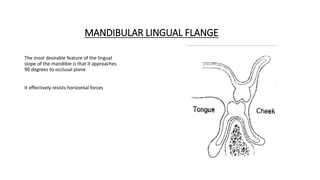
MANDIBULAR LINGUAL FLANGE
The most desirable feature of the lingual
slope of the mandible is that it approaches
90 degrees to occlusal plane
It effectively resists horizontal forces
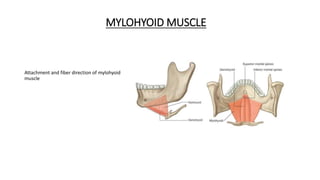
MYLOHYOID MUSCLE
Attachment and fiber direction of mylohyoid
muscle
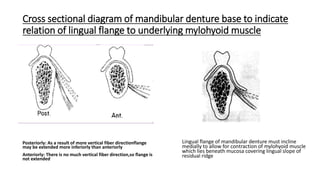
Cross sectional diagram of mandibular denture base to indicate
relation of lingual flange to underlying mylohyoid muscle
Posteriorly: As a result of more vertical fiber directionflange
may be extended more inferiorly than anteriorly
Anteriorly: There is no much vertical fiber direction,so flange is
not extended
Lingual flange of mandibular denture must incline
medially to allow for contraction of mylohyoid muscle
which lies beneath mucosa covering lingual slope of
residual ridge
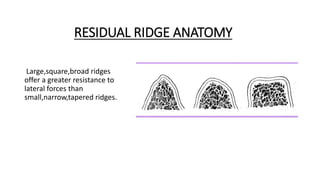
Large,square,broad ridges
offer a greater resistance to
lateral forces than
small,narrow,tapered ridges.
RESIDUAL RIDGE ANATOMY
ARCH FORM
• Square or tapered arches tend to resist rotation of the prosthesis
better than ovoid arches
SHAPE OF THE PALATAL VAULT
• It is limited by the length and angulation of the palatal ridge slope.
• A steep palatal vault may enhance stability
2)RELATIONSHIP OF EXTERNAL SURFACE AND PERIPHERY TO
SURROUNDING OROFACIAL MUSCULATURE
• The orofacial musculature and the polished surface of the denture
can facilitate stability in two ways:
• i) The action of certain muscle groups must be permitted to occur
without interference by the denture base
• ii) The normal functioning of some muscle groups can be used to
enhance stability.
• FISH IN 1933 he wrote that
• “IT IS NOT SO WIDELY UNDERSTOOD THAT THE ACTUAL SHAPE OF THE
WHOLE OF THE BUCCAL,LABIAL AND LINGUAL SURFACES CAN WRECK
THE STABILITY OF A DENTURE JUST AS COMPLETELY AS A BAD
IMPRESSION OR WRONG BITE”
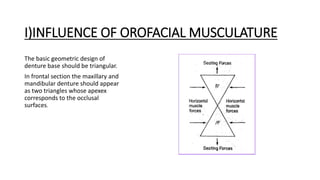
I)INFLUENCE OF OROFACIAL MUSCULATURE
The basic geometric design of
denture base should be triangular.
In frontal section the maxillary and
mandibular denture should appear
as two triangles whose apexex
corresponds to the occlusal
surfaces.
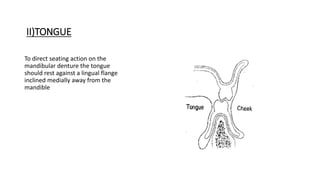
II)TONGUE
To direct seating action on the
mandibular denture the tongue
should rest against a lingual flange
inclined medially away from the
mandible
IMPORTANCE OF MODIOLUS AND ASSOCIATED
MUSCULATURE
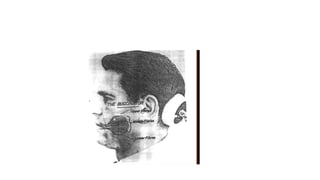
• FISH describes the muscle of the modiolus and their actions in detail.
• The modiolus is an anatomic landmark near the corner of the mouth
that is formed by the intersection of several muscles of cheeks and
lips
The denture base must be countered to permit the modiolus to
function freely
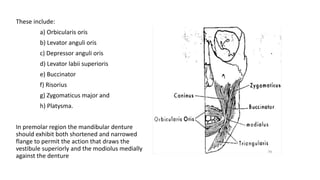
These include:
a) Orbicularis oris
b) Levator anguli oris
c) Depressor anguli oris
d) Levator labii superioris
e) Buccinator
f) Risorius
g) Zygomaticus major and
h) Platysma.
In premolar region the mandibular denture
should exhibit both shortened and narrowed
flange to permit the action that draws the
vestibule superiorly and the modiolus medially
against the denture
SIGNIFICANCE OF BUCCINATOR MUSCLE
• The buccinators is a broad muscle forming the entire wall of the
cheek from the corner of mouth and passing along the outer surface
of the maxilla and mandible till it reaches the ramus.
• It can be divided into
1. Superior fibers - act to seat the maxillary dentures
2. Middle fibres – control the bolus
3. Inferior fibres – contribute to denture stability
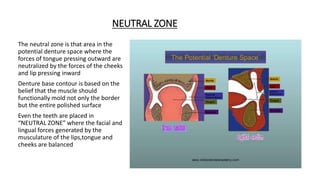
NEUTRAL ZONE
The neutral zone is that area in the
potential denture space where the
forces of tongue pressing outward are
neutralized by the forces of the cheeks
and lip pressing inward
Denture base contour is based on the
belief that the muscle should
functionally mold not only the border
but the entire polished surface
Even the teeth are placed in
“NEUTRAL ZONE” where the facial and
lingual forces generated by the
musculature of the lips,tongue and
cheeks are balanced
“The most common cause of instability of
lower denture is violation of the neutral
zone by incorrect arrangement of teeth or
incorrect form of labial and lingual angles of
the polished surface”
RELATIONSHIP OF OPPOSING
OCCLUSAL SURFACES
• Harmony developed between the opposing occlusal surface also
contributes to stability regardless of the type of posterior tooth form
or occlusal scheme used, the denture must be free of interference
with in the functional range of movements of the patient
• Bilateral simultaneous posterior tooth contact in centric relation is
essential
I) THEORIES OF OCCLUSION
• The selection of anatomic,semianatomic or non anatomic artificial
teeth depends on the occlusal scheme
• According to certain monoplane occlusal scheme positioning 0 degree
teeth slightly lingual to the mandibular ridge crest may enhance
denture stability
• In case of unfavourable ridges exhibititing severe ridge resorption
pattern may contribute to compromised stability due to poor denture
base residual ridge relationship
II TOOTH POSITION
AND OCCLUSAL PLANE
Anterior teeth:
The anterior teeth arrangement must fulfil
certain functional as well as esthetic
requirements.
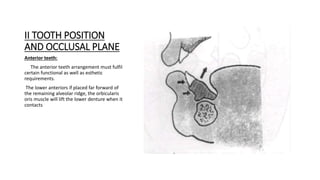
The lower anteriors if placed far forward of
the remaining alveolar ridge, the orbicularis
oris muscle will lift the lower denture when it
contacts
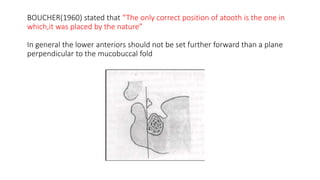
BOUCHER(1960) stated that “The only correct position of atooth is the one in
which,it was placed by the nature”
In general the lower anteriors should not be set further forward than a plane
perpendicular to the mucobuccal fold
• Posterior teeth :
The posterior teeth bear the functional burden for the occlusion.By
their proper arrangement they serve to air in retention and stability
and preserve the health of masticatory tissues.
The buccolingual position of the lower posterior teeth is determined by
the needs of rentention and stability
Significance of occlusal plane :
• A mandibular occlusal plane is too high can result in reduced stability
REASON :
The lateral tilting forces directed against the teeth are magnified and the muscular support
from the tongue will be obliterated.
Forces the tongue into a higher position which raise the floor of the mouth and creating undue
pressure on the border of the lingual flange resulting in a partial loss of the border seal.
RIGDE RELATIONSHIPS
• Ridges that are not parallel to each other will cause the movement of
the denture bases when the teeth are occluded because of
unfavourable distribution of forces
• The antero posterior and lateral ridge relationship will also influence
the stability of the denture.
• The amount of maxillary and mandibular ridge resorption which occur
when the natural teeth are removed will affect these relationships
• JACOBSON(1983) stated that : “Stability is a problem in prognathic
and retrognathic patients.The class III patients frequently display a
lower arch anterior to the upper arch in cetric relation.sufficient
mandibular occlusion must be developed so that contact against the
maxillary dentures extend posteriorly more than half the distance
from the incisive papilla to the hamular notch without this contact
the maxillary denture would tip anteriosuperiorly,traumatizing the
maxillary anterior ridge and loosening the maxillary denture”.
CONCLUSION
The factors of stability involve the tissue,occlusal and polished surfaces
of the denture.Care must be taken in the development of all three of
these surfaces to ensure optimal stability of the final prosthesis.

Stability in complete dentures

  • 1.
  • 2.
    A CONTEMPORARY REVIEWOF THE FACTORS INVOLVED IN COMPLETE DENTURE . PART II:STABILITY T.E.JACOBSON,DDS.,*and A.J.KROL,DDS** Presented by Dr.Sethumadhav First Year MDS,PROSTHODONTICS Narayana dental college
  • 3.
    CONTENTS INTRODUCTION DEFINITION FACTORS AFFECING STABILITY -RELATIONSHIPOF DENTURE BASE TO UNDERLYING TISSUE -RELATIONSHIP OF EXTERNAL SURFACE AND PERIPHERY TO SURROUNDING OROFACIAL MUSCULATURE -RELATIONSHIP OF OPPOSING OCCLUSAL SURFACE SUMMARY AND CONCLUSION REFERENCES contents
  • 4.
    INTRODUCTION Complete denture stabilityis the resistance to horizontal or rotational forces It differs from retention in that stability resists forces in the horizontal plane whereas retention is the resistance to vertical dislodging forces It is usually the distinguishable factor between success and failure of the prosthesis INTRODUCTION
  • 6.
    DEFINITION THE QUALITYOF A PROSTHESIS TO BE FIRM,STEADY OR CONSTANT TO RESIST THE DISPLACEMENT BY FUNCTIONAL,HORIZONTAL OR ROTATIONAL STRESS (GPT).
  • 7.
    FACTORS AFFECTING STABILITY 1) RELATIONSHIP OFDENTURE BASE TO UNDERLYING TISSUES It depends on: a) Accuracy of impression procedure by clinicians b) Adequate extension of the denture border as limited by the movable tissues i) It provides border seal ii) Coverage of maximum support area iii) maximum contact of denture base with facial and lingual ridge slopes
  • 8.
    c) Nature ofthe overlying soft tissues i)It determines the potential of overlying soft tissues in region of tolerating stress d) The ridge surface is at right angles to the occlusal plane
  • 9.
    MANDIBULAR LINGUAL FLANGE Themost desirable feature of the lingual slope of the mandible is that it approaches 90 degrees to occlusal plane It effectively resists horizontal forces
  • 10.
    MYLOHYOID MUSCLE Attachment andfiber direction of mylohyoid muscle
  • 11.
    Cross sectional diagramof mandibular denture base to indicate relation of lingual flange to underlying mylohyoid muscle Posteriorly: As a result of more vertical fiber directionflange may be extended more inferiorly than anteriorly Anteriorly: There is no much vertical fiber direction,so flange is not extended Lingual flange of mandibular denture must incline medially to allow for contraction of mylohyoid muscle which lies beneath mucosa covering lingual slope of residual ridge
  • 12.
    Large,square,broad ridges offer agreater resistance to lateral forces than small,narrow,tapered ridges. RESIDUAL RIDGE ANATOMY
  • 13.
    ARCH FORM • Squareor tapered arches tend to resist rotation of the prosthesis better than ovoid arches
  • 14.
    SHAPE OF THEPALATAL VAULT • It is limited by the length and angulation of the palatal ridge slope. • A steep palatal vault may enhance stability
  • 15.
    2)RELATIONSHIP OF EXTERNALSURFACE AND PERIPHERY TO SURROUNDING OROFACIAL MUSCULATURE • The orofacial musculature and the polished surface of the denture can facilitate stability in two ways: • i) The action of certain muscle groups must be permitted to occur without interference by the denture base • ii) The normal functioning of some muscle groups can be used to enhance stability.
  • 16.
    • FISH IN1933 he wrote that • “IT IS NOT SO WIDELY UNDERSTOOD THAT THE ACTUAL SHAPE OF THE WHOLE OF THE BUCCAL,LABIAL AND LINGUAL SURFACES CAN WRECK THE STABILITY OF A DENTURE JUST AS COMPLETELY AS A BAD IMPRESSION OR WRONG BITE”
  • 17.
    I)INFLUENCE OF OROFACIALMUSCULATURE The basic geometric design of denture base should be triangular. In frontal section the maxillary and mandibular denture should appear as two triangles whose apexex corresponds to the occlusal surfaces.
  • 18.
    II)TONGUE To direct seatingaction on the mandibular denture the tongue should rest against a lingual flange inclined medially away from the mandible
  • 19.
    IMPORTANCE OF MODIOLUSAND ASSOCIATED MUSCULATURE • FISH describes the muscle of the modiolus and their actions in detail. • The modiolus is an anatomic landmark near the corner of the mouth that is formed by the intersection of several muscles of cheeks and lips The denture base must be countered to permit the modiolus to function freely
  • 20.
    These include: a) Orbicularisoris b) Levator anguli oris c) Depressor anguli oris d) Levator labii superioris e) Buccinator f) Risorius g) Zygomaticus major and h) Platysma. In premolar region the mandibular denture should exhibit both shortened and narrowed flange to permit the action that draws the vestibule superiorly and the modiolus medially against the denture
  • 21.
    SIGNIFICANCE OF BUCCINATORMUSCLE • The buccinators is a broad muscle forming the entire wall of the cheek from the corner of mouth and passing along the outer surface of the maxilla and mandible till it reaches the ramus. • It can be divided into 1. Superior fibers - act to seat the maxillary dentures 2. Middle fibres – control the bolus 3. Inferior fibres – contribute to denture stability
  • 23.
    NEUTRAL ZONE The neutralzone is that area in the potential denture space where the forces of tongue pressing outward are neutralized by the forces of the cheeks and lip pressing inward Denture base contour is based on the belief that the muscle should functionally mold not only the border but the entire polished surface Even the teeth are placed in “NEUTRAL ZONE” where the facial and lingual forces generated by the musculature of the lips,tongue and cheeks are balanced
  • 24.
    “The most commoncause of instability of lower denture is violation of the neutral zone by incorrect arrangement of teeth or incorrect form of labial and lingual angles of the polished surface”
  • 25.
    RELATIONSHIP OF OPPOSING OCCLUSALSURFACES • Harmony developed between the opposing occlusal surface also contributes to stability regardless of the type of posterior tooth form or occlusal scheme used, the denture must be free of interference with in the functional range of movements of the patient • Bilateral simultaneous posterior tooth contact in centric relation is essential
  • 26.
    I) THEORIES OFOCCLUSION • The selection of anatomic,semianatomic or non anatomic artificial teeth depends on the occlusal scheme • According to certain monoplane occlusal scheme positioning 0 degree teeth slightly lingual to the mandibular ridge crest may enhance denture stability • In case of unfavourable ridges exhibititing severe ridge resorption pattern may contribute to compromised stability due to poor denture base residual ridge relationship
  • 27.
    II TOOTH POSITION ANDOCCLUSAL PLANE Anterior teeth: The anterior teeth arrangement must fulfil certain functional as well as esthetic requirements. The lower anteriors if placed far forward of the remaining alveolar ridge, the orbicularis oris muscle will lift the lower denture when it contacts
  • 28.
    BOUCHER(1960) stated that“The only correct position of atooth is the one in which,it was placed by the nature” In general the lower anteriors should not be set further forward than a plane perpendicular to the mucobuccal fold
  • 29.
    • Posterior teeth: The posterior teeth bear the functional burden for the occlusion.By their proper arrangement they serve to air in retention and stability and preserve the health of masticatory tissues. The buccolingual position of the lower posterior teeth is determined by the needs of rentention and stability
  • 30.
    Significance of occlusalplane : • A mandibular occlusal plane is too high can result in reduced stability REASON : The lateral tilting forces directed against the teeth are magnified and the muscular support from the tongue will be obliterated. Forces the tongue into a higher position which raise the floor of the mouth and creating undue pressure on the border of the lingual flange resulting in a partial loss of the border seal.
  • 31.
    RIGDE RELATIONSHIPS • Ridgesthat are not parallel to each other will cause the movement of the denture bases when the teeth are occluded because of unfavourable distribution of forces • The antero posterior and lateral ridge relationship will also influence the stability of the denture. • The amount of maxillary and mandibular ridge resorption which occur when the natural teeth are removed will affect these relationships
  • 32.
    • JACOBSON(1983) statedthat : “Stability is a problem in prognathic and retrognathic patients.The class III patients frequently display a lower arch anterior to the upper arch in cetric relation.sufficient mandibular occlusion must be developed so that contact against the maxillary dentures extend posteriorly more than half the distance from the incisive papilla to the hamular notch without this contact the maxillary denture would tip anteriosuperiorly,traumatizing the maxillary anterior ridge and loosening the maxillary denture”.
  • 33.
    CONCLUSION The factors ofstability involve the tissue,occlusal and polished surfaces of the denture.Care must be taken in the development of all three of these surfaces to ensure optimal stability of the final prosthesis.

Editor's Notes

  • #5 Yieyehdweiuefusmnxdcb