MANAGEMENT OF
ABUSED TISSUE
By
Paavana
I MDS
CONTENTS
• Introduction.
• Causes of tissue abuse.
• Factors responsible for tissue abuse.
• Associated tissue reaction and its management
• Conclusion
• References
INTRODUCTION
• ABUSE - Improper usage
• In PROSTHODONTICS-Improper usage of dental prosthesis
• Although every effort to eliminate sources of dissatisfaction in
prosthesis construction is made, it is impossible to eliminate all
possible sources.
COMPROMISED AND ABUSED TISSUE
Congenital or acquired
anatomic abnormalities
Systemic deficiencies
and disorders.
Detrimental
psychologic factors
Faulty prostheses.
Combination
Tissue
abuse
Over
extension
Ill fitting
dentures
Continuous
wearing
Traumatic
injuries
Faulty
occlusion
Bony
spicules
FACTORS RESPONSIBLE FOR TISSUE
ABUSE
EPULIS FISSURATUM
Syn-Reactive fibrous hyperplasia, Denture-induced fibrous hyperplasia
• EPULIS-Benign hyperplasia of fibrous connective tissue
• HISTOLOGICALLY
1. Epulis granulomatosa (pyogenic/telangiectatic granuloma)
2. Giant cell epulis (peripheral giant cell granuloma)
3. Epulis fissurata (denture epulis, inflammatory fibrous hyperplasia)
4. Epulis fibromatosa/ossifying fibroid epulis (focal fibrous
hyperplasia/peripheral ossifying fibroma)
• EPULIS FISSURATUM-
Reactive inflammatory lesion
associated with the periphery of
ill-fitting dentures
• CAUSES-Prolonged use of ill
fitting dentures
 Over extended denture flanges
 Unpolished /improperly polished
denture surface
 Broken dentures.
-Associated with Combination
syndrome
• Female predilection
• Commonly seen - Mandible.
• Varies from small single fold to
multiple folds.
MANAGEMENT
Surgical management-excision by scalpel or laser
Prosthodontic management-Addressing the
causative agent to prevent recurrence
>correction of over extended denture flanges
>finishing and polishing of denture borders
>Poorly fitting dentures can be relined or
new ones are constructed
TRAUMATIC ULCERS
A ulcer is a break in continuity of the skin and epithelium
CAUSES -Repetitive minor trauma due to
• In denture wearers-Seen in 19.5% of removable denture
wearers(complete denture wearers )
 In complete denture wearers
- Over extended denture borders
- Unpolished denture surfaces
- Due to increased vertical dimension
- Lack of retention and stability
 In partial denture wearers
- Over extended denture borders
- Unpolished denture surfaces
- Due to increased vertical dimension
- Trauma by natural teeth due to presence of sharp cusp tips
- Impinging edges of retentive clasps
- Lack of retention and stability
• Self inflicting injuries
- Mal positioned tooth
- Trauma due to sharp cusp tips /broken tooth.
- Supra erupted teeth
- Rough or defective restoration.
- Impinging edges of sharp submerged rootstumps
Traumatic ulcer on the labial mucosa Traumatic ulcer on lateral border of
tongue
• MANAGEMENT
• Diagnosis of ulcer- by differentiating it from other ulcers by ruling
out other causes of ulceration
-No age predilection
-commonly seen on tongue, lip and labial/ buccal mucosa.
-Shape-symmetrical
-Solitary.
-Tends to heal spontaneously once irritant has been removed.
• Removal of the causative factor.
• correction of denture extensions.
• -finishing and polishing of dentures.
• -correction of occlusion
• - Relining or rebasing of dentures to
improve fit/new prostheses fabrication.
• -enameloplasty / Smoothening of sharp
cusp tips of natural teeth (RPD Wearers)
In denture
wearers
• orthodontic movement of mal positioned teeth.
• -correction of occlusal plane in case of supra
erupted teeth by root canal treatment followed by
crown/extraction
• -Enameloplasty/smoothening of impinging cusp
tips.
• -Rehabilitation of retained root stumps either by
extraction/post and core and crown.
Removal of
mechano
traumatic
agents-
• Most ulcers will heal completely without any intervention.
• Maintaining good oral hygiene and use of an antiseptic mouthwash
or spray (e.g. chlorhexidine) can prevent secondary infection and
therefore hasten healing.
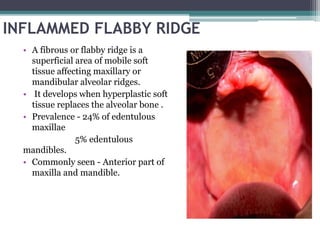
INFLAMMED FLABBY RIDGE
• A fibrous or flabby ridge is a
superficial area of mobile soft
tissue affecting maxillary or
mandibular alveolar ridges.
• It develops when hyperplastic soft
tissue replaces the alveolar bone .
• Prevalence - 24% of edentulous
maxillae
5% edentulous
mandibles.
• Commonly seen - Anterior part of
maxilla and mandible.
• Causes
Chronic irritation due to old dentures –
1.Over extended borders.
2.Occlusal plane discrepancies
3.Changes in vertical dimension of occlusion
4.Poor adaptation of prostheses
Excessive load concentration on the anterior segment of the
ridge
Rapid ridge resorption and flabby tissue formation
• Combination syndrome
 The characteristic features that occur when an edentulous maxilla is
opposed by natural mandibular anterior teeth, including loss of
bone from the anterior portion of the maxillary ridge, overgrowth of
the tuberosities, papillary hyperplasia of the hard palatal mucosa,
extrusion of mandibular anterior teeth and loss of alveolar bone and
ridge height beneath the mandibular removable partial denture
bases, also called anterior hyperfunction syndrome.(GPT)
Described by Ellsworth kelly in 1972
MANAGEMENT
PROSTHODONTIC
MANAGEMENT
CONVENTIONAL
WITH SURGICAL
INTERVENTION
WITHOUT
SURGICAL
INTERVENTIION
IMPLANT
RETAINED
FIXED REMOVABLE
CONVENTIONAL
• Surgical management-
• Surgical excision of flabby tissue.
• RIDGE AUGMENTATION with graft material is opted
 Patient's general health and motivation level were in favor
 Sufficient bone height in posterior maxilla as a guide for grafting
 Additional surgery for graft harvesting might be required in some cases.
• CONVENTIONAL PROSTHODONTIC
MANAGEMENT
MODIFICATION IN THE IMPRESSION TECHNIQUE
 Primary impression is made in the conventional manner with the help
of irreversible hydrocolloidal impression material with minimum
tissue displacement.
 However various modifications have been done during secondary
impression.
1. Zafrulla Khan’s Window technique:
2. Palatal splinting using a two-part tray system:
Osborne in 1964
3. Two part impression technique: Mucostatic and
mucodisplacive combination
• Osborne in 1964
4. Modified Fluid wax impression:
• Preliminary impression made with an irreversible
hydrocolloid impression material.
• Border mold the tray with modelling plastic impression
compound in segments.
• Trim the tray over the crest of the residual ridge and create a
window opening above the displaceable ridge.
• Melt the impression wax in a water bath and apply onto the
borders of the tray with a wax spatula until a glossy surface is
visible.
• Apply adhesive on the tray surrounding the window opening
and allow it to dry.
• Place the impression tray on the ridge and inject vinyl
polysiloxane impression material over the window opening
• IMPLANT RETAINED PROSTHESIS
• It includes
a) Fixed prosthesis
b) Implant retained overdenture
• Fixed and removable implant retained prostheses offer potential
benefits to many of the problems encountered with conventional
prosthodontics.
• Attractive alternative due to the enhanced stability, retention and
oral function.
• The success rates for maxillary implants have been shown to be as
low as 78.7%.
• Other factors that must be considered include:
 surgery
 Discomfort and inconvenience
 General health of the patient
 Risk of surgical complications
 Implant failure.
DENTURE STOMATITIS
Syn-denture sore mouth, chronic atrophic
candidiasis, Candida-associated denture induced
stomatitis, denture-associated erythematous
stomatitis
• Inflammation and redness of
the oral mucous membrane
occurs beneath a denture.
• Female predilection
• Found in 15% to over 70% of
denture wearers.
• NEWTON’S CLASSIFICATION(1962)
TYPE 1 TYPE 2 TYPE 3
ETIOLOGICAL FACTORS
• In denture wearers
Poor denture hygiene
Continual and nighttime wearing of removable dentures
Improperly polished denture surfaces
Accumulation of denture plaque
Bacterial and yeast contamination of denture surface.
• Other factors include
1. Systemic factors
a. Physiological. (advanced age)
b. Endocrine dysfunctions.
c. Nutritional deficiencies.
d. Neoplasias.
e. Immunosuppression.
f. Ample spectrum antibiotics.
2. Local factors
a. Antimicrobials and topical or inhaled corticosteroids
b. Carbohydrate rich diet
c. Tobacco and alcohol consumption
d. Hyposalivation
• MANAGEMENT
• Good oral hygiene is mandatory.
• Local factors which promote growth of yeasts, such as smoking or
wearing the dentures throughout the night, must be discouraged.
• Dentures should be removed for as long as possible and definitely
overnight.
• Dentures should be brushed in warm, soapy water and soaked
overnight in an antiseptic solution.
• Denture fitting and occlusal balance should be checked to avoid
trauma.
• A new prosthesis should be made, if necessary. Dentures must be
adequately polished and glazed, as pores increase denture
contamination by oral microorganisms . Tissue conditioning agents
are generally not recommended for these patients. If there is no
other choice, an antifungal agent, like nystatin, miconazole or
ketoconazole may be incorporated to the agent.
• Antifungal medications
RECOMMENDED –
Yeasts have been isolated.
 When lesions do not resolve with hygiene instructions.
• FIRST CHOICE TREATMENT - Topical application of
 NYSTATIN -dry powder, lozenge (pastille), and liquid forms
MICONAZOLE - gel, varnish, lacquer and chewing gum.
• SYSTEMIC ANTIFUNGAL DRUGS
 FLUCONAZOLE -50-100 mg capsule/day
ITRACONAZOLE-100-200 mg/day
KETOCONAZOLE -200-400 mg tablets taken once or
twice daily
• Almost exclusively reserved for patients with systemic factors
that condition the development and persistence of
candidiasis, such as immunosuppression or diabetes.
ANGULAR CHELITIS
• Inflammation of one or both corners of the mouth.
• CAUSES-.
o Most common- Infection caused by Candida albicans,
Staphylococcus aureus, and β-hemolytic streptococci.
o Other factors-
 Use of ill fitting dentures
 Loss of vertical dimension of the mouth
 Abnormal skin folds at the corners of the mouth,
 Contact allergy
 Nutritional deficiencies
 Anemia
 Dry skin
 Hypersalivation
 Atopic or seborrheic dermatitis
• CLNICAL FEATURES-
 infantile thrush in denture
wearers
 In elderly patients with denture-
induced stomatitis, inflammation
frequently extends along folds of
the facial skin extending from the
angles of the mouth.
MANAGEMENT
• Highly dependent on the cause.
• S aureusis - topical treatment with a combination of mupirocin or
fusidic acid and 1% hydrocortisone cream (to counter inflammation)
works effectively.
• Candida - an antifungal ointment like ketoconazole should be
prescribed.
• For those with oropharyngeal candidiasis, systemic therapy need to
be prescribed.
• Patients using inhaled steroids should rinse with water after use to
minimize the amount of residual steroid left in the mouth and
reduce the chance of infection.
• For patients with underlying deficiencies, correcting nutritional
deficiencies should reverse the inflammatory process
FRICTIONAL KERATOSIS
• White keratinized patches
• CAUSES –Prolonged mild
abrasion of the mucous
membrane by irritants such as
a sharp tooth, cheek biting or
dentures
• At first, the patches are pale and
translucent, but later become
dense and white, sometimes
with a rough surface.
MANAGEMENT
• Any frictional irritant is removed.
• Biting, sucking, or improper chewing habits should be discontinued.
• Fractured or rough tooth surfaces or irregularly fitting dentures or
other appliances should be corrected.
• Observe and monitor the patient to be certain that the frictional
area is resolving in a timely fashion.
• In general, the patient should be reevaluated in 2-3 weeks for signs
of lesion regression or resolution.
• In the absence of resolution, even when the cause has been
eliminated, obtain a biopsy specimen of the tissue to confirm that no
dysplastic or neoplastic change is present.
ABUSE DUE TO DENTAL MATERIAL
ALLERGY
METAL ALLERGIES
• CAUSATIVE AGENT
COMMON-Nickel
RARE- Mercury, gold, platinum, palladium, silver and cobalt
• Female predilection.
• Varies from 9-24%
• ASSOCIATED REACTION- Type IV or delayed allergic reaction.
Allergy due to nickel crown Allergy due to silver amalgam
ALLERGY DUE TO DENTAL
IMPLANTS
• Titanium alloys - Preferred choice for dental
implants
• However small amounts of other elements
associated with titanium alloys can initiate
allergic reactions in patients.
• ASSOCIATED REACTION-
 Type IV
 RARE- type I and III
• MANAGEMENT
Before treatment planning
• Proper medical/allergy history.
Unknown allergy history
Diagnosis- Various disgnostic tests
include
 Epicutaneous tests (patch
tests)-After applying different
allergens on the back of the
patient, the consequences of the
allergens are evaluated, preferably
after 48 and 72 hours for the
majority of allergens.
 Skin test (prick test) –type –I
reactions. Involves intradermal
inoculation of the allergen.
 The lymphocyte transformation
test (LTT) is applied by an in vitro
method in mucosal sensitizing
allergens.
Known allergy history
Non allergic alternatives such as
• For crowns and implants
 All ceramic restorations
 Zirconia
 Peek materials
• In orthodontic treatments
 ceramic brackets
 polycarbonate brackets
 gold brackets
• Restorations
 Composite
 glass ionomer
In presence of any metallic restorations
• If metal hypersensitivity is established, the following metallic
restoration/allergen should be immediately removed from the
mouth.
• Topical steroidal therapy.
• Replacement with non – allergic alternatives
RESIN ALLERGIES
• CAUSATIVE AGENT-
• Di- and mono-methacrylate
resins.
• Although the occurrence of
allergies to dental resins is low,
most methacrylates can
nevertheless induce a Type IV
(delayed) allergic
hypersensitivity reaction.
• Type I reactions in rare cases.
• MANAGEMENT
• ALLERGY-FREE DENTURE
• High-impact polystyrene: Elastomer graft polymer with
styrene. Similar to polystyrene and injection molded.
• Polycarbonates: Includes glass fiber-reinforced materials,
which have advantages over methylmethacrylate (MMA) because of
their high impact strength.
• Polyvinyl chloride-based acrylic: In this group of mixed
polymers consisting of vinyl chloride, vinyl acetate and MMA acid
ester are used as denture materials.
• Eclipse prosthetic resin system: Light cure
fabricate denture (Dentsply)
It consist of indirect buildup method for fabricating
dentures, i.e., monomer free and flask free; does not
contain any ethyl, methyl, butyl, or propyl methacrylates;
and can be used for allergic patients.
• • Valplast: Flexible denture base material, i.e., ideal for
partial denture but very rarely used for complete
dentures. It is a nylon thermoplastic material which
eliminates the concern about acrylic allergy.
• • Metallic denture base: Used for cast partial denture
as well as completed denture. Metals used are usually base
metal alloys, Ti alloys.
• LATEX GLOVES ALLERGY
• Polyether component-main causative
agent.
• Repeated exposure & duration plays
important role.
• CLINICAL FEATURES
• Dermatitis of hand (eczema) most
common adverse reaction
• Localized rashes & swelling to wheezing
& anaphylaxis
• Most serious systemic reactions occur
when gloves or rubber dam contact
mucous membrane – generalized
angioneurotic edema, chest pain, rash
on neck or chest region and respiratory
distress
MANAGEMENT
Use Vinyl gloves or gloves made of other synthetic polymer gloves:-
• Polythene gloves.
• Powder free gloves.
• Nitrile gloves.
IATROGENIC TISSUE ABUSE
• Iatrogenic trauma - Trauma
that has been induced by the
dentist’s activity, manner, or
therapy.
The four most significant factors
leading to the soft tissue injuries are:
• Visibility and access
• The presence of local
anesthesia
• The use of gloves
• Nervous patients
MANAGEMENT
• Tends to heal spontaneously.
• To avoid any bite injuries ,the patient should be educated about the
need the control the force during chewing during the anesthetic
period.
• In case of any burn injuries, Immediate treatment consists of
washing the area with plenty of water in order to remove the acid
and prevent further injury.
• In case of any injury due to rotary instruments, the lesion tends to
heal spontaneously. However sutures might be need in some cases.
RADIATION INJURIES
• Radiation therapy - Treat head
and neck cancers.
• Prolonged course of therapy
leads to-
 Sub mucosal connective tissue
 Vasculature
 Hyalinization of collagen
 Depolarization of large
molecules
 Vascular permeability
 Tissue edema
Signs and symptoms
• Severe radiation mucositis
• Ulceration
• Formation of pseudomembrane
• Radiation caries
The degree & extent of mucositis can become so severe that the oral
intake of solid food becomes impossible due to pain.
• MANAGEMENT
Radiation Prosthesis
Radiation prosthesis can be defined as any device artificially
fabricated that aids in the efficient administration of radiotherapy
to the affected areas and thereby helps in limiting the post therapy
morbidity.
• CLASSIFICATION
1) Positioning Stent
a) Perioral cone positioning stent
b) Tongue depressing stent
2) Shielding Stent
a) Tissue recontouring stent
b) Tissue bolus compensators
3) Radiation Carriers Incorporated With Radioisotopes
a) Preloaded carriers
b) Afterloaded carriers
POSITIONING STENTS:
• These devices are used to displace the positions of various
structures to assist in the efficient administration of radiotherapy.
Types of radiation stents include
• Tongue Depressing Stents-
A tongue depressing stent is a custom made device which positions the
mandible and depresses the tongue during radiotherapy .
• Peri oral Cone Positioning Stents-
A peri oral cone positioning stent positions a peri oral cone during
radiotherapy for head and neck tumors. This type of stent is commonly
used when boosting the dose to the tumor site
• SHIELDING STENT
They are used to shield the vital structures which are adjacent to
radiation therapy sites from excess dosage of radiation.
TYPES
> Tissue recontouring stent
> Tissue bolus compensators
Tissue re contouring stent:
 These stents are effective when treating skin lesions which are
associated with lips when the beam is adjusted for midlines.
 Low doses are delivered at the corners of the mouth because of the
curvature of the lips.
 A stent can be made to flatten the lip and the corner of the mouth,
thereby placing the entire lip in the same plane.
• Tissue bolus compensators
 These prostheses help in the treatment of superficial lesions of the
face with irregular contours.
 BOLUS is a tissue equivalent material which is placed directly onto
or into the irregularities, that helps in converting irregular tissue
contours into flat surfaces which are perpendicular to the central
axis of the ionizing beam, to thereby more accurately aid in the
homogenous distribution of the radiation.
Radiation carriers incorporated with radioisotopes
 This type of prostheses is needed when radiation therapy is to be
administered to confined areas by means of capsules, beads, tubes
or needles of radiation emitting materials.
 They are used to carry the radiation sources close to the site of
treatment (intracavitary) or directly into the tumour
(interstitial).They are of two types:
a) Preloaded carriers
b) After loaded carriers
TISSUE INJURIES DUE TO MALOCCLUSION
Causes
• Size mismatch between jaw
and teeth
• Certain oral habits (eg, thumb-
sucking, tongue thrusting)
• Missing teeth
• Certain congenital defects
• Lacerations of the soft tissue
can be seen
• Gingival erythema along with
signs of injury can be seen on
the palate or cheeks due to the
impingement of incisal
/occlusal edges of
corresponding teeth
MANAGEMENT
• DENTAL MODIFICATION- Occlusion can be improved by
aligning teeth properly, by selectively grinding teeth and correcting
restorations that contact prematurely, and by inserting crowns or
onlays to build up tooth surfaces that are below the plane of
occlusion.
• ORTHODONTIC APPLIANCES (BRACES)-Orthodontic
appliances (braces) apply a continuous mild force to teeth to
gradually remodel the surrounding alveolar bone.
• SURGERY-When orthodontic treatment alone is insufficient,
surgical correction of jaw abnormalities contributing to
malocclusion (orthognathic surgery) may be indicated.
INJURIES DUE TO TRAUMA FROM OCCLUSION
• TFO -Pathologic alterations or adaptive changes which develop in
the periodontium as a result of undue force produced by the
masticatory muscles.
• CLASSIFICATION
1. ACUTE TFO
• Results from an abrupt occlusal impact, such as that produced by
biting on a hard object (e.g., an olive pit).
• In addition, restorations or prosthetic appliances that interfere with
the direction of occlusal forces on the teeth may induce acute
trauma
2.CHRONIC TFO
• Develops from gradual changes in
a) occlusion produced by tooth wear,
b) drifting movement,
c) extrusion of teeth,
d) combined with parafunctional habits such as bruxism and clenching
• Clinical signs-According to
Box and Stillman
 Traumatic crest
 Asymmetrical gingival
recession.
 Stillman's clefts
 McCall's festoons
 Absence of stippling
• MANAGEMENT
• Orthodontic correction is usually restricted to cases where tooth
malpositions are the prime cause of trauma.
• Before orthodontic appliances are removed, the clinician should
ensure that occlusal interferences are eliminated.
• This assessment should be made in both static and functional
excursion.
• Investigations that may aid this decision may include visual
inspection using articulating paper, occlusion, mobility assessment,
radiographs and the use of the lately developed computer-aided
occlusal evaluation systems.
• Retention should be custom-designed for each patient taking into
account the nature of the initial malocclusion and periodontal status
of the patient.
CONCLUSION
• Any faulty prostheses can alter the character, condition and form of
the underlying oral tissues. The pathological changes must be
carefully examined and resolved. It is essential for the patient to
develop good oral and denture hygiene habits in order to achieve
oral tissue health, esthetics, control of oral odor and affirmation of
patient’s sense of well being.
REFERENCES
• Zarb G, Hobkirk JA, Eckert SE, Jacob RF.Prosthodontic treatment for
Edentulous patients.13th Edition.
• Winkler S.Essentials of complete denture prosthodontics.2nd Edition.
• Jainkittivong A, Aneksuk V, Langlais RP. Oral mucosal lesions in denture
wearers. Gerodontology 2010 ;27(1):26-32.
• Gendreau, L & Loewy Z. G. Epidemiology and Etiology of Denture Stomatitis. J
Prosthodont 2011, 20(4): 251–260.
• Chaturvedi TP. Allergy related to dental implant and its clinical significance.
Clin Cosmet Investig Dent 2013;5:57-61
• Tomoyasu Y, Mukae K, Suda M, Hayashi T, Ishii M, Sakaguchi M, Watanabe
Y, Jinzenji A, Arai Y, Higuchi H, Maeda S and Miyawaki T. Allergic Reactions
to Local Anesthetics in Dental Patients: Analysis of Intracutaneous and
Challenge Tests Open Dent J. 2011; 5: 146–149.
Abused tissue management 2

Abused tissue management 2

  • 1.
  • 2.
    CONTENTS • Introduction. • Causesof tissue abuse. • Factors responsible for tissue abuse. • Associated tissue reaction and its management • Conclusion • References
  • 3.
    INTRODUCTION • ABUSE -Improper usage • In PROSTHODONTICS-Improper usage of dental prosthesis • Although every effort to eliminate sources of dissatisfaction in prosthesis construction is made, it is impossible to eliminate all possible sources.
  • 4.
    COMPROMISED AND ABUSEDTISSUE Congenital or acquired anatomic abnormalities Systemic deficiencies and disorders. Detrimental psychologic factors Faulty prostheses. Combination
  • 5.
  • 6.
  • 8.
    EPULIS FISSURATUM Syn-Reactive fibroushyperplasia, Denture-induced fibrous hyperplasia • EPULIS-Benign hyperplasia of fibrous connective tissue • HISTOLOGICALLY 1. Epulis granulomatosa (pyogenic/telangiectatic granuloma) 2. Giant cell epulis (peripheral giant cell granuloma) 3. Epulis fissurata (denture epulis, inflammatory fibrous hyperplasia) 4. Epulis fibromatosa/ossifying fibroid epulis (focal fibrous hyperplasia/peripheral ossifying fibroma)
  • 9.
    • EPULIS FISSURATUM- Reactiveinflammatory lesion associated with the periphery of ill-fitting dentures • CAUSES-Prolonged use of ill fitting dentures  Over extended denture flanges  Unpolished /improperly polished denture surface  Broken dentures. -Associated with Combination syndrome • Female predilection • Commonly seen - Mandible. • Varies from small single fold to multiple folds.
  • 10.
    MANAGEMENT Surgical management-excision byscalpel or laser Prosthodontic management-Addressing the causative agent to prevent recurrence >correction of over extended denture flanges >finishing and polishing of denture borders >Poorly fitting dentures can be relined or new ones are constructed
  • 11.
    TRAUMATIC ULCERS A ulceris a break in continuity of the skin and epithelium CAUSES -Repetitive minor trauma due to • In denture wearers-Seen in 19.5% of removable denture wearers(complete denture wearers )  In complete denture wearers - Over extended denture borders - Unpolished denture surfaces - Due to increased vertical dimension - Lack of retention and stability  In partial denture wearers - Over extended denture borders - Unpolished denture surfaces - Due to increased vertical dimension - Trauma by natural teeth due to presence of sharp cusp tips - Impinging edges of retentive clasps - Lack of retention and stability
  • 12.
    • Self inflictinginjuries - Mal positioned tooth - Trauma due to sharp cusp tips /broken tooth. - Supra erupted teeth - Rough or defective restoration. - Impinging edges of sharp submerged rootstumps
  • 13.
    Traumatic ulcer onthe labial mucosa Traumatic ulcer on lateral border of tongue
  • 14.
    • MANAGEMENT • Diagnosisof ulcer- by differentiating it from other ulcers by ruling out other causes of ulceration -No age predilection -commonly seen on tongue, lip and labial/ buccal mucosa. -Shape-symmetrical -Solitary. -Tends to heal spontaneously once irritant has been removed.
  • 15.
    • Removal ofthe causative factor. • correction of denture extensions. • -finishing and polishing of dentures. • -correction of occlusion • - Relining or rebasing of dentures to improve fit/new prostheses fabrication. • -enameloplasty / Smoothening of sharp cusp tips of natural teeth (RPD Wearers) In denture wearers • orthodontic movement of mal positioned teeth. • -correction of occlusal plane in case of supra erupted teeth by root canal treatment followed by crown/extraction • -Enameloplasty/smoothening of impinging cusp tips. • -Rehabilitation of retained root stumps either by extraction/post and core and crown. Removal of mechano traumatic agents-
  • 16.
    • Most ulcerswill heal completely without any intervention. • Maintaining good oral hygiene and use of an antiseptic mouthwash or spray (e.g. chlorhexidine) can prevent secondary infection and therefore hasten healing.
  • 17.
    INFLAMMED FLABBY RIDGE •A fibrous or flabby ridge is a superficial area of mobile soft tissue affecting maxillary or mandibular alveolar ridges. • It develops when hyperplastic soft tissue replaces the alveolar bone . • Prevalence - 24% of edentulous maxillae 5% edentulous mandibles. • Commonly seen - Anterior part of maxilla and mandible.
  • 18.
    • Causes Chronic irritationdue to old dentures – 1.Over extended borders. 2.Occlusal plane discrepancies 3.Changes in vertical dimension of occlusion 4.Poor adaptation of prostheses Excessive load concentration on the anterior segment of the ridge Rapid ridge resorption and flabby tissue formation
  • 19.
    • Combination syndrome The characteristic features that occur when an edentulous maxilla is opposed by natural mandibular anterior teeth, including loss of bone from the anterior portion of the maxillary ridge, overgrowth of the tuberosities, papillary hyperplasia of the hard palatal mucosa, extrusion of mandibular anterior teeth and loss of alveolar bone and ridge height beneath the mandibular removable partial denture bases, also called anterior hyperfunction syndrome.(GPT) Described by Ellsworth kelly in 1972
  • 20.
  • 21.
    CONVENTIONAL • Surgical management- •Surgical excision of flabby tissue. • RIDGE AUGMENTATION with graft material is opted  Patient's general health and motivation level were in favor  Sufficient bone height in posterior maxilla as a guide for grafting  Additional surgery for graft harvesting might be required in some cases.
  • 22.
    • CONVENTIONAL PROSTHODONTIC MANAGEMENT MODIFICATIONIN THE IMPRESSION TECHNIQUE  Primary impression is made in the conventional manner with the help of irreversible hydrocolloidal impression material with minimum tissue displacement.  However various modifications have been done during secondary impression.
  • 23.
    1. Zafrulla Khan’sWindow technique:
  • 26.
    2. Palatal splintingusing a two-part tray system: Osborne in 1964
  • 28.
    3. Two partimpression technique: Mucostatic and mucodisplacive combination • Osborne in 1964
  • 30.
    4. Modified Fluidwax impression: • Preliminary impression made with an irreversible hydrocolloid impression material. • Border mold the tray with modelling plastic impression compound in segments. • Trim the tray over the crest of the residual ridge and create a window opening above the displaceable ridge. • Melt the impression wax in a water bath and apply onto the borders of the tray with a wax spatula until a glossy surface is visible. • Apply adhesive on the tray surrounding the window opening and allow it to dry. • Place the impression tray on the ridge and inject vinyl polysiloxane impression material over the window opening
  • 31.
    • IMPLANT RETAINEDPROSTHESIS • It includes a) Fixed prosthesis b) Implant retained overdenture
  • 32.
    • Fixed andremovable implant retained prostheses offer potential benefits to many of the problems encountered with conventional prosthodontics. • Attractive alternative due to the enhanced stability, retention and oral function. • The success rates for maxillary implants have been shown to be as low as 78.7%. • Other factors that must be considered include:  surgery  Discomfort and inconvenience  General health of the patient  Risk of surgical complications  Implant failure.
  • 33.
    DENTURE STOMATITIS Syn-denture soremouth, chronic atrophic candidiasis, Candida-associated denture induced stomatitis, denture-associated erythematous stomatitis • Inflammation and redness of the oral mucous membrane occurs beneath a denture. • Female predilection • Found in 15% to over 70% of denture wearers.
  • 34.
  • 35.
    ETIOLOGICAL FACTORS • Indenture wearers Poor denture hygiene Continual and nighttime wearing of removable dentures Improperly polished denture surfaces Accumulation of denture plaque Bacterial and yeast contamination of denture surface.
  • 36.
    • Other factorsinclude 1. Systemic factors a. Physiological. (advanced age) b. Endocrine dysfunctions. c. Nutritional deficiencies. d. Neoplasias. e. Immunosuppression. f. Ample spectrum antibiotics. 2. Local factors a. Antimicrobials and topical or inhaled corticosteroids b. Carbohydrate rich diet c. Tobacco and alcohol consumption d. Hyposalivation
  • 37.
    • MANAGEMENT • Goodoral hygiene is mandatory. • Local factors which promote growth of yeasts, such as smoking or wearing the dentures throughout the night, must be discouraged. • Dentures should be removed for as long as possible and definitely overnight. • Dentures should be brushed in warm, soapy water and soaked overnight in an antiseptic solution. • Denture fitting and occlusal balance should be checked to avoid trauma. • A new prosthesis should be made, if necessary. Dentures must be adequately polished and glazed, as pores increase denture contamination by oral microorganisms . Tissue conditioning agents are generally not recommended for these patients. If there is no other choice, an antifungal agent, like nystatin, miconazole or ketoconazole may be incorporated to the agent.
  • 38.
    • Antifungal medications RECOMMENDED– Yeasts have been isolated.  When lesions do not resolve with hygiene instructions. • FIRST CHOICE TREATMENT - Topical application of  NYSTATIN -dry powder, lozenge (pastille), and liquid forms MICONAZOLE - gel, varnish, lacquer and chewing gum. • SYSTEMIC ANTIFUNGAL DRUGS  FLUCONAZOLE -50-100 mg capsule/day ITRACONAZOLE-100-200 mg/day KETOCONAZOLE -200-400 mg tablets taken once or twice daily • Almost exclusively reserved for patients with systemic factors that condition the development and persistence of candidiasis, such as immunosuppression or diabetes.
  • 39.
    ANGULAR CHELITIS • Inflammationof one or both corners of the mouth. • CAUSES-. o Most common- Infection caused by Candida albicans, Staphylococcus aureus, and β-hemolytic streptococci. o Other factors-  Use of ill fitting dentures  Loss of vertical dimension of the mouth  Abnormal skin folds at the corners of the mouth,  Contact allergy  Nutritional deficiencies  Anemia  Dry skin  Hypersalivation  Atopic or seborrheic dermatitis
  • 40.
    • CLNICAL FEATURES- infantile thrush in denture wearers  In elderly patients with denture- induced stomatitis, inflammation frequently extends along folds of the facial skin extending from the angles of the mouth.
  • 41.
    MANAGEMENT • Highly dependenton the cause. • S aureusis - topical treatment with a combination of mupirocin or fusidic acid and 1% hydrocortisone cream (to counter inflammation) works effectively. • Candida - an antifungal ointment like ketoconazole should be prescribed. • For those with oropharyngeal candidiasis, systemic therapy need to be prescribed. • Patients using inhaled steroids should rinse with water after use to minimize the amount of residual steroid left in the mouth and reduce the chance of infection. • For patients with underlying deficiencies, correcting nutritional deficiencies should reverse the inflammatory process
  • 42.
    FRICTIONAL KERATOSIS • Whitekeratinized patches • CAUSES –Prolonged mild abrasion of the mucous membrane by irritants such as a sharp tooth, cheek biting or dentures • At first, the patches are pale and translucent, but later become dense and white, sometimes with a rough surface.
  • 43.
    MANAGEMENT • Any frictionalirritant is removed. • Biting, sucking, or improper chewing habits should be discontinued. • Fractured or rough tooth surfaces or irregularly fitting dentures or other appliances should be corrected. • Observe and monitor the patient to be certain that the frictional area is resolving in a timely fashion. • In general, the patient should be reevaluated in 2-3 weeks for signs of lesion regression or resolution. • In the absence of resolution, even when the cause has been eliminated, obtain a biopsy specimen of the tissue to confirm that no dysplastic or neoplastic change is present.
  • 44.
    ABUSE DUE TODENTAL MATERIAL ALLERGY METAL ALLERGIES • CAUSATIVE AGENT COMMON-Nickel RARE- Mercury, gold, platinum, palladium, silver and cobalt • Female predilection. • Varies from 9-24% • ASSOCIATED REACTION- Type IV or delayed allergic reaction.
  • 45.
    Allergy due tonickel crown Allergy due to silver amalgam
  • 46.
    ALLERGY DUE TODENTAL IMPLANTS • Titanium alloys - Preferred choice for dental implants • However small amounts of other elements associated with titanium alloys can initiate allergic reactions in patients. • ASSOCIATED REACTION-  Type IV  RARE- type I and III
  • 48.
    • MANAGEMENT Before treatmentplanning • Proper medical/allergy history. Unknown allergy history Diagnosis- Various disgnostic tests include  Epicutaneous tests (patch tests)-After applying different allergens on the back of the patient, the consequences of the allergens are evaluated, preferably after 48 and 72 hours for the majority of allergens.  Skin test (prick test) –type –I reactions. Involves intradermal inoculation of the allergen.  The lymphocyte transformation test (LTT) is applied by an in vitro method in mucosal sensitizing allergens. Known allergy history Non allergic alternatives such as • For crowns and implants  All ceramic restorations  Zirconia  Peek materials • In orthodontic treatments  ceramic brackets  polycarbonate brackets  gold brackets • Restorations  Composite  glass ionomer
  • 49.
    In presence ofany metallic restorations • If metal hypersensitivity is established, the following metallic restoration/allergen should be immediately removed from the mouth. • Topical steroidal therapy. • Replacement with non – allergic alternatives
  • 50.
    RESIN ALLERGIES • CAUSATIVEAGENT- • Di- and mono-methacrylate resins. • Although the occurrence of allergies to dental resins is low, most methacrylates can nevertheless induce a Type IV (delayed) allergic hypersensitivity reaction. • Type I reactions in rare cases.
  • 51.
  • 52.
    • ALLERGY-FREE DENTURE •High-impact polystyrene: Elastomer graft polymer with styrene. Similar to polystyrene and injection molded. • Polycarbonates: Includes glass fiber-reinforced materials, which have advantages over methylmethacrylate (MMA) because of their high impact strength. • Polyvinyl chloride-based acrylic: In this group of mixed polymers consisting of vinyl chloride, vinyl acetate and MMA acid ester are used as denture materials.
  • 53.
    • Eclipse prostheticresin system: Light cure fabricate denture (Dentsply) It consist of indirect buildup method for fabricating dentures, i.e., monomer free and flask free; does not contain any ethyl, methyl, butyl, or propyl methacrylates; and can be used for allergic patients. • • Valplast: Flexible denture base material, i.e., ideal for partial denture but very rarely used for complete dentures. It is a nylon thermoplastic material which eliminates the concern about acrylic allergy. • • Metallic denture base: Used for cast partial denture as well as completed denture. Metals used are usually base metal alloys, Ti alloys.
  • 54.
    • LATEX GLOVESALLERGY • Polyether component-main causative agent. • Repeated exposure & duration plays important role. • CLINICAL FEATURES • Dermatitis of hand (eczema) most common adverse reaction • Localized rashes & swelling to wheezing & anaphylaxis • Most serious systemic reactions occur when gloves or rubber dam contact mucous membrane – generalized angioneurotic edema, chest pain, rash on neck or chest region and respiratory distress
  • 55.
    MANAGEMENT Use Vinyl glovesor gloves made of other synthetic polymer gloves:- • Polythene gloves. • Powder free gloves. • Nitrile gloves.
  • 56.
    IATROGENIC TISSUE ABUSE •Iatrogenic trauma - Trauma that has been induced by the dentist’s activity, manner, or therapy. The four most significant factors leading to the soft tissue injuries are: • Visibility and access • The presence of local anesthesia • The use of gloves • Nervous patients
  • 57.
    MANAGEMENT • Tends toheal spontaneously. • To avoid any bite injuries ,the patient should be educated about the need the control the force during chewing during the anesthetic period. • In case of any burn injuries, Immediate treatment consists of washing the area with plenty of water in order to remove the acid and prevent further injury. • In case of any injury due to rotary instruments, the lesion tends to heal spontaneously. However sutures might be need in some cases.
  • 58.
    RADIATION INJURIES • Radiationtherapy - Treat head and neck cancers. • Prolonged course of therapy leads to-  Sub mucosal connective tissue  Vasculature  Hyalinization of collagen  Depolarization of large molecules  Vascular permeability  Tissue edema
  • 59.
    Signs and symptoms •Severe radiation mucositis • Ulceration • Formation of pseudomembrane • Radiation caries The degree & extent of mucositis can become so severe that the oral intake of solid food becomes impossible due to pain.
  • 60.
    • MANAGEMENT Radiation Prosthesis Radiationprosthesis can be defined as any device artificially fabricated that aids in the efficient administration of radiotherapy to the affected areas and thereby helps in limiting the post therapy morbidity.
  • 61.
    • CLASSIFICATION 1) PositioningStent a) Perioral cone positioning stent b) Tongue depressing stent 2) Shielding Stent a) Tissue recontouring stent b) Tissue bolus compensators 3) Radiation Carriers Incorporated With Radioisotopes a) Preloaded carriers b) Afterloaded carriers
  • 62.
    POSITIONING STENTS: • Thesedevices are used to displace the positions of various structures to assist in the efficient administration of radiotherapy.
  • 63.
    Types of radiationstents include • Tongue Depressing Stents- A tongue depressing stent is a custom made device which positions the mandible and depresses the tongue during radiotherapy .
  • 64.
    • Peri oralCone Positioning Stents- A peri oral cone positioning stent positions a peri oral cone during radiotherapy for head and neck tumors. This type of stent is commonly used when boosting the dose to the tumor site
  • 65.
    • SHIELDING STENT Theyare used to shield the vital structures which are adjacent to radiation therapy sites from excess dosage of radiation. TYPES > Tissue recontouring stent > Tissue bolus compensators
  • 66.
    Tissue re contouringstent:  These stents are effective when treating skin lesions which are associated with lips when the beam is adjusted for midlines.  Low doses are delivered at the corners of the mouth because of the curvature of the lips.  A stent can be made to flatten the lip and the corner of the mouth, thereby placing the entire lip in the same plane.
  • 67.
    • Tissue boluscompensators  These prostheses help in the treatment of superficial lesions of the face with irregular contours.  BOLUS is a tissue equivalent material which is placed directly onto or into the irregularities, that helps in converting irregular tissue contours into flat surfaces which are perpendicular to the central axis of the ionizing beam, to thereby more accurately aid in the homogenous distribution of the radiation.
  • 68.
    Radiation carriers incorporatedwith radioisotopes  This type of prostheses is needed when radiation therapy is to be administered to confined areas by means of capsules, beads, tubes or needles of radiation emitting materials.  They are used to carry the radiation sources close to the site of treatment (intracavitary) or directly into the tumour (interstitial).They are of two types: a) Preloaded carriers b) After loaded carriers
  • 69.
    TISSUE INJURIES DUETO MALOCCLUSION Causes • Size mismatch between jaw and teeth • Certain oral habits (eg, thumb- sucking, tongue thrusting) • Missing teeth • Certain congenital defects • Lacerations of the soft tissue can be seen • Gingival erythema along with signs of injury can be seen on the palate or cheeks due to the impingement of incisal /occlusal edges of corresponding teeth
  • 70.
    MANAGEMENT • DENTAL MODIFICATION-Occlusion can be improved by aligning teeth properly, by selectively grinding teeth and correcting restorations that contact prematurely, and by inserting crowns or onlays to build up tooth surfaces that are below the plane of occlusion. • ORTHODONTIC APPLIANCES (BRACES)-Orthodontic appliances (braces) apply a continuous mild force to teeth to gradually remodel the surrounding alveolar bone. • SURGERY-When orthodontic treatment alone is insufficient, surgical correction of jaw abnormalities contributing to malocclusion (orthognathic surgery) may be indicated.
  • 71.
    INJURIES DUE TOTRAUMA FROM OCCLUSION • TFO -Pathologic alterations or adaptive changes which develop in the periodontium as a result of undue force produced by the masticatory muscles. • CLASSIFICATION 1. ACUTE TFO • Results from an abrupt occlusal impact, such as that produced by biting on a hard object (e.g., an olive pit). • In addition, restorations or prosthetic appliances that interfere with the direction of occlusal forces on the teeth may induce acute trauma 2.CHRONIC TFO • Develops from gradual changes in a) occlusion produced by tooth wear, b) drifting movement, c) extrusion of teeth, d) combined with parafunctional habits such as bruxism and clenching
  • 72.
    • Clinical signs-Accordingto Box and Stillman  Traumatic crest  Asymmetrical gingival recession.  Stillman's clefts  McCall's festoons  Absence of stippling
  • 73.
    • MANAGEMENT • Orthodonticcorrection is usually restricted to cases where tooth malpositions are the prime cause of trauma. • Before orthodontic appliances are removed, the clinician should ensure that occlusal interferences are eliminated. • This assessment should be made in both static and functional excursion. • Investigations that may aid this decision may include visual inspection using articulating paper, occlusion, mobility assessment, radiographs and the use of the lately developed computer-aided occlusal evaluation systems. • Retention should be custom-designed for each patient taking into account the nature of the initial malocclusion and periodontal status of the patient.
  • 74.
    CONCLUSION • Any faultyprostheses can alter the character, condition and form of the underlying oral tissues. The pathological changes must be carefully examined and resolved. It is essential for the patient to develop good oral and denture hygiene habits in order to achieve oral tissue health, esthetics, control of oral odor and affirmation of patient’s sense of well being.
  • 75.
    REFERENCES • Zarb G,Hobkirk JA, Eckert SE, Jacob RF.Prosthodontic treatment for Edentulous patients.13th Edition. • Winkler S.Essentials of complete denture prosthodontics.2nd Edition. • Jainkittivong A, Aneksuk V, Langlais RP. Oral mucosal lesions in denture wearers. Gerodontology 2010 ;27(1):26-32. • Gendreau, L & Loewy Z. G. Epidemiology and Etiology of Denture Stomatitis. J Prosthodont 2011, 20(4): 251–260. • Chaturvedi TP. Allergy related to dental implant and its clinical significance. Clin Cosmet Investig Dent 2013;5:57-61 • Tomoyasu Y, Mukae K, Suda M, Hayashi T, Ishii M, Sakaguchi M, Watanabe Y, Jinzenji A, Arai Y, Higuchi H, Maeda S and Miyawaki T. Allergic Reactions to Local Anesthetics in Dental Patients: Analysis of Intracutaneous and Challenge Tests Open Dent J. 2011; 5: 146–149.

Editor's Notes

  • #11 OLD POORLY FITTING DENTURES CAN BE RELINED OR NEW ONES ARE CONSTRUCTED ONCE ITS HEALED EXCISION BY SCALPEL OR LASER
  • #23 Commonly used technique A wax spaced custom tray is fabricated from the primary cast. A window is cut in the custom tray which corresponds to the flabby part of the ridge A blunt instrument is used to determine the relative amount of displacement or mobility of the flabby tissue. After border molding zinc oxide eugenol impression is made. Trim back any impression material which has escaped through the window of the tray Reseat the impression and apply impression plaster over the exposed flabby tissue. Remove the impression tray carefully when the impression plaster has set and check that it is satisfactory . Apply a separating medium over the plaster part of the impression before pouring it. This can be applied using a brush or a wax knife . The material should be stiff enough to be applied with a brush, but not runny to the extent that it drips
  • #32 An implant retained overdenture in comparison to a fixed prosthesis is initially economic and the surgery is often more straightforward as usually fewer implants are required. However, the recurrent cost due to maintenance can be considerable.
  • #33  It is thought that this could be due to the placement of shorter implants into highly vascular, poor volume, low-density bone.10 The diminished alveolar bone volume in this subject group may result in restrictions on suitable implant sites or the need for bone augmentation.4
  • #38 The mouth must be kept as clean as possible and a thorough rinse after meals should be performed 4 antiseptic solution such as bleach (10 drops of household bleach in a denture cup), chlorhexidine (not when the denture has metal components), or in any solution suitable for sterilizing baby´s feeding bottles 6 promote the growth of cells
  • #40 patients found to have S aureus in their lip lesions, 70% will have the same organism in their anterior nares.3 For those wearing oral dentures or appliances. Nutritional deficiencies, especially of iron and B vitamins, are important in the development of angular cheilitis.1
  • #49  1. In the positive test for an allergen, the area of skin related to the tested allergen will showed erythematous reactions, vesicles, and etching. Patch tests are limited in use due to their poor sensitivity, which has been demonstrated for approximately 75% of type IV metal allergies.28 Lack of standardization for certain metals like titanium may limit the use of a patch test.29 2. It is analyzed within 15 to 30 minutes.30 Red, papular, and/or vesicular reactions of the skin may appear in positive test conditions. Prick tests are not recommended for testing of allergy related to a dental material in the oral cavity. Frequently, type IV allergy is associated with dental materials in the oral cavity. The optimized version of LTT is known as Memory Lymphocyte Immuno Stimulation Assay (MELISA). Local and systemic effects of hypersensitivity resulting from allergies can be analyzed by this method.31,32
  • #53 3. This denture acrylic group includes luxene, virlene which show good dimensional consistency, low water absorption, and high breaking strength. They require a complex special apparatus for processing using the melt-press process, which means these materials are less used. stability, and good proprioception.
  • #61 These devices shield the vital structures during treatment , positions the beam , carry the radioactive material to the tumor site and recontour the tissues.
  • #69 The main purpose of these prostheses is to hold the radiation source securely in the same place during the entire period of treatment. It should be easy to load and unload The exact location and the number of sources are determined by the radiotherapist and are marked on the dental model
  • #74 Once traumatic occlusion has been eliminated via tooth movement, and other treatment goals are obtained the patients appliance can be debonded and retention phase started