Neutral zone concept
in complete dentures
Table of contents
 Introduction
 Definition
 Review of literature
 Anatomy : Muscles of mastication
Muscles of facial expression
Tongue
 Age changes
 Neutral zone concept
 Neutral zone and denture surface
 Steps in complete denture fabrication based on
neutral zone principle
 Summary
 Conclusion
 Reference
Introduction
 Complete dentures are primarily mechanical
devices, but since they function in the oral
cavity, they must be fashioned so that they are
in harmony with normal neuromuscular function.
 Failure to recognize the cardinal
importance of tooth position and flange
form and contour often results in dentures
which are unstable and unsatisfactory,
even though they were skillfully designed
and expertly constructed.
 When all of the natural teeth have been
lost, there exists within the oral cavity a
void which is the potential denture space .
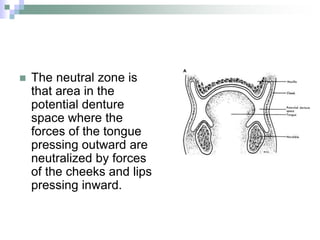
 The neutral zone is
that area in the
potential denture
space where the
forces of the tongue
pressing outward are
neutralized by forces
of the cheeks and lips
pressing inward.
Definition
 NEUTRAL ZONE (GPT 8) : the potential space between
the lips and cheeks on one side and the tongue on the
other; that area or position where the forces between the
tongue and cheeks or lips are equal
 Acc to Beresin & Schiesser :The neutral zone is that
area in the mouth where, during function, the forces of
the tongue pressing outward are neutralized by the
forces of the cheeks and lips pressing inward.
Review of literature
Pound ,JPD,1954,4,6
 pointed out that in advanced resorption the
maxillary ridge moves lingually and the
mandibular ridge moves buccally.
 He stressed upon the importance of
polished surface and the need for healthy
state of ridges.
 He also stated that “tooth over the ridge
is the greatest fallacy.
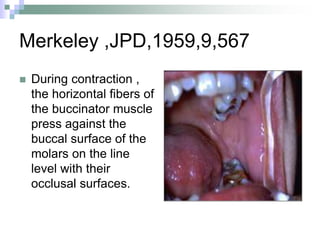
Merkeley ,JPD,1959,9,567
 During contraction ,
the horizontal fibers of
the buccinator muscle
press against the
buccal surface of the
molars on the line
level with their
occlusal surfaces.
0
10
20
30
40
50
60
70
80
90
1st
Qtr
2nd
Qtr
3rd
Qtr
4th
Qtr
East
West
North
 Similar directed pressure is exerted by the
modiolus in the region of bicuspids .
 Upper 3rd of the buccal surface of the
lower bicuspids & molars are ground to
slope lingually .
Russell ,JPD , 1959, 9,180
 He showed to register the dynamics of the
musculature in a direct wax pattern .
 Stone index of this wax pattern was made.
 Lower denture is designed to fit within the
index .
 Opposing upper denture is made to
conform to the lower denture
Lundquist ,JPD,1959,9,44
 The buccinator muscle is effective
bilaterally as an aid in denture retention
and stabilization only if the patient is a
bilateral chewer .
 Alteration of the buccal contour of the
denture did not show any appreciable
variation in the electromyographic
recording
Freehette, JPD ,1961,11,1032
 There was an accompanying decrease in the
number of positive pressure stroke on the
balancing side during unilateral chewing on
either side.
 This emphasizes again the importance of
bilateral chewing as a means of augmenting the
stability of complete denture.
Shanahan ,JPD, 1962 ,12, 420,
 Patients with advanced resorption of mandibular ridge
need denture made from dynamic impression because
they provide more comfort and stability than denture
made from a static impression.
 Dynamic impression are made by physiologically
extending the denture base into prescribed areas of
extension for retention and then making an impression of
the denture supporting tissues while the various function
of the mouth are performed
Raybin ,JPD,1963,13,263.
 The development of the proper forms of the
polished surface of dentures must be based
upon accurate impressions of the tissue which
limit the extent of the dentures, and the teeth
must be arranged in relation to the ridges so the
slopes of the soft wax pattern for the polished
surface can have a favorable angle with the
cheeks , lips , and tongue .
Schiesser,JPD,1964,14,854
 the lower denture is instable if :-
1. The incisor teeth are set so far labially that the
lip causes the denture to rise
2. It is too wide in bicuspid region
3. The molars encroach on the tongue , and the
buccal and lingual flanges in the molar region
are parallel so that the tongue and buccinator
muscle will not hold them down
Stromberg & Hickey ,JPD,1965,15
,213
 Compared the retention of the denture
formed by the physiologic technique and
manual method .
 They concluded that there was no
significant difference between the
retention of the two forms .
Lott & Levin ,JPD ,1972,16,394
 They proposed the flange technique of
recording the neutral zone and denture
fabrication according to it.
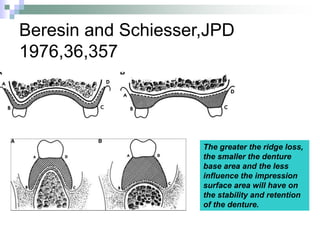
Beresin and Schiesser,JPD
1976,36,357
The greater the ridge loss,
the smaller the denture
base area and the less
influence the impression
surface area will have on
the stability and retention
of the denture.
Razek & Abdalla,JPD,1981,46,484
 They concluded that
 The width of the neutral zone is minimum at the level of
the occusal plane and increases gradually as it goes up
and down
 The width of the neutral zone is also minimum at the
posterior (molar) region and increases gradually toward
the anterior .
 Width of the neutral zone increases as the vertical
dimension of occlusion increases and decreases as the
vertical dimension of occlusion decreases .
Levin ,JPD,1985,45,242
 When ridge is highly resorbed , thicker
lingual borders and incorporation of
sublingual extensions apparently are
advantageous .
Fahmy & Kharat, JPD,1990,64,
459-462
 Evaluated patients’ chewing efficiency and
satisfaction for complete dentures made with
either a conventional or neutral zone technique.
 Patients had better chewing efficiency when
wearing conventional dentures; however,
patients could not detect any difference in
masticatory performance between their
conventionally fabricated dentures and neutral
zone dentures.
 Patients did report greater comfort and
improved speech clarity with the dentures
fabricated using the neutral zone
technique compared with their
conventionally prepared dentures
Wright ,Int J Prosthodont
,1991,4,159-163
 Proper shaping of the polished surface of
a denture is important to facilitate the
intraoral manipulation and control of the
prosthesis by the patient .
 A method for assessment of polished
surface form and tooth position in
processed denture is described .
 Low- viscocity silicone impression material
is placed on the dentures , and the
patient’s chewing movement are used to
define those areas requiring modification
Fahmi , JPD, 1992, 67,805
 The neutral zone in relation to the crest of
the residual ridge was investigated in the
anterior , premolar & molar regions
 The position of the neutral zone in relation
to the alveolar ridge was found to be
highly affected by the period of
edentulousness .
 The longer the edentulousness ,the more
buccally / labially located was the neutral
zone .
Alfano & Leupold, JPD,
2001;85:621-3.
 A technique has been presented that
allows the practitioner to accurately record
the maxillomandibular relationship of a
patient.
 Because the patient functionally molds
the mandibular rim into the area of the
neutral zone, a more stable record base is
created.
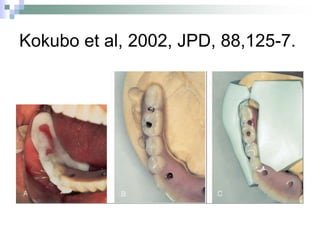
Kokubo et al, 2002, JPD, 88,125-7.
G . Nishigawa et al, Journal of Oral
Rehabilitation 2003 ,30, 646
 Using the FEA program developed in this study,
the effect of the bucco-lingual position of the
artificial posterior teeth under occlusal force on
the denture supporting bone of the edentulous
patient can be examined
 it was revealed that the difference of the loading
point of the occlusal force affected the buccal
side of the alveolar bone of maxilla rather than
the palatal side of the alveolar bone
Makzoume,JPD,2004,92,563-8.
 Findings indicated that the location of the neutral
zone was not the same with the
swallowing/modeling plastic impression
compound technique and the phonation/tissue
conditioner technique.
 However, statistical significance does not
necessarily imply clinical significance, and the
results yielded by these 2 techniques may be
clinically acceptable.
 In general, the PNZ technique resulted in
impressions where the neutral zone
appeared to be narrower as the buccal
surface was located more lingual
compared to the SNZ technique.
Gahan & Walmsley
BDJ,2005,198,269
 Most effective for a highly atrophic ridge —
aids retention and stability.
 Uses muscle function to produce the
impression.
 Defines polished surfaces and tooth
position.
 Requires an extra clinical stage.
 Requires good communication with your
technician.
 Produces a lower denture that is in muscle
balance and in harmony with the
surrounding structures.
DENTURE SPACE
 Various structures of the oral cavity
change considerably when a patient
becomes edentulous.
 The lips and cheeks are no longer
supported by the teeth and bone, and
therefore show a tendency to "fall" into the
oral cavity.
 At the same time, the tongue will expand
into the space formerly occupied by the
teeth. In this way, characteristic spaces
develop in the oral cavity of the edentulous
patient forming the so called DENTURE
SPACE
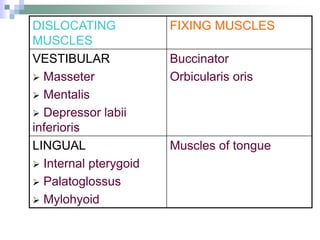
DISLOCATING
MUSCLES
FIXING MUSCLES
VESTIBULAR
 Masseter
 Mentalis
 Depressor labii
inferioris
Buccinator
Orbicularis oris
LINGUAL
 Internal pterygoid
 Palatoglossus
 Mylohyoid
Muscles of tongue
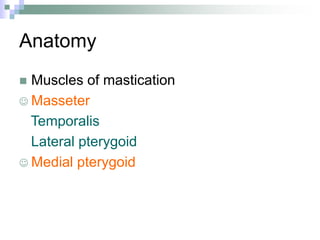
Anatomy
 Muscles of mastication
 Masseter
Temporalis
Lateral pterygoid
 Medial pterygoid
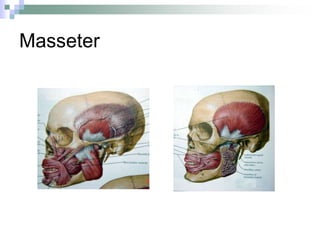
Masseter
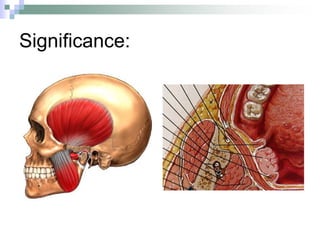
Significance:
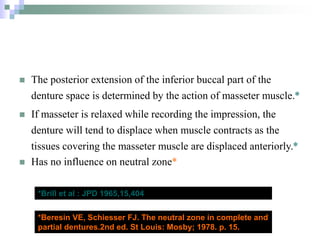
 The posterior extension of the inferior buccal part of the
denture space is determined by the action of masseter muscle.*
 If masseter is relaxed while recording the impression, the
denture will tend to displace when muscle contracts as the
tissues covering the masseter muscle are displaced anteriorly.*
 Has no influence on neutral zone*
*Brill et al : JPD 1965,15,404
*Beresin VE, Schiesser FJ. The neutral zone in complete and
partial dentures.2nd ed. St Louis: Mosby; 1978. p. 15.
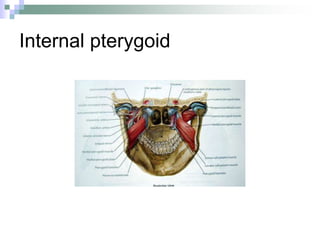
Internal pterygoid
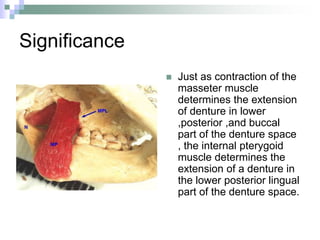
Significance
 Just as contraction of the
masseter muscle
determines the extension
of denture in lower
,posterior ,and buccal
part of the denture space
, the internal pterygoid
muscle determines the
extension of a denture in
the lower posterior lingual
part of the denture space.
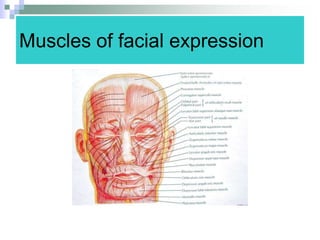
Muscles of facial expression
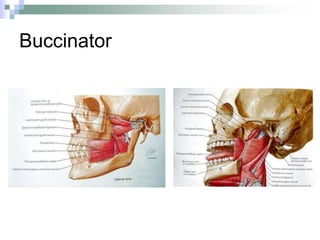
Buccinator
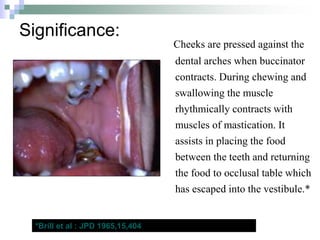
Significance:
Cheeks are pressed against the
dental arches when buccinator
contracts. During chewing and
swallowing the muscle
rhythmically contracts with
muscles of mastication. It
assists in placing the food
between the teeth and returning
the food to occlusal table which
has escaped into the vestibule.*
*Brill et al : JPD 1965,15,404
 Any overextension will interfere with the
buccinator in function and result in either
displacement of the denture or pain from the
traumatized mucosa.
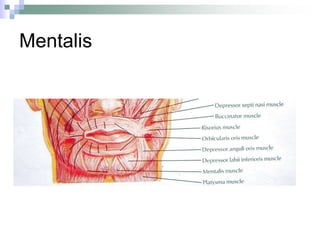
Mentalis
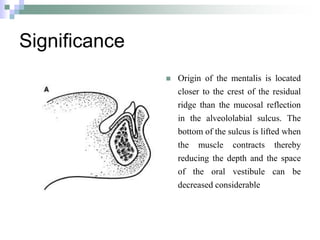
Significance
 Origin of the mentalis is located
closer to the crest of the residual
ridge than the mucosal reflection
in the alveololabial sulcus. The
bottom of the sulcus is lifted when
the muscle contracts thereby
reducing the depth and the space
of the oral vestibule can be
decreased considerable
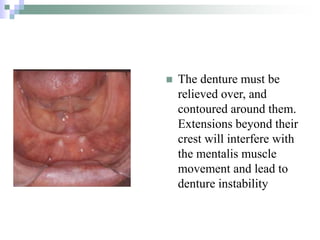
 The denture must be
relieved over, and
contoured around them.
Extensions beyond their
crest will interfere with
the mentalis muscle
movement and lead to
denture instability
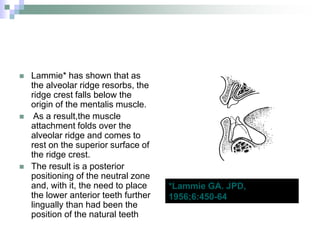
 Lammie* has shown that as
the alveolar ridge resorbs, the
ridge crest falls below the
origin of the mentalis muscle.
 As a result,the muscle
attachment folds over the
alveolar ridge and comes to
rest on the superior surface of
the ridge crest.
 The result is a posterior
positioning of the neutral zone
and, with it, the need to place
the lower anterior teeth further
lingually than had been the
position of the natural teeth
*Lammie GA. JPD,
1956;6:450-64.
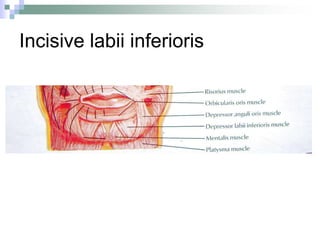
Incisive labii inferioris
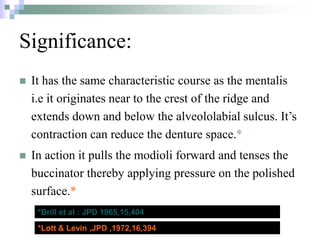
Significance:
 It has the same characteristic course as the mentalis
i.e it originates near to the crest of the ridge and
extends down and below the alveololabial sulcus. It’s
contraction can reduce the denture space.*
 In action it pulls the modioli forward and tenses the
buccinator thereby applying pressure on the polished
surface.*
*Brill et al : JPD 1965,15,404
*Lott & Levin ,JPD ,1972,16,394
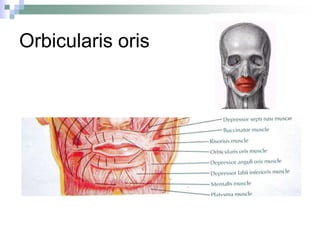
Orbicularis oris
Significance
 It is active when the lips are pressed against
the teeth. Like buccinator, orbicularis oris
rhythmically contracts during chewing,
sucking and swallowing
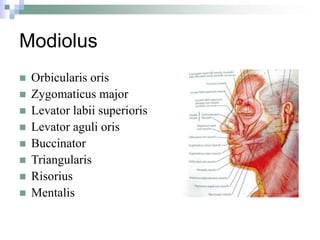
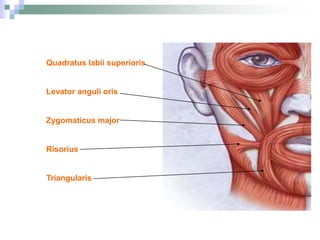
Modiolus
 Orbicularis oris
 Zygomaticus major
 Levator labii superioris
 Levator aguli oris
 Buccinator
 Triangularis
 Risorius
 Mentalis
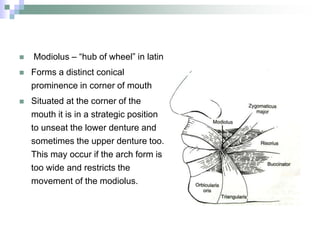
 Modiolus – “hub of wheel” in latin
 Forms a distinct conical
prominence in corner of mouth
 Situated at the corner of the
mouth it is in a strategic position
to unseat the lower denture and
sometimes the upper denture too.
This may occur if the arch form is
too wide and restricts the
movement of the modiolus.
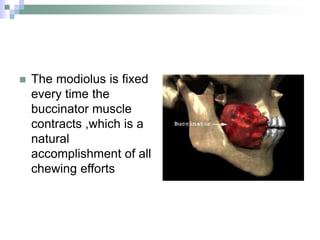
 The modiolus is fixed
every time the
buccinator muscle
contracts ,which is a
natural
accomplishment of all
chewing efforts
 The contraction of the modiolus presses
the corner of the mouth against the
premolars so the occlusal table is closed
from in front .
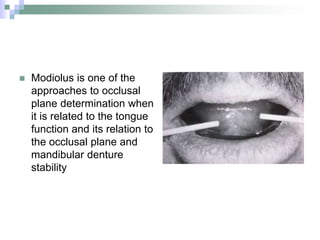
 Modiolus is one of the
approaches to occlusal
plane determination when
it is related to the tongue
function and its relation to
the occlusal plane and
mandibular denture
stability
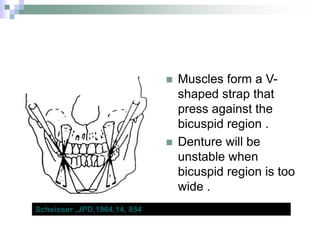
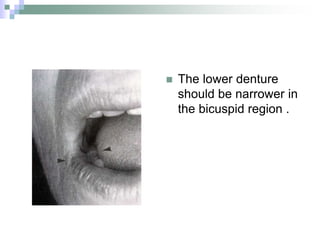
 Muscles form a V-
shaped strap that
press against the
bicuspid region .
 Denture will be
unstable when
bicuspid region is too
wide .
Scheisser ,JPD,1964,14, 854
 The lower denture
should be narrower in
the bicuspid region .
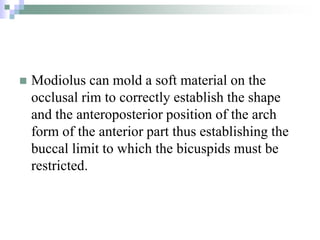
 Modiolus can mold a soft material on the
occlusal rim to correctly establish the shape
and the anteroposterior position of the arch
form of the anterior part thus establishing the
buccal limit to which the bicuspids must be
restricted.
Quadratus labii superioris
Levator anguli oris
Zygomaticus major
Risorius
Triangularis
Tongue
 Powerful and extremely adaptable
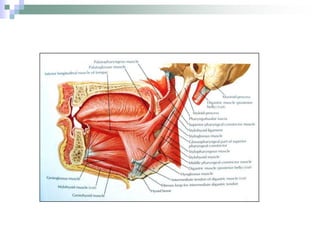
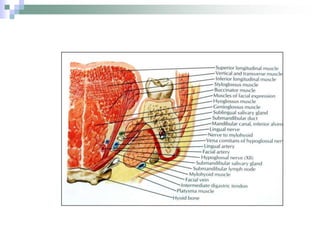
 It has two set of muscles: intrinsic and extrinsic
 They consist of the extrinsic and intrinsic groups of
muscles. The extrinsic muscles have their origin
external to the tongue, but their course terminates
within it. Their contraction causes the tongue to move
in relation to other oral structures. The intrinsic
muscles lie completely within the tongue, and their
activities sustain or alter tongue form.
Genioglossus
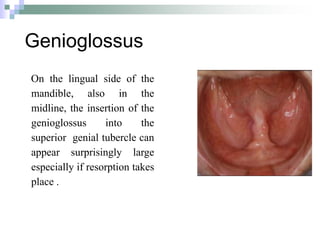
On the lingual side of the
mandible, also in the
midline, the insertion of the
genioglossus into the
superior genial tubercle can
appear surprisingly large
especially if resorption takes
place .
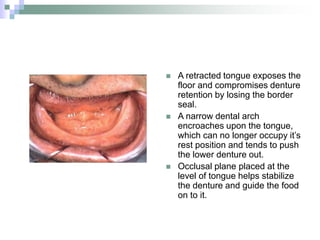
 A retracted tongue exposes the
floor and compromises denture
retention by losing the border
seal.
 A narrow dental arch
encroaches upon the tongue,
which can no longer occupy it’s
rest position and tends to push
the lower denture out.
 Occlusal plane placed at the
level of tongue helps stabilize
the denture and guide the food
on to it.
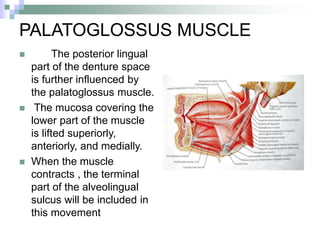
PALATOGLOSSUS MUSCLE
 The posterior lingual
part of the denture space
is further influenced by
the palatoglossus muscle.
 The mucosa covering the
lower part of the muscle
is lifted superiorly,
anteriorly, and medially.
 When the muscle
contracts , the terminal
part of the alveolingual
sulcus will be included in
this movement
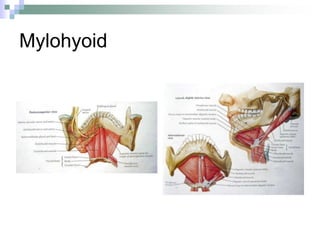
Mylohyoid
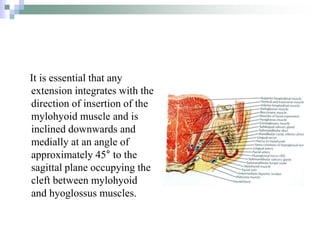
It is essential that any
extension integrates with the
direction of insertion of the
mylohyoid muscle and is
inclined downwards and
medially at an angle of
approximately 45° to the
sagittal plane occupying the
cleft between mylohyoid
and hyoglossus muscles.
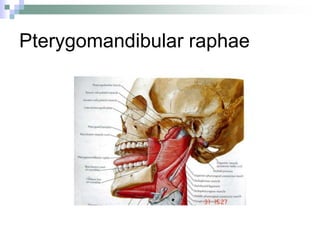
Pterygomandibular raphae
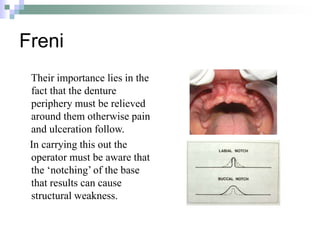
Freni
Their importance lies in the
fact that the denture
periphery must be relieved
around them otherwise pain
and ulceration follow.
In carrying this out the
operator must be aware that
the ‘notching’ of the base
that results can cause
structural weakness.
changes in edentulous mouth
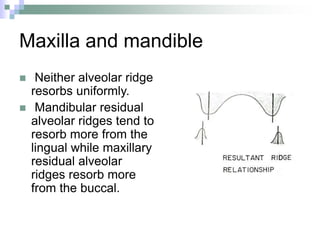
Maxilla and mandible
 Neither alveolar ridge
resorbs uniformly.
 Mandibular residual
alveolar ridges tend to
resorb more from the
lingual while maxillary
residual alveolar
ridges resorb more
from the buccal.
 Usually, the longer a patient is
edentulous, the greater is this interridge
facial/lingual and facial/palatal dimensional
disparity.
Lips and modioli
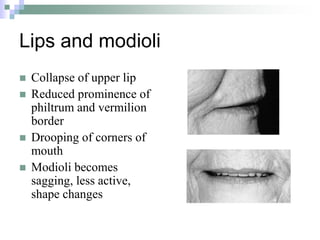
 Collapse of upper lip
 Reduced prominence of
philtrum and vermilion
border
 Drooping of corners of
mouth
 Modioli becomes
sagging, less active,
shape changes
Muscle attachment
 As the mandibular ridge resorbs the crest falls below
the level of the mentalis. As a result mentalis tends to
fold over and rests on the ridge.It pushes the neutral
zone posteriorly.
 The freni occupy a more superior position on the
ridge
 In some cases the buccinator attachment over the
external oblique ridge is lost after severe resorption .
Tongue
 In addition, it is estimated that tongue size increases
by approximately 10% in the edentulous patient.
 This lingual increase contributes further to the
confusion about optimum tooth placement, under the
dislodging forces.
Wright , JPD ,1961,5,629
 The position of the neutral zone in relation
to the alveolar ridge was found to be
highly affected by the period of
edentulousness .
 The longer the edentulousness ,the more
buccally / labially located was the neutral
zone
Fahmi , JPD, 1992, 67,805
 Since residual alveolar ridges are spatially
changing in a tight spaced functioning
stomatognathic apparatus, it appears prudent to
build prostheses that fit into current functional
spaces and use local forces to enhance
prosthetic function, stabilization and retention.
Denture surfaces
Sir wilfred fish described (1948) three
surfaces of a denture
 Impression surface
 Occlusal surface
 Polished surface
 With the neutral-zone concept, the
impression surface is called the ‘‘base’’
and the polished surface is called the
‘‘body’’ of the denture
Impression surface
That part of the denture in contact with the
tissues and on which the denture rests. The
retention of the denture depends on physical
forces developed by adhesion and atmospheric
pressure.
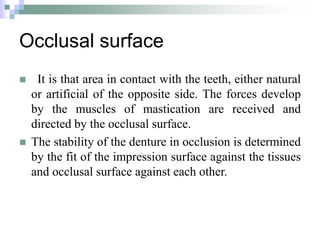
Occlusal surface
 It is that area in contact with the teeth, either natural
or artificial of the opposite side. The forces develop
by the muscles of mastication are received and
directed by the occlusal surface.
 The stability of the denture in occlusion is determined
by the fit of the impression surface against the tissues
and occlusal surface against each other.
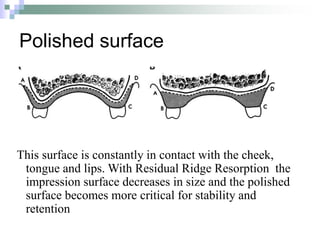
Polished surface
This surface is constantly in contact with the cheek,
tongue and lips. With Residual Ridge Resorption the
impression surface decreases in size and the polished
surface becomes more critical for stability and
retention
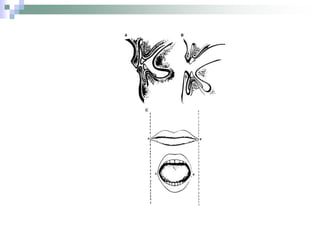
 Since most of the time jaws are at rest stability is more
dependent on forces on external surface as transmitted to
impression surface . The only time teeth make contact is
during mastication and swallowing. In order to construct
dentures that function properly not only in chewing but also in
speaking and swallowing , one must develop the fit and
contour of the external surface as accurately as that of
impression surface and occlusal surface
ACTIVE MUSCULAR FIXATION
 When forces of the tongue are directed against a
lower denture, the denture will be easily dislocated if the
forces are not counteracted by equal forces exerted by
the musculature of the cheeks and lower lip. Their
antagonistic activity can be used to stabilize dentures.
 Similar action of antagonistic muscle groups
between the functioning genioglossus and orbicularis
oris muscles will fix a lower denture by opposing forces
on its anterior section
PASSIVE MUSCULAR FIXATION
 It is possible to fix a lower denture even if all the
muscles of the cheeks, lower lip, and tongue are
quite passive. The denture is fixed by the mass
and weight of these structures and through the
pressure exerted by muscle tonus.
 Two factors that help in this are
 1. The inclination of the polished surfaces.
 2. The position of the polished surfaces of the
denture between the cheeks and the lower lip on
the one side and the tongue on the other side.
INCLINATION OF POLISHED
SURFACES
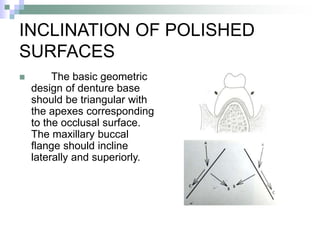
 The basic geometric
design of denture base
should be triangular with
the apexes corresponding
to the occlusal surface.
The maxillary buccal
flange should incline
laterally and superiorly.
 The buccal flanges of the lower denture
must slope inferiorly and laterally, and the
borders must be extended out beneath a
fold of the buccinator muscle in the molar
region.
The lingual flanges must also definitely extend inferiorly
and medially below the anterior and lateral parts of the
tongue, and as far posteriorly as permitted by the range
of action of the tongue and the internal pterygoid muscle.
Such inclination will provide a favorable vertical
component to any horizontally directed forces.
Narrow artificial teeth permit the polished
surfaces to be automatically formed with
favorable inclined planes that can be wedged
below the tongue, lower lip, and cheeks. In this
way, these structures are brought to rest on the
polished surfaces, and their weight will force the
denture to remain on its foundation.
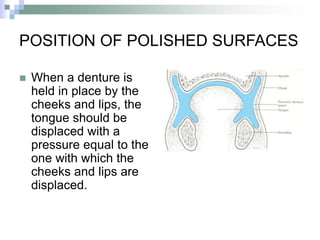
POSITION OF POLISHED SURFACES
 When a denture is
held in place by the
cheeks and lips, the
tongue should be
displaced with a
pressure equal to the
one with which the
cheeks and lips are
displaced.
 The denture must be placed in the denture space so
that there is an equilibrium between the inward pressure
exerted by the lips and the cheeks and the outward
pressure exerted by the tongue.
 The denture space has been given different names
because of this possible equilibrium. Some of these are:
the dead space,
the stable zone,
the neutral zone, and
the zone of minimal conflict.
 The of theory neutralization of forces that
stabilize dentures was made by Dr.
Russell Tench
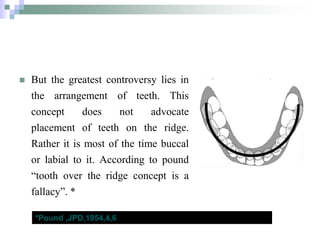
 But the greatest controversy lies in
the arrangement of teeth. This
concept does not advocate
placement of teeth on the ridge.
Rather it is most of the time buccal
or labial to it. According to pound
“tooth over the ridge concept is a
fallacy”. *
*Pound ,JPD,1954,4,6

Neutral zone concept in complte dentures.ppt

  • 1.
    Neutral zone concept incomplete dentures
  • 2.
    Table of contents Introduction  Definition  Review of literature  Anatomy : Muscles of mastication Muscles of facial expression Tongue  Age changes
  • 3.
     Neutral zoneconcept  Neutral zone and denture surface  Steps in complete denture fabrication based on neutral zone principle  Summary  Conclusion  Reference
  • 4.
    Introduction  Complete denturesare primarily mechanical devices, but since they function in the oral cavity, they must be fashioned so that they are in harmony with normal neuromuscular function.
  • 5.
     Failure torecognize the cardinal importance of tooth position and flange form and contour often results in dentures which are unstable and unsatisfactory, even though they were skillfully designed and expertly constructed.
  • 6.
     When allof the natural teeth have been lost, there exists within the oral cavity a void which is the potential denture space .
  • 7.
     The neutralzone is that area in the potential denture space where the forces of the tongue pressing outward are neutralized by forces of the cheeks and lips pressing inward.
  • 8.
    Definition  NEUTRAL ZONE(GPT 8) : the potential space between the lips and cheeks on one side and the tongue on the other; that area or position where the forces between the tongue and cheeks or lips are equal  Acc to Beresin & Schiesser :The neutral zone is that area in the mouth where, during function, the forces of the tongue pressing outward are neutralized by the forces of the cheeks and lips pressing inward.
  • 9.
  • 10.
    Pound ,JPD,1954,4,6  pointedout that in advanced resorption the maxillary ridge moves lingually and the mandibular ridge moves buccally.  He stressed upon the importance of polished surface and the need for healthy state of ridges.  He also stated that “tooth over the ridge is the greatest fallacy.
  • 11.
    Merkeley ,JPD,1959,9,567  Duringcontraction , the horizontal fibers of the buccinator muscle press against the buccal surface of the molars on the line level with their occlusal surfaces. 0 10 20 30 40 50 60 70 80 90 1st Qtr 2nd Qtr 3rd Qtr 4th Qtr East West North
  • 12.
     Similar directedpressure is exerted by the modiolus in the region of bicuspids .  Upper 3rd of the buccal surface of the lower bicuspids & molars are ground to slope lingually .
  • 13.
    Russell ,JPD ,1959, 9,180  He showed to register the dynamics of the musculature in a direct wax pattern .  Stone index of this wax pattern was made.  Lower denture is designed to fit within the index .  Opposing upper denture is made to conform to the lower denture
  • 14.
    Lundquist ,JPD,1959,9,44  Thebuccinator muscle is effective bilaterally as an aid in denture retention and stabilization only if the patient is a bilateral chewer .  Alteration of the buccal contour of the denture did not show any appreciable variation in the electromyographic recording
  • 15.
    Freehette, JPD ,1961,11,1032 There was an accompanying decrease in the number of positive pressure stroke on the balancing side during unilateral chewing on either side.  This emphasizes again the importance of bilateral chewing as a means of augmenting the stability of complete denture.
  • 16.
    Shanahan ,JPD, 1962,12, 420,  Patients with advanced resorption of mandibular ridge need denture made from dynamic impression because they provide more comfort and stability than denture made from a static impression.  Dynamic impression are made by physiologically extending the denture base into prescribed areas of extension for retention and then making an impression of the denture supporting tissues while the various function of the mouth are performed
  • 17.
    Raybin ,JPD,1963,13,263.  Thedevelopment of the proper forms of the polished surface of dentures must be based upon accurate impressions of the tissue which limit the extent of the dentures, and the teeth must be arranged in relation to the ridges so the slopes of the soft wax pattern for the polished surface can have a favorable angle with the cheeks , lips , and tongue .
  • 18.
    Schiesser,JPD,1964,14,854  the lowerdenture is instable if :- 1. The incisor teeth are set so far labially that the lip causes the denture to rise 2. It is too wide in bicuspid region 3. The molars encroach on the tongue , and the buccal and lingual flanges in the molar region are parallel so that the tongue and buccinator muscle will not hold them down
  • 19.
    Stromberg & Hickey,JPD,1965,15 ,213  Compared the retention of the denture formed by the physiologic technique and manual method .  They concluded that there was no significant difference between the retention of the two forms .
  • 20.
    Lott & Levin,JPD ,1972,16,394  They proposed the flange technique of recording the neutral zone and denture fabrication according to it.
  • 21.
    Beresin and Schiesser,JPD 1976,36,357 Thegreater the ridge loss, the smaller the denture base area and the less influence the impression surface area will have on the stability and retention of the denture.
  • 22.
    Razek & Abdalla,JPD,1981,46,484 They concluded that  The width of the neutral zone is minimum at the level of the occusal plane and increases gradually as it goes up and down  The width of the neutral zone is also minimum at the posterior (molar) region and increases gradually toward the anterior .  Width of the neutral zone increases as the vertical dimension of occlusion increases and decreases as the vertical dimension of occlusion decreases .
  • 23.
    Levin ,JPD,1985,45,242  Whenridge is highly resorbed , thicker lingual borders and incorporation of sublingual extensions apparently are advantageous .
  • 24.
    Fahmy & Kharat,JPD,1990,64, 459-462  Evaluated patients’ chewing efficiency and satisfaction for complete dentures made with either a conventional or neutral zone technique.  Patients had better chewing efficiency when wearing conventional dentures; however, patients could not detect any difference in masticatory performance between their conventionally fabricated dentures and neutral zone dentures.
  • 25.
     Patients didreport greater comfort and improved speech clarity with the dentures fabricated using the neutral zone technique compared with their conventionally prepared dentures
  • 26.
    Wright ,Int JProsthodont ,1991,4,159-163  Proper shaping of the polished surface of a denture is important to facilitate the intraoral manipulation and control of the prosthesis by the patient .  A method for assessment of polished surface form and tooth position in processed denture is described .
  • 27.
     Low- viscocitysilicone impression material is placed on the dentures , and the patient’s chewing movement are used to define those areas requiring modification
  • 28.
    Fahmi , JPD,1992, 67,805  The neutral zone in relation to the crest of the residual ridge was investigated in the anterior , premolar & molar regions  The position of the neutral zone in relation to the alveolar ridge was found to be highly affected by the period of edentulousness .
  • 29.
     The longerthe edentulousness ,the more buccally / labially located was the neutral zone .
  • 30.
    Alfano & Leupold,JPD, 2001;85:621-3.  A technique has been presented that allows the practitioner to accurately record the maxillomandibular relationship of a patient.  Because the patient functionally molds the mandibular rim into the area of the neutral zone, a more stable record base is created.
  • 31.
    Kokubo et al,2002, JPD, 88,125-7.
  • 32.
    G . Nishigawaet al, Journal of Oral Rehabilitation 2003 ,30, 646  Using the FEA program developed in this study, the effect of the bucco-lingual position of the artificial posterior teeth under occlusal force on the denture supporting bone of the edentulous patient can be examined  it was revealed that the difference of the loading point of the occlusal force affected the buccal side of the alveolar bone of maxilla rather than the palatal side of the alveolar bone
  • 33.
    Makzoume,JPD,2004,92,563-8.  Findings indicatedthat the location of the neutral zone was not the same with the swallowing/modeling plastic impression compound technique and the phonation/tissue conditioner technique.  However, statistical significance does not necessarily imply clinical significance, and the results yielded by these 2 techniques may be clinically acceptable.
  • 34.
     In general,the PNZ technique resulted in impressions where the neutral zone appeared to be narrower as the buccal surface was located more lingual compared to the SNZ technique.
  • 35.
    Gahan & Walmsley BDJ,2005,198,269 Most effective for a highly atrophic ridge — aids retention and stability.  Uses muscle function to produce the impression.  Defines polished surfaces and tooth position.
  • 36.
     Requires anextra clinical stage.  Requires good communication with your technician.  Produces a lower denture that is in muscle balance and in harmony with the surrounding structures.
  • 37.
    DENTURE SPACE  Variousstructures of the oral cavity change considerably when a patient becomes edentulous.  The lips and cheeks are no longer supported by the teeth and bone, and therefore show a tendency to "fall" into the oral cavity.
  • 38.
     At thesame time, the tongue will expand into the space formerly occupied by the teeth. In this way, characteristic spaces develop in the oral cavity of the edentulous patient forming the so called DENTURE SPACE
  • 39.
    DISLOCATING MUSCLES FIXING MUSCLES VESTIBULAR  Masseter Mentalis  Depressor labii inferioris Buccinator Orbicularis oris LINGUAL  Internal pterygoid  Palatoglossus  Mylohyoid Muscles of tongue
  • 40.
    Anatomy  Muscles ofmastication  Masseter Temporalis Lateral pterygoid  Medial pterygoid
  • 41.
  • 42.
  • 43.
     The posteriorextension of the inferior buccal part of the denture space is determined by the action of masseter muscle.*  If masseter is relaxed while recording the impression, the denture will tend to displace when muscle contracts as the tissues covering the masseter muscle are displaced anteriorly.*  Has no influence on neutral zone* *Brill et al : JPD 1965,15,404 *Beresin VE, Schiesser FJ. The neutral zone in complete and partial dentures.2nd ed. St Louis: Mosby; 1978. p. 15.
  • 44.
  • 45.
    Significance  Just ascontraction of the masseter muscle determines the extension of denture in lower ,posterior ,and buccal part of the denture space , the internal pterygoid muscle determines the extension of a denture in the lower posterior lingual part of the denture space.
  • 46.
  • 47.
  • 49.
    Significance: Cheeks are pressedagainst the dental arches when buccinator contracts. During chewing and swallowing the muscle rhythmically contracts with muscles of mastication. It assists in placing the food between the teeth and returning the food to occlusal table which has escaped into the vestibule.* *Brill et al : JPD 1965,15,404
  • 50.
     Any overextensionwill interfere with the buccinator in function and result in either displacement of the denture or pain from the traumatized mucosa.
  • 51.
  • 52.
    Significance  Origin ofthe mentalis is located closer to the crest of the residual ridge than the mucosal reflection in the alveololabial sulcus. The bottom of the sulcus is lifted when the muscle contracts thereby reducing the depth and the space of the oral vestibule can be decreased considerable
  • 53.
     The denturemust be relieved over, and contoured around them. Extensions beyond their crest will interfere with the mentalis muscle movement and lead to denture instability
  • 54.
     Lammie* hasshown that as the alveolar ridge resorbs, the ridge crest falls below the origin of the mentalis muscle.  As a result,the muscle attachment folds over the alveolar ridge and comes to rest on the superior surface of the ridge crest.  The result is a posterior positioning of the neutral zone and, with it, the need to place the lower anterior teeth further lingually than had been the position of the natural teeth *Lammie GA. JPD, 1956;6:450-64.
  • 55.
  • 56.
    Significance:  It hasthe same characteristic course as the mentalis i.e it originates near to the crest of the ridge and extends down and below the alveololabial sulcus. It’s contraction can reduce the denture space.*  In action it pulls the modioli forward and tenses the buccinator thereby applying pressure on the polished surface.* *Brill et al : JPD 1965,15,404 *Lott & Levin ,JPD ,1972,16,394
  • 57.
  • 58.
    Significance  It isactive when the lips are pressed against the teeth. Like buccinator, orbicularis oris rhythmically contracts during chewing, sucking and swallowing
  • 59.
    Modiolus  Orbicularis oris Zygomaticus major  Levator labii superioris  Levator aguli oris  Buccinator  Triangularis  Risorius  Mentalis
  • 60.
     Modiolus –“hub of wheel” in latin  Forms a distinct conical prominence in corner of mouth  Situated at the corner of the mouth it is in a strategic position to unseat the lower denture and sometimes the upper denture too. This may occur if the arch form is too wide and restricts the movement of the modiolus.
  • 61.
     The modiolusis fixed every time the buccinator muscle contracts ,which is a natural accomplishment of all chewing efforts
  • 62.
     The contractionof the modiolus presses the corner of the mouth against the premolars so the occlusal table is closed from in front .
  • 63.
     Modiolus isone of the approaches to occlusal plane determination when it is related to the tongue function and its relation to the occlusal plane and mandibular denture stability
  • 64.
     Muscles forma V- shaped strap that press against the bicuspid region .  Denture will be unstable when bicuspid region is too wide . Scheisser ,JPD,1964,14, 854
  • 65.
     The lowerdenture should be narrower in the bicuspid region .
  • 66.
     Modiolus canmold a soft material on the occlusal rim to correctly establish the shape and the anteroposterior position of the arch form of the anterior part thus establishing the buccal limit to which the bicuspids must be restricted.
  • 67.
    Quadratus labii superioris Levatoranguli oris Zygomaticus major Risorius Triangularis
  • 68.
    Tongue  Powerful andextremely adaptable  It has two set of muscles: intrinsic and extrinsic  They consist of the extrinsic and intrinsic groups of muscles. The extrinsic muscles have their origin external to the tongue, but their course terminates within it. Their contraction causes the tongue to move in relation to other oral structures. The intrinsic muscles lie completely within the tongue, and their activities sustain or alter tongue form.
  • 71.
    Genioglossus On the lingualside of the mandible, also in the midline, the insertion of the genioglossus into the superior genial tubercle can appear surprisingly large especially if resorption takes place .
  • 72.
     A retractedtongue exposes the floor and compromises denture retention by losing the border seal.  A narrow dental arch encroaches upon the tongue, which can no longer occupy it’s rest position and tends to push the lower denture out.  Occlusal plane placed at the level of tongue helps stabilize the denture and guide the food on to it.
  • 73.
    PALATOGLOSSUS MUSCLE  Theposterior lingual part of the denture space is further influenced by the palatoglossus muscle.  The mucosa covering the lower part of the muscle is lifted superiorly, anteriorly, and medially.  When the muscle contracts , the terminal part of the alveolingual sulcus will be included in this movement
  • 74.
  • 75.
    It is essentialthat any extension integrates with the direction of insertion of the mylohyoid muscle and is inclined downwards and medially at an angle of approximately 45° to the sagittal plane occupying the cleft between mylohyoid and hyoglossus muscles.
  • 76.
  • 77.
    Freni Their importance liesin the fact that the denture periphery must be relieved around them otherwise pain and ulceration follow. In carrying this out the operator must be aware that the ‘notching’ of the base that results can cause structural weakness.
  • 78.
  • 79.
    Maxilla and mandible Neither alveolar ridge resorbs uniformly.  Mandibular residual alveolar ridges tend to resorb more from the lingual while maxillary residual alveolar ridges resorb more from the buccal.
  • 80.
     Usually, thelonger a patient is edentulous, the greater is this interridge facial/lingual and facial/palatal dimensional disparity.
  • 81.
    Lips and modioli Collapse of upper lip  Reduced prominence of philtrum and vermilion border  Drooping of corners of mouth  Modioli becomes sagging, less active, shape changes
  • 82.
    Muscle attachment  Asthe mandibular ridge resorbs the crest falls below the level of the mentalis. As a result mentalis tends to fold over and rests on the ridge.It pushes the neutral zone posteriorly.  The freni occupy a more superior position on the ridge  In some cases the buccinator attachment over the external oblique ridge is lost after severe resorption .
  • 83.
    Tongue  In addition,it is estimated that tongue size increases by approximately 10% in the edentulous patient.  This lingual increase contributes further to the confusion about optimum tooth placement, under the dislodging forces. Wright , JPD ,1961,5,629
  • 84.
     The positionof the neutral zone in relation to the alveolar ridge was found to be highly affected by the period of edentulousness .  The longer the edentulousness ,the more buccally / labially located was the neutral zone Fahmi , JPD, 1992, 67,805
  • 85.
     Since residualalveolar ridges are spatially changing in a tight spaced functioning stomatognathic apparatus, it appears prudent to build prostheses that fit into current functional spaces and use local forces to enhance prosthetic function, stabilization and retention.
  • 86.
    Denture surfaces Sir wilfredfish described (1948) three surfaces of a denture  Impression surface  Occlusal surface  Polished surface
  • 87.
     With theneutral-zone concept, the impression surface is called the ‘‘base’’ and the polished surface is called the ‘‘body’’ of the denture
  • 88.
    Impression surface That partof the denture in contact with the tissues and on which the denture rests. The retention of the denture depends on physical forces developed by adhesion and atmospheric pressure.
  • 89.
    Occlusal surface  Itis that area in contact with the teeth, either natural or artificial of the opposite side. The forces develop by the muscles of mastication are received and directed by the occlusal surface.  The stability of the denture in occlusion is determined by the fit of the impression surface against the tissues and occlusal surface against each other.
  • 90.
    Polished surface This surfaceis constantly in contact with the cheek, tongue and lips. With Residual Ridge Resorption the impression surface decreases in size and the polished surface becomes more critical for stability and retention
  • 91.
     Since mostof the time jaws are at rest stability is more dependent on forces on external surface as transmitted to impression surface . The only time teeth make contact is during mastication and swallowing. In order to construct dentures that function properly not only in chewing but also in speaking and swallowing , one must develop the fit and contour of the external surface as accurately as that of impression surface and occlusal surface
  • 93.
    ACTIVE MUSCULAR FIXATION When forces of the tongue are directed against a lower denture, the denture will be easily dislocated if the forces are not counteracted by equal forces exerted by the musculature of the cheeks and lower lip. Their antagonistic activity can be used to stabilize dentures.  Similar action of antagonistic muscle groups between the functioning genioglossus and orbicularis oris muscles will fix a lower denture by opposing forces on its anterior section
  • 94.
    PASSIVE MUSCULAR FIXATION It is possible to fix a lower denture even if all the muscles of the cheeks, lower lip, and tongue are quite passive. The denture is fixed by the mass and weight of these structures and through the pressure exerted by muscle tonus.  Two factors that help in this are  1. The inclination of the polished surfaces.  2. The position of the polished surfaces of the denture between the cheeks and the lower lip on the one side and the tongue on the other side.
  • 95.
    INCLINATION OF POLISHED SURFACES The basic geometric design of denture base should be triangular with the apexes corresponding to the occlusal surface. The maxillary buccal flange should incline laterally and superiorly.
  • 96.
     The buccalflanges of the lower denture must slope inferiorly and laterally, and the borders must be extended out beneath a fold of the buccinator muscle in the molar region.
  • 97.
    The lingual flangesmust also definitely extend inferiorly and medially below the anterior and lateral parts of the tongue, and as far posteriorly as permitted by the range of action of the tongue and the internal pterygoid muscle. Such inclination will provide a favorable vertical component to any horizontally directed forces.
  • 98.
    Narrow artificial teethpermit the polished surfaces to be automatically formed with favorable inclined planes that can be wedged below the tongue, lower lip, and cheeks. In this way, these structures are brought to rest on the polished surfaces, and their weight will force the denture to remain on its foundation.
  • 99.
    POSITION OF POLISHEDSURFACES  When a denture is held in place by the cheeks and lips, the tongue should be displaced with a pressure equal to the one with which the cheeks and lips are displaced.
  • 100.
     The denturemust be placed in the denture space so that there is an equilibrium between the inward pressure exerted by the lips and the cheeks and the outward pressure exerted by the tongue.  The denture space has been given different names because of this possible equilibrium. Some of these are: the dead space, the stable zone, the neutral zone, and the zone of minimal conflict.
  • 101.
     The oftheory neutralization of forces that stabilize dentures was made by Dr. Russell Tench
  • 102.
     But thegreatest controversy lies in the arrangement of teeth. This concept does not advocate placement of teeth on the ridge. Rather it is most of the time buccal or labial to it. According to pound “tooth over the ridge concept is a fallacy”. * *Pound ,JPD,1954,4,6