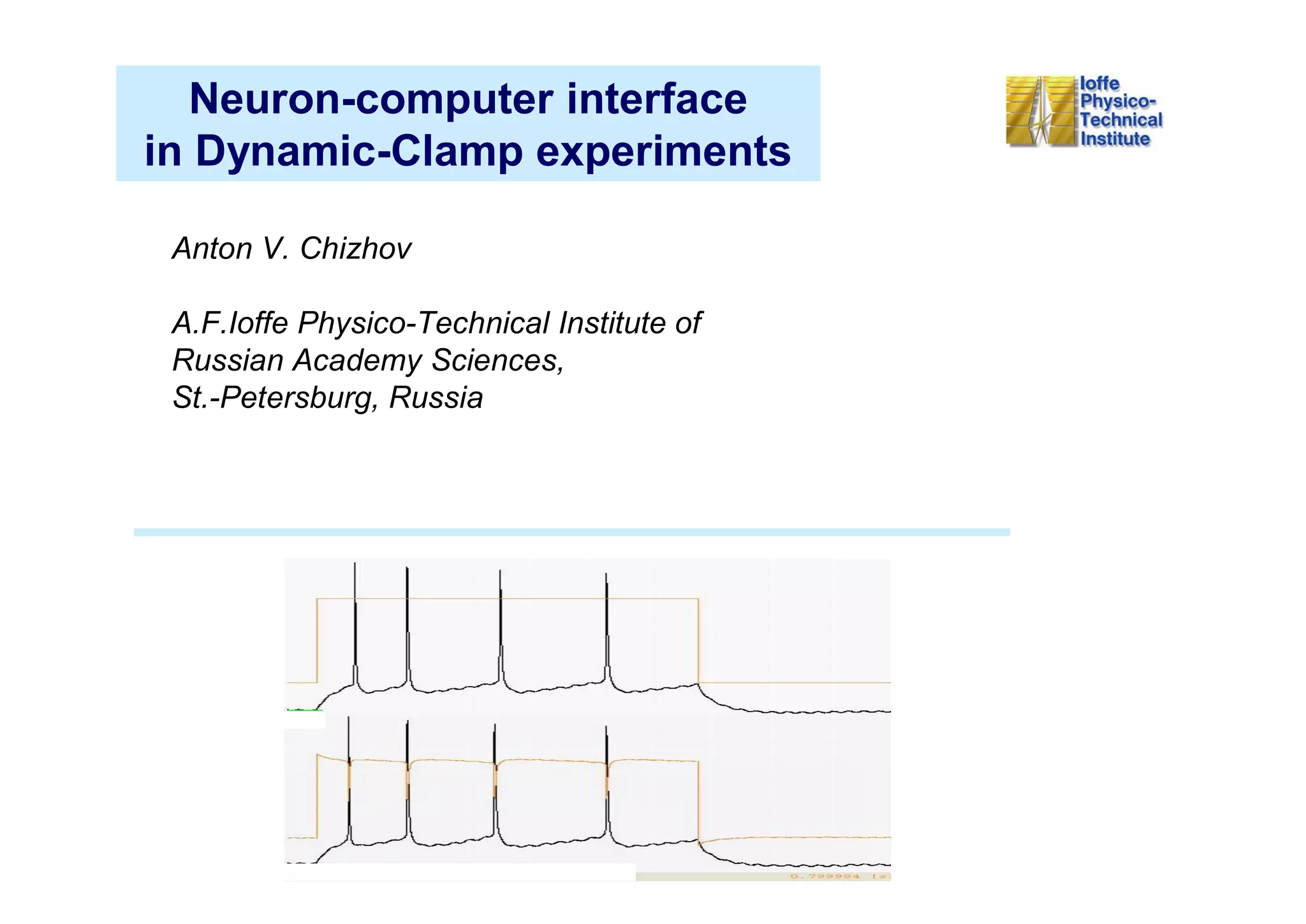
Neuron-computer interface
in Dynamic-Clamp experiments

 Anton V. Chizhov

 A.F.Ioffe Physico-Technical Institute of
 Russian Academy Sciences,
 St.-Petersburg, Russia
Leaky integrate-and-fire model

Hodgkin-Huxley neuron model

Control parameters of neuron


Dynamic-clamp
    • Artificial synaptic current

    • Artificial voltage-dependent
    current

    • Synaptic conductance
    estimation
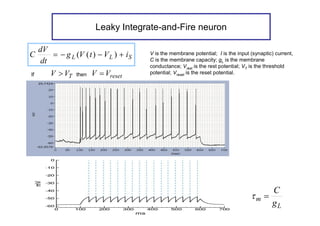
Leaky Integrate-and-Fire neuron

     dV
C          g L (V ( t )  V L )  i S   V is the membrane potential; I is the input (synaptic) current,
      dt                                  C is the membrane capacity; gL is the membrane
                                          conductance; Vrest is the rest potential; VT is the threshold
If       V  VT   then   V  Vreset       potential; Vreset is the reset potential.


                                                                                           C
                                                                                      m 
                                                                                           gL
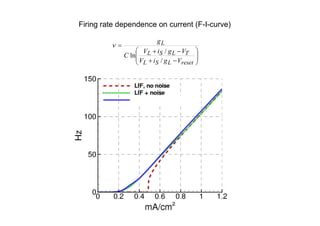
Firing rate dependence on current (F-I-curve)

                         gL
         
                   V  i / g V   
              C ln L S L T
                   V  i / g V   
                                   
                   L S L reset    
V(x)
                                     r       Внутри      V(x+Δx)

                                                   jm

                                     C
                                                         im
     g S (V  VL )  iS
                                                         φ≈0
                                Снаружи
h


                            VNa          V


                                             gNa

                                                    gK
                           Vrest
                            VK


           [Покровский, 1978]
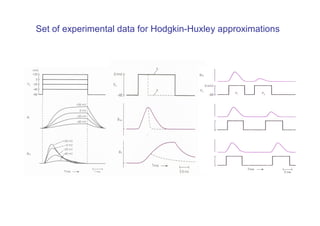
Set of experimental data for Hodgkin-Huxley approximations
Model of a pyramidal neuron
       dV
   C        I Na  I DR  I A  I M  I H  I L  I AHP  iS
       dt
                 p       q
                                                                 E X P Е R I М Е N Т
    I ...  g... x (t ) y (t ) (V (t )  V... )

    dx x (U )  x
                  ,
    dt    x (U )
    dy y (U )  y
       
    dt    y (U )

Approximations for I Na , I DR , I A , I M , I H
are taken from [L.Graham, 1999]; IAHP is
from [N.Kopell et al., 2000]
                                                                     Model with noise


Color noise model for
synaptic current IS is the
Ornstein-Uhlenbeck process:
  diS    0
      iS (t )  iS  2  (t )
  dt
E X P E R I M E N T
                  Control parameters of
                        a neuron
    dV ( t )
C              g Na m 3 (V , t )h (V , t )(V (t )  VNa ) 
     dt
                      4                                                     2V
               g K n (V , t )(V (t )  VK )  g L (V ( t )  VL )  iS  k 2
                                                                           x

Voltage-gated channels kinetics:
dm    m (V )  m
     
                                                                                       MODEL
 dt      m (V )
dh   h (V )  h                         [Hodgkin, Huxley, 1952]
     
 dt     h (V )
dn   n (V )  n
     
 dt     n (V )


Property: Neuron is controlled by two parameters
                                          [Покровский, 1978]

iS  GE (V  VE )  GI (V  VI )  I electrode   s (V  V0 )  u

     u  GE (VE  V0 )  GI (VI  V0 )  I electrode
     s  GE  GI
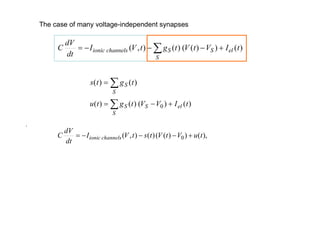
The case of many voltage-independent synapses

           dV
         C      I ionic channels (V , t )   g S (t ) (V (t )  VS )  I el (t )
           dt                                 S


                        s(t )   g S (t )
                                  S

                        u (t )   g S (t ) (VS  V0 )  I el (t )
                                  S
,
             dV
         C        I ionic channels (V , t )  s(t ) (V (t )  V0 )  u(t ),
             dt
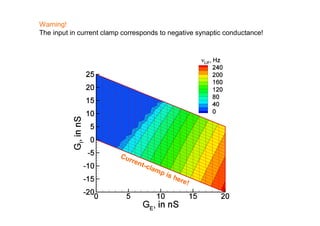
Warning!
The input in current clamp corresponds to negative synaptic conductance!


                          Cur
                              rent
                                   -c   lam
                                              p is
                                                     her
                                                         e   !
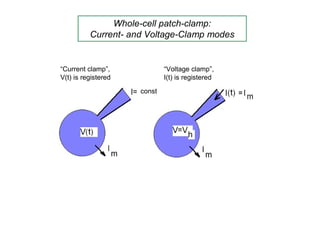
Whole-cell patch-clamp:
          Current- and Voltage-Clamp modes


“Current clamp”,             “Voltage clamp”,
V(t) is registered           I(t) is registered

                     const
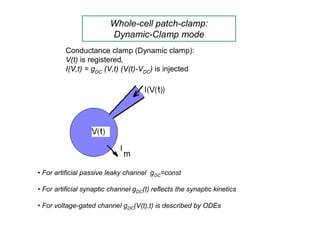
Whole-cell patch-clamp:
                         Dynamic-Clamp mode
          Conductance clamp (Dynamic clamp):
          V(t) is registered,
          I(V,t) = gDC (V,t) (V(t)-VDC) is injected


• For artificial passive leaky channel gDC=const

• For artificial synaptic channel gDC(t) reflects the synaptic kinetics

• For voltage-gated channel gDC(V(t),t) is described by ODEs
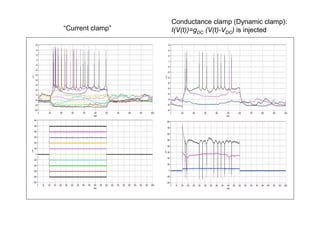
Conductance clamp (Dynamic clamp):
“Current clamp”   I(V(t))=gDC (V(t)-VDC) is injected
Dynamic clamp for synaptic current

 [Sharp AA, O'Neil MB, Abbott LF, Marder E. Dynamic clamp: computer-generated
 conductances in real neurons. // J.Neurophysiol. 1993, 69(3):992-5]


                                  I  g GABA (t ) (V  VGABA )
                                    
gGABA (t )  gGABA e  t /  1  e  t /  2 ,  1  5 s,  2  15 s, gGABA  8 nS
              max                                                      max
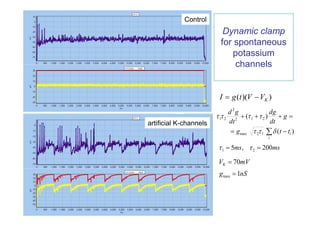
Control
                           Dynamic clamp
                          for spontaneous
                             potassium
                              channels


                         I  g (t )(V  VK )
                              d 2g             dg
                         1 2 2  ( 1   2 )  g 
artificial K-channels         dt               dt
                                g max  2 1   (t  ti )
                                               i

                          1  5ms,  2  200ms

                         VK  70mV
                         g max  1nS
Dynamic clamp                                                  Model [Graham, 1999] for
             to study firing properties of                                        CA1 pyramidal neuron
                        neuron
                                                                                                              Hz
                                                                            0.6                               80
             Experiment: pyramidal cell                                                                       60
             of visual cortex                                               0.5                               40
                                                          Hz
            0.06                                         Hz                                                   20
                                                                            0.4


                                                                s, mS/cm2
                                           (2.7; 0.06)
                                                          110
            0.05                                          100
                                                                                                              0
                                                          90
            0.04                                          80                0.3
s, mS/cm2


                                                          70
                                                          60
            0.03                                          50
                                                          40                0.2
                            (1.7; 0.024)                  30
            0.02                                          20

            0.01
                                                          10
                                                          0                 0.1

               0      1            2                3                         0      2     4 6 8         10
                                       2                                                         2
                          u, A/cm                                                       u,mkA/cm
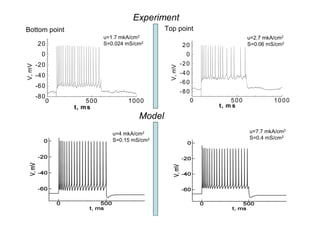
Experiment
Bottom point                                    Top point
                            u=1.7 mkA/cm2                                      u=2.7 mkA/cm2
        20                  S=0.024 mS/cm2                 20                  S=0.06 mS/cm2
         0                                                  0
        -20                                               -2 0
V, mV


                                                  V, mV
        -40                                               -4 0
                                                          -6 0
        -60
                                                          -8 0
        -80
              0       500           1000                         0       500            1000
                  t, m s                                             t, m s
                                        Model
                               u=4 mkA/cm2                                     u=7.7 mkA/cm2
                               S=0.15 mS/cm2                                   S=0.4 mS/cm2
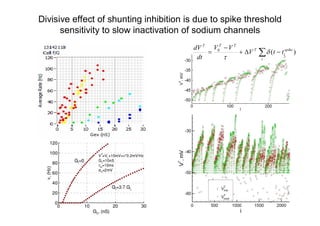
Divisive effect of shunting inhibition is due to spike threshold
      sensitivity to slow inactivation of sodium channels
                                        dV T V0T  V T
                                                       V T     (t  t   i
                                                                              spike
                                                                                      )
                                         dt                     i
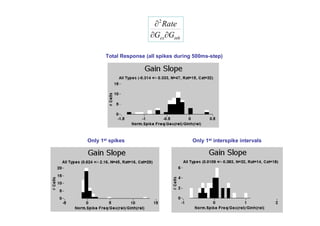
 2 Rate
                        Gex Ginh

       Total Response (all spikes during 500ms-step)


Only 1st spikes                         Only 1st interspike intervals
Dynamic clamp for voltage-gated current:
         compensation of INaP
    Hippocampal Pyramidal Neuron In Vitro


                         [Vervaeke K, Hu H., Graham L.J., Storm J.F.
                         Contrasting effects of the persistent Na+
                         current on neuronal excitability and spike
                         timing, Neuron, v49, 2006]
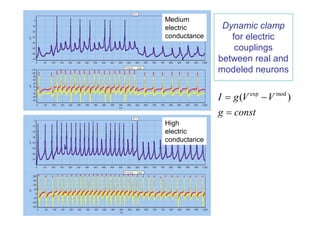
Medium
electric       Dynamic clamp
conductance      for electric
                  couplings
              between real and
              modeled neurons


              I  g (V exp  V mod )
              g  const
High
electric
conductance
Dynamic clamp for synaptic conductance
                         estimations in-vivo


                      Preferred direction                   Null direction


        V
      Эксперимент [Lyle Graham et al.]: Внутриклеточные измерения patch-clamp
      в зрительной коре кошки in vivo. Стимул – движущаяся полоска.
      V                                                                         20 mV


GABAA : GI                                                                        10 nS

AMPA : GE                                                                         5 nS
                                                                             1s
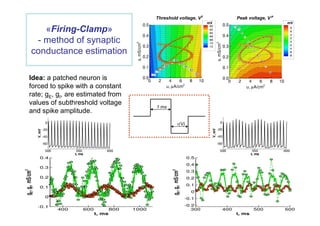
Threshold voltage, VT   Peak voltage, V P

   «Firing-Clamp»
 - method of synaptic
conductance estimation

Idea: a patched neuron is
forced to spike with a constant
rate; gE, gI, are estimated from
values of subthreshold voltage
                                   1 ms
and spike amplitude.
                                            τ(V)
Conclusions


Dynamic Clamp

• is needed for measuring firing characteristics of neuron

• is needed for estimation input synaptic conductances in-vivo

• helps to create artificial ionic intrinsic or synaptic channels

Neuron-computer interface in Dynamic-Clamp experiments

  • 1.
    Neuron-computer interface in Dynamic-Clampexperiments Anton V. Chizhov A.F.Ioffe Physico-Technical Institute of Russian Academy Sciences, St.-Petersburg, Russia
  • 2.
    Leaky integrate-and-fire model Hodgkin-Huxleyneuron model Control parameters of neuron Dynamic-clamp • Artificial synaptic current • Artificial voltage-dependent current • Synaptic conductance estimation
  • 3.
    Leaky Integrate-and-Fire neuron dV C   g L (V ( t )  V L )  i S V is the membrane potential; I is the input (synaptic) current, dt C is the membrane capacity; gL is the membrane conductance; Vrest is the rest potential; VT is the threshold If V  VT then V  Vreset potential; Vreset is the reset potential. C m  gL
  • 4.
    Firing rate dependenceon current (F-I-curve) gL   V  i / g V  C ln L S L T  V  i / g V    L S L reset 
  • 5.
    V(x) r Внутри V(x+Δx) jm C im  g S (V  VL )  iS φ≈0 Снаружи h VNa V gNa gK Vrest VK [Покровский, 1978]
  • 6.
    Set of experimentaldata for Hodgkin-Huxley approximations
  • 7.
    Model of apyramidal neuron dV C   I Na  I DR  I A  I M  I H  I L  I AHP  iS dt p q E X P Е R I М Е N Т I ...  g... x (t ) y (t ) (V (t )  V... ) dx x (U )  x  , dt  x (U ) dy y (U )  y  dt  y (U ) Approximations for I Na , I DR , I A , I M , I H are taken from [L.Graham, 1999]; IAHP is from [N.Kopell et al., 2000] Model with noise Color noise model for synaptic current IS is the Ornstein-Uhlenbeck process: diS 0   iS (t )  iS  2  (t ) dt
  • 8.
    E X PE R I M E N T Control parameters of a neuron dV ( t ) C   g Na m 3 (V , t )h (V , t )(V (t )  VNa )  dt 4  2V  g K n (V , t )(V (t )  VK )  g L (V ( t )  VL )  iS  k 2 x Voltage-gated channels kinetics: dm m (V )  m   MODEL dt  m (V ) dh h (V )  h [Hodgkin, Huxley, 1952]   dt  h (V ) dn n (V )  n   dt  n (V ) Property: Neuron is controlled by two parameters [Покровский, 1978] iS  GE (V  VE )  GI (V  VI )  I electrode   s (V  V0 )  u u  GE (VE  V0 )  GI (VI  V0 )  I electrode s  GE  GI
  • 9.
    The case ofmany voltage-independent synapses dV C   I ionic channels (V , t )   g S (t ) (V (t )  VS )  I el (t ) dt S s(t )   g S (t ) S u (t )   g S (t ) (VS  V0 )  I el (t ) S , dV C   I ionic channels (V , t )  s(t ) (V (t )  V0 )  u(t ), dt
  • 10.
    Warning! The input incurrent clamp corresponds to negative synaptic conductance! Cur rent -c lam p is her e !
  • 11.
    Whole-cell patch-clamp: Current- and Voltage-Clamp modes “Current clamp”, “Voltage clamp”, V(t) is registered I(t) is registered const
  • 12.
    Whole-cell patch-clamp: Dynamic-Clamp mode Conductance clamp (Dynamic clamp): V(t) is registered, I(V,t) = gDC (V,t) (V(t)-VDC) is injected • For artificial passive leaky channel gDC=const • For artificial synaptic channel gDC(t) reflects the synaptic kinetics • For voltage-gated channel gDC(V(t),t) is described by ODEs
  • 13.
    Conductance clamp (Dynamicclamp): “Current clamp” I(V(t))=gDC (V(t)-VDC) is injected
  • 14.
    Dynamic clamp forsynaptic current [Sharp AA, O'Neil MB, Abbott LF, Marder E. Dynamic clamp: computer-generated conductances in real neurons. // J.Neurophysiol. 1993, 69(3):992-5] I  g GABA (t ) (V  VGABA )   gGABA (t )  gGABA e  t /  1  e  t /  2 ,  1  5 s,  2  15 s, gGABA  8 nS max max
  • 15.
    Control Dynamic clamp for spontaneous potassium channels I  g (t )(V  VK ) d 2g dg  1 2 2  ( 1   2 )  g  artificial K-channels dt dt  g max  2 1   (t  ti ) i  1  5ms,  2  200ms VK  70mV g max  1nS
  • 16.
    Dynamic clamp Model [Graham, 1999] for to study firing properties of CA1 pyramidal neuron neuron Hz 0.6 80 Experiment: pyramidal cell 60 of visual cortex 0.5 40 Hz 0.06 Hz 20 0.4 s, mS/cm2 (2.7; 0.06) 110 0.05 100 0 90 0.04 80 0.3 s, mS/cm2 70 60 0.03 50 40 0.2 (1.7; 0.024) 30 0.02 20 0.01 10 0 0.1 0 1 2 3 0 2 4 6 8 10 2 2 u, A/cm u,mkA/cm
  • 17.
    Experiment Bottom point Top point u=1.7 mkA/cm2 u=2.7 mkA/cm2 20 S=0.024 mS/cm2 20 S=0.06 mS/cm2 0 0 -20 -2 0 V, mV V, mV -40 -4 0 -6 0 -60 -8 0 -80 0 500 1000 0 500 1000 t, m s t, m s Model u=4 mkA/cm2 u=7.7 mkA/cm2 S=0.15 mS/cm2 S=0.4 mS/cm2
  • 18.
    Divisive effect ofshunting inhibition is due to spike threshold sensitivity to slow inactivation of sodium channels dV T V0T  V T   V T   (t  t i spike ) dt  i
  • 19.
     2 Rate Gex Ginh Total Response (all spikes during 500ms-step) Only 1st spikes Only 1st interspike intervals
  • 20.
    Dynamic clamp forvoltage-gated current: compensation of INaP Hippocampal Pyramidal Neuron In Vitro [Vervaeke K, Hu H., Graham L.J., Storm J.F. Contrasting effects of the persistent Na+ current on neuronal excitability and spike timing, Neuron, v49, 2006]
  • 21.
    Medium electric Dynamic clamp conductance for electric couplings between real and modeled neurons I  g (V exp  V mod ) g  const High electric conductance
  • 22.
    Dynamic clamp forsynaptic conductance estimations in-vivo Preferred direction Null direction V Эксперимент [Lyle Graham et al.]: Внутриклеточные измерения patch-clamp в зрительной коре кошки in vivo. Стимул – движущаяся полоска. V  20 mV GABAA : GI 10 nS AMPA : GE 5 nS 1s
  • 23.
    Threshold voltage, VT Peak voltage, V P «Firing-Clamp» - method of synaptic conductance estimation Idea: a patched neuron is forced to spike with a constant rate; gE, gI, are estimated from values of subthreshold voltage 1 ms and spike amplitude. τ(V)
  • 25.
    Conclusions Dynamic Clamp • isneeded for measuring firing characteristics of neuron • is needed for estimation input synaptic conductances in-vivo • helps to create artificial ionic intrinsic or synaptic channels