BY GROUP 2
CONTENT LIST
1. NEURONS AND BEHAVIOR
SYNAPSES
2. THE NERVOUS SYSTEM
3. NEUROTRANSMITTERS BEHAVIOR
4. PSYCHOACTIVE DRUGS AND
BEHAVIORS
5. THE ENDOCRINE SYSTEM
2
NEURONS AND BEHAVIOR SYNAPSES
3
STRUCTURE OF NEURON
4
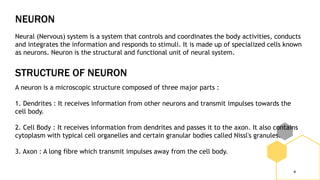
A neuron is a microscopic structure composed of three major parts :
1. Dendrites : It receives information from other neurons and transmit impulses towards the
cell body.
2. Cell Body : It receives information from dendrites and passes it to the axon. It also contains
cytoplasm with typical cell organelles and certain granular bodies called Nissl's granules.
3. Axon : A long fibre which transmit impulses away from the cell body.
NEURON
Neural (Nervous) system is a system that controls and coordinates the body activities, conducts
and integrates the information and responds to stimuli. It is made up of specialized cells known
as neurons. Neuron is the structural and functional unit of neural system.
5
• Some of the neurons are covered with myelin sheath, which helps to insulate and speed
neural impulses.
• Each branch of axon terminates as a bulb-like structure called synaptic knob, which possess
synaptic vesicles containing chemicals called neurotransmitters.
TYPES OF NEURONS
6
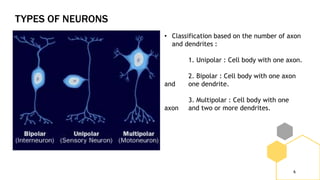
• Classification based on the number of axon
and dendrites :
1. Unipolar : Cell body with one axon.
2. Bipolar : Cell body with one axon
and one dendrite.
3. Multipolar : Cell body with one
axon and two or more dendrites.
SYNAPSES
7
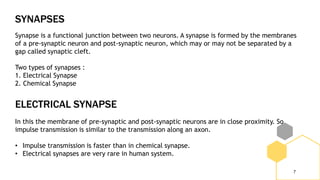
Synapse is a functional junction between two neurons. A synapse is formed by the membranes
of a pre-synaptic neuron and post-synaptic neuron, which may or may not be separated by a
gap called synaptic cleft.
Two types of synapses :
1. Electrical Synapse
2. Chemical Synapse
ELECTRICAL SYNAPSE
In this the membrane of pre-synaptic and post-synaptic neurons are in close proximity. So
impulse transmission is similar to the transmission along an axon.
• Impulse transmission is faster than in chemical synapse.
• Electrical synapses are very rare in human system.
CHEMICAL SYNAPSE
8
In this there is a fluid filled space between the
presynaptic and postsynaptic neuron. The
presynaptic regions have swellings called
Synaptic knob (buttons).
• Do you know how the pre-
synaptic neuron transmits an
impulse across the synaptic cleft to the
post-synaptic neuron ?
1. Neurotransmitters involved.
2. The axon terminals contain
synaptic vesicles filled with
the neurotransmitters (acetylcholine or
adrenaline).
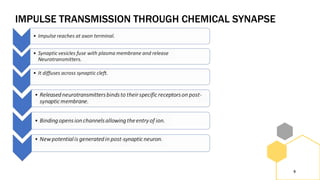
IMPULSE TRANSMISSION THROUGH CHEMICAL SYNAPSE
9
HUMAN NERVOUS SYSTEM
10
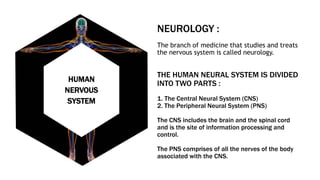
NEUROLOGY :
The branch of medicine that studies and treats
the nervous system is called neurology.
THE HUMAN NEURAL SYSTEM IS DIVIDED
INTO TWO PARTS :
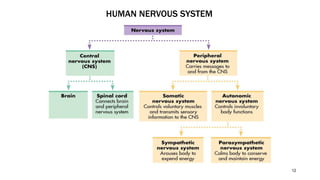
1. The Central Neural System (CNS)
2. The Peripheral Neural System (PNS)
The CNS includes the brain and the spinal cord
and is the site of information processing and
control.
The PNS comprises of all the nerves of the body
associated with the CNS.
HUMAN
NERVOUS
SYSTEM
HUMAN NERVOUS SYSTEM
12
CENTRAL NERVOUS SYSTEM
When we think of the nervous system, our thoughts immediately go to the brain. The brain is a
hive of neuronal activity, with billions of interwoven neurons firing to preserve and recall
memories, coordinate thoughts and speech, and plan future actions.
13
1. It is protected in cranial cavity.
2. It has 3-layered connective tissue membranes called cranial meninges.
3. Meninges consist of outer dura mater, middle arachnoid mater and inner pia mater.
4. The subarachnoid space (space between pia mater and arachnoid mater) is filled with
cerebrospinal fluid (CSF).
5. The ventricles of brain are also filled with CSF.
BRAIN
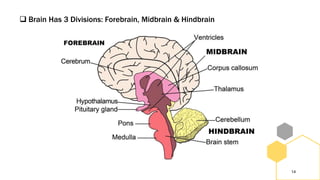
 Brain Has 3 Divisions: Forebrain, Midbrain & Hindbrain
14
FOREBRAIN
15
It is the anterior part. Consists of cerebrum & diencephalon.
 CEREBRUM
- Largest part. It has 2 cerebral hemispheres held together by a tract of nerve fibres (Corpus
callosum).
• Outer part of cerebrum is called cerebral cortex. It has convulsions and depressions and is
formed of gray matter.
Cerebral cortex consists of :
1. Motor area : Controls voluntary movements of muscles.
2. Sensory (Somaesthetic) area : Controls the functioning of sense organs.
3. Association area : It is neither clearly sensory nor motor in function. Responsible for
intersensory associations, memory and communication.
• Inner part of cerebrum is formed of white matter.
 DIENCEPHALON (THALAMUS & HYPOTHALAMUS)
THALAMUS
It is the structure around which the cerebrum wraps. It is a coordinating centre (relay station)
for sensory and motor impulses.
HYPOTHALAMUS
a. Regulates temperature, thirst, hunger and emotions.
b. Secretes hypothalamic hormones.
c. Controls sleep, wakefulness, blood pressure, heart rate.
• The inner parts of cerebral hemispheres and a group of associated deep structures like
amygdala, hippocampus, hypothalamus, etc. together constitute Limbic system (Limbic
lobe). It regulates sexual behaviour, motivations, emotions (excitement, pleasure, rage, fear
etc).
MIDBRAIN
1. It is located between thalamus/hypothalamus and Pons.
HINDBRAIN
17
2. A canal (cerebral aqueduct) passes through the midbrain.
3. Mid brain consists of 4 round lobes called Corporaquadrigemina.
4. Their anterior pair is the centre of visual reflexes and the posterior pair is a centre of
auditory reflex.
It consists of cerebellum, Pons & Medulla oblongata. Midbrain & hindbrain form the Brain
stem.
1. Cerebellum (“little cerebrum”) : It has very convoluted surface to accommodate more
neurons. It coordinates muscular activities and body equilibrium.
2. Pons varoli : It consists of fibre tracts that interconnect different regions of the brain. It
coordinates the activities of eye and ear and regulates respiration.
3. Medulla oblongata : It is connected to spinal cord. It controls respiration, cardiovascular
reflexes, gastric secretions, peristalsis etc. It also controls salivation, vomiting, sneezing &
coughing.
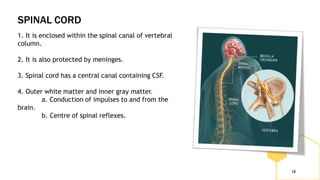
SPINAL CORD
18
1. It is enclosed within the spinal canal of vertebral
column.
2. It is also protected by meninges.
3. Spinal cord has a central canal containing CSF.
4. Outer white matter and inner gray matter.
a. Conduction of impulses to and from the
brain.
b. Centre of spinal reflexes.
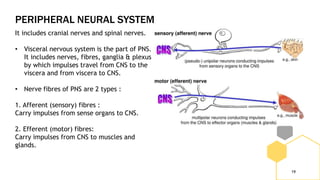
PERIPHERAL NEURAL SYSTEM
19
It includes cranial nerves and spinal nerves.
• Visceral nervous system is the part of PNS.
It includes nerves, fibres, ganglia & plexus
by which impulses travel from CNS to the
viscera and from viscera to CNS.
• Nerve fibres of PNS are 2 types :
1. Afferent (sensory) fibres :
Carry impulses from sense organs to CNS.
2. Efferent (motor) fibres:
Carry impulses from CNS to muscles and
glands.
20
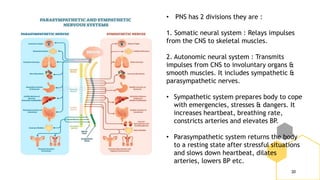
• PNS has 2 divisions they are :
1. Somatic neural system : Relays impulses
from the CNS to skeletal muscles.
2. Autonomic neural system : Transmits
impulses from CNS to involuntary organs &
smooth muscles. It includes sympathetic &
parasympathetic nerves.
• Sympathetic system prepares body to cope
with emergencies, stresses & dangers. It
increases heartbeat, breathing rate,
constricts arteries and elevates BP.
• Parasympathetic system returns the body
to a resting state after stressful situations
and slows down heartbeat, dilates
arteries, lowers BP etc.
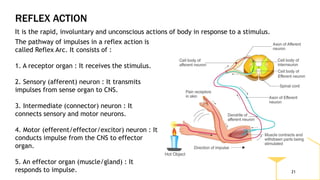
REFLEX ACTION
21
It is the rapid, involuntary and unconscious actions of body in response to a stimulus.
The pathway of impulses in a reflex action is
called Reflex Arc. It consists of :
1. A receptor organ : It receives the stimulus.
2. Sensory (afferent) neuron : It transmits
impulses from sense organ to CNS.
3. Intermediate (connector) neuron : It
connects sensory and motor neurons.
4. Motor (efferent/effector/excitor) neuron : It
conducts impulse from the CNS to effector
organ.
5. An effector organ (muscle/gland) : It
responds to impulse.
NEUROTRANSMITTERS BEHAVIOR
22
INTRODUCTION
23
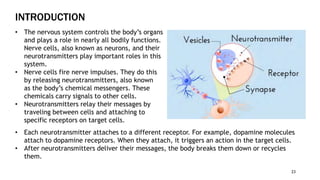
• The nervous system controls the body’s organs
and plays a role in nearly all bodily functions.
Nerve cells, also known as neurons, and their
neurotransmitters play important roles in this
system.
• Nerve cells fire nerve impulses. They do this
by releasing neurotransmitters, also known
as the body’s chemical messengers. These
chemicals carry signals to other cells.
• Neurotransmitters relay their messages by
traveling between cells and attaching to
specific receptors on target cells.
• Each neurotransmitter attaches to a different receptor. For example, dopamine molecules
attach to dopamine receptors. When they attach, it triggers an action in the target cells.
• After neurotransmitters deliver their messages, the body breaks them down or recycles
them.
WHAT BODY FUNCTIONS DO NERVES AND NEUROTRANSMITTERS
HELP CONTROL ?
24
• Heartbeat and blood pressure.
• Breathing.
• Muscle movements.
• Thoughts, memory, learning and feelings.
• Sleep, healing and aging.
• Stress response.
• Hormone regulation.
• Digestion, sense of hunger and thirst.
• Senses (response to what you see, hear, feel, touch and taste).
WORKING OF NEUROTRANSMITTER
25
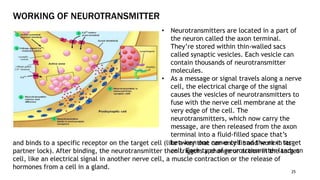
• Neurotransmitters are located in a part of
the neuron called the axon terminal.
They’re stored within thin-walled sacs
called synaptic vesicles. Each vesicle can
contain thousands of neurotransmitter
molecules.
• As a message or signal travels along a nerve
cell, the electrical charge of the signal
causes the vesicles of neurotransmitters to
fuse with the nerve cell membrane at the
very edge of the cell. The
neurotransmitters, which now carry the
message, are then released from the axon
terminal into a fluid-filled space that’s
between one nerve cell and the next target
cell. Each type of neurotransmitter lands on
and binds to a specific receptor on the target cell (like a key that can only fit and work in its
partner lock). After binding, the neurotransmitter then triggers a change or action in the target
cell, like an electrical signal in another nerve cell, a muscle contraction or the release of
hormones from a cell in a gland.
TYPES OF NEUROTRANSMITTERS
26
Experts have identified over 100 neurotransmitters to date and are still discovering more.
Neurotransmitters have different types of actions:
• Excitatory neurotransmitters encourage a target cell to take action.
• Inhibitory neurotransmitters decrease the chances of the target cell taking action. In some
cases, these neurotransmitters have a relaxation-like effect.
• Modulatory neurotransmitters can send messages to many neurons at the same time They
also communicate with other neurotransmitters.
• Some neurotransmitters can carry out several functions depending on the type of receptor
they connect to.
ACETYLCHOLINE
27
Acetylcholine is an excitatory neurotransmitter with a wide range of roles.
For example, it:
• triggers muscle contractions
• stimulates saliva and sweat production
• controls the heartbeat
• It also plays a role in memory, motivation, and attention.
• Low levels of acetylcholine link with issues relating to memory and thinking, such
as Alzheimer’s disease.
• Some Alzheimer’s disease medications help slow the breakdown of acetylcholine in the body.
This can help manage some symptoms, such as memory loss.
• The nutrient choline, present in many foods, is a building block of acetylcholine. People
need choline in their diet to produce enough acetylcholine. However, it is not clear whether
consuming more choline can help boost levels of this neurotransmitter.
• Choline is present in beef liver, eggs, soybeans, and potatoes. Choline supplements are also
available.
DOPAMINE
28
Dopamine is important source in :
• Memory, learning, behavior, movement control, regulating blood flow.
• Many people know dopamine as a pleasure or reward neurotransmitter. The brain releases
dopamine during pleasurable activities.
• Researchers believe there is a link between dopamine deficiency and Parkinson’s disease.
• Drugs that regulate dopamine levels may help treat Parkinson’s disease as well
as depression, addiction, anxiety, bipolar disorder, and other conditions.
• The body needs certain amino acids to produce dopamine. Amino acids are present
in protein-rich foods, such as meat, fish, and eggs.
• While there are no dopamine supplements, exercise may help boost levels naturally.
• Ihibits unnecessary movements inhibits the release of prolactin and stimulates the secretion
of growth hormones
ENDORPHINS
29
• Endorphins inhibit pain and create a feeling of pleasure. They have links to laughter, love,
sex, and appetizing food.
• Many people feel better after exercising. One reason for this may be that exercise boosts
endorphin levels. Laughter may also cause a release of endorphins.
• Endorphins may also help manage pain. Research says that aerobic exercise can help
prevent migraine frequency, duration, and intensity.
• The Arthritis Foundation recommends exercise for people with fibromyalgia to reduce pain
and boost mood.
EPINEPHRINE
30
• Epinephrine (also known as adrenaline) plays a role in the body’s “fight-or-flight” response.
It is both a hormone and a neurotransmitter.
• When a person experiences stress or fear, their body releases epinephrine .This increases
heart rate and breathing and gives the muscles a jolt of energy. It also helps the brain make
quick decisions.
• However, chronic stress can cause the body to release too much epinephrine. Over time,
stress can lead to health problems such as decreased immunity, high blood
pressure, diabetes, and heart disease.
• Doctors can use epinephrine to treat some life threatening conditions, including:
Anaphylaxis, a severe allergic reaction ,asthma attacks ,cardiac arrest and
some infections.
SUMMARY
31
• ACETYLCHOLINE : Excitatory
• DOPAMINE : Both
• ENDORPHIN : Inhibitory
• EPINEPHRINE : Excitatory
EXTRA
• GABA : Inhibitory
• SEROTONIN : Inhibitory
PSYCHOACTIVE DRUGS AND BEHAVIORS
32
WHAT ARE DRUGS AND HOW ARE THEY OBTAINED ?
33
• A drug is a chemical substance (excluding
food) that can influence or affect your body
function to restore, maintain, or enhance
physical or mental health.
• The study of drugs and their effect is known
as pharmacology.
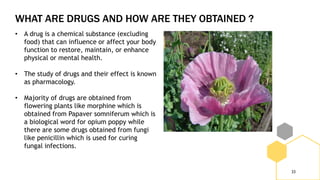
• Majority of drugs are obtained from
flowering plants like morphine which is
obtained from Papaver somniferum which is
a biological word for opium poppy while
there are some drugs obtained from fungi
like penicillin which is used for curing
fungal infections.
MISCONCEPTIONS BETWEEN DRUG USE AND DRUG MISUSE
34
• These drugs are generally taken by snorting, injection,
inhaling or by oral ingestion.
• Drug use means taking a drug properly in its correct
dosage like the medicines prescribed by the doctor, and
other drugs like barbiturates, benzodiazepines are used
as medicines to help patient cope up with mental illness.
• The excessive usage of a drug is drug
misuse which can potentially harm the
user or the people around them which
can be usually noticed in their changed
personality and behavior.
DRUG ABUSE AND ADDICTION
35
• Curiosity, need for adventure, excitement and experimentation are some common causes
that lead to drug abuse.
• Many youngsters and adults use this as a means to escape from problems, stress and the
pressure to excel in academics.
• Repeated usage of drugs results to addiction.
• Addiction is psychological attachment to certain feeling and a temporary feeling of well
being which comes with drug abuse.
• Addiction usually leads to dependence which manifests itself in the form of withdrawal
syndrome if regular dosage of drugs is discontinued.
EFFECTS OF PSYCHOACTIVE DRUGS ON BEHAVIOUR
36
• Many drugs like LSD (lysergic acid diethylamide), GHB (gamma-Hydroxybutyric acid) some
stimulants like cocaine also known as coke obtained from a flowering plant erythroxylum
coca, ecstasy, nicotine and marijuana can cause permanent mental illnesses like depression,
anxiety, hallucinations.
• Prolonged drug misuse can change the balance of neurotransmitters like acetylcholine which
can change the structure of our brain. These changes affect your mood, your ability to think
i.e., it decreases your rationality, and even your personality.
• As the frequency of drug misuse increases, it starts to take more and more time away from
the couple, which creates an emotional distance between the partners that is difficult to
overcome which ultimately leads to emotional stress and depression.
• Excessive doping of psychoactive drugs can also lead to nervous breakdown. nervous
breakdown is usually accompanied by extreme anxiety or fear, intense stress, and a feeling
which won’t allow you to cope up with anything.
EFFECTS OF PSYCHOACTIVE DRUGS
37
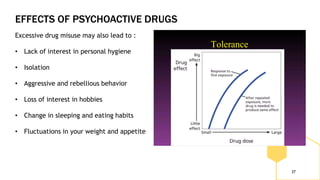
Excessive drug misuse may also lead to :
• Lack of interest in personal hygiene
• Isolation
• Aggressive and rebellious behavior
• Loss of interest in hobbies
• Change in sleeping and eating habits
• Fluctuations in your weight and appetite
PREVENTION OF USAGE OF PSYCHOACTIVE DRUGS
38
Keeping the above pointers into consideration it is very clear that psychoactive drugs can affect
our physical and mental health in various ways, which can be prevented by :
• Educating and counselling- Educating the drug addict to face problem, stress and to accept
disappointments as a part of life.
• Seeking help from parents – Help from parents should be sought immediately which can help
the young ones to vent their feelings of anxiety and guilt.
• Avoiding peer pressure – A child should not be forced beyond his/her capabilities.
• Seeking professional and medical help – A lot of help in the form of psychologists,
psychiatrists and rehabilitation programme are available to help the drug addicts who has
enough will power and gives in sufficient efforts to overcome the problem.
ENDOCRINE SYSTEM
39
ENDOCRINE SYSTEM
40
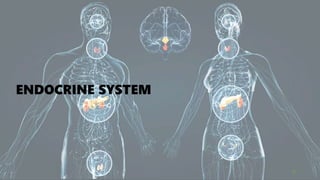
The endocrine system is a complex network of glands and organs.
• It secretes hormones to control and coordinate our body’s metabolism, energy level,
reproduction, growth and development and response to injury, stress and mood.
• The endocrine glands and hormones producing different parts of our body constitute the
endocrine system.
MAJOR ENDOCRINE GLANDS :
1. Hypothalamus
2. Pituitary Gland
3. Pineal Gland
4. Thyroid
5. Parathyroid Gland
6. Thymus
7. Pancreas
8. Adrenal Gland
9. Testis
10. Ovaries
HYPOTHALAMUS
41
What is Hypothalamus ?
• The Hypothalamus is a small part of the brain that plays an important role in HOMEOSTASIS
(controlling water balance, sleep, temperature, appetite and blood pressure) of the body.
• The hypothalamus secrets hormones that stimulate or suppress the release of hormones in
the pituitary gland.
FUNCTIONS :
• Releasing hormones
• Maintaining daily physiological cycles
• Controlling appetite
PITUITARY GLAND
42
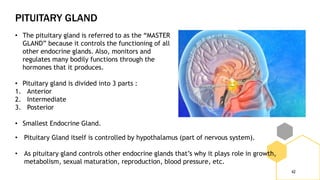
• The pituitary gland is referred to as the “MASTER
GLAND” because it controls the functioning of all
other endocrine glands. Also, monitors and
regulates many bodily functions through the
hormones that it produces.
• Pituitary gland is divided into 3 parts :
1. Anterior
2. Intermediate
3. Posterior
• Smallest Endocrine Gland.
• Pituitary Gland itself is controlled by hypothalamus (part of nervous system).
• As pituitary gland controls other endocrine glands that’s why it plays role in growth,
metabolism, sexual maturation, reproduction, blood pressure, etc.
HORMONES RELEASED BY PITUITARY GLAND
43
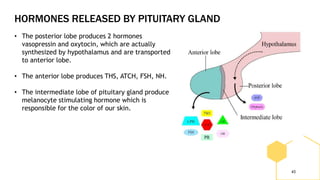
• The posterior lobe produces 2 hormones
vasopressin and oxytocin, which are actually
synthesized by hypothalamus and are transported
to anterior lobe.
• The anterior lobe produces THS, ATCH, FSH, NH.
• The intermediate lobe of pituitary gland produce
melanocyte stimulating hormone which is
responsible for the color of our skin.
PINEAL GLAND
44
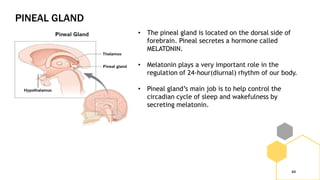
• The pineal gland is located on the dorsal side of
forebrain. Pineal secretes a hormone called
MELATONIN.
• Melatonin plays a very important role in the
regulation of 24-hour(diurnal) rhythm of our body.
• Pineal gland’s main job is to help control the
circadian cycle of sleep and wakefulness by
secreting melatonin.
THYROID
45
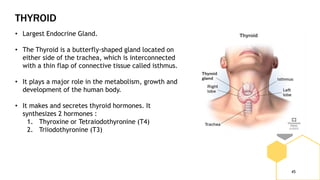
• Largest Endocrine Gland.
• The Thyroid is a butterfly-shaped gland located on
either side of the trachea, which is interconnected
with a thin flap of connective tissue called isthmus.
• It plays a major role in the metabolism, growth and
development of the human body.
• It makes and secretes thyroid hormones. It
synthesizes 2 hormones :
1. Thyroxine or Tetraiodothyronine (T4)
2. Triiodothyronine (T3)
46
• The thyroid depends on iodine intake from your diet. Deficiency of iodine in our diet
results in Hypothyroidism and enlargement of thyroid gland results in Goitre.
• If the secretion of the thyroid hormone increases to an abnormal level it results in
Hyperthyroidism.
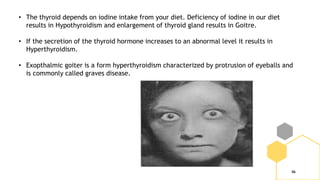
• Exopthalmic goiter is a form hyperthyroidism characterized by protrusion of eyeballs and
is commonly called graves disease.
PARATHYROID GLAND
47
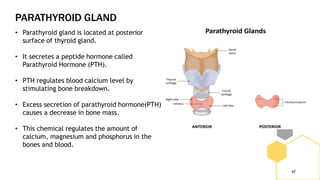
• Parathyroid gland is located at posterior
surface of thyroid gland.
• It secretes a peptide hormone called
Parathyroid Hormone (PTH).
• PTH regulates blood calcium level by
stimulating bone breakdown.
• Excess secretion of parathyroid hormone(PTH)
causes a decrease in bone mass.
• This chemical regulates the amount of
calcium, magnesium and phosphorus in the
bones and blood.
THYMUS
48
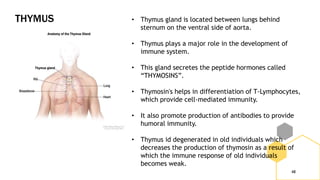
• Thymus gland is located between lungs behind
sternum on the ventral side of aorta.
• Thymus plays a major role in the development of
immune system.
• This gland secretes the peptide hormones called
“THYMOSINS”.
• Thymosin's helps in differentiation of T-Lymphocytes,
which provide cell-mediated immunity.
• It also promote production of antibodies to provide
humoral immunity.
• Thymus id degenerated in old individuals which
decreases the production of thymosin as a result of
which the immune response of old individuals
becomes weak.
49
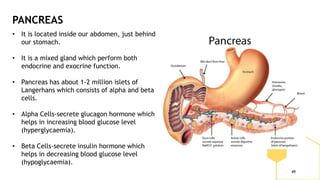
PANCREAS
• It is located inside our abdomen, just behind
our stomach.
• It is a mixed gland which perform both
endocrine and exocrine function.
• Pancreas has about 1-2 million islets of
Langerhans which consists of alpha and beta
cells.
• Alpha Cells-secrete glucagon hormone which
helps in increasing blood glucose level
(hyperglycaemia).
• Beta Cells-secrete insulin hormone which
helps in decreasing blood glucose level
(hypoglycaemia).
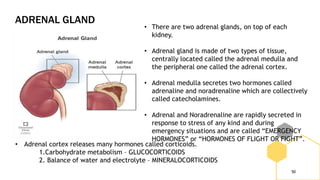
ADRENAL GLAND
50
• There are two adrenal glands, on top of each
kidney.
• Adrenal gland is made of two types of tissue,
centrally located called the adrenal medulla and
the peripheral one called the adrenal cortex.
• Adrenal medulla secretes two hormones called
adrenaline and noradrenaline which are collectively
called catecholamines.
• Adrenal and Noradrenaline are rapidly secreted in
response to stress of any kind and during
emergency situations and are called “EMERGENCY
HORMONES” or “HORMONES OF FLIGHT OR FIGHT”.
• Adrenal cortex releases many hormones called corticoids.
1.Carbohydrate metabolism – GLUCOCORTICOIDS
2. Balance of water and electrolyte – MINERALOCORTICOIDS
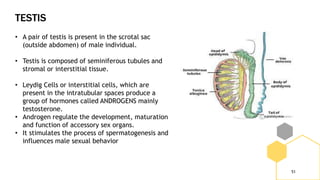
TESTIS
51
• A pair of testis is present in the scrotal sac
(outside abdomen) of male individual.
• Testis is composed of seminiferous tubules and
stromal or interstitial tissue.
• Leydig Cells or interstitial cells, which are
present in the intratubular spaces produce a
group of hormones called ANDROGENS mainly
testosterone.
• Androgen regulate the development, maturation
and function of accessory sex organs.
• It stimulates the process of spermatogenesis and
influences male sexual behavior
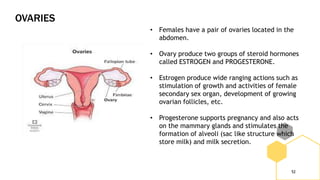
OVARIES
52
• Females have a pair of ovaries located in the
abdomen.
• Ovary produce two groups of steroid hormones
called ESTROGEN and PROGESTERONE.
• Estrogen produce wide ranging actions such as
stimulation of growth and activities of female
secondary sex organ, development of growing
ovarian follicles, etc.
• Progesterone supports pregnancy and also acts
on the mammary glands and stimulates the
formation of alveoli (sac like structure which
store milk) and milk secretion.
THANK YOU
53

Neurological Basis Of Behavior Presentation.pptx

  • 1.
  • 2.
    CONTENT LIST 1. NEURONSAND BEHAVIOR SYNAPSES 2. THE NERVOUS SYSTEM 3. NEUROTRANSMITTERS BEHAVIOR 4. PSYCHOACTIVE DRUGS AND BEHAVIORS 5. THE ENDOCRINE SYSTEM 2
  • 3.
  • 4.
    STRUCTURE OF NEURON 4 Aneuron is a microscopic structure composed of three major parts : 1. Dendrites : It receives information from other neurons and transmit impulses towards the cell body. 2. Cell Body : It receives information from dendrites and passes it to the axon. It also contains cytoplasm with typical cell organelles and certain granular bodies called Nissl's granules. 3. Axon : A long fibre which transmit impulses away from the cell body. NEURON Neural (Nervous) system is a system that controls and coordinates the body activities, conducts and integrates the information and responds to stimuli. It is made up of specialized cells known as neurons. Neuron is the structural and functional unit of neural system.
  • 5.
    5 • Some ofthe neurons are covered with myelin sheath, which helps to insulate and speed neural impulses. • Each branch of axon terminates as a bulb-like structure called synaptic knob, which possess synaptic vesicles containing chemicals called neurotransmitters.
  • 6.
    TYPES OF NEURONS 6 •Classification based on the number of axon and dendrites : 1. Unipolar : Cell body with one axon. 2. Bipolar : Cell body with one axon and one dendrite. 3. Multipolar : Cell body with one axon and two or more dendrites.
  • 7.
    SYNAPSES 7 Synapse is afunctional junction between two neurons. A synapse is formed by the membranes of a pre-synaptic neuron and post-synaptic neuron, which may or may not be separated by a gap called synaptic cleft. Two types of synapses : 1. Electrical Synapse 2. Chemical Synapse ELECTRICAL SYNAPSE In this the membrane of pre-synaptic and post-synaptic neurons are in close proximity. So impulse transmission is similar to the transmission along an axon. • Impulse transmission is faster than in chemical synapse. • Electrical synapses are very rare in human system.
  • 8.
    CHEMICAL SYNAPSE 8 In thisthere is a fluid filled space between the presynaptic and postsynaptic neuron. The presynaptic regions have swellings called Synaptic knob (buttons). • Do you know how the pre- synaptic neuron transmits an impulse across the synaptic cleft to the post-synaptic neuron ? 1. Neurotransmitters involved. 2. The axon terminals contain synaptic vesicles filled with the neurotransmitters (acetylcholine or adrenaline).
  • 9.
    IMPULSE TRANSMISSION THROUGHCHEMICAL SYNAPSE 9
  • 10.
  • 11.
    NEUROLOGY : The branchof medicine that studies and treats the nervous system is called neurology. THE HUMAN NEURAL SYSTEM IS DIVIDED INTO TWO PARTS : 1. The Central Neural System (CNS) 2. The Peripheral Neural System (PNS) The CNS includes the brain and the spinal cord and is the site of information processing and control. The PNS comprises of all the nerves of the body associated with the CNS. HUMAN NERVOUS SYSTEM
  • 12.
  • 13.
    CENTRAL NERVOUS SYSTEM Whenwe think of the nervous system, our thoughts immediately go to the brain. The brain is a hive of neuronal activity, with billions of interwoven neurons firing to preserve and recall memories, coordinate thoughts and speech, and plan future actions. 13 1. It is protected in cranial cavity. 2. It has 3-layered connective tissue membranes called cranial meninges. 3. Meninges consist of outer dura mater, middle arachnoid mater and inner pia mater. 4. The subarachnoid space (space between pia mater and arachnoid mater) is filled with cerebrospinal fluid (CSF). 5. The ventricles of brain are also filled with CSF. BRAIN
  • 14.
     Brain Has3 Divisions: Forebrain, Midbrain & Hindbrain 14
  • 15.
    FOREBRAIN 15 It is theanterior part. Consists of cerebrum & diencephalon.  CEREBRUM - Largest part. It has 2 cerebral hemispheres held together by a tract of nerve fibres (Corpus callosum). • Outer part of cerebrum is called cerebral cortex. It has convulsions and depressions and is formed of gray matter. Cerebral cortex consists of : 1. Motor area : Controls voluntary movements of muscles. 2. Sensory (Somaesthetic) area : Controls the functioning of sense organs. 3. Association area : It is neither clearly sensory nor motor in function. Responsible for intersensory associations, memory and communication. • Inner part of cerebrum is formed of white matter.
  • 16.
     DIENCEPHALON (THALAMUS& HYPOTHALAMUS) THALAMUS It is the structure around which the cerebrum wraps. It is a coordinating centre (relay station) for sensory and motor impulses. HYPOTHALAMUS a. Regulates temperature, thirst, hunger and emotions. b. Secretes hypothalamic hormones. c. Controls sleep, wakefulness, blood pressure, heart rate. • The inner parts of cerebral hemispheres and a group of associated deep structures like amygdala, hippocampus, hypothalamus, etc. together constitute Limbic system (Limbic lobe). It regulates sexual behaviour, motivations, emotions (excitement, pleasure, rage, fear etc). MIDBRAIN 1. It is located between thalamus/hypothalamus and Pons.
  • 17.
    HINDBRAIN 17 2. A canal(cerebral aqueduct) passes through the midbrain. 3. Mid brain consists of 4 round lobes called Corporaquadrigemina. 4. Their anterior pair is the centre of visual reflexes and the posterior pair is a centre of auditory reflex. It consists of cerebellum, Pons & Medulla oblongata. Midbrain & hindbrain form the Brain stem. 1. Cerebellum (“little cerebrum”) : It has very convoluted surface to accommodate more neurons. It coordinates muscular activities and body equilibrium. 2. Pons varoli : It consists of fibre tracts that interconnect different regions of the brain. It coordinates the activities of eye and ear and regulates respiration. 3. Medulla oblongata : It is connected to spinal cord. It controls respiration, cardiovascular reflexes, gastric secretions, peristalsis etc. It also controls salivation, vomiting, sneezing & coughing.
  • 18.
    SPINAL CORD 18 1. Itis enclosed within the spinal canal of vertebral column. 2. It is also protected by meninges. 3. Spinal cord has a central canal containing CSF. 4. Outer white matter and inner gray matter. a. Conduction of impulses to and from the brain. b. Centre of spinal reflexes.
  • 19.
    PERIPHERAL NEURAL SYSTEM 19 Itincludes cranial nerves and spinal nerves. • Visceral nervous system is the part of PNS. It includes nerves, fibres, ganglia & plexus by which impulses travel from CNS to the viscera and from viscera to CNS. • Nerve fibres of PNS are 2 types : 1. Afferent (sensory) fibres : Carry impulses from sense organs to CNS. 2. Efferent (motor) fibres: Carry impulses from CNS to muscles and glands.
  • 20.
    20 • PNS has2 divisions they are : 1. Somatic neural system : Relays impulses from the CNS to skeletal muscles. 2. Autonomic neural system : Transmits impulses from CNS to involuntary organs & smooth muscles. It includes sympathetic & parasympathetic nerves. • Sympathetic system prepares body to cope with emergencies, stresses & dangers. It increases heartbeat, breathing rate, constricts arteries and elevates BP. • Parasympathetic system returns the body to a resting state after stressful situations and slows down heartbeat, dilates arteries, lowers BP etc.
  • 21.
    REFLEX ACTION 21 It isthe rapid, involuntary and unconscious actions of body in response to a stimulus. The pathway of impulses in a reflex action is called Reflex Arc. It consists of : 1. A receptor organ : It receives the stimulus. 2. Sensory (afferent) neuron : It transmits impulses from sense organ to CNS. 3. Intermediate (connector) neuron : It connects sensory and motor neurons. 4. Motor (efferent/effector/excitor) neuron : It conducts impulse from the CNS to effector organ. 5. An effector organ (muscle/gland) : It responds to impulse.
  • 22.
  • 23.
    INTRODUCTION 23 • The nervoussystem controls the body’s organs and plays a role in nearly all bodily functions. Nerve cells, also known as neurons, and their neurotransmitters play important roles in this system. • Nerve cells fire nerve impulses. They do this by releasing neurotransmitters, also known as the body’s chemical messengers. These chemicals carry signals to other cells. • Neurotransmitters relay their messages by traveling between cells and attaching to specific receptors on target cells. • Each neurotransmitter attaches to a different receptor. For example, dopamine molecules attach to dopamine receptors. When they attach, it triggers an action in the target cells. • After neurotransmitters deliver their messages, the body breaks them down or recycles them.
  • 24.
    WHAT BODY FUNCTIONSDO NERVES AND NEUROTRANSMITTERS HELP CONTROL ? 24 • Heartbeat and blood pressure. • Breathing. • Muscle movements. • Thoughts, memory, learning and feelings. • Sleep, healing and aging. • Stress response. • Hormone regulation. • Digestion, sense of hunger and thirst. • Senses (response to what you see, hear, feel, touch and taste).
  • 25.
    WORKING OF NEUROTRANSMITTER 25 •Neurotransmitters are located in a part of the neuron called the axon terminal. They’re stored within thin-walled sacs called synaptic vesicles. Each vesicle can contain thousands of neurotransmitter molecules. • As a message or signal travels along a nerve cell, the electrical charge of the signal causes the vesicles of neurotransmitters to fuse with the nerve cell membrane at the very edge of the cell. The neurotransmitters, which now carry the message, are then released from the axon terminal into a fluid-filled space that’s between one nerve cell and the next target cell. Each type of neurotransmitter lands on and binds to a specific receptor on the target cell (like a key that can only fit and work in its partner lock). After binding, the neurotransmitter then triggers a change or action in the target cell, like an electrical signal in another nerve cell, a muscle contraction or the release of hormones from a cell in a gland.
  • 26.
    TYPES OF NEUROTRANSMITTERS 26 Expertshave identified over 100 neurotransmitters to date and are still discovering more. Neurotransmitters have different types of actions: • Excitatory neurotransmitters encourage a target cell to take action. • Inhibitory neurotransmitters decrease the chances of the target cell taking action. In some cases, these neurotransmitters have a relaxation-like effect. • Modulatory neurotransmitters can send messages to many neurons at the same time They also communicate with other neurotransmitters. • Some neurotransmitters can carry out several functions depending on the type of receptor they connect to.
  • 27.
    ACETYLCHOLINE 27 Acetylcholine is anexcitatory neurotransmitter with a wide range of roles. For example, it: • triggers muscle contractions • stimulates saliva and sweat production • controls the heartbeat • It also plays a role in memory, motivation, and attention. • Low levels of acetylcholine link with issues relating to memory and thinking, such as Alzheimer’s disease. • Some Alzheimer’s disease medications help slow the breakdown of acetylcholine in the body. This can help manage some symptoms, such as memory loss. • The nutrient choline, present in many foods, is a building block of acetylcholine. People need choline in their diet to produce enough acetylcholine. However, it is not clear whether consuming more choline can help boost levels of this neurotransmitter. • Choline is present in beef liver, eggs, soybeans, and potatoes. Choline supplements are also available.
  • 28.
    DOPAMINE 28 Dopamine is importantsource in : • Memory, learning, behavior, movement control, regulating blood flow. • Many people know dopamine as a pleasure or reward neurotransmitter. The brain releases dopamine during pleasurable activities. • Researchers believe there is a link between dopamine deficiency and Parkinson’s disease. • Drugs that regulate dopamine levels may help treat Parkinson’s disease as well as depression, addiction, anxiety, bipolar disorder, and other conditions. • The body needs certain amino acids to produce dopamine. Amino acids are present in protein-rich foods, such as meat, fish, and eggs. • While there are no dopamine supplements, exercise may help boost levels naturally. • Ihibits unnecessary movements inhibits the release of prolactin and stimulates the secretion of growth hormones
  • 29.
    ENDORPHINS 29 • Endorphins inhibitpain and create a feeling of pleasure. They have links to laughter, love, sex, and appetizing food. • Many people feel better after exercising. One reason for this may be that exercise boosts endorphin levels. Laughter may also cause a release of endorphins. • Endorphins may also help manage pain. Research says that aerobic exercise can help prevent migraine frequency, duration, and intensity. • The Arthritis Foundation recommends exercise for people with fibromyalgia to reduce pain and boost mood.
  • 30.
    EPINEPHRINE 30 • Epinephrine (alsoknown as adrenaline) plays a role in the body’s “fight-or-flight” response. It is both a hormone and a neurotransmitter. • When a person experiences stress or fear, their body releases epinephrine .This increases heart rate and breathing and gives the muscles a jolt of energy. It also helps the brain make quick decisions. • However, chronic stress can cause the body to release too much epinephrine. Over time, stress can lead to health problems such as decreased immunity, high blood pressure, diabetes, and heart disease. • Doctors can use epinephrine to treat some life threatening conditions, including: Anaphylaxis, a severe allergic reaction ,asthma attacks ,cardiac arrest and some infections.
  • 31.
    SUMMARY 31 • ACETYLCHOLINE :Excitatory • DOPAMINE : Both • ENDORPHIN : Inhibitory • EPINEPHRINE : Excitatory EXTRA • GABA : Inhibitory • SEROTONIN : Inhibitory
  • 32.
  • 33.
    WHAT ARE DRUGSAND HOW ARE THEY OBTAINED ? 33 • A drug is a chemical substance (excluding food) that can influence or affect your body function to restore, maintain, or enhance physical or mental health. • The study of drugs and their effect is known as pharmacology. • Majority of drugs are obtained from flowering plants like morphine which is obtained from Papaver somniferum which is a biological word for opium poppy while there are some drugs obtained from fungi like penicillin which is used for curing fungal infections.
  • 34.
    MISCONCEPTIONS BETWEEN DRUGUSE AND DRUG MISUSE 34 • These drugs are generally taken by snorting, injection, inhaling or by oral ingestion. • Drug use means taking a drug properly in its correct dosage like the medicines prescribed by the doctor, and other drugs like barbiturates, benzodiazepines are used as medicines to help patient cope up with mental illness. • The excessive usage of a drug is drug misuse which can potentially harm the user or the people around them which can be usually noticed in their changed personality and behavior.
  • 35.
    DRUG ABUSE ANDADDICTION 35 • Curiosity, need for adventure, excitement and experimentation are some common causes that lead to drug abuse. • Many youngsters and adults use this as a means to escape from problems, stress and the pressure to excel in academics. • Repeated usage of drugs results to addiction. • Addiction is psychological attachment to certain feeling and a temporary feeling of well being which comes with drug abuse. • Addiction usually leads to dependence which manifests itself in the form of withdrawal syndrome if regular dosage of drugs is discontinued.
  • 36.
    EFFECTS OF PSYCHOACTIVEDRUGS ON BEHAVIOUR 36 • Many drugs like LSD (lysergic acid diethylamide), GHB (gamma-Hydroxybutyric acid) some stimulants like cocaine also known as coke obtained from a flowering plant erythroxylum coca, ecstasy, nicotine and marijuana can cause permanent mental illnesses like depression, anxiety, hallucinations. • Prolonged drug misuse can change the balance of neurotransmitters like acetylcholine which can change the structure of our brain. These changes affect your mood, your ability to think i.e., it decreases your rationality, and even your personality. • As the frequency of drug misuse increases, it starts to take more and more time away from the couple, which creates an emotional distance between the partners that is difficult to overcome which ultimately leads to emotional stress and depression. • Excessive doping of psychoactive drugs can also lead to nervous breakdown. nervous breakdown is usually accompanied by extreme anxiety or fear, intense stress, and a feeling which won’t allow you to cope up with anything.
  • 37.
    EFFECTS OF PSYCHOACTIVEDRUGS 37 Excessive drug misuse may also lead to : • Lack of interest in personal hygiene • Isolation • Aggressive and rebellious behavior • Loss of interest in hobbies • Change in sleeping and eating habits • Fluctuations in your weight and appetite
  • 38.
    PREVENTION OF USAGEOF PSYCHOACTIVE DRUGS 38 Keeping the above pointers into consideration it is very clear that psychoactive drugs can affect our physical and mental health in various ways, which can be prevented by : • Educating and counselling- Educating the drug addict to face problem, stress and to accept disappointments as a part of life. • Seeking help from parents – Help from parents should be sought immediately which can help the young ones to vent their feelings of anxiety and guilt. • Avoiding peer pressure – A child should not be forced beyond his/her capabilities. • Seeking professional and medical help – A lot of help in the form of psychologists, psychiatrists and rehabilitation programme are available to help the drug addicts who has enough will power and gives in sufficient efforts to overcome the problem.
  • 39.
  • 40.
    ENDOCRINE SYSTEM 40 The endocrinesystem is a complex network of glands and organs. • It secretes hormones to control and coordinate our body’s metabolism, energy level, reproduction, growth and development and response to injury, stress and mood. • The endocrine glands and hormones producing different parts of our body constitute the endocrine system. MAJOR ENDOCRINE GLANDS : 1. Hypothalamus 2. Pituitary Gland 3. Pineal Gland 4. Thyroid 5. Parathyroid Gland 6. Thymus 7. Pancreas 8. Adrenal Gland 9. Testis 10. Ovaries
  • 41.
    HYPOTHALAMUS 41 What is Hypothalamus? • The Hypothalamus is a small part of the brain that plays an important role in HOMEOSTASIS (controlling water balance, sleep, temperature, appetite and blood pressure) of the body. • The hypothalamus secrets hormones that stimulate or suppress the release of hormones in the pituitary gland. FUNCTIONS : • Releasing hormones • Maintaining daily physiological cycles • Controlling appetite
  • 42.
    PITUITARY GLAND 42 • Thepituitary gland is referred to as the “MASTER GLAND” because it controls the functioning of all other endocrine glands. Also, monitors and regulates many bodily functions through the hormones that it produces. • Pituitary gland is divided into 3 parts : 1. Anterior 2. Intermediate 3. Posterior • Smallest Endocrine Gland. • Pituitary Gland itself is controlled by hypothalamus (part of nervous system). • As pituitary gland controls other endocrine glands that’s why it plays role in growth, metabolism, sexual maturation, reproduction, blood pressure, etc.
  • 43.
    HORMONES RELEASED BYPITUITARY GLAND 43 • The posterior lobe produces 2 hormones vasopressin and oxytocin, which are actually synthesized by hypothalamus and are transported to anterior lobe. • The anterior lobe produces THS, ATCH, FSH, NH. • The intermediate lobe of pituitary gland produce melanocyte stimulating hormone which is responsible for the color of our skin.
  • 44.
    PINEAL GLAND 44 • Thepineal gland is located on the dorsal side of forebrain. Pineal secretes a hormone called MELATONIN. • Melatonin plays a very important role in the regulation of 24-hour(diurnal) rhythm of our body. • Pineal gland’s main job is to help control the circadian cycle of sleep and wakefulness by secreting melatonin.
  • 45.
    THYROID 45 • Largest EndocrineGland. • The Thyroid is a butterfly-shaped gland located on either side of the trachea, which is interconnected with a thin flap of connective tissue called isthmus. • It plays a major role in the metabolism, growth and development of the human body. • It makes and secretes thyroid hormones. It synthesizes 2 hormones : 1. Thyroxine or Tetraiodothyronine (T4) 2. Triiodothyronine (T3)
  • 46.
    46 • The thyroiddepends on iodine intake from your diet. Deficiency of iodine in our diet results in Hypothyroidism and enlargement of thyroid gland results in Goitre. • If the secretion of the thyroid hormone increases to an abnormal level it results in Hyperthyroidism. • Exopthalmic goiter is a form hyperthyroidism characterized by protrusion of eyeballs and is commonly called graves disease.
  • 47.
    PARATHYROID GLAND 47 • Parathyroidgland is located at posterior surface of thyroid gland. • It secretes a peptide hormone called Parathyroid Hormone (PTH). • PTH regulates blood calcium level by stimulating bone breakdown. • Excess secretion of parathyroid hormone(PTH) causes a decrease in bone mass. • This chemical regulates the amount of calcium, magnesium and phosphorus in the bones and blood.
  • 48.
    THYMUS 48 • Thymus glandis located between lungs behind sternum on the ventral side of aorta. • Thymus plays a major role in the development of immune system. • This gland secretes the peptide hormones called “THYMOSINS”. • Thymosin's helps in differentiation of T-Lymphocytes, which provide cell-mediated immunity. • It also promote production of antibodies to provide humoral immunity. • Thymus id degenerated in old individuals which decreases the production of thymosin as a result of which the immune response of old individuals becomes weak.
  • 49.
    49 PANCREAS • It islocated inside our abdomen, just behind our stomach. • It is a mixed gland which perform both endocrine and exocrine function. • Pancreas has about 1-2 million islets of Langerhans which consists of alpha and beta cells. • Alpha Cells-secrete glucagon hormone which helps in increasing blood glucose level (hyperglycaemia). • Beta Cells-secrete insulin hormone which helps in decreasing blood glucose level (hypoglycaemia).
  • 50.
    ADRENAL GLAND 50 • Thereare two adrenal glands, on top of each kidney. • Adrenal gland is made of two types of tissue, centrally located called the adrenal medulla and the peripheral one called the adrenal cortex. • Adrenal medulla secretes two hormones called adrenaline and noradrenaline which are collectively called catecholamines. • Adrenal and Noradrenaline are rapidly secreted in response to stress of any kind and during emergency situations and are called “EMERGENCY HORMONES” or “HORMONES OF FLIGHT OR FIGHT”. • Adrenal cortex releases many hormones called corticoids. 1.Carbohydrate metabolism – GLUCOCORTICOIDS 2. Balance of water and electrolyte – MINERALOCORTICOIDS
  • 51.
    TESTIS 51 • A pairof testis is present in the scrotal sac (outside abdomen) of male individual. • Testis is composed of seminiferous tubules and stromal or interstitial tissue. • Leydig Cells or interstitial cells, which are present in the intratubular spaces produce a group of hormones called ANDROGENS mainly testosterone. • Androgen regulate the development, maturation and function of accessory sex organs. • It stimulates the process of spermatogenesis and influences male sexual behavior
  • 52.
    OVARIES 52 • Females havea pair of ovaries located in the abdomen. • Ovary produce two groups of steroid hormones called ESTROGEN and PROGESTERONE. • Estrogen produce wide ranging actions such as stimulation of growth and activities of female secondary sex organ, development of growing ovarian follicles, etc. • Progesterone supports pregnancy and also acts on the mammary glands and stimulates the formation of alveoli (sac like structure which store milk) and milk secretion.
  • 53.