1
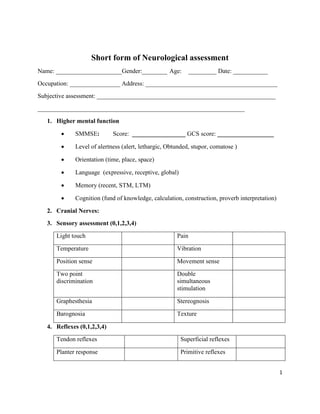
Short form of Neurological assessment
Name: _____________________Gender:________ Age: _________ Date: ___________
Occupation: ________________ Address: __________________________________________
Subjective assessment: _________________________________________________________
__________________________________________________________________
1. Higher mental function
 SMMSE: Score: _________________ GCS score: __________________
 Level of alertness (alert, lethargic, Obtunded, stupor, comatose )
 Orientation (time, place, space)
 Language (expressive, receptive, global)
 Memory (recent, STM, LTM)
 Cognition (fund of knowledge, calculation, construction, proverb interpretation)
2. Cranial Nerves:
3. Sensory assessment (0,1,2,3,4)
Light touch Pain
Temperature Vibration
Position sense Movement sense
Two point
discrimination
Double
simultaneous
stimulation
Graphesthesia Stereognosis
Barognosia Texture
4. Reflexes (0,1,2,3,4)
Tendon reflexes Superficial reflexes
Planter response Primitive reflexes
2
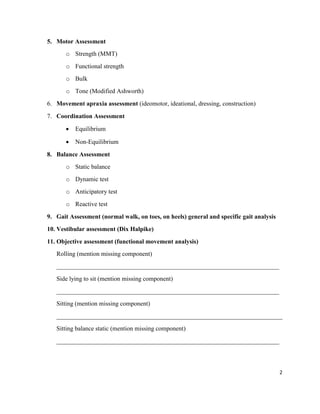
5. Motor Assessment
o Strength (MMT)
o Functional strength
o Bulk
o Tone (Modified Ashworth)
6. Movement apraxia assessment (ideomotor, ideational, dressing, construction)
7. Coordination Assessment
 Equilibrium
 Non-Equilibrium
8. Balance Assessment
o Static balance
o Dynamic test
o Anticipatory test
o Reactive test
9. Gait Assessment (normal walk, on toes, on heels) general and specific gait analysis
10. Vestibular assessment (Dix Halpike)
11. Objective assessment (functional movement analysis)
Rolling (mention missing component)
_______________________________________________________________________
Side lying to sit (mention missing component)
_______________________________________________________________________
Sitting (mention missing component)
________________________________________________________________________
Sitting balance static (mention missing component)
_______________________________________________________________________
3
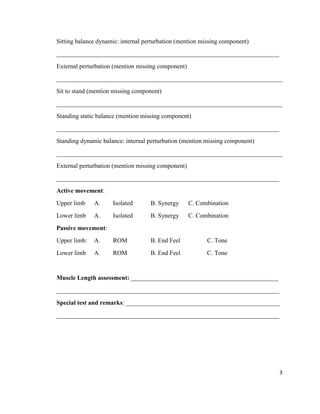
Sitting balance dynamic: internal perturbation (mention missing component)
_______________________________________________________________________
External perturbation (mention missing component)
________________________________________________________________________
Sit to stand (mention missing component)
________________________________________________________________________
Standing static balance (mention missing component)
_______________________________________________________________________
Standing dynamic balance: internal perturbation (mention missing component)
________________________________________________________________________
External perturbation (mention missing component)
_______________________________________________________________________
Active movement:
Upper limb A. Isolated B. Synergy C. Combination
Lower limb A. Isolated B. Synergy C. Combination
Passive movement:
Upper limb: A. ROM B. End Feel C. Tone
Lower limb A. ROM B. End Feel C. Tone
Muscle Length assessment: _______________________________________________
_______________________________________________________________________
Special test and remarks: _________________________________________________
_______________________________________________________________________
4
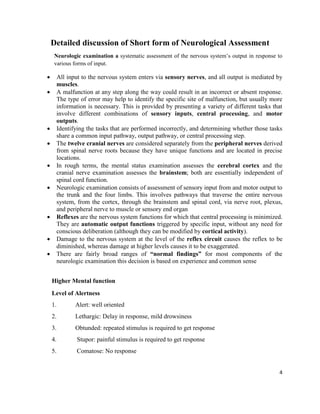
Detailed discussion of Short form of Neurological Assessment
Neurologic examination a systematic assessment of the nervous system’s output in response to
various forms of input.
 All input to the nervous system enters via sensory nerves, and all output is mediated by
muscles.
 A malfunction at any step along the way could result in an incorrect or absent response.
The type of error may help to identify the specific site of malfunction, but usually more
information is necessary. This is provided by presenting a variety of different tasks that
involve different combinations of sensory inputs, central processing, and motor
outputs.
 Identifying the tasks that are performed incorrectly, and determining whether those tasks
share a common input pathway, output pathway, or central processing step.
 The twelve cranial nerves are considered separately from the peripheral nerves derived
from spinal nerve roots because they have unique functions and are located in precise
locations.
 In rough terms, the mental status examination assesses the cerebral cortex and the
cranial nerve examination assesses the brainstem; both are essentially independent of
spinal cord function.
 Neurologic examination consists of assessment of sensory input from and motor output to
the trunk and the four limbs. This involves pathways that traverse the entire nervous
system, from the cortex, through the brainstem and spinal cord, via nerve root, plexus,
and peripheral nerve to muscle or sensory end organ
 Reflexes are the nervous system functions for which that central processing is minimized.
They are automatic output functions triggered by specific input, without any need for
conscious deliberation (although they can be modified by cortical activity).
 Damage to the nervous system at the level of the reflex circuit causes the reflex to be
diminished, whereas damage at higher levels causes it to be exaggerated.
 There are fairly broad ranges of “normal findings” for most components of the
neurologic examination this decision is based on experience and common sense
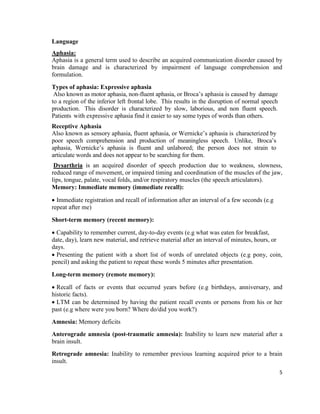
Higher Mental function
Level of Alertness
1. Alert: well oriented
2. Lethargic: Delay in response, mild drowsiness
3. Obtunded: repeated stimulus is required to get response
4. Stupor: painful stimulus is required to get response
5. Comatose: No response
5
Language
Aphasia:
Aphasia is a general term used to describe an acquired communication disorder caused by
brain damage and is characterized by impairment of language comprehension and
formulation.
Types of aphasia: Expressive aphasia
Also known as motor aphasia, non-fluent aphasia, or Broca’s aphasia is caused by damage
to a region of the inferior left frontal lobe. This results in the disruption of normal speech
production. This disorder is characterized by slow, laborious, and non fluent speech.
Patients with expressive aphasia find it easier to say some types of words than others.
Receptive Aphasia
Also known as sensory aphasia, fluent aphasia, or Wernicke’s aphasia is characterized by
poor speech comprehension and production of meaningless speech. Unlike, Broca’s
aphasia, Wernicke’s aphasia is fluent and unlabored; the person does not strain to
articulate words and does not appear to be searching for them.
Dysarthria is an acquired disorder of speech production due to weakness, slowness,
reduced range of movement, or impaired timing and coordination of the muscles of the jaw,
lips, tongue, palate, vocal folds, and/or respiratory muscles (the speech articulators).
Memory: Immediate memory (immediate recall):
 Immediate registration and recall of information after an interval of a few seconds (e.g
repeat after me)
Short-term memory (recent memory):
 Capability to remember current, day-to-day events (e.g what was eaten for breakfast,
date, day), learn new material, and retrieve material after an interval of minutes, hours, or
days.
 Presenting the patient with a short list of words of unrelated objects (e.g pony, coin,
pencil) and asking the patient to repeat these words 5 minutes after presentation.
Long-term memory (remote memory):
 Recall of facts or events that occurred years before (e.g birthdays, anniversary, and
historic facts).
 LTM can be determined by having the patient recall events or persons from his or her
past (e.g where were you born? Where do/did you work?)
Amnesia: Memory deficits
Anterograde amnesia (post-traumatic amnesia): Inability to learn new material after a
brain insult.
Retrograde amnesia: Inability to remember previous learning acquired prior to a brain
insult.
6
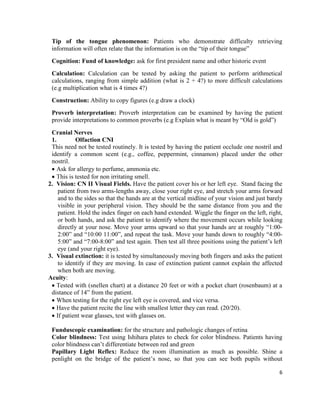
Tip of the tongue phenomenon: Patients who demonstrate difficulty retrieving
information will often relate that the information is on the “tip of their tongue”
Cognition: Fund of knowledge: ask for first president name and other historic event
Calculation: Calculation can be tested by asking the patient to perform arithmetical
calculations, ranging from simple addition (what is 2 + 4?) to more difficult calculations
(e.g multiplication what is 4 times 4?)
Construction: Ability to copy figures (e.g draw a clock)
Proverb interpretation: Proverb interpretation can be examined by having the patient
provide interpretations to common proverbs (e.g Explain what is meant by “Old is gold”)
Cranial Nerves
1. Olfaction CNI
This need not be tested routinely. It is tested by having the patient occlude one nostril and
identify a common scent (e.g., coffee, peppermint, cinnamon) placed under the other
nostril.
 Ask for allergy to perfume, ammonia etc.
 This is tested for non irritating smell.
2. Vision: CN II Visual Fields. Have the patient cover his or her left eye. Stand facing the
patient from two arms-lengths away, close your right eye, and stretch your arms forward
and to the sides so that the hands are at the vertical midline of your vision and just barely
visible in your peripheral vision. They should be the same distance from you and the
patient. Hold the index finger on each hand extended. Wiggle the finger on the left, right,
or both hands, and ask the patient to identify where the movement occurs while looking
directly at your nose. Move your arms upward so that your hands are at roughly “1:00-
2:00” and “10:00 11:00”, and repeat the task. Move your hands down to roughly “4:00-
5:00” and “7:00-8:00” and test again. Then test all three positions using the patient’s left
eye (and your right eye).
3. Visual extinction: it is tested by simultaneously moving both fingers and asks the patient
to identify if they are moving. In case of extinction patient cannot explain the affected
when both are moving.
Acuity:
 Tested with (snellen chart) at a distance 20 feet or with a pocket chart (rosenbaum) at a
distance of 14” from the patient.
 When testing for the right eye left eye is covered, and vice versa.
 Have the patient recite the line with smallest letter they can read. (20/20).
 If patient wear glasses, test with glasses on.
Funduscopic examination: for the structure and pathologic changes of retina
Color blindness: Test using Ishihara plates to check for color blindness. Patients having
color blindness can’t differentiate between red and green
Papillary Light Reflex: Reduce the room illumination as much as possible. Shine a
penlight on the bridge of the patient’s nose, so that you can see both pupils without
7
directing light at either of them. Check that they are the same size. Now move the penlight
so that it is directly shining on the right pupil, and check to see that both pupils have
constricted to the same size.
Direct response: shine the light on left eye it will show constriction of left pupil.
Consensual light response: illuminate left eye, in response to it right pupil will also
constrict.
Accommodation Reflex: ask the patient to focus on distant object (30 ft) then look on a
nearby object. Normally, the pupils constrict to in response to accommodation. The
accommodation response is consensual.(1, 2)
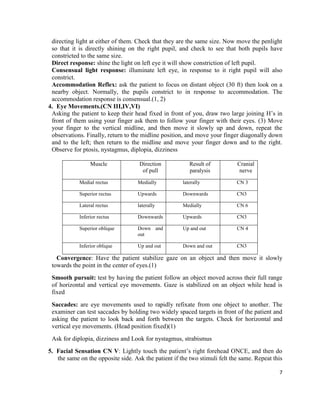
4. Eye Movements.(CN III,IV,VI)
Asking the patient to keep their head fixed in front of you, draw two large joining H’s in
front of them using your finger ask them to follow your finger with their eyes. (3) Move
your finger to the vertical midline, and then move it slowly up and down, repeat the
observations. Finally, return to the midline position, and move your finger diagonally down
and to the left; then return to the midline and move your finger down and to the right.
Observe for ptosis, nystagmus, diplopia, dizziness
Muscle Direction
of pull
Result of
paralysis
Cranial
nerve
Medial rectus Medially laterally CN 3
Superior rectus Upwards Downwards CN3
Lateral rectus laterally Medially CN 6
Inferior rectus Downwards Upwards CN3
Superior oblique Down and
out
Up and out CN 4
Inferior oblique Up and out Down and out CN3
Convergence: Have the patient stabilize gaze on an object and then move it slowly
towards the point in the center of eyes.(1)
Smooth pursuit: test by having the patient follow an object moved across their full range
of horizontal and vertical eye movements. Gaze is stabilized on an object while head is
fixed
Saccades: are eye movements used to rapidly refixate from one object to another. The
examiner can test saccades by holding two widely spaced targets in front of the patient and
asking the patient to look back and forth between the targets. Check for horizontal and
vertical eye movements. (Head position fixed)(1)
Ask for diplopia, dizziness and Look for nystagmus, strabismus
5. Facial Sensation CN V: Lightly touch the patient’s right forehead ONCE, and then do
the same on the opposite side. Ask the patient if the two stimuli felt the same. Repeat this
8
procedure on the cheek and on the chin. This is usually adequate testing. In some
circumstances, the testing should be repeated applying light pressure with a pin.
The corneal reflex is not routinely necessary, but is useful in uncooperative patients or
when the rest of the exam suggests that there may be a problem with facial sensation or
strength. It is tested by having the patient look to the far left, then touching the patient’s
right eye with a fine wisp of cotton (introduced from the patient’s right field of vision)
and observing the reflexive blink that occurs in each eye. The process is then repeated
with the left eye.
Muscles of mastication: Have the patient open the jaw against resistance, and then close
the jaw against resistance. Have the patient move the chin side to side.
6. Facial Strength CN VII
Muscles of facial expression: Have the patient close his or her eyes tightly. Observe
whether the lashes are buried equally on the two sides, and whether you can open either
eye manually. Then have the patient look up and wrinkle the forehead; note whether the
two sides are equally wrinkled. Have the patient smile, and observe whether one side of
the face is activated more quickly or more completely than other.
Taste sensation: anterior 2.3rd
of tongue
7. Hearing CN VIII For bedside examination purposes, it usually suffices to perform a
quick screen by holding your fingers a few inches away from the patient’s ear and
rubbing them softly. When there is reduced auditory acuity in one or both ears,
additional information can be obtained from the Weber and Rinne tests.
Rinne test, place a sounding tuning fork on the patient’s mastoid process and then next to
their ear and ask which is louder. A normal patient will find the second position louder.
Weber’s test, place the tuning fork base down in the centre of the patient’s forehead and
ask if it is louder in either ear. Normally it should be heard equally in both ears.
Functions of vestibular:
 Gaze stabilization
 Resolve visual conflict and somato sensory conflict
 Do ongoing postural adjustments
 Central stability and verticality
 Maintain posture and balance
VOR(vestibulooccular reflex):
1. Keep Object stationary. Ask patient to move Head while maintaining gaze on the
object
2. Move head vertical then horizontal and finally oblique
3. Then ask the patient to move head while maintaining gaze on the moving object.
First move the object slowly then rapidly.
4. Move object and head in same direction inner phase.
5. Move object and head in opposite direction outer-phase
6. Repeat step 2
Ask for dizziness and look for nystagmus during movements. Also diplopia and blurred
vision
9
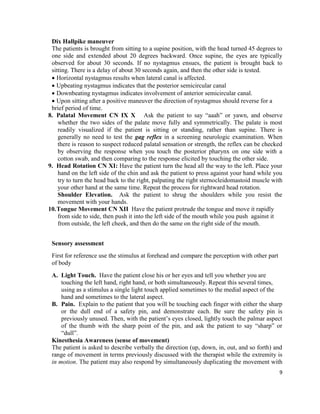
Dix Hallpike maneuver
The patients is brought from sitting to a supine position, with the head turned 45 degrees to
one side and extended about 20 degrees backward. Once supine, the eyes are typically
observed for about 30 seconds. If no nystagmus ensues, the patient is brought back to
sitting. There is a delay of about 30 seconds again, and then the other side is tested.
 Horizontal nystagmus results when lateral canal is affected.
 Upbeating nystagmus indicates that the posterior semicircular canal
 Downbeating nystagmus indicates involvement of anterior semicircular canal.
 Upon sitting after a positive maneuver the direction of nystagmus should reverse for a
brief period of time.
8. Palatal Movement CN IX X Ask the patient to say “aaah” or yawn, and observe
whether the two sides of the palate move fully and symmetrically. The palate is most
readily visualized if the patient is sitting or standing, rather than supine. There is
generally no need to test the gag reflex in a screening neurologic examination. When
there is reason to suspect reduced palatal sensation or strength, the reflex can be checked
by observing the response when you touch the posterior pharynx on one side with a
cotton swab, and then comparing to the response elicited by touching the other side.
9. Head Rotation CN XI: Have the patient turn the head all the way to the left. Place your
hand on the left side of the chin and ask the patient to press against your hand while you
try to turn the head back to the right, palpating the right sternocleidomastoid muscle with
your other hand at the same time. Repeat the process for rightward head rotation.
Shoulder Elevation. Ask the patient to shrug the shoulders while you resist the
movement with your hands.
10.Tongue Movement CN XII Have the patient protrude the tongue and move it rapidly
from side to side, then push it into the left side of the mouth while you push against it
from outside, the left cheek, and then do the same on the right side of the mouth.
Sensory assessment
First for reference use the stimulus at forehead and compare the perception with other part
of body
A. Light Touch. Have the patient close his or her eyes and tell you whether you are
touching the left hand, right hand, or both simultaneously. Repeat this several times,
using as a stimulus a single light touch applied sometimes to the medial aspect of the
hand and sometimes to the lateral aspect.
B. Pain. Explain to the patient that you will be touching each finger with either the sharp
or the dull end of a safety pin, and demonstrate each. Be sure the safety pin is
previously unused. Then, with the patient’s eyes closed, lightly touch the palmar aspect
of the thumb with the sharp point of the pin, and ask the patient to say “sharp” or
“dull”.
Kinesthesia Awareness (sense of movement)
The patient is asked to describe verbally the direction (up, down, in, out, and so forth) and
range of movement in terms previously discussed with the therapist while the extremity is
in motion. The patient may also respond by simultaneously duplicating the movement with
10
the contralateral extremity. This second approach, however, is impractical with proximal
lower extremity joints, owing to potential stress on the low back. During testing, movement
of larger joints is usually discerned more quickly than that of smaller joints. The therapist’s
grip should remain constant and minimal (fingertip grip over bony prominences), to reduce
tactile stimulation.
Proprioceptive Awareness (sense of position)
While the extremity or joint(s) is held in a static position by the therapist, the patient is
asked to describe the position verbally or to duplicate the position of the extremity or
joint(s) with the contralateral extremity (position matching). His test may also be
performed unilaterally using the same extremity or joint(s); first held in position by the
examiner, then returned to resting position, followed by active duplication of position by
patient using the same limb.
C. Vibration. Tap a 128 Hz tuning fork lightly against a solid surface to produce a slight
vibration. With the patient’s eyes closed, hold the non-vibrating end of the tuning fork
firmly on the DIP joint of the patient’s left thumb, and ask the patient if the vibration is
detectable. Let the vibration fade until the patient no longer detects it, then apply the tuning
fork to your own thumb to see if you can still feel any vibration. Repeat this testing on the
patient’s right thumb and both great toes
Two point discrimination
This test determines the ability to perceive two points applied to the skin simultaneously. It
is a measure of the smallest distance between two stimuli (applied simultaneously and with
equal pressure) that can still be perceived as two distinct stimuli. Two-point discrimination
values vary for different individuals and body parts.
Double Simultaneous Stimulation
This test determines the ability to perceive simultaneous touch stimuli (double
simultaneous stimulation [DSS]). The therapist simultaneously (and with equal pressure)
touches: (1) identical locations on opposite sides of the body, (2) proximally and distally on
opposite sides of the body, and/or (3) proximal and distal locations on the same side of the
body. he term extinction phenomenon is used to describe a situation in which only the
proximal stimulus is perceived, with “extinction” of the distal.
D. Graphesthesia. Ask the patient to close the eyes and identify a number from 0 to 9 that
you draw on his or her index finger using a ballpoint pen. Repeat with several other
numbers, and compare to the other hand. Perform analogous testing on the feet, but your
drawing may need to be larger there.
E. Stereognosis. Ask the patient to close the eyes and identify a small object (e.g., nickel,
dime, quarter, penny, key, paper clip) you place in his or her right hand. Test the left hand
in the same way.
11
Movement Apraxia assessment
Apraxia: Partial or complete inability to execute purposeful movements (even with
strength or ability)
Apraxia is neurological condition characterized by loss of the ability to perform activities
that a person is physically able and willing to do.
Types of Apraxia: There are following types are as follows:
A. Ideomotor Apraxia: An inability to remember a command.
B. Ideational Apraxia: It is a perceptual deficit. An inability to formulate a plan to
accomplish a task (scratch nose, brush teeth, draw a clock, comb hair)
C. Constructional Apraxia: Inabilities to copy, draws, or build simple figures.(2D& 3D
picture)
D. Dressing Apraxia: is the inability to dress oneself (inability to coordinate dress with
body parts)
Reflexes
Tendon Reflexes. The reflexes at the biceps, triceps, brachioradialis, knee, and ankle are
the ones commonly tested. The joint under consideration should be at about 90o
and fully
relaxed – it is often helpful to cradle the joint in your own arm to support it. With your
other arm, hold the end of the hammer and let the head of the hammer drop like a
pendulum so that it strikes the tendon (specifically, just anterior to the elbow for the
biceps reflex, just posterior to the elbow for the triceps reflex, about 2 inches above the
wrist on the radial aspect of the forearm for the brachioradialis reflex, just below the
patella for the knee reflex, and just behind the ankle for the ankle reflex).
Aim can sometimes be improved by striking your finger or thumb after positioning it
across the tendon. You should strive to develop a technique that results in a reproducible
level of force from one occasion to the next. The most reliable information comes from
using the least force necessary to elicit the reflex – in many cases, your fingers are
sufficient and the hammer is not even necessary.
At the other extreme, when a patient has reflexes that are difficult to elicit, you can
amplify them by using reinforcement procedures: ask the patient to clench his or her teeth
or (when testing lower extremity reflexes) to hook together the flexed fingers of both
hands and pull. This is also known as the Jendrassik maneuver. Reflexes are graded on an
essentially subjective scale
0 = absent, 1 = reduced (hypoactive), 2 = normal, 3 = increased (hyperactive), 4 = clonus
Clonus is a rhythmic series of muscle contractions induced by stretching the tendon. It
most commonly occurs at the ankle, where it is typically elicited by suddenly dorsiflexing
the patient’s foot and maintaining light upward pressure on the sole.
Plantar Response: Using a blunt, narrow surface (e.g., key, or the handle of a reflex
hammer), stroke the sole of the patient’s foot on the lateral edge, starting near the heel and
12
proceeding along the lateral edge almost to the base of the little toe, then curve the path
medially just proximal to the base of the other toes.
The normal response is for all the toes to flex (a “flexor plantar response”). When there is
damage to the central nervous system motor pathways, an abnormal reflex occurs: The
great toe extends (dorsiflexes) and the other toes fan out. This is called an extensor plantar
response; it is also known as a Babinski sign or up going planters.(It is positive in 12 month
baby, hypoglycemic, deep coma and UMNL)
Superficial Reflexes: These include the abdominal reflexes and the cremasteric reflexes.
Primitive Reflexes: There are different primitive reflxes, moro, grasp etc
Motor assessment
Strength
The most common convention for grading muscle strength is the 0 to 5 Medical Research
Council (MRC) scale:
0 = no contraction
1 = visible muscle twitch but no movement of the joint
2 = weak contraction insufficient to overcome gravity
3 = weak contraction able to overcome gravity but no additional resistance
4 = weak contraction able to overcome some resistance but not full resistance
5 = normal; able to overcome full resistance
2. Bulk. While testing strength, the muscles active in each movement should be inspected
and palpated for evidence of atrophy. Fasciculations (random, involuntary muscle
twitches) should also be noted.
3. Tone. Ask the patient to relax and let you manipulate the limbs passively. This is
harder for most patients than you might imagine, and you may need to try to distract them
by engaging them in unrelated conversation. Several forms of increased resistance to
passive manipulation are distinguished.
Spasticity depends on the limb position and the velocity with which the limb is moved,
classically resulting in a “clasp-knife phenomenon” when the limb is moved rapidly: the
limb moves freely for a short distance, but then there is a “catch” and you must use
progressively more force to move the limb until at a certain point there is a sudden release
and you can move the limb freely again.
Rigidity, in contrast, is characterized by increased resistance throughout the movement.
“Lead-pipe rigidity” applies to resistance that is uniform throughout the movement.
13
“Cogwheel rigidity” is characterized by rhythmic interruption of the resistance, producing
a ratchet-like effect. Rigidity is often enhanced by distracting the patient.
Paratonia is increased resistance that becomes less prominent when the patient is
distracted.
Pronator Drift
Ask the patient to stretch out the arms so that they are level and fully extended, with the
palms facing straight up – then to close the eyes. Watch for five to ten seconds to see if
either arm tends to pronate (so that the palm turns inward) and drift downward
Coordination assessment
1. Finger tapping. Ask the patient to make a fist with the right hand, then extend the
thumb and index finger and tap the index finger on the tip of the thumb as quickly as
possible. Repeat with the left hand. Observe for speed, accuracy, and regularity of rhythm.
2. Rapid alternating movements. Have the patient alternately pronate and supinate the
right hand against a stable surface (such as a table, or the patient’s own thigh or left hand)
as rapidly as possible; repeat for the left hand. Again, observe speed, accuracy and rhythm.
3. Finger-to-nose testing. Ask the patient to use the tip of his or her right index finger
to touch the tip of your index finger, then the patient’s nose, then your finger again, and so
forth. Hold your finger so that it is near the extreme of the patient’s reach, and move it to
several different positions during the testing. Repeat the test using the patient’s left arm.
Observe for accuracy and tremor.
4. Heel-to-shin testing. Have the patient lie supine, place the right heel on the left
knee, and then move the heel smoothly down the shin to the ankle. Repeat using the left
heel on the right shin. Again, observe for accuracy and tremor.
Involuntary Movements
Observe the patient throughout the history and physical for tremor, myoclonus (rapid
shock-like muscle jerks), chorea (rapid, jerky twitches, similar to myoclonus but more
random in location and more likely to blend into one another), athetosis (slow, writhing
movements of the limbs), ballismus (large amplitude flinging limb movements), tics
(abrupt, stereotyped coordinated movements or vocalizations), dystonia (maintenance of an
abnormal posture or repetitive twisting movements), or other involuntary motor activity.
Balance assessment: Static balance: 30(15) second eye close and 30 second eye open
Dynamic balance: internal perturbation: Look up ,look down ,Look Right side with trunk
rotation to Right side ,Look Left side with trunk rotation to Left side ,Forward reach with
normal side ,Crossing of mid line from intact side ,Flexion of hip with over head flexion of
the arm
External perturbations: Forward, backward and sideways slow and fast
Dynamic balance: Berg Balance test
Anticipatory balance: Functional reach tests
Reactive test: Paster day and mazten test
14
Gait assessment: Observe the patient’s casual gait, preferably with the patient unaware of
being observed. Have the patient walk toward you while walking on the heels, then walk
away from you walking on tiptoes. Finally, have the patient walk in tandem, placing one
foot directly in front of the other as if walking on a tightrope (the “drunken driving test”).
Generalized gait assessment: speed, cadence, ballistic movement, arm swing
Specific gait assessment: Horizontal and vertical displacement of hip. Knee and ankle
Vestibular assessment: Dix Halpike test, Dizziness Handicap test Fekkuda test
Objective Assessment (Functional movements)
1.Rolling Component
Upper quadrant: Rotation of neck, Horizontal flexion, protraction of shoulder and Rotation of
trunk
Lower Quadrant: Flexion of hip, Flexion and extension of hip
2. Side lying to sit
Upper quadrant: Neck side flexion, Abduction of shoulder. Wight on elbow weight on wrist
Lower Quadrant side flexion of trunk .Clearing of feet with hip and knee flexion
3.Sitting component
feet and knees close to gather ,Wt evenly distributed , anterior pelvic tilt, flexion of hip with
extension of trunk(shoulders over hips), and head balance on level shoulder
4.Sitting balance static 30 seconds eye open 30 seconds eye closed.
5.Sitting balance dynamic (a) Internal perturbation (displacement) External perturbation
displacement
a) Internal perturbation
Look up ,look down ,Look Right side with trunk rotation to Right side ,Look Left side with trunk
rotation to Left side ,Forward reach with normal side ,Crossing of mid line from intact side
,Flexion of hip with over head flexion of the arm
b) External perturbation (displacement)
Forward, backward and sideways slow and fast
6.Sit to stand Foot placement, hip and knee flexion, anterior pelvic tilt, inclination of trunk (pre
extension phase), extension phase (extension of trunk, extension of hip, knees and ankle
dorsiflexion)
7. Standing balance: Standing alignment : Fee t are few inches apart ,Shoulder over hips ,Head
balance on level shoulder ,Erect trunk ,Weight evenly distributed on both feet ,Hips in front of
ankle
Static; 30 seconds eye open 30 seconds’ eye closed.
Standing balance; dynamic
Internal perturbation : Look up ,look down ,Look Right side with trunk rotation to Right side
,Look Left side with trunk rotation to Left side ,Forward reach with normal side ,Crossing of mid
line from intact side ,Flexion of hip with over head flexion of the arm
15
External perturbation (displacement)
Forward, backward and sideways slow and fast
PREDICTION OF OUTCOME AND GOAL SETTING
• Determine and record problem list
• Predict outcome for the individual clients with respect to
• Set long term and short term goals up to 3 weeks target
1. Discharge status/type of residence
 Home alone with no community services
 Home alone with community supports
 Home with others + community supports
 Hostel
 Nursing home
2. Upper Limb Goals
• Fully functional
• Stabilizing/assisting
• Non-functional but pain free (full range of motion no contractures to enable ease of
dressing and bathing)
3. Mobility Goals
• You should describe mobility goals in appropriate detail and should include:
1.Level of independence (amount of supervision or assistance)
2.Aid used including wheelchair
3.Type of surfaces client can negotiate
4.Distance
For example: Patient will walk under supervision (level of independence) with tripod cane
(assistive device) on level surface (type of surface) for 50 meters (distance).
16
References
 Hal bluemenfeld MD P. Neuroanatomy through clinical cases. Available from:
http://www.neuroexam.com/neuroexam/content.php?p=20.
 Valentin Dragoi PD, Department of Neurobiology and Anatomy, The UT Medical School at
Houston Neuroscience online The University of Texas Health Science Center at Houston
(UTHealth). Available from: http://neuroscience.uth.tmc.edu/s3/chapter07.html.
 Cranial Nerve Examination. Available from: http://www.osceskills.com/e-
learning/subjects/cranial-nerve-examination/.
 O sullivan Physical assessment and rehabilitation 6th
Edition

General Neuro Assessment.pdf

  • 1.
    1 Short form ofNeurological assessment Name: _____________________Gender:________ Age: _________ Date: ___________ Occupation: ________________ Address: __________________________________________ Subjective assessment: _________________________________________________________ __________________________________________________________________ 1. Higher mental function  SMMSE: Score: _________________ GCS score: __________________  Level of alertness (alert, lethargic, Obtunded, stupor, comatose )  Orientation (time, place, space)  Language (expressive, receptive, global)  Memory (recent, STM, LTM)  Cognition (fund of knowledge, calculation, construction, proverb interpretation) 2. Cranial Nerves: 3. Sensory assessment (0,1,2,3,4) Light touch Pain Temperature Vibration Position sense Movement sense Two point discrimination Double simultaneous stimulation Graphesthesia Stereognosis Barognosia Texture 4. Reflexes (0,1,2,3,4) Tendon reflexes Superficial reflexes Planter response Primitive reflexes
  • 2.
    2 5. Motor Assessment oStrength (MMT) o Functional strength o Bulk o Tone (Modified Ashworth) 6. Movement apraxia assessment (ideomotor, ideational, dressing, construction) 7. Coordination Assessment  Equilibrium  Non-Equilibrium 8. Balance Assessment o Static balance o Dynamic test o Anticipatory test o Reactive test 9. Gait Assessment (normal walk, on toes, on heels) general and specific gait analysis 10. Vestibular assessment (Dix Halpike) 11. Objective assessment (functional movement analysis) Rolling (mention missing component) _______________________________________________________________________ Side lying to sit (mention missing component) _______________________________________________________________________ Sitting (mention missing component) ________________________________________________________________________ Sitting balance static (mention missing component) _______________________________________________________________________
  • 3.
    3 Sitting balance dynamic:internal perturbation (mention missing component) _______________________________________________________________________ External perturbation (mention missing component) ________________________________________________________________________ Sit to stand (mention missing component) ________________________________________________________________________ Standing static balance (mention missing component) _______________________________________________________________________ Standing dynamic balance: internal perturbation (mention missing component) ________________________________________________________________________ External perturbation (mention missing component) _______________________________________________________________________ Active movement: Upper limb A. Isolated B. Synergy C. Combination Lower limb A. Isolated B. Synergy C. Combination Passive movement: Upper limb: A. ROM B. End Feel C. Tone Lower limb A. ROM B. End Feel C. Tone Muscle Length assessment: _______________________________________________ _______________________________________________________________________ Special test and remarks: _________________________________________________ _______________________________________________________________________
  • 4.
    4 Detailed discussion ofShort form of Neurological Assessment Neurologic examination a systematic assessment of the nervous system’s output in response to various forms of input.  All input to the nervous system enters via sensory nerves, and all output is mediated by muscles.  A malfunction at any step along the way could result in an incorrect or absent response. The type of error may help to identify the specific site of malfunction, but usually more information is necessary. This is provided by presenting a variety of different tasks that involve different combinations of sensory inputs, central processing, and motor outputs.  Identifying the tasks that are performed incorrectly, and determining whether those tasks share a common input pathway, output pathway, or central processing step.  The twelve cranial nerves are considered separately from the peripheral nerves derived from spinal nerve roots because they have unique functions and are located in precise locations.  In rough terms, the mental status examination assesses the cerebral cortex and the cranial nerve examination assesses the brainstem; both are essentially independent of spinal cord function.  Neurologic examination consists of assessment of sensory input from and motor output to the trunk and the four limbs. This involves pathways that traverse the entire nervous system, from the cortex, through the brainstem and spinal cord, via nerve root, plexus, and peripheral nerve to muscle or sensory end organ  Reflexes are the nervous system functions for which that central processing is minimized. They are automatic output functions triggered by specific input, without any need for conscious deliberation (although they can be modified by cortical activity).  Damage to the nervous system at the level of the reflex circuit causes the reflex to be diminished, whereas damage at higher levels causes it to be exaggerated.  There are fairly broad ranges of “normal findings” for most components of the neurologic examination this decision is based on experience and common sense Higher Mental function Level of Alertness 1. Alert: well oriented 2. Lethargic: Delay in response, mild drowsiness 3. Obtunded: repeated stimulus is required to get response 4. Stupor: painful stimulus is required to get response 5. Comatose: No response
  • 5.
    5 Language Aphasia: Aphasia is ageneral term used to describe an acquired communication disorder caused by brain damage and is characterized by impairment of language comprehension and formulation. Types of aphasia: Expressive aphasia Also known as motor aphasia, non-fluent aphasia, or Broca’s aphasia is caused by damage to a region of the inferior left frontal lobe. This results in the disruption of normal speech production. This disorder is characterized by slow, laborious, and non fluent speech. Patients with expressive aphasia find it easier to say some types of words than others. Receptive Aphasia Also known as sensory aphasia, fluent aphasia, or Wernicke’s aphasia is characterized by poor speech comprehension and production of meaningless speech. Unlike, Broca’s aphasia, Wernicke’s aphasia is fluent and unlabored; the person does not strain to articulate words and does not appear to be searching for them. Dysarthria is an acquired disorder of speech production due to weakness, slowness, reduced range of movement, or impaired timing and coordination of the muscles of the jaw, lips, tongue, palate, vocal folds, and/or respiratory muscles (the speech articulators). Memory: Immediate memory (immediate recall):  Immediate registration and recall of information after an interval of a few seconds (e.g repeat after me) Short-term memory (recent memory):  Capability to remember current, day-to-day events (e.g what was eaten for breakfast, date, day), learn new material, and retrieve material after an interval of minutes, hours, or days.  Presenting the patient with a short list of words of unrelated objects (e.g pony, coin, pencil) and asking the patient to repeat these words 5 minutes after presentation. Long-term memory (remote memory):  Recall of facts or events that occurred years before (e.g birthdays, anniversary, and historic facts).  LTM can be determined by having the patient recall events or persons from his or her past (e.g where were you born? Where do/did you work?) Amnesia: Memory deficits Anterograde amnesia (post-traumatic amnesia): Inability to learn new material after a brain insult. Retrograde amnesia: Inability to remember previous learning acquired prior to a brain insult.
  • 6.
    6 Tip of thetongue phenomenon: Patients who demonstrate difficulty retrieving information will often relate that the information is on the “tip of their tongue” Cognition: Fund of knowledge: ask for first president name and other historic event Calculation: Calculation can be tested by asking the patient to perform arithmetical calculations, ranging from simple addition (what is 2 + 4?) to more difficult calculations (e.g multiplication what is 4 times 4?) Construction: Ability to copy figures (e.g draw a clock) Proverb interpretation: Proverb interpretation can be examined by having the patient provide interpretations to common proverbs (e.g Explain what is meant by “Old is gold”) Cranial Nerves 1. Olfaction CNI This need not be tested routinely. It is tested by having the patient occlude one nostril and identify a common scent (e.g., coffee, peppermint, cinnamon) placed under the other nostril.  Ask for allergy to perfume, ammonia etc.  This is tested for non irritating smell. 2. Vision: CN II Visual Fields. Have the patient cover his or her left eye. Stand facing the patient from two arms-lengths away, close your right eye, and stretch your arms forward and to the sides so that the hands are at the vertical midline of your vision and just barely visible in your peripheral vision. They should be the same distance from you and the patient. Hold the index finger on each hand extended. Wiggle the finger on the left, right, or both hands, and ask the patient to identify where the movement occurs while looking directly at your nose. Move your arms upward so that your hands are at roughly “1:00- 2:00” and “10:00 11:00”, and repeat the task. Move your hands down to roughly “4:00- 5:00” and “7:00-8:00” and test again. Then test all three positions using the patient’s left eye (and your right eye). 3. Visual extinction: it is tested by simultaneously moving both fingers and asks the patient to identify if they are moving. In case of extinction patient cannot explain the affected when both are moving. Acuity:  Tested with (snellen chart) at a distance 20 feet or with a pocket chart (rosenbaum) at a distance of 14” from the patient.  When testing for the right eye left eye is covered, and vice versa.  Have the patient recite the line with smallest letter they can read. (20/20).  If patient wear glasses, test with glasses on. Funduscopic examination: for the structure and pathologic changes of retina Color blindness: Test using Ishihara plates to check for color blindness. Patients having color blindness can’t differentiate between red and green Papillary Light Reflex: Reduce the room illumination as much as possible. Shine a penlight on the bridge of the patient’s nose, so that you can see both pupils without
  • 7.
    7 directing light ateither of them. Check that they are the same size. Now move the penlight so that it is directly shining on the right pupil, and check to see that both pupils have constricted to the same size. Direct response: shine the light on left eye it will show constriction of left pupil. Consensual light response: illuminate left eye, in response to it right pupil will also constrict. Accommodation Reflex: ask the patient to focus on distant object (30 ft) then look on a nearby object. Normally, the pupils constrict to in response to accommodation. The accommodation response is consensual.(1, 2) 4. Eye Movements.(CN III,IV,VI) Asking the patient to keep their head fixed in front of you, draw two large joining H’s in front of them using your finger ask them to follow your finger with their eyes. (3) Move your finger to the vertical midline, and then move it slowly up and down, repeat the observations. Finally, return to the midline position, and move your finger diagonally down and to the left; then return to the midline and move your finger down and to the right. Observe for ptosis, nystagmus, diplopia, dizziness Muscle Direction of pull Result of paralysis Cranial nerve Medial rectus Medially laterally CN 3 Superior rectus Upwards Downwards CN3 Lateral rectus laterally Medially CN 6 Inferior rectus Downwards Upwards CN3 Superior oblique Down and out Up and out CN 4 Inferior oblique Up and out Down and out CN3 Convergence: Have the patient stabilize gaze on an object and then move it slowly towards the point in the center of eyes.(1) Smooth pursuit: test by having the patient follow an object moved across their full range of horizontal and vertical eye movements. Gaze is stabilized on an object while head is fixed Saccades: are eye movements used to rapidly refixate from one object to another. The examiner can test saccades by holding two widely spaced targets in front of the patient and asking the patient to look back and forth between the targets. Check for horizontal and vertical eye movements. (Head position fixed)(1) Ask for diplopia, dizziness and Look for nystagmus, strabismus 5. Facial Sensation CN V: Lightly touch the patient’s right forehead ONCE, and then do the same on the opposite side. Ask the patient if the two stimuli felt the same. Repeat this
  • 8.
    8 procedure on thecheek and on the chin. This is usually adequate testing. In some circumstances, the testing should be repeated applying light pressure with a pin. The corneal reflex is not routinely necessary, but is useful in uncooperative patients or when the rest of the exam suggests that there may be a problem with facial sensation or strength. It is tested by having the patient look to the far left, then touching the patient’s right eye with a fine wisp of cotton (introduced from the patient’s right field of vision) and observing the reflexive blink that occurs in each eye. The process is then repeated with the left eye. Muscles of mastication: Have the patient open the jaw against resistance, and then close the jaw against resistance. Have the patient move the chin side to side. 6. Facial Strength CN VII Muscles of facial expression: Have the patient close his or her eyes tightly. Observe whether the lashes are buried equally on the two sides, and whether you can open either eye manually. Then have the patient look up and wrinkle the forehead; note whether the two sides are equally wrinkled. Have the patient smile, and observe whether one side of the face is activated more quickly or more completely than other. Taste sensation: anterior 2.3rd of tongue 7. Hearing CN VIII For bedside examination purposes, it usually suffices to perform a quick screen by holding your fingers a few inches away from the patient’s ear and rubbing them softly. When there is reduced auditory acuity in one or both ears, additional information can be obtained from the Weber and Rinne tests. Rinne test, place a sounding tuning fork on the patient’s mastoid process and then next to their ear and ask which is louder. A normal patient will find the second position louder. Weber’s test, place the tuning fork base down in the centre of the patient’s forehead and ask if it is louder in either ear. Normally it should be heard equally in both ears. Functions of vestibular:  Gaze stabilization  Resolve visual conflict and somato sensory conflict  Do ongoing postural adjustments  Central stability and verticality  Maintain posture and balance VOR(vestibulooccular reflex): 1. Keep Object stationary. Ask patient to move Head while maintaining gaze on the object 2. Move head vertical then horizontal and finally oblique 3. Then ask the patient to move head while maintaining gaze on the moving object. First move the object slowly then rapidly. 4. Move object and head in same direction inner phase. 5. Move object and head in opposite direction outer-phase 6. Repeat step 2 Ask for dizziness and look for nystagmus during movements. Also diplopia and blurred vision
  • 9.
    9 Dix Hallpike maneuver Thepatients is brought from sitting to a supine position, with the head turned 45 degrees to one side and extended about 20 degrees backward. Once supine, the eyes are typically observed for about 30 seconds. If no nystagmus ensues, the patient is brought back to sitting. There is a delay of about 30 seconds again, and then the other side is tested.  Horizontal nystagmus results when lateral canal is affected.  Upbeating nystagmus indicates that the posterior semicircular canal  Downbeating nystagmus indicates involvement of anterior semicircular canal.  Upon sitting after a positive maneuver the direction of nystagmus should reverse for a brief period of time. 8. Palatal Movement CN IX X Ask the patient to say “aaah” or yawn, and observe whether the two sides of the palate move fully and symmetrically. The palate is most readily visualized if the patient is sitting or standing, rather than supine. There is generally no need to test the gag reflex in a screening neurologic examination. When there is reason to suspect reduced palatal sensation or strength, the reflex can be checked by observing the response when you touch the posterior pharynx on one side with a cotton swab, and then comparing to the response elicited by touching the other side. 9. Head Rotation CN XI: Have the patient turn the head all the way to the left. Place your hand on the left side of the chin and ask the patient to press against your hand while you try to turn the head back to the right, palpating the right sternocleidomastoid muscle with your other hand at the same time. Repeat the process for rightward head rotation. Shoulder Elevation. Ask the patient to shrug the shoulders while you resist the movement with your hands. 10.Tongue Movement CN XII Have the patient protrude the tongue and move it rapidly from side to side, then push it into the left side of the mouth while you push against it from outside, the left cheek, and then do the same on the right side of the mouth. Sensory assessment First for reference use the stimulus at forehead and compare the perception with other part of body A. Light Touch. Have the patient close his or her eyes and tell you whether you are touching the left hand, right hand, or both simultaneously. Repeat this several times, using as a stimulus a single light touch applied sometimes to the medial aspect of the hand and sometimes to the lateral aspect. B. Pain. Explain to the patient that you will be touching each finger with either the sharp or the dull end of a safety pin, and demonstrate each. Be sure the safety pin is previously unused. Then, with the patient’s eyes closed, lightly touch the palmar aspect of the thumb with the sharp point of the pin, and ask the patient to say “sharp” or “dull”. Kinesthesia Awareness (sense of movement) The patient is asked to describe verbally the direction (up, down, in, out, and so forth) and range of movement in terms previously discussed with the therapist while the extremity is in motion. The patient may also respond by simultaneously duplicating the movement with
  • 10.
    10 the contralateral extremity.This second approach, however, is impractical with proximal lower extremity joints, owing to potential stress on the low back. During testing, movement of larger joints is usually discerned more quickly than that of smaller joints. The therapist’s grip should remain constant and minimal (fingertip grip over bony prominences), to reduce tactile stimulation. Proprioceptive Awareness (sense of position) While the extremity or joint(s) is held in a static position by the therapist, the patient is asked to describe the position verbally or to duplicate the position of the extremity or joint(s) with the contralateral extremity (position matching). His test may also be performed unilaterally using the same extremity or joint(s); first held in position by the examiner, then returned to resting position, followed by active duplication of position by patient using the same limb. C. Vibration. Tap a 128 Hz tuning fork lightly against a solid surface to produce a slight vibration. With the patient’s eyes closed, hold the non-vibrating end of the tuning fork firmly on the DIP joint of the patient’s left thumb, and ask the patient if the vibration is detectable. Let the vibration fade until the patient no longer detects it, then apply the tuning fork to your own thumb to see if you can still feel any vibration. Repeat this testing on the patient’s right thumb and both great toes Two point discrimination This test determines the ability to perceive two points applied to the skin simultaneously. It is a measure of the smallest distance between two stimuli (applied simultaneously and with equal pressure) that can still be perceived as two distinct stimuli. Two-point discrimination values vary for different individuals and body parts. Double Simultaneous Stimulation This test determines the ability to perceive simultaneous touch stimuli (double simultaneous stimulation [DSS]). The therapist simultaneously (and with equal pressure) touches: (1) identical locations on opposite sides of the body, (2) proximally and distally on opposite sides of the body, and/or (3) proximal and distal locations on the same side of the body. he term extinction phenomenon is used to describe a situation in which only the proximal stimulus is perceived, with “extinction” of the distal. D. Graphesthesia. Ask the patient to close the eyes and identify a number from 0 to 9 that you draw on his or her index finger using a ballpoint pen. Repeat with several other numbers, and compare to the other hand. Perform analogous testing on the feet, but your drawing may need to be larger there. E. Stereognosis. Ask the patient to close the eyes and identify a small object (e.g., nickel, dime, quarter, penny, key, paper clip) you place in his or her right hand. Test the left hand in the same way.
  • 11.
    11 Movement Apraxia assessment Apraxia:Partial or complete inability to execute purposeful movements (even with strength or ability) Apraxia is neurological condition characterized by loss of the ability to perform activities that a person is physically able and willing to do. Types of Apraxia: There are following types are as follows: A. Ideomotor Apraxia: An inability to remember a command. B. Ideational Apraxia: It is a perceptual deficit. An inability to formulate a plan to accomplish a task (scratch nose, brush teeth, draw a clock, comb hair) C. Constructional Apraxia: Inabilities to copy, draws, or build simple figures.(2D& 3D picture) D. Dressing Apraxia: is the inability to dress oneself (inability to coordinate dress with body parts) Reflexes Tendon Reflexes. The reflexes at the biceps, triceps, brachioradialis, knee, and ankle are the ones commonly tested. The joint under consideration should be at about 90o and fully relaxed – it is often helpful to cradle the joint in your own arm to support it. With your other arm, hold the end of the hammer and let the head of the hammer drop like a pendulum so that it strikes the tendon (specifically, just anterior to the elbow for the biceps reflex, just posterior to the elbow for the triceps reflex, about 2 inches above the wrist on the radial aspect of the forearm for the brachioradialis reflex, just below the patella for the knee reflex, and just behind the ankle for the ankle reflex). Aim can sometimes be improved by striking your finger or thumb after positioning it across the tendon. You should strive to develop a technique that results in a reproducible level of force from one occasion to the next. The most reliable information comes from using the least force necessary to elicit the reflex – in many cases, your fingers are sufficient and the hammer is not even necessary. At the other extreme, when a patient has reflexes that are difficult to elicit, you can amplify them by using reinforcement procedures: ask the patient to clench his or her teeth or (when testing lower extremity reflexes) to hook together the flexed fingers of both hands and pull. This is also known as the Jendrassik maneuver. Reflexes are graded on an essentially subjective scale 0 = absent, 1 = reduced (hypoactive), 2 = normal, 3 = increased (hyperactive), 4 = clonus Clonus is a rhythmic series of muscle contractions induced by stretching the tendon. It most commonly occurs at the ankle, where it is typically elicited by suddenly dorsiflexing the patient’s foot and maintaining light upward pressure on the sole. Plantar Response: Using a blunt, narrow surface (e.g., key, or the handle of a reflex hammer), stroke the sole of the patient’s foot on the lateral edge, starting near the heel and
  • 12.
    12 proceeding along thelateral edge almost to the base of the little toe, then curve the path medially just proximal to the base of the other toes. The normal response is for all the toes to flex (a “flexor plantar response”). When there is damage to the central nervous system motor pathways, an abnormal reflex occurs: The great toe extends (dorsiflexes) and the other toes fan out. This is called an extensor plantar response; it is also known as a Babinski sign or up going planters.(It is positive in 12 month baby, hypoglycemic, deep coma and UMNL) Superficial Reflexes: These include the abdominal reflexes and the cremasteric reflexes. Primitive Reflexes: There are different primitive reflxes, moro, grasp etc Motor assessment Strength The most common convention for grading muscle strength is the 0 to 5 Medical Research Council (MRC) scale: 0 = no contraction 1 = visible muscle twitch but no movement of the joint 2 = weak contraction insufficient to overcome gravity 3 = weak contraction able to overcome gravity but no additional resistance 4 = weak contraction able to overcome some resistance but not full resistance 5 = normal; able to overcome full resistance 2. Bulk. While testing strength, the muscles active in each movement should be inspected and palpated for evidence of atrophy. Fasciculations (random, involuntary muscle twitches) should also be noted. 3. Tone. Ask the patient to relax and let you manipulate the limbs passively. This is harder for most patients than you might imagine, and you may need to try to distract them by engaging them in unrelated conversation. Several forms of increased resistance to passive manipulation are distinguished. Spasticity depends on the limb position and the velocity with which the limb is moved, classically resulting in a “clasp-knife phenomenon” when the limb is moved rapidly: the limb moves freely for a short distance, but then there is a “catch” and you must use progressively more force to move the limb until at a certain point there is a sudden release and you can move the limb freely again. Rigidity, in contrast, is characterized by increased resistance throughout the movement. “Lead-pipe rigidity” applies to resistance that is uniform throughout the movement.
  • 13.
    13 “Cogwheel rigidity” ischaracterized by rhythmic interruption of the resistance, producing a ratchet-like effect. Rigidity is often enhanced by distracting the patient. Paratonia is increased resistance that becomes less prominent when the patient is distracted. Pronator Drift Ask the patient to stretch out the arms so that they are level and fully extended, with the palms facing straight up – then to close the eyes. Watch for five to ten seconds to see if either arm tends to pronate (so that the palm turns inward) and drift downward Coordination assessment 1. Finger tapping. Ask the patient to make a fist with the right hand, then extend the thumb and index finger and tap the index finger on the tip of the thumb as quickly as possible. Repeat with the left hand. Observe for speed, accuracy, and regularity of rhythm. 2. Rapid alternating movements. Have the patient alternately pronate and supinate the right hand against a stable surface (such as a table, or the patient’s own thigh or left hand) as rapidly as possible; repeat for the left hand. Again, observe speed, accuracy and rhythm. 3. Finger-to-nose testing. Ask the patient to use the tip of his or her right index finger to touch the tip of your index finger, then the patient’s nose, then your finger again, and so forth. Hold your finger so that it is near the extreme of the patient’s reach, and move it to several different positions during the testing. Repeat the test using the patient’s left arm. Observe for accuracy and tremor. 4. Heel-to-shin testing. Have the patient lie supine, place the right heel on the left knee, and then move the heel smoothly down the shin to the ankle. Repeat using the left heel on the right shin. Again, observe for accuracy and tremor. Involuntary Movements Observe the patient throughout the history and physical for tremor, myoclonus (rapid shock-like muscle jerks), chorea (rapid, jerky twitches, similar to myoclonus but more random in location and more likely to blend into one another), athetosis (slow, writhing movements of the limbs), ballismus (large amplitude flinging limb movements), tics (abrupt, stereotyped coordinated movements or vocalizations), dystonia (maintenance of an abnormal posture or repetitive twisting movements), or other involuntary motor activity. Balance assessment: Static balance: 30(15) second eye close and 30 second eye open Dynamic balance: internal perturbation: Look up ,look down ,Look Right side with trunk rotation to Right side ,Look Left side with trunk rotation to Left side ,Forward reach with normal side ,Crossing of mid line from intact side ,Flexion of hip with over head flexion of the arm External perturbations: Forward, backward and sideways slow and fast Dynamic balance: Berg Balance test Anticipatory balance: Functional reach tests Reactive test: Paster day and mazten test
  • 14.
    14 Gait assessment: Observethe patient’s casual gait, preferably with the patient unaware of being observed. Have the patient walk toward you while walking on the heels, then walk away from you walking on tiptoes. Finally, have the patient walk in tandem, placing one foot directly in front of the other as if walking on a tightrope (the “drunken driving test”). Generalized gait assessment: speed, cadence, ballistic movement, arm swing Specific gait assessment: Horizontal and vertical displacement of hip. Knee and ankle Vestibular assessment: Dix Halpike test, Dizziness Handicap test Fekkuda test Objective Assessment (Functional movements) 1.Rolling Component Upper quadrant: Rotation of neck, Horizontal flexion, protraction of shoulder and Rotation of trunk Lower Quadrant: Flexion of hip, Flexion and extension of hip 2. Side lying to sit Upper quadrant: Neck side flexion, Abduction of shoulder. Wight on elbow weight on wrist Lower Quadrant side flexion of trunk .Clearing of feet with hip and knee flexion 3.Sitting component feet and knees close to gather ,Wt evenly distributed , anterior pelvic tilt, flexion of hip with extension of trunk(shoulders over hips), and head balance on level shoulder 4.Sitting balance static 30 seconds eye open 30 seconds eye closed. 5.Sitting balance dynamic (a) Internal perturbation (displacement) External perturbation displacement a) Internal perturbation Look up ,look down ,Look Right side with trunk rotation to Right side ,Look Left side with trunk rotation to Left side ,Forward reach with normal side ,Crossing of mid line from intact side ,Flexion of hip with over head flexion of the arm b) External perturbation (displacement) Forward, backward and sideways slow and fast 6.Sit to stand Foot placement, hip and knee flexion, anterior pelvic tilt, inclination of trunk (pre extension phase), extension phase (extension of trunk, extension of hip, knees and ankle dorsiflexion) 7. Standing balance: Standing alignment : Fee t are few inches apart ,Shoulder over hips ,Head balance on level shoulder ,Erect trunk ,Weight evenly distributed on both feet ,Hips in front of ankle Static; 30 seconds eye open 30 seconds’ eye closed. Standing balance; dynamic Internal perturbation : Look up ,look down ,Look Right side with trunk rotation to Right side ,Look Left side with trunk rotation to Left side ,Forward reach with normal side ,Crossing of mid line from intact side ,Flexion of hip with over head flexion of the arm
  • 15.
    15 External perturbation (displacement) Forward,backward and sideways slow and fast PREDICTION OF OUTCOME AND GOAL SETTING • Determine and record problem list • Predict outcome for the individual clients with respect to • Set long term and short term goals up to 3 weeks target 1. Discharge status/type of residence  Home alone with no community services  Home alone with community supports  Home with others + community supports  Hostel  Nursing home 2. Upper Limb Goals • Fully functional • Stabilizing/assisting • Non-functional but pain free (full range of motion no contractures to enable ease of dressing and bathing) 3. Mobility Goals • You should describe mobility goals in appropriate detail and should include: 1.Level of independence (amount of supervision or assistance) 2.Aid used including wheelchair 3.Type of surfaces client can negotiate 4.Distance For example: Patient will walk under supervision (level of independence) with tripod cane (assistive device) on level surface (type of surface) for 50 meters (distance).
  • 16.
    16 References  Hal bluemenfeldMD P. Neuroanatomy through clinical cases. Available from: http://www.neuroexam.com/neuroexam/content.php?p=20.  Valentin Dragoi PD, Department of Neurobiology and Anatomy, The UT Medical School at Houston Neuroscience online The University of Texas Health Science Center at Houston (UTHealth). Available from: http://neuroscience.uth.tmc.edu/s3/chapter07.html.  Cranial Nerve Examination. Available from: http://www.osceskills.com/e- learning/subjects/cranial-nerve-examination/.  O sullivan Physical assessment and rehabilitation 6th Edition