Nervous system
pcd
Outlines
• Introduction
• History and
• Clinical examination
10/07/2024 2
Introduction
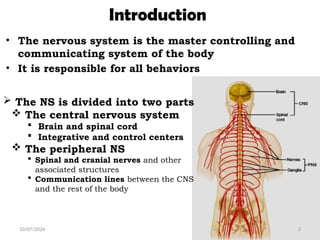
• The nervous system is the master controlling and
communicating system of the body
• It is responsible for all behaviors
 The NS is divided into two parts
 The central nervous system
 Brain and spinal cord
 Integrative and control centers
 The peripheral NS
 Spinal and cranial nerves and other
associated structures
 Communication lines between the CNS
and the rest of the body
10/07/2024 3
Functions
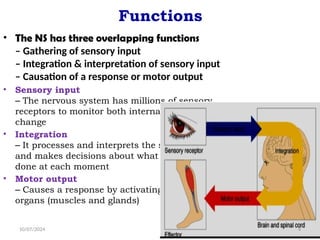
• The NS has three overlapping functions
– Gathering of sensory input
– Integration & interpretation of sensory input
– Causation of a response or motor output
• Sensory input
– The nervous system has millions of sensory
receptors to monitor both internal & external
change
• Integration
– It processes and interprets the sensory input
and makes decisions about what should be
done at each moment
• Motor output
– Causes a response by activating effector
organs (muscles and glands)
10/07/2024 4
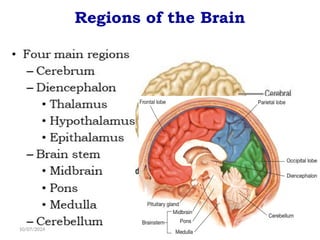
Regions of the Brain
10/07/2024 5
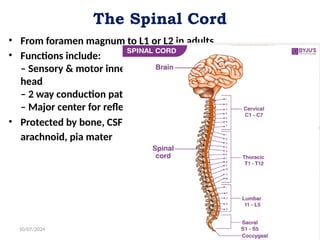
The Spinal Cord
• From foramen magnum to L1 or L2 in adults
• Functions include:
– Sensory & motor innervation of the entire body inferior to the
head
– 2 way conduction pathways b/n the body & the brain
– Major center for reflexes
• Protected by bone, CSF & meninges made of dura mater,
arachnoid, pia mater
10/07/2024 6
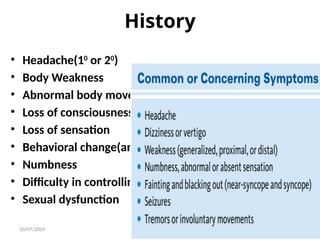
History
• Headache(10
or 20
)
• Body Weakness
• Abnormal body movement
• Loss of consciousness
• Loss of sensation
• Behavioral change(any)
• Numbness
• Difficulty in controlling/passing urine and stool
• Sexual dysfunction
10/07/2024 7
Past medical history
• History of hospitalization, operation
• Seizure attacks
• Birth and childhood development
• Past history of similar episode
Family history
History of similar illness in the family
Family history of HTN, DM
10/07/2024 8
Neurologic Examination
Components:
Mental Status Examination
Cranial nerve exam
Motor exam
Sensory exam
Meningeal signs
10/07/2024 9
Mental Status Examination
• Level of consciousness
• Orientation
• Memory
• Attention
• Arithmetic calculation
• Constructional tasks
• Speech and language
• Insight and judgment
• Emotional state(mood)
• Hallucinations
• Delusion
10/07/2024 10
Components of neurologic
examination
• Mental Status Examination
• Cranial Nerves
• Motor System
• Sensory System
• Meningeal Signs
10/07/2024 11
MENTAL STATE EXAMINATION
Components:
 Level of Consciousness
 Orientation
 Memory
 Arithmetic Calculations
 Constructional Tasks
 Speech & Language
 Insight & Judgement
 Emotional State(Mood)
 Hallucinations
 Delusion
10/07/2024 12
LEVEL OF CONSCIOUSNESS
• Conscious: fully alert having a clear sensorium
• Drowsy: light sleep, easily arousable & alert for a brief
period
• Stupor: only a brief & incomplete arousal even by
vigorous stimuli
• Comatose: pt cannot be aroused by any stimuli
10/07/2024 13
Glasgow Coma Scale (GCS)
10/07/2024 14
• A method used to assess the level of consciousness more objective
GCS Score:= (E[4] + V[5] + M[6])
= Best possible score 15;
= Worst possible score 3.
ORIENTATION
• TO TIME = time, day, date, week, month, year
• TO PLACE = where now, address, town/city, zone, region….
• TO PERSON = his name, name of relatives, friends, known
persons
MEMORY
• IMMEDIATE MEMORY = to repeat a list of 3 items e.g.
pencil, car, bird
• RECENT MEMORY = ask to recall the 3 items 5, 15min later
• REMOTE MEMORY = ask schools, jobs held, known past
events
10/07/2024 15
 Digits span= to repeat series of numbers, start with two digits, if
able to repeat seven digits stop testing
 Digits span reversed = start with two digits, should at least be able
to repeat four digits backward
 Spelling backward = a five letter word e.g. T-A-B-L-E
ARITHMETIC CALCULATIONS
Simple to complex
E.g. 8+7+6, 6+9-4, 6 x 5, 20÷ 4
Use the 100 -7 test or the 21 -3 test
ATTENTION
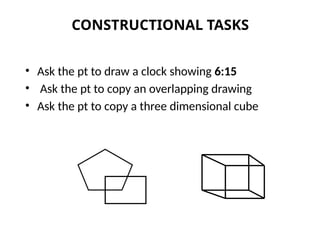
CONSTRUCTIONAL TASKS
• Ask the pt to draw a clock showing 6:15
• Ask the pt to copy an overlapping drawing
• Ask the pt to copy a three dimensional cube
Insight & Judgment
• Insight = perception or understanding of a situation
- Does the pt understand that he/she is sick?
• Judgment- abstract reasoning: ability to assess situations
accurately and form valuable opinion /decision /conclusions.
- What would you do if you found a wallet on the sidewalk?
- interpreting proverbs
Emotional state (mood)
- Sadness/depression
- Anger
- Anxiety/worry
- Detachment/ indifference
HALLUCINATIONS AND DELUSIONS
• HALLUCINATION
– False perceptions without external stimuli
– Types:
Auditory - hear voices e.g. ‘you are horrible’, ‘go kill yourself’
Visual - sees people or animals, insects, rats, tiny people.
Olfactory - smells foul odor from external environment, his own
Tactile/somatic - e.g. insects are crawling over them
• DELUSION
– A false belief held despite evidences against it
– False fixed beliefs not in keeping with the culture.
e.g. controlled by psychic or physical forces
10/07/2024 19
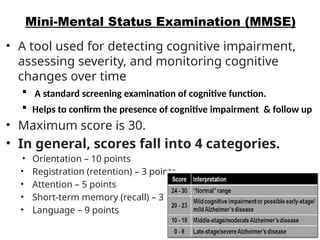
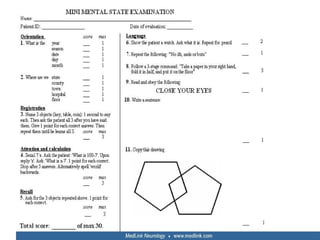
Mini-Mental Status Examination (MMSE)
• A tool used for detecting cognitive impairment,
assessing severity, and monitoring cognitive
changes over time
 A standard screening examination of cognitive function.
 Helps to confirm the presence of cognitive impairment & follow up
• Maximum score is 30.
• In general, scores fall into 4 categories.
• Orientation – 10 points
• Registration (retention) – 3 points
• Attention – 5 points
• Short-term memory (recall) – 3 points
• Language – 9 points
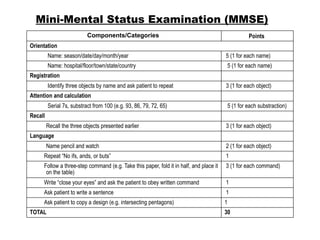
Mini-Mental Status Examination (MMSE)
Components/Categories Points
Orientation
Name: season/date/day/month/year 5 (1 for each name)
Name: hospital/floor/town/state/country 5 (1 for each name)
Registration
Identify three objects by name and ask patient to repeat 3 (1 for each object)
Attention and calculation
Serial 7s, substract from 100 (e.g. 93, 86, 79, 72, 65) 5 (1 for each substraction)
Recall
Recall the three objects presented earlier 3 (1 for each object)
Language
Name pencil and watch 2 (1 for each object)
Repeat “No ifs, ands, or buts” 1
Follow a three-step command (e.g. Take this paper, fold it in half, and place it
on the table)
3 (1 for each command)
Write “close your eyes” and ask the patient to obey written command 1
Ask patient to write a sentence 1
Ask patient to copy a design (e.g. intersecting pentagons) 1
TOTAL 30
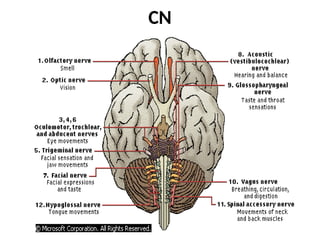
C.
Nerve
Other Name Functions Superficial Exit Level
CN I Olfactory n. Smell
Olfactory bulb [superior to B. Stem]
CN II Optic Visual acuity, visual fields, and ocular fundi Optic chiasm [superior to B. Stem]
CN III Oculomotor EOM movements Medial midbrain
CN IV Trochlear EOM movements Dorsal midbrain
CN V Trigeminal Corneal reflexes, facial sensation, and jaw movements
Sen  Corneal reflex, Sensation over the face
Mot  muscle of Mastication
Pons
CN VI Abducent EOM movements Pons
CN VII Facial Facial movements
Mot  muscles of the face & scalp
Sen  Ant 2/3 of the tongue taste
Pons
CN VIII Vestibulocochlear Hearing and balance Rostral medulla
CN IX Glossopharyngeal Swallowing and rise of the palate, gag reflex
The taste of posterior third of tongue
Rostral medulla
CN X Vagus Rostral medulla
CN XI Spinal Accessory Shoulder and neck movements Spinal C1-C6
CN XII Hypoglossal Tongue symmetry, position, and movement Rostral Medulla
CRANIAL NERVES (CN)
CN
CRANIAL NERVES (CN)
• CN I (Olfactory nerve): for Smelling/olfaction
 Test each nostril: by soap, coffee, lemon, alcohol…etc.
– Abolished sense = anosmia.
– Perversion of sense = parosmia
10/07/2024 25
 Rough test
 reading book
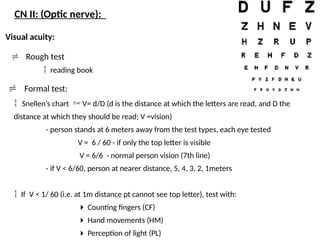
Visual acuity:
CN II: (Optic nerve):
 Snellen’s chart  V= d/D (d is the distance at which the letters are read, and D the
distance at which they should be read; V =vision)
- person stands at 6 meters away from the test types, each eye tested
V = 6 / 60 - if only the top letter is visible
V = 6/6 - normal person vision (7th line)
- if V < 6/60, person at nearer distance, 5, 4, 3, 2, 1meters
 If V < 1/ 60 (i.e. at 1m distance pt cannot see top letter), test with:
 Counting fingers (CF)
 Hand movements (HM)
 Perception of light (PL)
 Formal test:
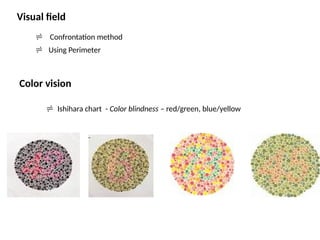
 Confrontation method
 Using Perimeter
Visual field
 Ishihara chart - Color blindness – red/green, blue/yellow
Color vision
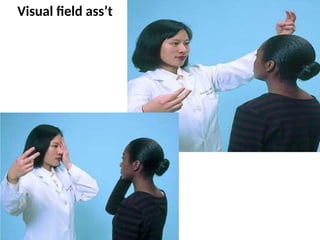
Visual field ass’t
30
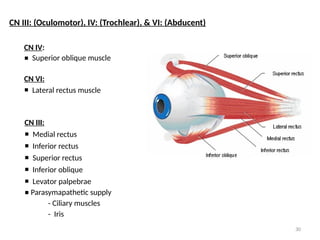
CN III:
 Medial rectus
 Inferior rectus
 Superior rectus
 Inferior oblique
 Levator palpebrae
 Parasymapathetic supply
- Ciliary muscles
- Iris
CN III: (Oculomotor), IV: (Trochlear), & VI: (Abducent)
CN IV:
 Superior oblique muscle
CN VI:
 Lateral rectus muscle
31
1. Eyelids for ptosis
Testing CN: III, IV &VI:
• Upper eyelid elevation - by third nerve & sympathetic supply
2. Examination of ocular Movements
 Observe the eyes (by elevating the lids) and note
- the resting position
- spontaneous and conjugate movements of the eyes.
 Ask the pt to look in all directions & observe for:
- Any direction of impaired movement
- Presence of squint (strabismus), nystagmus, diplopia
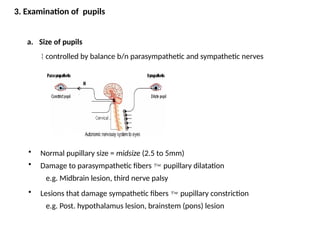
3. Examination of pupils
• Normal pupillary size = midsize (2.5 to 5mm)
• Damage to parasympathetic fibers  pupillary dilatation
e.g. Midbrain lesion, third nerve palsy
• Lesions that damage sympathetic fibers  pupillary constriction
e.g. Post. hypothalamus lesion, brainstem (pons) lesion
III
a. Size of pupils
 controlled by balance b/n parasympathetic and sympathetic nerves
33
• In lesions in mid brain  pupil unreactive to light (fixed) & dilated
• In lesions damaging CN III  pupil unreactive to light (fixed) & dilated
• In lesions affecting sympathetic nerve  pupil reactive to light & constricted
b. The pupillary light reflex: (direct and consensual)
• Optic nerve (sensory) + parasympathetic nerve via CN III (motor)
34
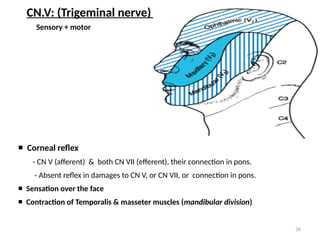
CN.V: (Trigeminal nerve)
Sensory + motor
 Corneal reflex
- CN V (afferent) & both CN VII (efferent), their connection in pons.
- Absent reflex in damages to CN V, or CN VII, or connection in pons.
 Sensation over the face
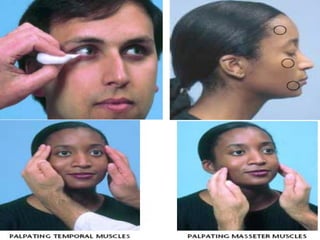
 Contraction of Temporalis & masseter muscles (mandibular division)
35
36
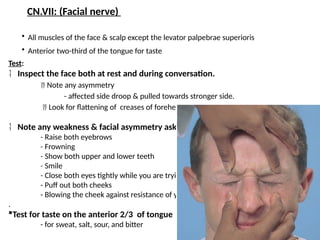
• All muscles of the face & scalp except the levator palpebrae superioris
• Anterior two-third of the tongue for taste
CN.VII: (Facial nerve)
Test:
 Inspect the face both at rest and during conversation.
 Note any asymmetry
- affected side droop & pulled towards stronger side.
 Look for flattening of creases of forehead & naso-labial angle
 Note any weakness & facial asymmetry asking the pt to:
- Raise both eyebrows
- Frowning
- Show both upper and lower teeth
- Smile
- Close both eyes tightly while you are trying to open it.
- Puff out both cheeks
- Blowing the cheek against resistance of your hand
.
Test for taste on the anterior 2/3 of tongue
- for sweat, salt, sour, and bitter
37
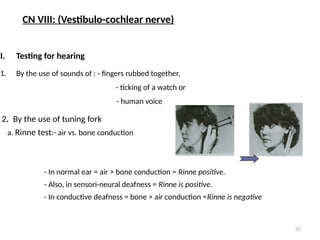
I. Testing for hearing
1. By the use of sounds of : - fingers rubbed together,
- ticking of a watch or
- human voice
2. By the use of tuning fork
a. Rinne test:- air vs. bone conduction
- In normal ear = air > bone conduction = Rinne positive.
- Also, in sensori-neural deafness = Rinne is positive.
- In conductive deafness = bone > air conduction =Rinne is negative
CN VIII: (Vestibulo-cochlear nerve)
38
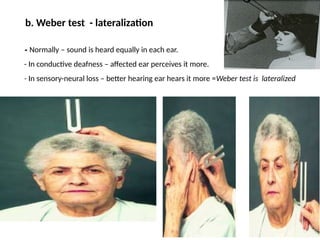
- Normally – sound is heard equally in each ear.
- In conductive deafness – affected ear perceives it more.
- In sensory-neural loss – better hearing ear hears it more =Weber test is lateralized
b. Weber test - lateralization
Stimuli
Result in normal person
Slow drift (tonic deviation) of eyes Compensatory (fast phase) nystagmus
Cold water To the side of the irrigated ear Away from the side of the irrigated ear
Warm water To the opposite side of irrigated ear To the side of the irrigated ear

COWS represents this fast phase
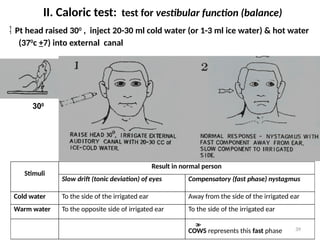
II. Caloric test: test for vestibular function (balance)
300
 Pt head raised 300
, inject 20-30 ml cold water (or 1-3 ml ice water) & hot water
(370
c +7) into external canal
39
40
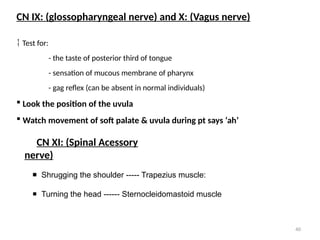
CN IX: (glossopharyngeal nerve) and X: (Vagus nerve)
 Test for:
- the taste of posterior third of tongue
- sensation of mucous membrane of pharynx
- gag reflex (can be absent in normal individuals)
 Look the position of the uvula
 Watch movement of soft palate & uvula during pt says ‘ah’
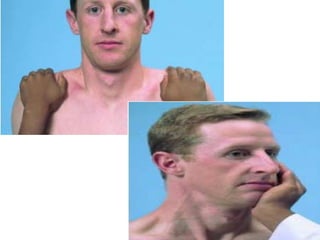
CN XI: (Spinal Acessory
nerve)
 Shrugging the shoulder ----- Trapezius muscle:
 Turning the head ------ Sternocleidomastoid muscle
41
42
• look the tongue for - asymmetry, atrophy, fasciculation, tremor
• symmetry of movement – on moving from side to side
• Check for strength –of pushing the tongue against the inside of the each
cheek as you palpate it externally.
CN XII: (Hypoglossal nerve)
43
MOTOR EXAMINATION
 Muscle bulk
 Muscle Tone
 Power of muscles
 Reflexes
Involuntary movements(tremors, chorea, or fasciculations)
 Coordination's
 Gait
44
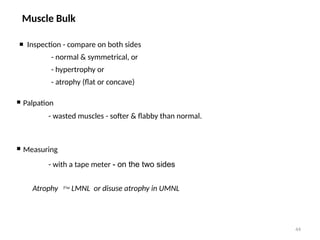
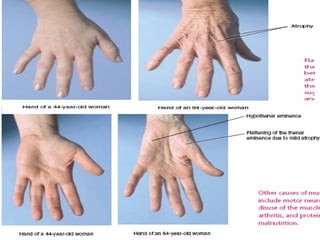
Muscle Bulk
 Inspection - compare on both sides
- normal & symmetrical, or
- hypertrophy or
- atrophy (flat or concave)
 Palpation
- wasted muscles - softer & flabby than normal.
 Measuring
- with a tape meter - on the two sides
Atrophy  LMNL or disuse atrophy in UMNL
45
46
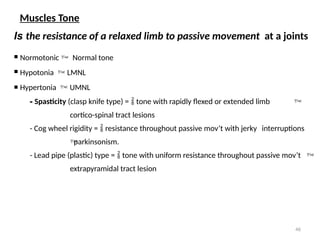
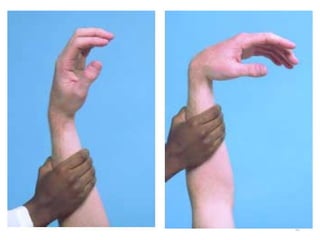
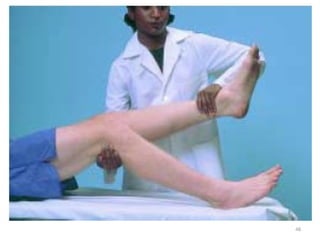
Muscles Tone
Is the resistance of a relaxed limb to passive movement at a joints
 Normotonic  Normal tone
 Hypotonia  LMNL
 Hypertonia  UMNL
- Spasticity (clasp knife type) =  tone with rapidly flexed or extended limb 
cortico-spinal tract lesions
- Cog wheel rigidity =  resistance throughout passive mov’t with jerky interruptions

parkinsonism.
- Lead pipe (plastic) type =  tone with uniform resistance throughout passive mov’t 
extrapyramidal tract lesion
47
48
60
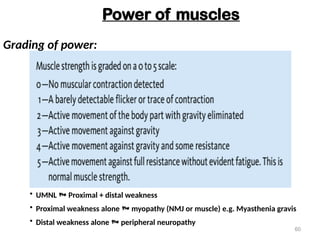
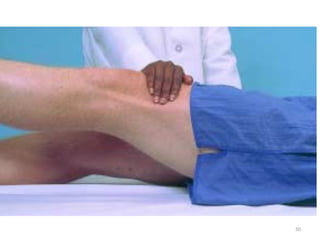
Power of muscles
Grading of power:
• UMNL  Proximal + distal weakness
• Proximal weakness alone  myopathy (NMJ or muscle) e.g. Myasthenia gravis
• Distal weakness alone  peripheral neuropathy
50
51
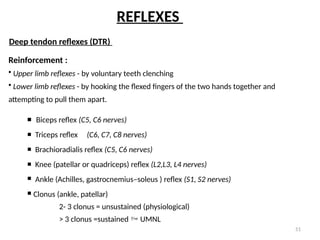
Deep tendon reflexes (DTR)
Reinforcement :
• Upper limb reflexes - by voluntary teeth clenching
• Lower limb reflexes - by hooking the flexed fingers of the two hands together and
attempting to pull them apart.
 Biceps reflex (C5, C6 nerves)
 Triceps reflex (C6, C7, C8 nerves)
 Brachioradialis reflex (C5, C6 nerves)
 Knee (patellar or quadriceps) reflex (L2,L3, L4 nerves)
 Ankle (Achilles, gastrocnemius–soleus ) reflex (S1, S2 nerves)
 Clonus (ankle, patellar)
2- 3 clonus = unsustained (physiological)
> 3 clonus =sustained  UMNL
REFLEXES
52
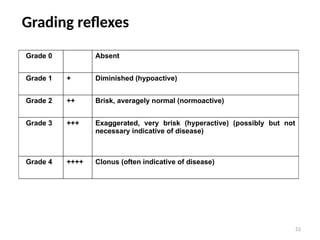
Grading reflexes
Grade 0 Absent
Grade 1 + Diminished (hypoactive)
Grade 2 ++ Brisk, averagely normal (normoactive)
Grade 3 +++ Exaggerated, very brisk (hyperactive) (possibly but not
necessary indicative of disease)
Grade 4 ++++ Clonus (often indicative of disease)
53
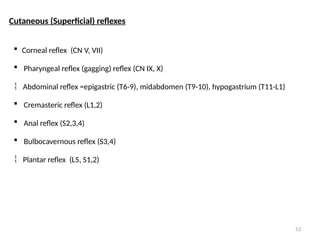
Cutaneous (Superficial) reflexes
 Corneal reflex (CN V, VII)
 Pharyngeal reflex (gagging) reflex (CN IX, X)
 Abdominal reflex =epigastric (T6-9), midabdomen (T9-10), hypogastrium (T11-L1)
 Cremasteric reflex (L1,2)
 Anal reflex (S2,3,4)
 Bulbocavernous reflex (S3,4)
 Plantar reflex (L5, S1,2)
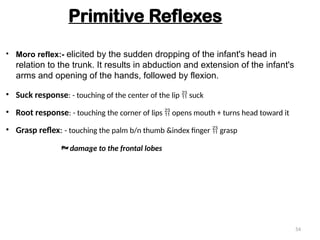
• Suck response: - touching of the center of the lip  suck
• Root response: - touching the corner of lips  opens mouth + turns head toward it
• Grasp reflex: - touching the palm b/n thumb &index finger  grasp
Primitive Reflexes
 damage to the frontal lobes
• Moro reflex:- elicited by the sudden dropping of the infant's head in
relation to the trunk. It results in abduction and extension of the infant's
arms and opening of the hands, followed by flexion.
54
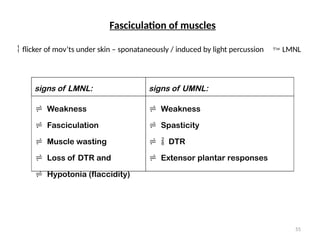
Fasciculation of muscles
signs of LMNL: signs of UMNL:
 Weakness
 Fasciculation
 Muscle wasting
 Loss of DTR and
 Hypotonia (flaccidity)
 Weakness
 Spasticity
  DTR
 Extensor plantar responses
 flicker of mov’ts under skin – sponataneously / induced by light percussion  LMNL
55
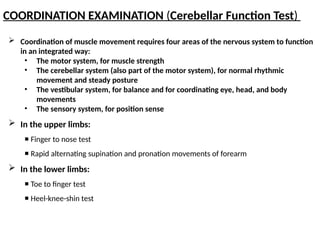
COORDINATION EXAMINATION (Cerebellar Function Test)
 Coordination of muscle movement requires four areas of the nervous system to function
in an integrated way:
• The motor system, for muscle strength
• The cerebellar system (also part of the motor system), for normal rhythmic
movement and steady posture
• The vestibular system, for balance and for coordinating eye, head, and body
movements
• The sensory system, for position sense
 In the upper limbs:
 Finger to nose test
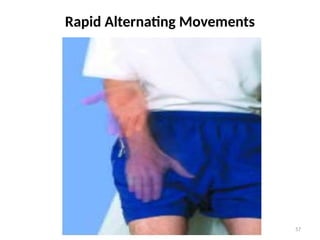
 Rapid alternating supination and pronation movements of forearm
 In the lower limbs:
 Toe to finger test
 Heel-knee-shin test
57
Rapid Alternating Movements
58
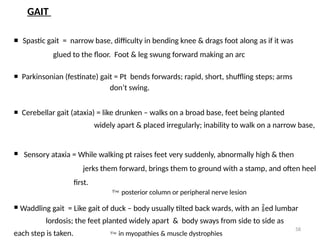
GAIT
 Spastic gait = narrow base, difficulty in bending knee & drags foot along as if it was
glued to the floor. Foot & leg swung forward making an arc
 Parkinsonian (festinate) gait = Pt bends forwards; rapid, short, shuffling steps; arms
don’t swing.
 Cerebellar gait (ataxia) = like drunken – walks on a broad base, feet being planted
widely apart & placed irregularly; inability to walk on a narrow base,
 Sensory ataxia = While walking pt raises feet very suddenly, abnormally high & then
jerks them forward, brings them to ground with a stamp, and often heel
first.
 posterior column or peripheral nerve lesion
 Waddling gait = Like gait of duck – body usually tilted back wards, with an ed lumbar
lordosis; the feet planted widely apart & body sways from side to side as
each step is taken.  in myopathies & muscle dystrophies
59
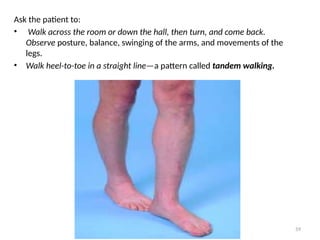
Ask the patient to:
• Walk across the room or down the hall, then turn, and come back.
Observe posture, balance, swinging of the arms, and movements of the
legs.
• Walk heel-to-toe in a straight line—a pattern called tandem walking.
60
Stance
THE ROMBERG TEST :This is mainly a test of position sense.
• The patient should first stand with feet together and eyes open and then
close both eyes for 20 to 30 seconds without support.
• Note the patient’s ability to maintain an upright posture.
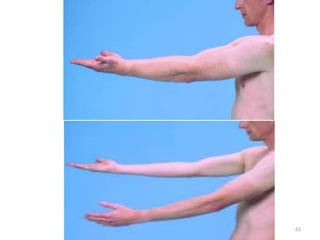
TEST FOR PRONATOR DRIFT
• The patient should stand for 20 to 30 seconds with both arms straight
forward, palms up, and with eyes closed.
• A person who cannot stand may be tested for a pronator drift in the sitting
position.
61
62
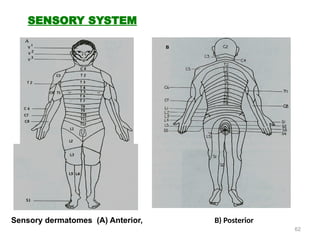
SENSORY SYSTEM
Sensory dermatomes (A) Anterior,
B
B) Posterior
63
• Light touch = wisp of cotton or examiner’s finger.
• Pain = blunt & sharp end of new pin
• Temperature
• Position sense
• Deep pressure
• Vibration sense
• Two point discrimination
- on finger tips = normally 2mm separation can be recognized
- on pulps of toes = ~1cm separation recognized normally
• Recognition of size, shape, weight & form (Stereognosis)
• Identification of number or letter written on palm (Graphesthesia)
• Romberg’s sign = test for loss of position sense (sensory ataxia) .
Sensory Exam
64
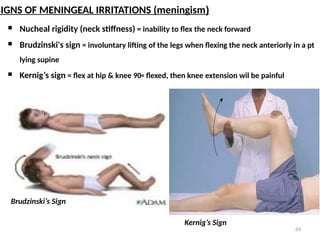
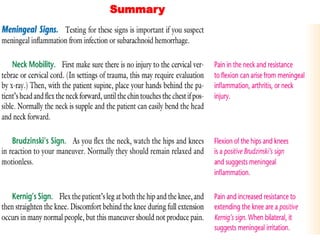
SIGNS OF MENINGEAL IRRITATIONS (meningism)
 Nucheal rigidity (neck stiffness) = inability to flex the neck forward
 Brudzinski's sign = involuntary lifting of the legs when flexing the neck anteriorly in a pt
lying supine
 Kernig’s sign = flex at hip & knee 90◦ flexed, then knee extension wil be painful
Brudzinski’s Sign
Kernig’s Sign
65
Summary
66
Thank you!!
THE END

8. Nervous system.pptxEEEEEEEEEEEEEEEEEEEEEEEEE

  • 1.
  • 2.
    Outlines • Introduction • Historyand • Clinical examination 10/07/2024 2
  • 3.
    Introduction • The nervoussystem is the master controlling and communicating system of the body • It is responsible for all behaviors  The NS is divided into two parts  The central nervous system  Brain and spinal cord  Integrative and control centers  The peripheral NS  Spinal and cranial nerves and other associated structures  Communication lines between the CNS and the rest of the body 10/07/2024 3
  • 4.
    Functions • The NShas three overlapping functions – Gathering of sensory input – Integration & interpretation of sensory input – Causation of a response or motor output • Sensory input – The nervous system has millions of sensory receptors to monitor both internal & external change • Integration – It processes and interprets the sensory input and makes decisions about what should be done at each moment • Motor output – Causes a response by activating effector organs (muscles and glands) 10/07/2024 4
  • 5.
    Regions of theBrain 10/07/2024 5
  • 6.
    The Spinal Cord •From foramen magnum to L1 or L2 in adults • Functions include: – Sensory & motor innervation of the entire body inferior to the head – 2 way conduction pathways b/n the body & the brain – Major center for reflexes • Protected by bone, CSF & meninges made of dura mater, arachnoid, pia mater 10/07/2024 6
  • 7.
    History • Headache(10 or 20 ) •Body Weakness • Abnormal body movement • Loss of consciousness • Loss of sensation • Behavioral change(any) • Numbness • Difficulty in controlling/passing urine and stool • Sexual dysfunction 10/07/2024 7
  • 8.
    Past medical history •History of hospitalization, operation • Seizure attacks • Birth and childhood development • Past history of similar episode Family history History of similar illness in the family Family history of HTN, DM 10/07/2024 8
  • 9.
    Neurologic Examination Components: Mental StatusExamination Cranial nerve exam Motor exam Sensory exam Meningeal signs 10/07/2024 9
  • 10.
    Mental Status Examination •Level of consciousness • Orientation • Memory • Attention • Arithmetic calculation • Constructional tasks • Speech and language • Insight and judgment • Emotional state(mood) • Hallucinations • Delusion 10/07/2024 10
  • 11.
    Components of neurologic examination •Mental Status Examination • Cranial Nerves • Motor System • Sensory System • Meningeal Signs 10/07/2024 11
  • 12.
    MENTAL STATE EXAMINATION Components: Level of Consciousness  Orientation  Memory  Arithmetic Calculations  Constructional Tasks  Speech & Language  Insight & Judgement  Emotional State(Mood)  Hallucinations  Delusion 10/07/2024 12
  • 13.
    LEVEL OF CONSCIOUSNESS •Conscious: fully alert having a clear sensorium • Drowsy: light sleep, easily arousable & alert for a brief period • Stupor: only a brief & incomplete arousal even by vigorous stimuli • Comatose: pt cannot be aroused by any stimuli 10/07/2024 13
  • 14.
    Glasgow Coma Scale(GCS) 10/07/2024 14 • A method used to assess the level of consciousness more objective GCS Score:= (E[4] + V[5] + M[6]) = Best possible score 15; = Worst possible score 3.
  • 15.
    ORIENTATION • TO TIME= time, day, date, week, month, year • TO PLACE = where now, address, town/city, zone, region…. • TO PERSON = his name, name of relatives, friends, known persons MEMORY • IMMEDIATE MEMORY = to repeat a list of 3 items e.g. pencil, car, bird • RECENT MEMORY = ask to recall the 3 items 5, 15min later • REMOTE MEMORY = ask schools, jobs held, known past events 10/07/2024 15
  • 16.
     Digits span=to repeat series of numbers, start with two digits, if able to repeat seven digits stop testing  Digits span reversed = start with two digits, should at least be able to repeat four digits backward  Spelling backward = a five letter word e.g. T-A-B-L-E ARITHMETIC CALCULATIONS Simple to complex E.g. 8+7+6, 6+9-4, 6 x 5, 20÷ 4 Use the 100 -7 test or the 21 -3 test ATTENTION
  • 17.
    CONSTRUCTIONAL TASKS • Askthe pt to draw a clock showing 6:15 • Ask the pt to copy an overlapping drawing • Ask the pt to copy a three dimensional cube
  • 18.
    Insight & Judgment •Insight = perception or understanding of a situation - Does the pt understand that he/she is sick? • Judgment- abstract reasoning: ability to assess situations accurately and form valuable opinion /decision /conclusions. - What would you do if you found a wallet on the sidewalk? - interpreting proverbs Emotional state (mood) - Sadness/depression - Anger - Anxiety/worry - Detachment/ indifference
  • 19.
    HALLUCINATIONS AND DELUSIONS •HALLUCINATION – False perceptions without external stimuli – Types: Auditory - hear voices e.g. ‘you are horrible’, ‘go kill yourself’ Visual - sees people or animals, insects, rats, tiny people. Olfactory - smells foul odor from external environment, his own Tactile/somatic - e.g. insects are crawling over them • DELUSION – A false belief held despite evidences against it – False fixed beliefs not in keeping with the culture. e.g. controlled by psychic or physical forces 10/07/2024 19
  • 20.
    Mini-Mental Status Examination(MMSE) • A tool used for detecting cognitive impairment, assessing severity, and monitoring cognitive changes over time  A standard screening examination of cognitive function.  Helps to confirm the presence of cognitive impairment & follow up • Maximum score is 30. • In general, scores fall into 4 categories. • Orientation – 10 points • Registration (retention) – 3 points • Attention – 5 points • Short-term memory (recall) – 3 points • Language – 9 points
  • 21.
    Mini-Mental Status Examination(MMSE) Components/Categories Points Orientation Name: season/date/day/month/year 5 (1 for each name) Name: hospital/floor/town/state/country 5 (1 for each name) Registration Identify three objects by name and ask patient to repeat 3 (1 for each object) Attention and calculation Serial 7s, substract from 100 (e.g. 93, 86, 79, 72, 65) 5 (1 for each substraction) Recall Recall the three objects presented earlier 3 (1 for each object) Language Name pencil and watch 2 (1 for each object) Repeat “No ifs, ands, or buts” 1 Follow a three-step command (e.g. Take this paper, fold it in half, and place it on the table) 3 (1 for each command) Write “close your eyes” and ask the patient to obey written command 1 Ask patient to write a sentence 1 Ask patient to copy a design (e.g. intersecting pentagons) 1 TOTAL 30
  • 23.
    C. Nerve Other Name FunctionsSuperficial Exit Level CN I Olfactory n. Smell Olfactory bulb [superior to B. Stem] CN II Optic Visual acuity, visual fields, and ocular fundi Optic chiasm [superior to B. Stem] CN III Oculomotor EOM movements Medial midbrain CN IV Trochlear EOM movements Dorsal midbrain CN V Trigeminal Corneal reflexes, facial sensation, and jaw movements Sen  Corneal reflex, Sensation over the face Mot  muscle of Mastication Pons CN VI Abducent EOM movements Pons CN VII Facial Facial movements Mot  muscles of the face & scalp Sen  Ant 2/3 of the tongue taste Pons CN VIII Vestibulocochlear Hearing and balance Rostral medulla CN IX Glossopharyngeal Swallowing and rise of the palate, gag reflex The taste of posterior third of tongue Rostral medulla CN X Vagus Rostral medulla CN XI Spinal Accessory Shoulder and neck movements Spinal C1-C6 CN XII Hypoglossal Tongue symmetry, position, and movement Rostral Medulla CRANIAL NERVES (CN)
  • 24.
  • 25.
    CRANIAL NERVES (CN) •CN I (Olfactory nerve): for Smelling/olfaction  Test each nostril: by soap, coffee, lemon, alcohol…etc. – Abolished sense = anosmia. – Perversion of sense = parosmia 10/07/2024 25
  • 26.
     Rough test reading book Visual acuity: CN II: (Optic nerve):  Snellen’s chart  V= d/D (d is the distance at which the letters are read, and D the distance at which they should be read; V =vision) - person stands at 6 meters away from the test types, each eye tested V = 6 / 60 - if only the top letter is visible V = 6/6 - normal person vision (7th line) - if V < 6/60, person at nearer distance, 5, 4, 3, 2, 1meters  If V < 1/ 60 (i.e. at 1m distance pt cannot see top letter), test with:  Counting fingers (CF)  Hand movements (HM)  Perception of light (PL)  Formal test:
  • 27.
     Confrontation method Using Perimeter Visual field  Ishihara chart - Color blindness – red/green, blue/yellow Color vision
  • 28.
  • 30.
    30 CN III:  Medialrectus  Inferior rectus  Superior rectus  Inferior oblique  Levator palpebrae  Parasymapathetic supply - Ciliary muscles - Iris CN III: (Oculomotor), IV: (Trochlear), & VI: (Abducent) CN IV:  Superior oblique muscle CN VI:  Lateral rectus muscle
  • 31.
    31 1. Eyelids forptosis Testing CN: III, IV &VI: • Upper eyelid elevation - by third nerve & sympathetic supply 2. Examination of ocular Movements  Observe the eyes (by elevating the lids) and note - the resting position - spontaneous and conjugate movements of the eyes.  Ask the pt to look in all directions & observe for: - Any direction of impaired movement - Presence of squint (strabismus), nystagmus, diplopia
  • 32.
    3. Examination ofpupils • Normal pupillary size = midsize (2.5 to 5mm) • Damage to parasympathetic fibers  pupillary dilatation e.g. Midbrain lesion, third nerve palsy • Lesions that damage sympathetic fibers  pupillary constriction e.g. Post. hypothalamus lesion, brainstem (pons) lesion III a. Size of pupils  controlled by balance b/n parasympathetic and sympathetic nerves
  • 33.
    33 • In lesionsin mid brain  pupil unreactive to light (fixed) & dilated • In lesions damaging CN III  pupil unreactive to light (fixed) & dilated • In lesions affecting sympathetic nerve  pupil reactive to light & constricted b. The pupillary light reflex: (direct and consensual) • Optic nerve (sensory) + parasympathetic nerve via CN III (motor)
  • 34.
    34 CN.V: (Trigeminal nerve) Sensory+ motor  Corneal reflex - CN V (afferent) & both CN VII (efferent), their connection in pons. - Absent reflex in damages to CN V, or CN VII, or connection in pons.  Sensation over the face  Contraction of Temporalis & masseter muscles (mandibular division)
  • 35.
  • 36.
    36 • All musclesof the face & scalp except the levator palpebrae superioris • Anterior two-third of the tongue for taste CN.VII: (Facial nerve) Test:  Inspect the face both at rest and during conversation.  Note any asymmetry - affected side droop & pulled towards stronger side.  Look for flattening of creases of forehead & naso-labial angle  Note any weakness & facial asymmetry asking the pt to: - Raise both eyebrows - Frowning - Show both upper and lower teeth - Smile - Close both eyes tightly while you are trying to open it. - Puff out both cheeks - Blowing the cheek against resistance of your hand . Test for taste on the anterior 2/3 of tongue - for sweat, salt, sour, and bitter
  • 37.
    37 I. Testing forhearing 1. By the use of sounds of : - fingers rubbed together, - ticking of a watch or - human voice 2. By the use of tuning fork a. Rinne test:- air vs. bone conduction - In normal ear = air > bone conduction = Rinne positive. - Also, in sensori-neural deafness = Rinne is positive. - In conductive deafness = bone > air conduction =Rinne is negative CN VIII: (Vestibulo-cochlear nerve)
  • 38.
    38 - Normally –sound is heard equally in each ear. - In conductive deafness – affected ear perceives it more. - In sensory-neural loss – better hearing ear hears it more =Weber test is lateralized b. Weber test - lateralization
  • 39.
    Stimuli Result in normalperson Slow drift (tonic deviation) of eyes Compensatory (fast phase) nystagmus Cold water To the side of the irrigated ear Away from the side of the irrigated ear Warm water To the opposite side of irrigated ear To the side of the irrigated ear  COWS represents this fast phase II. Caloric test: test for vestibular function (balance) 300  Pt head raised 300 , inject 20-30 ml cold water (or 1-3 ml ice water) & hot water (370 c +7) into external canal 39
  • 40.
    40 CN IX: (glossopharyngealnerve) and X: (Vagus nerve)  Test for: - the taste of posterior third of tongue - sensation of mucous membrane of pharynx - gag reflex (can be absent in normal individuals)  Look the position of the uvula  Watch movement of soft palate & uvula during pt says ‘ah’ CN XI: (Spinal Acessory nerve)  Shrugging the shoulder ----- Trapezius muscle:  Turning the head ------ Sternocleidomastoid muscle
  • 41.
  • 42.
    42 • look thetongue for - asymmetry, atrophy, fasciculation, tremor • symmetry of movement – on moving from side to side • Check for strength –of pushing the tongue against the inside of the each cheek as you palpate it externally. CN XII: (Hypoglossal nerve)
  • 43.
    43 MOTOR EXAMINATION  Musclebulk  Muscle Tone  Power of muscles  Reflexes Involuntary movements(tremors, chorea, or fasciculations)  Coordination's  Gait
  • 44.
    44 Muscle Bulk  Inspection- compare on both sides - normal & symmetrical, or - hypertrophy or - atrophy (flat or concave)  Palpation - wasted muscles - softer & flabby than normal.  Measuring - with a tape meter - on the two sides Atrophy  LMNL or disuse atrophy in UMNL
  • 45.
  • 46.
    46 Muscles Tone Is theresistance of a relaxed limb to passive movement at a joints  Normotonic  Normal tone  Hypotonia  LMNL  Hypertonia  UMNL - Spasticity (clasp knife type) =  tone with rapidly flexed or extended limb  cortico-spinal tract lesions - Cog wheel rigidity =  resistance throughout passive mov’t with jerky interruptions  parkinsonism. - Lead pipe (plastic) type =  tone with uniform resistance throughout passive mov’t  extrapyramidal tract lesion
  • 47.
  • 48.
  • 49.
    60 Power of muscles Gradingof power: • UMNL  Proximal + distal weakness • Proximal weakness alone  myopathy (NMJ or muscle) e.g. Myasthenia gravis • Distal weakness alone  peripheral neuropathy
  • 50.
  • 51.
    51 Deep tendon reflexes(DTR) Reinforcement : • Upper limb reflexes - by voluntary teeth clenching • Lower limb reflexes - by hooking the flexed fingers of the two hands together and attempting to pull them apart.  Biceps reflex (C5, C6 nerves)  Triceps reflex (C6, C7, C8 nerves)  Brachioradialis reflex (C5, C6 nerves)  Knee (patellar or quadriceps) reflex (L2,L3, L4 nerves)  Ankle (Achilles, gastrocnemius–soleus ) reflex (S1, S2 nerves)  Clonus (ankle, patellar) 2- 3 clonus = unsustained (physiological) > 3 clonus =sustained  UMNL REFLEXES
  • 52.
    52 Grading reflexes Grade 0Absent Grade 1 + Diminished (hypoactive) Grade 2 ++ Brisk, averagely normal (normoactive) Grade 3 +++ Exaggerated, very brisk (hyperactive) (possibly but not necessary indicative of disease) Grade 4 ++++ Clonus (often indicative of disease)
  • 53.
    53 Cutaneous (Superficial) reflexes Corneal reflex (CN V, VII)  Pharyngeal reflex (gagging) reflex (CN IX, X)  Abdominal reflex =epigastric (T6-9), midabdomen (T9-10), hypogastrium (T11-L1)  Cremasteric reflex (L1,2)  Anal reflex (S2,3,4)  Bulbocavernous reflex (S3,4)  Plantar reflex (L5, S1,2)
  • 54.
    • Suck response:- touching of the center of the lip  suck • Root response: - touching the corner of lips  opens mouth + turns head toward it • Grasp reflex: - touching the palm b/n thumb &index finger  grasp Primitive Reflexes  damage to the frontal lobes • Moro reflex:- elicited by the sudden dropping of the infant's head in relation to the trunk. It results in abduction and extension of the infant's arms and opening of the hands, followed by flexion. 54
  • 55.
    Fasciculation of muscles signsof LMNL: signs of UMNL:  Weakness  Fasciculation  Muscle wasting  Loss of DTR and  Hypotonia (flaccidity)  Weakness  Spasticity   DTR  Extensor plantar responses  flicker of mov’ts under skin – sponataneously / induced by light percussion  LMNL 55
  • 56.
    COORDINATION EXAMINATION (CerebellarFunction Test)  Coordination of muscle movement requires four areas of the nervous system to function in an integrated way: • The motor system, for muscle strength • The cerebellar system (also part of the motor system), for normal rhythmic movement and steady posture • The vestibular system, for balance and for coordinating eye, head, and body movements • The sensory system, for position sense  In the upper limbs:  Finger to nose test  Rapid alternating supination and pronation movements of forearm  In the lower limbs:  Toe to finger test  Heel-knee-shin test
  • 57.
  • 58.
    58 GAIT  Spastic gait= narrow base, difficulty in bending knee & drags foot along as if it was glued to the floor. Foot & leg swung forward making an arc  Parkinsonian (festinate) gait = Pt bends forwards; rapid, short, shuffling steps; arms don’t swing.  Cerebellar gait (ataxia) = like drunken – walks on a broad base, feet being planted widely apart & placed irregularly; inability to walk on a narrow base,  Sensory ataxia = While walking pt raises feet very suddenly, abnormally high & then jerks them forward, brings them to ground with a stamp, and often heel first.  posterior column or peripheral nerve lesion  Waddling gait = Like gait of duck – body usually tilted back wards, with an ed lumbar lordosis; the feet planted widely apart & body sways from side to side as each step is taken.  in myopathies & muscle dystrophies
  • 59.
    59 Ask the patientto: • Walk across the room or down the hall, then turn, and come back. Observe posture, balance, swinging of the arms, and movements of the legs. • Walk heel-to-toe in a straight line—a pattern called tandem walking.
  • 60.
    60 Stance THE ROMBERG TEST:This is mainly a test of position sense. • The patient should first stand with feet together and eyes open and then close both eyes for 20 to 30 seconds without support. • Note the patient’s ability to maintain an upright posture. TEST FOR PRONATOR DRIFT • The patient should stand for 20 to 30 seconds with both arms straight forward, palms up, and with eyes closed. • A person who cannot stand may be tested for a pronator drift in the sitting position.
  • 61.
  • 62.
    62 SENSORY SYSTEM Sensory dermatomes(A) Anterior, B B) Posterior
  • 63.
    63 • Light touch= wisp of cotton or examiner’s finger. • Pain = blunt & sharp end of new pin • Temperature • Position sense • Deep pressure • Vibration sense • Two point discrimination - on finger tips = normally 2mm separation can be recognized - on pulps of toes = ~1cm separation recognized normally • Recognition of size, shape, weight & form (Stereognosis) • Identification of number or letter written on palm (Graphesthesia) • Romberg’s sign = test for loss of position sense (sensory ataxia) . Sensory Exam
  • 64.
    64 SIGNS OF MENINGEALIRRITATIONS (meningism)  Nucheal rigidity (neck stiffness) = inability to flex the neck forward  Brudzinski's sign = involuntary lifting of the legs when flexing the neck anteriorly in a pt lying supine  Kernig’s sign = flex at hip & knee 90◦ flexed, then knee extension wil be painful Brudzinski’s Sign Kernig’s Sign
  • 65.
  • 66.