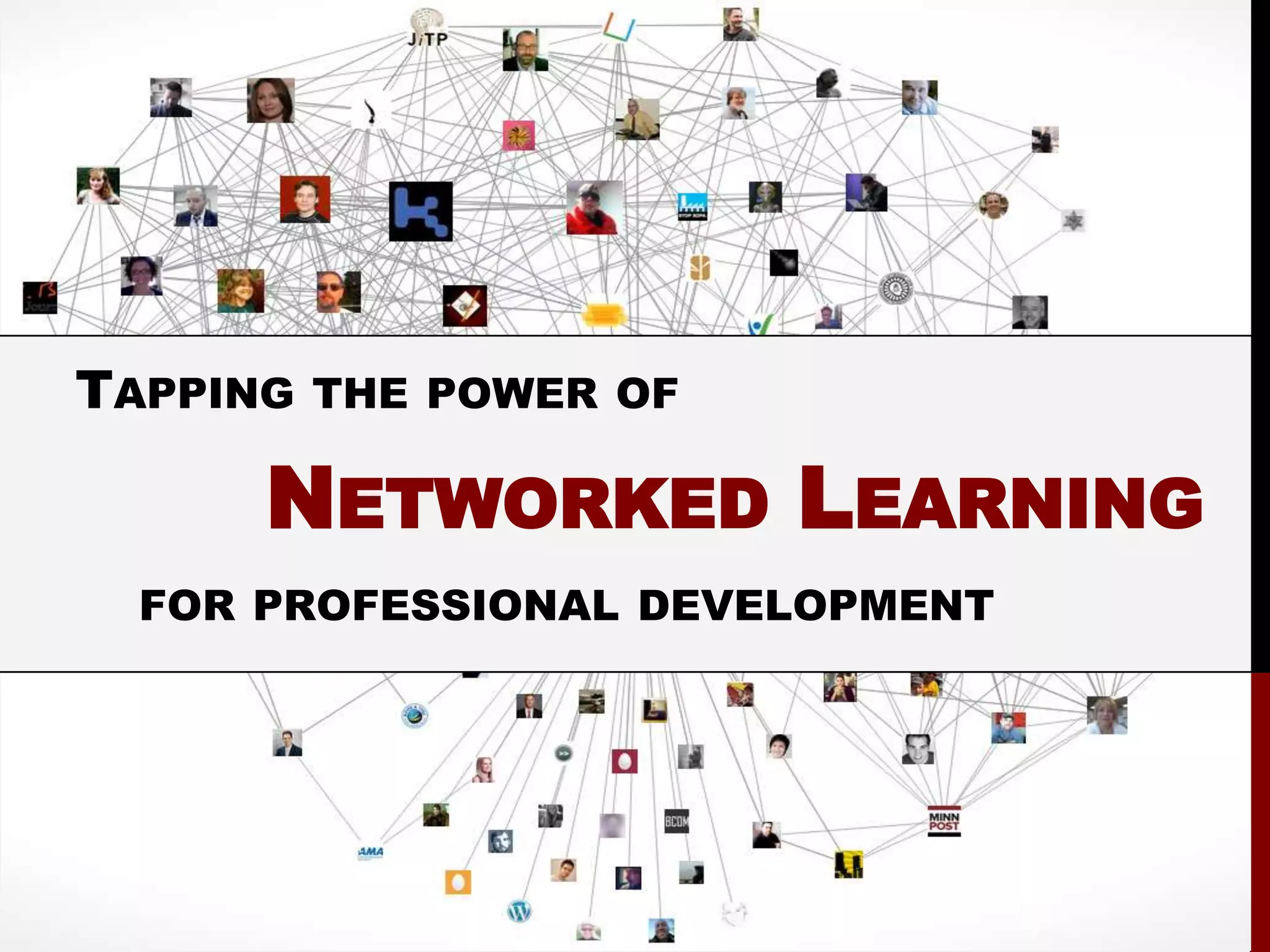

TAPPING THE POWER OF

      NETWORKED LEARNING
  FOR PROFESSIONAL DEVELOPMENT
Abram Anders
Labovitz School of Business and Economics
University of Minnesota Duluth
http://www.d.umn.edu/~adanders/
adanders@d.umn.edu

Joe Moses
Department of Writing Studies
University of Minnesota
moses004@umn.edu
EMERGING TRENDS

Corporate leaders like IBM, GE, and
Nationwide are moving to patterns of
networked sharing and informal learning
to promote effectiveness, innovation, and
just-in-time problem solving.
EMERGING TRENDS

Blogs, social media, and networks of
practice are becoming integral to the
work of successful professionals and
organizational best practices.


Ardichvili, Alexandre. “Learning and Knowledge Sharing in Virtual
Communities of Practice: Motivators, Barriers, and Enablers.” Advances
in Developing Human Resources 10, no. 4 (June 5, 2008): 541–554.
NONPROFIT LEADERS

Nonprofits already lead in social media,
using the social web for marketing, event
promotion, and to build relationships with
stakeholders.


Barnes, Nora Ganim. “Social Media Usage Now Ubiquitous Among US
Top Charities, Ahead of All Other Sectors” UMass Dartmouth. University
of Massachusetts. Web. March 27, 2013.
NONPROFIT LEARNERS

Studies cite strong connections between
learning and mission performance;
organizations that capture and share
learning with staff and volunteers realize
faster skill development and more
effective direct service.

McHargue, Susan K.. “Learning for Performance in Nonprofit
Organizations,” Advances in Developing Human Resources Vol. 5, No. 2
May 2003 196-204.
NETWORKED LEARNING

Networked learning argues the creation
of connections between people,
information, and tools is a rich context of
both situated and informal learning
processes in support of capacities for
adaptability, creativity, and professional
growth.
NETWORKED LEARNING

Networked learning ...
•   Builds on applications and services
    that are readily available on the web
    and that many professionals already
    use
•   Extends the value of social and
    professional networking activity
NETWORKED LEARNING

Networked learning
 • Supports the development of essential
   21st century skills and digital literacies
 • Leverages social interaction and
   collective intelligence to make the
   work we already do more productive
   and available for more uses
PRESENTATION ITINERARY

1. Reviewing Networked Learning and
   MOOCs Research
2. Leveraging Personal Learning
   Networks (PLNs) for Professional
   Success
3. Using MOOCs and Online Learning
   Skills to Kickstart your Development
INTERACTION AND DISCUSSION

We invite your active participation: share
your questions, comments, resources,
and ideas. We will also pose several
questions to draw on our attendees
experiences and expertise.


Twitter Discussion: #mnnptech
Google Doc: http://z.umn.edu/mnnptech
JOIN US!

April 10th


See the
Conference
Site for more
details.

Networked Learning for Nonprofits

  • 1.
    TAPPING THE POWEROF NETWORKED LEARNING FOR PROFESSIONAL DEVELOPMENT
  • 2.
    Abram Anders Labovitz Schoolof Business and Economics University of Minnesota Duluth http://www.d.umn.edu/~adanders/ adanders@d.umn.edu Joe Moses Department of Writing Studies University of Minnesota moses004@umn.edu
  • 3.
    EMERGING TRENDS Corporate leaderslike IBM, GE, and Nationwide are moving to patterns of networked sharing and informal learning to promote effectiveness, innovation, and just-in-time problem solving.
  • 4.
    EMERGING TRENDS Blogs, socialmedia, and networks of practice are becoming integral to the work of successful professionals and organizational best practices. Ardichvili, Alexandre. “Learning and Knowledge Sharing in Virtual Communities of Practice: Motivators, Barriers, and Enablers.” Advances in Developing Human Resources 10, no. 4 (June 5, 2008): 541–554.
  • 5.
    NONPROFIT LEADERS Nonprofits alreadylead in social media, using the social web for marketing, event promotion, and to build relationships with stakeholders. Barnes, Nora Ganim. “Social Media Usage Now Ubiquitous Among US Top Charities, Ahead of All Other Sectors” UMass Dartmouth. University of Massachusetts. Web. March 27, 2013.
  • 6.
    NONPROFIT LEARNERS Studies citestrong connections between learning and mission performance; organizations that capture and share learning with staff and volunteers realize faster skill development and more effective direct service. McHargue, Susan K.. “Learning for Performance in Nonprofit Organizations,” Advances in Developing Human Resources Vol. 5, No. 2 May 2003 196-204.
  • 7.
    NETWORKED LEARNING Networked learningargues the creation of connections between people, information, and tools is a rich context of both situated and informal learning processes in support of capacities for adaptability, creativity, and professional growth.
  • 8.
    NETWORKED LEARNING Networked learning... • Builds on applications and services that are readily available on the web and that many professionals already use • Extends the value of social and professional networking activity
  • 9.
    NETWORKED LEARNING Networked learning • Supports the development of essential 21st century skills and digital literacies • Leverages social interaction and collective intelligence to make the work we already do more productive and available for more uses
  • 10.
    PRESENTATION ITINERARY 1. ReviewingNetworked Learning and MOOCs Research 2. Leveraging Personal Learning Networks (PLNs) for Professional Success 3. Using MOOCs and Online Learning Skills to Kickstart your Development
  • 11.
    INTERACTION AND DISCUSSION Weinvite your active participation: share your questions, comments, resources, and ideas. We will also pose several questions to draw on our attendees experiences and expertise. Twitter Discussion: #mnnptech Google Doc: http://z.umn.edu/mnnptech
  • 12.
    JOIN US! April 10th Seethe Conference Site for more details.