Teaching and Learning CollaborativelyGroup 4-Sara Bates
How do we define collaboration?Collaboration 1.0Partner reading, playing nicely together,telephone calls, AOL and MSNCollaboration is not just cooperationCollaboration 2.0Learning is SOCIAL and learning is EVERYWHERENot my knowledge or your knowledge, but OUR knowledgeNetworking-relationships, ideas, knowledge
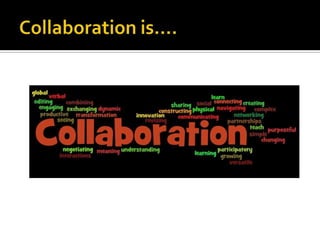
Collaboration is….
The Future of Teaching and Learning with CollaborationWeb 2.0 allows us to interact in ways we haven’t been able to interact in beforeDiscover new relationship, ideas, and subjectsSocial networking-allows  students to “learn more about specific subjects, to test out ideas and theories, to learn facts, and to gauge each other’s opinions” (http://mindshift.kqed.org/2011/02/three-trends-that-define-the-future-of-teaching-and-learning/)Focus on what we gain as a result of our collaborations
21 Things That Will Be Obsolete by 20201.Desks4. Homework6. Differentiated Instruction7. Fear of Wikipedia12. Centralized Institutions15. Paid/Outsourced Professional Development16. Current curricular norms 17. Parent-teacher conference nightFrom http://mindshift.kqed.org/2011/03/21-things-that-will-be-obsolete-by-2020/
Collaboration keeps businesses aliveCollaboration, Innovation, Education“Collaboration encourages the transcending of traditional boundaries used to atomise and separate teams, departments, business units and organisations; it interconnects artificial separations in business, encouraging sharing, creativity, empowerment and innovation.”--Giles Hutchins, global director for sustainability solutions at AtosFrom http://www.guardian.co.uk/sustainable-business/blog/biomimicry-business-transformation-collaboration
Collaboration in our schoolsCollaboration as a skillMust be taught, must be modeledReflect post secondary plans and include real world examplesCollaboration as a cultural normCreating a collaboration conducive environmentCollaboration on a variety of levelsStart small, think bigRelationships and networkingCollaborative experiences
Google Appshttp://www.google.com/apps/intl/en/edu/collaboration.htmlUsing Google Docs for Classroom Instruction, blog by Philip Greenspun of MITGoogle Apps Lesson Plans
Google AppsGoogle DocsGroups can edit documents together, commenting to one anotherEasy to embed PrivacyWorks with any operating systemDocument, Presentation, Form, Drawing, TableUses in K-12 education? Uses in higher ed? Uses in business world?
Google AppsGoogle SitesTeam managed web sitesUse as e-portfoliosEasy way to create and manage web pages in the education environment
Google AppsGoogle GroupsSet mailing lists, share documents, web pages and calendarsEach group has a common e-mail address for sharing/editing purposes
More on collaborationhttp://del.icio.us/kmorrow/collaboration?&page=2http://www.edutopia.org/collaboration-agehttp://cooltoolsforschools.wikispaces.com/Collaborative+Tools

Teaching and learning collaboratively

  • 1.
    Teaching and LearningCollaborativelyGroup 4-Sara Bates
  • 2.
    How do wedefine collaboration?Collaboration 1.0Partner reading, playing nicely together,telephone calls, AOL and MSNCollaboration is not just cooperationCollaboration 2.0Learning is SOCIAL and learning is EVERYWHERENot my knowledge or your knowledge, but OUR knowledgeNetworking-relationships, ideas, knowledge
  • 3.
  • 4.
    The Future ofTeaching and Learning with CollaborationWeb 2.0 allows us to interact in ways we haven’t been able to interact in beforeDiscover new relationship, ideas, and subjectsSocial networking-allows students to “learn more about specific subjects, to test out ideas and theories, to learn facts, and to gauge each other’s opinions” (http://mindshift.kqed.org/2011/02/three-trends-that-define-the-future-of-teaching-and-learning/)Focus on what we gain as a result of our collaborations
  • 5.
    21 Things ThatWill Be Obsolete by 20201.Desks4. Homework6. Differentiated Instruction7. Fear of Wikipedia12. Centralized Institutions15. Paid/Outsourced Professional Development16. Current curricular norms 17. Parent-teacher conference nightFrom http://mindshift.kqed.org/2011/03/21-things-that-will-be-obsolete-by-2020/
  • 6.
    Collaboration keeps businessesaliveCollaboration, Innovation, Education“Collaboration encourages the transcending of traditional boundaries used to atomise and separate teams, departments, business units and organisations; it interconnects artificial separations in business, encouraging sharing, creativity, empowerment and innovation.”--Giles Hutchins, global director for sustainability solutions at AtosFrom http://www.guardian.co.uk/sustainable-business/blog/biomimicry-business-transformation-collaboration
  • 7.
    Collaboration in ourschoolsCollaboration as a skillMust be taught, must be modeledReflect post secondary plans and include real world examplesCollaboration as a cultural normCreating a collaboration conducive environmentCollaboration on a variety of levelsStart small, think bigRelationships and networkingCollaborative experiences
  • 8.
    Google Appshttp://www.google.com/apps/intl/en/edu/collaboration.htmlUsing GoogleDocs for Classroom Instruction, blog by Philip Greenspun of MITGoogle Apps Lesson Plans
  • 9.
    Google AppsGoogle DocsGroupscan edit documents together, commenting to one anotherEasy to embed PrivacyWorks with any operating systemDocument, Presentation, Form, Drawing, TableUses in K-12 education? Uses in higher ed? Uses in business world?
  • 10.
    Google AppsGoogle SitesTeammanaged web sitesUse as e-portfoliosEasy way to create and manage web pages in the education environment
  • 11.
    Google AppsGoogle GroupsSetmailing lists, share documents, web pages and calendarsEach group has a common e-mail address for sharing/editing purposes
  • 12.