Network Security
(ITEC4111)
Lecture-01-03
Network Security-
An Introduction
Course Instructor: Hafeez Ahmed
University of Education Lahore (Multan campus)
Administrative
• Instructor
• Hafeez Ahmed, Visiting lecturer
• MS-EE (Wireless Communications)
• PhD (Information Security)- In progress…
• Communication
• Google Class Room (GCR) Joining code- jxzbfiv
• https://classroom.google.com/c/MzUzMzU4NzE5NjY5?cjc=jxzbfiv
• Email: hafeezahmad.vf@ue.edu.pk
• Whatsapp Class Group: +92-300-6611638
University of Education Lahore (Multan campus)
Class Format
• Meet two times a week
• Online classes on GCR
• https://classroom.google.com/c/MzUzMzU4NzE5NjY5?cjc=jxzbfiv
• GCR Code: jxzbfiv
• Mostly lecture format
– Will attempt to have a class exercise. Will be noted on GCR.
– Will attempt to make this relevant for online mode too.
• Lectures video taped for online classes
– All have access to tapes. Link on GCR.
• Posted slides not sufficient to master material alone
University of Education Lahore (Multan campus)
Class Readings
• Text Book- Computer Security: Art and Science by Matt Bishop 2nd
edition
• Reference Book: Cryptography and Network Security Principles
and Practice by William Stallings 6th Edition
• Additional readings shall be provided via GCR or email
University of Education Lahore (Multan campus)
Grading Policy
• Mid term exam- 20%
• Quiz- 3~ 5%
• Assignment- 3~ 5 %
• Final Project Presentation 5 %
• Attendance and participation* 5 %
• Final term exam 60%
University of Education Lahore (Multan campus)
Security- Definition
The protection afforded to an automated information
system in order to attain the applicable objectives of
preserving the confidentiality, integrity and availability
of information system resources (includes hardware,
software, firmware, information/data, and
telecommunications).
University of Education Lahore (Multan campus)
Security Components- CIA triad
• Confidentiality
– Keeping data and resources hidden
– To be secured, information needs to be hidden from unauthorized access
• Integrity
– Data integrity (integrity) & Origin integrity (authentication)
– protected from unauthorized change
• Availability
– Enabling access to data and resources
– available to an authorized entity when it is needed
University of Education Lahore (Multan campus)
e-Voting Machine (EVM)- A case study
University of Education Lahore (Multan campus)
Expectations of Voting
•Vote is by secret ballot
•The vote should be correctly tallied; all votes
cast should be counted in the election
•Every eligible voter who presents
themselves at the polling place should be
able to vote
University of Education Lahore (Multan campus)
Confidentiality
Integrity
Availability
Threat Terms
• Threat – Set of circumstances that has the potential to cause loss or
harm. Or a potential violation of security.
• Vulnerability – Weakness in the system that could be exploited to
cause loss or harm
• Attack – When an entity exploits a vulnerability on system
• Control – A means to prevent a vulnerability from being exploited
University of Education Lahore (Multan campus)
Classes of Threats
• Disclosure – Unauthorized access to information
• Deception – Acceptance of false data
• Disruption – Interruption or prevention of correct
operation
• Usurpation – Unauthorized control of some part of a
system
University of Education Lahore (Multan campus)
Some Common Threats
• Snooping
– Unauthorized interception of information
• Modification or alteration
– Unauthorized change of information
• Masquerading or Spoofing
– An impersonation of one entity by another
• Repudiation of origin
– A false denial that an entity sent or created something.
• Denial of receipt
– A false denial that an entity received some information.
University of Education Lahore (Multan campus)
More Common Threats
• Delay
– A temporary inhibition of service
• Denial of Service
– A long-term inhibition of service
University of Education Lahore (Multan campus)
Taxonomy of attacks with relation to security goals
University of Education Lahore (Multan campus)
More Definitions
• Policy
– A statement of what is and what is not allowed
– Divides the world into secure and non-secure states
– A secure system starts in a secure state. All transitions keep it in a
secure state.
• Mechanism
– A method, tool, or procedure for enforcing a security policy
University of Education Lahore (Multan campus)
Assurance
• Evidence of how much to trust a system
• Evidence can include:
– System specifications
– Design
– Implementation
• Mappings between the levels
University of Education Lahore (Multan campus)
An example- Aspirin Assurance
• Why do you trust Aspirin from a major manufacturer?
– FDA certifies the aspirin recipe
– Factory follows manufacturing standards
– Safety seals
• Analogy to software assurance
University of Education Lahore (Multan campus)
The OSI security architecture
• ITU-T Recommendation: X.800, Security Architecture for OSI,
defines systematic approach.
• The OSI security architecture is useful to managers as a way of
organizing the task of providing security.
• The OSI security architecture focuses on:
• 1. Security attacks,
• 2. Mechanisms, and
• 3. Services.
University of Education Lahore (Multan campus)
The OSI security architecture
• Security attack: Any action that compromises the security of
information owned by an organization.
• Security mechanism: A process (or a device incorporating such a
process) that is designed to detect, prevent, or recover from a security
attack.
• Security service: A processing or communication service that
enhances the security of the data processing systems and the
information transfers of an organization. The services are intended to
counter security attacks, and they make use of one or more security
mechanisms to provide the service.
University of Education Lahore (Multan campus)
Security Attacks
• Active attack- An active attack attempts to alter system resources or
affect their operation.
• Passive attack- A passive attack attempts to learn or make use of
information from the system but does not affect system resources.
University of Education Lahore (Multan campus)
Active Attack Passive Attack
Attacker needs to have physical control of the
media or network.
Attacker merely needs to observe the
communication in the media or network.
It can be easily detected. It cannot be easily detected.
It affects the system. It does not affect the system.
It involves a modification of data. It involves the monitoring of data.
Types of active attacks are Masquerade,
session replay, denial of service, distributed
denial of service.
Types of passive attacks are the Release of a
message, traffic analysis.
It does not check for loopholes or
vulnerabilities.
It scans the ports and network in the search of
loopholes and vulnerabilities.
It is difficult to prevent network from active
attack.
Passive attacks can be prevented.
University of Education Lahore (Multan campus)
Network and Internet Security-
security violation
• 1. User A transmits a file to user B. The file contains sensitive
information (e.g., payroll records) that is to be protected from
disclosure. User C, who is not authorized to read the file, is able to
monitor the transmission and capture a copy of the file during its
transmission.
• 2. A network manager, D, transmits a message to a computer, E, under
its management. The message instructs computer E to update an
authorization file to include the identities of a number of new users
who are to be given access to that computer. User F intercepts the
message, alters its contents to add or delete entries, and then forwards
the message to computer E, which accepts the message as coming
from manager D and updates its authorization file accordingly.
University of Education Lahore (Multan campus)
Network and Internet Security-
security violation
• 3. Rather than intercept a message, user F constructs its own message with
the desired entries and transmits that message to computer E as if it had
come from manager D. Computer E accepts the message as coming from
manager D and updates its authorization file accordingly.
• 4. An employee is fired without warning. The personnel manager sends a
message to a server system to invalidate the employee’s account. When the
invalidation is accomplished, the server is to post a notice to the employee’s
file as confirmation of the action. The employee is able to intercept the
message and delay it long enough to make a final access to the server to
retrieve sensitive information. The message is then forwarded, the action
taken, and the confirmation posted. The employee’s action may go
unnoticed for some considerable time.
University of Education Lahore (Multan campus)
Network and Internet Security-
security violation
• 5. A message is sent from a customer to a stockbroker with
instructions for various transactions. Subsequently, the investments
lose value and the customer denies sending the message.
• Although this list by no means exhausts the possible types of network
security violations, it illustrates the range of concerns of network
security.
University of Education Lahore (Multan campus)
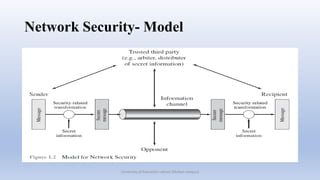
Network Security- Model
University of Education Lahore (Multan campus)
Key Points
• Must look at the big picture when securing a system
• Main components of security
– Confidentiality
– Integrity
– Availability
• Differentiating Threats, Vulnerabilities, Attacks and Controls
• Policy vs mechanism
• Assurance
University of Education Lahore (Multan campus)
Exercise Problem:
Consider an automated teller machine (ATM) in which users provide a personal
identification number (PIN) and a card for account access. Give examples of
confidentiality, integrity, and availability requirements associated with the
system and, in each case, indicate the degree of importance of the requirement.
University of Education Lahore (Multan campus)
End of Lecture, Thanks!
Queries?

Network Security- Lecture-01-03-1.pdf

  • 1.
    Network Security (ITEC4111) Lecture-01-03 Network Security- AnIntroduction Course Instructor: Hafeez Ahmed University of Education Lahore (Multan campus)
  • 2.
    Administrative • Instructor • HafeezAhmed, Visiting lecturer • MS-EE (Wireless Communications) • PhD (Information Security)- In progress… • Communication • Google Class Room (GCR) Joining code- jxzbfiv • https://classroom.google.com/c/MzUzMzU4NzE5NjY5?cjc=jxzbfiv • Email: hafeezahmad.vf@ue.edu.pk • Whatsapp Class Group: +92-300-6611638 University of Education Lahore (Multan campus)
  • 3.
    Class Format • Meettwo times a week • Online classes on GCR • https://classroom.google.com/c/MzUzMzU4NzE5NjY5?cjc=jxzbfiv • GCR Code: jxzbfiv • Mostly lecture format – Will attempt to have a class exercise. Will be noted on GCR. – Will attempt to make this relevant for online mode too. • Lectures video taped for online classes – All have access to tapes. Link on GCR. • Posted slides not sufficient to master material alone University of Education Lahore (Multan campus)
  • 4.
    Class Readings • TextBook- Computer Security: Art and Science by Matt Bishop 2nd edition • Reference Book: Cryptography and Network Security Principles and Practice by William Stallings 6th Edition • Additional readings shall be provided via GCR or email University of Education Lahore (Multan campus)
  • 5.
    Grading Policy • Midterm exam- 20% • Quiz- 3~ 5% • Assignment- 3~ 5 % • Final Project Presentation 5 % • Attendance and participation* 5 % • Final term exam 60% University of Education Lahore (Multan campus)
  • 6.
    Security- Definition The protectionafforded to an automated information system in order to attain the applicable objectives of preserving the confidentiality, integrity and availability of information system resources (includes hardware, software, firmware, information/data, and telecommunications). University of Education Lahore (Multan campus)
  • 7.
    Security Components- CIAtriad • Confidentiality – Keeping data and resources hidden – To be secured, information needs to be hidden from unauthorized access • Integrity – Data integrity (integrity) & Origin integrity (authentication) – protected from unauthorized change • Availability – Enabling access to data and resources – available to an authorized entity when it is needed University of Education Lahore (Multan campus)
  • 8.
    e-Voting Machine (EVM)-A case study University of Education Lahore (Multan campus)
  • 9.
    Expectations of Voting •Voteis by secret ballot •The vote should be correctly tallied; all votes cast should be counted in the election •Every eligible voter who presents themselves at the polling place should be able to vote University of Education Lahore (Multan campus) Confidentiality Integrity Availability
  • 10.
    Threat Terms • Threat– Set of circumstances that has the potential to cause loss or harm. Or a potential violation of security. • Vulnerability – Weakness in the system that could be exploited to cause loss or harm • Attack – When an entity exploits a vulnerability on system • Control – A means to prevent a vulnerability from being exploited University of Education Lahore (Multan campus)
  • 11.
    Classes of Threats •Disclosure – Unauthorized access to information • Deception – Acceptance of false data • Disruption – Interruption or prevention of correct operation • Usurpation – Unauthorized control of some part of a system University of Education Lahore (Multan campus)
  • 12.
    Some Common Threats •Snooping – Unauthorized interception of information • Modification or alteration – Unauthorized change of information • Masquerading or Spoofing – An impersonation of one entity by another • Repudiation of origin – A false denial that an entity sent or created something. • Denial of receipt – A false denial that an entity received some information. University of Education Lahore (Multan campus)
  • 13.
    More Common Threats •Delay – A temporary inhibition of service • Denial of Service – A long-term inhibition of service University of Education Lahore (Multan campus)
  • 14.
    Taxonomy of attackswith relation to security goals University of Education Lahore (Multan campus)
  • 15.
    More Definitions • Policy –A statement of what is and what is not allowed – Divides the world into secure and non-secure states – A secure system starts in a secure state. All transitions keep it in a secure state. • Mechanism – A method, tool, or procedure for enforcing a security policy University of Education Lahore (Multan campus)
  • 16.
    Assurance • Evidence ofhow much to trust a system • Evidence can include: – System specifications – Design – Implementation • Mappings between the levels University of Education Lahore (Multan campus)
  • 17.
    An example- AspirinAssurance • Why do you trust Aspirin from a major manufacturer? – FDA certifies the aspirin recipe – Factory follows manufacturing standards – Safety seals • Analogy to software assurance University of Education Lahore (Multan campus)
  • 18.
    The OSI securityarchitecture • ITU-T Recommendation: X.800, Security Architecture for OSI, defines systematic approach. • The OSI security architecture is useful to managers as a way of organizing the task of providing security. • The OSI security architecture focuses on: • 1. Security attacks, • 2. Mechanisms, and • 3. Services. University of Education Lahore (Multan campus)
  • 19.
    The OSI securityarchitecture • Security attack: Any action that compromises the security of information owned by an organization. • Security mechanism: A process (or a device incorporating such a process) that is designed to detect, prevent, or recover from a security attack. • Security service: A processing or communication service that enhances the security of the data processing systems and the information transfers of an organization. The services are intended to counter security attacks, and they make use of one or more security mechanisms to provide the service. University of Education Lahore (Multan campus)
  • 20.
    Security Attacks • Activeattack- An active attack attempts to alter system resources or affect their operation. • Passive attack- A passive attack attempts to learn or make use of information from the system but does not affect system resources. University of Education Lahore (Multan campus)
  • 21.
    University of EducationLahore (Multan campus) Active Attack Passive Attack Attacker needs to have physical control of the media or network. Attacker merely needs to observe the communication in the media or network. It can be easily detected. It cannot be easily detected. It affects the system. It does not affect the system. It involves a modification of data. It involves the monitoring of data. Types of active attacks are Masquerade, session replay, denial of service, distributed denial of service. Types of passive attacks are the Release of a message, traffic analysis. It does not check for loopholes or vulnerabilities. It scans the ports and network in the search of loopholes and vulnerabilities. It is difficult to prevent network from active attack. Passive attacks can be prevented.
  • 22.
    University of EducationLahore (Multan campus)
  • 23.
    University of EducationLahore (Multan campus)
  • 24.
    University of EducationLahore (Multan campus)
  • 25.
    Network and InternetSecurity- security violation • 1. User A transmits a file to user B. The file contains sensitive information (e.g., payroll records) that is to be protected from disclosure. User C, who is not authorized to read the file, is able to monitor the transmission and capture a copy of the file during its transmission. • 2. A network manager, D, transmits a message to a computer, E, under its management. The message instructs computer E to update an authorization file to include the identities of a number of new users who are to be given access to that computer. User F intercepts the message, alters its contents to add or delete entries, and then forwards the message to computer E, which accepts the message as coming from manager D and updates its authorization file accordingly. University of Education Lahore (Multan campus)
  • 26.
    Network and InternetSecurity- security violation • 3. Rather than intercept a message, user F constructs its own message with the desired entries and transmits that message to computer E as if it had come from manager D. Computer E accepts the message as coming from manager D and updates its authorization file accordingly. • 4. An employee is fired without warning. The personnel manager sends a message to a server system to invalidate the employee’s account. When the invalidation is accomplished, the server is to post a notice to the employee’s file as confirmation of the action. The employee is able to intercept the message and delay it long enough to make a final access to the server to retrieve sensitive information. The message is then forwarded, the action taken, and the confirmation posted. The employee’s action may go unnoticed for some considerable time. University of Education Lahore (Multan campus)
  • 27.
    Network and InternetSecurity- security violation • 5. A message is sent from a customer to a stockbroker with instructions for various transactions. Subsequently, the investments lose value and the customer denies sending the message. • Although this list by no means exhausts the possible types of network security violations, it illustrates the range of concerns of network security. University of Education Lahore (Multan campus)
  • 28.
    Network Security- Model Universityof Education Lahore (Multan campus)
  • 29.
    Key Points • Mustlook at the big picture when securing a system • Main components of security – Confidentiality – Integrity – Availability • Differentiating Threats, Vulnerabilities, Attacks and Controls • Policy vs mechanism • Assurance University of Education Lahore (Multan campus)
  • 30.
    University of EducationLahore (Multan campus) Exercise Problem: Consider an automated teller machine (ATM) in which users provide a personal identification number (PIN) and a card for account access. Give examples of confidentiality, integrity, and availability requirements associated with the system and, in each case, indicate the degree of importance of the requirement.
  • 31.
    University of EducationLahore (Multan campus) End of Lecture, Thanks! Queries?