UNIT-1-OVERVIEW
1.1 Computer securityconcepts
1.2 The OSI security architecture
1.3 Security attacks
1.4 Security services
1.5 Security mechanisms
1.6 A model for network security
1.7 Classical encryption techniques: Symmetric cipher model
1.8 Substitution techniques
1.9 Transposition techniques
1.10 Rotor machines
1.11 Steganography
1.1 COMPUTER SECURITY CONCEPTS
A Definition Of Computer Security
These three concepts form what is often referred to as the CIA triad (Figure 1.1). The
three concepts embody the fundamental security objectives for both data and for information
and computing services. FIPS PUB 199 provides a useful characterization of these three
objectives in terms of requirements and the definition of a loss of security in each category:
• Confidentiality (covers both data confidentiality and privacy): preserving authorized
restrictions on information access and disclosure, including means for protecting personal
privacy and proprietary information. A loss of confidentiality is the unauthorized disclosure
of information.
• Integrity (covers both data and system integrity): Guarding against improper information
modification or destruction, and includes ensuring information non-repudiation and
authenticity. A loss of integrity is the unauthorized modification or destruction of
information.
• Availability: Ensuring timely and reliable access to and use of information. A loss of
availability is the disruption of access to or use of information or an information system.
Although the use of the CIA triad to define security objectives is well established, some in the
security field feel that additional concepts are needed to present a complete picture. Two of
the most commonly mentioned are:
2.
• Authenticity: Theproperty of being genuine and being able to be verified and trusted;
confidence in the validity of a transmission, a message, or message originator.
• Accountability: The security goal that generates the requirement for actions of an entity to
be traced uniquely to that entity.
1.1.1 The challenges of computer security
1. The major requirements for security services can be given self-explanatory, one-word
labels: confidentiality, authentication, nonrepudiation, or integrity.
2. In developing a particular security mechanism or algorithm, one must always consider
potential attacks on those security features.
3. When the various aspects of the thread are considered that elaborate security mechanisms
make sense.
4. It is necessary to decide where to use the security mechanisms, both in terms of physical
placement(at what points in a network) and in a logical sense(at what layer or layers of a
architecture such as TCP/IP)
5. Security mechanism typically involve more than a particular algorithm or protocol.
6. Computer and network security is essentially a battle of wits between a attackers and the
designer/ administrator.
7. Security requires regular, even constant, monitoring.
8. Security is still too often an afterthought to be incorporated into a system after the design is
complete rather than being an integral part of the design process.
9. Many users and even security administrator view strong security as an impediment to
efficient and user-friendly operation of an information system.
1.2 THE OSI SECURITY ARCHITECTURE
The OSI security architecture focuses on security attack, security mechanism , security service
3.
security attack:Any action that compromises the security of information owned by an
organization.
Security mechanism: A process that is designed to detect, prevent, or recover from a
security attack.
Security service: A processing or communication service that enhances the security of
the data processing systems and the information transfers of an organization.
1.3 SECURITY ATTACKS
A useful means of classifying security attacks, used both in X.800 and RFC 2828, is in terms of
passive attacks and active attacks. A passive attack attempts to learn or make use of information
from the system but does not affect system resources.
Passive attacks are in the nature of eavesdropping on, or monitoring of, transmissions. The goal of
the opponent is to obtain information that is being transmitted. Two types of passive attacks are:
release of message contents - as shown above in Stallings Figure 1.2a here
traffic analysis - monitor traffic flow to determine location and identity of communicating
hosts and could observe the frequency and length of messages being exchanged
These attacks are difficult to detect because they do not involve any alteration of the data.
ACTIVE ATTACKS
Active attacks involve some modification of the data stream or the creation of a false stream and
can be subdivided into four categories: masquerade, replay, modification of messages, and denial of
service:
• masquerade of one entity as some other
4.
• replay previousmessages (as shown above in Stallings Figure 1.3b)
• modify/alter (part of) messages in transit to produce an unauthorized effect
• denial of service - prevents or inhibits the normal use or management of communications
facilities
Active attacks present the opposite characteristics of passive attacks. Whereas passive attacks are
difficult to detect, measures are available to prevent their success. On the other hand, it is quite
difficult to prevent active attacks absolutely, because of the wide variety of potential physical,
software, and network vulnerabilities. Instead, the goal is to detect active attacks and to recover
from any disruption or delays caused by them.
1.4 SECURITY SERVICES
enhance security of data processing systems and information transfers of an
organization
intended to counter security attacks
using one or more security mechanisms
often replicates functions normally associated with physical documents
which, for example, have signatures, dates; need protection from disclosure, tampering, or
destruction; be notarized or witnessed; be recorded or licensed
Consider the role of a security service, and what may be required.
5.
Note both similaritiesand differences with traditional paper documents, which for example:
• have signatures & dates;
• need protection from disclosure, tampering, or destruction;
• may be notarized or witnessed;
• may be recorded or licensed
Security Services (X.800)
Authentication - assurance that communicating entity is the one claimed
have both peer-entity & data origin authentication
Access Control - prevention of the unauthorized use of a resource
Data Confidentiality –protection of data from unauthorized disclosure
Data Integrity - assurance that data received is as sent by an authorized entity
Non-Repudiation - protection against denial by one of the parties in a communication
Availability – resource accessible/usable
1.5 SECURITY MECHANISM
feature designed to detect, prevent, or recover from a security attack
no single mechanism that will support all services required
however one particular element underlies many of the security mechanisms in use:
cryptographic techniques
hence our focus on this topic
specific security mechanisms:
encipherment, digital signatures, access controls, data integrity, authentication
exchange, traffic padding, routing control, notarization
pervasive security mechanisms:
6.
trusted functionality,security labels, event detection, security audit trails, security
recovery
1.6 Model for Network Security
In considering the place of encryption, its useful to use the following two models from Stallings
section 1.6.
The first, illustrated in Figure models information being transferred from one party to another over
an insecure communications channel, in the presence of possible opponents. The two parties, who
are the principals in this transaction, must cooperate for the exchange to take place. They can use
an appropriate security transform (encryption algorithm), with suitable keys, possibly negotiated
using the presence of a trusted third party. Parts One through Four of this book concentrates on the
types of security mechanisms and services that fit into the model shown here.
Model for Network Access Security
The second, illustrated in Figure 1.5, model is concerned with controlled access to information
or resources on a computer system, in the presence of possible opponents. Here appropriate
controls are needed on the access to and within the system, to provide suitable security.
The security mechanisms needed to cope with unwanted access fall into two broad categories
(as shown in this figure).
7.
The first categorymight be termed a gatekeeper function. It includes password-based login
procedures that are designed to deny access to all but authorized users and screening logic that
is designed to detect and reject worms, viruses, and other similar attacks. Once either an
unwanted user or unwanted software gains access,
the second line of defense consists of a variety of internal controls that monitor activity and
analyze stored information in an attempt to detect the presence of unwanted intruders.
1.7 SYMMETRIC CIPHER MODEL
A symmetric encryption scheme has five ingredients
Plaintext: This is the original intelligible message or data that is fed into the algorithm as
input.
Encryption algorithm: The encryption algorithm performs various substitutions and
transformations on the plaintext.
Secret key: The secret key is also input to the encryption algorithm. The key is a value
independent of the plaintext and of the algorithm. The algorithm will produce a different
output depending on the specific key being used at the time. The exact substitutions and
transformations performed by the algorithm depend on the key.
Ciphertext: This is the scrambled message produced as output. It depends on the plaintext
and the secret key. For a given message, two different keys will produce two different
ciphertexts. The ciphertext is an apparently random stream of data and, as it stands, is
unintelligible.
Decryption algorithm: This is essentially the encryption algorithm run in reverse. It takes
the ciphertext and the secret key and produces the original plaintext.
There are two requirements for secure use of conventional encryption:
1. We need a strong encryption algorithm. At a minimum, we would like the algorithm to be
such that an opponent who knows the algorithm and has access to one or more ciphertexts
would be unable to decipher the ciphertext or figure out the key. This requirement is usually
stated in a stronger form: The opponent should be unable to decrypt ciphertext or discover the
8.
key even ifhe or she is in possession of a number of ciphertexts together with the plaintext
that produced each ciphertext.
2. Sender and receiver must have obtained copies of the secret key in a secure fashion and must
keep the key secure. If someone can discover the key and knows the algorithm, all
communication using this key is readable.
We assume that it is impractical to decrypt a message on the basis of the
ciphertext plus knowledge of the encryption/decryption algorithm. In other words, we do not need
to keep the algorithm secret; we need to keep only the key secret. This feature of symmetric
encryption is what makes it feasible for widespread use. The fact that the algorithm need not be
kept secret means that manufacturers can and have developed low-cost chip implementations of
data encryption algorithms. These chips are widely available and incorporated into a number of
products. With the use of symmetric encryption, the principal security problem is maintaining the
secrecy of the key.
Let us take a closer look at the essential elements of a symmetric encryp-tion scheme, using Figure
2.2. A source produces a message in plaintext, X = [X1, X2, ..... , XM]. The M elements of X are
letters in some finite alphabet. Traditionally, the alphabet usually consisted of the 26 capital
letters. Nowadays, the binary alphabet {0, 1} is typically used. For encryption, a key of the
form K = [K1, K2, ..... , KJ] is generated. If the key is generated at the message source, then it must
also be provided to the destination by means of some secure chan-nel. Alternatively, a third party
could generate the key and securely deliver it to both source and destination.
With the message X and the encryption key K as input, the encryption algo-rithm forms the
ciphertext Y = [Y1, Y2, ..... , YN]. We can write this as
9.
Y = E(K,X)
This notation indicates that Y is produced by using encryption algorithm E as a function of the
plaintext X , with the specific function determined by the value of the key K .
The intended receiver, in possession of the key, is able to invert the transformation:
X = D(K, Y)
Cryptography
Cryptographic systems are characterized along three independent dimensions:
1. The type of operations used for transforming plaintext to ciphertext. All encryption
algorithms are based on two general principles: substitution, in which each element in the plaintext
(bit, letter, group of bits or letters) is mapped into another element, and transposition, in which
elements in the plaintext are rearranged. The fundamental requirement is that no informa-tion be
lost (that is, that all operations are reversible). Most systems, referred to as product systems,
involve multiple stages of substitutions and transpositions.
2. The number of keys used. If both sender and receiver use the same key, the system is
referred to as symmetric, single-key, secret-key, or conventional encryp-tion. If the sender and
receiver use different keys, the system is referred to as asymmetric, two-key, or public-key
encryption.
3. The way in which the plaintext is processed. A block cipher processes the input one block
of elements at a time, producing an output block for each input block. A stream cipher processes
the input elements continuously, producing output one element at a time, as it goes along.
Cryptanalysis and Brute-Force Attack
Typically, the objective of attacking an encryption system is to recover the key in use rather than
simply to recover the plaintext of a single ciphertext. There are two gen-eral approaches to
attacking a conventional encryption scheme:
Cryptanalysis: Cryptanalytic attacks rely on the nature of the algorithm plus perhaps some
knowledge of the general characteristics of the plaintext or even some sample plaintext–ciphertext
pairs. This type of attack exploits the characteristics of the algorithm to attempt to deduce a
specific plaintext or to deduce the key being used.
Brute-force attack: The attacker tries every possible key on a piece of cipher-text until an
intelligible translation into plaintext is obtained. On average, half of all possible keys must be tried
to achieve success.
10.
If either typeof attack succeeds in deducing the key, the effect is catastrophic: All future and past
messages encrypted with that key are compromised.
We first consider cryptanalysis and then discuss brute-force attacks.
Table 2.1 summarizes the various types of cryptanalytic attacks based on the amount of
information known to the cryptanalyst. The most difficult problem is pre-sented when all that is
available is the ciphertext only. In some cases, not even the encryption algorithm is known, but in
general, we can assume that the opponent does know the algorithm used for encryption. One
possible attack under these circumstances is the brute-force approach of trying all possible keys. If
the key space is very large, this becomes impractical. Thus, the opponent must rely on an analysis
of the ciphertext itself, generally applying various statistical tests to it. To use this approach, the
opponent must have some general idea of the type of plaintext that is concealed, such as English or
French text, an EXE file, a Java source listing, an accounting file, and so on.
The ciphertext-only attack is the easiest to defend against because the opponent has the least
amount of information to work with. In many cases, however, the analyst has more information.
The analyst may be able to capture one or more plaintext messages as well as their encryptions. Or
the analyst may know that certain plaintext patterns will appear in a message. For example, a file
11.
that is encodedin the Postscript format always begins with the same pattern, or there may be a
standardized header or banner to an electronic funds transfer message, and so on. All these are
examples of known plaintext. With this knowledge, the analyst may be able to deduce the key on
the basis of the way in which the known plaintext is transformed.
Table 2.1 lists two other types of attack: chosen ciphertext and chosen text. These are less
commonly employed as cryptanalytic techniques but are nevertheless possible avenues of attack.
Only relatively weak algorithms fail to withstand a ciphertext-only attack. Generally, an
encryption algorithm is designed to withstand a known-plaintext attack.
Two more definitions are worthy of note. An encryption scheme is unconditionally secure if the
ciphertext generated by the scheme does not con-tain enough information to determine uniquely
the corresponding plaintext, no matter how much ciphertext is available. That is, no matter how
much time an opponent has, it is impossible for him or her to decrypt the ciphertext simply
because the required information is not there. With the exception of a scheme known as the one-
time pad (described later in this chapter), there is no encryp-tion algorithm that is unconditionally
secure. Therefore, all that the users of an encryption algorithm can strive for is an algorithm that
meets one or both of the following criteria:
• The cost of breaking the cipher exceeds the value of the encrypted information.
• The time required to break the cipher exceeds the useful lifetime of the information.
An encryption scheme is said to be computationally secure if either of the foregoing two criteria
are met. Unfortunately, it is very difficult to estimate the amount of effort required to cryptanalyze
ciphertext successfully.
A brute-force attack involves trying every possible key until an intelligible translation of the
ciphertext into plaintext is obtained. On average, half of all possible keys must be tried to achieve
success. Table 2.2 shows how much time is involved for various key spaces.
12.
1.8 SUBSTITUTION TECHNIQUES
Inthis section and the next, we examine a sampling of what might be called classical encryption
techniques. A study of these techniques enables us to illustrate the basic approaches to symmetric
encryption used today and the types of cryptanalytic attacks that must be anticipated.
The two basic building blocks of all encryption techniques are substitution and transposition. We
examine these in the next two sections. Finally, we discuss a system that combines both
substitution and transposition.
A substitution technique is one in which the letters of plaintext are replaced by other letters or by
numbers or symbols. If the plaintext is viewed as a sequence of bits, then substitution involves
replacing plaintext bit patterns with ciphertext bit patterns.
Caesar Cipher
The earliest known, and the simplest, use of a substitution cipher was by Julius Caesar. The Caesar
cipher involves replacing each letter of the alphabet with the letter standing three places further
down the alphabet. For example,
Plain: meet me after the toga party
Cipher: PHHW PH DIWHU WKH WRJD SDUWB
Note that the alphabet is wrapped around, so that the letter following Z is A. We can define the
transformation by listing all possibilities, as follows:
Plain: a b c d e f g h i j k l m n o p q r s t u v w x y z
cipher: D E F G H I J K L M N O P Q R S T U V W X Y Z A B C
Let us assign a numerical equivalent to each letter:
Then the algorithm can be expressed as follows. For each plaintext letter p, substitute the
ciphertext letter C:2
C = E(3, p) = (p + 3) mod 26
A shift may be of any amount, so that the general Caesar algorithm is
C = E(k, p) = (p + k) mod 26 (2.1)
13.
where k takeson a value in the range 1 to 25. The decryption algorithm is simply
p = D(k, C) = (C - k) mod 26 (2.2)
If it is known that a given ciphertext is a Caesar cipher, then a brute-force cryptanalysis is easily
performed: simply try all the 25 possible keys. Figure 2.3 shows the results of applying this
strategy to the example ciphertext. In this case, the plaintext leaps out as occupying the third line.
Three important characteristics of this problem enabled us to use a brute-force cryptanalysis:
The encryption and decryption algorithms are known.
There are only 25 keys to try.
The language of the plaintext is known and easily recognizable.
In most networking situations, we can assume that the algorithms are known. What generally
makes brute-force cryptanalysis impractical is the use of an algorithm that employs a large number
of keys. For example, the triple DES algorithm, examined in Chapter 6, makes use of a 168-bit
key, giving a key space of 2168 or greater than 3.7 * 1050 possible keys.
Monoalphabetic Ciphers
With only 25 possible keys, the Caesar cipher is far from secure. A dramatic increase in the key
space can be achieved by allowing an arbitrary substitution. Before proceeding, we define the
term permutation. A permutation of a finite set of elements S is an ordered sequence of all the
elements of S, with each element appearing exactly once. For example, if S = {a, b, c}, there are
six permutations of S:
abc, acb, bac, bca, cab, cba
In general, there are n! permutations of a set of n elements, because the first element can be chosen
in one of n ways, the second in n - 1 ways, the third in n - 2 ways, and so on.
Recall the assignment for the Caesar cipher:
plain: a b c d e f g h i j k l m n o p q r s t u v w x y z
cipher: D E F G H I J K L M N O P Q R S T U V W X Y Z A B C
If, instead, the “cipher” line can be any permutation of the 26 alphabetic characters, then there are
26! or greater than 4 * 1026 possible keys. This is 10 orders of magnitude greater than the key
space for DES and would seem to eliminate brute-force techniques for cryptanalysis. Such an
approach is referred to as a monoalphabetic substitution cipher, because a single cipher alphabet
(mapping from plain alphabet to cipher alphabet) is used per message.
14.
There is, however,another line of attack. If the cryptanalyst knows the nature of the plaintext
(e.g., noncompressed English text), then the analyst can exploit the regularities of the language.
The ciphertext to be solved is
UZQSOVUOHXMOPVGPOZPEVSGZWSZOPFPESXUDBMETSXAIZ
VUEPHZHMDZSHZOWSFPAPPDTSVPQUZWYMXUZUHSX
EPYEPOPDZSZUFPOMBZWPFUPZHMDJUDTMOHMQ
As a first step, the relative frequency of the letters can be determined and compared to a standard
frequency distribution for English, such as is shown in Figure 2.5 (based on [LEWA00]). If the
message were long enough, this technique alone might be sufficient, but because this is a relatively
short message, we cannot expect an exact match. In any case, the relative frequencies of the letters
in the ciphertext (in percentages) are as follows:
15.
Comparing this breakdownwith Figure 2.5, it seems likely that cipher letters P and Z are the
equivalents of plain letters e and t, but it is not certain which is which. The letters S, U, O, M, and
H are all of relatively high frequency and probably correspond to plain letters from the set {a, h, i,
n, o, r, s}. The letters with the lowest frequencies (namely, A, B, G, Y, I, J) are likely included in
the set {b, j, k, q, v, x, z}.
There are a number of ways to proceed at this point. We could make some tentative assignments
and start to fill in the plaintext to see if it looks like a reasonable “skeleton” of a message. A more
systematic approach is to look for other regularities. For example, certain words may be known to
be in the text. Or we could look for repeating sequences of cipher letters and try to deduce their
plaintext equivalents.
A powerful tool is to look at the frequency of two-letter combinations, known as digrams. A table
similar to Figure 2.5 could be drawn up showing the relative frequency of digrams. The most
common such digram is th. In our ciphertext, the most common digram is ZW, which appears
three times. So we make the correspondence of Z with t and W with h. Then, by our earlier
hypothesis, we can equate P with e. Now notice that the sequence ZWP appears in the ciphertext,
and we can translate that sequence as “the.” This is the most frequent trigram (three-letter
combination) in English, which seems to indicate that we are on the right track.
Next, notice the sequence ZWSZ in the first line. We do not know that these four letters form a
complete word, but if they do, it is of the form th_t. If so, S equates with a.
So far, then, we have
Only four letters have been identified, but already we have quite a bit of the message. Continued
analysis of frequencies plus trial and error should easily yield a solution from this point. The
complete plaintext, with spaces added between words, follows:
it was disclosed yesterday that several informal but direct contacts have been made with political
representatives of the viet cong in Moscow
Monoalphabetic ciphers are easy to break because they reflect the frequency data of the original
alphabet. A countermeasure is to provide multiple substitutes, known as homophones, for a single
letter. For example, the letter e could be assigned a number of different cipher symbols, such as
16, 74, 35, and 21, with each homophone assigned to a letter in rotation or randomly. If the
16.
number of symbolsassigned to each letter is proportional to the relative frequency of that letter,
then single-letter frequency information is completely obliterated. The great mathematician
Carl Friedrich Gauss believed that he had devised an unbreakable cipher using homo-phones.
However, even with homophones, each element of plaintext affects only one element of
ciphertext, and multiple-letter patterns (e.g., digram frequencies) still survive in the ciphertext,
making cryptanalysis relatively straightforward.
Playfair Cipher
The best-known multiple-letter encryption cipher is the Playfair, which treats digrams in the
plaintext as single units and translates these units into ciphertext digrams.
The Playfair algorithm is based on the use of a 5 x 5 matrix of letters con-structed using a
keyword. Here is an example, solved by Lord Peter Wimsey in Dorothy Sayers’s Have His
Carcase:
In this case, the keyword is monarchy. The matrix is constructed by filling in the letters of the
keyword (minus duplicates) from left to right and from top to bot-tom, and then filling in the
remainder of the matrix with the remaining letters in alphabetic order. The letters I and J count as
one letter. Plaintext is encrypted two letters at a time, according to the following rules:
1. Repeating plaintext letters that are in the same pair are separated with a filler letter, such as
x, so that balloon would be treated as ba lx lo on.
2. plaintext letters that fall in the same row of the matrix are each replaced by the letter to the
right, with the first element of the row circularly following the last. For example, ar is
encrypted as RM.
3. Two plaintext letters that fall in the same column are each replaced by the letter beneath,
with the top element of the column circularly following the last. For example, mu is
encrypted as CM.
4. Otherwise, each plaintext letter in a pair is replaced by the letter that lies in its own row and
the column occupied by the other plaintext letter. Thus, hs becomes BP and ea becomes IM
(or JM, as the encipherer wishes).
The Playfair cipher is a great advance over simple monoalphabetic ciphers. For one thing, whereas
there are only 26 letters, there are 26 x 26 = 676 digrams,
17.
that identification ofindividual digrams is more difficult. Furthermore, the relative frequencies of
individual letters exhibit a much greater range than that of digrams, making frequency analysis
much more difficult. For these reasons, the Playfair cipher was for a long time considered
unbreakable. It was used as the standard field system by the British Army in World War I and still
enjoyed considerable use by the U.S. Army and other Allied forces during World War II.
Despite this level of confidence in its security, the Playfair cipher is relatively easy to break,
because it still leaves much of the structure of the plaintext language intact. A few hundred letters
of ciphertext are generally sufficient.
Hill Cipher
Another interesting multiletter cipher is the Hill cipher, developed by the mathe-matician Lester
Hill in 1929.
CONCEPTS FROM LINEAR ALGEBRA Before describing the Hill cipher, let us briefly review
some terminology from linear algebra. In this discussion, we are concerned with matrix arithmetic
modulo 26. For the reader who needs a refresher on matrix multiplication and inversion, see
Appendix E.
We define the inverse M - 1 of a square matrix M by the equation M(M - 1) = M - 1M = I,
where I is the identity matrix. I is a square matrix that is all zeros except for ones along the main
diagonal from upper left to lower right. The inverse of a matrix does not always exist, but when it
does, it satisfies the preceding equation. For example,
To explain how the inverse of a matrix is computed, we begin by with the con-cept of determinant.
For any square matrix (m x m), the determinant equals the sum of all the products that can be
formed by taking exactly one element from each row and exactly one element from each column,
with certain of the product terms pre-ceded by a minus sign. For a 2 x 2 matrix,
18.
where C andP are row vectors of length 3 representing the plaintext and ciphertext, and K is a 3 *
3 matrix representing the encryption key. Operations are performed mod 26.
For example, consider the plaintext “paymoremoney” and use the encrypttion key
The first three letters of the plaintext are represented by the vector (15 0 24). Then (15 0 24)K =
(303 303 531) mod 26 = (17 17 11) = RRL. Continuing in this fash-ion, the ciphertext for the
entire plaintext is RRLMWBKASPDH.
Decryption requires using the inverse of the matrix K. We can compute det K = 23, and therefore,
(det K)-1 mod 26 = 17. We can then compute the inverse as
19.
It is easilyseen that if the matrix K - 1 is applied to the ciphertext, then the plaintext is recovered.
In general terms, the Hill system can be expressed as
C = E(K, P) = PK mod 26
P = D(K, C) = CK - 1 mod 26 = PKK - 1 = P
As with Playfair, the strength of the Hill cipher is that it completely hides single-letter frequencies.
Indeed, with Hill, the use of a larger matrix hides more fre-quency information. Thus, a 3 * 3 Hill
cipher hides not only single-letter but also two-letter frequency information.
Although the Hill cipher is strong against a ciphertext-only attack, it is easily broken with a known
plaintext attack. For an m * m Hill cipher, suppose we have m plaintext–ciphertext pairs, each of
length m. We label the pairs Pj = (p1j p1j ..... pmj) and Cj = (c1j c1j ..... cmj) such
that Cj = PjK for 1 „ j „ m and for some unknown key matrix K. Now define
two m * m matrices X = (pij) and Y = (cij) . Then we can form the matrix equation Y = XK.
If X has an inverse, then we can determine K = X - 1Y. If X is not invertible, then a new version
of X can be formed with additional plaintext–ciphertext pairs until an invertible X is obtained.
Consider this example. Suppose that the plaintext “hillcipher” is encrypted using a 2 * 2 Hill
cipher to yield the ciphertext HCRZSSXNSP. Thus, we know that
(7 8)K mod 26 = (7 2); (11 11)K mod 26 = (17 25); and so on. Using the first two plaintext–
ciphertext pairs, we have
20.
This result isverified by testing the remaining plaintext–ciphertext pairs.
Polyalphabetic Ciphers
Another way to improve on the simple monoalphabetic technique is to use different
monoalphabetic substitutions as one proceeds through the plaintext message. The general name for
this approach is polyalphabetic substitution cipher. All these tech-niques have the following
features in common:
1. A set of related monoalphabetic substitution rules is used.
2. A key determines which particular rule is chosen for a given transformation.
VIGENERE` CIPHER The best known, and one of the simplest, polyalphabetic ciphers is the
Vigenère cipher. In this scheme, the set of related monoalphabetic substitution rules consists of the
26 Caesar ciphers with shifts of 0 through 25. Each cipher is denoted by a key letter, which is the
ciphertext letter that substitutes for the plaintext letter a. Thus, a Caesar cipher with a shift of 3 is
denoted by the key value d.
We can express the Vigenère cipher in the following manner. Assume a sequence of plaintext
letters P = p0, p1, p2, ..... , pn - 1 and a key consisting of the sequence of letters K = k0, k1, k2, .....
, km - 1, where typically m < n. The sequence of ciphertext letters C = C0, C1, C2, ..... , Cn - 1 is
calculated as follows:
C = C0, C1, C2, ..... , Cn - 1 = E(K, P) = E[(k0, k1, k2, ..... , km - 1), (p0, p1, p2, ..... , pn - 1)]
= (p0 + k0) mod 26, (p1 + k1) mod 26, ..... , (pm - 1 + km - 1) mod 26,
(pm + k0) mod 26, (pm + 1 + k1) mod 26, ..... , (p2m - 1 + km - 1) mod 26, .....
Thus, the first letter of the key is added to the first letter of the plaintext, mod 26, the second letters
are added, and so on through the first m letters of the plaintext. For the next m letters of the
plaintext, the key letters are repeated. This process continues until all of the plaintext sequence is
encrypted. A general equation of the encryption process is
21.
Compare this withEquation (2.1) for the Caesar cipher. In essence, each plaintext character is
encrypted with a different Caesar cipher, depending on the corresponding key character. Similarly,
decryption is a generalization of Equation (2.2):
To encrypt a message, a key is needed that is as long as the message. Usually, the key is a
repeating keyword. For example, if the keyword is deceptive, the message “we are discovered save
yourself” is encrypted as
The strength of this cipher is that there are multiple ciphertext letters for each plaintext letter, one
for each unique letter of the keyword. Thus, the letter frequency information is obscured.
However, not all knowledge of the plaintext structure is lost. For example, Figure 2.6 shows the
frequency distribution for a Vigenère cipher with a keyword of length 9. An improvement is
achieved over the Playfair cipher, but considerable frequency information remains.
It is instructive to sketch a method of breaking this cipher, because the method reveals some of the
mathematical principles that apply in cryptanalysis.
First, suppose that the opponent believes that the ciphertext was encrypted using either
monoalphabetic substitution or a Vigenère cipher. A simple test can be made to make a
determination. If a monoalphabetic substitution is used, then the statistical properties of the
ciphertext should be the same as that of the language of the plaintext. Thus, referring to Figure 2.5,
there should be one cipher letter with a relative frequency of occurrence of about 12.7%, one with
about 9.06%, and so on. If only a single message is available for analysis, we would not expect an
exact match of this small sample with the statistical profile of the plain-text language.
Nevertheless, if the correspondence is close, we can assume a monoalphabetic substitution.
22.
If, on theother hand, a Vigenère cipher is suspected, then progress depends on determining the
length of the keyword, as will be seen in a moment. For now, let us con-centrate on how the
keyword length can be determined.The important insight that leads to a solution is the following:
If two identical sequences of plaintext letters occur at a dis-tance that is an integer multiple of the
keyword length, they will generate identical ciphertext sequences. In the foregoing example, two
instances of the sequence “red” are separated by nine character positions. Consequently, in both
cases, r is encrypted using key letter e, e is encrypted using key letter p, and d is encrypted using
key letter t. Thus, in both cases, the ciphertext sequence is VTW. We indicate this above by
underlining the relevant ciphertext letters and shading the relevant ciphertext numbers.
An analyst looking at only the ciphertext would detect the repeated sequences VTW at a
displacement of 9 and make the assumption that the keyword is either three or nine letters in
length. The appearance of VTW twice could be by chance and not reflect identical plaintext letters
encrypted with identical key letters. However, if the message is long enough, there will be a
number of such repeated ciphertext sequences. By looking for common factors in the
displacements of the various sequences, the analyst should be able to make a good guess of the
keyword length.
Solution of the cipher now depends on an important insight. If the keyword length is m, then the
cipher, in effect, consists of m monoalphabetic substitution ciphers. For example, with the
keyword DECEPTIVE, the letters in positions 1, 10, 19, and so on are all encrypted with the same
monoalphabetic cipher. Thus, we can use the known frequency characteristics of the plaintext
language to attack each of the monoalphabetic ciphers separately.
The periodic nature of the keyword can be eliminated by using a nonrepeating keyword that is as
long as the message itself. Vigenère proposed what is referred to as an autokey system, in which a
keyword is concatenated with the plaintext itself to provide a running key. For our example,
key: deceptivewearediscoveredsav
plaintext: wearediscoveredsaveyourself
ciphertext: ZICVTWQNGKZEIIGASXSTSLVVWLA
Even this scheme is vulnerable to cryptanalysis. Because the key and the plain-text share the same
frequency distribution of letters, a statistical technique can be applied. For example, e enciphered
by e, by Figure 2.5, can be expected to occur with a frequency of (0.127)2 L 0.016, whereas t
enciphered by t would occur only about half as often. These regularities can be exploited to
achieve successful cryptanalysis.
VERNAM CIPHER The ultimate defense against such a cryptanalysis is to choose a keyword that
is as long as the plaintext and has no statistical relationship to it. Such a system was introduced by
an AT&T engineer named Gilbert Vernam in 1918. His system works on binary data (bits) rather
than letters. The system can be expressed succinctly as follows (Figure 2.7):
23.
where
pi = ith binary digit of plaintext ki = ith binary digit of key
ci = ith binary digit of ciphertext
Compare this with Equation (2.3) for the Vigenère cipher.
Thus, the ciphertext is generated by performing the bitwise XOR of the plain-text and the key.
Because of the properties of the XOR, decryption simply involves the same bitwise operation:
which compares with Equation (2.4).
The essence of this technique is the means of construction of the key. Vernam proposed the use of
a running loop of tape that eventually repeated the key, so that in fact the system worked with a
very long but repeating keyword. Although such a scheme, with a long key, presents formidable
cryptanalytic diffi-culties, it can be broken with sufficient ciphertext, the use of known or probable
plaintext sequences, or both.
One-Time Pad
An Army Signal Corp officer, Joseph Mauborgne, proposed an improvement to the Vernam cipher
that yields the ultimate in security. Mauborgne suggested using a random key that is as long as the
message, so that the key need not be repeated. In addition, the key is to be used to encrypt and
24.
decrypt a singlemessage, and then is discarded. Each new message requires a new key of the same
length as the new mes-sage. Such a scheme, known as a one-time pad, is unbreakable. It produces
random output that bears no statistical relationship to the plaintext. Because the ciphertext contains
no information whatsoever about the plaintext, there is simply no way to break the code.
An example should illustrate our point. Suppose that we are using a Vigenère scheme with 27
characters in which the twenty-seventh character is the space character, but with a one-time key
that is as long as the message. Consider the ciphertext
ANKYODKYUREPFJBYOJDSPLREYIUNOFDOIUERFPLUYTS
We now show two different decryptions using two different keys:
ciphertext: ANKYODKYUREPFJBYOJDSPLREYIUNOFDOIUERFPLUYTS
key: pxlmvmsydofuyrvzwc tnlebnecvgdupahfzzlmnyih
plaintext: mr mustard with the candlestick in the hall
ciphertext: ANKYODKYUREPFJBYOJDSPLREYIUNOFDOIUERFPLUYTS
key: mfugpmiydgaxgoufhklllmhsqdqogtewbqfgyovuhwt
plaintext: miss scarlet with the knife in the library
Suppose that a cryptanalyst had managed to find these two keys. Two plausible plaintexts are
produced. How is the cryptanalyst to decide which is the correct decryption (i.e., which is the
correct key)? If the actual key were produced in a truly random fashion, then the cryptanalyst
cannot say that one of these two keys is more likely than the other. Thus, there is no way to decide
which key is correct and there-fore which plaintext is correct.
In fact, given any plaintext of equal length to the ciphertext, there is a key that produces that
plaintext. Therefore, if you did an exhaustive search of all possible keys, you would end up with
many legible plaintexts, with no way of knowing which was the intended plaintext. Therefore, the
code is unbreakable.
The security of the one-time pad is entirely due to the randomness of the key. If the stream of
characters that constitute the key is truly random, then the stream of characters that constitute the
ciphertext will be truly random. Thus, there are no patterns or regularities that a cryptanalyst can
use to attack the ciphertext.
In theory, we need look no further for a cipher. The one-time pad offers com-plete security but, in
practice, has two fundamental difficulties
25.
1. There isthe practical problem of making large quantities of random keys. Any heavily used
system might require millions of random characters on a regular basis. Supplying truly random
characters in this volume is a significant task.
2. Even more daunting is the problem of key distribution and protection. For every message to be
sent, a key of equal length is needed by both sender and receiver. Thus, a mammoth key
distribution problem exists.
Because of these difficulties, the one-time pad is of limited utility and is useful primarily for low-
bandwidth channels requiring very high security.
The one-time pad is the only cryptosystem that exhibits what is referred to as perfect secrecy.
1.9 TRANSPOSITION TECHNIQUES
All the techniques examined so far involve the substitution of a cipher text symbol for a plaintext
symbol. A very different kind of mapping is achieved by performing some sort of permutation on
the plaintext letters. This technique is referred to as a transposition cipher.
The simplest such cipher is the rail fence technique, in which the plaintext is written down as a
sequence of diagonals and then read off as a sequence of rows. For example, to encipher the
message “meet me after the toga party” with a rail fence of depth 2, we write the following:
m e m a t r h t g p r y
e t e f e t e o a a t
The encrypted message is
MEMATRHTGPRYETEFETEOAAT
This sort of thing would be trivial to cryptanalyze. A more complex scheme is to write the
message in a rectangle, row by row, and read the message off, column by column, but permute the
order of the columns. The order of the columns then becomes the key to the algorithm. For
example,
Thus, in this example, the key is 4312567. To encrypt, start with the column that is labeled 1, in
this case column 3. Write down all the letters in that column. Proceed to column 4, which is
labeled 2, then column 2, then column 1, then columns 5, 6, and 7.
26.
A pure transpositioncipher is easily recognized because it has the same letter frequencies as the
original plaintext. For the type of columnar transposition just shown, cryptanalysis is fairly
straightforward and involves laying out the ciphertext in a matrix and playing around with column
positions. Digram and trigram frequency tables can be useful.
The transposition cipher can be made significantly more secure by performing more than one stage
of transposition. The result is a more complex permutation that is not easily reconstructed. Thus, if
the foregoing message is reencrypted using the same algorithm,
To visualize the result of this double transposition, designate the letters in the original plaintext
message by the numbers designating their position. Thus, with 28 letters in the message, the
original sequence of letters is
01 02 03 04 05 06 07 08 09 10 11 12 13 14
15 16 17 18 19 20 21 22 23 24 25 26 27 28
After the first transposition, we have
03 10 17 24 04 11 18 25 02 09 16 23 01 08
15 22 05 12 19 26 06 13 20 27 07 14 21 28
which has a somewhat regular structure. But after the second transposition, we have
17 09 05 27 24 16 12 07 10 02 22 20 03 25
15 13 04 23 19 14 11 01 26 21 18 08 06 28
This is a much less structured permutation and is much more difficult to cryptanalyze.
1.10 ROTOR MACHINES
This is as true of substitution ciphers as it is of transposition ciphers. Before the introduction of
DES, the most important application of the principle of multiple stages of encryption was a class
of systems known as rotor machines.9
The basic principle of the rotor machine is illustrated in Figure 2.8. The machine consists of a set
of independently rotating cylinders through which electrical pulses can flow. Each cylinder has 26
input pins and 26 output pins, with internal wiring that connects each input pin to a unique output
pin. For simplicity, only three of the internal connections in each cylinder are shown.
27.
If we associateeach input and output pin with a letter of the alphabet, then a single cylinder
defines a monoalphabetic substitution. For example, in Figure 2.8, if an operator depresses the key
for the letter A, an electric signal is applied to the first pin of the first cylinder and flows through
the internal connection to the twenty-fifth output pin.
Consider a machine with a single cylinder. After each input key is depressed, the cylinder rotates
one position, so that the internal connections are shifted accordingly. Thus, a different
monoalphabetic substitution cipher is defined. After 26 letters of plaintext, the cylinder would be
back to the initial position. Thus, we have a poly-alphabetic substitution algorithm with a period of
26.
A single-cylinder system is trivial and does not present a formidable cryptana-lytic task. The
power of the rotor machine is in the use of multiple cylinders, in which the output pins of one
cylinder are connected to the input pins of the next. Figure 2.8 shows a three-cylinder system. The
left half of the figure shows a position in which the input from the operator to the first pin
(plaintext letter a) is routed through the three cylinders to appear at the output of the second pin
(ciphertext letter B).
With multiple cylinders, the one closest to the operator input rotates one pin position with each
keystroke. The right half of Figure 2.8 shows the system’s config-uration after a single keystroke.
For every complete rotation of the inner cylinder, the middle cylinder rotates one pin position.
Finally, for every complete rotation of the middle cylinder, the outer cylinder rotates one pin
position. This is the same type of operation seen with an odometer. The result is that there are 26 *
26 * 26 = 17,576 different substitution alphabets used before the system repeats. The addition of
fourth and fifth rotors results in periods of 456,976 and 11,881,376 letters, respectively. As David
Kahn eloquently put it, referring to a five-rotor machine [KAHN96, ]:
28.
A period ofthat length thwarts any practical possibility of a straightforward solution on the basis
of letter frequency. This general solution would need about 50 letters per cipher alphabet, meaning
that all five rotors would have to go through their com-bined cycle 50 times. The ciphertext would
have to be as long as all the speeches made on the floor of the Senate and the House of
Representatives in three successive sessions of Congress. No cryptanalyst is likely to bag that kind
of trophy in his lifetime; even diplomats, who can be as verbose as politicians, rarely scale those
heights of loquacity.
1.11 STEGANOGRAPHY
A plaintext message may be hidden in one of two ways. The methods of steganography conceal
the existence of the message, whereas the methods of cryptography render the message
unintelligible to outsiders by various transformations of the text.
A simple form of steganography, but one that is time-consuming to construct, is one in which an
arrangement of words or letters within an apparently innocuous text spells out the real message.
For example, the sequence of first letters of each word of the overall message spells out the hidden
message. Figure 2.9 shows an example in which a subset of the words of the overall message is
used to convey the hidden message. See if you can decipher this; it’s not too hard.
Character marking: Selected letters of printed or typewritten text are over-written in
pencil. The marks are ordinarily not visible unless the paper is held at an angle to bright
light.
Invisible ink: A number of substances can be used for writing but leave no visible trace
until heat or some chemical is applied to the paper.
Pin punctures: Small pin punctures on selected letters are ordinarily not visi-ble unless
the paper is held up in front of a light.
Typewriter correction ribbon: Used between lines typed with a black ribbon, the results
of typing with the correction tape are visible only under a strong light.
Advantage: It can be employed by parties who have something to lose should the fact of their
secret communication be discovered.
Drawbacks: it requires lot of overhead to hide a relatively few bits of information.
29.
UNIT II -BLOCKCIPHER AND DATA ENCRYPTION STANDARD
2.1 Block Cipher Principle
2.2 The Data Encryption Standard
2.3 The Strength Of DES
2.4 Differential And Linear Cryptanalysis
2.5 Block Cipher Design Principles
2.6 Advanced Encryption Standard: Finite Field Arithmetic
2.7 AES Structure
2.8 AES Transformation Function
2.9 AES Key Expansion
2.10 AES Implementation
2.1 Block cipher principle
Stream Ciphers and Block Ciphers
A stream cipher is one that encrypts a digital data stream one bit or one byte at a time. Examples of
classical stream ciphers are the autokeyed Vigenère cipher and the Vernam cipher. In the ideal case,
a one-time pad version of the Vernam cipher would be used (Figure 2.7), in which the keystream
(ki) is as long as the plaintext bit stream (pi). If the cryptographic keystream is random, then this
cipher is unbreakable by any means other than acquiring the keystream. However, the keystream
must be provided to both users in advance via some independent and secure channel. This
introduces insurmountable logistical problems if the intended data traffic is very large.
Accordingly, for practical reasons, the bit-stream generator must be implemented as an algorithmic
procedure, so that the cryptographic bit stream can be produced by both users. In this approach
(Figure 3.1a), the bit-stream generator is a key-controlled algorithm and must produce a bit stream
that is cryptographically strong. Now, the two users need only share the generating key, and each
can produce the keystream.
A block cipher is one in which a block of plaintext is treated as a whole and used to produce a
ciphertext block of equal length. Typically, a block size of 64 or 128 bits is used. As with a stream
cipher, the two users share a symmetric encryption key (Figure 3.1b). Using some of the modes of
operation explained in Chapter 6, a block cipher can be used to achieve the same effect as a stream
cipher.
Far more effort has gone into analyzing block ciphers. In general, they seem applicable to a broader
range of applications than stream ciphers. The vast majority of network-based symmetric
cryptographic applications make use of block ciphers. Accordingly, the concern in this chapter, and
in our discussions throughout the book of symmetric encryption, will primarily focus on block
ciphers.
Motivation for the Feistel Cipher Structure
30.
A block cipheroperates on a plaintext block of n bits to produce a
ciphertext block of n bits. There are 2n possible different plaintext blocks and, for the
encryption to be reversible (i.e., for decryption to be possible), each must
produce a unique ciphertext block. Such a transformation is called reversible, or nonsingular. The
following examples illustrate nonsingular and singular transfor- mations for n = 2.
In the latter case,a ciphertext of 01 could have been produced by one of two plain-
text blocks.So if we limit ourselves to reversible mappings,the numberof different
transformationsis2n!.2
Figure 3.2 illustrates the logic of a general substitution cipher for n = 4. A 4-bit input produces
one of 16 possible input states, which is mapped by the substitution cipher into a unique one of 16
possible output states, each of which is represented by 4 ciphertext bits. The encryption and
decryption mappings can be
31.
definedbyatabulation,asshowninTable3.1.Thisisthemostgeneralformofblock cipher andcan be
used to define any reversible mapping between
plaintext and ciphertext.Feistelreferstothisastheidealblockcipher,becauseitallowsforthemax-
imumnumberofpossibleencryptionmappingsfromtheplaintextblock[FEIS75].
But there is a practical problem with the ideal block cipher. If a small block
size,such as n = 4,is used,then the system is equivalent to a classical substitution cipher.Such syste
ms,as we have seen,are vulnerable to a statistical analysis of the plaintext. This weakness is not inh
erent in the use of a substitution cipher but rather results from the use of a small block size. If n is
sufficiently large and an arbitrary reversible substitution between plaintext and ciphertext is
allowed, then the statistical characteristics of the source plaintext are masked to such an extent that
this type of cryptanalysis isinfeasible.
An arbitrary reversible substitution cipher (the ideal block cipher) for alarge
blocksizeisnotpractical,however,fromanimplementationandperformancepoint
32.
of view.For sucha transformation, the mapping itself constitutes the key.Consider again Table 3.1,
which defines one particular reversible mapping from
plaintextto ciphertext for n = 4. The mapping can be defined by the entries in the second column,
which show the value of the ciphertext for each plaintext block. This, in essence, is the key that
determines the specific mapping from among all possible mappings. In this case, using this
straightforward method of defining the key, the required key length is (4 bits) * (16 rows) = 64 bits.
In general, foran n-bitideal block cipher,the length of the key defined in this fashion is n * 2n bits.
For a 64-bit block, which is a desirable length to thwart statistical attacks, the required key length
is 64 * 264 = 270 ~~ 1021 bits.
In considering these difficulties, Feistel points out that what is needed is an approximation to the
ideal block cipher system for large n, built up out of compo- nents that are easily realizable
[FEIS75]. But before turning to Feistel’s approach, let us make one other
observation. We could use the general
block substitution cipher but,tomakeitsimplementation tractable,confineourselves toasubset ofth
e 2n! possible reversible mappings. For example, suppose we define the mapping in
terms of a set of linear equations.In the case of n = 4,we have
y1 = k11x1 + k12x2 + k13x3 + k14x4 y2 = k21x1 + k22x2 + k23x3 + k24x4 y3 = k31x1 +
k32x2 + k33x3 + k34x4 y4 = k41x1 + k42x2 + k43x3 + k44x4
where the xi are the four binary digits of the plaintext block, the yi are the four binary digits of
the ciphertext block, the kij are the binary coefficients, and arith- metic is mod 2. The
key size is just n2, in this case 16 bits. The danger with this kind of formulation is that it may
be vulnerable to cryptanalysis by an attacker that is aware of the structure of
the algorithm. In this example, what we have is essentially the Hill cipher
discussed in Chapter 2, applied to binary data rather than characters. As we saw in Chapter 2,
a simple linear system such as this is quite vulnerable.
The Feistel Cipher
Feistelproposed[FEIS73]thatwecanapproximatetheidealblockcipherbyutilizing
theconceptofaproductcipher,whichistheexecutionoftwoormoresimpleciphers
insequenceinsuchawaythatthefinalresultorproductiscryptographicallystronger
thananyofthecomponentciphers.Theessenceoftheapproachistodevelopablock
cipher with a key length of k bits and a block length of n bits,allowing a total of 2k possible transfor
mations,rather thanthe2n!transformations availablewith theideal blockcipher.
In particular, Feistel proposed the use of a cipher that alternates substitutions
and permutations,where these termsare defined as follows:
Substitution: Each plaintext element or group of elements is uniquely replaced by a
corresponding ciphertext element or group of elements.
33.
Permutation: A sequenceof plaintext elements is replaced by a permutation of that sequence.
That is, no elements are added or deleted or replaced in the sequence, rather the order in which the
elements appear in the sequence is changed.
In fact,Feistel’s is a practical application of a proposal by Claude Shannon to develop a product
cipher that alternates confusion and diffusion functions
DIFFUSION AND CONFUSION The terms diffusion and confusion were introduced by Claude
Shannon to capture the two basic building blocks for any cryptographic system [SHAN49].
Shannon’s concern was to thwart cryptanalysis based on statistical analysis. The reasoning is
as follows. Assume the attacker has some knowledge of the statisticalcharacteristics of the plaint
ext. For example, in a human-readable message in some language, the frequency
distribution of the various letters may be known.Or there may be words or phrases likely to appear
in the message. If these statistics are in any way reflected in the ciphertext, the cryptanalyst may
be able to deduce the encryption key, part of the key,or at least a set of keys likely to contain the
exact key.In what Shannon refers to as a strongly ideal cipher, all statistics of the ciphertext
are independent of the particular key used.
Other than recourse to ideal systems, Shannon suggests two methods for frustrating statistical
cryptanalysis: diffusion and confusion. In diffusion, the statistical structure of the plaintext is
dissipated into long-range statistics of the ciphertext. This is achieved by having each plaintext
digit affect the value of many ciphertext
digits; generally, this is equivalent to having each ciphertext digit be affected by many plainte
xt digits. An example of diffusion is to encrypt a message M = m1, m2, m3, ... of characters
with an averaging operation:
adding k successivelettersto getaciphertext letter yn.Onecanshowthatthestatis-
tical structure of the plaintext has been dissipated.Thus,the letter frequencies in the ciphertext will be
more nearly equal than in the plaintext; the digram frequencies
will also be more nearly equal,and so on.In a binary block cipher,diffusion can be achieved by repe
atedly performing some permutation on the data followed by applying a function to that
permutation; the effect is that bits
from different positions in the original plaintext contribute to a single bitof ciphertext.5
Every block cipher involves a transformation of a block of plaintext into a block of ciphertext,
where the transformation depends on the key. The mechanism of diffusion seeks to make the
statistical relationship between the
plaintext and ciphertext as complex as possible in order to thwart attempts to deduce the key.On the
other hand, confusion seeks to make the relationship between the statistics of the ciphertext and the
value of the encryption key as complex as possible,again to thwart attempts to discover
the key. Thus, even if the attacker can get somehandle
34.
on thestatistics ofthe ciphertext,the way in which thekey was used to produce that
ciphertextissocomplexastomakeitdifficulttodeducethekey.Thisisachievedby
the use of a complex substitution algorithm.In contrast,a simple linear substitution
functionwouldaddlittleconfusion.
FEISTEL CIPHER STRUCTURE The left-hand side of Figure 3.3 depicts the structure
proposed by Feistel.The inputs to the encryption algorithm are a plaintext block of
length2wbitsandakeyK.Theplaintextblockisdividedintotwohalves,L0andR0. Thetwohalves of
thedatapassthrough n rounds ofprocessingandthencombine to
produce the ciphertext block.Each round i has as inputs Li-1 and Ri-1 derived from the previous
round, as well as a subkey Ki derived from the overall K. In general, the subkeys Ki are different
from K and from each other. In Figure 3.3, 16 rounds
are used,although any number of rounds could be implemented.
All rounds have the same structure. A substitution is performed on the left
half of the data.This is done by applying a round function F to the right half of the data and then
taking the exclusive-OR of the output of that function and the left half of the data. The round
function has the same general structure for each round
but is parameterized by the round subkey Ki.Another way to express this is to say that F is a
function of right-half block of w bits and a subkey of y bits, which pro-
duces an output value of length w bits: F(REi,Ki+1). Following this substitution, a
35.
permutation is performedthat consists of the interchange of the two halves of the data.6 This
structure is a particular form of the substitution-permutation network (SPN) proposed byShannon.
TheexactrealizationofaFeistelnetworkdependsonthechoiceofthefollowing
parameters and designfeatures:
Block size: Larger block sizes mean greater security (all other things being equal) but reduced
encryption/decryption speed for a given algorithm. The
greater security is achieved by greater diffusion.Traditionally, a block size of
64 bits has been considered a reasonable tradeoff and was nearly universal in
blockcipherdesign.However,thenewAESusesa128-bitblocksize.
Keysize:Largerkeysizemeansgreatersecuritybutmaydecreaseencryption/ decryption
speed. The greater security is achieved by greater resistance to brute-
force attacks and greater confusion.Key sizes of 64 bits or less are now
widely considered to be inadequate,and 128 bits has become a common size.
Number of rounds: The essence of the Feistel cipher is that a single round offers inadequate
security but that multiple rounds offer increasing security. A typical size is 16 rounds.
Subkey generation algorithm: Greater complexity in this algorithm should lead to greater
difficulty of cryptanalysis.
Round function F: Again,greater complexitygenerally means greater resistance to cryptanalysis.
36.
There are twoother considerations in the design of a Feistel cipher:
Fastsoftwareencryption/decryption:Inmanycases,encryptionisembedded in applications or
utility functions in such a way as to preclude a hardware implementation. Accordingly,
the speed of execution of the algorithm becomes aconcern.
Easeofanalysis:Althoughwewouldliketomakeouralgorithmasdifficultas
possible to cryptanalyze,there is great benefit in making thealgorithm easy to analyze. That is, if the
algorithm can be concisely and clearly explained, it is
easier to analyze that algorithm for cryptanalytic vulnerabilities and therefore
develop a higher level of assurance as to its strength.DES, for example, does
nothaveaneasilyanalyzedfunctionality.
FEISTEL DECRYPTIONALGORITHM TheprocessofdecryptionwithaFeistelcipheris essentia
lly the same as the encryption process. The rule is
as follows: Use the ciphertext as input to the algorithm,but use the subkeys Ki in reverse order.That
is, use Kn in the first round,Kn-1 in the second round,and so on,until K1 is used in the last
round. This is
a nice feature, because it means we need not implement two different algorithms;one for encryptio
n and one for decryption.
Tosee that the same algorithm with a reversed key order produces the correct result, Figure 3.3
shows the encryption process going down the left-hand side and the decryption process going up
the right-hand side for a 16-round algorithm. For clarity, we use the notation LEi and REi for data
traveling through the encryption algorithm and LDi and RDi for data traveling through the
decryption
algorithm. The diagram indicates that,at every round,the intermediate value of the decryption
process is equal to the corresponding value of the encryption process with
thetwo halves of the value swapped. To put this another way, let
the output of the ith encryptionroundbeLEi7REi (LEi concatenatedwithREi).Thenthecorrespond
ing outputofthe(16–i)thdecryptionroundisREi7LEi or,equivalently,LD16-i7RD16-i. Let us
walk through Figure 3.3 to demonstrate the validity of the preceding assertions. After the last
iteration of the encryption process, the two halves of the
output are swapped, so that the ciphertext is RE167LE16.The output of that round is the ciphertext.
Now take that ciphertext and use it as input to the same algorithm.
The input to the first round is RE16 7 LE16, which is equal to the 32-bit swap of the output of the
sixteenth round of the encryption process.
Now we would like to show that the outputof the first round of the decryption
processisequaltoa32-
bitswapoftheinputtothesixteenthroundoftheencryption process.First,considertheencryptionpro
cess.Weseethat
37.
Thus,we have LD1= RE15 and RD1 = LE15. Therefore, the output of the first round of the
decryption process is RE157LE15,which is the 32-bitswap of the input to the sixteenth round of the
encryption. This correspondence holds all the way through the 16 iterations, as is easily
shown. We can cast this process in general terms. For the ith iteration of the encryption algorithm,
Thus,wehavedescribedtheinputstotheithiterationasafunctionoftheoutputs,and these equations c
onfirm the assignmentsshown in the right-hand side of Figure3.3. Finally, we see that the output of
the last round of the decryption process is
RE0 || LE0. A 32-bit swap recovers the original plaintext, demonstrating the validity of the Feistel
decryption process.
Note that the derivation does not require that F be a reversible function. To see this, take a limiting
case in which F produces a constant output (e.g., all ones) regardless of the values of its two
arguments. The equations still hold.
Tohelpclarifytheprecedingconcepts,letuslookataspecificexample(Figure3.4) and
focus on the fifteenth round of encryption,corresponding to the second round of
38.
decryption.Supposethattheblocksateachstageare32bits(two16bithalves)andthat thekeysizeis
24bits.Supposethatattheendofencryptionroundfourteen,thevalueof theintermediate block (in
hexadecimal) is DE7F03A6. Then LE14 = DE7F and RE14 = 03A6. Also assume that the
value of K15 is 12DE52. After round 15,
we have LE15 =03A6andRE15 = F(03A6, 12DE52) NOR DE7F.
Now let’s look at the decryption. We assume that LD1 = RE15 and RD1 = LE15,
as shown in Figure 3.3, and we want to demonstrate that LD2 = RE14 and RD2 = LE14. So,
we start with LD1 = F(03A6, 12DE52) NOR DE7F and RD1 = 03A6.
Then, from Figure 3.3, LD2 = 03A6 = RE14 and RD2 = F(03A6, 12DE52) NOR [F(03A6,
12DE52) { DE7F]= DE7F = LE14.
2.2 The Data Encryption Standard(DES)
In the late 1960s,IBM set up a research project in computer cryptography led by
Horst Feistel. The project concluded in 1971 with the development of an algorithm with the
designation LUCIFER [FEIS73], which was sold to Lloyd’s of London for use in a cash-dispensing
system, also developed by IBM. LUCIFER is a Feistel block cipher that operates on blocks of
64 bits, using a key size of 128 bits. Because of the promising results produced by the LUCIFER
project, IBM embarked on an effort to develop a marketable commercial encryption product that
ideally could be implemented on a single chip. The effort was headed by Walter Tuchman and
Carl Meyer, and it involved not only IBM researchers but also outside consultants and technical
advice from the National Security Agency (NSA). The outcome of this effort was a refined version
of LUCIFER that was more resistant to cryptanalysis but that had a reduced key size of 56 bits, in
order to fit on a singlechip.
In 1973,the NationalBureau of Standards (NBS) issued a request for proposals for a national cipher
standard. IBM submitted the results of its Tuchman–Meyer project. This was by far the best
algorithm proposed and was adopted in 1977 asthe Data Encryption Standard.
Before its adoption as a standard, the proposed DES was subjected to intense criticism, which has no
t subsided to this day.Two areas drew the critics’ fire. First, the key length in IBM’s original
LUCIFER algorithm was 128 bits, but that of the proposed system was only 56 bits, an enormous
reduction in key size of 72 bits. Critics feared that this key length was too short to withstand brute-
force attacks. The second area of concern was that the design criteria for the internal structure of
DES, the S-boxes, were classified. Thus, users could not be sure that the internal structure of DES
was free of any hidden weak points that would enable NSA to decipher messages without benefit
of the key.
DES Encryption
The overall scheme for DES encryption is illustrated in Figure 3.5. As with any encryption
scheme, there are two inputs to the encryption function:the plaintext to be encrypted
and the key.In this case,the plaintext must be 64 bits in length and the keyis56bitsinlength.
39.
Looking at theleft-hand side of the figure, we can see that the processing of the plaintext proceeds
in three phases. First, the 64-bit plaintext passes through an initial permutation (IP) that rearranges
the bits to produce the permuted input. This is followed by a phase consisting of sixteen
rounds of the same function, which involves both permutation and substitution functions. The
output of thelast (sixteenth) round consists of 64 bits that are a function of the input
plaintext and the key. The left and right halves of the output are swapped to produce the
preoutput.Finally,the preoutput is passed through a permutation [IP-1] that is the inverse of the
initial permutation function, to produce the 64-bit ciphertext. With the exception of the initial and
final permutations, DES has the exact structure of a Feistel cipher,as shown in Figure 3.3.
The right-hand portion of Figure 3.5 shows the way in which the 56-bit key is used. Initially, the
key is passed through a permutation function. Then, for each of the sixteen rounds, a subkey (Ki ) is
produced by the combination of a left circular shift and a permutation. The permutation function
is the same for each round, but a different subkey is produced because of the repeated shifts of the
key bits.
INITIAL PERMUTATION The initial permutation and its inverse are defined by tables, as
shown in Tables 3.2a and 3.2b, respectively. The tables are to be interpreted as follows. The input to
a table consists of 64 bits numbered from 1 to 64. The 64 entries
in the permutation table contain a permutation of the numbers from 1 to 64. Each
40.
entry in thepermutation table indicates the position of a numbered input bit in the output, which
also consists of 64 bits.
To see that these two permutation functions are indeed the inverse of each other, consider the
following 64-bit input M:
41.
If we thentake the inverse permutation Y = IP-1(X) = IP-1(IP(M)), it can be seen that the original
ordering of the bits is restored.
DETAILS OF SINGLE ROUND Figure3.6showstheinternalstructureofasingleround. Again,
begin by focusing on the left-hand side of the diagram. The left and right halves of each 64-
bit intermediate value are treated as separate 32-
bit quantities, labeled L (left) and R (right).As in any classic Feistel cipher, the
overallprocessingateachroundcanbesummarizedinthefollowingformulas:
The round key Ki is 48 bits. The R input is 32 bits. This R input is first expanded to 48 bits by using
a table that defines a permutation plus an expansion that involves duplication of 16 of the R bits
(Table 3.2c). The resulting 48 bits are XORed with Ki . This 48-bit result passes through a
substitution function that produces a 32-bit output, which is permuted as defined by Table 3.2d.
Theroleof theS-boxesinthe functionFisillustratedin Figure3.7.Thesubstitution consists of a set
of eight S-boxes, each of which accepts 6 bits as input and
produces 4 bits as output.These transformations are defined in Table 3.3, which is
interpretedasfollows:ThefirstandlastbitsoftheinputtoboxSi forma2bitbinary numbertoselecto
neoffoursubstitutionsdefinedbythefourrowsinthetableforSi. Themiddle four bits select one of th
e sixteen columns.Thedecimal value in the cell selected by the row and column is then converted to i
ts 4bit representation to produce the output.For example,in S1,for input 011001,the row is 01 (row
1) and the columnis1100(column12).Thevalueinrow1,column12is9,sotheoutputis1001.
42.
EachrowofanS-boxdefines ageneralreversiblesubstitution.Figure3.2may
be usefulin understanding the mapping.Thefigure shows the substitution for row0 ofboxS1.
The operation of the S-boxes is worth further comment. Ignore for the momentthe contribution of the
key (Ki ).If you examine the expansion table, you see that the 32bitsofinputaresplitintogroupsof
4bitsandthenbecomegroupsof6bitsbytaking theouterbitsfromthetwoadjacent groups.Forexample
,if partof theinputwordis
... efgh ijkl mnop ...
this becomes
... defghi hijklm lmnopq ...
43.
The outer twobits of each group select one of four possible substitutions (onerow of an S-box).
Then a 4-bit output value is substituted for the particular 4-bit input (the middle four input
bits). The 32-bit output from the eight S-boxes is then permuted, so that on the next
round, the output from each S-box immediately affectsasmanyothersaspossible.
KEY GENERATION Returning to Figures 3.5 and 3.6,we see that a 64-bit key is used
as inputto the algorithm.Thebits of the keyare numbered from 1 through 64;every
eighthbitisignored,asindicatedbythelackofshadinginTable3.4a.Thekeyisfirst subjected to
a permutation governed by a table labeled Permuted Choice One (Table3.4b).Theresulting56-
bitkeyisthentreatedastwo28-bitquantities,labeled C0 and D0.At each round, Ci-1 and Di-
1 are separately subjected to a circular left
shiftor(rotation)of1or2bits,asgovernedbyTable3.4d.Theseshiftedvaluesserve as input to the
next round. They also serve as input to the part labeled Permuted
ChoiceTwo (Table 3.4c),which produces a 48-bit output that serves as input to the function F(Ri-
1,Ki).
DES Decryption
AswithanyFeistelcipher,decryptionusesthesamealgorithmasencryption,except
that the application of the subkeys is reversed.
45.
2.3 THE STRENGTHOF DES
Since its adoption as a federal standard, there have been lingering concerns about the level of
security provided by DES. These concerns, by and large, fall into two areas: key size and the nature
of the algorithm.
The Use of 56-Bit Keys
With a key length of 56 bits, there are 256 possible keys, which is approximately
7.2 * 1016 keys. Thus, on the face of it, a brute-force attack
appears impractical. Assuming that,on average, half the key space has to be searched,a single
machine performing one DES encryption per microsecond would take more than a thousand
years (see Table 2.2) to break the cipher.However,theassumptionofoneencryptionpermicrosecond
isoverly conservative. As far back as 1977, Diffie and Hellman postulated that the technology
existed tobuild aparallel machine with1 million encryption devices,each ofwhich could
perform one encryption per microsecond [DIFF77]. This would bring the average search time
down to about 10 hours.
DES finally and definitively proved insecure in July1998,when the Electronic Frontier
Foundation (EFF) announced that it had broken a DES encryption using a special-
purpose “DES cracker” machine that was built for less than $250,000. The attack took less than
three days. The EFF has published a detaileddescription of themachine,enablingotherstobuild
theirowncracker[EFF98].And,ofcourse,hardwareprices will continueto drop asspeeds increase,mak
ing DES virtually worthless. It is important to note that there is more to a key-search
attack than simply running through all possible keys. Unless known plaintext is
provided, the analyst must be able to recognize plaintext as plaintext. If the message is just
plain text in English, then the result pops out easily, although the task
of recognizing English would have to be automated. If the text message has been compressed b
efore encryption,thenrecognitionismoredifficult.Andifthemessageissomemoregeneral type of
data, such as a numerical file, and this has been compressed,the problem becomes even more
difficult to automate. Thus, to supplementthe brute-force approach, some degree of knowledge
about the expected plaintext is needed, and some means of automatically distinguishing plaintext
from garble is also needed.
The EFF approach addresses this issue as well and introduces some automated techniques that
would be effective in many contexts.
The Nature of the DES Algorithm
Another concern is the possibility that cryptanalysis is possible by exploiting the characteristics of
the DES algorithm. The focus of concern has been on the eight substitution tables, or S-boxes, that
are used in each iteration. Because the design criteria for these boxes, and indeed for the entire
algorithm, were not made public,there isa suspicion that the boxes were constructed insuch a way th
at cryptanalysis ispossibleforanopponentwhoknowstheweaknessesintheS-boxes.Thisassertion
is tantalizing,and over theyears a numberof regularities and unexpected behaviors of the S-boxes
46.
have been discovered.Despite this, no one has so far succeeded in
discoveringthesupposedfatalweaknessesintheS-boxes.9
Timing Attacks
We discuss timing attacks in more detail in Part Two,as they relate to public-
key algorithms. However, the issue may also berelevant for symmetric ciphers. Inessence,atimi
ngattackisoneinwhichinformationaboutthekeyortheplaintextis obtained by observing how long
it takes a given implementation to perform decryptions on various ciphertexts.
A timing attack exploits the fact that an encryption or decryption algorithm often takes slightly
different amounts of time on different inputs.reports on an approach that yields the Hamming
weight(number of bits equal to one) of the secret key.This is a long way from knowing the actual
key, but it is an intriguing first step. The authors conclude that DESappears to be fairly resistant to
a successful timing attack but suggest some avenues to explore.Although this is an interesting
line of attack,it so far appears unlikely that this technique will ever be successful against DES
or more powerful symmetric ciphers such as triple DES andAES.
2.4 DIFFERENTIAL AND LINEAR CRYPTANALYSIS
For most of its life, the prime concern with DES has been its vulnerability to brute-
force attack because of its relatively short (56 bits) key length. However, there has also
been interest in findingcryptanalytic attacks on DES. With the increasing
popularity of block ciphers with longer key lengths, including triple DES, brute-force
attacks have become increasingly impractical. Thus, there has been increased
emphasis on cryptanalytic attacks on DES and other symmetric block ciphers. In this
section, we provide a brief overview of the two most powerful and promising approaches:
differential cryptanalysis and linear cryptanalysis.
Differential Cryptanalysis
One of the most significant advances in cryptanalysis in recent years is differential cryptanalysis. In
this section, we discuss the technique and its applicability to DES.
HISTORY Differential cryptanalysis was not reported in the open literature until 1990. The first
published effort appears to have been the cryptanalysis of a block cipher called FEAL by Murphy
[MURP90]. This was followed by
a number of papers by Biham and Shamir,who demonstrated this form of attack on a variety of encr
yption algorithms and hash functions; their results are summarized in [BIHA93].
The most publicized results for this approach have been those that have application to DES.
Differential cryptanalysis is the first published attack that is capable of breaking DES in less than
255 encryptions. The scheme, as reported in [BIHA93], can successfully cryptanalyze DES with an
effort on the order of 247 encryptions, requiring 247 chosen plaintexts. Although 247 is certainly
significantly less than 255, the need for the adversary to find 247 chosen plaintexts makes
this attack of only theoretical interest.
47.
Although differential cryptanalysisis a powerful tool,it does not do very well against DES. The
reason, according to a member of the IBM team that designed
DES [COPP94],is that differential cryptanalysis was known to the team as early as 1974. The need
to strengthen DES against attacks using differential cryptanalysis
played a large part in the design of the S-boxes and the permutation P.As evidence
of the impact of these changes, consider these comparable results reported in [BIHA93].
Differential cryptanalysis of an eight-round
LUCIFER algorithm requires only 256 chosen plaintexts,whereas an attack on an eight-
round version of DESrequires214 chosenplaintexts.
DIFFERENTIAL CRYPTANALYSIS ATTACKThe differential cryptanalysis attack is
complex; [BIHA93] provides a complete description. The rationale
behind differential cryptanalysis is to observe the behavior of pairs of text blocks evolving along eac
h roundofthecipher,insteadofobservingtheevolutionofasingletextblock.Here,we
provideabriefoverviewsothatyoucangettheflavoroftheattack.
Webegin with a change in notation for DES. Consider the original plaintext block m to consist of
two halves m0, m1. Each round of DES maps theright-hand input into the left-
hand output and sets the right-hand output to be a function of the left-
hand inputand thesubkey for this round.So,at each round,onlyone new 32-bit
block is created.If we label each new block mi(2 „ i „ 17),then the intermediate
messagehalvesarerelatedasfollows:
In differential cryptanalysis, we start with two messages, m and m¿, with a known XOR differe
nce Δm = m NOR m¿, and consider the difference between the intermediate message
halves: Δmi = mi NOR m¿i.Then we have
Now,suppose that many pairs of inputs to f with the same difference yield the
same output difference if the same subkey is used.Toput this more precisely,let us
saythatX maycauseYwithprobability p,ifforafraction p ofthepairsinwhichthe input XOR is X,
the output XOR equals Y. We want to suppose that there are a number of values of X that have high
probability of causing a particular output difference. Therefore, if we know ¢mi - 1 and ¢mi with
high probability, then we know ¢mi+1 withhighprobability.
48.
Furthermore,ifanumberofsuchdifferencesaredetermined,it is feasibleto determine the subkey use
d in the function f.
Theoverallstrategyofdifferentialcryptanalysisisbasedontheseconsiderations for a single round. The
procedure is to begin with two plaintext messages m and m¿ withagivendifferenceandtracethrou
ghaprobablepatternofdifferencesaftereach
roundtoyieldaprobabledifference fortheciphertext.Actually,therearetwoproba-
blepatternsofdifferencesforthetwo32-
bithalves:(¢m17|| ¢m16).Next,wesubmitm and m¿ for encryption to determine the actual difference
under the unknown key and comparetheresulttotheprobabledifference.If thereisamatch,
then we suspect that all the probable patterns at all the intermediate rounds are correct. With that
assumption, we can make some deductions about the key bits. This procedure must be repeated
many times to determine all the key bits.
Figure3.8,basedonafigurein[BIHA93],illustratesthepropagationofdiffer- ences through three
rounds of DES. The probabilities shown on the right refer to
the probability that a given set of intermediate differences will appear as a function
of the input differences. Overall, after three rounds, the probability that the output difference is as
shown is equal to 0.25 * 1 * 0.25 = 0.0625.
Linear Cryptanalysis
49.
Amorerecentdevelopmentislinearcryptanalysis,describedin[MATS93].Thisattack isbasedonfindin
glinearapproximationstodescribethetransformationsperformedin DES.Thismethodcanfinda DES k
ey given243 knownplaintexts,ascomparedto 247 chosenplaintextsfordifferentialcryptanalysis.Alth
oughthisisaminorimprovement,
becauseitmaybeeasiertoacquireknownplaintextratherthanchosenplaintext,itstill
leaves linear cryptanalysis infeasible as an attack on DES.So far,little work has been
donebyothergroupstovalidatethelinearcryptanalyticapproach.
We now give a brief summary of the principle on which linear cryptanalysis is based. For a cipher
with n-bit plaintext and ciphertext blocks and an m-bit key, let
(where x = 0 or 1; 1 <= a; b <= n; c <= m; and where the a, b, and g terms represent fixed, unique
bit locations) that holds with probability p != 0.5. The further p is from 0.5, the more effective the
equation. Once a proposed relation is determined, the pro- cedure is to compute the results of the
left-hand side of the preceding equation for a large number of plaintext–ciphertext pairs. If the
result is 0 more than half the time, assume K[g1, g2, „.. , gc] = 0. If it is
1 most of the time, assume K[g1, g2, „.. , gc] = 1. This gives us a linear equation on the key bits.Try
to get more such relations so that we can solve for the key bits. Because we are dealing with
linear equations, the problem can be approached one round of the cipher at a time, with the
results combined.
2.5 Block Cipher Design Principles
DES Design Criteria
The criteria used in the design of DES, as reported in [COPP94], focused on the design of the S-
boxes and on the P function that takes the output of the S-boxes (Figure 3.7). The criteria for the S-
boxes are as follows.
1. No output bit of any Sbox should be too close a linear function of the input bits. Sp
ecifically, if we select any output bit and any subset of the six input bits, the fracton
of inputs for which this output bit equals the XOR of these input bits
should not be close to 0 or 1, but rather should be near 1/2.
2. Each row of an S-box (determined by a fixed value of the leftmost andright-
mostinputbits)shouldincludeall16possibleoutputbitcombinations.
3. If two inputs to an S-box differ in exactly one bit, the outputs must differ in at
least twobits.
50.
4. If twoinputs to an S-box differ in the two middle bits exactly,the outputs must
differinatleasttwobits.
5. IftwoinputstoanS-
boxdifferintheirfirsttwobitsandareidenticalintheirlast twobits,thetwooutputsmust
not bethesame.
6. For any nonzero 6-bit difference between inputs, no more than
eight of the 32 pairs of inputs exhibiting that difference may result in
the same output difference.
7. This is a criterion similar to the previous one, but for the case of three S-boxes.
Coppersmith pointed out that the first criterion in the preceding list was needed because the S-
boxes are the only nonlinear part of DES. If the S-boxes were linear (i.e., each output bit is a linear
combination of the input bits), the entire algorithm would be linear and easily broken. We have
seen this phenomenon with the Hill cipher, which is linear. The remaining criteria were primarily
aimed at thwarting differential cryptanalysis and at providing good confusion properties.
The criteria for the permutation P are as follows.
1. The four output bits from each S-box at round i are distributed so that twoof them affect
(provide input for) “middle bits” of round (i + 1) and the other two affect end bits. The two
middle bits of input to an S-box are not shared with adjacent S-boxes. The end bits are the
two left-hand bits and the two right-handbits,whicharesharedwithadjacentS-boxes.
2.The four output bits from each S-box affect six different S-
boxes on the next round,andnotwoaffectthesameS-box.
3. For two S-boxes j, k, if an output bit from Sj affects a middle bit of Sk on the next round,
then an output bit from Sk cannot affect a middle bit of Sj. This implies that, for j = k, an
output bit from Sj must not affect a middle bit of Sj.
These criteria are intended to increase the diffusion of the algorithm.
Number of Rounds
The cryptographic strength of a Feistel cipher derives from three
aspects of the design:the number of rounds,the function F,and the keyschedule algorithm.Let us
look first at the choice of the number of rounds.
The greater the number of rounds, the more difficult it is to perform crypt- analysis, even for a
relatively weak F.In general, the criterion should be that the number of rounds is chosen so that
known cryptanalytic efforts require greater effort than a simple brute-
force key search attack.This criterion was certainly used
in the design of DES.Schneier [SCHN96] observes that for 16-round DES,a differ-
ential cryptanalysis attack is slightly less efficient than brute force:The differential
cryptanalysis attack requires 255.1 operations,10 whereas brute force requires 255. If DES had 15 or
fewer rounds, differential cryptanalysis would require less effort than a brute-force keysearch.
51.
This criterion isattractive,because it makes it easy to judge the strength of an algorithm and to
compare different algorithms. In the absence of a
cryptanalytic breakthrough, the strength of any algorithm that
satisfies the criterion can be judgedsolelyonkeylength.
Design of Function F
The heart of a Feistel block cipher is the function F.As we have seen, in DES, this
function reliesontheuseof S-boxes.Thisisalso thecasefor manyothersymmetric
block ciphers.However,we canmakesome generalcommentsaboutthecriteriafor
designingF.Afterthat,welookspecificallyatS-boxdesign.
DESIGN CRITERIA FOR F The function F provides the element of confusion in a
Feistel cipher.Thus,it must be difficult to“unscramble”the substitution performed by F.One
obvious criterion is that F be nonlinear, as we discussed previously.The more nonlinear F,the more
difficult any type of cryptanalysis will be.
There are several measures of nonlinearity,which are beyond the scope of this book.In rough
terms,the more difficult it is to approximate F by a set of linear equations,the more nonlinear Fis.
Several other criteria should be considered in designing F.
We would like the algorithm to have good avalanche properties. Recall that, in general,
this means that a change in one bit of the input should
produce a change in many bits of the output. A more stringent version of this is the
strict avalanche criterion (SAC) [WEBS86], which states that any output bit j of an S-
box should change with probability 1/2 when any single input bit i is inverted for
all i, j. Although SAC is expressed in terms of S-boxes, a similar criterion could be applied to
F as a whole. This is important when considering designs that do not include S-boxes.
Another criterion proposed in [WEBS86] is the bit independence criterion
(BIC),which states that output bits j and k should change independently when any single input
bit i is inverted for all i, j, and k. The SAC and BIC criteria appear to
strengthentheeffectivenessoftheconfusionfunction.
S-BOX DESIGN One of the most intense areas of research in the field of symmetric block ciphers
is that of S-box design. The papers are almost too numerous to count. Here we mention some
general principles. In essence, we would like any change to the input vector to an S-box to result in
random-looking changes to the output. The relationship should be nonlinear and difficult to
approximate with linear functions.
OneobviouscharacteristicoftheS-boxisitssize.Ann * m S-boxhas ninput
bits and m outputbits.DEShas 6 ×4 S-boxes.Theencryption algorithm Blowfish, has 8 ×32 S-
boxes.Larger S-boxes, by and large,are more resistant to differential
and linear cryptanalysis [SCHN96]. On the other hand, the larger the dimension n,the
(exponentially) larger the lookup table. Thus, for practical reasons,a limit
of n equal to about 8 to10 is usually imposed.Anotherpractical consideration is that the larger the S-
box,the more difficult it is to design it properly.
52.
S-boxes are typicallyorganized in a different manner than used in DES. An n * m S-
box typically consists of 2n rows of m bits each.The n bits of input select one of the rows of the S-
box,and the m bits in that row are the output.Forexample, in an 8 * 32 S-box, if the input
is 00001001, the output consists of the 32 bits in row 9 (the first row islabeled row 0).
A related criterion for S-boxes is proposed and analyzed in [HEYS95].
The authors define the guaranteed avalanche (GA) criterion as follows:An S-
box satisfies GA of order g if,for a 1-bit input change,at least g output bits change.The authors
conclude that a GA in the range of order 2 to order 5 provides strong diffusion
characteristicsfortheoverallencryptionalgorithm.
Random:Usesomepseudorandomnumbergenerationorsometableofrandom
digitstogeneratetheentriesintheS-boxes.Thismayleadtoboxeswithundesir-
ablecharacteristicsforsmallsizes(e.g.,6 * 4)butshouldbeacceptableforlarge S-
boxes (e.g., 8 *32).
Random with testing: Choose S-box entries randomly, then test the results
against various criteria,and throw away those that do not pass.
Human-made:Thisisamoreorlessmanualapproachwithonlysimplemathe-
matics tosupport it.It isapparently thetechniqueusedintheDESdesign.This app
roachisdifficulttocarrythroughforlargeS-boxes.
Math-made:GenerateSboxesaccordingtomathematicalprinciples.
Byusing mathematicalconstruction,Sboxescanbeconstructedthatofferprovensec
urity againstlinearanddifferentialcryptanalysis,togetherwithgooddiffusion.
AvariationonthefirsttechniqueistouseS-boxesthatarebothrandomandkey
dependent.An example of this approach is Blowfish,which starts with S-boxes filled with
pseudorandom digits and then alters the contents using the key.A tremendous advantageofkey-
dependentS-boxesisthat,becausetheyarenotfixed,itisimpossible toanalyzetheS-
boxesaheadoftimetolookforweaknesses.
Key Schedule Algorithm
A final area of block cipher design, and one that has received less attention than S-
boxdesign,isthekeyschedulealgorithm.WithanyFeistelblockcipher,thekeyis used to generate
one subkey for each round. In general, we would like
to select subkeystomaximizethedifficultyofdeducingindividualsubkeysandthedifficulty
of working back to the main key. No general principles for this have yet been promulgated.
ADVANCED STANDARD ENCRYPTION
2.6 FINITE FIELD ARITHMETIC
In AES, all operations are performed on 8-bit bytes. In particular, the arithmetic operations of
addition, multiplication, and division are performed over the finite field GF(28). Section 4.7
discusses such operations in some detail. For the reader who has not studied Chapter 4, and as a
quick review for those who have, this section summarizes the important concepts.
53.
In essence, afield is a set in which we can do addition, subtraction, multiplication, and division
without leaving the set. Division is defined with the following rule: a/b = a(b - 1).
An example of a finite field (one with a finite number of elements) is the set Zp consisting of all
the integers {0, 1, ... , p - 1}, where p is a prime number and in which arithmetic is carried out
modulo p.
Virtuallyallencryptionalgorithms,bothconventionalandpublic-key,involve arithmetic operations
on integers. If one of the operations used in the algorithm is
division,thenweneedtoworkinarithmeticdefinedoverafield;thisisbecausedivision requires that
each nonzero element have a multiplicative inverse. For conve-
nience and for implementation efficiency,we would also like to work with integers that fit exactly
into a given number of bits, with no wasted bit patterns. That is,we wish to work with integers in
the range 0 through 2n - 1, which fit into an n-
bit word. Unfortunately, the set of such integers, Z2n, using modular arithmetic, is not a
field. For example, the integer 2 has no multiplicative inverse in Z2n, that is, there is
no integer b,suchthat 2b mod 2n = 1.
There is a way of defining a finite field containing 2n elements; such a field is referred to as
GF(2n). Consider the set, S, of all polynomials of degree n - 1 or less with binary coefficients.
Thus, each polynomial has the form
where each ai takes on the value 0 or 1. There are a total of 2n different polynomials in S. For n =
3, the 23 = 8 polynomials in the set are
With the appropriate definition of arithmetic operations, each such set S is a finite field. The
definition consists of the following elements.
1. Arithmeticfollowstheordinaryrulesofpolynomialarithmeticusingthebasic
rulesofalgebrawiththefollowingtworefinements.
2. Arithmetic on the coefficients is performed modulo 2. This is the same as the
XOR operation.
3. If multiplication results ina polynomial of degree greater than n - 1,then the
polynomialisreducedmodulosomeirreduciblepolynomialm(x)ofdegreen.
That is,we divide by m(x) and keep the remainder. For a polynomial f(x),the
remainder is expressed as r(x) = f(x)modm(x).A polynomial m(x) is called irreduci
ble if and only if m(x) cannot be expressed as a product of two poly-
nomials,both of degree lower than that of m(x).
54.
For example, toconstruct the finite field GF(23), we need to choose an irre- ducible polynomial of
degree 3. There are only two such polynomials: (x3 + x2 + 1) and (x3 + x + 1). Addition is
equivalent to taking the XOR of like terms. Thus, (x + 1) + x = 1.
A polynomial in GF(2n) can be uniquely represented by its n binary coeffi- cients(an-1an-
2 ...a0).Therefore,everypolynomialinGF(2n)canberepresentedby an n-
bit number.Addition is performed by taking the bitwise XOR of the two n-
bit elements.There is no simple XOR operation that will accomplish multiplication in GF(2n).
However, a reasonably straightforward, easily implemented, technique is
available.Inessence,itcanbeshownthatmultiplicationofanumberinGF(2n)by2
consistsofaleftshiftfollowedbyaconditionalXORwithaconstant.Multiplication
bylargernumberscanbeachievedbyrepeatedapplicationofthisrule.
Tosummarize, AES operates on 8-bit bytes. Addition of two bytes is defined as the bitwise XOR
operation. Multiplication of two bytes is defined as multiplication in the finite field GF(28), with
the irreducible polynomial2 m(x) = x8 + x4 + x3 + x + 1. The developers of Rijndael give as
their motivation for selecting this one of the 30 possible irreducible polynomials of degree 8 that it
is the first one on the list given in [LIDL94].
2.7 AES STRUCTURE
General Structure
Figure 5.1 shows the overall structure of the AES encryption process. The cipher
takesaplaintextblocksizeof128bits,or16bytes.Thekeylengthcanbe16,24,or32
bytes (128, 192,or 256 bits).The algorithm is referred to asAES-128,AES-192,or
AES-256,dependingonthekeylength.
Theinputtotheencryptionanddecryptionalgorithmsisasingle128-bitblock.
InFIPSPUB197,thisblockis depictedasa 4 * 4squarematrixofbytes.ThisblockiscopiedintotheS
tatearray,whichismodifiedateachstageofencryptionordecryption.After the final stage, State is co
pied to an output matrix.These operations aredepictedinFigure5.2a.Similarly,thekeyisdepictedas
asquarematrixofbytes.This key is then expanded into an array of key schedule words. Figure 5.2b
shows the expansion for the 128-bit key.Each word is four bytes,and the total key schedule is
44wordsforthe128-
bitkey.Notethattheorderingofbyteswithinamatrixisbycolumn.So,forexample,thefirstfourbytes
ofa128-bitplaintextinputtotheencryption cipher occupy the first column of the in matrix, the
second four bytes occupy the
second column,and so on.Similarly,the first four bytes of the expanded key,which
formaword,occupythefirstcolumnofthewmatrix.
The cipher consists of N rounds, where the number of rounds depends on the
key length:10 rounds for a 16-byte key,12 rounds for a 24-byte key,and 14 rounds for a 32-byte
key (Table 5.1). The first N - 1 rounds consist of four distinct trans-
formationfunctions:SubBytes,ShiftRows,MixColumns,andAddRoundKey,which are described
55.
subsequently. The finalround contains only three transformations, and there is a initial single
transformation (AddRoundKey) before the first round,
which can be considered Round 0. Each transformation takes one or more 4 * 4 matrices as input
and produces a 4 * 4 matrix as output. Figure 5.1 shows that the output of each round is a 4 * 4
matrix, with the output of the final round being the ciphertext. Also, the key expansion function
generates N + 1 round keys, each of which is a distinct 4 * 4 matrix. Each round key serve as one of
the inputs to the AddRoundKey transformation in each round.
56.
Detailed Structure
Figure 5.3showstheAEScipherinmore detail,indicating thesequence oftransfor-
mations in each round and showing the corresponding decryption function.As was done in Chapter
3, we show encryption proceeding down the page and decryption proceeding up thepage.
Before delving into details, we can make several comments about the overall AES structure.
1. One noteworthy feature of this structure is that it is not a Feistel structure. Recall that, in
the classic Feistel structure, half of the data block is used to
modify the other half of the data block and then the halves are swapped.AES instead
processes the entire data block as a single matrix during each round using substitutions
andpermutation.
2. The key that is provided as input is expanded into an array of forty-four 32-
bit words,w[i].Four distinct words (128 bits) serve as a round key for each round;
theseareindicatedinFigure5.3.
3. Fourdifferentstagesare used,one of permutationand threeofsubstitution:
Substitute bytes: Uses an S-box to perform a byte-by-byte substitution of the block
ShiftRows:Asimplepermutation
MixColumns:AsubstitutionthatmakesuseofarithmeticoverGF(28)
57.
AddRoundKey: A simplebitwiseXORof thecurrent block witha portion of the
expandedkey.
4. The structure is quite simple. For both encryption and decryption, the
cipher beginswithanAddRoundKeystage,followedby nineroundsthateachincludes all four stages, f
ollowed by a tenth round of three stages. Figure 5.4 depicts the structureofa fullencryptionround.
5. Only theAddRoundKey stage makes use of the key.For this reason,the cipher begins and ends wit
h an AddRoundKey stage.Any other stage,applied at the beginning or end,is reversible without kno
wledge of the key and so would add nosecurity.
6. The AddRoundKey stage is, in effect, a form of Vernam cipher and by itself would not be
formidable. The other three stages together provide
confusion, diffusion,andnonlinearity,butbythemselveswouldprovidenosecuritybecause
theydonotusethekey.WecanviewthecipherasalternatingoperationsofXOR
encryption(AddRoundKey)ofablock,followedbyscramblingoftheblock(the
otherthreestages),followedbyXORencryption,andsoon.Thisschemeisboth
efficientandhighlysecure.
7. Each stage is easily reversible. For the Substitute Byte, ShiftRows,
and MixColumnsstages,aninverse function is usedin the decryptionalgorithm.For theAddRo
undKeystage,theinverseisachievedbyXORingthesameroundkey to the block,
using the result that A Ⓧ B Ⓧ B = A.
8. As with most block ciphers, the decryption algorithm
makes use of the expanded key in reverse order. However, the decryption
algorithm is not identical to the encryption algorithm. This is a consequence of the
particular structure of AES.
9. Once it is established that all four stages are reversible,it is easy to verify that decryption
does recover the plaintext. Figure 5.3 lays out encryption and decryption
going in opposite vertical directions. At each
horizontal point (e.g., the dashed line in the figure),State is the same for both encryption an
d decryption.
10. The final round of both encryption and decryption consists of only three stages. Again,
this is a consequence of the particular structure of AES and is required to make the
cipherreversible.
58.
2.8 AES TRANSFORMATIONFUNCTIONS
Wenow turn to a discussion of each of the four transformations used
in AES. For eachstage,wedescribetheforward(encryption)algorithm,theinverse(decryption)
algorithm,and the rationale for the stage.
Substitute Bytes Transformation
FORWARD AND INVERSE TRANSFORMATIONS The forward substitute byte transfor
mation, called SubBytes, is a simple table lookup (Figure 5.5a). AES defines a 16 * 16
matrix of byte values, called an S-box (Table 5.2a), that contains a permutation of all
possible 256 8-bit values. Each individual byte of State is mapped into a new byte in
the following way: The leftmost 4 bits of the byte are used as a row value and
the rightmost 4 bits are used as a column value.
TheserowandcolumnvaluesserveasindexesintotheS-boxtoselectaunique8-bit
outputvalue.Forexample,thehexadecimalvalue3 {95} referencesrow9,column5
60.
of the S-box,which contains the value {2A}. Accordingly, the value {95} is mapped into the value
{2A}.
Here is an example of the SubBytes transformation:
61.
The S-box isconstructed in the following fashion (Figure 5.6a).
1. Initialize the S-box with the byte values in ascending sequence row by row.
The first row contains {00}, {01}, {02}, ... , {0F}; the second row contains
{10}, {11},etc.;and so on.Thus,the value of the byte at row y,column x is {yx}.
2. Map each byte in the S-box to its multiplicative inverse in the finite field GF(28);
the value {00} is mapped to itself.
3. ConsiderthateachbyteintheS-
boxconsistsof8bitslabeled(b7,b6,b5,b4,b3, b2, b1, b0).Apply the following transformati
on to each bit of each byte in the S-box:
where ci is the ith bit of byte c with the value {63}; that is, (c7c6c5c4c3c2c1c0)
= (01100011). The prime (¿) indicates that the variable is to be updated by the value on
the right. The AES standard depicts this transformation in matrix form asfollows.
62.
Equation (5.2) hasto be interpreted carefully. In ordinary matrix multiplica- tion,4 each element in
the product matrix is the sum of products of the elementsof one row and one column. In this case,
each element in the product matrix
is the bitwise XOR of products of elements of one row and one column.Furthermore,the final
addition shown in Equation (5.2) is a bitwise XOR. Recall from Section 4.7
that the bitwise XOR is addition in GF(28).
As an example, consider the input value {95}. The multiplicative inverse in GF(28) is {95} -
1 = {8A}, which is 10001010 in binary. Using Equation (5.2),
The result is {2A}, which should appear in row {09} column {05} of the S-box.
This is verified by checking Table 5.2a.
Theinversesubstitutebytetransformation,calledInvSubBytes,makesuse of the inverse S-box
shown in Table 5.2b. Note, for example, that the input {2A} produces the output {95}, and
the input {95} to the S-box produces {2A}.The inverse S-
box is constructed (Figure 5.6b) by applying the inverse of the transfor-
mation in Equation (5.1) followed by taking the multiplicative inverse in GF(28).
The inverse transformation is
bi¿ = b(i+2) mod 8 Ⓧ b(i+5) mod 8 Ⓧ b(i+7) mod 8 Ⓧ di
where byte d = {05}, or 00000101. We can depict this transformation as follows.
63.
To see thatInvSubBytes is the inverse of SubBytes, label the matrices in SubBytes and
InvSubBytes as X and B, respectively, and the vector versions of con- stants c and d as C and D,
respectively. For some 8-bit vector B, Equation (5.2) becomes B¿ = XB Ⓧ C. We need to
show that Y(XB Ⓧ C) Ⓧ D = B. To multiply out, we must show YXB Ⓧ YC Ⓧ D = B.
This becomes
We have demonstrated that YX equals the identity matrix, and the YC = D, so that YC Ⓧ D equals
the null vector.
RATIONALE The S-box is designed to be resistant to known cryptanalytic attacks. Specifically,
the Rijndael developers sought a design that has a low correlation between input bits and output
bits and the property that the output is not a linear mathematical function of the input [DAEM01].
The nonlinearity is due to the use of the multiplicative inverse.
In addition, the constant in Equation (5.1) was chosen so that the S-box has no fixed points
[S-box(a) = a] and no “opposite fixed points” [S-box(a) = Bar a], where Bar a is the bitwise
complement of a.
Of course, the S-box must be invertible, that is, IS-box[S-box(a)] = a.
64.
However, the S-boxdoes not self-inverse in the sense that it is not true that S-box(a) = IS-
box(a). For example, S-box({95}) = {2A}, but IS-box({95}) = {AD}.
FORWARD AND INVERSE TRANSFORMATIONS The forward shift row transformation,
called ShiftRows, is depicted in Figure 5.7a. The first row of State is not altered. For the second
row, a 1-byte circular left shift is performed. For the third row, a 2-byte circular left shift is
performed. For the fourth row, a 3-byte circular left shift is performed. The following is an example
of ShiftRows.
The inverse shift row transformation,called InvShiftRows,performs the circu- lar shifts in
the opposite direction for each of the last three rows, with a 1-
byte circular right shift for the second row,and so on.
RATIONALE The shift row transformation is more substantial than it may first appear. This is
because the State, as well as the cipher input and output, is treated as an array of four 4-byte
columns. Thus, on encryption, the first 4 bytes of the plaintext are copied to the first column
of State, and so on. Furthermore, as will be seen, the round key is applied to State column by
column. Thus, a row shift moves an individual byte from one column to another, which is a linear
distance of a multiple of 4 bytes. Also note that the transformation ensures that the 4 bytes of one
column are spread out to four different columns. Figure 5.4 illustrates the effect.
65.
FORWARD AND INVERSETRANSFORMATIONSTheforward mix column transformation,
called MixColumns, operates on each column individually. Each byte of a column is mapped into a
new value that is a function of all four bytes in that column.
The transformation can be defined by the following matrix multiplication on State (Figure 5.7b):
Eachelementintheproductmatrixisthesumofproductsofelementsofonerowand onecolumn.Inthi
scase,theindividualadditionsandmultiplications5areperformed in GF(28). The MixColumns
transformation on a single column of State can be expressed as
Let us verify the first column of this example.Recall from Section 4.7 that,in GF(28), addition is the
bitwise XOR operation and that multiplication can be per-
formed according to the rule established in Equation (4.14). In particular,multipli-
cationofavaluebyx(i.e.,by{02})canbeimplementedasa1-bitleftshiftfollowed by a conditional
bitwise XOR with (0001 1011) if the leftmost bit of the original
value (prior to the shift) is 1.Thus,to verify the MixColumns transformation on the
first column,we need to show that
The other equations can be similarly verified.
The inverse mix column transformation, called InvMixColumns, is defined by the following
matrix multiplication:
66.
It isnot immediatelyclearthatEquation(5.5)istheinverseofEquation (5.3).
We need to show
That is, the inverse transformation matrix times the forward transformation matrix equals the
identity matrix. To verify the first column of Equation (5.6), we need to show
For the first equation, we have {0E} . {02} = 00011100 and {09} . {03}
= {09} Ⓧ ({09} # {02}) = 00001001 Ⓧ 00010010 = 00011011. Then
The other equations can be similarly verified.
TheAES document describes another way of characterizing the MixColumns transformation,
which is in terms of polynomial
arithmetic. In the standard, MixColumnsisdefinedbyconsideringeachcolumnofStatetobeafour
-termpoly- nomial with coefficients in GF(28). Each column is multiplied modulo (x4 + 1) by
thefixedpolynomiala(x),givenby
a(x) = {03}x3 + {01}x2 + {01}x + {02} (5.7)
67.
Appendix 5A demonstratesthat multiplication of each column of State by a(x) can be written as the
matrix multiplication of Equation (5.3). Similarly, it can be seen that the transformation in Equation
(5.5) corresponds to treating each column as a four-term polynomial and multiplying each column
by b(x), given by
b(x) = {0B}x3 + {0D}x2 + {09}x + {0E} (5.8)
It readily can be shown that b(x) = a-1(x) mod (x4 + 1).
RATIONALE The coefficients of the matrix in Equation (5.3) are based on a linear code with
maximal distance between code words, which ensures a good mixing amongthebytesofeach
column.Themixcolumntransformationcombinedwiththe shift row transformation ensures that
after a few rounds all output bits depend on allinputbits.See[DAEM99]foradiscussion.
In addition, the choice of coefficients in MixColumns, which are all {01}, { 02}, or { 03}, was
influenced by implementation considerations. As was discussed, multi- plication by these
coefficients involves at most a shift and an XOR. The coefficients in InvMixColumns are more
formidable to implement. However, encryption was deemed more important than decryption
for two reasons:
1.FortheCFBandOFBciphermodes(Figures6.5and6.6;describedinChapter6), onlyencrypti
onisused.
2.As with any block cipher,AES can be used to construct a message authentica-
tion code (Chapter 12),and for this,only encryption isused.
AddRoundKey Transformation
FORWARD AND INVERSE TRANSFORMATIONS In the forward add round key transfor-
mation, called AddRoundKey, the 128 bits of State are bitwise XORed with the 128 bits of the
round key. As shown in Figure 5.5b, the operation is viewed as a columnwise operation between
the 4 bytes of a State column and one word of the round key; it can also be viewed as a byte-level
operation. The following is an example of AddRoundKey:
The first matrix is State, and the second matrix is the round key.
The inverse add round key transformation is identical to the forward add round key
transformation, because the XOR operation is its own inverse.
RATIONALE The add round key transformation is as simple as possible and affects
every bit of State.The complexity of the round key expansion,plus the complexity
of the other stages ofAES,ensure security.
68.
Figure 5.8 isanother view of a single round of AES, emphasizing the mecha- nisms and inputs of
each transformation.
2.9 AES KEY EXPANSION
Key Expansion Algorithm
TheAESkeyexpansionalgorithmtakesasinputafour-word(16-
byte)keyandproducesalineararrayof44words(176bytes).Thisissufficienttoprovideafour-
word round key for the initial AddRoundKey stage and each of the
10 rounds of the cipher.The pseudocode on the next page describes the expansion.
The key is copied into the first four words of the expanded key. The remain- der of
the expanded key is filled in four words at a time. Each added word w[i] depends on
the immediately preceding word, w[i - 1], and the word four posi- tions back, w[i - 4].
In three out of four cases, a simple XOR is used. For a word whose position in the w array is
a multiple of 4, a more complex function is used. Figure 5.9 illustrates the generation of
the expanded key, using the symbol g to represent that complex
function. The function g consists of the following subfunctions.
69.
1. RotWord performsa one-byte circular left shift on a word.This means that an
inputword[B0,B1,B2,B3]istransformedinto[B1,B2,B3,B0].
2. SubWord performs a byte substitution on each byte of its input word, usingthe S-
box(Table5.2a).
3. The result of steps 1 and 2 is XORed with a round constant,Rcon[j].
70.
The round constantis a word in which the three rightmost bytes are always 0. Thus,theeffect
ofanXORofawordwithRconistoonlyperformanXORontheleft-
mostbyteoftheword.Theroundconstantisdifferentfor eachroundand isdefinedas Rcon[j]
= (RC[j],0,0,0),withRC[1] = 1,RC[j] = 2 RC[j-1]andwithmultiplica-
tiondefinedoverthefieldGF(28).ThevaluesofRC[j]inhexadecimalare
For example, suppose that the round key for round 8 is
EA D2 73 21 B5 8D BA D2 31 2B F5 60 7F 8D 29 2F
Then the first 4 bytes (first column) of the round key for round 9 are calculated as follows:
Rationale
The Rijndael developers designed the expansion key algorithm to be resistant to known
cryptanalytic attacks. The inclusion of a round-dependent round constant eliminates the symmetry,
or similarity, between the ways in which round keys aregeneratedindifferentrounds.
Thespecificcriteriathatwereusedare[DAEM99]
• Knowledge of a part of the cipher key or round key does not enable calcula-
tion of many other round-key bits.
• Aninvertibletransformation [i.e.,knowledgeofanyNk consecutivewords of the expanded
key enables regeneration the entire expanded key (Nk = key sizeinwords)].
• Speedon awide range ofprocessors.
• Usageof roundconstantsto eliminatesymmetries.
• Diffusion of cipher key differences into the round keys; that is, each key bit
affects manyround keybits.
• Enough nonlinearity to prohibit the full determination of round key differ-
encesfromcipherkeydifferencesonly.
• Simplicity of description.
The authors do not quantify the first point on the preceding list,but the idea is
that if you know less than Nk consecutive words of either the cipher key or one of the
round keys, then it is difficult to reconstruct the remaining unknown bits.
The fewerbitsoneknows,themoredifficultitistodothereconstructionortodetermine
other bits in the key expansion.
71.
2.10 AES IMPLEMENTATION
Aswas mentioned, the AES decryption cipher is not identical to the encryption cipher (Figure 5.3).
That is, the sequence of transformations for decryption differs
from that for encryption,although the form of the key schedules for encryption and decryption is the
same. This has the disadvantage that two separate software or firmware modules are needed for
applications that require both encryption and decryption. There is, however, an equivalent version
of the decryption algorithm that has the same structure as the encryption algorithm.
The equivalent version has the same sequence of transformations as the encryption algorithm (with
transformations replaced by their inverses). Toachieve this equivalence, a change in key schedule
isneeded.Two separate changes are needed to bring the decryption structure in line
with the encryption structure.As illustrated in Figure 5.3, an encryption round has the structure
SubBytes, ShiftRows, MixColumns, AddRoundKey. The standard decryption round has
the structure InvShiftRows, InvSubBytes, AddRoundKey, InvMixColumns. Thus, the first
two stages of the decryption round need to be interchanged, and the second two stages of the
decryption round need to be interchanged.
INTERCHANGING INVSHIFTROWS AND INVSUBBYTES InvShiftRows affects the
sequence of bytes in State but does not alter byte contents and does not depend on byte contents to
perform its transformation. InvSubBytes affects the contents of bytes in State but does not alter
byte sequence and does not depend on byte
sequence to perform its transformation. Thus, these two operations commute and
can be interchanged.ForagivenStateSi,
InvShiftRows [InvSubBytes (Si)] = InvSubBytes [InvShiftRows (Si)]
INTERCHANGING ADDROUNDKEY AND INVMIXCOLUMNS The transformations Add-
RoundKey and InvMixColumns do not alter the sequence of bytes in State. If we
viewthekeyasasequenceofwords,thenbothAddRoundKeyandInvMixColumns
operate on State one column at a time.These two operations are linear with respect
to thecolumninput.That is,for agivenStateSi anda given roundkeywj,
InvMixColumns (Si Ⓧ wj) = [InvMixColumns (Si)] Ⓧ [InvMixColumns (wj)]
To see this, suppose that the first column of State Si is the sequence is the
sequence (y0, y1, y2, y3) and the first column of the round key wj is (k0, k1, k2, k3). Then we need
to show
72.
Thisequationisvalidbyinspection.Thus,wecaninterchangeAddRoundKeyand InvMixColumns,
provided thatwe first apply InvMixColumns to the
round key. NotethatwedonotneedtoapplyInvMixColumnstotheroundkeyfortheinputtothe first
AddRoundKey transformation (preceding the first round) nor to the
last AddRoundKeytransformation(inround10).ThisisbecausethesetwoAddRoundKey transformatio
ns are not interchanged with InvMixColumns to produce the equivalent decryptionalgorithm.
8-BIT PROCESSOR AES can be implemented very efficiently on an8-
bit processor. AddRoundKey is a bytewise XOR operation. ShiftRows is a simple byte-
shifting operation.SubBytesoperatesatthebytelevelandonlyrequiresatableof256bytes. The
transformation MixColumns requires matrix multiplication
in the field GF(28),whichmeans that all operations are carried out on bytes.
The transformation MixColumns requires matrix multiplication
in the field GF(28),whichmeans that all operations are carried out on bytes.MixColumns only requi
res multiplication by {02} and {03},which,as we have seen,involved simple shifts,
conditional XORs, and XORs. This can be implemented in a more efficient way that eliminates the
shifts and conditional XORs. Equation set (5.4) shows the equations for the MixColumns
transformation on a single column. Using theidentity {03} x = ({02} x) Ⓧ x, we can rewrite
Equation set (5.4) as follows.
Themultiplicationby{02}involvesashiftandaconditionalXOR.Suchanimple-
mentationmay be vulnerableto a timingattackof the sort describedin Section3.4.Tocounterthisattack
andtoincreaseprocessingefficiencyatthecostofsomestorage,the multiplicationcanbereplacedbyat
ablelookup.Definethe256-bytetableX2,such
that X2[i] = {02} i.ThenEquationset(5.9) canberewritten as
73.
32-BIT PROCESSOR Theimplementation described in the preceding subsection uses only 8-
bitoperations.Fora32-bitprocessor,amoreefficientimplementationcanbe
achieved if operations are defined on 32-bit words.Toshow this,we first define the four
transformations of a round in algebraic form. Suppose we begin with
a State matrixconsistingofelementsai, j andaroundkeymatrixconsistingofelementski,j. Thenthe
transformationscanbeexpressedasfollows.
74.
In the ShiftRowsequation, the column indices are taken mod 4. Wecan com- bine all of these
expressions into a single equation:
In the second equation,weare expressing the matrix multiplication as a linear com-
binationofvectors.Wedefinefour256-word(1024-byte)tablesasfollows.
Thus,each table takes as input a byte value and produces a column vector (a 32-bit word) that is a
function of the S-box entry for that byte value. These tables can be calculatedinadvance.
Wecandefinearoundfunctionoperatingonacolumninthefollowingfashion.
As a result,an implementation based on the preceding equation requires only
four table lookups and four XORs per column per round,plus 4 Kbytes to store the table.Thedevelop
ersofRijndaelbelievethatthiscompact,efficientimplementation
was probablyoneof the most important factorsin theselection ofRijndael forAES.
75.
UNIT III- PUBLIC-KEYCRYPTOGRAPHY AND RSA
3.1 Principles of public-key cryptosystem
3.2 The RSA Algorithm
3.3 Other Public Key Cryptosystems:Diffie-Hellman key exchange
3.4 ElGamal Cryptographic System
3.5 Elliptic Curve Arithmetic
3.6 Elliptic Curve Cryptography
3.7 Pseudorandam Number Generation Based on an Asymmetric cipher
3.1 Principles Of Public-Key Cryptosystems
Public-Key Cryptosystems
ApplicationsforPublic-KeyCryptosystems Requirements forPublic-KeyCryptography Public-
Key Cryptanalysis
3.2 The RSAAlgorithm
The Security of RSA
KEY POINTS
◆ Asymmetric encryption is a form of cryptosystem in which encryption and decryption are
performed using the different keys—one a public key and one a private key. It is also known as
public-key encryption.
◆ Asymmetric encryption transforms plaintext into ciphertext using a one of two keys and an
encryption algorithm. Using the paired key and a decryption algorithm, the plaintext is recovered
from the ciphertext.
◆ Asymmetric encryption can be used for confidentiality, authentication, or both.
◆ The most widely used public-key cryptosystem is RSA. The difficulty of attacking RSA is
based on the difficulty of finding the prime factors of a composite number.
The development of public-key cryptography is the greatest and perhaps the only true revolution in
the entire history of cryptography. From its earliest beginnings to modern times, virtually all
cryptographic systems have been based on the elementary tools of substitution and permutation.
After millennia of working with algorithms that could be calculated by hand,a major advance in
symmetric cryptography occurred with the development of the rotor encryption/decryption machine.
Theelectromechanical rotor enabled the developmentof fiendishly complex cipher systems. With th
e availability of computers, even more complex
76.
systems were devised,themostprominentofwhichwas theLucifer effort atIBMthatculminated
in the Data Encryption Standard (DES). But both rotor machines and DES,
althoughrepresentingsignificantadvances,stillreliedonthebread-and-buttertools of substitution
and permutation. Public-key cryptography provides a radical departure from all that has gone
before. For one thing, public-key algorithms are based on mathematical
functions ratherthanonsubstitutionandpermutation.Moreimportant,public-
keycryptography isasymmetric,involvingtheuseoftwoseparatekeys,incontrasttosymmetricencryp-
tion,which uses only one key.The use of two keys has profound consequences in the
areasofconfidentiality,keydistribution,andauthentication,asweshallsee.
Before proceeding,we should mention several common misconceptions con- cerningpublic-
keyencryption.Onesuchmisconceptionisthatpublic-keyencryptionis more secure from cryptanalysis
than is symmetricencryption. In fact, the securityof any encryption scheme depends on the length
of the key and the computational work involved in breaking a cipher. There is nothing in principle
about either symmetric or public-key encryption that makes one superior to another from the point
of view of resisting cryptanalysis.
Asecondmisconceptionisthatpublic-keyencryptionisageneral-purposetechnique that has made
symmetricencryption obsolete. Onthe contrary, because of the computational overhead of current publ
ic-key encryption schemes,there seems no
foreseeable likelihood that symmetric encryption will be abandoned.As one of the inventors of public
-key encryption has put it [DIFF88],“the restriction of public-key cryptography to key management
and signature applications is almost universally accepted.”
Finally,there is a feeling that key distribution is trivial when using public-
key encryption,comparedtotherathercumbersomehandshakinginvolvedwithkeydistri-
bution centers for symmetric encryption.In fact, some form of protocol is needed, generally
involving a central agent, and the procedures involved are not simpler
nor any more efficient than those required for symmetric encryption (e.g.,see analysis in [NEED78]).
Thischapterandthenextprovideanoverviewofpublickeycryptography.First, we look at its conceptual
framework.Interestingly,the concept for this technique was developed and published before it was
shown to be practical to adopt it. Next,
we examinetheRSAalgorithm,whichisthemostimportantencryption/decryptionalgorithm
that has been shown to be feasible for public-key encryption.
Much of the theory of public-key cryptosystems is based on number theory.If
one ispreparedtoacceptthe resultsgiveninthischapter,an understandingofnumber theory is not
strictly necessary. However, to gain a full appreciation of public-
key algorithms,some understanding of number theory is required.
Table 9.1 defines some key terms.
Table 9.1 Terminology Related to Asymmetric Encryption
Asymmetric Keys
77.
Two related keys,apublic key and a private key,that are used to perform complementary operations,
such as encryption and decryption or signature generation and signature verification.
Public Key Certificate
A digital document issued and digitally signed by the private key of a Certification Authority that
bindsthename of a subscriber to a public key.The certificate indicates that the subscriber identified in
the certificate has sole control and access to the corresponding private key.
Public Key (Asymmetric) Cryptographic Algorithm
A cryptographic algorithm that uses two related keys,a public key and a private key.The two keys ha
ve the property that deriving the private key from the public key is computationally infeasible.
Public Key Infrastructure (PKI)
A set of policies, processes, server platforms, software and workstations used for the purpose of
administering certificates and public-private key pairs, including the ability to issue, maintain, and
revoke public key certificates.
3.2 THE RSA ALGORITHM
Thepioneering paper byDiffie and Hellman[DIFF76b] introduced anewapproach to
cryptography and, in effect, challenged cryptologists to come up with a crypto- graphic algorithm
that met the requirements for public-key systems. A number of
algorithms havebeenproposed for public-keycryptography.Some of these,though initially
promising,turned out to bebreakable.
Oneofthefirstsuccessfulresponsestothechallengewasdevelopedin1977by Ron Rivest, Adi
Shamir, and Len Adleman at MIT and first published in 1978 [RIVE78].5TheRivest-Shamir-
Adleman(RSA)schemehas sincethattimereigned supreme as the most widely accepted and
implemented general-purpose approach topublic-keyencryption.
The RSA scheme is a block cipher in which the plaintext and ciphertext are
integers between 0 and n -1 for some n.A typical size for n is 1024 bits,or 309 dec- imal digits.
That is, n is less than 21024. We examine RSA in this section in some detail, beginning with an
explanation of the algorithm. Then we examine some of
thecomputationalandcryptanalyticalimplications ofRSA.
Description of the Algorithm
RSA makes use of an expression with exponentials. Plaintext is encrypted in blocks,with each
block having a binary value less than some number n.That is,the block size must be less than or
equal to log2(n) + 1; in practice, the block size is i bits, where 2i 6 n £ 2i+1. Encryption and
decryption are of the following form, for some plaintext block M and ciphertext blockC.
C = Me mod n
M = Cd mod n = 1Me d mod n = Med mod n
78.
Both sender andreceiver must know the value of n. The sender knows the value of e,
and only the receiver knows the value of d. Thus, this is a public-
key encryption algorithm with a public key of PU ={e,n} and a private key of PR ={d,n}. For this
algorithm to be satisfactory for public-key encryption, the following require- ments must be met.
1.It is possible to find values of e, d, n such that Med mod n = M for all M < n.
2.It is relativelyeasy to calculate Me mod n and Cd mod n for all values of M < n.
3.It is infeasible to determine d given e and n.
For now, we focus on the first requirement and consider the other questions later. We need to find
a relationship of the form
Med mod n = M
The preceding relationship holds if e and d are multiplicative inverses modulo
ϕ(n), where ϕ(n) is the Euler totient function. It is shown in Chapter 8 that for p,
q prime, ϕ (pq) = (p - 1)(q - 1). The relationship between e and d can be expressed as
ed mod ϕ(n) = 1 (9.1)
Thisisequivalenttosaying
That is,e and d are multiplicative inverses mod ϕ(n).Note that,according to the rules of modular
arithmetic, this is true only if d (and therefore e) is relatively prime
to ϕ(n).Equivalently,gcd(ϕ(n),d) = 1.See Appendix 9A for a proof that Equation (9.1) satisfies the
requirementforRSA.
Weare now ready to state the RSA scheme.The ingredients are the following:
p, q,two prime numbers (private,chosen)
n = pq (public, calculated)
e, with gcd(ϕ(n), e) = 1; 1 < e < ϕ(n) (public, chosen)
d K e-1 (mod ϕ(n)) (private, calculated)
The private key consists of {d, n} and the public key consists of {e, n}.Suppose that user A has
published its public key and that user B wishes to send the message M to A. Then B
calculates C = Me mod n and transmits C. On receipt of this cipher- text, user A decrypts by
calculating M = Cd mod n.
79.
Figure9.5summarizestheRSAalgorithm.ItcorrespondstoFigure9.1a:Alice
generatesapublic/privatekeypair;BobencryptsusingAlice’spublickey;andAlice
decrypts using herprivate key.An example from [SING99] is shown in Figure 9.6. Forthisexampl
e,thekeysweregeneratedas follows.
1. Select two prime numbers, p = 17 and q = 11.
2. Calculate n = pq = 17 ´ 11 = 187.
3. Calculate ϕ(n) = (p - 1)(q - 1) = 16 ´ 10 = 160.
4. Select e such that e is relatively prime to ϕ(n) = 160 and less than f(n); we choosee=7.
5. DeterminedsuchthatdeK1(mod160)andd<160.Thecorrectvalueisd=23,
because 23 ´ 7 = 161 = (1 ´ 160) + 1;d can be calculated using the extended
Euclid’salgorithm(Chapter4).
TheresultingkeysarepublickeyPU={7,187}andprivatekeyPR={23,187}. Theexampleshowst
heuseofthesekeysforaplaintextinputofM=88.Forencryp- tion, we need to
calculate C = 887 mod 187. Exploiting the properties of modular
arithmetic,wecandothisasfollows.
887 mod 187 = [(884 mod 187) ´ (882 mod 187)´ (881 mod 187)] mod 187
881 mod 187 = 88
882 mod 187 = 7744 mod 187 = 77
884 mod 187 = 59,969,536 mod 187 = 132
887 mod 187 = (88 ´ 77 ´ 132) mod 187 = 894,432 mod 187 = 11
80.
For decryption, wecalculate M = 1123 mod 187:
1123 mod 187 = [(111 mod 187) ´ (112 mod 187) ´ (114 mod 187)
´ (118 mod 187) ´ (118 mod 187)] mod 187
111 mod 187 = 11
112 mod 187 = 121
114 mod 187 = 14,641 mod 187 = 55
118 mod 187 = 214,358,881 mod 187 = 33
1123 mod 187 = (11 ´ 121 ´ 55 ´ 33 ´ 33) mod 187 = 79,720,245 mod 187 = 88
We now look at an example from [HELL79], which shows the use of RSA to process multiple
blocks of data. In this simple example, the plaintext is an alphanumeric string. Each plaintext
81.
symbol is assigneda unique code of two decimal digits (e.g., a = 00, A = 26).6 A plaintext
block consists of fourdecimal
digits, or two alphanumeric characters. Figure 9.7a illustrates the sequence of events for
the encryption of multiple blocks, and Figure 9.7b gives a specific example. The circled
numbers indicate the order in which operations are performed.
Computational Aspects
Wenowturnto the issue ofthe complexity ofthecomputation requiredtouse RSA. There are
actually two issues to consider: encryption/decryption and key genera-
tion.Let us look first at the process of encryption and decryption and then consider key generation.
EXPONENTIATION IN MODULAR ARITHMETIC Bothencryption and decryption in
RSAinvolve raising an integer to an integer power,mod n.If the exponentiation is done over the
integers and then reduced modulo n, the intermediate values would
be gargantuan. Fortunately, as the preceding example shows, we can make use of a property of
modulararithmetic:
[(a mod n) * (b mod n)] mod n = (a * b) mod n
Thus, we can reduce intermediate results modulo n. This makes the calculation practical.
Another consideration is the efficiency of exponentiation,because with RSA, we are dealing with
potentially large exponents. Tosee how efficiency might be increased, consider
that we wish to compute x16. A straightforward approach requires15multiplications:
82.
x16 = x* x * x * x * x * x * x * x * x * x * x * x * x * x * x * x
However,we can achieve the same final result with only four multiplications if we
repeatedlytakethesquareofeachpartialresult,successivelyforming(x2,x4,x8,x16).
Asanotherexample,supposewewishtocalculatex11modnforsomeintegersxand
n.Observethatx11 =x1+2+8 =(x)(x2)(x8).Inthiscase,wecomputexmodn,x2modn, x4modn,an
dx8modnandthencalculate[(xmodn)´(x2modn)´(x8modn)] mod n.
More generally, suppose we wish to find the value ab with a and m positive integers. If we
express b as a binary number bkbk-1. . . b0, then we have
Wecan therefore develop the algorithm7 for computing ab mod n, shown in
Figure 9.8.Table9.4shows an example of the execution of thisalgorithm.Notethat
the variable c is not needed;it is included for explanatory purposes.The final value
of c is the value of the exponent.
EFFICIENT OPERATION USING THE PUBLIC KEY To speed up the operation
of the RSA algorithm using the public key, a specific choice of e is usually made. The most
83.
common choice is65537 (216 + 1); two other popular choices are 3 and 17. Each of these
choices has only two 1 bits, so the number of multiplications required to perform
exponentiation isminimized.
However,withaverysmallpublickey,suchase=3,RSAbecomesvulnerable
to asimple attack.Supposewe have three different RSA users who all use the value e = 3 but have
unique values of n, namely (n1, n2, n3). If user A sends the same
encryptedmessageMtoallthreeusers,thenthethreeciphertextsareC1=M3modn1, C2 =M3 mod
n2,andC3 =M3 modn3.Itis likelythatn1,n2,andn3 are pairwiserela-
tively prime.Therefore,one can use the Chinese remainder theorem (CRT) to com-
pute M3 mod (n1n2n3).By the rules of the RSA algorithm,M is less than each of the ni;
therefore M3 < n1n2n3. Accordingly, the attacker need only compute the cube root of M3.
This attack canbe countered by adding a uniquepseudorandom bit string as padding to each insta
nce of M to be encrypted.This approach is discussed subsequently.
ThereadermayhavenotedthatthedefinitionoftheRSAalgorithm(Figure9.5)
requiresthatduringkeygenerationthe userselectsa valueofe thatis relativelyprime to f(n).Thus,if a
value of e isselected first and the primes pand qare generated,it may turn out that gcd(f(n), e) Z 1.
In that case, the user must reject the p, q values and generatea newp,qpair.
Table 9.4 Result of the Fast Modular Exponentiation Algorithm for ab mod n, where a = 7,
b = 560 = 1000110000, and n = 561
EFFICIENT OPERATION USING THE PRIVATE KEY Wecannot similarly choose a small
constant value of d for efficient operation. A small value of d is vulnerable to a brute-
force attack and to other forms of cryptanalysis [WIEN90].However,there is a way to speed up
computation using the CRT.Wewish to compute the value M = Cd mod n. Let us define the
following intermediate results:
Vp = Cd mod p Vq = Cd mod q
Following the CRT using Equation (8.8), define the quantities
Xp = q * (q - 1 mod p) Xq = p * (p - 1 mod q)
The CRT then shows, using Equation (8.9), that
84.
M = (VpXp + Vq Xq) mod n
Furthermore, we can simplify the calculation of Vp and Vq using Fermat’s theorem, which states
that ap-1 K 1 (mod p) if p and a are relatively prime. Some thought should convince you that the
following are valid.
Vp = Cd mod p = Cd mod (p -1) mod p Vq = Cdmod q = Cd mod (q-1)mod q
Thequantitiesdmod(p-1)anddmod(q-1)canbeprecalculated.Theend resultisthat the
calculationisapproximatelyfourtimesasfastasevaluatingM=Cd modndirectly[BONE02].
KEY GENERATION Before the application of the public-key cryptosystem, each participant
must generate a pair of keys. This involves the following tasks.
• Determining two prime numbers,p and q.
• Selecting either e or d and calculating the other.
First, consider the selection of p and q. Because the value of n = pq will be known to any
potential adversary, in order to prevent the discovery of p and q by
exhaustivemethods,theseprimesmustbechosenfromasufficientlylargeset(i.e.,p and q must be l
arge numbers).On the other hand,the method used for finding large
primesmustbereasonablyefficient.
At present, there are no useful techniques that yield arbitrarily large primes, so some other
means of tackling the problem is needed. The procedure that is generally used is to pick at
random an odd number of the desired order of magni-
tude and test whether that number is prime.If not,picksuccessive random numbers
until one is found that tests prime.
A variety of tests for primality have been developed.Almost invariably,the tests are prob-
abilistic. That is, the test will merely determine that a given integer is probably prime. Despite
this lack of certainty, these tests can be run in such a way as to make the probability as close to
1.0 as desired. As an example, one of the more efficient and popular algorithms, the Miller-
Rabin algorithm, is described in Chapter 8. With this algorithm and most such algorithms,
the procedure for test- ing whether a given integer n is prime is to perform some calculation
that involves n and a randomly chosen integer a. If n “fails” the test, then n is not prime.
If n “passes” the test, then n may be prime or nonprime. If n passes many such tests with many
different randomly chosen values for a, then we can have high confidence that n is, in fact, prime.
In summary, the procedure for picking a prime number is as follows.
1.Pickanoddintegernatrandom(e.g.,usingapseudorandomnumbergenerator).
2.Pickanintegera < nat random.
3.Performtheprobabilisticprimalitytest,suchasMiller-
Rabin,withaasaparameter. Ifnfailsthetest,rejectthevaluenandgotostep1.
4.If n has passed a sufficient number of tests, accept n; otherwise, go to step2.
85.
This is asomewhat tedious procedure. However, remember that this process is performed
relatively infrequently: only when a new pair (PU, PR) is needed.
It is worth noting how many numbers are likely to be rejected before a prime
numberisfound.Aresultfromnumbertheory,knownastheprimenumbertheorem, states that the
primes near N are spaced on the average one every (ln N) integers. Thus, on average, one would
have to test on the order of ln(N) integers before a
prime is found.Actually,because all even integers can be immediately rejected,the
correct figure is ln(N)/2. For example, if a prime on the order of magnitude of 2200 were sought,
then about ln(2200)/2 = 70 trials would be needed to find a prime.
Having determined prime numbers p and q, the process of key generation is completed by
selecting a value of e and calculating d or, alternatively, selecting a
value of d and calculating e.Assuming the former,then we need to select an e such that gcd(f(n), e)
= 1 and then calculate d K e-1 (mod f(n)). Fortunately, there is a
singlealgorithmthatwill,atthesametime,calculatethegreatestcommondivisorof
two integers and,if the gcdis 1,determine the inverseof one of the integers modulo the
other. The algorithm, referred to as the extended Euclid’s
algorithm, is explained in Chapter 4.Thus,the procedure is to generate a series of random num-
bers, testing each against f(n) until a number relatively prime to f(n) is found. Again,we can
ask the question:How many random numbers must we test to find a
usable number, that is, a number relatively prime to f(n)? It can be shown easily that the probabi
lity that two random numbers are relatively prime is about 0.6;thus, very few tests would be needed
to find a suitable integer (see Problem 8.2).
The Security of RSA
Four possible approaches to attacking the RSA algorithm are
• Brute force: This involves trying all possible private keys.
• Mathematicalattacks:Thereareseveralapproaches,allequivalentineffortto
factoring theproductof two primes.
• Timingattacks:Thesedependontherunningtimeofthedecryptionalgorithm.
• Chosenciphertextattacks:ThistypeofattackexploitspropertiesoftheRSA algorithm.
The defense against the brute-force approach is the same for RSA as for other
cryptosystems, namely, to use a large key space. Thus, the larger the number of
bits in d, the better. However, because the calculations involved, both in key generation and in
encryption/decryption,are complex,the larger the size of the key,the slower thesystemwillrun.
Inthissubsection,weprovideanoverviewofmathematicalandtimingattacks.
THE FACTORING PROBLEM We can identify three approaches to attacking RSA
mathematically.
86.
1. Factor ninto its two prime factors.This enables calculation of ϕ(n) = (p - 1) ´(q - 1),
which in turn enables determination of d K e-1 (mod ϕ(n)).
2. Determine ϕ(n) directly, without first determining p and q. Again, this enables determination of d
K e-1 (mod ϕ(n)).
3. Determine d directly, without first determining ϕ(n).
Table 9.5 Progress in Factorization
million-instructions-per-second processor running for one year, which is about 3 ´x 1013 instructions
executed. A 1 GHz Pentium is about a 250-MIPS machine.
AstrikingfactaboutTable9.5concernsthemethodused.Untilthemid-1990s, factoring attacks
were made using an approach known as the quadratic sieve. The attack on RSA-130 used a newer
algorithm, the generalized number field sieve (GNFS), and was able to factor a larger number
than RSA-129 at only 20% of the computing effort.
Thethreat to larger key sizes is twofold:the continuing increase in computing power and
the continuing refinement of factoring algorithms. Wehave seen that the
movetoadifferentalgorithmresultedinatremendousspeedup.Wecanexpectfurther
refinements in the GNFS,and the use of an even betteralgorithm is also a possibility. Infact,arelated
algorithm,thespecialnumberfieldsieve(SNFS),can factornumbers witha specialized form conside
rably faster thanthe generalized numberfieldsieve. Figure9.9comparestheperformanceofthetwo
algorithms.Itisreasonabletoexpecta breakthrough that would enable a general factoring
performance in about the same
timeasSNFS,orevenbetter[ODLY95].Thus,weneedtobecarefulinchoosingakey
size for RSA. For the near future, a key size in the range of 1024 to 2048 bits seems reasonable.
In addition to specifying the size of n,anumberofother constraintshave been
suggested by researchers.Toavoid values of n that may be factored more easily,the
algorithm’sinventorssuggestthefollowingconstraintsonpandq.
1. p andqshoulddifferin lengthbyonlyafewdigits.Thus,fora1024-bitkey (309
decimaldigits),bothpandqshouldbeontheorderofmagnitudeof1075to10100.
2. Both(p-1)and(q-1)shouldcontainalargeprimefactor.
87.
3. gcd(p-1,q-1)shouldbesmall.
In addition,ithas been demonstrated that if e < n and d < n1/4, then d can be easily
determined[WIEN90].
TIMING ATTACKS If one needed yet another lesson about how difficult it is to assess
the securityof acryptographic algorithm,theappearance oftimingattacksprovides
a stunning one. Paul Kocher, a cryptographic consultant, demonstrated that a
snooper can determine a private key by keeping track of how long a computer takes
todeciphermessages[KOCH96,KALI96b].Timingattacksareapplicablenotjustto
RSA,but to other public-key cryptography systems.This attack is alarming for two
reasons:Itcomesfromacompletelyunexpecteddirection,anditisaciphertext-only attack.
Atimingattackissomewhatanalogoustoaburglarguessingthecombination
of asafebyobservinghowlong it takesforsomeone toturn the dial fromnumberto
number. Wecan explain the attack using the modular exponentiation algorithm of
Figure 9.8,but theattack can be adapted towork withany implementation that does
not run in fixed time.In this algorithm,modular exponentiation is accomplished bit by bit, with one
modular multiplication performed at each iteration and an addi-
tional modular multiplication performed for each 1 bit.
As Kocher points out in his paper, the attack is simplest to understand in
an extremecase.Supposethe targetsystemusesamodularmultiplicationfunctionthatis very
fast in almost all cases but in a few cases takes much more time than an entire average modular
exponentiation. The attack proceeds bit-by-bit starting with theleftmost bit,bk.
Suppose that the first j bits are known (to obtain the entire exponent, start with j = 0 and repeat the
attack until the entire exponent is known). For a given ciphertext,theattackercancompletethe
firstjiterationsoftheforloop.Theoperationofthesubsequentstepdependsontheunknownexponentb
it.Ifthebitisset,d ;(d´ a)modnwillbeexecuted.Forafewvaluesofaandd,themodularmultiplicatio
nwillbeextremelyslow,andtheattackerknowswhichtheseare.Therefore,iftheobservedtime toexec
utethedecryptionalgorithmisalwaysslowwhenthisparticulariterationisslowwitha1bit,thenthisbit
isassumedtobe1.Ifanumberofobservedexecutiontimesfor theentirealgorithmare fast,thenthisbi
t isassumedtobe0.
Although the timing attack is a serious threat, there are simple countermeasures that can be used,
including the following.
• Constantexponentiationtime:Ensurethatallexponentiationstakethesame
amount of time before returning a result.This is a simple fix but does degrade performance.
• Random delay: Better performance could be achieved by adding a random delay to the
exponentiation algorithm to confuse the timing attack. Kocher
pointsoutthatifdefendersdon’taddenoughnoise,attackerscouldstillsucceed
bycollectingadditionalmeasurementstocompensatefortherandomdelays.
• Blinding: Multiply the ciphertext by a random number before performing exponentiation.
88.
This process preventstheattacker from knowingwhatcipher- text bits are being processed inside
the computer and therefore prevents the bit-by-bitanalysisessentialtothetimingattack.
RSA Data Security incorporates a blinding feature into some of its products.
The private-key operation M = Cd mod n is implemented as follows.
1.Generateasecretrandomnumberrbetween0andn-1.
2.Compute C' = C(re) mod n,where e is the public exponent.
3.Compute M' = (C')d mod n with the ordinary RSA implementation.
4.Compute M = M'r-1 mod n.In this equation,r-1 is the multiplicative inverse of r mod n; see
Chapter 4 for a discussion of this concept. It can be demonstrated that this is the correct result by
observing that red mod n = r mod n.
RSA Data Security reports a 2 to 10% performance penalty for blinding.
CHOSEN CIPHERTEXT ATTACK AND OPTIMAL ASYMMETRIC ENCRYPTION PAD
DING
Thebasic RSA algorithm is vulnerable to a chosen ciphertext attack (CCA). CCA is
defined as an attack in which the adversary chooses a number of ciphertexts and is
thengiventhecorrespondingplaintexts,decryptedwiththetarget’sprivatekey.Thus, theadversaryc
ouldselectaplaintext,encryptitwiththetarget’spublickey,andthenbe able to get the plaintext back
by having it decrypted with the private key.Clearly, thisprovidestheadversarywithnonewinform
ation.Instead,theadversaryexploitsproperties of RSA and selects blocks of data that,when process
ed using the target’s privatekey,yieldinformationneededforcryptanalysis.
A simple example of a CCA against RSA takes advantage of the following property of RSA:
E(PU, M1) ´ E(PU, M2) = E(PU, [M1 ´ M2]) (9.2)
We can decrypt C = Me mod n using a CCA as follows.
1. Compute X =(C ´ 2e) mod n.
2. Submit X as a chosen ciphertext and receive back Y = Xd mod n. But now note that
X = (C mod n) * (2e mod n)
= (Me mod n) * (2e mod n)
= (2M)e mod n
Therefore, Y = (2M) mod n. From this, we can deduce M. Toovercome this
simple attack,practical RSA-based cryptosystems randomly pad the plaintext prior
to encryption. This randomizes the ciphertext so that Equation (9.2) no longer holds.
However,moresophisticatedCCAsarepossible,andasimplepaddingwitha random value has
been shown to be insufficient to provide the desired security.Tocounter such attacks, RSA
Security Inc., a leading RSA vendor and former holder of the RSA patent, recommends
modifying the plaintext using a procedure known
89.
asoptimalasymmetricencryptionpadding(OAEP).Afulldiscussionofthethreats
and OAEP arebeyond our scope;see [POIN02] for an introduction and [BELL94a]
for a thorough analysis.Here,we simply summarize the OAEPprocedure.
Figure 9.10 depicts OAEP encryption. As a first step, the message M to
be encryptedispadded.Asetofoptionalparameters,P,ispassedthroughahashfunction,
H.8 The output is then padded with zeros to get the desired length in the overall data
block (DB).Next,a random seed is generated and passed through another hash func-
tion,calledthemaskgeneratingfunction(MGF).Theresultinghashvalueisbit-by-bit XORed
with DB to produce a maskedDB. The maskedDB is in turn passed
through theMGFto formahashthatisXORedwiththeseedtoproducethemaskedseed.The concate
nationofthemaskedseedandthemaskedDBformstheencodedmessageEM. Note that the EM
includes the padded message, masked by the seed, and the
seed, maskedby the maskedDB.TheEM isthenencryptedusingRSA.
3.3 OTHER PUBLIC-KEY CRYPTOSYSTEMS
3.4 ELGAMAL CRYPTOGRAPHIC SYSTEM
In 1984,T.Elgamal announced a public-key scheme based on discrete logarithms, closely
related to the Diffie-Hellman technique [ELGA84, ELGA85]. The
ElGamal2 cryptosystemisusedinsomeforminanumberofstandardsincludingthe
digital signature standard (DSS), which is covered in Chapter 13,and the S/MIME e-mail standard
(Chapter18).
90.
As with DiffieHellman,the global elements of ElGamal are a prime number q and a,which is a primi
tive root of q.UserA generates a private/public key pair as follows:
1.Generate a random integer XA, such that 1 6 XA 6 q - 1.
2.Compute YA = aXA mod q.
3.A’sprivate key is XA; A’spubic key is {q, a, YA}.
Any user B that has access to A’s public key can encrypt a message as follows:
1. Represent the message as an integer M in the range 0 „ M „ q - 1. Longer messages are sent as
a sequence of blocks, with each block being an integer less thanq.
2.Choose a random integer k such that 1 „ k „ q - 1.
3.Compute a one-time key K = (YA)k mod q.
4.EncryptM asthepairof integers (C1, C2) where C1 = ak mod q; C2 = KM mod q
User A recovers the plaintext as follows:
1.Recover the key by computing K = (C1)XA mod q .
2.Compute M = (C2K-1) mod q .
ThesestepsaresummarizedinFigure10.3.ItcorrespondstoFigure9.1a:Alice
generatesapublic/privatekeypair;BobencryptsusingAlice’spublickey;andAlice
decryptsusingherprivatekey.
Let us demonstrate why the ElGamal scheme works.First, we show how K is
recoveredby thedecryption process:
K = (YA)k mod q Kis defined during the encryption process
K = (aXA mod q)k mod q substitute using YA = aXA mod q K = akXA mod q by the rules of
modular arithmetic
K = (C1)XA mod q substitute using C1 = ak mod q
Next, using K, we recover the plaintext as
C2 = KM mod q
(C2K-1) mod q = KMK-1 mod q = M mod q = M
We can restate the ElGamal process as follows, using Figure 10.3.
1. Bob generates a random integer k.
2. Bobgeneratesaone-timekeyK usingAlice’spublic-keycomponentsYA,q,andk.
3. Bobencryptskusingthepublickeycomponenta,yieldingC1.C1providessufficientinformation
forAlicetorecoverK.
4. BobencryptstheplaintextmessageMusingK.
5. AlicerecoversKfromC1 usingherprivatekey.
6. Alice uses K-1 to recover the plaintext message from C2.
91.
Thus,K functions asa one-time key,used to encrypt and decrypt the message.
For example, let us start with the prime field GF(19); that is, q = 19. It has primitive roots {2, 3, 10,
13, 14, 15}, as shown in Table 8.3. We choose a = 10.
Alice generates a key pair as follows:
1.Alice chooses XA = 5.
2.ThenYA = aXA modq = a5 mod 19 = 3 (seeTable8.3).
92.
3.Alice’s private keyis 5; Alice’s pubic key is {q, a, YA} = {19, 10, 3}.
Suppose Bob wants to send the message with the value M = 17. Then,
1.Bob chooses k = 6.
2.Then K = (YA)k mod q = 36 mod 19 = 729 mod 19 = 7.
3.So C1 = ak mod q = a6 mod 19 = 11C2 = KM mod q = 7 * 17 mod 19 = 119 mod 19 = 5
4.Bob sends theciphertext(11,5).
Fordecryption:
1.Alice calculates K = (C1)XA mod q = 115 mod 19 = 161051 mod 19 = 7.
2. Then K -1 in GF(19) is 7-1 mod 19 = 11.
3. Finally, M = (C2K- 1) mod q = 5 * 11 mod 19 = 55 mod 19 = 17.
If a message must be broken up into blocks and sent as a sequence of encrypted blocks,
a unique value of k should be used for each block.If k is used formore than one block,knowledge of
one block m1 of the message enables the user to computeotherblocksasfollows.Let
The security of ElGamal is based on the difficulty of computing discrete logarithms. To recover A’s
private key, an adversary would have to compute XA = dloga,q(YA) . Alternatively, to recover the
one-time key K, an adversary would have to determine the random number k, and this would
require comput- ing the discrete logarithm k = dloga,q(C1). [STIN06] points out that these calcu-
lations are regarded as infeasible if p is at least 300 decimal digits and q - 1 has at least one “large”
prime factor.
3.5 ELLIPTIC CURVE ARITHMETIC
Most of the products and standards that use public-key cryptography for encryp- tion and digital
signatures use RSA. As we have seen, the key length
for secure RSA use has increased over recent years,and this has put a heavier processing load
on applications using RSA.This burden has ramifications,especially for electronic commerce sites
that conduct large numbers of secure transactions. A competing
system challenges RSA:elliptic curve cryptography (ECC). ECC is showing up in standardization
efforts, including the IEEE P1363 Standard for Public-Key Cryptography.
93.
The principal attractionof ECC, compared to RSA, is that it appears to offer
equal security for a far smaller key size, thereby reducing processing overhead.On the other hand,
although the theory of ECC has been around for some time, it is only recently that products have
begun to appear and that there has beensustained
cryptanalytic interest in probing for weaknesses.Accordingly,the confidence level
in ECC is not yet as high as that in RSA.
ECC is fundamentally more difficult to explain than either RSA or Diffie- Hellman, and a full
mathematical description is beyond the scope of this book. This section and the next give some
background on elliptic curves and ECC. Webegin with a brief review of the concept of abelian
group. Next, we
examine the concept of elliptic curves defined over the real numbers.This is followed by a look at
elliptic curves defined over finite fields. Finally, we are able to examine elliptic curveciphers.
Thereadermaywishtoreview thematerial onfinitefields inChapter 4before proceeding.
Abelian Groups
A number of public-key ciphers are based on the use of an abelian group.For example,Diffie-
Hellman key exchange involves multiplying pairs of nonzero inte- gers modulo a prime
number q. Keys are generated by exponentiation over the group, with exponentiation
defined as repeated multiplication. For example,
determine k given a and ak; this is the discrete logarithm problem.
For elliptic curve cryptography,an operation over elliptic curves,called addi-
tion,is used.Multiplicationis definedby repeatedaddition.Forexample,
94.
where the additionis performed over an elliptic curve. Cryptanalysis involves
determining k given a and (a * k).
An elliptic curve is defined by an equation in two variables with coefficients.For cryptography, the
variables and coefficients are restricted to elements in a finite field, which results in the definition
of a finite abelian group. Before looking at this, we first look at elliptic curves in which the
variables and coefficients are real numbers. This case is perhaps easier to visualize.
Elliptic Curves over Real Numbers
Elliptic curves are not ellipses. They are so named because they are described by
cubicequations,similartothoseusedforcalculatingthecircumferenceofanellipse. In general, cubic
equations for elliptic curves take the following form, known as a Weierstrass equation:
y2 + axy + by = x3 + cx2 + dx + e
where a, b, c, d, e are real numbers and x and y take on values in the real numbers.4 Forour purpose,i
t is sufficient to limit ourselves to equations of the form
Such equations are said to be cubic,or of degree 3,because the highest expo-
nenttheycontainisa3.Alsoincludedinthedefinitionofanellipticcurveisasingle element
denoted O and called the point at infinity or the zero point,
which we discusssubsequently.Toplotsuchacurve,weneedtocompute
Forgiven values of a and b,the plotconsists of positive and negative values of y for
each value of x.Thus,each curve is symmetric about y = 0. Figure 10.4 shows two
examples ofellipticcurves.As youcansee,theformulasometimes producesweird- looking curves.
Now, consider the set of points E(a, b) consisting of all of the points (x, y) that satisfy Equation
(10.1) together with the element O. Using a different value of the pair (a, b) results in a different set
E(a, b). Using this terminology, the two curves in Figure 10.4 depict the sets E(-1, 0) and E(1,
1), respectively.
GEOMETRIC DESCRIPTION OF ADDITION It can be shown that a group can be defined
based on the set E(a, b) for specific values of a and b in Equation (10.1), provided the following
condition is met:
95.
Todefine the group,wemust define an operation,called addition and denoted by +, for the set
E(a, b), where a and b satisfy Equation (10.2). In geometric terms, the
rules for addition can be stated as follows:If three points on an elliptic curve lie on
a straight line, their sum is O. From this definition,we can define the rules of addi-
tionoveranellipticcurve.
1. O serves as the additive identity.Thus O = -O; for any point P on the elliptic curve, P + O = P.
In what follows, we assume P != O and Q != O.
ThenegativeofapointPisthepointwiththesamexcoordinatebutthenegative oftheycoordinate;thatis,if
P = (x,y),then-P =(x,-y).Notethatthesetwo pointscanbejoinedbyaverticalline.NotethatP + (-
P) = P -P = O.
1. Toadd two points P and Q with different x coordinates, draw a straight line between them and
find the third point of intersection R. It is easily seen that there is a unique point R that is
the point of intersection (unless the line is tan- gent to the curve at either P or Q, in which case we
96.
take R =P or R = Q, respectively). Toform a group structure, we need to define addition on these
three points: P + Q = -R. That is, we define P + Q to be the mirror
image (withrespecttothexaxis)ofthethirdpointofintersection.Figure10.4illustrates thisconstruction.
2. The geometric interpretation of the preceding item also applies to two points,P and -P, with the
same x coordinate. The points are joined by a vertical
line, whichcanbeviewedasalsointersectingthecurveattheinfinitypoint.Wethere- fore have P + (-
P) = O, which is consistent with item (2).
3. Todouble a point Q, draw the tangent line and find the other point of inter- section S.
Then Q + Q = 2Q = -S.
With the preceding list of rules, it can be shown that the set E(a, b) is an abelian group.
ALGEBRAIC DESCRIPTION OF ADDITION In this subsection, we present some results that
enable calculation of additions over elliptic curves.5 For two distinct points, P = (xP , yP)
and Q = (xQ, yQ), that are not negatives of each other, the slope of the line l that joins them
is Δ = (yQ - yP)>(xQ - xP) . There is exactly one other point
where l intersects the elliptic curve,and that is the negative of the sum of P and Q.
After some algebraic manipulation, we can express the sum R = P + Q as
Elliptic Curves over Zp
Ellipticcurvecryptographymakesuseofellipticcurvesinwhichthevariablesand coefficients are
all restricted to elements of a finite field. Two families of elliptic curves are used in cryptographic
applications: prime curves over Zp and binarycurvesoverGF(2m).
ForaprimecurveoverZp,weuseacubicequationinwhichthevariables and coefficients all take on
values in the set of integers from 0 through p -
1andinwhichcalculationsareperformedmodulop.Forabinarycurvedefinedover GF(2m),the vari
ables and coefficients all take on values in GF(2m) and in cal- culations are performed over GF(2m).
[FERN99] points out that prime curves are best for software applications,because the extended bit-
fiddling operations needed by binary curves are not required; and that binary curves are best for
hardware applications, where it takes remarkably few logic gates to create a powerful, fast
cryptosystem.Weexaminethese twofamiliesinthissectionandthenext.
97.
There is noobvious geometric interpretation of elliptic curve arithmeticover
finite fields.The algebraic interpretation used for elliptic curve arithmetic over real
numbers does readily carry over,and this is the approach we take.
For elliptic curves over Zp, as with real numbers, we limit ourselves to equa-
tions of the form of Equation (10.1),but in this case with coefficients and variables limited toZp:
Now consider the set Ep(a, b) consisting of all pairs of integers (x, y) that sat- isfy Equation (10.5),
together with a point at infinity O. The coefficients a and b and the variables x and y are all
elements of Zp.
For example, let p = 23 and consider the elliptic curve y2 = x3 + x + 1. In
this case, a = b = 1. Note that this equation is the same as that of Figure 10.4b. The figure shows a
continuous curve with all of the real points that satisfy the equation. For the set E23(1, 1), we are
only interested in the nonnegative integers in the quadrant from (0, 0) through (p - 1, p - 1) that
satisfy the equation mod
p. Table 10.1 lists the points (other than O) that are part of E23(1, 1). Figure 10.5
plots the points of E23(1, 1);note that the points,with one exception,are symmetric about y = 11.5.
98.
It can beshown that a finite abelian group can be defined based on the set Ep(a, b) provided that
(x3 + ax + b) mod p has no repeated factors. This is equiva- lent to the condition
Note that Equation (10.6) has the same form as Equation (10.2).
The rules for addition over Ep(a, b), correspond to the algebraic
technique describedforellipticcurvesdefinedoverrealnumbers.Forall pointsP, Q ÎEp(a, b):
99.
The last stepin the preceding equation involves taking the multiplicative inverse of 4 in Z23. This
can be done using the extended Euclidean algorithm defined in Section 4.4. To confirm, note that
(6 * 4) mod 23 = 24 mod 23 = 1.
xR = (62 - 3 - 3) mod 23 = 30 mod 23 = 7
yR = (6(3 - 7) - 10) mod 23 = (-34) mod 23 = 12
and 2P = (7, 12).
For determining the security of various elliptic curve ciphers, it is of some inter- est to know the
number of points in a finite abelian group defined over an elliptic curve. In the case of the finite
group EP(a, b), the number of points N is bounded by
Note that the number of points in Ep(a, b) is approximately equal to the number of
elements in Zp,namely p elements.
Elliptic Curves over GF(2m)
Recall from Chapter 4 that a finite field GF(2m) consists of 2m elements, together with addition
and multiplication operations that can be defined over
polynomials. For elliptic curves over GF(2m),we use a cubic equation in which the variables and
coefficients all take on values in GF(2m) for some number m and in which calcula-
tions are performed using the rules of arithmetic in GF(2m).
Itturnsoutthattheformofcubicequationappropriateforcryptographicappli-
cations for elliptic curves is somewhat different for GF(2m) than for Zp.The form is
100.
where it isunderstood that the variables x and y and the coefficients a and b are elements of
GF(2m) and that calculations are performed in GF(2m).
Now consider the set E2m(a, b) consisting of all pairs of integers (x, y) that satisfy Equation (10.7),
together with a point at infinity O.
For example, let us use the finite field GF(24) with the irreducible polynomial f(x) = x4 + x + 1.
This yields a generator g that satisfies f(g) = 0 with a value of g4 = g + 1 , or in binary, g = 0010.
We can develop the powers of g as follows.
Table 10.2 lists the points (other than O) that are part of E241g4, 12.Figure 10.6 plots
the points of E241g4, 12.
It can be shown that a finite abelian group can be defined based on the
set E2m(a, b),provided that b != 0.The rules for addition can be stated as follows.For all
points P, Q ÎE2m(a, b):
101.
3.6
3.6 ELLIPTIC CURVECRYPTOGRAPHY
The addition operation in ECC is the counterpart of modular
multiplication in RSA,and multiple addition is the counterpart of modular exponentiation.Toform a
cryptographic system using elliptic curves,we need to find a“hard problem”corre-
sponding to factoring the product of two primes or taking the discrete logarithm.
102.
Consider the equationQ = kP where Q, P Î EP(a, b) and k < p. It is rela-
tivelyeasytocalculateQ given kandP,butitisrelativelyhardtodetermine kgiven Q and P.Thisisc
alled the discretelogarithmproblem for ellipticcurves.
We give an example taken from the Certicom Web site(www.certicom.com).
Consider the group E23(9,17). This is the group defined by the equation y2 mod
23 = (x3 + 9x + 17) mod 23 . What is the discrete logarithm k of Q = (4, 5) to the base P = (16, 5)?
The brute-force method is to compute multiples of P until Q is found. Thus,
P = (16, 5); 2P = (20, 20); 3P = (14, 14); 4P = (19, 20); 5P = (13, 10);
6P = 17, 32; 7P = 18, 72; 8P = (12, 17); 9P = (4, 5)
Because 9P = (4, 5) = Q, the discrete logarithm Q = (4, 5) to the base P = (16, 5) is k = 9. In a
real application, k would be so large as to make the brute- force approach infeasible.
In the remainderof thissection,we show twoapproaches toECC thatgive the flavorofthistechnique.
Analog of Diffie-Hellman Key Exchange
Keyexchangeusingellipticcurvescanbedoneinthefollowingmanner.Firstpicka large integer q,
which is either a prime number p or an integer of the form 2m, and elliptic curve
parameters a and b for Equation (10.5) or Equation (10.7). This defines the elliptic group of
points Eq(a, b). Next, pick a base point G = (x1, y1)
in Ep(a, b) whose order is a very large value n.The order n of a point G on an elliptic curve is the
smallest positive integer n such that nG = 0 and G are parameters of
thecryptosystemknowntoallparticipants.
A key exchange between users A and B can be accomplished as follows (Figure 10.7).
1. A selects an integer nA less than n.This is A’s private key.A then generates a public
key PA = nA * G; the public key is a point in Eq(a,b).
2. BsimilarlyselectsaprivatekeynB andcomputesapublickeyPB.
3. A generates the secret key k = nA * PB. B generates the secret key k = nB * PA.
The two calculations in step 3 produce the same result because
nA * PB = nA * (nB * G) = nB * (nA * G) = nB * PA
Tobreak this scheme,an attacker would need to be able to compute k given G
and kG, which is assumed to be hard.
As an example,6 take p = 211; Ep(0, - 4), which is equivalent to the curve
y2 = x3 - 4; and G = (2, 2). One can calculate that 240G = O. A’s private key is
nA = 121, so A’s public key is PA = 121(2, 2) = (115, 48). B’s private key
is nB = 203, so B’s public key is 203(2, 3) = (130, 203). The shared secret key is
103.
121(130, 203) =203(115, 48) = (161, 69).
Note that the secret key is a pair of numbers. If this key is to be used as a session key
for conventional encryption, then a single number must be gener- ated. We could simply use
the x coordinates or some simple function of the x coordinate.
Elliptic Curve Encryption/Decryption
Several approaches to encryption/decryption using elliptic curves have been ana-
lyzed in the literature. In this subsection, we look at perhaps the simplest.The first task in this
system is to encode the plaintext message m to be sent as an x–y point Pm. It is the point Pm that
will be encrypted as a ciphertext and subsequently decrypted.Note that we cannot simply encode t
he message as the x or y coordinate of a point, because not all such coordinates are in Eq(a, b); for
example, see Table
Again, there are several approaches to this encoding, which we will not
address here, but suffice it to say that there are relatively straightforward tech- niques that can be
used.
104.
As with thekey exchange system,an encryption/decryption system requires a point G and an elliptic
group Eq(a, b) as parameters. Each user A selects a private key nA and generates a public
key PA = nA *G.
Toencrypt and send a message Pm to B,A chooses a random positive integer k
and produces the ciphertext Cm consisting of the pair of points:
Cm = {kG, Pm + kPB}
Note that A has used B’s public key PB.To decrypt the ciphertext, B multiplies the first point in the
pair by B’s secret key and subtracts the result from the second point:
Pm + kPB - nB(kG) = Pm + k(nBG) - nB(kG) = Pm
A has masked the message Pm by adding kPB to it. Nobody but A knows the value of k, so even
though Pb is a public key, nobody can remove the mask kPB. However, A also includes a “clue,”
which is enough to remove the mask if one knows the private key nB. For an attacker to recover the
message, the attacker would have to compute k given G and kG, which is assumed to be hard.
As an example of the encryption process (taken from [KOBL94]), take p = 751; Ep(-1, 188)
, which is equivalent to the curve y2 = x3 - x + 188; and G = (0, 376). Suppose that A wishes to
send a message to B that is encoded in the elliptic point Pm = (562, 201) and that A selects the
random number k = 386. B’s public key is PB = (201, 5). We have 386(0, 376) = (676, 558),
and (562, 201) + 386(201, 5) = (385, 328). Thus, A sends the cipher text {(676, 558),
(385, 328)}.
Security of Elliptic Curve Cryptography
The security of ECC depends on how difficult it is to determine k given kP and P.
This is referred to as the elliptic curve logarithm problem.The fastest known technique for taking
the elliptic curve logarithm is known as the Pollard rho
method. Table 10.3 compares various algorithms by showing comparable key sizes in terms
ofcomputationaleffortforcryptanalysis.Ascanbeseen,aconsiderablysmallerkey
size can be used for ECCcompared toRSA.Furthermore,for equal key lengths,the computational
effort required for ECC and RSA is comparable [JURI97]. Thus, there is a computational advantage
to using ECC with a shorter key length than a comparably secureRSA.
Table 10.3 Comparable Key Sizes in Terms of Computational Effort for Cryptanalysis
105.
3.7 PSEUDORANDOM NUMBERGENERATION BASED ON AN ASYMMETRIC
CIPHER
Wenoted in Chapter 7 that because a symmetric block cipher produces an
apparently random output,it can serve as the basis of a pseudorandom number generator (PRNG). Si
milarly, an asymmetric encryption algorithm produces apparently random output and can be used
to build a PRNG. Because asymmetric algorithms are typically much slower than symmetric
algorithms, asymmetric algorithms are not used to generate open-ended PRNG bit streams.
Rather, the asymmetric approach is useful for creating a pseudorandom function (PRF) for
generating a short pseudorandom bitsequence.
In this section, we examine two PRNG designs based on pseudorandom functions.
PRNG Based on RSA
For a sufficient key length, the RSA algorithm is considered secure and is a good candidate to form
the basis of a PRNG. Such a PRNG, known as the Micali-Schnorr PRNG [MICA91], is
recommended in the ANSI standard X9.82 (Random Number Generation) and in the ISO standard
18031 (Random Bit Generation).
ThePRNGisillustratedinFigure10.8.Ascanbeseen,thisPRNGhasmuchthe samestructureastheo
utputfeedback(OFB)modeusedasaPRNG(seeFigure7.3b
and the portion of Figure 6.6a enclosed with a dashed box).In this case,the encryption algorithm is
RSA rather than a symmetric block cipher. Also, a portion of the
output is fed back to the next iteration of the encryption algorithm and the remain-
der of the outputis usedaspseudorandombits.Themotivation for this separationof
the outputinto two distinctparts is so that the pseudorandom bits from onestage do not provide input
to the next stage. This separation should contribute to forward unpredictability.
Thevariablestrengthinrequirement4isdefinedinNISTSP800-90asfollows: A numberassociated
with the amount of work (that is, the number of operations)
required to break a cryptographic algorithm or system; a security strength is speci- fied in bits and is
a specific value from the set (112, 128, 192,
256) for this Recommendation.Theamount of workneeded is 2strength.
There is clearly a tradeoff between r and k. Because RSA is computation- ally intensive
compared to a block cipher, we would like to generate as many pseudorandom bits
per iteration as possible and therefore would
like a large value of k.However, for cryptographic strength, we would like r to be as large as poss
ible.
For example, if e = 3 and N = 1024 , then we have the inequality 3r 7 1024, yielding a minimum
required size for r of 683 bits. For r set to that size, k = 341 bits are generated for each
exponentiation (each RSA encryption). In this case, each exponentiation requires only one modular
squaring of a 683-bit number and one modular multiplication. That is, we need only calculate 1xi *
1xi mod n22mod n .
PRNG Based on Elliptic Curve Cryptography
Inthissubsection,webrieflysummarizeatechniquedevelopedbytheU.S.National Security Agency
(NSA) known as dual elliptic curve PRNG (DEC PRNG). This technique is recommended in NIST
SP 800-90, the ANSI standard X9.82, and the ISO standard 18031.There has been some
controversy regarding both the security
andefficiencyofthisalgorithmcomparedtootheralternatives(e.g.,see[SCHO06], [BROW07]).
[SCHO06] summarizes the algorithm as follows: Let P and Q be two known points on a given
elliptic curve. The seed of the DEC PRNG is a random integer s0 Î {0, 1, ...... , #E(GF(p)) - 1},
where # E(GF(p)) denotes the number of points onthecurve.Letxdenoteafunctionthatgivesthex-
coordinateofapointofthecurve. Let lsbi1s2 denote the i least significant bits of
an integer s. The DEC PRNG trans-
formstheseedintothepseudorandomsequenceoflength240k,k > 0,asfollows.
Given the security concerns expressed for this PRNG,the only motivation for its use would be that it
is used in a system that already implements ECC but does not implement any other symmetric,
asymmetric, or hash cryptographicalgorithm that could be used to build aPRNG.
108.
UNIT-IV
4.1 Message AuthenticationCodes
4.2 Message Authentication Requirements
4.3 Message Authentication Functions
4.4 Requirements For Message Authentication Codes
4.5 Security Of MACs
4.6 MACs Based Hash Functions
4.7 MACs Based Ciphers
4.8 Authenticated Encryption
4.9 Digital Signatures
4.10 ElGamal Digital Signature Scheme
4.11 Schnorr Digital Signature Scheme
4.12 Digital Signature Standard
4.1 MESSAGE AUTHENTICATION CODES
o Message Authentication Requirements
o Message Authentication Functions
· Message Encryption
· Message Authentication Code
o Requirements for Message Authentication Codes
o Security of MACs
· Brute-Force Attacks Cryptanalysis
o MACs Based on Hash Functions: HMAC
· HMAC Design Objectives HMAC Algorithm Security of HMAC
o MACs Based on Block Ciphers: DAA and CMAC
· Data Authentication Algorithm
· Cipher-Based Message Authentication Code (CMAC)
o Authenticated Encryption: CCM and GCM
· CounterwithCipherBlockChaining-
MessageAuthenticationCode Galois/Counter Mode
o Pseudorandom Number Generation Using Hash Functions and Macs
· PRNG Based on Hash function PRNG Based on MAC function
4.2 MESSAGE AUTHENTICATION REQUIREMENTS
In the context of communications across a network, the following attacks can be identified.
Disclosure: Releaseofmessagecontentstoanypersonorprocessnotpossessing the appropriate cryp
tographic key.
109.
Traffic analysis: Discoveryof the pattern of traffic between parties. In a connection-oriented
application, the frequency and duration of connections couldbedetermined.Ineitheraconnection-
orientedorconnectionlessenvironment,thenumberandlengthofmessagesbetweenpartiescouldbed
etermined.
Masquerade:Insertionofmessagesintothenetworkfromafraudulentsource. This includes the
creation of messages by an opponent that are purported to come from an authorized entity. Also
included are fraudulent acknowledgments of message receipt or non-receipt by someone other than
the message recipient.
Contentmodification:Changestothecontentsofamessage,includinginsertion,deletion,transposition,a
ndmodification.
Sequencemodification: Anymodificationtoasequenceofmessagesbetween parties,includinginserti
on,deletion,andreordering.
Timing modification: Delayorreplayofmessages.Inaconnectionoriented application,anentiresess
ionorsequenceofmessagescouldbeareplayofsomeprevious validsession,or individualmessages
in the sequencecouldbe delayed or replayed.Inaconnectionless application,an individual
message(e.g.,data- gram)couldbedelayedor replayed.
Source repudiation: Denial of transmission of message by source.
Destinationrepudiation:Denialofreceiptofmessagebydestination.
Measures to deal with the first two attacks are in the realm of message confidentiality and are dealt
with in Part One. Measures to deal with items (3) through(2) in the foregoing list are generally
regarded as message authentication. Mechanismsfordealingspecificallywithitem(7)comeundert
heheadingofdigitalsignatures. Generally, a digital signature technique will also counter some or all
of the attacks listed under items (3) through (6). Dealing with item (8) may require a
combination of the use of digital signatures and a protocol designed to counter this attack.
In summary, message authentication is a procedure to verify that received messages come from
the alleged source and have not been altered. Message authentication may also verify Sequencing
and timeliness.A digital signature is an authentication technique that also includes measures to
counter repudiation by the source.
4.3 MESSAGE AUTHENTICATION FUNCTIONS
Any message authentication or digital signature mechanism has two levels of functionality. At the
lower level, there must be some sort of function that produces an authenticator: a value to be used
to authenticate a message. This lower-levelfunction is then used as aprimitive in a higher-
level authentication protocol that enables a receiver toverify the authenticity ofamessage.
This section is concerned with the types of functions that may be used to produce an authenticator.
These may be grouped into three classes.
Hash function: A function that maps a message of any length into a fixed-
length hashvalue,whichserves as the authenticator
Messageencryption:Theciphertextoftheentiremessageservesasitsauthenticator
110.
Messageauthenticationcode(MAC):Afunctionofthemessageandasecret key thatproduces
a fixed-length value that serves as the authenticator Hash functions, and how they may serve for
messageauthentication,arediscussed in Chapter 11.The remainder of this section briefly examines th
e remaining two topics.The remainder of the chapter elaborates on the topic of MACs.
Message encryption by itself can provide a measure of authentication.The analysis differsfor
symmetricandpublic-keyencryptionschemes.
SYMMETRIC ENCRYPTION Considerthestraightforwarduseofsymmetricencryption (Figure 1
2.1a). A message M transmitted from source A to destination B is encrypted using a secret key
K shared byA and B.If no other party knows the key, then confidentiality is provided: No other
party can recover the plaintext of the message. In addition,B is assured that themessage was
generated byA.Why?Themessage must have come fromA,becauseAis theonlyother party thatpos
sesses K and therefore the only other party with the information necessary to construct cipher- text
that can be decrypted with K. Furthermore, if M is recovered, B knows that
none of the bits of M have been altered,because an opponent that does not know K would not know h
ow to alter bits in the ciphertext to produce the desiredchanges in the plaintext.
So we may say that symmetric encryption provides authentication as well as
confidentiality.However,this flatstatement needs to be qualified.Consider exactly what is
happening at B. Given a decryption function D and a secret key K, the destination will
accept any InputX and produce output Y = D(K, X). If X is the ciphertext of a legitimate
message M produced by the corresponding encryption function, then Y is some plaintext
message M. Otherwise, Y will likely be a meaningless sequence of bits. There may need to
be some automated means of determining at B whether Y is legitimate plaintext and therefore must
have come from A.
111.
The implications ofthe line of reasoning in the preceding paragraph are pro-
found from the point of view of authentication.Suppose the message M can be any arbitrary bit
pattern.In that case, there is no way to determine automatically, at thedestination,whetheran incomi
ng message istheciphertext ofa legitimatemessage. This conclusion is incontrovertible: If M can be
any bit pattern, then regardless of the value of X, the value Y = D(K, X) is some bit pattern and
therefore must be accepted as authenticplaintext.
Thus, in general, we require that only a small subset of all possible bit pat- terns be considered
legitimate plaintext. In that case, any spurious ciphertext is unlikely to produce legitimate
plaintext. For example, suppose that only one bit pattern in 106 is legitimate plaintext. Then the
probability that any randomly chosen bit pattern, treated as ciphertext, will produce a legitimate
plaintext message isonly 10-6.
For a number of applications and encryption schemes, the desired conditions
prevailasamatterofcourse.Forexample,supposethatwearetransmittingEnglish- language
messages using a Caesar cipher with a shift of one (K = 1). A sends the following
legitimate ciphertext:
Nbsftfbupbutboeepftfbupbutboemjuumfmbnctfbujwz
B decrypts to produce the following plaintext:
mareseatoatsanddoeseatoatsandlittlelambseativy
A simple frequency analysis confirms that this message has the profile of ordinary English. On the
other hand, if an opponent generates the following random sequence ofletters:
zuvrsoevgqxlzwigamdvnmhpmccxiuureosfbcebtqxsxq
this decrypts to
ytuqrndufpwkyvhfzlcumlgolbbwhttqdnreabdaspwrwp
which does not fit the profile of ordinary English.
It may be difficult to determine automatically if incoming ciphertext decrypts
tointelligibleplaintext.Iftheplaintextis,say,abinaryobjectfileordigitizedX-rays, determination of
properly formed and therefore authentic plaintext may be diffi-
cult.Thus,an opponentcould achieve acertain level ofdisruption simplyby issuing
messages with random content purporting to come from a legitimate user.
One solution to this problem is to force the plaintext to have some structure that is easily
recognized but that cannot be replicated without recourse to the encryption function. We could, for
example, append an error-detecting code, also known as a frame check sequence (FCS) or
checksum, to each message before encryption, as illustrated in Figure 12.2a. A prepares a plaintext
message M and then provides this as input to a function F that produces an FCS. The FCS is
appended to M and the entire block is then encrypted. At the destination, B
112.
decrypts the incomingblock and treats the results as a message with an appended FCS. B applies
the same function F to attempt to reproduce the FCS. If the calcu- lated FCS isequal to the
incoming FCS,then the message isconsidered authentic.It is unlikely that any random sequence of bi
ts would exhibit the desired relationship.
Note that the order in which the FCS and encryption functions are performed is critical.
The sequenceillustrated in Figure 12.2a asinternalerror control,whichtheauthors contrastwi
th externalerror control (Figure 12.2b). With internal error control, authentication is provided
because an opponent would have difficulty generating ciphertext that, when decrypted, would have
valid error control bits. If instead the FCS is the outer code, an opponent can construct messages
with valid error-control codes. Although the opponent cannot
know what the decrypted plaintext will be,he or she can still hope to create confusion and disrupt
operations.
An errorcontrol code is just one example; in fact, any sort of structuring added to the transmitted
message serves to strengthen the authentication capability.Suchstructureisprovidedbytheuseofaco
mmunicationsarchitectureconsistingof layered protocols. As an example, consider the structure of
messages transmitted using theTCP/IP protocol architecture.
Figure 12.3 shows the format of aTCP segment, illustrating the TCP header. Now suppose that each
pair of hosts shared a unique secret key, so that all exchanges between a pair of hosts used the
samekey, regardless of application.Then we could simply encrypt all of the datagram except the IP
header. Again, if an opponent substituted some arbitrary bit pattern for
the encrypted TCP segment, the resulting plaintext would not include a meaningful header. In this
case, the header includes not only a checksum (which covers the header) but also other useful
information, such as the sequence number. Because
successiveTCPsegmentsonagivenconnectionarenumberedsequentially,encryp-
tion assures that an opponent does not delay,misorder,or delete any segments.
113.
PUBLIC-KEY ENCRYPTION
The straightforwarduse of publickey encryption (Figure 12.1b) provides confidentiality but not a
uthentication.The source (A) usesthe public key PUb of the destination (B) to encrypt M. Because
only B has the
Corresponding private key PRb, only B can decrypt the message.
This scheme provides no authentication, because any opponent could also use B’s public key to
encrypt a message and claim to beA.
Toprovideauthentication,Ausesitsprivatekeytoencryptthemessage,andBusesA’spublickey
todecrypt(Figure12.1c).Thisprovidesauthenticationusingthe sametypeofreasoning
asinthesymmetricencryptioncase:Themessagemusthavecome fromA becauseA is the only party
that possesses PRa and therefore the only party with the information necessary to construct
ciphertext that can be decrypted with PUa.Again,thesame reasoning asbefore applies:
There must besomeinternal structure to the plaintext so that the receiver can distinguish between
well-formed plaintext and randombits.
Assumingthereissuchstructure,thentheschemeofFigure12.1cdoesprovide authentication. It also
provides what is known as digtal signature.1 Only A could have constructed the ciphertext because
only A possesses PRa.Not even B, the recipient, could have constructed the ciphertext.Therefore, if
B is in possession ofthe ciphertext, B has the means to prove that the message must have come from
A.In effect,A has “signed” the message by using its private key to encrypt. Note thatthisschemedoe
snotprovideconfidentiality.AnyoneinpossessionofA’spublickey can decrypt theciphertext.
Toprovide both confidentiality and authentication, A can encrypt M first using its privatekey,
which provides the digital signature,and then using B’s public key, which provides confidentiality
(Figure 12.1d). The disadvantage of this approachisthatthepublickeyalgorithm, whichiscomple
x,must beexercisedfour times rather than two in each communication.
Message Authentication Code
114.
An alternative authenticationtechnique involves the use of a secret key to generate asmallfixed-
sizeblockofdata,knownasacryptographicchecksumorMAC,thatisappended to the message.This t
echnique assumes that two communicating parties, say A and B,share a common secret key K.
When A has a message to send to B,it calculates the MACas a function of the message and the key:
MAC = MAC(K, M)
where
M = inputmessage
C = MACfunction
K = shared secretkey
MAC = message authentication code
The message plus MACare transmitted to the intended recipient.The recipient per- forms the same
calculation on the received message, using the same secret key, to
generate a new MAC. The received MAC is compared to the calculated MAC (Figure 12.4a).
If we assume that only the receiver and the sender know the identity of the secret key,and if the
received MAC matches the calculated MAC,then
1.The receiver is assured that the message has not been altered. If an attacker
alters the message but does not alter the MAC,then the receiver’s calculation of the MAC will differ
from the received MAC. Because the attacker is assumed not to know the secret key,the attacker ca
nnot alter the MAC to cor- respond to the alterations in the message.
2. The receiver is assured that the message is from the alleged sender.Because no oneelseknowsthese
cretkey,nooneelsecouldprepareamessagewithaproper MAC.
115.
3. Ifthemessage includesasequencenumber(suchasisusedwithHDLC,X.25,
andTCP),then the receiver can be assured of the proper sequence because an
attacker cannotsuccessfully alter thesequence number.AMAC function is similar to encryption. On
e difference is that the MAC algorithm need not be reversible, as it must be for decryption.
In general, the MAC functionisamany-onefunction.Thedomainofthefunctionconsistsofmessages
of some arbitrary length, whereas the range consists of all possible MACs and all possible keys. If
an n-bit MAC is used, then there are 2n possible MACs, whereas there are N possible messages
with N 77 2n. Furthermore, with a k-bit key, there are 2k possible keys.
For example, suppose that we are using 100-bit messages and a 10-bit MAC. Then, there are a total
of 2100 different messages but only 210 different MACs. So, on average, each MAC value is
generated by a total of 2100/210 = 290 different messages. If a 5-bit key is used, then there are
25 = 32 different mappings from the set of messages to the set of MAC values.
It turns out that,because of the mathematical properties of the authentication
function,it is less vulnerable to being broken than encryption.
TheprocessdepictedinFigure12.4aprovidesauthenticationbutnotconfidentiality,becausethemessa
geasawholeistransmittedintheclear.Confidentialitycanbeprovidedbyperforming message encryp
tion eitherafter(Figure12.4b) or before(Figure12.4c)theMACalgorithm.Inboththesecases,twosep
aratekeysareneeded,each of which is shared by the sender and the receiver.In the first case,the MA
C is calculated with the message as input and is then concatenated to the message. The entire block
is then encrypted. In the second case, the message is encrypted
first. ThentheMACiscalculatedusingtheresultingciphertextandisconcatenatedtotheciphertextto
formthetransmittedblock.Typically,itispreferabletotietheauthenticationdirectlytotheplaintext,
sothemethodofFigure12.4bisused.
Because symmetric encryption will provide authentication and because it is
widelyusedwithreadilyavailableproducts,whynotsimplyusethisinsteadofaseparate message
authentication code? suggests three situations in which a message authenticationcodeis used.
1. There are a number of applications in which the same message is broadcast toa number of destina
tions. Examples are notification to users that the networkis now unavailable or an alarm signal in a m
ilitary control center.It is cheaper and more reliable to have only one destination responsible for
monitoring authenticity.Thus,the message must be broadcast in plaintext with an associated
message authentication code. The responsible system has the secret key and performs
authentication. If a violation occurs, the other destination systems are alerted by a general alarm.
2. Another possible scenario is an exchange in which one side has a heavy load and cannot afford
the time to decrypt all incoming messages. Authentication is carried out on a selective basis,
messages being chosen at random for checking.
3. Authentication of a computer program in plaintext is an attractive service. The computer program
can be executed without having to decrypt it every time, which wouldbewastefulofprocessor
resources.However, ifamessageauthentiation code were attached to the program, it could be checked
wheneverassurancewasrequiredoftheintegrityoftheprogram.
116.
Three other rationalesmay be added.
Forsomeapplications,it may notbeofconcerntokeepmessagessecret,butitis important to
authenticate messages. An example is the Simple Network
Management ProtocolVersion3 (SNMPv3),which separates the functions of confidentialityandauth
entication.Forthisapplication,itisusuallyimportantfor a managedsystem to authenticateincoming SN
MP messages,particularly if themessage contains a command to change parameters at the managed syst
em.On theotherhand,itmaynotbenecessarytoconcealtheSNMPtraffic.
4. Separation of authentication and confidentiality functions affords architectural flexibility.
Forexample,it may be desiredto performauthenticationat theapplication level but to provide confiden
tiality at a lower level,such as the transport layer.
5.A user maywish to prolong the period of protectionbeyond the time of reception and yet allow proc
essing of message contents.With message encryption, the protection is lost when the message is
decrypted, so the message is pro- tected against fraudulent modificationsonly intransit but Not
within the target system.
6. Finally, note that the MAC does not provide a digital signature, because both sender and receiver
share the same key.
4.4 REQUIREMENTS FOR MESSAGE AUTHENTICATION CODES
A MAC, also known as a cryptographic checksum, is generated by a function C of the form
T = MAC(K, M)
where M is a variable-length message, K is a secret key shared only by senderand
receiver,and MAC(K,M) is the fixed-length authenticator,sometimes called a tag. The tag is
appended to the message at the source at a time when the message is
assumed or known to be correct.Thereceiver authenticates that message by recomputing thetag.
When an entire message is encrypted for confidentiality, using either sym- metric or asymmetric
encryption, the security of the scheme generally depends on the bit length of the key. Barring some
weakness in the algorithm, the opponent must resort to a brute-force attack
using all possible keys. On average, such an attack will require 2(k - 1) attempts for a k-
bit key. In particular, for a ciphertext- only attack, the opponent, given ciphertext C,
performs Pi = D(Ki, C) for all pos- sible key values Ki until a Pi is produced that matches the
form of acceptable plaintext.In the case of a MAC,the considerations are entirely different. In gener
al,the MAC function is a many-to-one function, due to the many-to-one
nature of the function.Using brute-force methods,how would an opponent attempt to discover a
key? If confidentiality is not employed, the opponent has access to plaintext mes-
sagesand their associatedMACs.Suppose k 7 n;thatis,suppose thatthekeysizeis greater than th
e MAC size. Then, given a known M1 and T1, with T1 = MAC(K, M1), the cryptanalyst
can perform Ti = MAC(Ki, M1) for all possi- ble key values ki. At least one key is guaranteed to
produce a match of Ti = T1. Note that a total of 2k tags will be produced,but there are only
117.
2n 6 2kdifferent tagvalues.Thus,a numberof keys will produce the correct tag and the opponent has
no way of knowing which is the correct key. On average, a total of 2k/2n = 2(k - n) keys will
produce a match. Thus, the opponent must iterate the attack.
And so on. On average, a rounds will be needed if k = a * n. For example, if an 80-bit key is used
and the tab is 32 bits, then the first round will produce
about248 possiblekeys.Thesecondroundwillnarrowthepossiblekeystoabout216 possibili-
ties.The third round should produce only a single key,which must be the one used by thesender.
If the key length is less than or equal to the tag length, then it is likely that a first round will
produce a single match. It is possible that more than one key will
produce such a match,in which case the opponent would need to perform the same
test on a new (message,tag) pair.
Thus,a brute-force attempt to discover the authentication key is no less effort
and may be more effort than that required to discover a decryption key of the same length. However,
other attacks that do not require the discovery of the key are possible.
Consider the following MAC algorithm. Let M = (X1 || X2 || Á || Xm) be a message that is treated as
a concatenation of 64-bit blocks Xi. Then define
where Ⓧ is the exclusive-OR (XOR) operation and the encryption algorithm is
DES inelectronic codebook mode.Thus,the key length is 56bits,and the tag length is 64 bits. If
an opponent observes {M || MAC(K, M)}, a brute-force attempt to determine K will require at
least 256 encryptions. But the opponent can attack the system by replacing X1 through Xm-
1 with any desired values Y1 through Ym-1 and replacing Xm with Ym, where Ym is calculatedas
The opponent can now concatenate the new message, which consists
of Y1 through Ym,usingtheoriginaltagtoformamessage thatwillbeacceptedasauthen-
118.
tic by thereceiver.With this tactic,any message of length 64 * (m - 1) bits can be
fraudulentlyinserted.
Thus, in assessing the security of a MAC function, we need to consider the types of attacks that
may be mounted against it. With that in mind, let us state the requirements for the function. Assume
that an opponent knows the MAC function but does not know K. Then the MAC function should
satisfy the following requirements.
1. If an opponent observes M and MAC(K, M), it should be computationally infeasible for the
opponent to construct a message M¿ such that MAC(K,’') = MAC(K, M)
2. MAC(K, M) should be uniformly distributed in the sense that for randomly cho-
sen messages, M and M¿, the probability that MAC(K, M) = MAC(K, M') is 2 -n, where n is
the number of bits in the tag.
3. Let M’’’’ be equal to some known transformation on M.That is, M” = f(M).For example, f may
involve inverting one or more specific bits. In that case,Pr [MAC(K, M) = MAC(K, M')] = 2-n
The first requirement speaks to the earlier example, in which an opponent is able to construct a new
message to match a given tag, even though the opponent does not know and does not learn
the key. The second requirement deals with the need to thwart a brute-
force attack based on chosen plaintext.That is,if we assume that the opponent does not know K but
does have access to the MAC function and can present messages for MAC generation, then the
opponent could try various messages until finding one that matches a given tag. If
the MAC function exhibits uniform distribution, then a brute-force method would require, on
average, 2(n - 1) attemptsbefore finding a message that fits a given tag.
The final requirement dictates that the authentication algorithm should not beweaker with respect to
certain parts or bits of the message than others. If this were not the case, then an opponent who
had M and MAC(K, M) could attempt varia tions on M at the known“weak spots”with a likelihood
of early success at producing a new message that matched the old tags.
4.5 SECURITY OF MACS
Just as with encryption algorithms and hash functions, we can group attacks on MACs into two
categories: brute-force attacks and cryptanalysis.
Brute-Force Attacks
A brute-force attack on a MAC is a more difficult undertaking than a brute-force attack on a hash
function because it requires known message-tag pairs. Let us see
why this is so.Toattack a hash code, we can proceed in the following way.Given a fixed
message x with n-bit hash code h = H(x), a brute-force method of finding a
collision is to pick a random bit string y and check if H(y) = H(x).The attacker can
do this repeatedly off line.Whether an off-line attack can be used on a MAC Algorithm depends
on the relative size of the key and the tag.
To proceed, we need to state the desired security property of a MAC algo- rithm, which can be
expressed as follows.
119.
Computationresistance:Givenoneormoretext-MACpairs[xi,MAC(K,xi)], it is
Computationallyinfeasible to compute any text-MAC pair [x, MAC(K, x)] for any new
input x |=xi.
In other words, the attacker would like to come up with the valid MAC code for a given message x.
There are two lines of attack possible: attack the key space and attack the MAC value. We examine
each of these in turn.
If an attacker can determine the MAC key, then it is possible to generate a
valid MACvalue for any input x.Suppose the key sizeis k bits and that the attacker has one known
text–tag pair. Then the attacker can compute the n-bit tag on the
known text for all possible keys.At least one key is guaranteed to produce the correct tag,namely,th
e valid key that was initially used to produce the known text–tag pair. This phase of the attack takes
a level of effort proportional to 2k (that is, one
operationforeachofthe 2k possible keyvalues).However,aswasdescribedearlier, because the
MAC is a many-to-one mapping,there may be other keys that produce the correct value.
Thus,if more than one key is found to produce the correct value, additional text–tag pairs must be
tested. It can be shown that the level of effort drops off rapidly with each additional text–MAC pair
and that the overall level of effortisroughly2k[MENE97].
An attacker can also work on the tag without attempting to recover the key. Here, the objective is to
generate a valid tag for a given message or to find a message that matches a given tag. In either
case, the level of effort is comparable to that for attacking the one-way or weak collision-resistant
property of a hash code, or 2n. In the case of the MAC, the attack cannot be conducted off line
without further input; the attacker will require chosen text–tag pairs or knowledge of the key.
To summarize, the level of effort for brute-force attack on a MAC algorithm can be expressed as
min(2k, 2n). The assessment of strength is similar to that for symmetric encryption algorithms. It
would appear reasonable to require that the key length and tag length satisfy a relationship such as
min(k, n) Ú N, where N is perhaps in the range of 128 bits.
Cryptanalysis
As with encryption algorithms and hash functions, cryptanalytic attacks on MAC algorithms seek
to exploit some property of the algorithm to perform some attack other than an exhaustive search.
The way to measure the resistance of a MAC algorithm to cryptanalysis is to compare its strength
to the effort required for a brute-force attack. That is, an ideal MAC algorithm will require a
cryptanalytic effort greater than or equal to the brute-force effort.
There is much more variety in the structure of MACs than in hash functions, so it is difficult to
generalize about the cryptanalysis of MACs. Furthermore, far less work has been done on
developing such attacks. A useful survey of some methods for specific MACs is [PREN96].
4.6 MACS BASED ON HASH FUNCTIONS: HMAC
120.
Later in thischapter,we look at examples of a MAC based on the use of a symmet-
ric block cipher. This has traditionally been the most common approach to constructing
aMAC.Inrecentyears,therehas beenincreasedinterestindeveloping a MAC derived from a
cryptographic hash function. The motivations for this interest are
1. Cryptographic hash functions such as MD5 and SHA generally execute faster
insoftwarethansymmetricblockcipherssuchasDES.
2. Librarycodeforcryptographichashfunctionsiswidelyavailable.
With the development of AES and the more widespread availability of code
for encryption algorithms, these considerations are less significant, but hash-
based MACscontinue tobewidely used.
A hash function such as SHA was not designed for use as a MAC and cannot
be useddirectlyfor thatpurpose,becauseit does notrely onasecretkey.Therehave been a number of
proposals for the incorporation of a secret key into an existing hash algorithm. The approach
that has received the most support is HMAC
[BELL96a,BELL96b].HMAChasbeenissuedasRFC2104,hasbeenchosenasthe mandatory-to-
implement MAC for IP security, and is used in other Internet proto-
cols,suchasSSL.HMAChas alsobeenissuedasaNISTstandard(FIPS198).
HMAC Design Objectives
RFC 2104 lists the following design objectives for HMAC.
Touse, without modifications, available hash functions. In particular, to use hash functions
that perform well in software and for which code is freely and widely available.
Toallow for easy replace ability of the embedded hash function in casefaster
or more secure hash functions are found or required.
Topreserve the original performance of the hash function without incurring a significant de
gradation.
Touseand handle keys in asimple way.
Tohave a well understood cryptographic analysis of the strength of the authentication
mechanism based on reasonable assumptions about the embedded hashfunction.
The first two objectives are important to the acceptability of HMAC. HMAC treats the hash
function as a “black box.” This has two benefits. First, an existing implementation of a hash
function can be used as a module in implementing HMAC. In this way, the bulk of
the HMAC code is prepackaged and ready to use without modification.Second,ifitiseverdesired
toreplaceagivenhashfunctioninan HMAC implementation, all that is required is to remove the exi
sting hash function module and drop in the new module.This could be done if a faster hash function
were desired. More important, if the security of the embedded hash function were compromised,
the security of HMAC could be retained simply by replacing the embedded hash function with a
more secure one (e.g., replacing SHA-2 with SHA-3).
121.
The last designobjective in the preceding list is,in fact,the main advantage of HMAC over other
proposed hash-based schemes. HMAC can be proven secure provided that the embedded hash
function has some reasonable cryptographic strength.
Wereturn to this point later in this section,but first weexamine the structure of HMAC.
HMAC Algorithm
Figure 12.5 illustrates the overall operation of HMAC. Define the following terms. H = embedded
hash function (e.g., MD5, SHA-1, RIPEMD-160)
IV = initial value input to hash function
M = message input to HMAC (including the padding specified in the embed- ded hash function)
Yi = i th block of M,0 Š i Š (L – 1)
L = number of blocks in M
b = number of bits in a block
n = length of hash code produced by embedded hash function
K = secret key; recommended length is Š n; if key length is greater than b, the key is input to the
hash function to produce an n-bit key
K+ = K padded with zeros on the left so that the result is b bits in length ipad = 00110110 (36 in
hexadecimal) repeated b/8 times
opad=01011100(5Cinhexadecimal)repeatedb/8times Then HMAC can be expressedas
122.
HMAC(K, M) =H[(K+ Ⓧ opad) || H[(K+ Ⓧ ipad) || M]]
We can describe the algorithm as follows.
1. Append zeros to the left end of K to create a b-bit string K+ (e.g., if K is of
length 160 bitsand b = 512,then K will beappended with 44 zeroes).
2. XOR(bitwiseexclusive-OR)K+ withipadtoproducetheb-bitblockSi.
3. Append M to Si.
4. ApplyH to the streamgenerated in step3.
5. XOR K+ withopad to producethe b-bit block So.
6. Append the hashresultfrom step 4 to So.
7. Apply H to the stream generated in step 6 and output theresult.
Note that the XOR with ipad results in flipping one-half of the bits of K.
Similarly,theXORwithopadresultsinflippingonehalfofthebitsofK,usingadifferent set of bits.
In effect,by passing Si and So through the compression function ofthe hash algorithm,we have pseud
orandomly generated two keys from K.
HMAC should execute in approximately the same time as the embedded hashfunction for long messa
ges.HMAC adds three executions of the hash compressionfunction (for Si,So,and the block produce
d from the inner hash).
A more efficient implementation is possible, as shown in Figure 12.6. Two quantities
are precomputed:
f(IV, (K + Ⓧ ipad))
f(IV, (K + Ⓧ opad))
where f(cv, block) is the compression function for thehash function,which takesas
argumentsachainingvariableof nbitsandablockof bbits andproducesachaining
variableofnbits.Thesequantities onlyneedtobecomputedinitiallyandeverytime
the keychanges.In effect,the precomputedquantitiessubstitute for theinitial value
(IV) in the hash function.With this implementation,only one additional instance of
the compression function is added to the processing normally produced by the hash
function.Thismoreefficientimplementationisespeciallyworthwhileifmostofthe
messages for whicha MACis computed areshort.
Security of HMAC
The security of any MAC function based on an embedded hash function depends in some way on
the cryptographic strength of the underlying hash function. The
appeal of HMAC is that its designers have been able to prove an exact relationship between the
strength of the embedded hash function and the strength of HMAC.
123.
The security ofa MAC function is generally expressed in terms of the probability of successful
forgery with a given amount of time spent by the forger and a given number of message–tag pairs
created with the same key. In essence, it is proved in [BELL96a] that for a given level of effort
(time, message–tag pairs) on messages generated by a legitimate user and seen by the attacker,
the probability of successful attack on HMAC is equivalent to one of the following attacks
on the embedded hashfunction.
1. The attacker is able to compute an output of the compression function even
with an IV that is random,secret, and unknown to the attacker.
2. The attacker finds collisions in the hash function even when the IV is random and secret.
In the first attack, we can view the compression function as equivalent tothe
hashfunctionappliedtoamessage consisting ofasingle bbit block.Forthisattack, the IV of the
hash function is replaced by a secret,random value of n bits.An attack
on this hash function requires either a brute-force attack on the key,which is a level
of effort ontheorder of 2n,or abirthdayattack,whichisaspecialcase ofthesecond
attack,discussednext.
In the second attack, the attacker is looking for two messages M and M¿ that produce the same ha
sh: H(M) = H(M¿). This is the birthday attack discussed in Chapter 11. We have shown that this
requires a level of effort of 2n/2 for a hash length of n. On this basis, the security of MD5 is called
into question, because a level of effort of 264 looks feasible with today’s technology. Does this
124.
mean that a128-bit hash function such as MD5 is unsuitable for HMAC? The answer is no, because
of the following argument. Toattack MD5, the attacker can choose any set of messages
and work on these off line on a dedicated computing facility to find a collision. Because the
attacker knows the hash algorithm and the default IV, the attacker can generate the hash
code for each of the messages that the attacker generates. However, when attacking HMAC, the
attacker cannot generate message/code pairs off line because the attacker does not know K.
Therefore, the attacker must observe a sequence of messages generated by HMAC under the same
key and perform the attack on these known messages. For a hash code length of 128 bits, this
requires 264 observed blocks (272 bits) generated using the same key. On a 1-Gbps
link, one would need to observe a continuous stream of messages with no change in key for about
150,000 years in order to succeed. Thus, if speed is a concern, it is fully accept-
able to use MD5 rather than SHA-1 as the embedded hash function for HMAC.
4.7 MACS BASED ON BLOCK CIPHERS: DAA AND CMAC
In this section, we look at two MACs that are based on the use of a block cipher mode of
operation. We begin with an older algorithm, the Data Authentication Algorithm (DAA), which is
now obsolete. Then we examine CMAC, which is designed to overcome the deficiencies of DAA.
Data Authentication Algorithm
The Data Authentication Algorithm (DAA), based on DES, has been one of the
most widely used MACs for a number of years.The algorithm is both a FIPS publication(FIPSPUB
113)andanANSIstandard(X9.17).However,aswediscusssubsequently, security weaknesses
in this algorithm have been discovered, and it is being replacedby newerandstronger algorithms.
Thealgorithmcan bedefinedasusingthecipherblockchaining(CBC)modeof operationof
DES (Figure6.4)withaninitializationvectorof zero.Thedata(e.g.,message, record, file, or program)
tobe authenticated are grouped into contiguous 64-bit blocks:D1, D2, ...., DN.If necessary,the
finalblockispaddedon therightwithzeroes to forma full 64bitblock.Using the DES encryptionalgori
thmE and a secret key K, adataauthenticationcode(DAC)iscalculatedasfollows(Figure12.7).
125.
The DAC consistsof either the entire block ON or the leftmost M bits of the block, with
16 <= M <= 64.
Cipher-Based Message Authentication Code (CMAC)
As was mentioned, DAA has been widely adopted in government and industry.
[BELL00] demonstrated that this MAC is secure under a reasonable set of security criteria,
with thefollowing restriction.Onlymessagesof one fixed length of mnbits are processed,
where n isthecipher blocksize and m isa fixedpositive integer.Asa simple example, notice that
given the CBC MAC of a one-block message X, say T = MAC(K, X), the adversary immediately
knows the CBC MAC for the two- block message X || (X {T) since this is once again T.
Black and Rogaway [BLAC00] demonstrated that this limitation could be overcome using three
keys: one key of length K to be used at each step of the cipher block chaining and two keys of
length n, where k is the key length and n is the cipher block length. This proposed
construction was refined by Iwata and Kurosawa so that the two n-bit keys could be derived
from the encryption key, rather than being provided separately [IWAT03]. This refinement,
adopted by NIST,istheCipher-basedMessageAuthenticationCode(CMAC)modeofoperation
for use with AES and triple DES. It is specified in NIST Special Publication 800-38B.
First, let us define the operation of CMAC when the message is an integer multiple n of the cipher
block length b. For AES, b = 128, and for triple DES, b = 64. The message is divided
into n blocks (M1, M2, . . . , Mn). The algorithm makes use of a k-bit encryption key K and an n-bit
constant, K1. For AES, the key
sizekis128,192,or256bits;fortripleDES,thekeysizeis112or168bits.CMACis
calculatedasfollows(Figure12.8).
126.
If the messageis not an integer multiple of the cipher block length, then the final block is padded to
the right (least significant bits) with a 1 and as many 0s as necessary so that the final block is also
of length b. The CMAC operation then proceeds as before, except that a different n-bit key K2 is
used instead of K1.
The two n-bit keys are derived from the k-bit encryption key as follows.
where multiplication ( . ) is done in the finite field GF(2n) and x and x2 are first- and
second order polynomials that are elements of GF(2n).Thus,the binary representation of x
127.
consistsof n -2 zeros followed by 10;the binary representation of x2 consists of n - 3 zeros followed
by 100. The finite field is defined with respect to an irreducible polynomial that is lexicographically
first among all such polynomials with the minimum possible number of nonzero terms. For the two
approved block sizes, the polynomials are x64 + x4 + x3 + x + 1 and x128 + x7 + x2 + x + 1.
Togenerate K1 and K2, the block cipher is applied to the block that consists entirely of 0 bits.
The first subkey is derived from the resulting ciphertext by aleft
shift of one bit and,conditionally,by XORing a constant that depends on the block size. The second
subkey is derived in the same manner from the first subkey. This property of finite
fields of the form GF(2n) was explained in the discussion of MixColumnsinChapter5.
4.8 AUTHENTICATED ENCRYPTION: CCM AND GCM
Authenticated encryption (AE) is a term used to describe encryption systems that simultaneously
protect confidentiality and authenticity (integrity) of communications. Many applications and
protocols require both forms of security, but until recently the two services have been designed
separately.
HtE:Hash-then-encrypt.Firstcomputethecryptographichashfunctionover
M as h = H(M). Then encrypt the message plus hash function: E(K, (M||h)).
MtE: MAC-then-encrypt. Use two keys. First authenticate the plaintext by computing
the MAC value as T = MAC(K1, M). Then encrypt the message plus tag: E(K2, (M || T).
This approach is taken by the SSL/TLS protocols (Chapter 16).
EtM: Encrypt-then-MAC. Use two keys. First encrypt the message to yieldthe
ciphertext C = E(K2, M). Then authenticate the ciphertext with T = MAC(
K1, C) to yield the pair (C, T). This approach is used in the IPsec protocol (Chapter 19).
E&M: Encrypt-and-MAC.
Use two keys. Encrypt the message to yield the ciphertext C = E(K2, M). Authenticate the plaintext
with T = MAC(K1, M) to yield the pair (C, T). These operations can be performed in either order.
This approach is used by the SSH protocol (Chapter 16).
Both decryption and verification are straightforward for each approach. For HtE, MtE, and E&M,
decrypt first, then verify. For EtM, verify first, then decrypt. There are security vulnerabilities with
all of these approaches.The HtE approach isusedin theWiredEquivalentPrivacy(WEP) protocoltop
rotectWiFinetworks.This approachhadfundamentalweaknessesandledtothereplacementoftheWE
Pproto- col. [BLAC05] and [BELL00] point out that there security concerns in each of the
threeencryption/MACapproacheslistedabove.Nevertheless,withproperdesign,any of these approach
es can provide a high level of security.This is the goal of the two approachesdiscussedinthissection,
bothofwhichhavebeenstandardizedbyNIST.
128.
Counter with CipherBlock Chaining-Message Authentication CodeThe CCM
mode of operation was standardized by NISTspecifically to support the securityrequirements of
IEEE 802.11 WiFi wireless local area networks (Chapter 17),butcanbeusedinanynetworking
applicationrequiring authenticated encryption.CCM is a variation of the encrypt-and-MAC
approach to authenticated encryption.ItisdefinedinNISTSP800-38C.
The key algorithmic ingredients of CCM are the AES encryption algorithm (Chapter 5), the CTR
mode of operation (Chapter 6), and the CMAC authentica-
tion algorithm (Section 12.6).A single key K is used for both encryption and MAC algorithms.Thei
nput totheCCMencryption process consistsofthreeelements.
1. Data that will be both authenticated and encrypted. This is the plaintext message P of
data block.
2. Associated data A that will be authenticated but not encrypted. An example is a protocol
header that must be transmitted in the clear for proper
protocol operation but which needs to be authenticated.
3. A nonce N that is assigned to the payload and the associated data. This is a
unique value that is different for every instance during the lifetime of a proto- col association
and is intended to prevent replay attacks and certain other types ofattacks.
Figure 12.9 illustrates the operation of CCM. For authentication, the input
includes the nonce,the associated data,and the plaintext.This input is formatted as a
sequence of blocks B0 through Br. The first block contains the nonce plus some formatting
bits that indicate the lengths of the N, A, and P elements. This is fol-
lowed by zero or more blocks that contain A,followed by zero of more blocks that
contain P.Theresultingsequence ofblocksserves as input to theCMACalgorithm, which
produces a MAC value with length Tlen, which is less than or equal to the
blocklength(Figure12.9a).
For encryption,a sequence of counters is generated that must be independent of the nonce. The
authentication tag is encrypted in CTR mode using
the single counter Ctr0.The Tlen most significant bits of the output are XORed with the tag to produ
ce an encrypted tag. The remaining counters are used for the CTR mode encryption of the
plaintext (Figure 6.7). The encrypted plaintext
is concatenated with the encrypted tag to form the ciphertext output (Figure 12.9b).
SP 800-38C defines the authentication/encryption process as follows.
129.
For decryption andverification,the recipient requires the following input:the ciphertext C, the
nonce N, the associated data A, the key K, and the initial counter Ctr0.Thestepsareasfollows.
130.
1. If Clen£ Tlen, then returnINVALID.
2. Apply the counter generation function to generate the counter blocks
Ctr0, Ctr1, Á, Ctrm, where m = < Clen/128 >.
3. For j = 0 to m, do Sj = E(K, Ctrj).
4. Set S = S1 || S2 || Á || Sm.
5. SetP =MSBClen-Tlen(C){MSBClen-Tlen(S).
6. SetT = LSBTlen(C) NOR MSBTlen(S0).
7. Apply the formatting function to (N, A,P) to produce the blocks B0, B1, Á , Br.
8. Set Y0 = E(K, B0).
9. Fori = 1tor,doYi = E(K,(Bi NOR Yi-1)).
10. If T |=MSBTlen (Yr), then return INVALID, else returnP
CCM is a relatively complex algorithm. Note that it requires two complete
passes through the plaintext,once to generate the MAC value,and once for encryp-
tion.Further,the details of the specification require a tradeoff between the length of
thenonceandthelengthofthetag,whichisanunnecessaryrestriction.Alsonotethat
theencryptionkeyisusedtwicewiththeCTRencryptionmode:oncetogeneratethe tag and once to en
crypt the plaintext plus tag.Whetherthese complexities add to the security of the algorithm is not
clear. In any case, two analyses of the algorithm
([JONS02]and[ROGA03])concludethatCCMprovidesahighlevelofsecurity.
Galois/Counter Mode
The GCM mode of operation, standardized by NIST in NIST SP 800-38D, is designed to be
parallelizable so that it can provide high throughput with low cost
and low latency.In essence, the message is encrypted in variant of CTR mode.The resulting cipherte
xt is multiplied with key material and message length informationover GF(2128) to generate the auth
enticator tag.The standard also specifies a modeof operation that supplies the MAC only,known as
GMAC.
The GCM mode makes use of two functions: GHASH, which is a keyed hash function, and GCTR,
which is essentially the CTR mode with the counters deter- mined by a simple increment by
one operation.
GHASHH(X) takes a input the hash key H and a bit string X such that len(X) = 128m bits forsome
positiveinteger m andproduces a128bitMACvalue. Thefunctionmaybespecifiedasfollows(Figur
e12.10a).
131.
Thisformulationhasdesirableperformanceimplications.Ifthesamehashkey istobeusedtoauthenti
catemultiplemessages,thenthevalues H2,H3,Ácan be precalculated one time for use with each
message to be authenticated. Then, the blocks of the data to be authenticated (X1, X2, Á , Xm) can
be processed in parallel, because the computations are independent of one another.
GCTRK(ICB, X) takes a input a secret key K and a bit string X arbitrary length and returns a cipher
text Y of bit length len(X).The function may be specified asfollows(Figure12.10b).
1. X is the empty string, then return the empty string as Y.
2. Let n = <(len(X)/128)>. That is, n is the smallest integer greater than or equal to len(X)/128.
132.
Note that thecounter values can be quickly generated and that the encryption operations can be
performed in parallel.
We can now define the overall authenticated encryption function (Figure 12.11). The input consists
of a secret key K, an initialization vector IV, a plaintext P, and
additional authenticated data A.Thenotation [x]s means the s-bit binary representationofthe
nonnegativeintegerx.Thestepsareasfollows.
1. Let H = E(K, 0128).
2. Define a block, J0, as If len(IV) = 96, then let J0 = IV || 031 ||
1.If len (IV) |=96, then let s = 128 < len(IV)/128 = -len(IV), and let
J0 = GHASHH(IV || 0s + 64 || [len(IV)]64).
3. Let C = GCTRK(inc32(J0), P).
133.
4. Let u= 128 <len(C)/128> - len(C) and let v = 128 <len(A)/128> -len(A).
5. Define a block, S, asS = GHASHH(A || 0v || C || 0u || [len(A)]64 || [len(C)]64)
6. Let T = MSBt(GCTRK1J0, S)), where t is the supported tag length.
7. Return (C, T).
In step 1,the hash key is generated by encrypting a block of all zeros with the secret key K. In step 2,
the pre-counter block (J0) is generated from the IV. In par- ticular, when the length of the IV is
96 bits, then the padding string 031 || 1 is appended to the IV to form the pre-counter block.
Otherwise,
the IV is padded with the minimum number of 0 bits, possibly none, so that the length of the result-
ing string is a multiple of 128 bits (the block size); this string in turn is appended
with 64 additional 0 bits, followed by the 64-bit representation of the length of the IV, and
the GHASH function is applied to the resulting string to form the pre- counter block.
Thus, GCM is based on the CTR mode of operation and adds a MAC that authenticates both the
message and additional data that requires only authentica-
tion.The function that computes the hash uses only multiplication in a Galois field. This choice was
made because the operation of multiplication is easy to perform
withinaGaloisfieldandiseasilyimplementedinhardware[MCGR05].
[MCGR04] examines the available block cipher modes of operation and shows that a CTR-based
authenticated encryption approach is the most efficient mode of operation for high-
speed packet networks.The paper further demonstrates
that GCM meets a high level of security requirements.
4.9 DIGITAL SIGNATURES
o Digital Signatures
· Properties
· Attacks and Forgeries
· Digital Signature Requirements Direct Digital Signature
o ElGamal Digital Signature Scheme
o Schnorr Digital Signature Scheme
o Digital SignatureStandard
· The DSS Approach
· The Digital Signature Algorithm
4.10 ELGAMAL DIGITAL SIGNATURE SCHEME
Before examining the NIST Digital Signature standard, it will be helpful to under-
stand the ElGamal and Schnorr signature schemes.Recall from Chapter 10,that the
ElGamalencryptionscheme is designed to enableencryption by auser’spublic key with decryption
134.
by the user’sprivate key.The ElGamal signature scheme involves the use of the private key
for encryption and the public key for decryption [ELGA84,ELGA85].
Beforeproceeding,weneedaresultfromnumbertheory.RecallfromChapter8
thatforaprimenumberq,if aisaprimitiverootof q,then
are distinct (mod q). It can be shown that, if a is a primitive root of q, then
AswithElGamalencryption,theglobalelementsofElGamaldigitalsignature are a prime number
q and a, which is a primitive root of q. User A generates a private/publickey pairasfollows.
1.Generate a random integer XA, such that 1 6 XA<q - 1.
2.Compute YA = aXA modq.
3.A’sprivate key is XA; A’spubic key is {q, a,YA}.
To sign a message M, user A first computes the hash m = H(M), such that m is an integer in the
range 0 <= m <= q - 1. A then forms a digital signature as follows.
1. Choose a random integer K such that 1 <= K <= q - 1 and gcd(K, q -
1) = 1. Thatis,K isrelatively prime to q - 1.
2. Compute S1 = aKmod q. Note that this is the same as the computation ofC1for
ElGamal encryption.
3. ComputeK-1mod(q-1).Thatis,computetheinverseofKmoduloq-1.
4. ComputeS2 = K-1(m -XAS1)mod(q -1).
Thesignatureconsistsofthepair(S1,S2). AnyuserBcanverifythesignatureasfollows.
Compute V1 = am mod q.
S1 S2
Compute V2 = (YA) 1(S1) mod q.
The signature is valid if V1 = V2. Let us demonstrate that this is so. Assume that the equality is true.
Then we have
135.
For example, letus start with the prime field GF(19); that is, q = 19. It has primitive roots {2, 3,
10, 13, 14, 15}, as shown in Table 8.3. We choose a = 10.
Alice generates a key pair as follows:
1. Alice chooses XA = 16.
2. Then YA = aXA mod q = a16 mod 19 = 4.
3. Alice’s private key is 16;Alice’s pubic key is {q, a, Y
A} = {19, 10, 4}.
Suppose Alice wants to sign a message with hash value m = 14.
1. Alice chooses K = 5, which is relatively prime to q - 1 = 18.
2. S1 = aKmod q = 105mod 19 = 3 (see Table 8.3).
4.11 SCHNORR DIGITAL SIGNATURE SCHEME
As with the ElGamal digital signature scheme, the Schnorr signature scheme is based on
discrete logarithmsThe Schnorr scheme minimizes the message-dependent amount of computation
required to generate signature.The main work for signature generation does not depend on the
message and can be done during the idle time of the processor.The message-dependent part of
the signature generation requires multiplying a 2n-bit integer with an n-bit integer.
The scheme is based on using a prime modulus p, with p - 1 having a prime factor q of appropriate
size; that is, p - 1 == (mod q). Typically, we use p ~~ 21024 and q ~ 2160.Thus,p is a 1024-
bit number,and q is a 160-bit number,which is also the length of the SHA-1 hash value.
The first part of this scheme is the generation of a private/public key pair, which consists of the
following steps.
1. Chooseprimespandq,suchthatqisaprimefactorofp -1.
2. Choose an integer a,such that aq = 1mod p.The values a,p,and q comprise a globalpublickeythat
canbecommontoagroupofusers.
3. Choosearandomintegers with0 < s < q.Thisis theuser’sprivatekey.
4. Calculate v = a - s mod p. This is the user’s public key.
A user with private key s and public key v generates a signature as follows.
136.
1. Choose arandom integer r with 0 < r < q and compute x = armod p. This computation is
a preprocessing stage independent of the message M to be signed.
2. Concatenatethemessagewith x andhashtheresulttocomputethevaluee:
3. Compute y = (r + se) mod q. The signature consists of the pair (e,y).
Any other user can verify the signature as follows.
1. Compute x' = ayve modp.
2. Verify that e = H(M || x').
To see that the verification works, observe that
Hence, H(M || x') = H(M || x).
4.12 DIGITAL SIGNATURE STANDARD
The National Institute of Standards and Technology (NIST) has publishedFederal Information
Processing Standard FIPS 186, known as the Digital Signature Standard
(DSS). The DSS makes use of the Secure Hash Algorithm (SHA) described in Chapter 12 and pre
sents a new digital signature technique,the DigitalSignatureAlgorithm(DSA).TheDSSwasorigin
allyproposedin1991andrevisedin1993inresponseto publicfeedbackconcerning thesecurity ofthe
scheme.There was a further minor revision in 1996.In 2000,an expanded version of the standard
was issued as FIPS 186-2,subsequently updated to FIPS 186-3 in 2009.This latest version also
incorporates digital signature algorithms based on RSA and on ellipticcurvecryptography.In
this section,wediscusstheoriginal DSSalgorithm.
The DSS Approach
The DSS uses an algorithm that is designed to provide only the digital signature function. Unlike
RSA, it cannot be used for encryption or key exchange. Nevertheless, it is a public-key technique.
Figure 13.3 contrasts the DSS approach for generating digital signatures to that used with RSA. In
the RSA approach, the message to be signed is input to a hash function that produces a secure hash
code of fixed length. This hash code is then encrypted using the sender’s private key to form the
signature. Both themessage and the signature are then transmitted. The recipient takes the message
and produces a hash code. The recipient also decrypts the signature using the sender’s public key. If
the calculated hash code matches the decrypted signature, the signature is accepted as valid.
Because only the sender knows the private key, only the
sender could have produced a valid signature.
The DSS approach also makes use of a hash function. The hash code is pro-
vided as input to a signature function along with a random number k generated for
137.
thisparticularsignature.Thesignaturefunctionalsodependsonthesender’sprivate key (PRa)and a
set of parameters known to a group of communicating principals.
Wecanconsider thissettoconstitute aglobalpublic key (PUG).1Theresultisa signature consisting
of two components, labeled s and r.
Atthereceivingend,thehashcodeoftheincomingmessage isgenerated.This plus the signature is
input to a verification function. The verification function also
depends on the global public key as well as the sender’s public key (PUa),which is paired with the
sender’s private key. The output of the verification function is a
value that is equal to the signature component r if the signature is valid.The signature function is suc
h that only the sender, with knowledge of the private key,could have produced the valid signature.
The Digital Signature Algorithm
TheDSAisbasedonthedifficultyofcomputingdiscretelogarithms(seeChapter8) and is based on
schemes originally presented by ElGamal [ELGA85] and Schnorr [SCHN91].
Figure13.4summarizesthealgorithm.Therearethreeparametersthatarepublicandcanbecommonto
agroupofusers.A160-bitprimenumberqischosen.Next, a prime number p is selected with a
length between 512 and 1024 bits such that qdivides (p -
1).Finally,g is chosento beof the form h(p-1)/qmodp, where h isan integer between 1 and (p - 1)
with the restriction that g must be greater than 1.2 Thus,the global public-
key components ofDSA have thesamefor asin theSchnorr signature scheme.
With these numbers in hand, each user selects a private key and generates a
public key.Theprivate keyx mustbea numberfrom 1to (q - 1) and should bechosen randomly or
pseudorandomly.The public key is calculated from the private key as y = gx modp.Thecalculation
of y givenx is relativelystraightforward.However,giventhepublickeyy,itisbelievedtobecomputat
ionallyinfeasibletodetermine x,whichisthediscretelogarithm of y tothebase g,modp(seeChapter8
).
138.
To create asignature, a user calculates two quantities, r and s, that are functions of the public key
components (p, q, g), the user’s private key (x), the hash code of the message H(M), and an
additional integer k that should be generated randomly or pseudorandomly and be unique for each
signing.
At the receiving end, verification is performed using the formulas shown
in Figure13.4.Thereceivergeneratesaquantityvthatisafunctionofthepublickeycom-
ponents,the sender’s public key,and the hash code of the incoming message.If this quantitymatches
the r componentof thesignature,thenthesignatureisvalidated.
Figure 13.5 depicts the functions of signing and verifying.
The structure of the algorithm, as revealed in Figure 13.5, is quite interesting. Note that the test at
the end is on the value r, which does not depend on the message at all. Instead, r is a function
of k and the three global public-key components. The multiplicative inverse of k (mod q) is passed
to a function that also has as inputs the message hash code and the user’s private key. The structure
of this function is such that the receiver can recover r using the incoming message and signature,
the public key of the user, and the global public key. It is certainly not obvious from Figure 13.4 or
Figure 13.5 that such a scheme would work. A proof is provided in Appendix K. Given the
difficulty of taking discrete logarithms, it is infeasible for an opponent to recover k from r or to
recover x from s.
Another point worth noting is that the only computationally demanding task
in signature generation is the exponential calculation gkmod p.Because this value does not depend
on the message to be signed, it can be computed ahead of time.
139.
Indeed, a usercould precalculate a number of values of r to be used to sign documents as needed.
The only other somewhat demanding task is the determination of a multiplicative inverse, k- 1.
Again, a number of these values can be precalculated.
140.
UNIT V-TRANSPORT LEVELSECURITY
5.1 TRANSPORT LEVEL SECURITY
5.2 WEB SECURITY CONSIDERATIONS
5.3 SECURE SOCKET LAYER AND TRANSPORT LAYER SECURITY
5.4 TRANSPORT LAYER SECURITY
5.5 ELECTRONIC MAIL SECURITY
5.6 PRETTY GOOD PRIVACY
5.7 S/MIME
5.8 DOMAIN KEYS IDENTIFIED MAIL
5.9 IP SEURITY OVERVIEW
5.10 IP SECURITY POLICY
5.11 ENCAPSULATING SECURITY PAYLOAD
5.1 TRANSPORT LEVEL SECURITY
KEY POINTS
◆ Secure Socket Layer (SSL) provides security services between TCP and applications that use
TCP. The Internet standard version is called Transport Layer Service (TLS).
◆ SSL/TLS provides confidentiality using symmetric encryption and message integrity using a
message authentication code.
◆ SSL/TLS includes protocol mechanisms to enable two TCP users to deter- mine the security
mechanisms and services they will use.
◆ HTTPS (HTTP over SSL) refers to the combination of HTTP and SSL to implement secure
communication between a Web browser and a Web server.
◆ Secure Shell (SSH) provides secure remote logon and other secure client/server facilities.
Virtuallyallbusinesses,mostgovernmentagencies,andmanyindividualsnowhave Websites.Thenum
berofindividualsandcompanieswithInternetaccessisexpanding rapidlyandallofthesehavegraphical
Webbrowsers.Asaresult,businessesareenthsiasticaboutsettingupfacilitiesontheWebforelectronic
Commerce. Buttherealityis that the Internet and the Web are extremely vulnerable to
compromises of various sorts. Asbusinesseswakeuptothisreality,thedemandforsecureWebservice
sgrows. The topic of Web security is a broad one and can easily fill a book. In this chapter, we
begin with a discussion of the general requirements for Web security and then focus on three
standardized schemes that are becoming increasingly important as part of Web commerce
and that focus on security at the transport layer: SSL/TLS, HTTPS, and SSH.
5.2 WEB SECURITY CONSIDERATIONS
141.
TheWorldWideWeb is fundamentallya client/server application running over the Internet and
TCP/IP intranets.As such,the security tools and approaches discussed so far in this book are
relevant to the issue of Web security. But, as pointed out in [GARF02], theWeb presents new
challenges not generally appreciated in the context of computer and networksecurity.
The Internet is two-way. Unlike traditional publishing environments—even
electronicpublishingsystemsinvolvingteletext,voiceresponse,orfax-back— theWeb is
vulnerable to attacks on theWeb servers over the Internet.
The Web is increasingly serving as a highly visible outlet for
corporate and productinformationandastheplatformforbusinesstransactions.Reputations
can bedamaged and moneycan be lostif theWebservers aresubverted.
Although Web browsers are very easy to use,Web servers are relatively easy
to configure and manage,andWebcontent is increasingly easy to develop,the underlying
software is extraordinarily complex. This complex software may
hide many potential security flaws.The short history of the Web is filled with
examplesofnewandupgradedsystems,properlyinstalled,thatarevulnerable
to avarietyofsecurityattacks.
A Web server can be exploited as a launching pad into the corporation’s or agency’s entire
computer complex. Once the Web server is subverted, an attacker may be able to gain
access to data and systems not part of
the Web itself but connected to the server at the local site.
Casual and untrained (in security matters) users are common clients for Web-
based services. Such users are not necessarily aware of the security risks that
exist and do not have the tools or knowledge to take effective countermeasures.
Web Security Threats
Table16.1 provides asummary of the types ofsecurity threats facedwhen using the Web. One
way to group these threats is in terms of passive and active attacks. Passive attacks include
eavesdropping on network traffic between browser and server and gaining
access to information on a Web site that is supposed to be restricted. Active attacks include
impersonating another user, altering messagesin
transit between client and server,and altering information on aWebsite.
Another way to classifyWeb security threats is in terms of the location of the threat: Web server,
Web browser, and network traffic between browser and server.
Issuesofserverandbrowsersecurityfallintothecategoryofcomputersystemsecurity; Part Four of
this book addresses the issue of system security in general but is
alsoapplicabletoWebsystemsecurity.Issuesoftrafficsecurityfallintothecategory
of network security and are addressed in this chapter.
Web Traffic Security Approaches
142.
A number ofapproaches to providing Web security are possible. The various approaches that
have been considered are similar in the services
theyprovide and, to some extent,in the mechanisms that they use,but they differ with respect to their
scope of applicability and their relative location within the TCP/IP protocol stack.
Figure 16.1 illustrates this difference. One way to provide Web security is to
useIPsecurity(IPsec)(Figure16.1a).TheadvantageofusingIPsecisthatitistrans- parent to
end users and applications and provides a general-purpose solution. Furthermore, IPsec includes
a filtering capability so that only selected trafficneed incurtheoverheadofIPsecprocessing.
5.3 SECURE SOCKET LAYER AND TRANSPORT LAYER SECURITY
NetscapeoriginatedSSL.Version3oftheprotocolwasdesignedwithpublicreview and input from
industry and was published as an Internet draft document. Subsequently, when a consensus was
reached to submit the protocol for Internet
standardization,theTLSworking groupwasformedwithin IETF todevelopacommon standard.
This first published version of TLS can be viewed as essentially an
SSLv3.1andisveryclosetoandbackwardcompatiblewithSSLv3.
SSL Architecture
SSL is designedto make use ofTCP to provide areliable end-to-endsecureservice.
SSL is not a singleprotocol but rather two layers of protocols, as illustrated in Figure 16.2.
143.
The SSL RecordProtocol provides basic security services to various higher- layer protocols. In
particular, the Hypertext Transfer Protocol (HTTP), which provides the transfer service
for Web client/server interaction, can operate on top of SSL. Three higher-
layer protocols are defined as part of SSL: the Handshake Protocol,TheChange Cipher Spec Proto
col,andtheAlertProtocol.These SSL specific protocols are used in the management of SSL
exchanges and are examined later in thissection.
Two important SSL concepts are the SSL session and the SSL connection, which are defined in the
specification as follows.
Connection: A connection is a transport (in the OSI layering model definition) that
provides a suitable type of service. For SSL, such connections are peer-to-
peer relationships.The connections are transient.Every connection is
associatedwithonesession.
Session: AnSSLsessionisanassociationbetweenaclientandaserver.Sessions
are created by the Handshake Protocol.Sessions define a set of cryptographic
security parameterswhichcanbesharedamongmultipleconnections.Sessions are used to avoid the
expensive negotiation of new security parameters for each connection.
Between any pair of parties (applications such as HTTP on client and server), there may be multiple
secure connections. In theory, there may also be multiple
simultaneoussessions between parties,but this featureis not used inpractice.
There are a number of states associated with each session. Once a session is established, there is a
current operating state for both read and write (i.e., receive and send). In addition, during the
Handshake Protocol, pending read and write states are created. Upon successful conclusion of the
Handshake Protocol, the pending states become the current states.
A session state is defined by the following parameters.
144.
Sessionidentifier: Anarbitrarybytesequencechosenbytheservertoidentify
anactiveor resumable session state.
Peer certificate: An X509.v3 certificate of the peer.This element of the state may benull.
Compressionmethod: Thealgorithmusedtocompressdatapriortoencryption.
Cipherspec: Specifiesthebulkdataencryptionalgorithm(suchasnull,AES, etc.)andahas
halgorithm(suchasMD5orSHA-1)usedforMACcalculation.
Italsodefinescryptographicattributessuchasthehash_size.
Mastersecret: 48-bytesecretsharedbetweentheclientandserver.
Isresumable: Aflagindicatingwhetherthesessioncanbeusedtoinitiatenew connections.
A connection state is defined by the following parameters.
Server and client random: Byte sequences that are chosen by the server and
clientforeachconnection.
Server write MAC secret: The secret key used in MAC operations on data sent by
theserver.
Client write MAC secret: The secret key used in MAC operations on data sent by
theclient.
Server write key: The secret encryption key for data encrypted by the server and decrypted
by theclient.
Client write key: The symmetric encryption key for data encrypted
by the client and decrypted by the server.
Initializationvectors: WhenablockcipherinCBCmodeisused,aninitialization vector (IV) is
maintained for each key.This field is first initialized by the SSL Handshake Protocol. Thereafter,
the final ciphertext block from each record is preserved for use as the IV with the following record.
Sequence numbers: Each party maintains separate sequence
numbers for transmittedandreceivedmessagesforeachconnection.Whenapartysendsor
receivesachangecipherspecmessage,theappropriatesequencenumberisset tozero.
Sequence numbersmaynotexceed264–1.
SSL Record Protocol
The SSL Record Protocol provides two services for SSL connections
Confidentiality: The Handshake Protocol defines a shared secret key that is
usedforconventionalencryptionofSSLpayloads.
Message Integrity: The Handshake Protocol also defines a shared secret key
that is used to form a message authentication code (MAC).
145.
Figure 16.3 indicatesthe overall operation of the SSL Record
Protocol. The Record Protocol takes an application message to be transmitted,fragments the data
into manageable blocks, optionally compresses the data, applies a MAC,encrypts,
adds a header,and transmits the resulting unit in aTCP segment.Received data are decrypted,
verified, decompressed, and reassembled before being delivered to higher-level users.
The first step is fragmentation. Each upper-layer message is fragmented into blocks of
214 bytes (16384bytes) or less. Next, compression is optionallyapplied. Compression must be
lossless and may not increase the content length by more than 1024 bytes.
1In SSLv3 (as well as the current version of TLS), no compression
algorithm is specified, so the default compression algorithm is null.
Thenextstepinprocessingistocomputeamessageauthenticationcodeover
the compressed data.Forthis purpose,a shared secret key is used.Thecalculation is definedas
146.
Notethatthisisverysimilarto theHMACalgorithmdefinedinChapter12.The differenceis that the tw
o pads are concatenated in SSLv3 and are XORed in HMAC. The SSLv3 MAC algorithm is based on
the original Internet draft for HMAC,which usedconcatenation.Thefinalversionof HMAC
(defined inRFC2104)usestheXOR. Next,the compressed message plus the MAC are encrypted usi
ng symmetric encryption. Encryption may not increase the content length by more than
1024 bytes, so that the total length may not exceed 214 + 2048.The following encryption algorithms
are permitted:
Fortezza can be used in a smart card encryption scheme.
For stream encryption,the compressed message plus the MAC are encrypted. Note that the MAC is
computed before encryption takes place and that
the MAC is then encrypted along with the plaintext or compressed plaintext.
For block encryption, padding may be added after the MAC prior to encryption.
Thepaddingisintheformofanumberofpaddingbytesfollowedbyaone-byte indication of the
length of the padding.The total amount of padding is the smallestamount such that the total size of
the data to be encrypted (plaintext plus MACplus padding) is a multiple of the cipher’s block length.
An example is a plaintext of 58 bytes,with a MACof 20 bytes (using SHA-1), that is encrypted
using a block length of 8 bytes (e.g., DES). With the padding-length byte, this yields a total of 79
bytes. Tomake the total an integer multipleof8,onebyteofpaddingisadded.
The final step of SSL Record Protocol processing is to prepare a header consisting of the following
fields:
ContentType(8bits): Thehigher-layerprotocolusedtoprocesstheenclosed fragment.
MajorVersion(8bits): IndicatesmajorversionofSSLinuse.ForSSLv3,the valueis3.
MinorVersion(8bits): Indicatesminorversioninuse.ForSSLv3,thevalueis0.
Compressed Length (16 bits): The length in bytes of the plaintext
fragment(or compressed fragment if compression is used).The maximum value is
214+2048.
147.
Change Cipher SpecProtocol
TheChangeCipherSpecProtocolisoneofthethreeSSL-specificprotocolsthatuse the SSL Record
Protocol, and it is the simplest. This protocol consists of a single
message(Figure16.5a),whichconsistsofasinglebytewiththevalue1.Thesolepurpose of this
message is to cause the pending state to be copied into the current state, which updates the
cipher suite to be used on this connection.
Alert Protocol
The Alert Protocol is used to convey SSL-related alerts to the peer entity. As with other
applications that use SSL, alert messages are compressed and encrypted, as specified by the current
state.
Each message in this protocol consists of two bytes (Figure 16.5b). The first byte takes the value
warning (1) or fatal (2) to convey the severity of the message. If the level is fatal, SSL immediately
terminates the connection. Other connections on the same session may continue, but no
new connections on this session may be established. The second byte contains a code that indicates
the specific alert. First, we list those alerts that are always fatal (definitions from the
SSL specification):
unexpected_message:An inappropriate message was received.
148.
bad_record_mac:An incorrectMAC was received.
decompression_failure:Thedecompressionfunctionreceivedimproper input (e.g., unable
to decompress or decompress to greater than maximum allowable length).
handshake_failure:Senderwasunabletonegotiateanacceptablesetof
securityparametersgiventheoptionsavailable.
illegal_parameter:Afieldinahandshakemessagewasoutofrangeor
inconsistentwithotherfields.
The remaining alerts are the following.
close_notify: Notifies the recipient that the sender will not send any more
messages on thisconnection. Each party is required to send a close_notify alert before
closingthewritesideofaconnection.
no_certificate: May be sent in response to a certificate request if no
appropriatecertificateisavailable.
bad_certificate:A received certificate was corrupt (e.g., contained a signature that did
notverify).
unsupported_certificate:Thetypeofthereceivedcertificateisnot supported.
certificate_revoked:A certificate has been revoked by its signer.
certificate_expired:A certificate has expired.
certificate_unknown:Some other unspecified issue arose in
processing thecertificate,rendering itunacceptable.
Handshake Protocol
The most complex part of SSL is the Handshake Protocol.This protocol allows the server and client
to authenticate each other and to negotiate an encryption and MAC algorithm and cryptographic
keys to be used to protect data sent in an SSL record.The Handshake Protocol is used before any
application data is transmitted.
The Handshake Protocol consists of a series of messages exchanged by client and server. All of
these have the format shown in Figure 16.5c. Each message has threefields:
(f) Type (1 byte): Indicates one of 10 messages. Table 16.2 lists the defined message types.
(g) Length (3 bytes): The length of the message in bytes.
(h) Content( Ú 0bytes): Theparametersassociatedwiththismessage;theseare listed in
Table 16.2.
Figure16.6showstheinitialexchangeneededtoestablishalogicalconnection
betweenclientandserver.Theexchangecanbeviewedashavingfourphases.
149.
PHASE 1.ESTABLISH SECURITYCAPABILITIES This phase is used to initiate a logical
connection and to establish the security capabilities that will be associated with
it. Theexchangeisinitiatedbytheclient,whichsendsaclient_hellomessagewith
thefollowingparameters:
(i) Version: ThehighestSSLversionunderstoodbytheclient.
(j) Random: Aclient-generatedrandomstructureconsistingofa32-bittimestamp and 28 bytes
generated by a secure random number generator. These values
serveasnoncesandareusedduringkeyexchangetopreventreplayattacks.
150.
Session ID: Avariable-length session identifier. A nonzero value indicates
that the client wishes to update the parameters of an existing connection or to
create a new connection on this session.A zero value indicates that the client
wishestoestablishanewconnectiononanewsession.
CipherSuite: This is a list that contains the combinations of cryptographic algorithms supported by
the client, in decreasing order of preference. Each element of the list (each cipher suite) defines
both a key exchange algorithm andaCipherSpec;thesearediscussedsubsequently.
Compression Method: This is a list of the compression methods the client supports.
After sending the client_hello message, the client waits for the server_hello message, which
contains the same parameters as the client_hellomessage. For the server_hellomessage,
the following conventions apply.
The Version field contains the lower of the versions suggested by the client and the highest
supported by the server. The Random field is generated by
the server and is independent of the client’s Random field.If the SessionID field ofthe client was non
zero, the same value is used by the server;otherwise the server’s Session ID field contains the value
for a newsession.TheCipher Suite field contains the single cipher suite selected by the server from
151.
those proposed bythe client.The Compression field contains the compression method selected by
the server from those proposed by theclient.
The first element of the CipherSuite parameter is the key exchange method (i.e., the means by
which the cryptographic keys for conventional encryption and MAC are exchanged). The following
key exchange methods are supported.
RSA: Thesecretkeyisencryptedwiththereceiver’sRSApublickey.Apublic-keycertificatefor
thereceiver’skeymustbemadeavailable.
Fixed Diffie-Hellman: This is a Diffie-Hellman key exchange in which the server’s certificate
contains the Diffie-Hellman public parameters signed by the certificate authority (CA). That is, the
public-key certificate contains the Diffie-Hellmanpublic-
keyparameters.TheclientprovidesitsDiffie-Hellman public-key parameters either in
a certificate, if client authentication is required, or in a key exchange message.This method results
in a fixed secret key between two peers based on the Diffie-Hellman calculation
using the fixedpublickeys.
Ephemeral Diffie-Hellman: This technique is used to create ephemeral (temporary, one-time)
secret keys. In this case, the Diffie-Hellman public keys are exchanged, signed using the sender’s
private RSA or DSS key. The receiver can use the corresponding public key to verify the
signature. Certificates are used to authenticate the public keys. This would appear
to be the most secure of the three Diffie-Hellman options, because it results in a temporary,
authenticatedkey.
AnonymousDiffie-Hellman: ThebaseDiffie-Hellmanalgorithmisusedwith noauthentication.
Thatis,eachsidesendsitspublicDiffie-Hellmanparameters to the other with noauthentication.
Thisapproach is vulnerable to man-in-the- middleattacks,inwhichtheattackerconductsanonymous
Diffie-Hellmanwith both parties.
Fortezza: ThetechniquedefinedfortheFortezzascheme.
Following the definition of a key exchange method is the CipherSpec,which
includesthefollowingfields.
CipherAlgorithm: Anyofthealgorithmsmentionedearlier:RC4,RC2,DES,3DES,DES40,IDEA,
or Fortezza
MACAlgorithm: MD5 or SHA-1
CipherType: Stream orBlock
IsExportable: TrueorFalse
HashSize: 0, 16 (for MD5), or 20 (for SHA-1) bytes
Key Material: A sequence of bytes that contain data used in generating the writekeys
IVSize: ThesizeoftheInitializationValueforCipherBlockChaining(CBC) encryption
152.
PHASE2.SERVERAUTHENTICATIONANDKEYEXCHANGE
Theserverbeginsthisphase by sendingits certificate ifit needs to be authenticated;the message
contains one or achainof X.509certificates.Thecertificate messageisrequired for anyagreed-on
key exchange method except anonymous Diffie-Hellman.Note that if fixed Diffie- Hellman is used,
this certificate message functions as the server’s key exchange messagebecauseitcontainsthe
server’s publicDiffie-Hellmanparameters.
Next, a server_key_exchangemessage may be sent if it is required. It is not required in two instan
ces: (1) The server has sent a certificate with fixed Diffie-Hellman parameters or (2) a RSA
key exchange is to be used. The server_key_exchangemessage isneededforthefollowing:
AnonymousDiffie-Hellman: Themessagecontentconsistsofthetwoglobal Diffie-Hellman values
(a prime number and a primitive root of that number) plustheserver’spublicDiffie-
Hellmankey(seeFigure10.1).
Ephemeral Diffie-Hellman: The message content includes the three Diffie-
HellmanparametersprovidedforanonymousDiffie-Hellmanplusasignature of thoseparameters.
RSAkeyexchange(inwhichtheserverisusingRSAbuthasasignature-onlyRSA key):
Accordingly, the client cannot simply send a secret key encrypted with the server’s
public key. Instead, the server must create a temporary RSA
public/private key pair and use the server_key_exchangemessage to send the public key.
The message content includes the two parameters of the temporary RSA public key plus a
signature of thoseparameters.
Fortezza
Some further details about the signatures are warranted.As usual,a signature
iscreatedbytakingthehashofamessageandencryptingitwiththesender’sprivate key.In this case,t
he hash is defined as
hash(ClientHello.random | ServerHello.random | ServerParams)
So the hash covers not only the Diffie-Hellman or RSA parameters but also the two nonces
from the initial hello messages. This ensures against replay attacks and misrepresentation. In the
case of a DSS signature, the hash is performed using the SHA-1 algorithm. In the case of an RSA
signature, both an MD5 and an SHA-1 hash are calculated,and the concatenationof the two
hashes (36 bytes) is encrypted withtheserver’sprivatekey.
Next, a nonanonymous server (server not using anonymous Diffie-Hellman)
can request a certificate from the client.The certificate_requestmessage includes two parameters:
certificate_typeand certificate_authorities. Thecertificatetypeindicatesthepublic-
keyalgorithmanditsuse:
RSA, signatureonly
DSS, signature only
153.
RSA forfixed Diffie-Hellman; in this case the signature is used
only for authentication,bysendingacertificatesignedwith RSA
DSSforfixedDiffie-Hellman;again,usedonlyforauthentication
RSA for ephemeralDiffie-Hellman
DSSforephemeralDiffie-Hellman
Fortezza
Thesecondparameterinthecertificate_requestmessageisalistofthe distinguishednamesof
acceptablecertificateauthorities.
The final message in phase 2, and one that is always required, is the server_done message, which is
sent by the server to indicate the end of the server hello and associated messages. After sending this
message, the server will wait for a client response. This message has no parameters.
PHASE 3. CLIENT AUTHENTICATION AND KEY EXCHANGE Upon receipt of the
server_donemessage, the client should verify that the server provided a
valid certificate(ifrequired)andcheckthattheserver_helloparametersareacceptable. Ifallissatisfactory
,theclientsendsoneormoremessagesbacktotheserver.
If the server has requesteda certificate,the client begins this phase by sending a certificate
message. If no suitable certificate is available, the client sends a no_certificatealertinstead.
Next is the client_key_exchange message, which must be sent in this phase. The content of the
message depends on the type of key exchange, as follows.
RSA: The client generates a 48-byte pre-master secret and encrypts with
the public key from the server’scertificate or temporary RSA
key from a server_key_exchangemessage.
EphemeralorAnonymous Diffie-Hellman: Theclient’spublicDiffie-Hellman
parameters are sent.
Fixed Diffie-Hellman: The client’s public Diffie-Hellman parameters were
sent inacertificatemessage,sothecontentof thismessage isnull.
Fortezza:Theclient’sFortezzaparametersaresent.
Finally, in this phase, the client may send a certificate_verifymessage to provide explicit
verification of a client certificate. This message is only sent fol- lowing any client certificate that
has signing capability (i.e., all certificates except thosecontaining fixed Diffie-
Hellman parameters).Thismessage signsa hashcode based ontheprecedingmessages,definedas
CertificateVerify.signature.md5_hash=MD5(master_secret | pad_2 | MD5(handshake_messages |
master_secret | pad_1));
CertificateVerify.signature.sha_hash=SHA(master_secret | pad_2 | SHA(handshake_messages | mas
ter_secret | pad_1));
154.
where pad_1 andpad_2 are the values defined earlier for the MAC,handshake_messages
refers to all Handshake Protocol messages sent or received starting at client_hello but
not including this message, and master_secretis the calculated secret whose construction is
explained later in this section. If the user’s private key is DSS, then it is used to encrypt the SHA-1
hash. If the user’s private key is RSA, it is used to encrypt the concatenation of the MD5 and SHA-
1 hashes.In either case, the purpose is to verify the client’s owner- ship of the private key for the
client certificate. Even if someone is misusing the
client’scertificate,heorshewouldbeunabletosendthismessage.
PHASE 4. FINISH This phase completes the setting up of a secure connection.
The client sends a change_cipher_specmessage and copies the pending CipherSpec into the current
CipherSpec. Note that this message is not considered part of the Handshake Protocol but is sent
using the Change Cipher Spec Protocol. Theclient
then immediately sends the finished message under the new algorithms,keys,and secrets. The
finished message verifies that the key exchange and authentication
processesweresuccessful.Thecontentofthefinishedmessageistheconcatenationof two hashvalues:
MD5(master_secret | pad2 | MD5(handshake_messages | Sender | master_secret | pad1))
SHA(master_secret | pad2 | SHA(handshake_messages | Sender | master_secret | pad1))
where Sender is a code that identifies that the sender is the client and handshake_messagesis
all of the data from all handshake messages up to butnotincludingthismessage. In response to these
two messages, the server sends its own change_cipher_specmessage, transfersthepending
tothecurrent CipherSpec, and sends its finished message. At this point, the handshake is complete
and the client and server may begin toexchangeapplication-layer data.
Cryptographic Computations
Twofurther items areof interest:(1) the creation of ashared master secret bymeans of the key
exchange and (2) the generation of cryptographic parameters from the master secret.
MASTER SECRET CREATION The shared master secret is a one-time 48-byte value (384 bits)
generated for this session by means of secure key exchange. The creation is
in two stages. First, a pre_master_secret is exchanged.
Second, the master_secret is calculated by both parties. For pre_master_secret exchange, there
are two possibilities.
RSA: A48-bytepre_master_secretisgeneratedbytheclient,encrypted with the server’s public
RSA key, and sent to the server. The serverdecrypts the ciphertext using its private key to recover
the pre_master_secret.
Diffie-Hellman: BothclientandservergenerateaDiffie-
Hellmanpublickey. After these are exchanged,each side performs the Diffie-Hellman calculation to
create the sharedpre_master_secret.
Both sides now compute the master_secretas
155.
master_secret=MD5(pre_master_secret | SHA('A'|pre_master_secret | ClientHello.random | Server
Hello.random)
) ||MD5(pre_master_secret | SHA('BB' | pre_master_secret | ClientHello.random | Serv
erHello.random)) |MD5(pre_master_secret | SHA('CCC' | pre_master_secret | ClientHello.random |
ServerHello.random))
where ClientHello.random and ServerHello.randomare the two nonce values exchanged in the
initial hello messages.
GENERATION OF CRYPTOGRAPHIC PARAMETERS CipherSpecs require a client write
MACsecret,aserverwriteMACsecret,aclientwritekey,aserverwritekey,aclient write IV,and a
server write IV,which are generated from the master secret in that order.These parameters are
generated from the master secret by hashing the master secret into asequenceof secure bytes
of sufficient length forall needed parameters.Thegenerationofthekeymaterialfromthemaster
secretusesthesameformat for generation of the master secret from the pre-master secret as
key_block=MD5(master_secret | SHA('A' | master_secret | ServerHello.random | ClientHello.rando
m)
)||MD5(master_secret | SHA('BB' | master_secret | ServerHello.random | ClientHello.random)
)||
MD5(master_secret | SHA('CCC' | master_secret | ServerHello.random | ClientHello.random)
)||...
until enough output has been generated.The result of this algorithmic structure is a
pseudorandom function.Wecan view the master_secretas the pseudorandom
seed value to the function.The client and server random numbers can be viewed as
salt values tocomplicatecryptanalysis (seeChapter 20for adiscussionof theuseof salt values).
5.4 TRANSPORT LAYER SECURITY
TLS is an IETF standardization initiative whose goal is to produce an Internet standard version of
SSL. TLS is defined as a Proposed Internet Standard in RFC 5246. RFC 5246 is very similar to
SSLv3. In this section, we highlight the differences.
Version Number
The TLS Record Format is the same as that of the SSL Record Format (Figure 16.4), and the
fields in the header have the same meanings. The one difference is in version values. For the current
version of TLS, the major version is 3 and the minor version is 3.
Message Authentication Code
There are two differences between the SSLv3 and TLS MAC schemes: the actual algorithm and the
scope of the MAC calculation. TLS makes use of the HMAC algorithm defined in RFC 2104.
Recall from Chapter 12 that HMAC is defined as
156.
SSLv3 uses thesame algorithm, except that the padding bytes are concatenated with the secret key
rather than being XORed with the secret key padded to the block length. The level of security
should be about the same in both cases.
ForTLS,theMACcalculationencompassesthefieldsindicatedinthefollowing expression:
MAC(MAC_write_secret,seq_num | TLSCompressed.type | TLSCompressed.version | TLSCompress
ed.length | TLSCompressed.fragment)
The MAC calculation covers all of the fields covered by the SSLv3 calculation, plus the
field TLSCompressed.version, which is the version of the protocol being employed.
Pseudorandom Function
TLS makes use of a pseudorandom function referred to as PRF to expand secrets
into blocks of data for purposes of key generation or validation.The objective is to make use of a
relatively small shared secret value but to generate longer blocks of data in a way that is secure
from the kinds of attacks made on hash functions
and MACs.ThePRF is based on the data expansion function (Figure 16.7) givenas
157.
The data expansionfunction makes use of the HMAC algorithm with either MD5or SHA-1
as the underlying hash function. As can be seen, P_hash can be iterated as many times as
necessary to produce the required quantity of data. For example, if P_SHA-1was used to
generate 64 bytes of data, it would have to be iterated four times, producing 80 bytes of data
of which the last 16 would bedis- carded. In this case, P_MD5would also have to be iterated
four times, producing exactly 64 bytes of data.Notethat each iteration involves two executions
of HMAC—each of which in turn involves two executions of the underlying hash algorithm.
To make PRF as secure as possible, it uses two hash algorithms in a way that should guarantee its
security if either algorithm remains secure. PRF is defined as
PRF(secret,label,seed)=P_hash(S1,label | seed)
PRF takes as input a secret value, an identifying label, and a seed value and produces an output of
arbitrary length.
Alert Codes
TLS supports all of the alert codes defined in SSLv3 with the exception of no_certificate.
AnumberofadditionalcodesaredefinedinTLS;ofthese,the followingarealwaysfatal.
record_overflow:ATLSrecordwasreceivedwithapayload(ciphertext)
whose length exceeds 214+2048 bytes,or the ciphertext decrypted to a length
ofgreaterthan214+1024bytes.
unknown_ca:Avalidcertificatechainorpartialchainwasreceived,butthe
certificate was notacceptedbecause the CA certificatecould not belocated or
could not be matched with a known,trusted CA.
access_denied:Avalidcertificatewasreceived,butwhenaccesscontrol
was applied,the sender decided not to proceed with the negotiation.
decode_error: A message could not be decoded, because either a field
was out of its specified range or the length of the message was incorrect.
158.
protocol_version:Theprotocolversiontheclientattemptedtonegotiate is recognizedbut
notsupported.
insufficient_security: Returnedinstead ofhandshake_failure when a negotiation has failed
specifically because the server requires ciphers more secure than those supported by theclient.
unsupported_extension:Sent by clients that receive an extended
server hellocontaining an extension not in the corresponding client hello.
internal_error:An internal error unrelated to the peer or the correct-
ness of the protocol makes it impossible to continue.
decrypt_error:A handshake cryptographic operation failed, including being unable to verify a
signature, decrypt a key exchange, or validate a fin- ished message.
The remaining alerts include the following.
user_canceled:Thishandshake isbeingcanceledforsome reasonunre- lated to a protocolfailure.
no_renegotiation:Sent bya client in response to a hello request or by the server in response to a cli
ent hello after initial handshaking. Either of these messages
would normally result in renegotiation, but this alert indicates that the sender is not able to
renegotiate.This message is always a warning.
Cipher Suites
ThereareseveralsmalldifferencesbetweentheciphersuitesavailableunderSSLv3 and underTLS:
Key Exchange: TLS supports all of the key exchange techniques of SSLv3
withtheexceptionof Fortezza.
Symmetric EncryptionAlgorithms: TLS includes all of thesymmetricencryp- tion algorithms
found in SSLv3, with the exception of Fortezza.
Client Certificate Types
TLS defines the following certificate types to be requested in a
certificate_request message: rsa_sign, dss_sign, rsa_fixed_dh, and dss_fixed_dh. These are
all defined in SSLv3. In addition, SSLv3 includes rsa_ephemeral_dh, dss_ephemeral_dh, and
fortezza_kea.Ephemeral Diffie-Hellman involves signing the Diffie-Hellman parameters with
either RSA or DSS. For TLS, the rsa_sign and dss_sign types are used for that function; a separate
signing type is not needed to sign Diffie-Hellman parameters. TLS does not include the
Fortezza scheme.
certificate_verifyand Finished Messages
In the TLS certificate_verifymessage, the MD5 and SHA-1 hashes are calculated only over
handshake_messages. Recall that for SSLv3, the hash calculation also included the master secret a
nd pads.These extra fields were felt to add no additionalsecurity.
As with the finished message in SSLv3,the finished message inTLS is a hash based on the
shared master_secret,the previous handshake messages, and a label that identifies client or server.
159.
The calculation issomewhatdifferent.ForTLS, wehave
PRF(master_secret,finished_label,MD5(handshake_messages)|SHA-1(handshake_messages))
where finished_labelis the string “client finished” for the client and“server finished”for theserver.
Cryptographic Computations
The pre_master_secretforTLS is calculated in the same way as in SSLv3.As in SSLv3, the master_s
ecret in TLS is calculated as a hash function of the pre_master_secret and the two hello random
numbers. The form of the TLS calculation is different from that of SSLv3 and is defined as
master_secret= PRF(pre_master_secret,"master secret", ClientHello.random||ServerHello.random)
The algorithm is performed until 48 bytes of pseudorandom output are produced. The calculation
of the key block material (MAC secret keys, session encryption keys, and IVs) is defined as
key_block = PRF(master_secret, "key expansion", SecurityParameters.server_random||
SecurityParameters.client_random)
until enoughoutputhas been generated.Aswith SSLv3,the key_blockis afunc- tion of
the master_secret and the client and server random numbers, but
for TLS,theactualalgorithm isdifferent.
Padding
In SSL, the padding added prior to encryption of user data is the minimum amount
required so that the total size of the data to be encrypted is a multiple of the cipher’s block
length. In TLS, the padding can be any amount that results in a total that is a multiple of
the cipher’s block length, up to a maximum of 255 bytes. For example, if
the plaintext (or compressed text if compression is used) plus MAC plus padding.length byte is
79 bytes long, then the padding length (in bytes) can be 1, 9, 17, and so on, up to 249.
A variable padding length may be used to frustrate attacks based on an analysis of the lengths
of exchanged messages.
5.5 ELECTRONIC MAIL SECURITY
◆ PGP is an open-source, freely available software package for e-mail secu- rity. It provides
authentication through the use of digital signature, confidentiality through the use of symmetric
block encryption, compression using the ZIP algorithm, and e-mail compatibility using the radix-64
encoding scheme.
◆ PGP incorporates tools for developing a public-key trust model and public-key certificate
management.
◆ S/MIME is an Internet standard approach to e-mail security that incorporates the same
functionality as PGP.
160.
◆ DKIM isa specification used by e-mail providers for cryptographically signing e-mail
messages on behalf of the source domain.
In virtually all distributed environments, electronic mail is the most heavily used network-based
application. Users expect to be able to, and do, send e-mail to others who are connected directly or
indirectly to the Internet, regardless of host operating system or communications suite. With the
explo- sively growing reliance on e-mail, there grows a demand for authentication and
confidentiality services. Two schemes stand out as approaches that enjoy widespread use: Pretty
Good Privacy (PGP) and S/MIME. Both are examined in this chapter. The chapter closes with a
discussion of DomainKeys Identified Mail.
5.6 PRETTY GOOD PRIVACY
PGP is a remarkable phenomenon. Largely the effort of a single person, Phil Zimmermann, PGP
provides a confidentiality and authentication service that can be used for electronic mail and file
storage applications. In essence, Zimmermann has done the following:
1. Selectedthebestavailablecryptographicalgorithmsasbuildingblocks.
2. Integrated these algorithms into a general-purpose application that is inde-
pendent of operating system and processor and that is based on a small set of easy-to-
use commands.
3. Made the package and its documentation, including the source code, freely available via the
Internet, bulletin boards, and commercial networks such as AOL (America On Line).
4. Entered into an agreement with a company (Viacrypt, now Network Associates)
toprovideafullycompatible,low-costcommercialversionofPGP.
PGP has grown explosively and is now widely used. A number of reasons can be cited for this
growth.
1. It is available free worldwide in versions that run on a variety of
platforms, includingWindows,UNIX,Macintosh,andmanymore.Inaddition,thecommer-
cial version satisfies users who want a product that comes with vendor support.
2. Itisbasedonalgorithmsthathavesurvivedextensivepublicreviewandarecon- sidered extremely
secure. Specifically, the package includes RSA, DSS, and Diffie-Hellmanforpublic-
keyencryption;CAST-128,IDEA,and3DESforsym- metricencryption;andSHA-1forhashcoding.
3. It has a wide range of applicability, from corporations that wish to select
and enforce a standardized scheme for encrypting files and messages to individuals who wish tocomm
unicatesecurelywithothersworldwideoverthe Internetand other networks.
4. It was not developed by,nor is it controlled by,any governmental or standards organization.
For those with an instinctive distrust of“the establishment,”this makes PGPattractive.
5. PGP is now on an Internet standards track (RFC 3156; MIME Security
with OpenPGP). Nevertheless, PGP still has an aura of an antiestablishment endeavor.
161.
We begin withan overall look at the operation of PGP. Next, we examine how cryptographic keys
are created and stored.Then, we address the vital issue of public-key management.
Notation
Mostofthenotationusedinthischapterhasbeenusedbefore,butafewtermsarenew. Itisperhapsbestt
osummarizethoseatthebeginning.Thefollowingsymbolsareused.
The PGP documentation often uses the term secret key to refer to a key paired
with a public key in a public-key encryption scheme.As was mentioned earlier,this
practice risksconfusionwithasecretkeyusedforsymmetricencryption.Hence,we
use the term private key instead.
Operational Description
TheactualoperationofPGP,as opposedtothemanagement ofkeys,consists offour services:
authentication, confidentiality, compression, and e-
mail compatibility (Table18.1).Weexamine each of these in turn.
AUTHENTICATION Figure 18.1a illustrates the digital signature service provided by PGP. This is
the digital signature scheme discussed in Chapter 13 and illustrated in Figure 13.2. The sequence is
as follows.
1. Thesender creates a message.
2. SHA-1 is used to generate a 160-bit hash code of the message.
3. The hash code is encrypted with RSA using the sender’s private key,and the
resultisprependedto the message.
4. ThereceiverusesRSAwiththesender’spublickeytodecryptandrecoverthe hashcode.
5. The receiver generates a new hash code for the message and compares it with theDecrypted
hashcode.Ifthetwomatch,themessageisacceptedasauthentic.
162.
The combination ofSHA-1 and RSA provides an effective digital signature
scheme. Because of the strength of RSA, the recipient is assured that only the possessor of the
matching private key can generate the signature. Because of the strength of SHA-1, the recipient
is assured that no one else could generate a new message that matches the hash code and, hence,
the signature of the original message.
As an alternative, signatures can be generated using DSS/SHA-1.
Although signatures normally are found attached to the message or file that
theysign,thisisnotalwaysthecase:Detachedsignatures aresupported.Adetached signaturemaybe
163.
storedandtransmittedseparatelyfromthemessageitsigns.Thisis usefulinseveralcontexts.
Ausermaywishtomaintainaseparatesignaturelogofall messagessent or received. A detached
signature of an executable program can detect subsequent virus infection. Finally, detached
signatures can be used when more than one party must sign a document, such as a legal contract.
Each person’s signature is independent and therefore is applied only to the document. Otherwise,
signatures would have to be nested, with the second signer signing both the docu-
ment and the first signature,and so on.
CONFIDENTIALITY Another basicservice provided by PGPis confidentiality,which
is provided by encryptingmessages to be transmittedor to be stored locally as files. In both cases,
the symmetric encryption algorithm CAST-128 may be used. Alternatively,IDEAor3DESmay
beused.The64-bitcipherfeedback(CFB)mode isused.
As always, one must address the problem of key distribution. In PGP, each
symmetrickeyisusedonlyonce.Thatis,anewkeyisgeneratedasarandom128-bit number for
each message.Thus,although this is referred to in thedocumentation as a session key, it is in reality
a one-time key. Because it is to be used only once, the
session key is bound to the message and transmitted with it.Toprotect the key,it is encryptedwith
thereceiver’spublickey.
Figure18.1billustratesthesequence,which canbedescribedasfollows.
1. Thesender generates amessageanda random 128-bitnumberto beusedas
asessionkeyforthismessageonly.
2. Themessage is encrypted using CAST-128(or IDEA or 3DES) with the sessionkey.
3. ThesessionkeyisencryptedwithRSAusingtherecipient’spublickeyandis prepended to
themessage.
4. ThereceiverusesRSAwithits privatekeytodecryptand recoverthesession key.
5. The session key is used to decrypt the message.
As an alternative to the use of RSA for key encryption, PGP provides an option referred to
as Diffie-Hellman. As was explained in Chapter 10, Diffie- Hellman isa key exchange algorithm.
In fact,PGPuses a variantof Diffie-Hellman that does provide encryption/decryption,known
as ElGamal .
Severalobservationsmaybemade.First,toreduceencryptiontime,thecombi- nationofsymmetric
andpublic-keyencryptionisusedinpreferencetosimplyusing RSA orElGamalto encrypt the
messagedirectly:CAST-128and the other symmetricalgorithms are substantially faster than
RSA or ElGamal. Second,the use of the public-key algorithmsolves the session-keydistribution
problem,because only the recipient is able to recover the session key that is bound to the message.
Note that wedonotneedasession-keyexchangeprotocolofthetypediscussedinChapter14,because we
are not beginning an ongoing session. Rather, each message is a one-time independent event
with its own key.Furthermore,given the store-and-forward nature of electronic mail, the use
of handshaking to assure that both sides have the same session key is not practical.Finally,
the use of one-time symmetric keys strengthens what is already a strong symmetric encryption
approach. Only a small amount of plaintext is encrypted with each key, and there is no relationship
164.
among the keys.Thus, to the extent that the public-key algorithm is secure, the entire
scheme is secure.
Tothis end,PGPprovides the user with a range of keysize options from 768to3072bits(theDSSkey
forsignatures islimitedto1024bits).
CONFIDENTIALITY AND AUTHENTICATION As Figure 18.1c illustrates, both services may
be used for the same message. First, a signature is generated for the plaintext message and
prepended to the message. Then the plaintext message plus signature is encrypted using CAST-
128 (or IDEA or 3DES), and the session key is encrypted using RSA (or ElGamal). This sequence
is preferable to the opposite: encrypting the message and then generating a signature for
the encrypted message. It is generally more convenient to store a signature with a plaintext version
of a message. Furthermore, for purposes of third-party verification, if the signature is performed
first, a third party need not be concerned with the symmetric key when verifying the signature.
In summary, when both services are used, the sender first signs the message with its own
private key, then encrypts the message with a session key, and finally encrypts the session key with
the recipient’s public key.
COMPRESSION Asa default, PGP compresses the messageafter applying the signature but
before encryption.This has the benefit of saving spaceboth for e-mail transmissionandforfile
storage.The placement of the compression algorithm,indicated by Z for compressionand
Z–1fordecompressioninFigure18.1,iscritical.
1. Thesignature is generated before compression for two reasons:
a. It is preferable to sign an uncompressed message so that one can store only the
uncompressed message together with the signature for future verifica-
tion. Ifonesignedacompresseddocument,thenitwouldbenecessaryeither to store a compressed
version of the message for later verification or to recompressthe messagewhenverificationis
required.Even if one were willing to generate dynamically a recompressed messageforverification,P
GP’scompressionalgorithmpresentsadifficulty.Thealgorithmisnotdeterministic;variousimplement
ationsofthealgorithmachieve different tradeoffsinrunningspeed versuscompression
ratioand,asaresult,producedifferentcompressedforms.However,thesedifferentcompression
algorithms are interoperable because any version of the algorithm can correctly decompress
the output of any other version. Applying the hash function and signature after compression would
constrain all PGP implementations to the same version of the compression algorithm.
2. Message encryption is applied after compression to strengthen cryptographic security.
Because the compressed message has less redundancy than the originalplaintext,cryptanalysis
ismoredifficult.
The compression algorithm used is ZIP, which is described in Appendix O.
E-MAIL COMPATIBILITY WhenPGPisused,atleastpartoftheblocktobetransmitted
is encrypted. If only the signature service is used, then the message digest is encrypted
165.
(with the sender’sprivate key).
If the confidentiality service is used, themessage plus signature (if present) are encrypted
(With a one-time symmetric key). Thus, part or all of the resulting block consists of a stream of
arbitrary8-bit octets. However,many electronic mail systems only permit the use of blocks consisting
of ASCIItext.Toaccommodatethisrestriction,PGPprovidestheserviceofconverting the raw8-
bit binarystreamtoastream of printableASCIIcharacters.
The scheme used for this purpose is radix-64 conversion.
Each group of three octets of binary data is mapped into four ASCII characters.
This format also appends a CRC to detect transmission errors. See Appendix 18A for a description.
The use of radix 64 expands a message by 33%. Fortunately, the session key
andsignatureportionsofthemessagearerelativelycompact,andtheplaintextmes-
sage has been compressed.In fact,the compression should be more than enough to
compensate for theradix-64 expansion.Forexample,[HELD96] reportsan average
compression ratio of about 2.0 using ZIP.If we ignore the relatively small signature and key
components, the typical overall effect of compression and expansion of a file of length X would be
1.33 * 0.5 * X = 0.665 * X. Thus, there is still an overall compression of aboutone-third.
One noteworthy aspect of the radix-64 algorithm is that it blindly converts the input stream to radix-
64 format regardless of content, even if the input happens to
be ASCII text.Thus,if a message is signed but not encrypted and the conversion is applied to the
entire block, the output will be unreadable to the casual observer,
which provides a certain level of confidentiality.As an option, PGP can be configured to convert to
radix-64 format only the signature portion of signed plaintext
messages.This enables thehuman recipient to read the message without using PGP.PGP would still h
ave to be used to verify the signature.
Figure 18.2 shows the relationship among the four services so far discussed.
On transmission (if it is required), a signature is generated using a hash code of the uncompressed
plaintext. Then the plaintext(plussignature if present) is com- pressed.Next,ifconfidentialityis
required,theblock(compressedplaintextorcom- pressed signature plus plaintext) is encrypted and
prepended with the public-key- encrypted symmetric encryption key. Finally, the entire
block is converted to radix-64 format.
On reception,theincomingblock is firstconvertedback from radix-64 format to binary. Then, if the
message is encrypted, the recipient recovers the session key
and decrypts the message.The resulting block is thendecompressed.If the message is signed, the
recipient recovers the transmitted hash code and compares it to its own calculationofthehashcode.
166.
Cryptographic Keys andKey Rings
PGPmakesuseoffourtypes ofkeys:one-
timesessionsymmetrickeys,publickeys, privatekeys,andpassphrase-
basedsymmetrickeys(explainedsubsequently).Three
separate requirements can be identified with respect to these keys.
1. A means of generating unpredictable session keys is needed.
2. Wewouldliketoallowausertohavemultiplepublic-key/private-keypairs.One
reasonis that the user may wish to changehis or her key pair from timeto time. When this happens,
any messages in the pipeline will be constructed withan obsolete key.Furthermore,recipients
will know only the old public key until an update reaches them. In addition to the need to change
keys over time, a user may wish to have multiple key pairs at a given time to interact
withdifferent groupsofcorrespondentsorsimplytoenhancesecuritybylimitingtheamountof
material encrypted with any one key.The upshot of all this is that there is not a one-to-one
correspondence between users and their public keys. Thus, some meansisneededforidentifying
particularkeys.
3. Each PGP entity must maintain a file of its own public/private key pairs as
wellasafileofpublickeysofcorrespondents.
SESSION KEY GENERATION Eachsessionkeyisassociatedwithasinglemessageand
is used only for the purpose of encrypting and decrypting that message.Recall that message
encryption/decryption is done with a symmetric encryption algorithm. CAST-
167.
128 and IDEAuse 128-bit keys;3DES uses a 168-bit key.For the following discussion, we
assume CAST-128.
Random 128-bit numbers are generated using CAST-128 itself. The input to the random number
generator consists of a 128-bit key and two 64-bit blocks that
aretreatedasplaintexttobeencrypted.Usingcipherfeedback mode,theCAST-128 encrypter
produces two 64-bit cipher text blocks, which are concatenated to form the 128-bit
session key. The algorithm that is used is based on the one specified in ANSI X12.17.
The “plaintext” input to the random number generator, consisting of two 64-
bit blocks,is itself derived from a stream of 128-bit randomized numbers.These numbers are based
on keystroke input from the user.Both the keystroke timing and the actual keys struck are used to
generate the randomized stream.Thus,if the user hits arbitrary keys at his or her normal pace,
a reasonably “random” input will be generated.This random input is also combined with previous
session key output from CAST-128 to form the key input to the generator. The result,
given the effective scrambling of CAST128,is to produce a sequence of session keys that is effectiv
ely unpredictable.
KEY IDENTIFIERS As we have discussed, an encrypted message is accompanied by an
encrypted form of the session key that was used for message encryption. The session key itself is
encrypted with the recipient’s public key. Hence, only the
recipient will be able to recover the session key and therefore recover the message. If each user
employed a single public/private key pair, then the recipient would automatically know which key
to use to decrypt the session key: the recipient’s unique private key.However,we have stated
a requirement that any given user may havemultiplepublic/privatekeypairs.How, then, does the
recipient know which of its public keys was used to encrypt the session key? One simple solution
would be to transmit the public key with themessage.Therecipientcould then verify that this
is indeedoneof its public keys,andproceed.Thisschemewouldwork,butitisunnecessarilywastefulo
fspace.An RSA public key may be hundreds of decimal digits in length.Another solution
would betoassociate anidentifier witheachpublickey thatisuniqueatleastwithin one user.
That is,thecombination ofuser ID and keyID wouldbe sufficient toiden- tify a key uniquely.
Then only the much shorter key ID would need to be transmitted. This solution, however, raises a
management and overhead problem: KeyIDs must be assigned and stored so that both sender and
recipient could map from key IDtopublickey.Thisseemsunnecessarilyburdensome.
The solution adopted by PGP is to assign a key ID to each public key that is, with very high
probability, unique within a user ID. The key ID associated with each public key
consists of its least significant 64 bits.That is,the key ID of public keyPUa is(PUa mod 264).
Thisisasufficientlengththattheprobabilityofduplicate keyIDsisverysmall.
A key ID is also required for the PGP digital signature. Because a sender may use one of a number
of private keys to encrypt the message digest, the recipient must know which public key is
intended for use. Accordingly, the digital signature component of a message includes the 64-bit key
168.
ID of therequired public key. When the message is received, the recipient verifies that the key ID is
for a public key that it knows for that sender and then proceeds to verify the signature.
Now that the concept of key ID has been introduced, we can take a more detailed lookat the
format of a transmitted message,which is shown in Figure 18.3. A message consists of three
components: the messagecomponent, a signature (optional),and a session key component.
The message component includes the actual data to be stored or transmitted,
as well as a filename and a timestamp that specifies thetime of creation.
The signature component includes the following.
Timestamp:Thetimeatwhichthesignaturewasmade.
Messagedigest:The160-bitSHA-1digestencryptedwiththesender’sprivate
signature key. The digest is calculated over the signature timestamp concatenated with the data
portion of the message component. The inclusion of the signature timestamp in the digest insures
against replay types of attacks.The exclusion of the filename and timestamp portions of the
messagecomponent ensures that detached signatures are exactly the same as attached signatures
169.
prefixed to themessage. Detached signatures are calculated on a separate file that has none of the
message component header fields.
Leading two octets of message digest: Enables the recipient to determineif the correct public key
was used to decrypt the message digest forauthentication by comparing this plaintext copy
of the first two octets with the first two octets of the decrypted digest.These octets also serve as a 16-
bit frame check sequenceforthemessage.
KeyIDofsender’spublickey: Identifiesthepublickeythatshouldbeusedto decrypt the message
digest and,hence,identifies the private key that was used toencrypt themessagedigest.The message
component and optional signature component may be com- pressed using ZIP and may be
encrypted using a session key.
The session key component includes the session key and the identifier of the recipient’s public key
that was used by the senderto encrypt the session key.
The entire block is usually encoded with radix-64 encoding.
KEY RINGS Wehave seen how key IDs are critical to the operation of PGP and that two key IDs
are included in any PGP message that provides both confidentiality
and authentication.These keys need to be stored and organized in a systematic way for efficient
and effective use by all parties.Thescheme used in PGP is to provide a pair of data structures at
each node,one to store the public/private key pairs owned by that node and one to store the public
keys of other users known at this node. These data structures are referred to, respectively, as the
private-key ring and the public-key ring.
Figure18.4showsthegeneralstructureofaprivate-keyring.Wecanviewthe ring as a table in
which each row represents one of the public/private key pairs owned by this user.
Each row contains theentries:
Timestamp:Thedate/timewhenthiskeypairwasgenerated.
Key ID: The least significant 64 bits of the public key for this entry.
Public key: The public-key portion of the pair.
Privatekey: Theprivate-keyportionofthepair;thisfieldisencrypted.
UserID: Typically,thiswillbetheuser’se-mailaddress(e.g.,stallings@acm.org). However, the user
may choose to associate a different name with each pair (e.g., Stallings, WStallings,
WilliamStallings, etc.) or to reuse the same User ID more than once.
Theprivate-keyring can beindexedby eitherUser IDor Key ID;later wewill
see the need for both means of indexing.Although it is intended that the private-key ring be stored
only on the machine of the user that created and owns the key pairs and that it be accessible only to
that user, it makes sense to make the value of the private key as secure as
possible.Accordingly,theprivate key itself isnot stored in thekey ring.Rather,this
key is encrypted using CAST-128 (or IDEA or 3DES).
170.
The procedure isas follows:
1.The user selects a passphrase to be used for encrypting private keys.
2.When the system generates a new public/private key pair using RSA,it asks the user for the passphra
se.Using SHA-1,a 160bit hash code is generated fromthepassphrase,andthepassphraseisdiscarded.
3.The system encrypts the private key using CAST-128 with the 128 bits of
the hash code as the key.Thehashcode is then discarded,and the encrypted private key is stored in the
private-key ring.
Figure 18.4 also shows the general structure of a public-key ring. This data structure is used to
store public keys of other users that are known to this
user.For themoment,letusignoresomefieldsshowninthefigureanddescribethefollowing fields.
Timestamp:Thedate/timewhenthisentrywasgenerated.
Key ID: The least significant 64 bits of the public key for this entry.
Public Key: The public key for this entry.
UserID: Identifies the owner of this key.Multiple user IDs may be associated
withasinglepublickey.
The public-key ring can be indexed by either User ID or Key ID.
We are now in a position to show how these key rings are used in message
transmissionandreception.Forsimplicity,weignorecompressionandradix-64con- version
inthefollowingdiscussion.Firstconsidermessagetransmission(Figure18.5) and assume that the
message is to be both signed and encrypted. The sendingPGP entityperformsthefollowingsteps.
171.
Figure 18.5 PGPMessage Generation (from User A to User B: no compression or radix-64
conversion)
1.Signing the message:
a. PGP retrieves the sender’s private key from the private-key ring using your_userid as an
index. If your_useridwas not provided in the command,thefirstprivatekeyontheringisretrieved.
b. PGPpromptstheuserforthepassphrasetorecovertheunencryptedprivate key.
c. Thesignaturecomponentofthemessageisconstructed.
2.Encryptingthemessage:
a. PGPgeneratesasessionkeyandencryptsthemessage.
b. PGP retrieves the recipient’s public key from the public-key ring usingher_useridas
an index.
c. Thesessionkeycomponentofthemessageisconstructed.
The receiving PGP entity performs the following steps (Figure 18.6).
1. Decryptingthemessage:
a. PGPretrieves the receiver’s private key from the private-key ring using the KeyIDfield
inthesessionkeycomponentofthemessageasanindex.
b. PGP prompts the user for the passphrase to recover the unencrypted private key.
c. PGPthenrecoversthesessionkeyanddecryptsthemessage.
172.
2. Authenticatingthemessage:
a.PGPretrievesthesender’spublickeyfromthepublic-keyringusingtheKey IDfield
inthesignaturekeycomponentofthemessageasanindex.
b.PGPrecoversthetransmittedmessagedigest.
c. PGPcomputesthemessagedigestforthereceivedmessageandcomparesit tothe
transmitted message digesttoauthenticate.
Public-Key Management
Ascanbeseenfromthediscussionsofar,PGPcontainsaclever,efficient,interlock- ingsetof
functionsandformatstoprovideaneffectiveconfidentialityandauthentiation service. Tocomplete
the system, one final area needs to be addressed, that of public-key management. The PGP
documentation captures the importance of this area:
Thiswholebusinessofprotectingpublickeysfromtamperingisthe singlemostdifficultproblem
inpracticalpublickeyapplications.Itis the“Achilles heel”of public key cryptography,and a lot of
softwarecomplexityistiedupinsolvingthisoneproblem.
PGP provides a structure for solving this problem with several suggested options that may be
used. Because PGP is intended for use in a variety of formal
and informal environments,no rigid public-key management scheme is set up.
5.7 S/MIME
Secure/Multipurpose Internet Mail Extension (S/MIME) is a security enhancement
to the MIME Internet e-mail format standard based on technology from RSA Data
Security. Although both PGP and S/MIME are on an IETF standards
track, it appearslikelythatS/MIMEwillemergeastheindustrystandardforcommercialand
organizationaluse,whilePGPwillremainthechoiceforpersonale-mailsecurityfor
manyusers.S/MIMEisdefinedinanumberofdocumentsmostimportantlyRFCs 3370,3850,3851,an
d3852.
173.
Tounderstand S/MIME, weneed first to have a general understanding of the underlying e-
mail format that it uses,namely MIME.But to understand the significance of MIME,we need to go
back to the traditional e-mail format standard,RFC 822,which is still in common use.
RFC 5322
RFC 5322definesa formatfor textmessagesthataresentusingelectronicmail.It has
been the standard for Internet-
based text mail messages and remains in common use. IntheRFC5322context,messagesareviewedas
havinganenvelopeandcontents.The envelope contains whatever information is needed to accomplish
transmission and delivery. The contents compose the object to be delivered to the recipient. The RFC
5322 standard applies only to the contents. However, the content standard includes a
setofheaderfieldsthatmaybeusedbythemailsystemtocreatetheenvelope,andthe
standardisintendedtofacilitatetheacquisitionofsuchinformationbyprograms.
The overall structure of a message that conforms to RFC 5322 is very simple.
A message consists of some number of header lines (the header) followed by unrestricted text (the
body). The header is separated from the body by a blank line.Put differently, a message is ASCII
text, and all lines up to the first blank line are assumed to be header lines used by the user agent
part of the mail system.A header line usually consists of a keyword,followed bya colon,followed by
the keyword’s arguments;the format allows a long line to be broken up into several lines.Themost
frequentlyusedkeywordsareFrom,To,Subject,andDate.Hereisan example message:
Date: October 8, 2009 2:15:49 PM EDT
From: "William Stallings"<ws@shore.net>
Subject: The Syntax in RFC 5322 To: Smith@Other-host.com
Cc: Jones@Yet-Another-Host.com
Multipurpose Internet Mail Extensions
Multipurpose Internet Mail Extension (MIME) is an extension to the RFC 5322 framework that is
intended to address some of the problems and limitations of the use of Simple
Mail Transfer Protocol (SMTP), defined in RFC 821, or some other
mail transfer protocolandRFC 5322 forelectronic mail.[PARZ06]lists the follow-
inglimitationsoftheSMTP/5322scheme.
1. SMTP cannot transmit executable files or other binary objects. A number of
schemes are in use for converting binary files into a text form that can be used by SMTP mail
systems,including the popular UNIX UUencode/UUdecode scheme.
However,none of these is a standard or even a de facto standard.
2. SMTP cannot transmit text data that includes national language characters, because these are
represented by 8-bit codes with values of 128 decimal or higher,andSMTPislimitedto7-bitASCII.
3. SMTP servers may reject mail message over a certain size.
174.
4. SMTP gatewaysthat translate between ASCII and the character
codeEBCDIC donotuseaconsistentsetofmappings,resultingintranslationproblems.
5. SMTP gateways to X.400 electronic mail networks cannot handle nontextual dataincludedinX.40
0messages.
6.SomeSMTPimplementations do not adherecompletely to the SMTPstandards
definedinRFC821.Commonproblemsinclude:
Deletion,addition, or reordering of carriage return and linefeed
Truncatingor wrappinglines longerthan 76characters
Removal of trailing white space (tab and space characters)
Padding of lines in a message to the same length
Conversion of tab characters into multiple space characters
MIME is intended to resolve these problems in a manner that is compatible with existing RFC 5322
implementations. The specification is provided in RFCs 2045 through 2049.
The MIME specification includes the following elements.
1. Fivenewmessageheaderfieldsaredefined,whichmaybeincludedinanRFC
5322 header.These fields provide information about the body of the message.
2. A number of content formats are defined, thus standardizing
representations thatsupportmultimediaelectronicmail.
3. Transfer encodings are defined that enable the conversion of any content for-
mat into a form that is protected from alteration by the mail system.
In this subsection, we introduce the five message header fields. The next two subsections deal with
content formats and transfer encodings.
The five header fields defined in MIME are
MIME-Version: Must have the parameter value 1.0.This field indicates that themessage
conformstoRFCs2045and2046.
Content-Type: Describes the datacontainedinthebody withsufficientdetail that the receiving user
agent can pick an appropriate agent or mechanism to represent the data to the user or otherwise deal
with the data in an appropriate manner.
ContentTransferEncoding: Indicates the type of transformation that has been used to represent th
e body of the message in a way that is acceptable for mail transport.
• Content-ID: UsedtoidentifyMIMEentitiesuniquelyinmultiplecontexts.
• Content-Description: A text description of the object with the body; this is
useful when the object is not readable (e.g.,audio data).
175.
AnyorallofthesefieldsmayappearinanormalRFC5322header.Acompliant implementation must
supportthe MIME-Version, Content-Type, and Content- Transfer-Encodingfields;theContent-
IDandContent-Descriptionfieldsareoptional andmaybeignoredbytherecipientimplementation.
MIME CONTENT TYPES The bulk of the MIME specification is concerned with the definition of
a variety of content types.This reflects the need to provide standardizedwaysofdealingwithawid
evarietyofinformationrepresentationsina multimediaenvironment.
Table18.3liststhecontenttypesspecifiedinRFC2046.Therearesevendifferent majortypesofcontenta
ndatotalof15subtypes.Ingeneral,acontenttypedeclaresthe generaltypeofdata,and thesubtypespeci
fiesaparticularformatfor thattypeof data.
Forthetexttypeofbody,nospecialsoftwareisrequiredtogetthefullmeaning of the text aside
from support of the indicated character set.The primary subtype is plain text,which is simply a string
ofASCII characters or ISO 8859 characters.The enrichedsubtypeallowsgreaterformattingflexibility
The multipart type indicates that the body contains multiple, independent parts.The Content-
Type header field includes a parameter (called a boundary) that defines the delimiter between body
parts. This boundary should not appear in any parts of the message. Each boundary starts on
a new line and consists of two hyphens followed by the boundary value. The final boundary, which
indicates the end of the last part,also has a suffix of two hyphens.Within each part,there may be an
optional ordinary MIMEheader.
Table 18.3 MIME Content Types
176.
Therearefoursubtypesofthe multiparttype,all ofwhichhavethesame over-
all syntax.Themultipart/mixed subtype is used when there are multiple indepen- dent body parts
that need to be bundled in
a particular order. For the multipart/parallelsubtype,theorderofthepartsisnotsignificant.Ifther
ecipient’s system isappropriate,themultiple parts canbe presented inparallel.Forexample,a picture
or text part could be accompanied by a voice commentary that is played
while the picture or textis displayed.
Forthemultipart/alternativesubtype,thevariouspartsaredifferentrepresen-tationsofthe
sameinformation.Thefollowingisanexample:
From: Nathaniel Borenstein <nsb@bellcore.com> To: Ned Freed <ned@innosoft.com>
Subject: Formatted text mail MIME-Version: 1.0
Content-Type: multipart/alternative; boundary=boundary42
—boundary42
Content-Type: text/plain; charset=us-ascii
...plain text version of message goes here....
—boundary42
Content-Type: text/enriched
.... RFC 1896 text/enriched version of same message goes here ...
—boundary42—
In this subtype, the body parts are ordered in terms of increasing
preference. For this example,if the recipient system is capable of displaying the message in the
text/enriched format,this is done;otherwise,the plain text format is used.
The multipart/digest subtype is used when each of the body parts is inter-
pretedasanRFC5322message withheaders.Thissubtypeenablestheconstruction
of a message whose parts are individual messages.For example,the moderator of a
group might collect e-mail messages from participants,bundle these messages,and
send them out in one encapsulating MIME message.
The message type provides a number of important capabilities in MIME.The message/rfc822
subtype indicates that the body is an entire message,including header and body. Despite the name
of this subtype, the encapsulated messagemay benotonlya simpleRFC5322message butalso
anyMIMEmessage.
Themessage/partialsubtype enablesfragmentationofalargemessageintoa number of parts,
which must be reassembled at the destination. For this subtype, three parameters are specified in the
Content-Type: Message/Partial field: an id common to all fragments of the same message,
a sequence number unique to each fragment,andthetotal numberoffragments.
177.
The message/externalbody subtypeindicates that the actual data to be conveyed in this message are
not contained in the body.Instead, the body contains the information needed to access the data. As
with the other message types, the message/external-body subtype has an outer header and an
encapsulated message with its own header. The only necessary field in the outer header is the
Content-Type field, which identifies this as a message/external-body subtype.The inner header is the
message header for the encapsulated message. The Content-Type field in the
outer header must include an access-type parameter,which indicates the method of access,suchas
FTP(filetransferprotocol).
The application type refers to other kinds of data, typically either uninterpreted binary data or
information to be processed by a mail-based application.
MIME TRANSFER ENCODINGS The other major component of the MIME specification, in
addition to content type specification, is a definition of transfer encodings for message bodies. The
objective is to provide reliable delivery across the largest range of environments.
The MIME standard defines two methods of encoding data. The Content- Transfer-
Encoding field can actually take on six values, as listed in
Table 18.4. However,three of these values (7bit,8bit,and binary) indicate that no encoding has been
done but provide some information about the nature of the data. For SMTP transfer, it is safe to use
the 7bit form. The 8bit and binary forms may be usablein
other mail transport contexts.Another Content-Transfer-Encoding value is x-token,
which indicates that some other encoding scheme is used for which a name is to be supplied. Thi
s could be a vendor-specific or application-specific scheme. The two actual encoding schemes
defined are quoted-printable and base64. Two schemes are defined to provide a choice between
a transfer technique that is essentially human readable and one that is safe for all types of data in a
way that is reasonably compact. The quoted-printable transfer encoding is useful when the data
consists largely of octets that correspond to printable ASCII characters.
178.
In essence,it representsnonsafe characters by the hexadecimal representation of their code andi
ntroduces reversible (soft) line breaks to limit message lines to 76 characters.
Thebase64transferencoding,alsoknownasradix-64encoding,isacommon one for encoding
arbitrary binary data in such a way as to be invulnerable to the processing by mail-transport
programs. It is also used in PGP and is described in Appendix18A.
CANONICAL FORM An important concept in MIME and S/MIME is that of canonical form.
Canonical form is a format, appropriate to the content type, that isstandardized for use between syste
ms.This is in contrast to native form, which is a format that may be peculiar to a particular
system. Table 18.5, from RFC 2049, shouldhelpclarifythis matter.
S/MIME Functionality
In terms of general functionality, S/MIME is very similar to PGP. Both offer the ability to sign
and/or encrypt messages. In this subsection, we briefly summarize
S/MIMEcapability.Wethenlookinmoredetailatthiscapabilitybyexaminingmes-
sage formats and message preparation.
MIME-Version: 1.0
From: Nathaniel Borenstein <nsb@bellcore.com> To: Ned Freed <ned@innosoft.com>
Subject: A multipart example Content-Type: multipart/mixed;
boundary=unique-boundary-1
This is the preamble area of a multipart message. Mail readers that understand multipart format
should ignore this preamble. If you are reading this text, you might want to consider changing to a
mail reader that understands how to properly display multipart messages.
--unique-boundary-1
...Some text appears here...
[Note that the preceding blank line means no header fields were given and this is text, with charset
US ASCII. It could have been done with explicit typing as in the next part.]
From: (mailbox in US-ASCII) To: (address in US-ASCII) Subject: (subject in US-ASCII)
Content-Type: Text/plain; charset=ISO-8859-1 Content-Transfer-Encoding: Quoted-printable
... Additional text in ISO-8859-1 goes here ...
--unique-boundary-1--
179.
S/MIME provides thefollowing functions.
• Envelopeddata:Thisconsistsofencryptedcontentofanytypeandencrypted-
content encryption keys for one or more recipients.
• Signed data: A digital signature is formed by taking the message digest of the content
to be signed and then encrypting that with the private key of the signer. The content plus signature
are then encoded using base64 encoding. A signed data message can only be viewed by a recipient
with S/MIME capability.
• Clear-signed data: As with signed data, a digital signature of the content is formed.
However, in this case, only the digital
signature is encoded using base64.Asaresult,recipientswithoutS/MIMEcapabilitycanviewthemes
sage content,althoughtheycannotverifythesignature.
• Signedandenvelopeddata: Signed-onlyandencrypted-onlyentitiesmaybe nested, so
that encrypted data may be signed and signed data or clear-signed data may beencrypted.
CRYPTOGRAPHIC ALGORITHMS Table18.6summarizesthecryptographicalgorithms usedin S/
MIME.S/MIMEusesthefollowingterminologytakenfromRFC2119(Key WordsforuseinRFCstoInd
icateRequirementLevels)tospecifytherequirementlevel:
• MUST: The definition is an absolute requirement of
the specification. An implementation must include this feature or function to be in conformance
withthespecification.
• SHOULD:Theremayexistvalidreasonsinparticularcircumstancestoignore
this feature or function,butit is recommended that an implementation include the feature or function.
180.
S/MIME incorporates threepublic-key algorithms. The Digital Signature Standard (DSS)
described in Chapter 13 is the preferred algorithm for digital signature. S/MIME lists Diffie-
Hellman as the preferred algorithm for encrypting session keys; in fact, S/MIME uses a variant of
Diffie-Hellman that does provide
encryption/decryption.
S/MIME Messages
S/MIME makes use of a number of new MIME content types, which are
shownin Table18.7.AllofthenewapplicationtypesusethedesignationPKCS.Thisrefersto a set of
public-key cryptography specifications issued by RSA
Laboratories and made available for the S/MIME effort.
SECURING A MIME ENTITY
S/MIME secures a MIME entity with a signature, encryption, or both. A MIME entity may be
an entire message (except for the RFC5322headers),orif theMIME content type ismultipart,
then aMIMEentity is oneor more of the subparts of the message.TheMIME entity is prepared
according to the normal rules for MIME message preparation. Then the MIME entity plus some
security-related data, such as algorithm identifiers and certificates, are processed by S/MIME to
produce what is known as a PKCS object.A PKCS object is then treated as message content and
wrapped in MIME (provided with appropriate MIME headers).
In all cases, the message to be sent is converted to canonical form.In particular,for agiven
type andsubtype,theappropriate canonicalform isused for themessage content. For a multipart
message, the appropriate canonical form is used for each subpart.
Theuseof transferencodingrequiresspecialattention.Formostcases,the result ofapplyingthesecurity
algorithmwillbetoproduceanobjectthatispartiallyortotally represented in arbitrary binary
data. This will then be wrapped in an outer MIME message,andtransferencodingcanbeapplied
181.
atthatpoint,typicallybase64.However, in thecaseof amultipartsignedmessage(describedin moredet
aillater),the message contentinoneofthesubpartsisunchangedbythesecurityprocess.Unlessthat
content is 7bit,it should be transfer encoded using base64 or quotedprintable so that there is nodanger
ofalteringthecontenttowhichthesignaturewasapplied.
We now look at each of the S/MIME content types.
S/MIME Certificate Processing
S/MIME uses public-key certificates that conform to version 3 of X.509 .Thekey-
management scheme used by S/MIME is in some ways a hybrid between a strict X.509
certification hierarchy and PGP’s web of trust. As withthePGPmodel,S/MIMEmanagers and
/orusersmustconfigureeach client with a list of trusted keys and with certificate revocation lists.
That is,the responsi- bility is local for maintaining the certificates needed to verify
incomingsignatures and to encrypt outgoing messages.
On the other hand,the certificates are signed by certificationauthorities.
USER AGENT ROLE An S/MIME user has several key-management functions to perform.
Keygeneration: TheuserofsomerelatedadministrativeutilityMUST be capable of generating sepa
rate Diffie-Hellman and DSS key pairs and SHOULD be capable of generating
RSA key pairs.Each key pair MUST be generated from a good source of non- deterministic random
input and be protected in a secure fashion.A user agentSHOULDgenerateRSAkeypairswithalengt
hintherangeof768to1024bits andMUSTNOTgenerate alengthoflessthan512bits.
Registration: A user’s public key must be registered
with a certification authorityinordertoreceiveanX.509public-keycertificate.
Certificatestorageandretrieval:Auserrequiresaccesstoalocallistofcertifi-
catesinordertoverifyincomingsignaturesandtoencryptoutgoingmessages. Such a list
could be maintained by the user or by some local administrative
entity on behalf of a number of users.
182.
VERISIGNCERTIFICATES
VeriSignprovidesaCAservicethatisintendedtobecompatiblewithS/MIME
andavarietyofotherapplications.VeriSignissuesX.509certificateswiththeproduct
nameVeriSignDigitalID.As ofearly1998,over35,000commercialWebsiteswere
usingVeriSignServerDigitalIDs,andoveramillionconsumerDigitalIDshadbeen
issuedtousersofNetscapeandMicrosoftbrowsers.
The informationcontained in a Digital ID depends on the type of Digital ID and its use. At a
minimum, each Digital ID contains
• Owner’s public key
• Owner’snameoralias
• Expiration date of the Digital ID
• Serial number of the DigitalID
• Name of the certification authority that issued the Digital ID
• Digital signature of the certification authority that issued the Digital ID
Digital IDs can also contain other user-supplied information, including
• Address
• E-mailaddress
• Basic registration information (country,zipcode,age,andgender)
VeriSignprovidesthreelevels,orclasses,ofsecurityforpublic-keycertificates,
as summarized in Table 18.8.A user requests a certificate online atVeriSign’sWeb site or other
participating Web sites. Class 1
and Class 2 requests are processed on line,and in most cases take only a fewseconds toapprove.Bri
efly,the following procedures are used.
• ForClass1DigitalIDs,VeriSignconfirmstheuser’se-mailaddressbysending a PIN and Digital
ID pick-up information to the e-mail address provided in the application.
• For Class 2 Digital IDs, VeriSign verifies the information in the application through an
automated comparison with a consumer database in addition to performing all of the checking
associated with a Class 1 Digital ID.
Finally, confirmation is sent to the specified postal address alerting the user that a Digital ID has
been issued in his or her name.
• For Class 3 Digital IDs,VeriSign requires a higher level of identity assurance. An individual must
prove his or her identity by providing notarized credentials orapplyinginperson.
5.8 DOMAINKEYS IDENTIFIED MAIL
DomainKeysIdentifiedMail(DKIM)isaspecificationforcryptographicallysigning e-
mailmessages,permittingasigningdomaintoclaimresponsibilityforamessagein
183.
the mail stream.Messagerecipients (or agents acting in their behalf) can verify the
signaturebyqueryingthesigner’s domaindirectlytoretrievetheappropriatepublic key and
thereby can confirm that the message was attested to by a party in possession of the private key for
the signing domain. DKIM is a proposed Internet Standard
(RFC 4871:DomainKeys Identified Mail (DKIM) Signatures).DKIM has beenwidelyadopted
byarangeofe-mailproviders,includingcorporations,governmentagencies,gmail,yahoo,
andmanyInternetServiceProviders(ISPs).
Thissectionprovidesan overview of DKIM.Beforebeginning our discussion
of DKIM,we introduce the standard Internet mail architecture.Then we look at the
threat that DKIM is intended to address,and finally provide an overview of DKIM operation.
Internet Mail Architecture
Tounderstand the operation of DKIM, it is useful to have a basic grasp of the Internet mail
architecture,which is currently defined in [CROC09].Thissubsectionprovidesanoverviewof the
basicconcepts.At its most fundamental level,the Internet mail architecture consists of a user world
in the form of Message User Agents (MUA), and the transfer world, in the form of the Message
Handling Service (MHS), which is composed of Message TransferAgents (MTA).
The MHS accepts a message from one user and delivers it to one or more other users, creating a
virtual MUA-to-MUA exchange environment. This architecture involves three
types of interoperability. One is directly between users: messages must be formatted by
the MUA on behalf of themessage author so that themessage can be displayed to the message
recipient by the destination MUA. There are also interoperability requirements between
the MUA andthe MHS—first when a message is posted from an MUA to the MHS and later when it
is delivered from the MHS to the destination MUA. Interoperability is required
among the MTA components along the transfer path through the MHS.
Figure 18.9 illustrates the key components of the Internet mail architecture, which include the
following.
• MessageUserAgent(MUA):Worksonbehalfofuseractorsanduserapplica-
tions.Itistheirrepresentativewithinthee-mailservice.Typically,thisfunctionis housed inthe
user’scomputer and is referred to asaclient e-mail program or a localnetworke-mailserver.
TheauthorMUAformatsamessage andperforms initial submission into the MHS via a MSA. The
recipient MUA processes receivedmailforstorageand/ordisplaytotherecipientuser.
• MailSubmissionAgent(MSA): Accepts themessagesubmittedbyanMUA and enforces the poli
cies of the hosting domain and the requirements of Internet standards.
This function may be located together with the MUA or as a separate functional
model. In the latter case, the Simple Mail Transfer Protocol (SMTP) is used betweenthe MUA
and the MSA.
• MessageTransferAgent(MTA): Relays mail for one application-level hop. It is like a packet
switch or IP router in that its job is to make routing assess-
mentsandtomovethemessageclosertotherecipients.Relayingisperformed by a sequence of
MTAs until the message reaches a destination MDA. An MTA also adds trace
184.
information to themessage header. SMTP is used between MTAs and between an MTA and an
MSA orMDA.
• Mail DeliveryAgent(MDA): Responsible for transferring the message from the MHS to theMS.
• Message Store (MS): An MUA can employ a long-term MS. An MS can be
located on a remote server or on the same machine as the MUA.Typically,an MUA retrieves
messages from a remote server using POP (Post Office Protocol) or IMAP
(Internet MessageAccess Protocol).
Two other concepts need to be defined. An administrative management domain (ADMD) is an
Internet e-mail provider. Examples include a department
that operates a local mail relay (MTA),an IT department that operates an enterprise
mail relay,and an ISPthat operates a publicshared e-mail service.EachADMDcan have different
operating policies and trust-based decision making.
One obvious exampleisthedistinctionbetweenmailthatisexchangedwithinanorganizationand
mail that is exchanged between independent organizations. The rules for handling
the two types of traffic tend to be quite different.
TheDomain Name System (DNS) is a directory lookup service that provides
a mapping between the name of a host on the Internet and its numerical address.
185.
E-mailThreats
RFC 4684 (AnalysisofThreats Motivating DomainKeys Identified Mail) describes the threats being
addressed by DKIM in terms of the characteristics, capabilities, and location of potentialattackers.
CHARACTERISTICS RFC characterizes the range of attackers on a spectrum of three levels of
threat.
At the low end are attackers who simply want to send e-mail that a recipient
doesnotwanttoreceive.Theattackercanuseoneofanumberofcommercially
available tools that allow the sender to falsify the origin address of messages.
Thismakesit difficult for the receiver to filter spam on the basisof originating address ordomain.
1. At the next level are professional senders of bulk spam mail. Theseattackers
often operate as commercial enterprises and send messages on behalf of third parties. They employ
more comprehensive tools for attack, including Mail TransferAgents (MTAs)and registered
domains and networks of compromisedcomputers(zombies)to sendmessagesand (in somecases)to
harvestaddresses towhichtosend.
2.Themostsophisticatedandfinanciallymotivatedsendersofmessagesarethose whostandto
receivesubstantialfinancialbenefit,suchasfromane-mail-based fraud scheme. These attackers can
be expected to employ all of the above mechanisms and additionally may attack the Internet
infrastructure itself, includingDNScache-poisoningattacksandIProutingattacks.
CAPABILITIES RFC 4686 lists the following as capabilities that an attacker might have.
1.Submit messages to MTAs and Message Submission Agents (MSAs) at multiple locations in
theInternet.
2.Construct arbitrary Message Header fields, including those claiming to
be mailinglists,resenders,andothermailagents.
3.Signmessagesonbehalfofdomainsundertheircontrol.
4.Generate substantial numbers of either unsigned or apparently signed messages
thatmightbe usedtoattempt adenial-of-serviceattack.
5.Resendmessagesthatmayhavebeenpreviouslysignedbythedomain.
6.Transmitmessagesusinganyenvelopeinformationdesired.
7.Actasanauthorizedsubmitterformessagesfromacompromisedcomputer.
8.ManipulationofIProuting.Thiscouldbeusedtosubmitmessagesfromspecific IPaddressesordifficu
lt-to-traceaddresses,ortocausediversionofmessagestoa specific domain.
9.Limited influence over portions of DNS using mechanisms such as cache poisoning.Thismight
beusedtoinfluencemessageroutingortofalsifyadvertisementsofDNSbasedkeysorsigningpractic
es.
10.Accesstosignificantcomputingresources,forexample,throughtheconscriptionof worm-
infected“zombie”computers.This could allow the“bad actor”to perform varioustypesofbrute-
forceattacks.
186.
11.Abilitytoeavesdroponexistingtraffic,perhapsfromawireless network.
LOCATION DKIMfocusesprimarilyonattackerslocatedoutsideoftheadministrative
unitsoftheclaimedoriginatorandtherecipient.Theseadministrativeunitsfrequentlycorrespond to the
protected portions of the network adjacent to the originator and recipient. It is in this area that the
trust relationships required for authenticated message submission do not exist and do not scale
adequately to be
practical. Conversely, within these administrative units,there are other mechanisms (such as
authenticated message submission) that are easier to deploy and more likely to be
used than DKIM. External“bad actors” are usually attempting to exploit the “any- to-
any”natureofe-mailthatmotivatesmostrecipientMTAstoacceptmessagesfrom
anywhere for delivery to their local domain.They may generate messages without
signatures, with incorrect signatures, or with correct signatures from domains with
little traceability.They may also pose as mailing lists,greeting cards,or other agents thatlegitimatelys
endorresendmessagesonbehalfofothers.
DKIM Strategy
DKIM is designed to provide an e-mail authentication technique that is transparent to the end user.
In essence,a user’s e-mail message is signed by a private key of the administrative domain from
which thee-mail originates.Thesignaturecoversall of the content of the message and some of the
RFC 5322 message headers. At the receivingend,theMDAcanaccessthecorresponding public
keyviaaDNSandver- ify the signature, thus authenticating that the message comes from the
claimed administrativedomain.Thus,mailthatoriginatesfromsomewhereelsebutclaimsto
come from a given domain will not pass the authentication test and can be rejected.
Thisapproach differsfromthat ofS/MIMEandPGP,which usetheoriginator’s pri- vate key to sign
the content of the message. The motivation for DKIM is based on thefollowingreasoning.5
1.S/MIMEdependsonboththesendingandreceivingusersemployingS/MIME. For almost all users,
the bulk of incoming mail does not use S/MIME,and the
bulkofthemailtheuserwantstosendistorecipientsnotusingS/MIME.
2.S/MIME signs only the message content.Thus,RFC 5322 header information concerningorigincan
becompromised.
3.DKIMisnotimplementedinclientprograms(MUAs)andisthereforetranspar-
ent to the user;the user need take no action.
4.DKIMappliestoallmailfromcooperatingdomains.
5.DKIM allows good senders to prove that they did send a particular message
and to prevent forgers from masquerading as good senders.
Figure 18.10 is a simple example of the operation of DKIM.We begin with a message generated by
auser and transmittedintotheMHS toanMSA that iswithin theusersadministrativedomain.Ane-
mailmessageisgeneratedbyane-mailclient program.The content of the message,plus selected
RFC 5322 headers,is signed by the e-mail provider using the provider’s private key.
The signer is associated with a domain,whichcould be acorporate local network,an ISP,or a
187.
public e-mail facilitysuch as gmail.The signed message then passes through the Internet via a
sequence of MTAs. At the destination, the MDA retrieves the public key for the incoming
signatureandverifiesthesignature beforepassingthemessage ontothedestination e-mail
client. The default signing algorithm is RSA with SHA-256. RSA with SHA-1alsomaybeused.
DKIM Functional Flow
Figure 18.11 provides a more detailed look at the elements of DKIM operation.
Basicmessageprocessingisdivided betweenasigningAdministrativeManagement Domain (ADM
D) and a verifying ADMD. At its simplest, this is between the
originating ADMD and the delivering ADMD, but it can involve other ADMDs in the handling
path.
Signing is performed by an authorized module within the signingADMD and uses private
information from a Key Store. Within the originating ADMD, this might be performed by the
MUA,MSA, or an MTA.Verifying is performed by anauthorizedmodulewithintheverifying
ADMD.WithinadeliveringADMD,verifying might be performed by an MTA,MDA,or MUA.The
module verifies the signature or determines whether a particular signature was required.Verifying the
signa- ture uses public information from the Key Store. If the signature passes, reputation
information is used to assess the signer and that information is passed to the mes-
sage filteringsystem.If thesignature failsor there is nosignatureusing the author’s domain,
188.
information about signingpractices related to the author can be retrieved
remotely and/or locally,and that information is passed to the message filtering sys-
tem. For example, if the sender (e.g.,gmail) uses DKIM but no DKIM signature is
present,then the message may be considered fraudulent.
The signature is inserted into the RFC 5322 message as an additional
header entry,startingwiththekeywordDkim-
Signature.Youcanviewexamples from your own incoming mail by using the View Long
Headers (or similar wording) optionforanincomingmessage.Hereisanexample:
Before a message is signed, a process known as canonicalization is per- formed on both the header
and body of the RFC 5322 message. Canonicalization is necessary to deal with the possibility of
minor changes in the message made en route, including character encoding, treatment of trailing
white space in message lines, and the “folding” and “unfolding” of header lines. The intent of
189.
canonicalization is tomake a minimal transformation of the message (for the purpose of signing;
the message itself is not changed, so the canonicalization must be per- formed again by the verifier)
that will give it its best chance of producing the same canonical value at the receiving end. DKIM
defines two header canonicalization algorithms (“simple” and “relaxed”) and two for the body
(with the same names). The simple algorithm tolerates almost no modification, while the relaxed
tolerates common modifications.
The signature includes a number of fields. Each field begins with a tag consisting of a tag code
followed by an equals sign and ends with a semicolon. The fields include the following:
IP SECURITY
There are application-specific security mechanisms for a number of application areas, including
electronic mail (S/MIME, PGP), client/server (Kerberos), Web access (Secure Sockets Layer),
and others. However, users have securityconcerns that cut across protocol layers. For example,
an enterprise can run a secure, private IP network bydisallowing links to untrusted sites,encrypting
packets that leave the premises, and authenticating packets that enter the
premises. By implementing security at the IP level, an organization can ensure secure networking
not only for applications that have security mechanisms but also for the many security-ignorant
applications.
IPlevelsecurityencompassesthreefunctionalareas:authentication,confidentiality,and key managem
ent.The authentication mechanism assures that a received packet was, in fact, transmitted by the
party identified as the source in the packet header. In addition, this mechanism assures that the
packet has not been altered in transit.Theconfidentialityfacilityenablescommunicatingnodes
190.
toencryptMessages topreventeavesdroppingbythirdparties.Thekeymanagementfacilityis
concernedwiththesecureexchangeofkeys.WebeginthischapterwithanoverviewofIPsecurity(IPsec)
andanintroduction tothe IPsec architecture. Wethen look at each of the three functional
areas in detail. Appendix Lreviews Internet protocols.
IP SECURITY OVERVIEW
In 1994, the Internet Architecture Board (IAB) issued a report titled “Security in the Internet
Architecture” (RFC 1636). The report identified key areas for
security mechanisms. Among these were the need to secure the network infrastructure from
unauthorized monitoring and control of network traffic and the need to secure end-user-to-end-user
traffic using authentication and encryption mechanisms.
To provide security, the IAB included authentication and encryption as necessary security features
in the next-generation IP, which has been issued as IPv6. Fortunately, these security capabilities
were designed to be usable both with the current IPv4 and the future IPv6. This means that vendors
can begin offering these features now, and many vendors now do have some IPsec capability in
their products. The IPsec specification now exists as a set of Internet standards.
Applications of IPsec
IPsecprovidesthecapabilitytosecurecommunicationsacrossaLAN,acrossprivate
andpublicWANs,andacrosstheInternet.Examplesofitsuseinclude:
• SecurebranchofficeconnectivityovertheInternet: Acompanycanbuilda secure virtual private
network over the Internet or over a public WAN.This enables a business to rely
heavily on the Internet and reduce its need for privatenetworks,savingcostsandnetworkmanage
mentoverhead.
• SecureremoteaccessovertheInternet: Anenduserwhosesystemisequipped
withIPsecurityprotocolscanmakealocalcalltoanInternetServiceProvider
(ISP)andgainsecureaccesstoacompanynetwork.Thisreducesthecostoftoll
chargesfortravelingemployeesandtelecommuters.
•Establishing extranet and intranet connectivity with partners: IPsec can be used to secure
communication with other organizations, ensuring authentication and confidentiality and providing
a key exchange mechanism.
•Enhancingelectroniccommercesecurity: EventhoughsomeWebandelectronic commerceapplicati
onshavebuilt-insecurityprotocols,theuseofIPsecenhancesthatsecurity.IPsecguaranteesthatalltraffic
designatedbythenetworkadministrator is bothencryptedand authenticated,adding an additional layer
of security towhateverisprovidedattheapplicationlayer.
The principal feature of IPsec that enables it to support these varied applica-
tions is that it can encrypt and/or authenticate all traffic at the IP level.Thus,all dis-
tributedapplications(includingremotelogon,client/server,email,filetransfer,Web access,andsoon)
canbesecured.
191.
Figure 19.1 isa typical scenario of IPsec usage. An organization maintains LANs at dispersed
locations. Nonsecure IP traffic is conducted on each LAN.
For trafficoffsite,throughsomesortofprivateorpublicWAN,IPsecprotocolsareused.
Theseprotocolsoperateinnetworkingdevices,suchasarouterorfirewall,thatcon- nect each LAN
to the outside world. The IPsec networking device will typically encrypt and compress all traffic
going into the WANand decrypt and decompress
traffic coming from theWAN;these operations are transparent to workstations and
servers on the LAN.Secure transmission is also possible with individual users who dial into
the WAN.Such user workstations must implement the IPsec protocols to providesecurity.
Benefits of IPsec
Some of the benefits of IPsec:
•When IPsec is implemented in a firewall or router,it provides strong security thatcanbeapplied
toalltrafficcrossingtheperimeter.Trafficwithinacompanyorworkgroupdoesnotincurtheoverhead
ofsecurity-relatedprocessing.
• IPsec in a firewall is resistant to bypass if all traffic from the outside must use IP and the firewall is
the only means of entrance from the Internet into the organization.
• IPsec is below the transport layer (TCP, UDP) and sois transparent to applications.There is no
need to change software on a user or server system when IPsec is implemented in the firewall
or router. Even if IPsec is implemented in end systems, upper-layer software,including
applications,is not affected.
192.
• IPseccanbetransparenttoendusers.Thereisnoneedtotrainusersonsecurity mechanisms,issueke
yingmaterialonaper-userbasis,orrevokekeyingmaterialwhenusersleavetheorganization.
• IPseccanprovidesecurityforindividualusersifneeded.Thisisusefulforoffsite
workers and for setting up a secure virtual subnetwork within an organization for
sensitive applications.
Routing Applications
In addition to supporting end users and protecting premises systems and networks, IPsec can play a
vital role in the routing architecture required for internetworking.
[HUIT98]liststhefollowingexamplesoftheuseofIPsec.IPseccanassurethat
• A router advertisement (a new router advertises its presence) comes from an authorized router.
• A neighbor advertisement (a router seeks to establish or maintain a neighbor relationship with a
router in another routing domain) comes from an authorized router.
•AredirectmessagecomesfromtheroutertowhichtheinitialIPpacketwassent.
•A routing update is notforged.
Without such security measures, an opponent can disrupt communications or divert some traffic.
Routing protocols such as Open Shortest Path First (OSPF) should be run on top of security
associations between routers that are defined byIPsec.
IPsec Documents
IPsec encompasses three functional areas: authentication, confidentiality, and key management.
The totality of the IPsec specification is scattered across dozens of
RFCsanddraftIETFdocuments,makingthisthemostcomplexanddifficulttograsp of all IETF
specifications.The best way to grasp the scope of IPsec is to consult the latestversionoftheIPsec
documentroadmap,whichasofthiswritingis[FRAN09]. Thedocumentscanbecategorizedintothef
ollowinggroups.
•Architecture: Covers the general concepts, security requirements, definitions, and mechanisms
defining IPsec technology.
• AuthenticationHeader(AH): AHisanextensionheadertoprovidemessage authentication. The c
urrent specification is RFC 4302, IP Authentication Header.Because message authentication is
provided by ESP,the use ofAH is deprecated. It is included in IPsecv3 for backward compatibility
but should not be used in new applications.Wedo not discussAH in this chapter.
• EncapsulatingSecurityPayload(ESP):ESPconsistsofanencapsulatingheader and trailer
used to provide encryption or combined encryption/authentication. Thecurrentspecificationis
RFC4303,IPEncapsulatingSecurityPayload(ESP).
• Internet Key Exchange (IKE): This is a collection of documents describing the key management
schemes for use with IPsec. The main specification is RFC 4306, Internet Key Exchange (IKEv2)
Protocol, but there are a number of related RFCs.
193.
• Cryptographic algorithms:Thiscategoryencompasses alargesetofdocu-
ments that define and describe cryptographic algorithms for encryption,mes- sage authentication,
pseudorandom functions (PRFs), and cryptographic key exchange.
• Other: There are a variety of other IPsec-related RFCs,including those deal-
ing withsecurity policyandmanagementinformation base (MIB)content.
IPsec Services
IPsec provides security services at the IP layer by enabling a system to select required security
protocols,determine the algorithm(s) to use for the service(s),and put in place any cryptographic
keys required to provide the requested services.Twoprotocols are used to provide security:an authen
tication protocol designated by the header of the protocol, Authentication Header (AH); and a
combined encryption/ authentication protocol designated by the format of the packet for that
protocol, EncapsulatingSecurityPayload(ESP).RFC4301liststhefollowingservices:
• Accesscontrol
• Connectionless integrity
• Data origin authentication
• Rejection of replayed packets (a form of partial sequence integrity)
• Confidentiality(encryption)
• Limited traffic flow confidentiality
Transport and Tunnel Modes
BothAH and ESP support two modes of use:transport and tunnel mode.The operation of these two
modes is best understood in the context of a description
ofESP,whichiscoveredinSection19.3.Hereweprovideabriefoverview.
TRANSPORT MODE Transport mode provides protection primarily for upper-
layer protocols. That is, transport mode protection extends to the payload of
an IP packet.1 Examples include aTCP or UDP segment or an ICMP packet,all of which
operate directly above IP in a host protocol stack.Typically,transport mode is used for end-to-
end communication between two hosts (e.g.,a client and a server,or two workstations).When a
host runsAH or ESP over IPv4, the payload is the data that normallyfollowtheIPheader.
ForIPv6,thepayloadisthedatathatnormallyfollow both the IP header and any IPv6 extensions
headers that are present, with the possible exception of the destination options header, which may
be included in the protection.
ESP in transport mode encrypts and optionally authenticates the IP payload but not the IP header.
AH in transport mode authenticates the IP payload and selected portions of the IP header.
TUNNEL MODE Tunnel mode provides protection to the entire IP packet. Toachieve this,
after the AH or ESP fields are added to the IP packet, the entire packet plus security fields is
treated as the payload of new outer IP packet with a new outer IP header. The entire
original, inner, packet travels through a tunnel from one point of an IP network to another; no
194.
routers along theway are able to examine the inner IP header. Because the original packet is
encapsulated,the new, larger packet may have totally different source and destination addresses,
adding to the security.Tunnelmode is used when oneor both ends of a security association (SA) are a
security gateway, such as a firewall or router that implements IPsec. With tunnel mode, a number
of hosts on networks behind firewalls may engagein secure communications without
implementing IPsec. The unprotected packets generated by such hosts are tunnelled through
external networks by tunnel mode SAs set up by the IPsec software in the firewall or secure router
at the boundary of the local network.Here is an example of how tunnel mode IPsec operates. HostA
on a network generates an IP packet with the destination address of host B on another network.
This packet is routed from the originating host to a firewall or secure router at the
boundary of A’s network.The firewall filters all outgoing packets to determine the need for IPsec
processing. If this packet from A to B requires IPsec, the firewall
performs IPsec processingand encapsulates the packet with an outer IP header.The source IP address
of this outer IP packet is this firewall,and the destination address may be a firewall that forms the
boundary to B’s local network.This packet is now routed to B’s firewall, with intermediate routers
examining only the outer IP header. At B’s firewall, the outer IP header is stripped off, and the
inner packet is delivered toB.
ESP in tunnel mode encrypts and optionally authenticates the entire inner IP packet, including the
inner IP header. AH in tunnel mode authenticates the entire inner IP packet and selected portions of
the outer IP header.
Table 19.1 summarizes transport and tunnel mode functionality.
IP SECURITY POLICY
Fundamental to the operation of IPsec is the concept of a security policy applied to each IP packet
that transits from a source to a destination. IPsec policy is determined primarily by the interaction
of two databases, the security association database (SAD) and the security policy database (SP
D). This section provides an overview of these two databases and then summarizes their use during
IPsec operation.Figure19.2illustratestherelevantrelationships.
195.
Security Associations
A keyconcept that appears in both the authentication and confidentiality mecha-
nismsforIPisthesecurityassociation(SA).Anassociationisaone-waylogicalcon- nection between
a sender and a receiver that affords security services to thetraffic
carried on it.If a peer relationship is needed for two-way secure exchange,then two security
associations are required. Security services are afforded to an SA for the use of AH or ESP,but
notboth.
A security association is uniquely identified by three parameters.
•SecurityParametersIndex(SPI): AbitstringassignedtothisSAandhaving localsignificance
only.TheSPIiscarriedinAHandESPheaderstoenablethe receiving system to select the SA
under which a received packet will be processed.
•IPDestinationAddress: Thisistheaddressofthedestinationendpointofthe SA,whichmaybean
end-usersystemoranetworksystemsuchasafirewallor router.
• Security Protocol Identifier: This field from the outer IP headerindicates whether the
association is anAH or ESP security association.Hence, in any IP packet,the security association
is uniquely identified by the Destination Address in the IPv4 or IPv6 header and the SPI in the
enclosedextension header (AH or ESP).
Security Association Database
In each IPsec implementation, there is a nominal2 Security Association Database
that defines the parameters associated with each SA.A security association is nor-
mally defined by the following parameters in an SAD entry.
• SecurityParameterIndex: A32-bitvalueselectedbythereceivingendofan
SA to uniquely identify the SA.In an SAD entry for an outbound SA,the SPI is used to construct the
packet’s AH or ESP header. In an SAD entry for an
inbound SA,the SPI is used to map traffic to the appropriate SA.
• Sequence Number Counter: A 32-bit value used to generate the Sequence
NumberfieldinAHorESPheaders,describedinSection19.3(requiredforall implementations).
196.
• Sequence CounterOverflow: A flag indicating whether overflow of the Sequence Number
Counter should generate an auditable event and prevent further transmission of packets on this
SA (required for all implementations).
• Anti-Replay Window: Used to determine whether an inbound AH
or ESP packetisareplay,describedinSection19.3(requiredforallimplementations).
• AH Information: Authentication algorithm, keys, key lifetimes, and related
parameters being used with AH (required for AH implementations).
• ESP Information: Encryption and authentication algorithm, keys,initialization values, key
lifetimes, and related parameters being used with ESP (required for ESP implementations).
• Lifetime of this Security Association: A time interval or byte count after which an SA must be
replaced with a new SA (and new SPI) or terminated, plus an indication of which of these actions
should occur (required for all implementations).
• IPsec Protocol Mode: Tunnel, transport, or wildcard.
• Path MTU: Any observed path maximum transmission unit (maximum size of a packet
that can be transmittedwithoutfragmentation) and aging variables (required for all implementation
s).The key management mechanism that is used to distribute keys is coupledto
the authentication and privacy mechanisms only by way of the Security ParametersIndex (SPI).
Hence,authentication and privacy have been specified independent of anyspecifickeymanagement
mechanism.IPsec providestheuser withconsiderableflexibility in theway inwhich IPsec services
are applied to IP traffic. As we will see later, SAs can be combined in a
numberofwaystoyieldthedesireduserconfiguration.Furthermore,IPsecprovides a high degree of
granularity in discriminating between traffic that is afforded IPsec protection and traffic that is
allowed to bypass IPsec, as in the former case relating IPtraffictospecificSAs.
Security Policy Database
ThemeansbywhichIPtrafficisrelatedtospecificSAs(ornoSAinthecaseoftraffic allowed to bypass
IPsec) is the nominal Security PolicyDatabase (SPD).In its simplest form,an SPD contains entries,
each of which defines a subset of IP traffic and pointstoanSAforthattraffic.Inmorecomplexenviro
nments,theremaybemultiple entriesthat potentially relate toa single SA or multiple SAs associated
with a single SPDentry.ThereaderisreferredtotherelevantIPsecdocumentsforafulldiscussion.
EachSPD entry isdefinedby aset of IP and upperlayer protocol field values, calledselectors.
Ineffect,theseselectorsareusedtofilteroutgoingtrafficinorderto map it into a particular SA. Outb
ound processing obeys the following general sequence for each IP packet.
1.Compare the values of the appropriate fields in the packet (the selector fields) against the SPD
to find a matching SPD entry, which will point to zero or moreSAs.
2.DeterminetheSAifanyforthispacketanditsassociatedSPI.
3.Do the required IPsec processing (i.e.,AH or ESP processing). Thefollowingselectors determinea
n SPDentry:
197.
• RemoteIPAddress: ThismaybeasingleIPaddress,anenumeratedlistorrangeof addresses,or awild
card(mask)address.Thelattertwoare requiredtosupport
more than one destination system sharing the same SA (e.g.,behind a firewall).
•LocalIPAddress: ThismaybeasingleIPaddress,anenumeratedlistorrange
of addresses,or a wildcard (mask) address.The latter two are required to sup-
portmorethanonesourcesystemsharingthesameSA(e.g.,behindafirewall).
•NextLayerProtocol: TheIPprotocolheader(IPv4,IPv6,orIPv6Extension) includes a field
(Protocol for IPv4, Next Header for IPv6 or IPv6 Extension) that designates the protocol operating
over IP.This is an individual protocol number,ANY,or for IPv6 only,OPAQUE.If AH or ESP
is used, then this IP protocol header immediately precedes the AH or ESP header in the packet.
• Name: Auseridentifierfromtheoperatingsystem.ThisisnotafieldintheIP or upper-
layer headers but is available if IPsec is running on the same operat- ingsystemastheuser.
• Local and Remote Ports: These may be individualTCP or UDP port values,
an enumerated list of ports,or a wildcard port.
Table 19.2 provides an example of an SPD on a host system (as opposed toa
networksystemsuchasafirewallorrouter).Thistablereflectsthefollowingconfig-
uration:Alocalnetworkconfigurationconsistsoftwonetworks.Thebasiccorporate network
configuration has the IP network number 1.2.3.0/24.The local configuration also
includes a secure LAN, often known as a DMZ, that is identified as 1.2.4.0/24. The DMZ is
protected from both the outside world and the rest of the corporate LAN by firewalls. The host in
this example has the IP address 1.2.3.10, and it is authorized to connect to the server1.2.4.10 in
the DMZ.
TheentriesintheSPDshouldbeself-explanatory.Forexample,UDPport500 is the designated port
for IKE. Any traffic from the local host to a remote host for
purposesofanIKEexchange bypassestheIPsecprocessing.
IP Traffic Processing
198.
IPsec is executedon a packet-by-packet basis. When IPsec is implemented, each outbound IP
packet is processed by the IPsec logic before transmission, and each inbound packet is processed by
the IPsec logic after reception and before passing the packet contents on to the next higher
layer (e.g., TCP or UDP). Welook at the logic of these two situations in turn.
OUTBOUND PACKETS Figure19.3 highlights the main elements of IPsec processing for
outbound traffic. A block of data from a higher layer, such as TCP, is passed down to the IP layer
and an IP packet is formed, consisting of an IP header and an IP body. Then the following
steps occur:
1. IPsec searches the SPD for a match to this packet.
2. If no match is found, then the packet is discarded and an error message is generated.
1. If a match is found, further processing is determined by the first matching entry in the SPD.If th
e policyfor this packet is DISCARD,then the packet is discarded.If the policyis BYPASS,then
there is no further IPsec processing; thepacketisforwardedtothenetworkfortransmission.
2. If the policy is PROTECT,then a search is made of the SAD for a matching entry.Ifnoentryisfou
nd,thenIKEisinvokedtocreateanSAwiththeappropriatekeysandanentryismadein theSA.
199.
3. The matchingentry in the SAD determines the processing for this packet. Either encryption,
authentication, or both can be performed, and either transport or tunnel mode can be
used. The packet is then forwarded to the network fortransmission.
INBOUND PACKETS Figure 19.4 highlights the main elements of IPsec processing for inbound
traffic. An incoming IP packet triggers the IPsec processing. The following steps occur:
IPsec determines whether this is an unsecured IP packet or one that has ESP or AH headers/trailers,
by examining the IP Protocol field (IPv4) or Next Header field(IPv6).
1. If the packetis unsecured,IPsecsearches the SPD for a match to this packet. Ifthefirstmatchingentr
yhasapolicyofBYPASS,theIPheaderisprocessed andstrippedoffandthepacketbodyisdeliveredto
thenexthigherlayer,such asTCP.IfthefirstmatchingentryhasapolicyofPROTECTorDISCARD,or
ifthereisnomatchingentry,thepacketisdiscarded.
2. For a secured packet, IPsec searches the SAD. If no match is found, the packet is discarded.
Otherwise, IPsec applies the appropriate ESP or AH processing.Then,the IP header is processed
and strippedoff and thepacket body is delivered to thenext higher layer,such asTCP.
ENCAPSULATING SECURITY PAYLOAD
ESP can be used to provide confidentiality,
ESP FORMAT
200.
Figure 19.5a showsthe top-level format of an ESP packet.It contains the following fields.
•Security Parameters Index (32 bits): Identifies a security association.
•Sequence Number (32 bits): A monotonically increasing counter value;this providesananti-
replayfunction,asdiscussed forAH.
•Payload Data (variable): This is a transport-level segment (transport mode) or IP packet (tunnel
mode) that is protected byencryption.
•Padding (0 – 255 bytes): The purpose of this field is discussed later.
•PadLength(8bits): Indicatesthenumberofpadbytesimmediatelypreceding this field.
•NextHeader(8bits): Identifiesthetypeofdatacontainedinthepayloaddata field by identifying
the first header in that payload (for example,an extension header in IPv6,or an upper-layer protocol
such asTCP).
•IntegrityCheckValue(variable): Avariable-lengthfield(mustbeanintegral number of 32-bit
words) that contains the Integrity Check Value computed over the ESP packet minus the
Authentication Data field.When any combined mode algorithm is employed, the algorithm
itself is expected to return both decrypted plaintext and a pass/fail indication for the integrity
check. For combined mode algorithms, the ICV that would normally appear at the end of the ESP
packet (when integrity is selected) may be omitted. When theICVisomittedand integrity is
selected,itistheresponsibility of thecombined mode algorithm to encode within the Payload Data an
ICV-equivalent means ofverifying the integrity of the packet.
Two additionalfields may be present in the payload (Figure 19.5b). An initializationvalue(IV),
ornonce,ispresentifthisisrequiredbytheencryptionor authenticated encryption algorithm
201.
used for ESP.Iftunnel mode is being used,then theIPsecimplementationmayadd
trafficflowconfidentiality(TFC)paddingafterthe Payload Data and before the Padding field,as ex
plained subsequently.
Encryption and Authentication Algorithms
The Payload Data, Padding, Pad Length, and Next Header fields are encrypted by the ESP service.
If the algorithm used to encrypt the payload requires crypto- graphic synchronization data, such as
an initialization vector (IV), then these data may be carried explicitly at the beginning of the
Payload Data field. If included, an IV is usually not encrypted, although it is often referred to as
being part of the ciphertext.
The ICV field is optional. It is present only if the integrity service is selected and is provided by
either a separate integrity algorithm or a combined mode algorithmthat uses an ICV.TheICV is
computed after the encryption is performed.This order of processing facilitates rapid detection and
rejection of replayed or bogus packets by the receiver prior to decrypting the packet, hence
potentially reducing theimpactofdenialofservice(DoS)attacks.
Italsoallowsforthepossibilityofparallel processing of packets at the receiver,i.e.,decryption can ta
ke place in parallelwith integrity checking.Note that because the ICV is not protected by encryption,
a keyed integrity algorithm must be employed to compute the ICV.
Padding
The Padding field serves several purposes:
• If an encryption algorithm requires the plaintext to be a multiple of some number of bytes (e.g.,
the multiple of a single block for a block cipher), the
Padding field is used to expand the plaintext (consisting of the Payload Data,
Padding,Pad Length,and Next Header fields) to the required length.
• The ESP format requires that the Pad Length and Next Header fields be right aligned within a 32-
bit word. Equivalently, the ciphertext must be an integer multiple of32bits.
ThePadding fieldisusedtoassure thisalignment.
Additional padding may be added to provide partial trafficflow confidentiality byconcealingtheactu
al length of the payload.
Anti-Replay Service
A replay attack is one in which an attacker obtains a copy of an authenticated packet and later
transmits it to the intended destination. The receipt of duplicate,
authenticated IP packets may disrupt service in some way or may have some other undesired
consequence. The Sequence Number field is designed to thwart such attacks. First, we discuss
sequence number generation by the sender, and then we look at how it is processed by the recipient.
When a new SA is established, the sender initializes a sequence number counter to 0. Each time
that a packet is sent on this SA, the sender increments the counter and places the value in the
202.
Sequence Number field.Thus,thefirst value to be used is 1. If anti-replay is enabled (the default),
the sender must not allow thesequence number to cycle past 232 – 1 back to zero. Otherwise, there
would be multiple valid packets with the same sequence number. If the limit of 232 – 1 is
reached,thesendershouldterminatethisSAandnegotiateanewSAwithanewkey. Because IP is a c
onnectionless,unreliable service,the protocol does not guarantee that packets will be delivered in ord
er and does not guarantee that all packets will be delivered. Therefore, the IPsec authentication
document dictates that the receiver should implement a windowof size W,witha default of
W = 64.Theright edge of the window represents the highest sequence number, N,so far received for
a valid packet. For any packet with a sequence number in the range from N - W + 1
to N that has been correctly received (i.e., properlyauthenticated), the corresponding
slot in the window is marked (Figure 19.6). Inbound processing proceeds as follows when a
packet is received:
1.Ifthereceivedpacketfallswithinthewindowandisnew,theMACischecked.
If the packet is authenticated,the corresponding slot inthe window is marked.
2.If the received packet is to the right of the window and is new, the MAC is checked. If the packet
is authenticated, the window is advanced so that this sequence number is the right edge of the
window,and the corresponding slot in thewindowismarked.
3.If the received packet is to the left of the window or if authentication fails,the packet is discarded;
this is an auditable event.
Transport and Tunnel Modes
Figure19.7showstwowaysinwhichtheIPsecESPservicecanbeused.Intheupper part of the figure,
encryption (and optionally authentication) is provided directly
betweentwohosts.Figure19.7bshowshowtunnelmodeoperationcanbeusedtoset up a virtual
private network. In this example, an organization has four private
networks interconnected across the Internet.Hosts on the internal networks use the Internet for
transport of data but do not interact with other Internet-based hosts.By terminatingthetunnelsatthe
203.
securitygatewaytoeachinternalnetwork,theconfiguration allows thehosts to avoid implementing
the security capability. The former technique is supported by a transport mode SA, while the latter
technique uses a tunnel modeSA.
In this section, we look at the scope of ESP for the two modes. The considerations are somewhat
different for IPv4 and IPv6. We use the packet formats of Figure 19.8a as a starting point.
TRANSPORT MODE ESP Transport mode ESP is used to encrypt and optionally authenticate t
he data carried by IP (e.g.,aTCP segment),as shown in Figure 19.8b.
204.
Forthis mode usingIPv4,the ESP header is inserted into the IP packet immediately prior to the trans
port-layer header (e.g., TCP, UDP, ICMP), and an ESP trailer (Padding, Pad Length, and Next
Header fields) is placed after the IP packet. If authentication is selected,the ESPAuthentication
Data field is added after the ESP trailer. The entire transport-level segment plus the ESP trailer
are encrypted. Authentication covers all of the ciphertext plus the ESP header.
In the contextof IPv6,ESPis viewedas anend-to-endpayload;thatis,it is not examined or
processed by intermediate routers.Therefore,the ESP header appears after the IPv6 base header and
the hop-by-hop, routing, and fragment extension headers. The destination options extension header
could appear before or after the ESP header, depending on the semantics desired. For IPv6,
encryption covers the entire transport-level segment plus the ESP trailer plus the destination
options extension header if it occurs after the ESP header.Again,authentication covers the
ciphertext plus the ESPheader.
Transport mode operation may be summarized as follows.
1.At the source, the block of data consisting of the ESP trailer plus the entire transport-
layer segmentisencryptedand theplaintext ofthisblock isreplaced with its ciphertext to form the IP
packet for transmission. Authentication is added if this option is selected.
2.The packet is then routed to the destination. Each intermediate router needs to
examine and process the IP header plus any plaintext IP extension headers but
does not need to examinethe ciphertext.
3.The destination node examines and processes the IP header plus any plaintext IP extension headers.
Then, on the basis of the SPI in the ESP header, the destination node decrypts the remainder of
the packet to recover the plaintext transport-layersegment.
Transport mode operation provides confidentiality for any application that uses it, thus
avoiding the need to implement
confidentiality in every individual application.One drawback to this mode is that it is possible to do
traffic analysis on the transmitted packets.
TUNNEL MODE ESP Tunnel mode ESP is used to encrypt an entire IP packet (Figure 19.8c). For
this mode, the ESP header is prefixed to the packet and then the packet plus the ESP trailer is
encrypted. This method can be used to counter traffic analysis.
205.
Because the IPheader contains the destination address and possibly source routing directives and
hop-by-hop option information, it is not possible simply to transmit the encrypted IP packet
prefixed by the ESP header. Intermediate routers would be unable to process such a packet.
Therefore, it is necessary to encapsulate the entire block (ESP header plus ciphertext plus
Authentication Data, if present) with a new IP header that will contain sufficient information for
routing but not for traffic analysis.Whereas the transport mode is suitable for protecting
connections between hosts that support the ESP feature,the tunnel mode is useful in a
configuration that includes a firewall or other sort of security gateway that protects a trusted network
fromexternalnetworks.Inthislattercase,encryptionoccurs onlybetweenanexternal host and the
security gateway or between two security gateways. This relieves
hosts on the internal network of the processing burden of encryption and simplifies the key
distribution task by reducing the number of needed keys.Further,it thwarts
trafficanalysisbasedonultimatedestination.
Consider a case in which an external host wishes to communicate with a host on an internal
network protected by a firewall,and in which ESP is implemented in the external host and the
firewalls.The following steps occur for transfer of a transportlayer segment from the external host to
the internal host.
1. The source prepares an inner IP packet with a destination address of the target internal
host. This packet is prefixed by an ESP header; then the packet and
ESP trailer are encrypted and Authentication Data may be added. The resulting block is
encapsulated with a new IP header (base header plusoptional extensionssuchasroutingandhop-by-
hop optionsfor IPv6) whose destination address is the firewall; this forms the outer IP packet.
2.The outer packet is routed to the destination firewall. Each intermediate router needs
to examine and process the outer IP header plus any outer IP extensionheadersbut does
not needto examine the ciphertext.
3. The destination firewall examines and processes the outer IP header plus any outer IP extension
headers. Then, on the basis of the SPI in the ESP header, the destination node
decrypts the remainder of
the packet to recover the plaintext inner IP packet.This packet is then transmitted in the
internalnetwork.
4. The inner packet is routed through zero or more routers in the internal network to the
destination host.
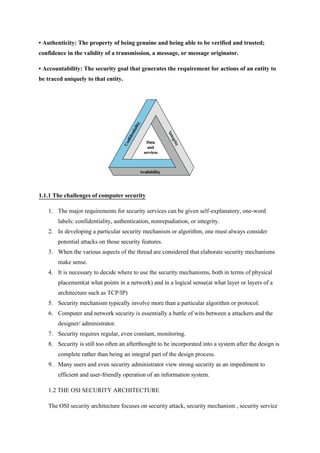
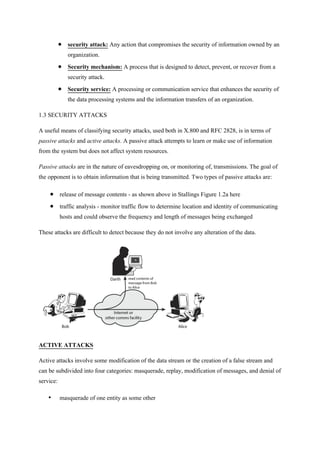
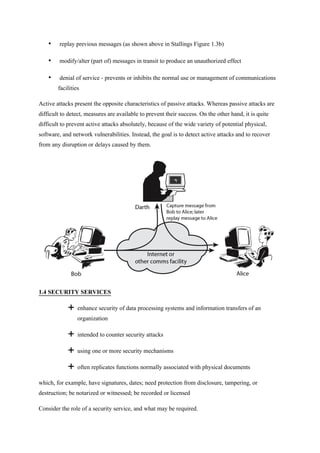
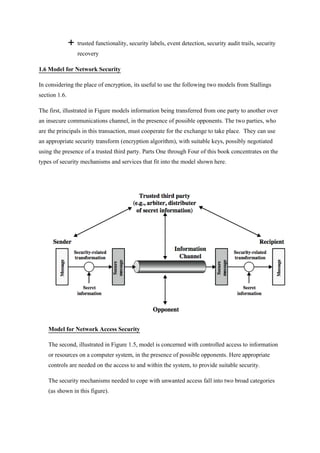
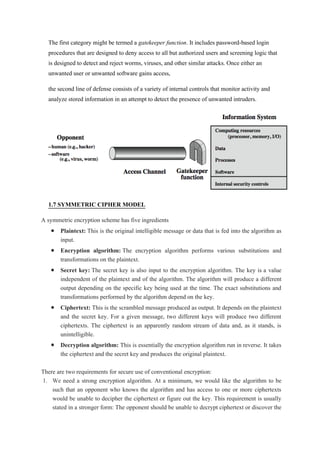
![key even if he or she is in possession of a number of ciphertexts together with the plaintext
that produced each ciphertext.
2. Sender and receiver must have obtained copies of the secret key in a secure fashion and must
keep the key secure. If someone can discover the key and knows the algorithm, all
communication using this key is readable.
We assume that it is impractical to decrypt a message on the basis of the
ciphertext plus knowledge of the encryption/decryption algorithm. In other words, we do not need
to keep the algorithm secret; we need to keep only the key secret. This feature of symmetric
encryption is what makes it feasible for widespread use. The fact that the algorithm need not be
kept secret means that manufacturers can and have developed low-cost chip implementations of
data encryption algorithms. These chips are widely available and incorporated into a number of
products. With the use of symmetric encryption, the principal security problem is maintaining the
secrecy of the key.
Let us take a closer look at the essential elements of a symmetric encryp-tion scheme, using Figure
2.2. A source produces a message in plaintext, X = [X1, X2, ..... , XM]. The M elements of X are
letters in some finite alphabet. Traditionally, the alphabet usually consisted of the 26 capital
letters. Nowadays, the binary alphabet {0, 1} is typically used. For encryption, a key of the
form K = [K1, K2, ..... , KJ] is generated. If the key is generated at the message source, then it must
also be provided to the destination by means of some secure chan-nel. Alternatively, a third party
could generate the key and securely deliver it to both source and destination.
With the message X and the encryption key K as input, the encryption algo-rithm forms the
ciphertext Y = [Y1, Y2, ..... , YN]. We can write this as](https://image.slidesharecdn.com/7mce3c1-cryptographyandnetworksecurity-250401150745-92e9a590/85/Cryptography-and-Network-Security-ppt-pdf-8-320.jpg)
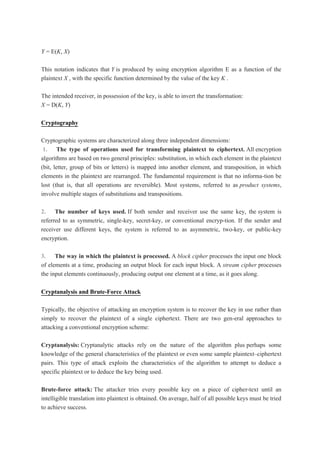
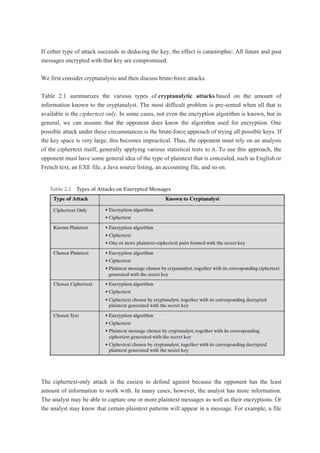
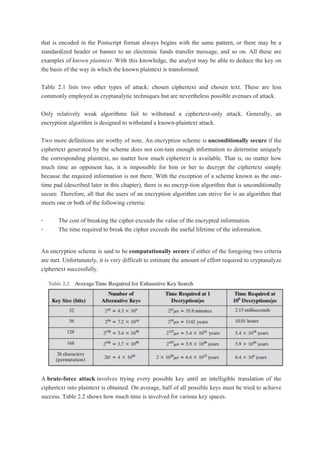
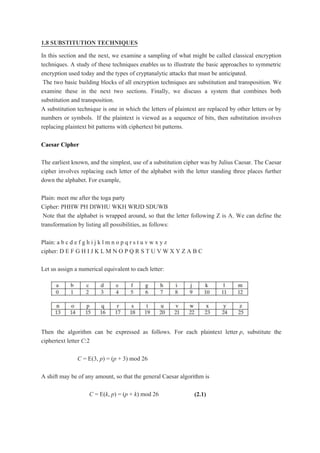
![There is, however, another line of attack. If the cryptanalyst knows the nature of the plaintext
(e.g., noncompressed English text), then the analyst can exploit the regularities of the language.
The ciphertext to be solved is
UZQSOVUOHXMOPVGPOZPEVSGZWSZOPFPESXUDBMETSXAIZ
VUEPHZHMDZSHZOWSFPAPPDTSVPQUZWYMXUZUHSX
EPYEPOPDZSZUFPOMBZWPFUPZHMDJUDTMOHMQ
As a first step, the relative frequency of the letters can be determined and compared to a standard
frequency distribution for English, such as is shown in Figure 2.5 (based on [LEWA00]). If the
message were long enough, this technique alone might be sufficient, but because this is a relatively
short message, we cannot expect an exact match. In any case, the relative frequencies of the letters
in the ciphertext (in percentages) are as follows:](https://image.slidesharecdn.com/7mce3c1-cryptographyandnetworksecurity-250401150745-92e9a590/85/Cryptography-and-Network-Security-ppt-pdf-14-320.jpg)
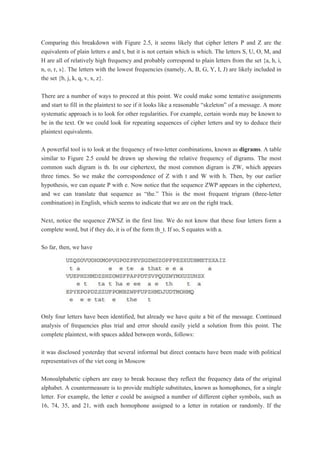
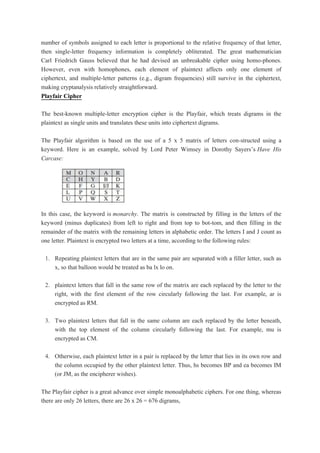
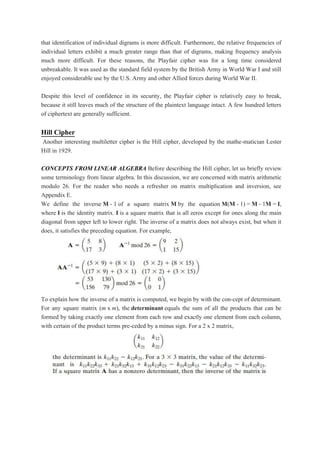
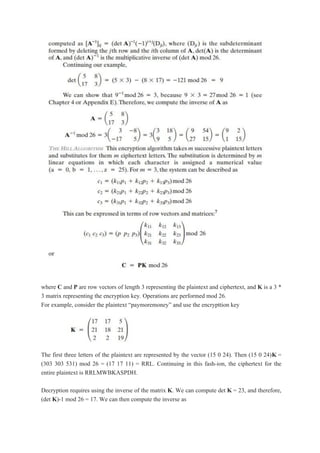
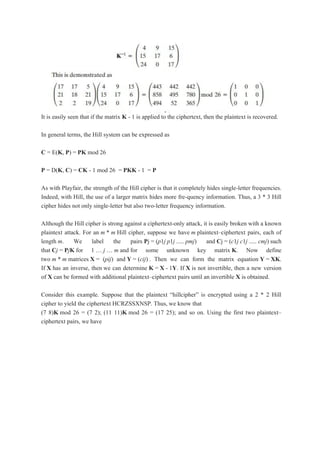
![This result is verified by testing the remaining plaintext–ciphertext pairs.
Polyalphabetic Ciphers
Another way to improve on the simple monoalphabetic technique is to use different
monoalphabetic substitutions as one proceeds through the plaintext message. The general name for
this approach is polyalphabetic substitution cipher. All these tech-niques have the following
features in common:
1. A set of related monoalphabetic substitution rules is used.
2. A key determines which particular rule is chosen for a given transformation.
VIGENERE` CIPHER The best known, and one of the simplest, polyalphabetic ciphers is the
Vigenère cipher. In this scheme, the set of related monoalphabetic substitution rules consists of the
26 Caesar ciphers with shifts of 0 through 25. Each cipher is denoted by a key letter, which is the
ciphertext letter that substitutes for the plaintext letter a. Thus, a Caesar cipher with a shift of 3 is
denoted by the key value d.
We can express the Vigenère cipher in the following manner. Assume a sequence of plaintext
letters P = p0, p1, p2, ..... , pn - 1 and a key consisting of the sequence of letters K = k0, k1, k2, .....
, km - 1, where typically m < n. The sequence of ciphertext letters C = C0, C1, C2, ..... , Cn - 1 is
calculated as follows:
C = C0, C1, C2, ..... , Cn - 1 = E(K, P) = E[(k0, k1, k2, ..... , km - 1), (p0, p1, p2, ..... , pn - 1)]
= (p0 + k0) mod 26, (p1 + k1) mod 26, ..... , (pm - 1 + km - 1) mod 26,
(pm + k0) mod 26, (pm + 1 + k1) mod 26, ..... , (p2m - 1 + km - 1) mod 26, .....
Thus, the first letter of the key is added to the first letter of the plaintext, mod 26, the second letters
are added, and so on through the first m letters of the plaintext. For the next m letters of the
plaintext, the key letters are repeated. This process continues until all of the plaintext sequence is
encrypted. A general equation of the encryption process is](https://image.slidesharecdn.com/7mce3c1-cryptographyandnetworksecurity-250401150745-92e9a590/85/Cryptography-and-Network-Security-ppt-pdf-20-320.jpg)
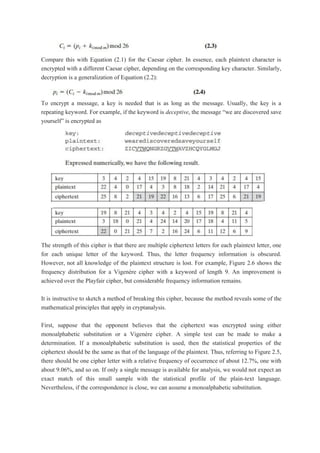
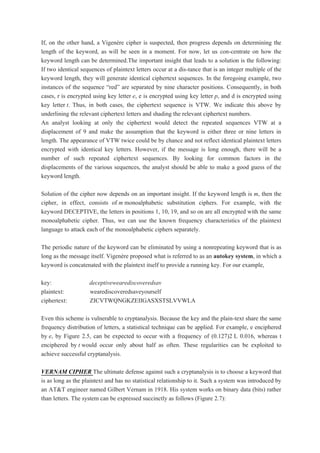
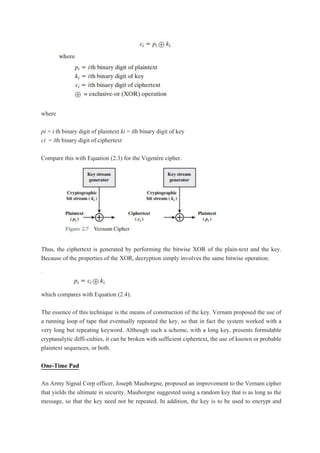

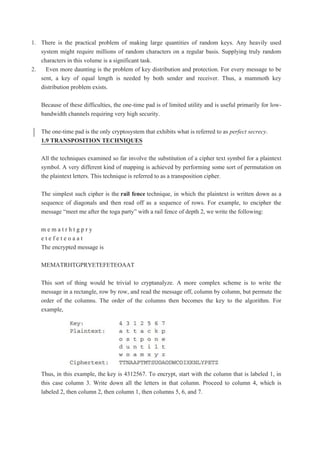
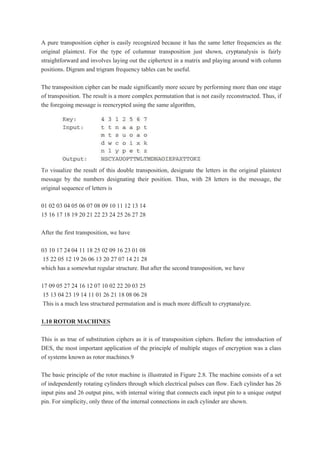
![If we associate each input and output pin with a letter of the alphabet, then a single cylinder
defines a monoalphabetic substitution. For example, in Figure 2.8, if an operator depresses the key
for the letter A, an electric signal is applied to the first pin of the first cylinder and flows through
the internal connection to the twenty-fifth output pin.
Consider a machine with a single cylinder. After each input key is depressed, the cylinder rotates
one position, so that the internal connections are shifted accordingly. Thus, a different
monoalphabetic substitution cipher is defined. After 26 letters of plaintext, the cylinder would be
back to the initial position. Thus, we have a poly-alphabetic substitution algorithm with a period of
26.
A single-cylinder system is trivial and does not present a formidable cryptana-lytic task. The
power of the rotor machine is in the use of multiple cylinders, in which the output pins of one
cylinder are connected to the input pins of the next. Figure 2.8 shows a three-cylinder system. The
left half of the figure shows a position in which the input from the operator to the first pin
(plaintext letter a) is routed through the three cylinders to appear at the output of the second pin
(ciphertext letter B).
With multiple cylinders, the one closest to the operator input rotates one pin position with each
keystroke. The right half of Figure 2.8 shows the system’s config-uration after a single keystroke.
For every complete rotation of the inner cylinder, the middle cylinder rotates one pin position.
Finally, for every complete rotation of the middle cylinder, the outer cylinder rotates one pin
position. This is the same type of operation seen with an odometer. The result is that there are 26 *
26 * 26 = 17,576 different substitution alphabets used before the system repeats. The addition of
fourth and fifth rotors results in periods of 456,976 and 11,881,376 letters, respectively. As David
Kahn eloquently put it, referring to a five-rotor machine [KAHN96, ]:](https://image.slidesharecdn.com/7mce3c1-cryptographyandnetworksecurity-250401150745-92e9a590/85/Cryptography-and-Network-Security-ppt-pdf-27-320.jpg)
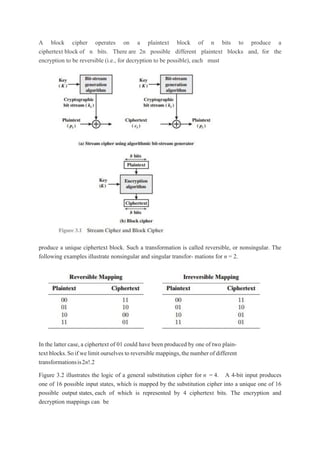
![definedbyatabulation,asshowninTable3.1.Thisisthemostgeneralformofblock cipher and can be
used to define any reversible mapping between
plaintext and ciphertext.Feistelreferstothisastheidealblockcipher,becauseitallowsforthemax-
imumnumberofpossibleencryptionmappingsfromtheplaintextblock[FEIS75].
But there is a practical problem with the ideal block cipher. If a small block
size,such as n = 4,is used,then the system is equivalent to a classical substitution cipher.Such syste
ms,as we have seen,are vulnerable to a statistical analysis of the plaintext. This weakness is not inh
erent in the use of a substitution cipher but rather results from the use of a small block size. If n is
sufficiently large and an arbitrary reversible substitution between plaintext and ciphertext is
allowed, then the statistical characteristics of the source plaintext are masked to such an extent that
this type of cryptanalysis isinfeasible.
An arbitrary reversible substitution cipher (the ideal block cipher) for alarge
blocksizeisnotpractical,however,fromanimplementationandperformancepoint](https://image.slidesharecdn.com/7mce3c1-cryptographyandnetworksecurity-250401150745-92e9a590/85/Cryptography-and-Network-Security-ppt-pdf-31-320.jpg)
![of view.For such a transformation, the mapping itself constitutes the key.Consider again Table 3.1,
which defines one particular reversible mapping from
plaintextto ciphertext for n = 4. The mapping can be defined by the entries in the second column,
which show the value of the ciphertext for each plaintext block. This, in essence, is the key that
determines the specific mapping from among all possible mappings. In this case, using this
straightforward method of defining the key, the required key length is (4 bits) * (16 rows) = 64 bits.
In general, foran n-bitideal block cipher,the length of the key defined in this fashion is n * 2n bits.
For a 64-bit block, which is a desirable length to thwart statistical attacks, the required key length
is 64 * 264 = 270 ~~ 1021 bits.
In considering these difficulties, Feistel points out that what is needed is an approximation to the
ideal block cipher system for large n, built up out of compo- nents that are easily realizable
[FEIS75]. But before turning to Feistel’s approach, let us make one other
observation. We could use the general
block substitution cipher but,tomakeitsimplementation tractable,confineourselves toasubset ofth
e 2n! possible reversible mappings. For example, suppose we define the mapping in
terms of a set of linear equations.In the case of n = 4,we have
y1 = k11x1 + k12x2 + k13x3 + k14x4 y2 = k21x1 + k22x2 + k23x3 + k24x4 y3 = k31x1 +
k32x2 + k33x3 + k34x4 y4 = k41x1 + k42x2 + k43x3 + k44x4
where the xi are the four binary digits of the plaintext block, the yi are the four binary digits of
the ciphertext block, the kij are the binary coefficients, and arith- metic is mod 2. The
key size is just n2, in this case 16 bits. The danger with this kind of formulation is that it may
be vulnerable to cryptanalysis by an attacker that is aware of the structure of
the algorithm. In this example, what we have is essentially the Hill cipher
discussed in Chapter 2, applied to binary data rather than characters. As we saw in Chapter 2,
a simple linear system such as this is quite vulnerable.
The Feistel Cipher
Feistelproposed[FEIS73]thatwecanapproximatetheidealblockcipherbyutilizing
theconceptofaproductcipher,whichistheexecutionoftwoormoresimpleciphers
insequenceinsuchawaythatthefinalresultorproductiscryptographicallystronger
thananyofthecomponentciphers.Theessenceoftheapproachistodevelopablock
cipher with a key length of k bits and a block length of n bits,allowing a total of 2k possible transfor
mations,rather thanthe2n!transformations availablewith theideal blockcipher.
In particular, Feistel proposed the use of a cipher that alternates substitutions
and permutations,where these termsare defined as follows:
Substitution: Each plaintext element or group of elements is uniquely replaced by a
corresponding ciphertext element or group of elements.](https://image.slidesharecdn.com/7mce3c1-cryptographyandnetworksecurity-250401150745-92e9a590/85/Cryptography-and-Network-Security-ppt-pdf-32-320.jpg)
![Permutation: A sequence of plaintext elements is replaced by a permutation of that sequence.
That is, no elements are added or deleted or replaced in the sequence, rather the order in which the
elements appear in the sequence is changed.
In fact,Feistel’s is a practical application of a proposal by Claude Shannon to develop a product
cipher that alternates confusion and diffusion functions
DIFFUSION AND CONFUSION The terms diffusion and confusion were introduced by Claude
Shannon to capture the two basic building blocks for any cryptographic system [SHAN49].
Shannon’s concern was to thwart cryptanalysis based on statistical analysis. The reasoning is
as follows. Assume the attacker has some knowledge of the statisticalcharacteristics of the plaint
ext. For example, in a human-readable message in some language, the frequency
distribution of the various letters may be known.Or there may be words or phrases likely to appear
in the message. If these statistics are in any way reflected in the ciphertext, the cryptanalyst may
be able to deduce the encryption key, part of the key,or at least a set of keys likely to contain the
exact key.In what Shannon refers to as a strongly ideal cipher, all statistics of the ciphertext
are independent of the particular key used.
Other than recourse to ideal systems, Shannon suggests two methods for frustrating statistical
cryptanalysis: diffusion and confusion. In diffusion, the statistical structure of the plaintext is
dissipated into long-range statistics of the ciphertext. This is achieved by having each plaintext
digit affect the value of many ciphertext
digits; generally, this is equivalent to having each ciphertext digit be affected by many plainte
xt digits. An example of diffusion is to encrypt a message M = m1, m2, m3, ... of characters
with an averaging operation:
adding k successivelettersto getaciphertext letter yn.Onecanshowthatthestatis-
tical structure of the plaintext has been dissipated.Thus,the letter frequencies in the ciphertext will be
more nearly equal than in the plaintext; the digram frequencies
will also be more nearly equal,and so on.In a binary block cipher,diffusion can be achieved by repe
atedly performing some permutation on the data followed by applying a function to that
permutation; the effect is that bits
from different positions in the original plaintext contribute to a single bitof ciphertext.5
Every block cipher involves a transformation of a block of plaintext into a block of ciphertext,
where the transformation depends on the key. The mechanism of diffusion seeks to make the
statistical relationship between the
plaintext and ciphertext as complex as possible in order to thwart attempts to deduce the key.On the
other hand, confusion seeks to make the relationship between the statistics of the ciphertext and the
value of the encryption key as complex as possible,again to thwart attempts to discover
the key. Thus, even if the attacker can get somehandle](https://image.slidesharecdn.com/7mce3c1-cryptographyandnetworksecurity-250401150745-92e9a590/85/Cryptography-and-Network-Security-ppt-pdf-33-320.jpg)
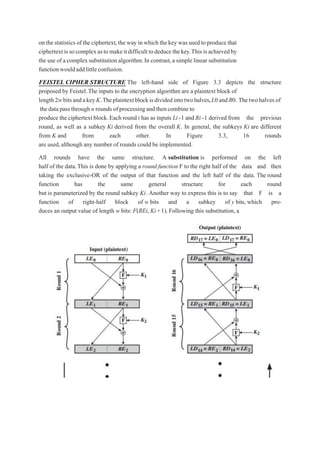
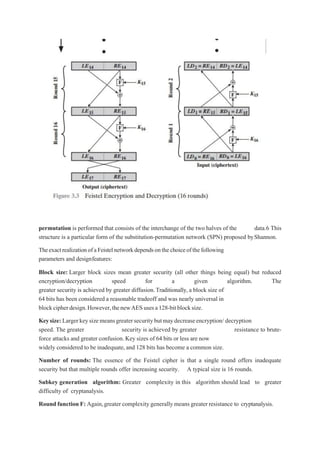
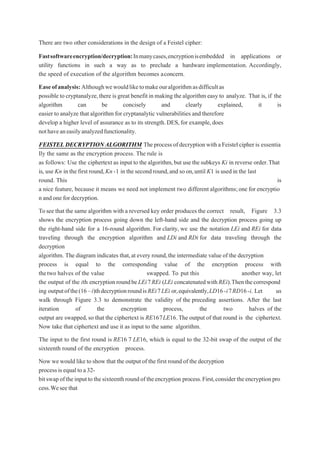
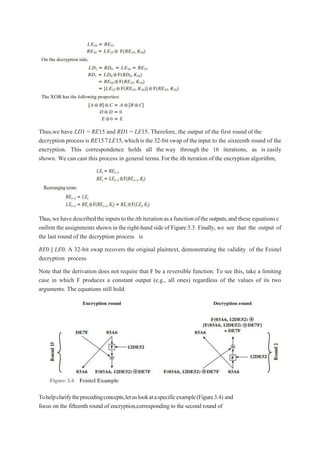
![decryption.Supposethattheblocksateachstageare32bits(two16bithalves)andthat thekeysizeis
24bits.Supposethatattheendofencryptionroundfourteen,thevalueof the intermediate block (in
hexadecimal) is DE7F03A6. Then LE14 = DE7F and RE14 = 03A6. Also assume that the
value of K15 is 12DE52. After round 15,
we have LE15 =03A6andRE15 = F(03A6, 12DE52) NOR DE7F.
Now let’s look at the decryption. We assume that LD1 = RE15 and RD1 = LE15,
as shown in Figure 3.3, and we want to demonstrate that LD2 = RE14 and RD2 = LE14. So,
we start with LD1 = F(03A6, 12DE52) NOR DE7F and RD1 = 03A6.
Then, from Figure 3.3, LD2 = 03A6 = RE14 and RD2 = F(03A6, 12DE52) NOR [F(03A6,
12DE52) { DE7F]= DE7F = LE14.
2.2 The Data Encryption Standard(DES)
In the late 1960s,IBM set up a research project in computer cryptography led by
Horst Feistel. The project concluded in 1971 with the development of an algorithm with the
designation LUCIFER [FEIS73], which was sold to Lloyd’s of London for use in a cash-dispensing
system, also developed by IBM. LUCIFER is a Feistel block cipher that operates on blocks of
64 bits, using a key size of 128 bits. Because of the promising results produced by the LUCIFER
project, IBM embarked on an effort to develop a marketable commercial encryption product that
ideally could be implemented on a single chip. The effort was headed by Walter Tuchman and
Carl Meyer, and it involved not only IBM researchers but also outside consultants and technical
advice from the National Security Agency (NSA). The outcome of this effort was a refined version
of LUCIFER that was more resistant to cryptanalysis but that had a reduced key size of 56 bits, in
order to fit on a singlechip.
In 1973,the NationalBureau of Standards (NBS) issued a request for proposals for a national cipher
standard. IBM submitted the results of its Tuchman–Meyer project. This was by far the best
algorithm proposed and was adopted in 1977 asthe Data Encryption Standard.
Before its adoption as a standard, the proposed DES was subjected to intense criticism, which has no
t subsided to this day.Two areas drew the critics’ fire. First, the key length in IBM’s original
LUCIFER algorithm was 128 bits, but that of the proposed system was only 56 bits, an enormous
reduction in key size of 72 bits. Critics feared that this key length was too short to withstand brute-
force attacks. The second area of concern was that the design criteria for the internal structure of
DES, the S-boxes, were classified. Thus, users could not be sure that the internal structure of DES
was free of any hidden weak points that would enable NSA to decipher messages without benefit
of the key.
DES Encryption
The overall scheme for DES encryption is illustrated in Figure 3.5. As with any encryption
scheme, there are two inputs to the encryption function:the plaintext to be encrypted
and the key.In this case,the plaintext must be 64 bits in length and the keyis56bitsinlength.](https://image.slidesharecdn.com/7mce3c1-cryptographyandnetworksecurity-250401150745-92e9a590/85/Cryptography-and-Network-Security-ppt-pdf-38-320.jpg)
![Looking at the left-hand side of the figure, we can see that the processing of the plaintext proceeds
in three phases. First, the 64-bit plaintext passes through an initial permutation (IP) that rearranges
the bits to produce the permuted input. This is followed by a phase consisting of sixteen
rounds of the same function, which involves both permutation and substitution functions. The
output of thelast (sixteenth) round consists of 64 bits that are a function of the input
plaintext and the key. The left and right halves of the output are swapped to produce the
preoutput.Finally,the preoutput is passed through a permutation [IP-1] that is the inverse of the
initial permutation function, to produce the 64-bit ciphertext. With the exception of the initial and
final permutations, DES has the exact structure of a Feistel cipher,as shown in Figure 3.3.
The right-hand portion of Figure 3.5 shows the way in which the 56-bit key is used. Initially, the
key is passed through a permutation function. Then, for each of the sixteen rounds, a subkey (Ki ) is
produced by the combination of a left circular shift and a permutation. The permutation function
is the same for each round, but a different subkey is produced because of the repeated shifts of the
key bits.
INITIAL PERMUTATION The initial permutation and its inverse are defined by tables, as
shown in Tables 3.2a and 3.2b, respectively. The tables are to be interpreted as follows. The input to
a table consists of 64 bits numbered from 1 to 64. The 64 entries
in the permutation table contain a permutation of the numbers from 1 to 64. Each](https://image.slidesharecdn.com/7mce3c1-cryptographyandnetworksecurity-250401150745-92e9a590/85/Cryptography-and-Network-Security-ppt-pdf-39-320.jpg)
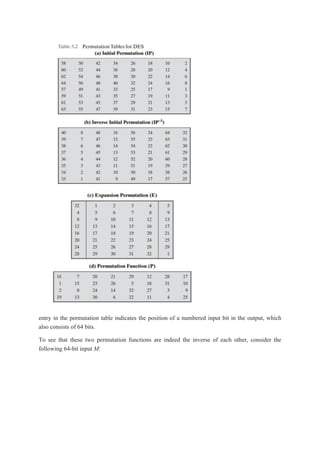
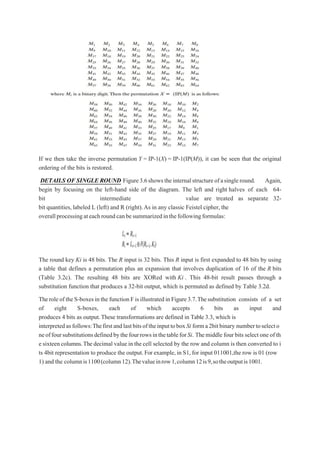
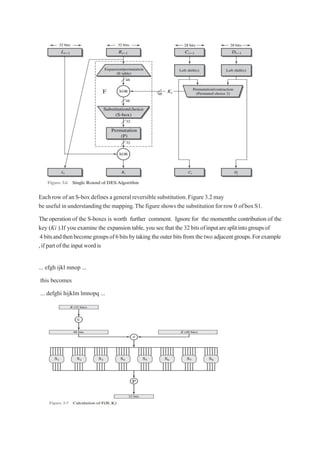
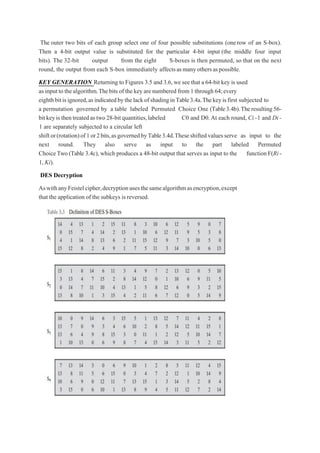
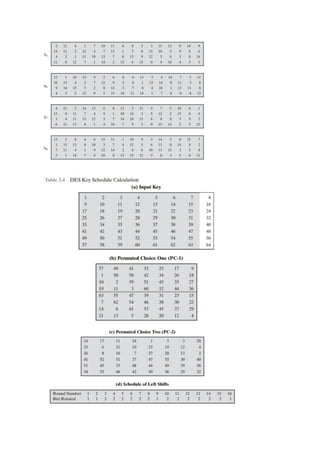
![2.3 THE STRENGTH OF DES
Since its adoption as a federal standard, there have been lingering concerns about the level of
security provided by DES. These concerns, by and large, fall into two areas: key size and the nature
of the algorithm.
The Use of 56-Bit Keys
With a key length of 56 bits, there are 256 possible keys, which is approximately
7.2 * 1016 keys. Thus, on the face of it, a brute-force attack
appears impractical. Assuming that,on average, half the key space has to be searched,a single
machine performing one DES encryption per microsecond would take more than a thousand
years (see Table 2.2) to break the cipher.However,theassumptionofoneencryptionpermicrosecond
isoverly conservative. As far back as 1977, Diffie and Hellman postulated that the technology
existed tobuild aparallel machine with1 million encryption devices,each ofwhich could
perform one encryption per microsecond [DIFF77]. This would bring the average search time
down to about 10 hours.
DES finally and definitively proved insecure in July1998,when the Electronic Frontier
Foundation (EFF) announced that it had broken a DES encryption using a special-
purpose “DES cracker” machine that was built for less than $250,000. The attack took less than
three days. The EFF has published a detaileddescription of themachine,enablingotherstobuild
theirowncracker[EFF98].And,ofcourse,hardwareprices will continueto drop asspeeds increase,mak
ing DES virtually worthless. It is important to note that there is more to a key-search
attack than simply running through all possible keys. Unless known plaintext is
provided, the analyst must be able to recognize plaintext as plaintext. If the message is just
plain text in English, then the result pops out easily, although the task
of recognizing English would have to be automated. If the text message has been compressed b
efore encryption,thenrecognitionismoredifficult.Andifthemessageissomemoregeneral type of
data, such as a numerical file, and this has been compressed,the problem becomes even more
difficult to automate. Thus, to supplementthe brute-force approach, some degree of knowledge
about the expected plaintext is needed, and some means of automatically distinguishing plaintext
from garble is also needed.
The EFF approach addresses this issue as well and introduces some automated techniques that
would be effective in many contexts.
The Nature of the DES Algorithm
Another concern is the possibility that cryptanalysis is possible by exploiting the characteristics of
the DES algorithm. The focus of concern has been on the eight substitution tables, or S-boxes, that
are used in each iteration. Because the design criteria for these boxes, and indeed for the entire
algorithm, were not made public,there isa suspicion that the boxes were constructed insuch a way th
at cryptanalysis ispossibleforanopponentwhoknowstheweaknessesintheS-boxes.Thisassertion
is tantalizing,and over theyears a numberof regularities and unexpected behaviors of the S-boxes](https://image.slidesharecdn.com/7mce3c1-cryptographyandnetworksecurity-250401150745-92e9a590/85/Cryptography-and-Network-Security-ppt-pdf-45-320.jpg)
![have been discovered. Despite this, no one has so far succeeded in
discoveringthesupposedfatalweaknessesintheS-boxes.9
Timing Attacks
We discuss timing attacks in more detail in Part Two,as they relate to public-
key algorithms. However, the issue may also berelevant for symmetric ciphers. Inessence,atimi
ngattackisoneinwhichinformationaboutthekeyortheplaintextis obtained by observing how long
it takes a given implementation to perform decryptions on various ciphertexts.
A timing attack exploits the fact that an encryption or decryption algorithm often takes slightly
different amounts of time on different inputs.reports on an approach that yields the Hamming
weight(number of bits equal to one) of the secret key.This is a long way from knowing the actual
key, but it is an intriguing first step. The authors conclude that DESappears to be fairly resistant to
a successful timing attack but suggest some avenues to explore.Although this is an interesting
line of attack,it so far appears unlikely that this technique will ever be successful against DES
or more powerful symmetric ciphers such as triple DES andAES.
2.4 DIFFERENTIAL AND LINEAR CRYPTANALYSIS
For most of its life, the prime concern with DES has been its vulnerability to brute-
force attack because of its relatively short (56 bits) key length. However, there has also
been interest in findingcryptanalytic attacks on DES. With the increasing
popularity of block ciphers with longer key lengths, including triple DES, brute-force
attacks have become increasingly impractical. Thus, there has been increased
emphasis on cryptanalytic attacks on DES and other symmetric block ciphers. In this
section, we provide a brief overview of the two most powerful and promising approaches:
differential cryptanalysis and linear cryptanalysis.
Differential Cryptanalysis
One of the most significant advances in cryptanalysis in recent years is differential cryptanalysis. In
this section, we discuss the technique and its applicability to DES.
HISTORY Differential cryptanalysis was not reported in the open literature until 1990. The first
published effort appears to have been the cryptanalysis of a block cipher called FEAL by Murphy
[MURP90]. This was followed by
a number of papers by Biham and Shamir,who demonstrated this form of attack on a variety of encr
yption algorithms and hash functions; their results are summarized in [BIHA93].
The most publicized results for this approach have been those that have application to DES.
Differential cryptanalysis is the first published attack that is capable of breaking DES in less than
255 encryptions. The scheme, as reported in [BIHA93], can successfully cryptanalyze DES with an
effort on the order of 247 encryptions, requiring 247 chosen plaintexts. Although 247 is certainly
significantly less than 255, the need for the adversary to find 247 chosen plaintexts makes
this attack of only theoretical interest.](https://image.slidesharecdn.com/7mce3c1-cryptographyandnetworksecurity-250401150745-92e9a590/85/Cryptography-and-Network-Security-ppt-pdf-46-320.jpg)
![Although differential cryptanalysis is a powerful tool,it does not do very well against DES. The
reason, according to a member of the IBM team that designed
DES [COPP94],is that differential cryptanalysis was known to the team as early as 1974. The need
to strengthen DES against attacks using differential cryptanalysis
played a large part in the design of the S-boxes and the permutation P.As evidence
of the impact of these changes, consider these comparable results reported in [BIHA93].
Differential cryptanalysis of an eight-round
LUCIFER algorithm requires only 256 chosen plaintexts,whereas an attack on an eight-
round version of DESrequires214 chosenplaintexts.
DIFFERENTIAL CRYPTANALYSIS ATTACKThe differential cryptanalysis attack is
complex; [BIHA93] provides a complete description. The rationale
behind differential cryptanalysis is to observe the behavior of pairs of text blocks evolving along eac
h roundofthecipher,insteadofobservingtheevolutionofasingletextblock.Here,we
provideabriefoverviewsothatyoucangettheflavoroftheattack.
Webegin with a change in notation for DES. Consider the original plaintext block m to consist of
two halves m0, m1. Each round of DES maps theright-hand input into the left-
hand output and sets the right-hand output to be a function of the left-
hand inputand thesubkey for this round.So,at each round,onlyone new 32-bit
block is created.If we label each new block mi(2 „ i „ 17),then the intermediate
messagehalvesarerelatedasfollows:
In differential cryptanalysis, we start with two messages, m and m¿, with a known XOR differe
nce Δm = m NOR m¿, and consider the difference between the intermediate message
halves: Δmi = mi NOR m¿i.Then we have
Now,suppose that many pairs of inputs to f with the same difference yield the
same output difference if the same subkey is used.Toput this more precisely,let us
saythatX maycauseYwithprobability p,ifforafraction p ofthepairsinwhichthe input XOR is X,
the output XOR equals Y. We want to suppose that there are a number of values of X that have high
probability of causing a particular output difference. Therefore, if we know ¢mi - 1 and ¢mi with
high probability, then we know ¢mi+1 withhighprobability.](https://image.slidesharecdn.com/7mce3c1-cryptographyandnetworksecurity-250401150745-92e9a590/85/Cryptography-and-Network-Security-ppt-pdf-47-320.jpg)
![Furthermore,ifanumberofsuchdifferencesaredetermined,it is feasible to determine the subkey use
d in the function f.
Theoverallstrategyofdifferentialcryptanalysisisbasedontheseconsiderations for a single round. The
procedure is to begin with two plaintext messages m and m¿ withagivendifferenceandtracethrou
ghaprobablepatternofdifferencesaftereach
roundtoyieldaprobabledifference fortheciphertext.Actually,therearetwoproba-
blepatternsofdifferencesforthetwo32-
bithalves:(¢m17|| ¢m16).Next,wesubmitm and m¿ for encryption to determine the actual difference
under the unknown key and comparetheresulttotheprobabledifference.If thereisamatch,
then we suspect that all the probable patterns at all the intermediate rounds are correct. With that
assumption, we can make some deductions about the key bits. This procedure must be repeated
many times to determine all the key bits.
Figure3.8,basedonafigurein[BIHA93],illustratesthepropagationofdiffer- ences through three
rounds of DES. The probabilities shown on the right refer to
the probability that a given set of intermediate differences will appear as a function
of the input differences. Overall, after three rounds, the probability that the output difference is as
shown is equal to 0.25 * 1 * 0.25 = 0.0625.
Linear Cryptanalysis](https://image.slidesharecdn.com/7mce3c1-cryptographyandnetworksecurity-250401150745-92e9a590/85/Cryptography-and-Network-Security-ppt-pdf-48-320.jpg)
![Amorerecentdevelopmentislinearcryptanalysis,describedin[MATS93].Thisattack isbasedonfindin
glinearapproximationstodescribethetransformationsperformedin DES.Thismethodcan finda DES k
ey given243 knownplaintexts,ascomparedto 247 chosenplaintextsfordifferentialcryptanalysis.Alth
oughthisisaminorimprovement,
becauseitmaybeeasiertoacquireknownplaintextratherthanchosenplaintext,itstill
leaves linear cryptanalysis infeasible as an attack on DES.So far,little work has been
donebyothergroupstovalidatethelinearcryptanalyticapproach.
We now give a brief summary of the principle on which linear cryptanalysis is based. For a cipher
with n-bit plaintext and ciphertext blocks and an m-bit key, let
(where x = 0 or 1; 1 <= a; b <= n; c <= m; and where the a, b, and g terms represent fixed, unique
bit locations) that holds with probability p != 0.5. The further p is from 0.5, the more effective the
equation. Once a proposed relation is determined, the pro- cedure is to compute the results of the
left-hand side of the preceding equation for a large number of plaintext–ciphertext pairs. If the
result is 0 more than half the time, assume K[g1, g2, „.. , gc] = 0. If it is
1 most of the time, assume K[g1, g2, „.. , gc] = 1. This gives us a linear equation on the key bits.Try
to get more such relations so that we can solve for the key bits. Because we are dealing with
linear equations, the problem can be approached one round of the cipher at a time, with the
results combined.
2.5 Block Cipher Design Principles
DES Design Criteria
The criteria used in the design of DES, as reported in [COPP94], focused on the design of the S-
boxes and on the P function that takes the output of the S-boxes (Figure 3.7). The criteria for the S-
boxes are as follows.
1. No output bit of any Sbox should be too close a linear function of the input bits. Sp
ecifically, if we select any output bit and any subset of the six input bits, the fracton
of inputs for which this output bit equals the XOR of these input bits
should not be close to 0 or 1, but rather should be near 1/2.
2. Each row of an S-box (determined by a fixed value of the leftmost andright-
mostinputbits)shouldincludeall16possibleoutputbitcombinations.
3. If two inputs to an S-box differ in exactly one bit, the outputs must differ in at
least twobits.](https://image.slidesharecdn.com/7mce3c1-cryptographyandnetworksecurity-250401150745-92e9a590/85/Cryptography-and-Network-Security-ppt-pdf-49-320.jpg)
![4. If two inputs to an S-box differ in the two middle bits exactly,the outputs must
differinatleasttwobits.
5. IftwoinputstoanS-
boxdifferintheirfirsttwobitsandareidenticalintheirlast twobits,thetwooutputsmust
not bethesame.
6. For any nonzero 6-bit difference between inputs, no more than
eight of the 32 pairs of inputs exhibiting that difference may result in
the same output difference.
7. This is a criterion similar to the previous one, but for the case of three S-boxes.
Coppersmith pointed out that the first criterion in the preceding list was needed because the S-
boxes are the only nonlinear part of DES. If the S-boxes were linear (i.e., each output bit is a linear
combination of the input bits), the entire algorithm would be linear and easily broken. We have
seen this phenomenon with the Hill cipher, which is linear. The remaining criteria were primarily
aimed at thwarting differential cryptanalysis and at providing good confusion properties.
The criteria for the permutation P are as follows.
1. The four output bits from each S-box at round i are distributed so that twoof them affect
(provide input for) “middle bits” of round (i + 1) and the other two affect end bits. The two
middle bits of input to an S-box are not shared with adjacent S-boxes. The end bits are the
two left-hand bits and the two right-handbits,whicharesharedwithadjacentS-boxes.
2.The four output bits from each S-box affect six different S-
boxes on the next round,andnotwoaffectthesameS-box.
3. For two S-boxes j, k, if an output bit from Sj affects a middle bit of Sk on the next round,
then an output bit from Sk cannot affect a middle bit of Sj. This implies that, for j = k, an
output bit from Sj must not affect a middle bit of Sj.
These criteria are intended to increase the diffusion of the algorithm.
Number of Rounds
The cryptographic strength of a Feistel cipher derives from three
aspects of the design:the number of rounds,the function F,and the keyschedule algorithm.Let us
look first at the choice of the number of rounds.
The greater the number of rounds, the more difficult it is to perform crypt- analysis, even for a
relatively weak F.In general, the criterion should be that the number of rounds is chosen so that
known cryptanalytic efforts require greater effort than a simple brute-
force key search attack.This criterion was certainly used
in the design of DES.Schneier [SCHN96] observes that for 16-round DES,a differ-
ential cryptanalysis attack is slightly less efficient than brute force:The differential
cryptanalysis attack requires 255.1 operations,10 whereas brute force requires 255. If DES had 15 or
fewer rounds, differential cryptanalysis would require less effort than a brute-force keysearch.](https://image.slidesharecdn.com/7mce3c1-cryptographyandnetworksecurity-250401150745-92e9a590/85/Cryptography-and-Network-Security-ppt-pdf-50-320.jpg)
![This criterion is attractive,because it makes it easy to judge the strength of an algorithm and to
compare different algorithms. In the absence of a
cryptanalytic breakthrough, the strength of any algorithm that
satisfies the criterion can be judgedsolelyonkeylength.
Design of Function F
The heart of a Feistel block cipher is the function F.As we have seen, in DES, this
function reliesontheuseof S-boxes.Thisisalso thecasefor manyothersymmetric
block ciphers.However,we canmakesome generalcommentsaboutthecriteriafor
designingF.Afterthat,welookspecificallyatS-boxdesign.
DESIGN CRITERIA FOR F The function F provides the element of confusion in a
Feistel cipher.Thus,it must be difficult to“unscramble”the substitution performed by F.One
obvious criterion is that F be nonlinear, as we discussed previously.The more nonlinear F,the more
difficult any type of cryptanalysis will be.
There are several measures of nonlinearity,which are beyond the scope of this book.In rough
terms,the more difficult it is to approximate F by a set of linear equations,the more nonlinear Fis.
Several other criteria should be considered in designing F.
We would like the algorithm to have good avalanche properties. Recall that, in general,
this means that a change in one bit of the input should
produce a change in many bits of the output. A more stringent version of this is the
strict avalanche criterion (SAC) [WEBS86], which states that any output bit j of an S-
box should change with probability 1/2 when any single input bit i is inverted for
all i, j. Although SAC is expressed in terms of S-boxes, a similar criterion could be applied to
F as a whole. This is important when considering designs that do not include S-boxes.
Another criterion proposed in [WEBS86] is the bit independence criterion
(BIC),which states that output bits j and k should change independently when any single input
bit i is inverted for all i, j, and k. The SAC and BIC criteria appear to
strengthentheeffectivenessoftheconfusionfunction.
S-BOX DESIGN One of the most intense areas of research in the field of symmetric block ciphers
is that of S-box design. The papers are almost too numerous to count. Here we mention some
general principles. In essence, we would like any change to the input vector to an S-box to result in
random-looking changes to the output. The relationship should be nonlinear and difficult to
approximate with linear functions.
OneobviouscharacteristicoftheS-boxisitssize.Ann * m S-boxhas ninput
bits and m outputbits.DEShas 6 ×4 S-boxes.Theencryption algorithm Blowfish, has 8 ×32 S-
boxes.Larger S-boxes, by and large,are more resistant to differential
and linear cryptanalysis [SCHN96]. On the other hand, the larger the dimension n,the
(exponentially) larger the lookup table. Thus, for practical reasons,a limit
of n equal to about 8 to10 is usually imposed.Anotherpractical consideration is that the larger the S-
box,the more difficult it is to design it properly.](https://image.slidesharecdn.com/7mce3c1-cryptographyandnetworksecurity-250401150745-92e9a590/85/Cryptography-and-Network-Security-ppt-pdf-51-320.jpg)
![S-boxes are typically organized in a different manner than used in DES. An n * m S-
box typically consists of 2n rows of m bits each.The n bits of input select one of the rows of the S-
box,and the m bits in that row are the output.Forexample, in an 8 * 32 S-box, if the input
is 00001001, the output consists of the 32 bits in row 9 (the first row islabeled row 0).
A related criterion for S-boxes is proposed and analyzed in [HEYS95].
The authors define the guaranteed avalanche (GA) criterion as follows:An S-
box satisfies GA of order g if,for a 1-bit input change,at least g output bits change.The authors
conclude that a GA in the range of order 2 to order 5 provides strong diffusion
characteristicsfortheoverallencryptionalgorithm.
Random:Usesomepseudorandomnumbergenerationorsometableofrandom
digitstogeneratetheentriesintheS-boxes.Thismayleadtoboxeswithundesir-
ablecharacteristicsforsmallsizes(e.g.,6 * 4)butshouldbeacceptableforlarge S-
boxes (e.g., 8 *32).
Random with testing: Choose S-box entries randomly, then test the results
against various criteria,and throw away those that do not pass.
Human-made:Thisisamoreorlessmanualapproachwithonlysimplemathe-
matics tosupport it.It isapparently thetechniqueusedintheDESdesign.This app
roachisdifficulttocarrythroughforlargeS-boxes.
Math-made:GenerateSboxesaccordingtomathematicalprinciples.
Byusing mathematicalconstruction,Sboxescanbeconstructedthatofferprovensec
urity againstlinearanddifferentialcryptanalysis,togetherwithgooddiffusion.
AvariationonthefirsttechniqueistouseS-boxesthatarebothrandomandkey
dependent.An example of this approach is Blowfish,which starts with S-boxes filled with
pseudorandom digits and then alters the contents using the key.A tremendous advantageofkey-
dependentS-boxesisthat,becausetheyarenotfixed,itisimpossible toanalyzetheS-
boxesaheadoftimetolookforweaknesses.
Key Schedule Algorithm
A final area of block cipher design, and one that has received less attention than S-
boxdesign,isthekeyschedulealgorithm.WithanyFeistelblockcipher,thekeyis used to generate
one subkey for each round. In general, we would like
to select subkeystomaximizethedifficultyofdeducingindividualsubkeysandthedifficulty
of working back to the main key. No general principles for this have yet been promulgated.
ADVANCED STANDARD ENCRYPTION
2.6 FINITE FIELD ARITHMETIC
In AES, all operations are performed on 8-bit bytes. In particular, the arithmetic operations of
addition, multiplication, and division are performed over the finite field GF(28). Section 4.7
discusses such operations in some detail. For the reader who has not studied Chapter 4, and as a
quick review for those who have, this section summarizes the important concepts.](https://image.slidesharecdn.com/7mce3c1-cryptographyandnetworksecurity-250401150745-92e9a590/85/Cryptography-and-Network-Security-ppt-pdf-52-320.jpg)
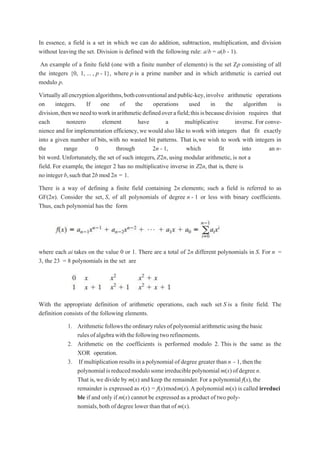
![For example, to construct the finite field GF(23), we need to choose an irre- ducible polynomial of
degree 3. There are only two such polynomials: (x3 + x2 + 1) and (x3 + x + 1). Addition is
equivalent to taking the XOR of like terms. Thus, (x + 1) + x = 1.
A polynomial in GF(2n) can be uniquely represented by its n binary coeffi- cients(an-1an-
2 ...a0).Therefore,everypolynomialinGF(2n)canberepresentedby an n-
bit number.Addition is performed by taking the bitwise XOR of the two n-
bit elements.There is no simple XOR operation that will accomplish multiplication in GF(2n).
However, a reasonably straightforward, easily implemented, technique is
available.Inessence,itcanbeshownthatmultiplicationofanumberinGF(2n)by2
consistsofaleftshiftfollowedbyaconditionalXORwithaconstant.Multiplication
bylargernumberscanbeachievedbyrepeatedapplicationofthisrule.
Tosummarize, AES operates on 8-bit bytes. Addition of two bytes is defined as the bitwise XOR
operation. Multiplication of two bytes is defined as multiplication in the finite field GF(28), with
the irreducible polynomial2 m(x) = x8 + x4 + x3 + x + 1. The developers of Rijndael give as
their motivation for selecting this one of the 30 possible irreducible polynomials of degree 8 that it
is the first one on the list given in [LIDL94].
2.7 AES STRUCTURE
General Structure
Figure 5.1 shows the overall structure of the AES encryption process. The cipher
takesaplaintextblocksizeof128bits,or16bytes.Thekeylengthcanbe16,24,or32
bytes (128, 192,or 256 bits).The algorithm is referred to asAES-128,AES-192,or
AES-256,dependingonthekeylength.
Theinputtotheencryptionanddecryptionalgorithmsisasingle128-bitblock.
InFIPSPUB197,thisblockis depictedasa 4 * 4squarematrixofbytes.ThisblockiscopiedintotheS
tatearray,whichismodifiedateachstageofencryptionordecryption.After the final stage, State is co
pied to an output matrix.These operations aredepictedinFigure5.2a.Similarly,thekeyisdepictedas
asquarematrixofbytes.This key is then expanded into an array of key schedule words. Figure 5.2b
shows the expansion for the 128-bit key.Each word is four bytes,and the total key schedule is
44wordsforthe128-
bitkey.Notethattheorderingofbyteswithinamatrixisbycolumn.So,forexample,thefirstfourbytes
ofa128-bitplaintextinputtotheencryption cipher occupy the first column of the in matrix, the
second four bytes occupy the
second column,and so on.Similarly,the first four bytes of the expanded key,which
formaword,occupythefirstcolumnofthewmatrix.
The cipher consists of N rounds, where the number of rounds depends on the
key length:10 rounds for a 16-byte key,12 rounds for a 24-byte key,and 14 rounds for a 32-byte
key (Table 5.1). The first N - 1 rounds consist of four distinct trans-
formationfunctions:SubBytes,ShiftRows,MixColumns,andAddRoundKey,which are described](https://image.slidesharecdn.com/7mce3c1-cryptographyandnetworksecurity-250401150745-92e9a590/85/Cryptography-and-Network-Security-ppt-pdf-54-320.jpg)
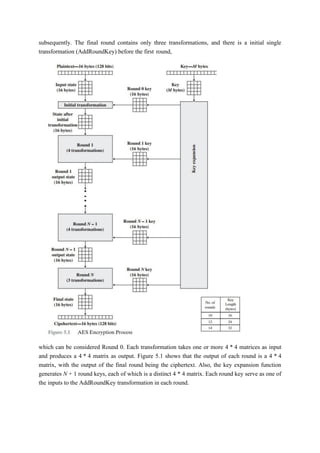
![Detailed Structure
Figure 5.3showstheAEScipher inmore detail,indicating thesequence oftransfor-
mations in each round and showing the corresponding decryption function.As was done in Chapter
3, we show encryption proceeding down the page and decryption proceeding up thepage.
Before delving into details, we can make several comments about the overall AES structure.
1. One noteworthy feature of this structure is that it is not a Feistel structure. Recall that, in
the classic Feistel structure, half of the data block is used to
modify the other half of the data block and then the halves are swapped.AES instead
processes the entire data block as a single matrix during each round using substitutions
andpermutation.
2. The key that is provided as input is expanded into an array of forty-four 32-
bit words,w[i].Four distinct words (128 bits) serve as a round key for each round;
theseareindicatedinFigure5.3.
3. Fourdifferentstagesare used,one of permutationand threeofsubstitution:
Substitute bytes: Uses an S-box to perform a byte-by-byte substitution of the block
ShiftRows:Asimplepermutation
MixColumns:AsubstitutionthatmakesuseofarithmeticoverGF(28)](https://image.slidesharecdn.com/7mce3c1-cryptographyandnetworksecurity-250401150745-92e9a590/85/Cryptography-and-Network-Security-ppt-pdf-56-320.jpg)
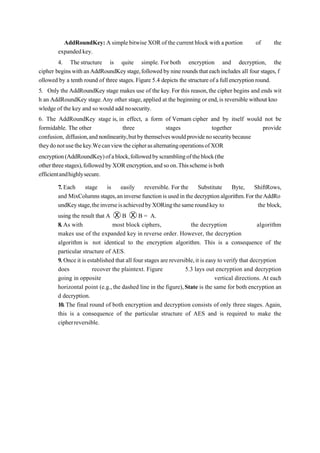
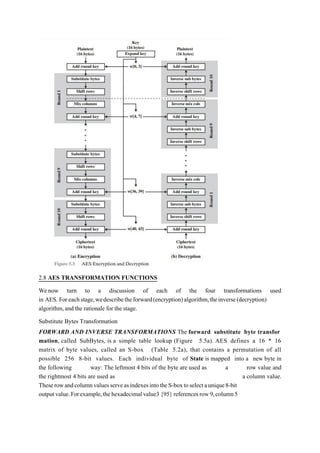
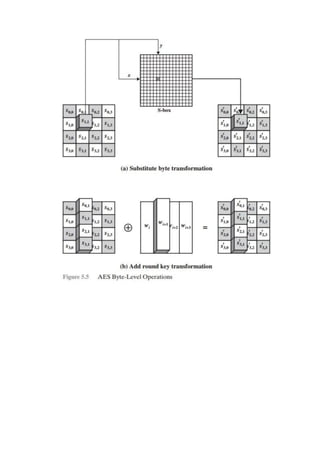
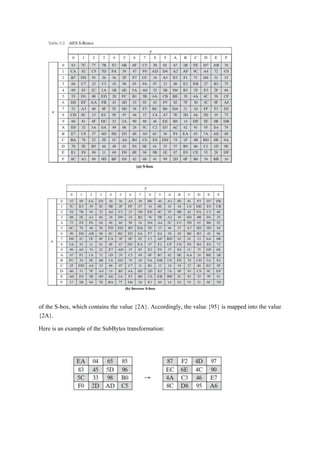
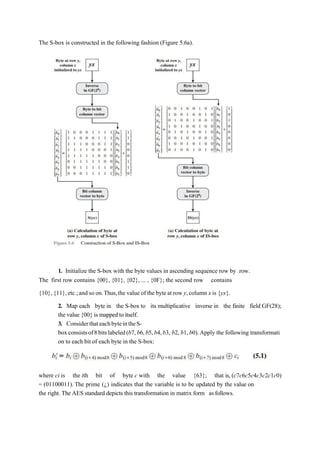
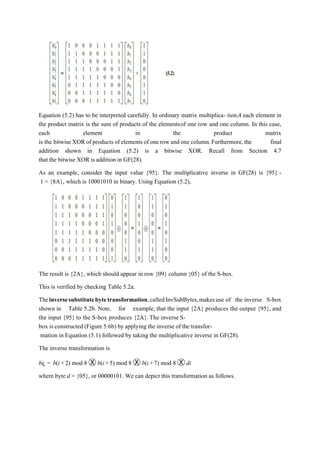
![To see that InvSubBytes is the inverse of SubBytes, label the matrices in SubBytes and
InvSubBytes as X and B, respectively, and the vector versions of con- stants c and d as C and D,
respectively. For some 8-bit vector B, Equation (5.2) becomes B¿ = XB Ⓧ C. We need to
show that Y(XB Ⓧ C) Ⓧ D = B. To multiply out, we must show YXB Ⓧ YC Ⓧ D = B.
This becomes
We have demonstrated that YX equals the identity matrix, and the YC = D, so that YC Ⓧ D equals
the null vector.
RATIONALE The S-box is designed to be resistant to known cryptanalytic attacks. Specifically,
the Rijndael developers sought a design that has a low correlation between input bits and output
bits and the property that the output is not a linear mathematical function of the input [DAEM01].
The nonlinearity is due to the use of the multiplicative inverse.
In addition, the constant in Equation (5.1) was chosen so that the S-box has no fixed points
[S-box(a) = a] and no “opposite fixed points” [S-box(a) = Bar a], where Bar a is the bitwise
complement of a.
Of course, the S-box must be invertible, that is, IS-box[S-box(a)] = a.](https://image.slidesharecdn.com/7mce3c1-cryptographyandnetworksecurity-250401150745-92e9a590/85/Cryptography-and-Network-Security-ppt-pdf-63-320.jpg)
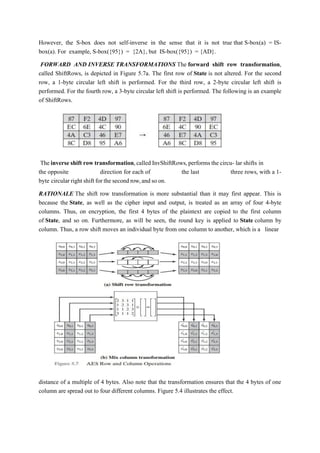
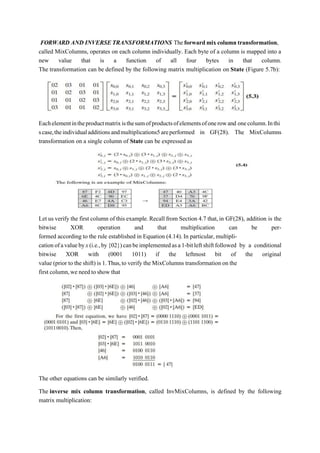
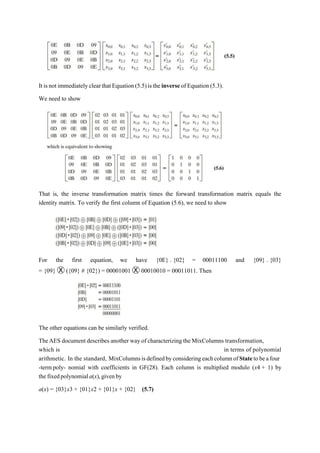
![Appendix 5A demonstrates that multiplication of each column of State by a(x) can be written as the
matrix multiplication of Equation (5.3). Similarly, it can be seen that the transformation in Equation
(5.5) corresponds to treating each column as a four-term polynomial and multiplying each column
by b(x), given by
b(x) = {0B}x3 + {0D}x2 + {09}x + {0E} (5.8)
It readily can be shown that b(x) = a-1(x) mod (x4 + 1).
RATIONALE The coefficients of the matrix in Equation (5.3) are based on a linear code with
maximal distance between code words, which ensures a good mixing amongthebytesofeach
column.Themixcolumntransformationcombinedwiththe shift row transformation ensures that
after a few rounds all output bits depend on allinputbits.See[DAEM99]foradiscussion.
In addition, the choice of coefficients in MixColumns, which are all {01}, { 02}, or { 03}, was
influenced by implementation considerations. As was discussed, multi- plication by these
coefficients involves at most a shift and an XOR. The coefficients in InvMixColumns are more
formidable to implement. However, encryption was deemed more important than decryption
for two reasons:
1.FortheCFBandOFBciphermodes(Figures6.5and6.6;describedinChapter6), onlyencrypti
onisused.
2.As with any block cipher,AES can be used to construct a message authentica-
tion code (Chapter 12),and for this,only encryption isused.
AddRoundKey Transformation
FORWARD AND INVERSE TRANSFORMATIONS In the forward add round key transfor-
mation, called AddRoundKey, the 128 bits of State are bitwise XORed with the 128 bits of the
round key. As shown in Figure 5.5b, the operation is viewed as a columnwise operation between
the 4 bytes of a State column and one word of the round key; it can also be viewed as a byte-level
operation. The following is an example of AddRoundKey:
The first matrix is State, and the second matrix is the round key.
The inverse add round key transformation is identical to the forward add round key
transformation, because the XOR operation is its own inverse.
RATIONALE The add round key transformation is as simple as possible and affects
every bit of State.The complexity of the round key expansion,plus the complexity
of the other stages ofAES,ensure security.](https://image.slidesharecdn.com/7mce3c1-cryptographyandnetworksecurity-250401150745-92e9a590/85/Cryptography-and-Network-Security-ppt-pdf-67-320.jpg)
![Figure 5.8 is another view of a single round of AES, emphasizing the mecha- nisms and inputs of
each transformation.
2.9 AES KEY EXPANSION
Key Expansion Algorithm
TheAESkeyexpansionalgorithmtakesasinputafour-word(16-
byte)keyandproducesalineararrayof44words(176bytes).Thisissufficienttoprovideafour-
word round key for the initial AddRoundKey stage and each of the
10 rounds of the cipher.The pseudocode on the next page describes the expansion.
The key is copied into the first four words of the expanded key. The remain- der of
the expanded key is filled in four words at a time. Each added word w[i] depends on
the immediately preceding word, w[i - 1], and the word four posi- tions back, w[i - 4].
In three out of four cases, a simple XOR is used. For a word whose position in the w array is
a multiple of 4, a more complex function is used. Figure 5.9 illustrates the generation of
the expanded key, using the symbol g to represent that complex
function. The function g consists of the following subfunctions.](https://image.slidesharecdn.com/7mce3c1-cryptographyandnetworksecurity-250401150745-92e9a590/85/Cryptography-and-Network-Security-ppt-pdf-68-320.jpg)
![1. RotWord performs a one-byte circular left shift on a word.This means that an
inputword[B0,B1,B2,B3]istransformedinto[B1,B2,B3,B0].
2. SubWord performs a byte substitution on each byte of its input word, usingthe S-
box(Table5.2a).
3. The result of steps 1 and 2 is XORed with a round constant,Rcon[j].](https://image.slidesharecdn.com/7mce3c1-cryptographyandnetworksecurity-250401150745-92e9a590/85/Cryptography-and-Network-Security-ppt-pdf-69-320.jpg)
![The round constant is a word in which the three rightmost bytes are always 0. Thus,theeffect
ofanXORofawordwithRconistoonlyperformanXORontheleft-
mostbyteoftheword.Theroundconstantisdifferentfor eachroundand isdefinedas Rcon[j]
= (RC[j],0,0,0),withRC[1] = 1,RC[j] = 2 RC[j-1]andwithmultiplica-
tiondefinedoverthefieldGF(28).ThevaluesofRC[j]inhexadecimalare
For example, suppose that the round key for round 8 is
EA D2 73 21 B5 8D BA D2 31 2B F5 60 7F 8D 29 2F
Then the first 4 bytes (first column) of the round key for round 9 are calculated as follows:
Rationale
The Rijndael developers designed the expansion key algorithm to be resistant to known
cryptanalytic attacks. The inclusion of a round-dependent round constant eliminates the symmetry,
or similarity, between the ways in which round keys aregeneratedindifferentrounds.
Thespecificcriteriathatwereusedare[DAEM99]
• Knowledge of a part of the cipher key or round key does not enable calcula-
tion of many other round-key bits.
• Aninvertibletransformation [i.e.,knowledgeofanyNk consecutivewords of the expanded
key enables regeneration the entire expanded key (Nk = key sizeinwords)].
• Speedon awide range ofprocessors.
• Usageof roundconstantsto eliminatesymmetries.
• Diffusion of cipher key differences into the round keys; that is, each key bit
affects manyround keybits.
• Enough nonlinearity to prohibit the full determination of round key differ-
encesfromcipherkeydifferencesonly.
• Simplicity of description.
The authors do not quantify the first point on the preceding list,but the idea is
that if you know less than Nk consecutive words of either the cipher key or one of the
round keys, then it is difficult to reconstruct the remaining unknown bits.
The fewerbitsoneknows,themoredifficultitistodothereconstructionortodetermine
other bits in the key expansion.](https://image.slidesharecdn.com/7mce3c1-cryptographyandnetworksecurity-250401150745-92e9a590/85/Cryptography-and-Network-Security-ppt-pdf-70-320.jpg)
![2.10 AES IMPLEMENTATION
As was mentioned, the AES decryption cipher is not identical to the encryption cipher (Figure 5.3).
That is, the sequence of transformations for decryption differs
from that for encryption,although the form of the key schedules for encryption and decryption is the
same. This has the disadvantage that two separate software or firmware modules are needed for
applications that require both encryption and decryption. There is, however, an equivalent version
of the decryption algorithm that has the same structure as the encryption algorithm.
The equivalent version has the same sequence of transformations as the encryption algorithm (with
transformations replaced by their inverses). Toachieve this equivalence, a change in key schedule
isneeded.Two separate changes are needed to bring the decryption structure in line
with the encryption structure.As illustrated in Figure 5.3, an encryption round has the structure
SubBytes, ShiftRows, MixColumns, AddRoundKey. The standard decryption round has
the structure InvShiftRows, InvSubBytes, AddRoundKey, InvMixColumns. Thus, the first
two stages of the decryption round need to be interchanged, and the second two stages of the
decryption round need to be interchanged.
INTERCHANGING INVSHIFTROWS AND INVSUBBYTES InvShiftRows affects the
sequence of bytes in State but does not alter byte contents and does not depend on byte contents to
perform its transformation. InvSubBytes affects the contents of bytes in State but does not alter
byte sequence and does not depend on byte
sequence to perform its transformation. Thus, these two operations commute and
can be interchanged.ForagivenStateSi,
InvShiftRows [InvSubBytes (Si)] = InvSubBytes [InvShiftRows (Si)]
INTERCHANGING ADDROUNDKEY AND INVMIXCOLUMNS The transformations Add-
RoundKey and InvMixColumns do not alter the sequence of bytes in State. If we
viewthekeyasasequenceofwords,thenbothAddRoundKeyandInvMixColumns
operate on State one column at a time.These two operations are linear with respect
to thecolumninput.That is,for agivenStateSi anda given roundkeywj,
InvMixColumns (Si Ⓧ wj) = [InvMixColumns (Si)] Ⓧ [InvMixColumns (wj)]
To see this, suppose that the first column of State Si is the sequence is the
sequence (y0, y1, y2, y3) and the first column of the round key wj is (k0, k1, k2, k3). Then we need
to show](https://image.slidesharecdn.com/7mce3c1-cryptographyandnetworksecurity-250401150745-92e9a590/85/Cryptography-and-Network-Security-ppt-pdf-71-320.jpg)
![Thisequationisvalidbyinspection.Thus,wecaninterchangeAddRoundKeyand InvMixColumns,
provided that we first apply InvMixColumns to the
round key. NotethatwedonotneedtoapplyInvMixColumnstotheroundkeyfortheinputtothe first
AddRoundKey transformation (preceding the first round) nor to the
last AddRoundKeytransformation(inround10).ThisisbecausethesetwoAddRoundKey transformatio
ns are not interchanged with InvMixColumns to produce the equivalent decryptionalgorithm.
8-BIT PROCESSOR AES can be implemented very efficiently on an8-
bit processor. AddRoundKey is a bytewise XOR operation. ShiftRows is a simple byte-
shifting operation.SubBytesoperatesatthebytelevelandonlyrequiresatableof256bytes. The
transformation MixColumns requires matrix multiplication
in the field GF(28),whichmeans that all operations are carried out on bytes.
The transformation MixColumns requires matrix multiplication
in the field GF(28),whichmeans that all operations are carried out on bytes.MixColumns only requi
res multiplication by {02} and {03},which,as we have seen,involved simple shifts,
conditional XORs, and XORs. This can be implemented in a more efficient way that eliminates the
shifts and conditional XORs. Equation set (5.4) shows the equations for the MixColumns
transformation on a single column. Using theidentity {03} x = ({02} x) Ⓧ x, we can rewrite
Equation set (5.4) as follows.
Themultiplicationby{02}involvesashiftandaconditionalXOR.Suchanimple-
mentationmay be vulnerableto a timingattackof the sort describedin Section3.4.Tocounterthisattack
andtoincreaseprocessingefficiencyatthecostofsomestorage,the multiplicationcanbereplacedbyat
ablelookup.Definethe256-bytetableX2,such
that X2[i] = {02} i.ThenEquationset(5.9) canberewritten as](https://image.slidesharecdn.com/7mce3c1-cryptographyandnetworksecurity-250401150745-92e9a590/85/Cryptography-and-Network-Security-ppt-pdf-72-320.jpg)
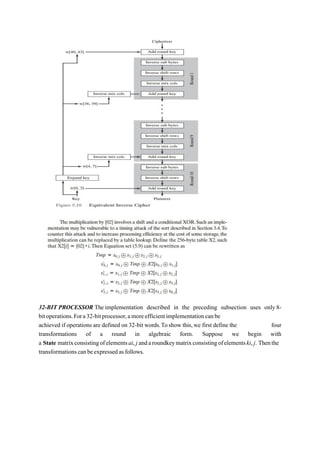
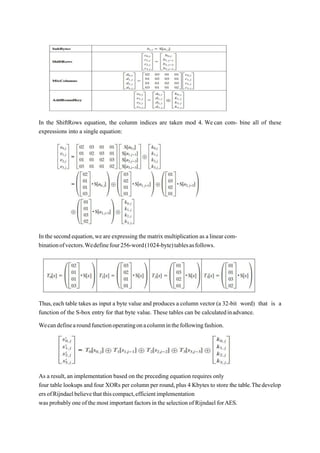
![systems were devised,themost prominentofwhichwas theLucifer effort atIBMthatculminated
in the Data Encryption Standard (DES). But both rotor machines and DES,
althoughrepresentingsignificantadvances,stillreliedonthebread-and-buttertools of substitution
and permutation. Public-key cryptography provides a radical departure from all that has gone
before. For one thing, public-key algorithms are based on mathematical
functions ratherthanonsubstitutionandpermutation.Moreimportant,public-
keycryptography isasymmetric,involvingtheuseoftwoseparatekeys,incontrasttosymmetricencryp-
tion,which uses only one key.The use of two keys has profound consequences in the
areasofconfidentiality,keydistribution,andauthentication,asweshallsee.
Before proceeding,we should mention several common misconceptions con- cerningpublic-
keyencryption.Onesuchmisconceptionisthatpublic-keyencryptionis more secure from cryptanalysis
than is symmetricencryption. In fact, the securityof any encryption scheme depends on the length
of the key and the computational work involved in breaking a cipher. There is nothing in principle
about either symmetric or public-key encryption that makes one superior to another from the point
of view of resisting cryptanalysis.
Asecondmisconceptionisthatpublic-keyencryptionisageneral-purposetechnique that has made
symmetricencryption obsolete. Onthe contrary, because of the computational overhead of current publ
ic-key encryption schemes,there seems no
foreseeable likelihood that symmetric encryption will be abandoned.As one of the inventors of public
-key encryption has put it [DIFF88],“the restriction of public-key cryptography to key management
and signature applications is almost universally accepted.”
Finally,there is a feeling that key distribution is trivial when using public-
key encryption,comparedtotherathercumbersomehandshakinginvolvedwithkeydistri-
bution centers for symmetric encryption.In fact, some form of protocol is needed, generally
involving a central agent, and the procedures involved are not simpler
nor any more efficient than those required for symmetric encryption (e.g.,see analysis in [NEED78]).
Thischapterandthenextprovideanoverviewofpublickeycryptography.First, we look at its conceptual
framework.Interestingly,the concept for this technique was developed and published before it was
shown to be practical to adopt it. Next,
we examinetheRSAalgorithm,whichisthemostimportantencryption/decryptionalgorithm
that has been shown to be feasible for public-key encryption.
Much of the theory of public-key cryptosystems is based on number theory.If
one ispreparedtoacceptthe resultsgiveninthischapter,an understandingofnumber theory is not
strictly necessary. However, to gain a full appreciation of public-
key algorithms,some understanding of number theory is required.
Table 9.1 defines some key terms.
Table 9.1 Terminology Related to Asymmetric Encryption
Asymmetric Keys](https://image.slidesharecdn.com/7mce3c1-cryptographyandnetworksecurity-250401150745-92e9a590/85/Cryptography-and-Network-Security-ppt-pdf-76-320.jpg)
![Two related keys,a public key and a private key,that are used to perform complementary operations,
such as encryption and decryption or signature generation and signature verification.
Public Key Certificate
A digital document issued and digitally signed by the private key of a Certification Authority that
bindsthename of a subscriber to a public key.The certificate indicates that the subscriber identified in
the certificate has sole control and access to the corresponding private key.
Public Key (Asymmetric) Cryptographic Algorithm
A cryptographic algorithm that uses two related keys,a public key and a private key.The two keys ha
ve the property that deriving the private key from the public key is computationally infeasible.
Public Key Infrastructure (PKI)
A set of policies, processes, server platforms, software and workstations used for the purpose of
administering certificates and public-private key pairs, including the ability to issue, maintain, and
revoke public key certificates.
3.2 THE RSA ALGORITHM
Thepioneering paper byDiffie and Hellman[DIFF76b] introduced anewapproach to
cryptography and, in effect, challenged cryptologists to come up with a crypto- graphic algorithm
that met the requirements for public-key systems. A number of
algorithms havebeenproposed for public-keycryptography.Some of these,though initially
promising,turned out to bebreakable.
Oneofthefirstsuccessfulresponsestothechallengewasdevelopedin1977by Ron Rivest, Adi
Shamir, and Len Adleman at MIT and first published in 1978 [RIVE78].5TheRivest-Shamir-
Adleman(RSA)schemehas sincethattimereigned supreme as the most widely accepted and
implemented general-purpose approach topublic-keyencryption.
The RSA scheme is a block cipher in which the plaintext and ciphertext are
integers between 0 and n -1 for some n.A typical size for n is 1024 bits,or 309 dec- imal digits.
That is, n is less than 21024. We examine RSA in this section in some detail, beginning with an
explanation of the algorithm. Then we examine some of
thecomputationalandcryptanalyticalimplications ofRSA.
Description of the Algorithm
RSA makes use of an expression with exponentials. Plaintext is encrypted in blocks,with each
block having a binary value less than some number n.That is,the block size must be less than or
equal to log2(n) + 1; in practice, the block size is i bits, where 2i 6 n £ 2i+1. Encryption and
decryption are of the following form, for some plaintext block M and ciphertext blockC.
C = Me mod n
M = Cd mod n = 1Me d mod n = Med mod n](https://image.slidesharecdn.com/7mce3c1-cryptographyandnetworksecurity-250401150745-92e9a590/85/Cryptography-and-Network-Security-ppt-pdf-77-320.jpg)
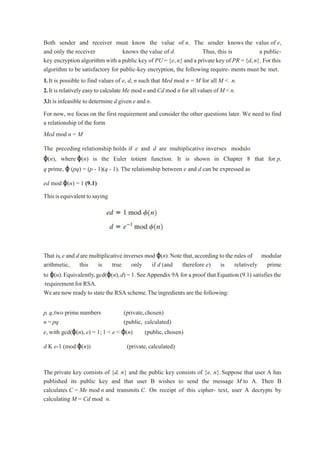
![Figure9.5summarizestheRSAalgorithm.ItcorrespondstoFigure9.1a:Alice
generatesapublic/privatekeypair;BobencryptsusingAlice’spublickey;andAlice
decrypts using her private key.An example from [SING99] is shown in Figure 9.6. Forthisexampl
e,thekeysweregeneratedas follows.
1. Select two prime numbers, p = 17 and q = 11.
2. Calculate n = pq = 17 ´ 11 = 187.
3. Calculate ϕ(n) = (p - 1)(q - 1) = 16 ´ 10 = 160.
4. Select e such that e is relatively prime to ϕ(n) = 160 and less than f(n); we choosee=7.
5. DeterminedsuchthatdeK1(mod160)andd<160.Thecorrectvalueisd=23,
because 23 ´ 7 = 161 = (1 ´ 160) + 1;d can be calculated using the extended
Euclid’salgorithm(Chapter4).
TheresultingkeysarepublickeyPU={7,187}andprivatekeyPR={23,187}. Theexampleshowst
heuseofthesekeysforaplaintextinputofM=88.Forencryp- tion, we need to
calculate C = 887 mod 187. Exploiting the properties of modular
arithmetic,wecandothisasfollows.
887 mod 187 = [(884 mod 187) ´ (882 mod 187)´ (881 mod 187)] mod 187
881 mod 187 = 88
882 mod 187 = 7744 mod 187 = 77
884 mod 187 = 59,969,536 mod 187 = 132
887 mod 187 = (88 ´ 77 ´ 132) mod 187 = 894,432 mod 187 = 11](https://image.slidesharecdn.com/7mce3c1-cryptographyandnetworksecurity-250401150745-92e9a590/85/Cryptography-and-Network-Security-ppt-pdf-79-320.jpg)
![For decryption, we calculate M = 1123 mod 187:
1123 mod 187 = [(111 mod 187) ´ (112 mod 187) ´ (114 mod 187)
´ (118 mod 187) ´ (118 mod 187)] mod 187
111 mod 187 = 11
112 mod 187 = 121
114 mod 187 = 14,641 mod 187 = 55
118 mod 187 = 214,358,881 mod 187 = 33
1123 mod 187 = (11 ´ 121 ´ 55 ´ 33 ´ 33) mod 187 = 79,720,245 mod 187 = 88
We now look at an example from [HELL79], which shows the use of RSA to process multiple
blocks of data. In this simple example, the plaintext is an alphanumeric string. Each plaintext](https://image.slidesharecdn.com/7mce3c1-cryptographyandnetworksecurity-250401150745-92e9a590/85/Cryptography-and-Network-Security-ppt-pdf-80-320.jpg)
![symbol is assigned a unique code of two decimal digits (e.g., a = 00, A = 26).6 A plaintext
block consists of fourdecimal
digits, or two alphanumeric characters. Figure 9.7a illustrates the sequence of events for
the encryption of multiple blocks, and Figure 9.7b gives a specific example. The circled
numbers indicate the order in which operations are performed.
Computational Aspects
Wenowturnto the issue ofthe complexity ofthecomputation requiredtouse RSA. There are
actually two issues to consider: encryption/decryption and key genera-
tion.Let us look first at the process of encryption and decryption and then consider key generation.
EXPONENTIATION IN MODULAR ARITHMETIC Bothencryption and decryption in
RSAinvolve raising an integer to an integer power,mod n.If the exponentiation is done over the
integers and then reduced modulo n, the intermediate values would
be gargantuan. Fortunately, as the preceding example shows, we can make use of a property of
modulararithmetic:
[(a mod n) * (b mod n)] mod n = (a * b) mod n
Thus, we can reduce intermediate results modulo n. This makes the calculation practical.
Another consideration is the efficiency of exponentiation,because with RSA, we are dealing with
potentially large exponents. Tosee how efficiency might be increased, consider
that we wish to compute x16. A straightforward approach requires15multiplications:](https://image.slidesharecdn.com/7mce3c1-cryptographyandnetworksecurity-250401150745-92e9a590/85/Cryptography-and-Network-Security-ppt-pdf-81-320.jpg)
![x16 = x * x * x * x * x * x * x * x * x * x * x * x * x * x * x * x
However,we can achieve the same final result with only four multiplications if we
repeatedlytakethesquareofeachpartialresult,successivelyforming(x2,x4,x8,x16).
Asanotherexample,supposewewishtocalculatex11modnforsomeintegersxand
n.Observethatx11 =x1+2+8 =(x)(x2)(x8).Inthiscase,wecomputexmodn,x2modn, x4modn,an
dx8modnandthencalculate[(xmodn)´(x2modn)´(x8modn)] mod n.
More generally, suppose we wish to find the value ab with a and m positive integers. If we
express b as a binary number bkbk-1. . . b0, then we have
Wecan therefore develop the algorithm7 for computing ab mod n, shown in
Figure 9.8.Table9.4shows an example of the execution of thisalgorithm.Notethat
the variable c is not needed;it is included for explanatory purposes.The final value
of c is the value of the exponent.
EFFICIENT OPERATION USING THE PUBLIC KEY To speed up the operation
of the RSA algorithm using the public key, a specific choice of e is usually made. The most](https://image.slidesharecdn.com/7mce3c1-cryptographyandnetworksecurity-250401150745-92e9a590/85/Cryptography-and-Network-Security-ppt-pdf-82-320.jpg)
![common choice is 65537 (216 + 1); two other popular choices are 3 and 17. Each of these
choices has only two 1 bits, so the number of multiplications required to perform
exponentiation isminimized.
However,withaverysmallpublickey,suchase=3,RSAbecomesvulnerable
to asimple attack.Supposewe have three different RSA users who all use the value e = 3 but have
unique values of n, namely (n1, n2, n3). If user A sends the same
encryptedmessageMtoallthreeusers,thenthethreeciphertextsareC1=M3modn1, C2 =M3 mod
n2,andC3 =M3 modn3.Itis likelythatn1,n2,andn3 are pairwiserela-
tively prime.Therefore,one can use the Chinese remainder theorem (CRT) to com-
pute M3 mod (n1n2n3).By the rules of the RSA algorithm,M is less than each of the ni;
therefore M3 < n1n2n3. Accordingly, the attacker need only compute the cube root of M3.
This attack canbe countered by adding a uniquepseudorandom bit string as padding to each insta
nce of M to be encrypted.This approach is discussed subsequently.
ThereadermayhavenotedthatthedefinitionoftheRSAalgorithm(Figure9.5)
requiresthatduringkeygenerationthe userselectsa valueofe thatis relativelyprime to f(n).Thus,if a
value of e isselected first and the primes pand qare generated,it may turn out that gcd(f(n), e) Z 1.
In that case, the user must reject the p, q values and generatea newp,qpair.
Table 9.4 Result of the Fast Modular Exponentiation Algorithm for ab mod n, where a = 7,
b = 560 = 1000110000, and n = 561
EFFICIENT OPERATION USING THE PRIVATE KEY Wecannot similarly choose a small
constant value of d for efficient operation. A small value of d is vulnerable to a brute-
force attack and to other forms of cryptanalysis [WIEN90].However,there is a way to speed up
computation using the CRT.Wewish to compute the value M = Cd mod n. Let us define the
following intermediate results:
Vp = Cd mod p Vq = Cd mod q
Following the CRT using Equation (8.8), define the quantities
Xp = q * (q - 1 mod p) Xq = p * (p - 1 mod q)
The CRT then shows, using Equation (8.9), that](https://image.slidesharecdn.com/7mce3c1-cryptographyandnetworksecurity-250401150745-92e9a590/85/Cryptography-and-Network-Security-ppt-pdf-83-320.jpg)
![M = (Vp Xp + Vq Xq) mod n
Furthermore, we can simplify the calculation of Vp and Vq using Fermat’s theorem, which states
that ap-1 K 1 (mod p) if p and a are relatively prime. Some thought should convince you that the
following are valid.
Vp = Cd mod p = Cd mod (p -1) mod p Vq = Cdmod q = Cd mod (q-1)mod q
Thequantitiesdmod(p-1)anddmod(q-1)canbeprecalculated.Theend resultisthat the
calculationisapproximatelyfourtimesasfastasevaluatingM=Cd modndirectly[BONE02].
KEY GENERATION Before the application of the public-key cryptosystem, each participant
must generate a pair of keys. This involves the following tasks.
• Determining two prime numbers,p and q.
• Selecting either e or d and calculating the other.
First, consider the selection of p and q. Because the value of n = pq will be known to any
potential adversary, in order to prevent the discovery of p and q by
exhaustivemethods,theseprimesmustbechosenfromasufficientlylargeset(i.e.,p and q must be l
arge numbers).On the other hand,the method used for finding large
primesmustbereasonablyefficient.
At present, there are no useful techniques that yield arbitrarily large primes, so some other
means of tackling the problem is needed. The procedure that is generally used is to pick at
random an odd number of the desired order of magni-
tude and test whether that number is prime.If not,picksuccessive random numbers
until one is found that tests prime.
A variety of tests for primality have been developed.Almost invariably,the tests are prob-
abilistic. That is, the test will merely determine that a given integer is probably prime. Despite
this lack of certainty, these tests can be run in such a way as to make the probability as close to
1.0 as desired. As an example, one of the more efficient and popular algorithms, the Miller-
Rabin algorithm, is described in Chapter 8. With this algorithm and most such algorithms,
the procedure for test- ing whether a given integer n is prime is to perform some calculation
that involves n and a randomly chosen integer a. If n “fails” the test, then n is not prime.
If n “passes” the test, then n may be prime or nonprime. If n passes many such tests with many
different randomly chosen values for a, then we can have high confidence that n is, in fact, prime.
In summary, the procedure for picking a prime number is as follows.
1.Pickanoddintegernatrandom(e.g.,usingapseudorandomnumbergenerator).
2.Pickanintegera < nat random.
3.Performtheprobabilisticprimalitytest,suchasMiller-
Rabin,withaasaparameter. Ifnfailsthetest,rejectthevaluenandgotostep1.
4.If n has passed a sufficient number of tests, accept n; otherwise, go to step2.](https://image.slidesharecdn.com/7mce3c1-cryptographyandnetworksecurity-250401150745-92e9a590/85/Cryptography-and-Network-Security-ppt-pdf-84-320.jpg)
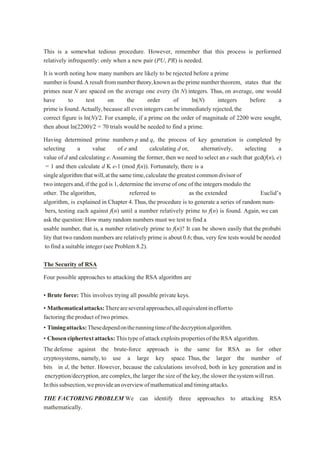
![1. Factor n into its two prime factors.This enables calculation of ϕ(n) = (p - 1) ´(q - 1),
which in turn enables determination of d K e-1 (mod ϕ(n)).
2. Determine ϕ(n) directly, without first determining p and q. Again, this enables determination of d
K e-1 (mod ϕ(n)).
3. Determine d directly, without first determining ϕ(n).
Table 9.5 Progress in Factorization
million-instructions-per-second processor running for one year, which is about 3 ´x 1013 instructions
executed. A 1 GHz Pentium is about a 250-MIPS machine.
AstrikingfactaboutTable9.5concernsthemethodused.Untilthemid-1990s, factoring attacks
were made using an approach known as the quadratic sieve. The attack on RSA-130 used a newer
algorithm, the generalized number field sieve (GNFS), and was able to factor a larger number
than RSA-129 at only 20% of the computing effort.
Thethreat to larger key sizes is twofold:the continuing increase in computing power and
the continuing refinement of factoring algorithms. Wehave seen that the
movetoadifferentalgorithmresultedinatremendousspeedup.Wecanexpectfurther
refinements in the GNFS,and the use of an even betteralgorithm is also a possibility. Infact,arelated
algorithm,thespecialnumberfieldsieve(SNFS),can factornumbers witha specialized form conside
rably faster thanthe generalized numberfieldsieve. Figure9.9comparestheperformanceofthetwo
algorithms.Itisreasonabletoexpecta breakthrough that would enable a general factoring
performance in about the same
timeasSNFS,orevenbetter[ODLY95].Thus,weneedtobecarefulinchoosingakey
size for RSA. For the near future, a key size in the range of 1024 to 2048 bits seems reasonable.
In addition to specifying the size of n,anumberofother constraintshave been
suggested by researchers.Toavoid values of n that may be factored more easily,the
algorithm’sinventorssuggestthefollowingconstraintsonpandq.
1. p andqshoulddifferin lengthbyonlyafewdigits.Thus,fora1024-bitkey (309
decimaldigits),bothpandqshouldbeontheorderofmagnitudeof1075to10100.
2. Both(p-1)and(q-1)shouldcontainalargeprimefactor.](https://image.slidesharecdn.com/7mce3c1-cryptographyandnetworksecurity-250401150745-92e9a590/85/Cryptography-and-Network-Security-ppt-pdf-86-320.jpg)
![3. gcd(p-1,q-1)shouldbesmall.
In addition,it has been demonstrated that if e < n and d < n1/4, then d can be easily
determined[WIEN90].
TIMING ATTACKS If one needed yet another lesson about how difficult it is to assess
the securityof acryptographic algorithm,theappearance oftimingattacksprovides
a stunning one. Paul Kocher, a cryptographic consultant, demonstrated that a
snooper can determine a private key by keeping track of how long a computer takes
todeciphermessages[KOCH96,KALI96b].Timingattacksareapplicablenotjustto
RSA,but to other public-key cryptography systems.This attack is alarming for two
reasons:Itcomesfromacompletelyunexpecteddirection,anditisaciphertext-only attack.
Atimingattackissomewhatanalogoustoaburglarguessingthecombination
of asafebyobservinghowlong it takesforsomeone toturn the dial fromnumberto
number. Wecan explain the attack using the modular exponentiation algorithm of
Figure 9.8,but theattack can be adapted towork withany implementation that does
not run in fixed time.In this algorithm,modular exponentiation is accomplished bit by bit, with one
modular multiplication performed at each iteration and an addi-
tional modular multiplication performed for each 1 bit.
As Kocher points out in his paper, the attack is simplest to understand in
an extremecase.Supposethe targetsystemusesamodularmultiplicationfunctionthatis very
fast in almost all cases but in a few cases takes much more time than an entire average modular
exponentiation. The attack proceeds bit-by-bit starting with theleftmost bit,bk.
Suppose that the first j bits are known (to obtain the entire exponent, start with j = 0 and repeat the
attack until the entire exponent is known). For a given ciphertext,theattackercancompletethe
firstjiterationsoftheforloop.Theoperationofthesubsequentstepdependsontheunknownexponentb
it.Ifthebitisset,d ;(d´ a)modnwillbeexecuted.Forafewvaluesofaandd,themodularmultiplicatio
nwillbeextremelyslow,andtheattackerknowswhichtheseare.Therefore,iftheobservedtime toexec
utethedecryptionalgorithmisalwaysslowwhenthisparticulariterationisslowwitha1bit,thenthisbit
isassumedtobe1.Ifanumberofobservedexecutiontimesfor theentirealgorithmare fast,thenthisbi
t isassumedtobe0.
Although the timing attack is a serious threat, there are simple countermeasures that can be used,
including the following.
• Constantexponentiationtime:Ensurethatallexponentiationstakethesame
amount of time before returning a result.This is a simple fix but does degrade performance.
• Random delay: Better performance could be achieved by adding a random delay to the
exponentiation algorithm to confuse the timing attack. Kocher
pointsoutthatifdefendersdon’taddenoughnoise,attackerscouldstillsucceed
bycollectingadditionalmeasurementstocompensatefortherandomdelays.
• Blinding: Multiply the ciphertext by a random number before performing exponentiation.](https://image.slidesharecdn.com/7mce3c1-cryptographyandnetworksecurity-250401150745-92e9a590/85/Cryptography-and-Network-Security-ppt-pdf-87-320.jpg)
![This process prevents theattacker from knowingwhatcipher- text bits are being processed inside
the computer and therefore prevents the bit-by-bitanalysisessentialtothetimingattack.
RSA Data Security incorporates a blinding feature into some of its products.
The private-key operation M = Cd mod n is implemented as follows.
1.Generateasecretrandomnumberrbetween0andn-1.
2.Compute C' = C(re) mod n,where e is the public exponent.
3.Compute M' = (C')d mod n with the ordinary RSA implementation.
4.Compute M = M'r-1 mod n.In this equation,r-1 is the multiplicative inverse of r mod n; see
Chapter 4 for a discussion of this concept. It can be demonstrated that this is the correct result by
observing that red mod n = r mod n.
RSA Data Security reports a 2 to 10% performance penalty for blinding.
CHOSEN CIPHERTEXT ATTACK AND OPTIMAL ASYMMETRIC ENCRYPTION PAD
DING
Thebasic RSA algorithm is vulnerable to a chosen ciphertext attack (CCA). CCA is
defined as an attack in which the adversary chooses a number of ciphertexts and is
thengiventhecorrespondingplaintexts,decryptedwiththetarget’sprivatekey.Thus, theadversaryc
ouldselectaplaintext,encryptitwiththetarget’spublickey,andthenbe able to get the plaintext back
by having it decrypted with the private key.Clearly, thisprovidestheadversarywithnonewinform
ation.Instead,theadversaryexploitsproperties of RSA and selects blocks of data that,when process
ed using the target’s privatekey,yieldinformationneededforcryptanalysis.
A simple example of a CCA against RSA takes advantage of the following property of RSA:
E(PU, M1) ´ E(PU, M2) = E(PU, [M1 ´ M2]) (9.2)
We can decrypt C = Me mod n using a CCA as follows.
1. Compute X =(C ´ 2e) mod n.
2. Submit X as a chosen ciphertext and receive back Y = Xd mod n. But now note that
X = (C mod n) * (2e mod n)
= (Me mod n) * (2e mod n)
= (2M)e mod n
Therefore, Y = (2M) mod n. From this, we can deduce M. Toovercome this
simple attack,practical RSA-based cryptosystems randomly pad the plaintext prior
to encryption. This randomizes the ciphertext so that Equation (9.2) no longer holds.
However,moresophisticatedCCAsarepossible,andasimplepaddingwitha random value has
been shown to be insufficient to provide the desired security.Tocounter such attacks, RSA
Security Inc., a leading RSA vendor and former holder of the RSA patent, recommends
modifying the plaintext using a procedure known](https://image.slidesharecdn.com/7mce3c1-cryptographyandnetworksecurity-250401150745-92e9a590/85/Cryptography-and-Network-Security-ppt-pdf-88-320.jpg)
![asoptimalasymmetricencryptionpadding(OAEP).Afulldiscussionofthethreats
and OAEP are beyond our scope;see [POIN02] for an introduction and [BELL94a]
for a thorough analysis.Here,we simply summarize the OAEPprocedure.
Figure 9.10 depicts OAEP encryption. As a first step, the message M to
be encryptedispadded.Asetofoptionalparameters,P,ispassedthroughahashfunction,
H.8 The output is then padded with zeros to get the desired length in the overall data
block (DB).Next,a random seed is generated and passed through another hash func-
tion,calledthemaskgeneratingfunction(MGF).Theresultinghashvalueisbit-by-bit XORed
with DB to produce a maskedDB. The maskedDB is in turn passed
through theMGFto formahashthatisXORedwiththeseedtoproducethemaskedseed.The concate
nationofthemaskedseedandthemaskedDBformstheencodedmessageEM. Note that the EM
includes the padded message, masked by the seed, and the
seed, maskedby the maskedDB.TheEM isthenencryptedusingRSA.
3.3 OTHER PUBLIC-KEY CRYPTOSYSTEMS
3.4 ELGAMAL CRYPTOGRAPHIC SYSTEM
In 1984,T.Elgamal announced a public-key scheme based on discrete logarithms, closely
related to the Diffie-Hellman technique [ELGA84, ELGA85]. The
ElGamal2 cryptosystemisusedinsomeforminanumberofstandardsincludingthe
digital signature standard (DSS), which is covered in Chapter 13,and the S/MIME e-mail standard
(Chapter18).](https://image.slidesharecdn.com/7mce3c1-cryptographyandnetworksecurity-250401150745-92e9a590/85/Cryptography-and-Network-Security-ppt-pdf-89-320.jpg)
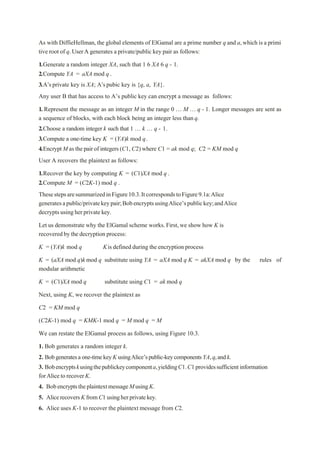
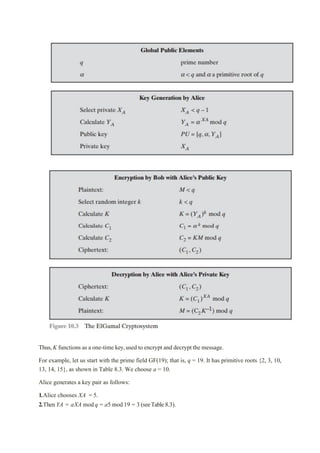
![3.Alice’s private key is 5; Alice’s pubic key is {q, a, YA} = {19, 10, 3}.
Suppose Bob wants to send the message with the value M = 17. Then,
1.Bob chooses k = 6.
2.Then K = (YA)k mod q = 36 mod 19 = 729 mod 19 = 7.
3.So C1 = ak mod q = a6 mod 19 = 11C2 = KM mod q = 7 * 17 mod 19 = 119 mod 19 = 5
4.Bob sends theciphertext(11,5).
Fordecryption:
1.Alice calculates K = (C1)XA mod q = 115 mod 19 = 161051 mod 19 = 7.
2. Then K -1 in GF(19) is 7-1 mod 19 = 11.
3. Finally, M = (C2K- 1) mod q = 5 * 11 mod 19 = 55 mod 19 = 17.
If a message must be broken up into blocks and sent as a sequence of encrypted blocks,
a unique value of k should be used for each block.If k is used formore than one block,knowledge of
one block m1 of the message enables the user to computeotherblocksasfollows.Let
The security of ElGamal is based on the difficulty of computing discrete logarithms. To recover A’s
private key, an adversary would have to compute XA = dloga,q(YA) . Alternatively, to recover the
one-time key K, an adversary would have to determine the random number k, and this would
require comput- ing the discrete logarithm k = dloga,q(C1). [STIN06] points out that these calcu-
lations are regarded as infeasible if p is at least 300 decimal digits and q - 1 has at least one “large”
prime factor.
3.5 ELLIPTIC CURVE ARITHMETIC
Most of the products and standards that use public-key cryptography for encryp- tion and digital
signatures use RSA. As we have seen, the key length
for secure RSA use has increased over recent years,and this has put a heavier processing load
on applications using RSA.This burden has ramifications,especially for electronic commerce sites
that conduct large numbers of secure transactions. A competing
system challenges RSA:elliptic curve cryptography (ECC). ECC is showing up in standardization
efforts, including the IEEE P1363 Standard for Public-Key Cryptography.](https://image.slidesharecdn.com/7mce3c1-cryptographyandnetworksecurity-250401150745-92e9a590/85/Cryptography-and-Network-Security-ppt-pdf-92-320.jpg)
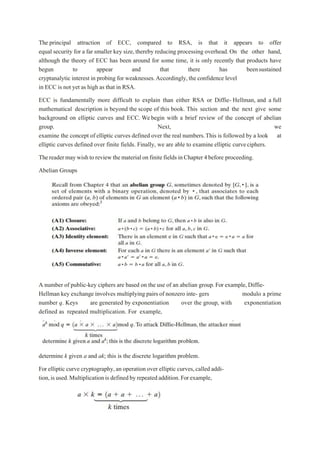
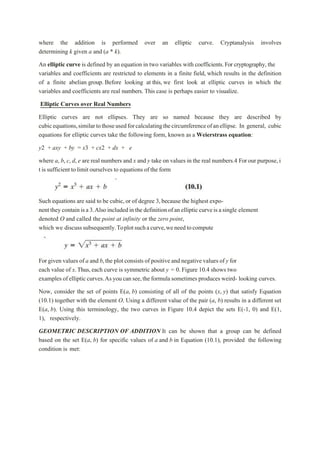
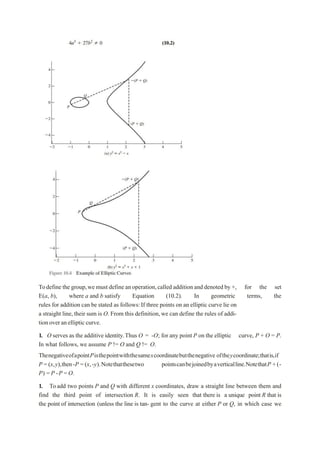
![take R = P or R = Q, respectively). Toform a group structure, we need to define addition on these
three points: P + Q = -R. That is, we define P + Q to be the mirror
image (withrespecttothexaxis)ofthethirdpointofintersection.Figure10.4illustrates thisconstruction.
2. The geometric interpretation of the preceding item also applies to two points,P and -P, with the
same x coordinate. The points are joined by a vertical
line, whichcanbeviewedasalsointersectingthecurveattheinfinitypoint.Wethere- fore have P + (-
P) = O, which is consistent with item (2).
3. Todouble a point Q, draw the tangent line and find the other point of inter- section S.
Then Q + Q = 2Q = -S.
With the preceding list of rules, it can be shown that the set E(a, b) is an abelian group.
ALGEBRAIC DESCRIPTION OF ADDITION In this subsection, we present some results that
enable calculation of additions over elliptic curves.5 For two distinct points, P = (xP , yP)
and Q = (xQ, yQ), that are not negatives of each other, the slope of the line l that joins them
is Δ = (yQ - yP)>(xQ - xP) . There is exactly one other point
where l intersects the elliptic curve,and that is the negative of the sum of P and Q.
After some algebraic manipulation, we can express the sum R = P + Q as
Elliptic Curves over Zp
Ellipticcurvecryptographymakesuseofellipticcurvesinwhichthevariablesand coefficients are
all restricted to elements of a finite field. Two families of elliptic curves are used in cryptographic
applications: prime curves over Zp and binarycurvesoverGF(2m).
ForaprimecurveoverZp,weuseacubicequationinwhichthevariables and coefficients all take on
values in the set of integers from 0 through p -
1andinwhichcalculationsareperformedmodulop.Forabinarycurvedefinedover GF(2m),the vari
ables and coefficients all take on values in GF(2m) and in cal- culations are performed over GF(2m).
[FERN99] points out that prime curves are best for software applications,because the extended bit-
fiddling operations needed by binary curves are not required; and that binary curves are best for
hardware applications, where it takes remarkably few logic gates to create a powerful, fast
cryptosystem.Weexaminethese twofamiliesinthissectionandthenext.](https://image.slidesharecdn.com/7mce3c1-cryptographyandnetworksecurity-250401150745-92e9a590/85/Cryptography-and-Network-Security-ppt-pdf-96-320.jpg)
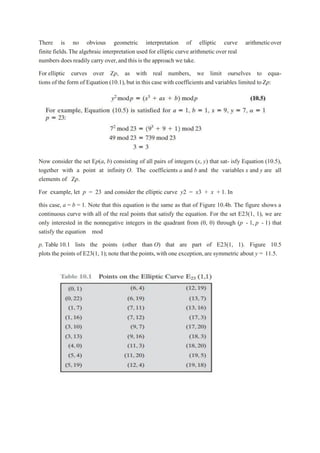
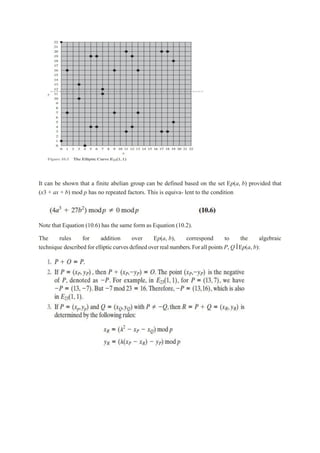
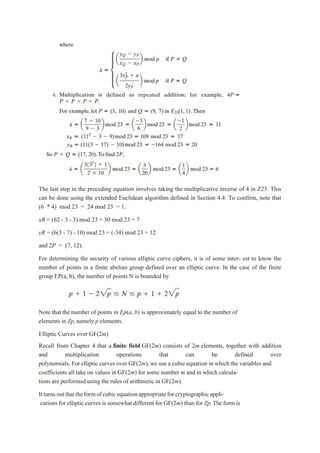
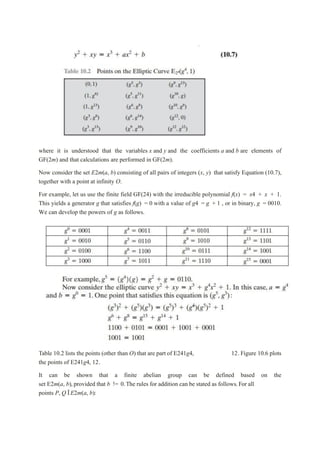
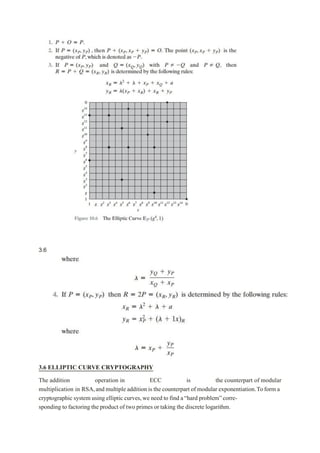
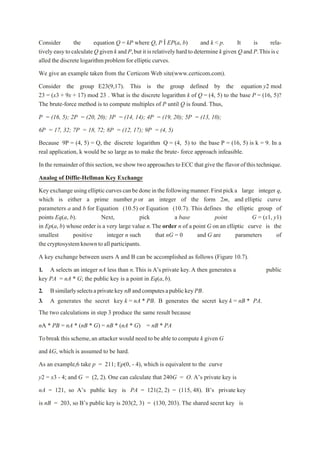
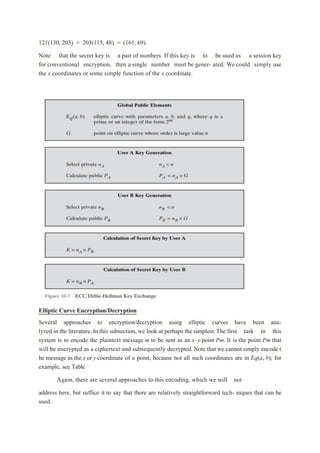
![As with the key exchange system,an encryption/decryption system requires a point G and an elliptic
group Eq(a, b) as parameters. Each user A selects a private key nA and generates a public
key PA = nA *G.
Toencrypt and send a message Pm to B,A chooses a random positive integer k
and produces the ciphertext Cm consisting of the pair of points:
Cm = {kG, Pm + kPB}
Note that A has used B’s public key PB.To decrypt the ciphertext, B multiplies the first point in the
pair by B’s secret key and subtracts the result from the second point:
Pm + kPB - nB(kG) = Pm + k(nBG) - nB(kG) = Pm
A has masked the message Pm by adding kPB to it. Nobody but A knows the value of k, so even
though Pb is a public key, nobody can remove the mask kPB. However, A also includes a “clue,”
which is enough to remove the mask if one knows the private key nB. For an attacker to recover the
message, the attacker would have to compute k given G and kG, which is assumed to be hard.
As an example of the encryption process (taken from [KOBL94]), take p = 751; Ep(-1, 188)
, which is equivalent to the curve y2 = x3 - x + 188; and G = (0, 376). Suppose that A wishes to
send a message to B that is encoded in the elliptic point Pm = (562, 201) and that A selects the
random number k = 386. B’s public key is PB = (201, 5). We have 386(0, 376) = (676, 558),
and (562, 201) + 386(201, 5) = (385, 328). Thus, A sends the cipher text {(676, 558),
(385, 328)}.
Security of Elliptic Curve Cryptography
The security of ECC depends on how difficult it is to determine k given kP and P.
This is referred to as the elliptic curve logarithm problem.The fastest known technique for taking
the elliptic curve logarithm is known as the Pollard rho
method. Table 10.3 compares various algorithms by showing comparable key sizes in terms
ofcomputationaleffortforcryptanalysis.Ascanbeseen,aconsiderablysmallerkey
size can be used for ECCcompared toRSA.Furthermore,for equal key lengths,the computational
effort required for ECC and RSA is comparable [JURI97]. Thus, there is a computational advantage
to using ECC with a shorter key length than a comparably secureRSA.
Table 10.3 Comparable Key Sizes in Terms of Computational Effort for Cryptanalysis](https://image.slidesharecdn.com/7mce3c1-cryptographyandnetworksecurity-250401150745-92e9a590/85/Cryptography-and-Network-Security-ppt-pdf-104-320.jpg)
![3.7 PSEUDORANDOM NUMBER GENERATION BASED ON AN ASYMMETRIC
CIPHER
Wenoted in Chapter 7 that because a symmetric block cipher produces an
apparently random output,it can serve as the basis of a pseudorandom number generator (PRNG). Si
milarly, an asymmetric encryption algorithm produces apparently random output and can be used
to build a PRNG. Because asymmetric algorithms are typically much slower than symmetric
algorithms, asymmetric algorithms are not used to generate open-ended PRNG bit streams.
Rather, the asymmetric approach is useful for creating a pseudorandom function (PRF) for
generating a short pseudorandom bitsequence.
In this section, we examine two PRNG designs based on pseudorandom functions.
PRNG Based on RSA
For a sufficient key length, the RSA algorithm is considered secure and is a good candidate to form
the basis of a PRNG. Such a PRNG, known as the Micali-Schnorr PRNG [MICA91], is
recommended in the ANSI standard X9.82 (Random Number Generation) and in the ISO standard
18031 (Random Bit Generation).
ThePRNGisillustratedinFigure10.8.Ascanbeseen,thisPRNGhasmuchthe samestructureastheo
utputfeedback(OFB)modeusedasaPRNG(seeFigure7.3b
and the portion of Figure 6.6a enclosed with a dashed box).In this case,the encryption algorithm is
RSA rather than a symmetric block cipher. Also, a portion of the
output is fed back to the next iteration of the encryption algorithm and the remain-
der of the outputis usedaspseudorandombits.Themotivation for this separationof
the outputinto two distinctparts is so that the pseudorandom bits from onestage do not provide input
to the next stage. This separation should contribute to forward unpredictability.](https://image.slidesharecdn.com/7mce3c1-cryptographyandnetworksecurity-250401150745-92e9a590/85/Cryptography-and-Network-Security-ppt-pdf-105-320.jpg)
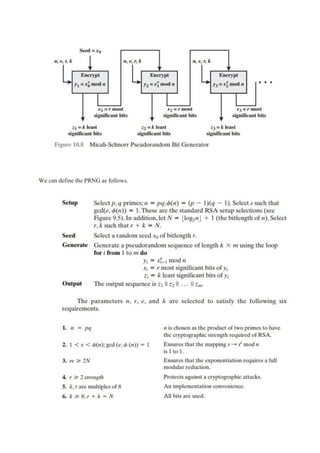
![Thevariablestrengthinrequirement4isdefinedinNISTSP800-90asfollows: A number associated
with the amount of work (that is, the number of operations)
required to break a cryptographic algorithm or system; a security strength is speci- fied in bits and is
a specific value from the set (112, 128, 192,
256) for this Recommendation.Theamount of workneeded is 2strength.
There is clearly a tradeoff between r and k. Because RSA is computation- ally intensive
compared to a block cipher, we would like to generate as many pseudorandom bits
per iteration as possible and therefore would
like a large value of k.However, for cryptographic strength, we would like r to be as large as poss
ible.
For example, if e = 3 and N = 1024 , then we have the inequality 3r 7 1024, yielding a minimum
required size for r of 683 bits. For r set to that size, k = 341 bits are generated for each
exponentiation (each RSA encryption). In this case, each exponentiation requires only one modular
squaring of a 683-bit number and one modular multiplication. That is, we need only calculate 1xi *
1xi mod n22mod n .
PRNG Based on Elliptic Curve Cryptography
Inthissubsection,webrieflysummarizeatechniquedevelopedbytheU.S.National Security Agency
(NSA) known as dual elliptic curve PRNG (DEC PRNG). This technique is recommended in NIST
SP 800-90, the ANSI standard X9.82, and the ISO standard 18031.There has been some
controversy regarding both the security
andefficiencyofthisalgorithmcomparedtootheralternatives(e.g.,see[SCHO06], [BROW07]).
[SCHO06] summarizes the algorithm as follows: Let P and Q be two known points on a given
elliptic curve. The seed of the DEC PRNG is a random integer s0 Î {0, 1, ...... , #E(GF(p)) - 1},
where # E(GF(p)) denotes the number of points onthecurve.Letxdenoteafunctionthatgivesthex-
coordinateofapointofthecurve. Let lsbi1s2 denote the i least significant bits of
an integer s. The DEC PRNG trans-
formstheseedintothepseudorandomsequenceoflength240k,k > 0,asfollows.
Given the security concerns expressed for this PRNG,the only motivation for its use would be that it
is used in a system that already implements ECC but does not implement any other symmetric,
asymmetric, or hash cryptographicalgorithm that could be used to build aPRNG.](https://image.slidesharecdn.com/7mce3c1-cryptographyandnetworksecurity-250401150745-92e9a590/85/Cryptography-and-Network-Security-ppt-pdf-107-320.jpg)
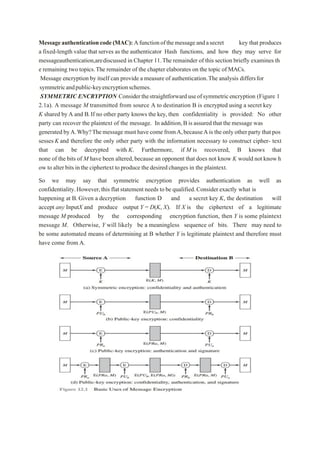
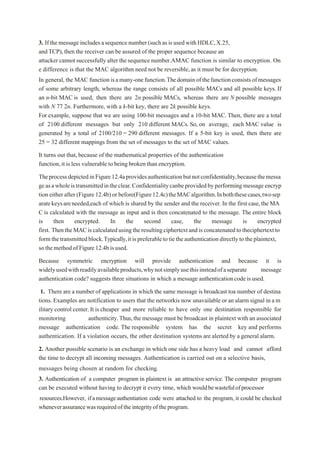
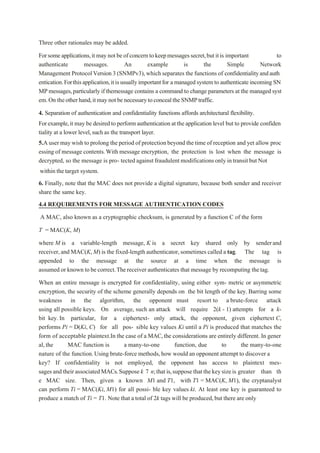
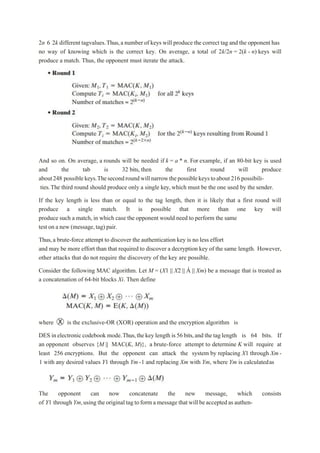
![tic by the receiver.With this tactic,any message of length 64 * (m - 1) bits can be
fraudulentlyinserted.
Thus, in assessing the security of a MAC function, we need to consider the types of attacks that
may be mounted against it. With that in mind, let us state the requirements for the function. Assume
that an opponent knows the MAC function but does not know K. Then the MAC function should
satisfy the following requirements.
1. If an opponent observes M and MAC(K, M), it should be computationally infeasible for the
opponent to construct a message M¿ such that MAC(K,’') = MAC(K, M)
2. MAC(K, M) should be uniformly distributed in the sense that for randomly cho-
sen messages, M and M¿, the probability that MAC(K, M) = MAC(K, M') is 2 -n, where n is
the number of bits in the tag.
3. Let M’’’’ be equal to some known transformation on M.That is, M” = f(M).For example, f may
involve inverting one or more specific bits. In that case,Pr [MAC(K, M) = MAC(K, M')] = 2-n
The first requirement speaks to the earlier example, in which an opponent is able to construct a new
message to match a given tag, even though the opponent does not know and does not learn
the key. The second requirement deals with the need to thwart a brute-
force attack based on chosen plaintext.That is,if we assume that the opponent does not know K but
does have access to the MAC function and can present messages for MAC generation, then the
opponent could try various messages until finding one that matches a given tag. If
the MAC function exhibits uniform distribution, then a brute-force method would require, on
average, 2(n - 1) attemptsbefore finding a message that fits a given tag.
The final requirement dictates that the authentication algorithm should not beweaker with respect to
certain parts or bits of the message than others. If this were not the case, then an opponent who
had M and MAC(K, M) could attempt varia tions on M at the known“weak spots”with a likelihood
of early success at producing a new message that matched the old tags.
4.5 SECURITY OF MACS
Just as with encryption algorithms and hash functions, we can group attacks on MACs into two
categories: brute-force attacks and cryptanalysis.
Brute-Force Attacks
A brute-force attack on a MAC is a more difficult undertaking than a brute-force attack on a hash
function because it requires known message-tag pairs. Let us see
why this is so.Toattack a hash code, we can proceed in the following way.Given a fixed
message x with n-bit hash code h = H(x), a brute-force method of finding a
collision is to pick a random bit string y and check if H(y) = H(x).The attacker can
do this repeatedly off line.Whether an off-line attack can be used on a MAC Algorithm depends
on the relative size of the key and the tag.
To proceed, we need to state the desired security property of a MAC algo- rithm, which can be
expressed as follows.](https://image.slidesharecdn.com/7mce3c1-cryptographyandnetworksecurity-250401150745-92e9a590/85/Cryptography-and-Network-Security-ppt-pdf-118-320.jpg)
![Computationresistance:Givenoneormoretext-MACpairs[xi,MAC(K,xi)], it is
Computationally infeasible to compute any text-MAC pair [x, MAC(K, x)] for any new
input x |=xi.
In other words, the attacker would like to come up with the valid MAC code for a given message x.
There are two lines of attack possible: attack the key space and attack the MAC value. We examine
each of these in turn.
If an attacker can determine the MAC key, then it is possible to generate a
valid MACvalue for any input x.Suppose the key sizeis k bits and that the attacker has one known
text–tag pair. Then the attacker can compute the n-bit tag on the
known text for all possible keys.At least one key is guaranteed to produce the correct tag,namely,th
e valid key that was initially used to produce the known text–tag pair. This phase of the attack takes
a level of effort proportional to 2k (that is, one
operationforeachofthe 2k possible keyvalues).However,aswasdescribedearlier, because the
MAC is a many-to-one mapping,there may be other keys that produce the correct value.
Thus,if more than one key is found to produce the correct value, additional text–tag pairs must be
tested. It can be shown that the level of effort drops off rapidly with each additional text–MAC pair
and that the overall level of effortisroughly2k[MENE97].
An attacker can also work on the tag without attempting to recover the key. Here, the objective is to
generate a valid tag for a given message or to find a message that matches a given tag. In either
case, the level of effort is comparable to that for attacking the one-way or weak collision-resistant
property of a hash code, or 2n. In the case of the MAC, the attack cannot be conducted off line
without further input; the attacker will require chosen text–tag pairs or knowledge of the key.
To summarize, the level of effort for brute-force attack on a MAC algorithm can be expressed as
min(2k, 2n). The assessment of strength is similar to that for symmetric encryption algorithms. It
would appear reasonable to require that the key length and tag length satisfy a relationship such as
min(k, n) Ú N, where N is perhaps in the range of 128 bits.
Cryptanalysis
As with encryption algorithms and hash functions, cryptanalytic attacks on MAC algorithms seek
to exploit some property of the algorithm to perform some attack other than an exhaustive search.
The way to measure the resistance of a MAC algorithm to cryptanalysis is to compare its strength
to the effort required for a brute-force attack. That is, an ideal MAC algorithm will require a
cryptanalytic effort greater than or equal to the brute-force effort.
There is much more variety in the structure of MACs than in hash functions, so it is difficult to
generalize about the cryptanalysis of MACs. Furthermore, far less work has been done on
developing such attacks. A useful survey of some methods for specific MACs is [PREN96].
4.6 MACS BASED ON HASH FUNCTIONS: HMAC](https://image.slidesharecdn.com/7mce3c1-cryptographyandnetworksecurity-250401150745-92e9a590/85/Cryptography-and-Network-Security-ppt-pdf-119-320.jpg)
![Later in this chapter,we look at examples of a MAC based on the use of a symmet-
ric block cipher. This has traditionally been the most common approach to constructing
aMAC.Inrecentyears,therehas beenincreasedinterestindeveloping a MAC derived from a
cryptographic hash function. The motivations for this interest are
1. Cryptographic hash functions such as MD5 and SHA generally execute faster
insoftwarethansymmetricblockcipherssuchasDES.
2. Librarycodeforcryptographichashfunctionsiswidelyavailable.
With the development of AES and the more widespread availability of code
for encryption algorithms, these considerations are less significant, but hash-
based MACscontinue tobewidely used.
A hash function such as SHA was not designed for use as a MAC and cannot
be useddirectlyfor thatpurpose,becauseit does notrely onasecretkey.Therehave been a number of
proposals for the incorporation of a secret key into an existing hash algorithm. The approach
that has received the most support is HMAC
[BELL96a,BELL96b].HMAChasbeenissuedasRFC2104,hasbeenchosenasthe mandatory-to-
implement MAC for IP security, and is used in other Internet proto-
cols,suchasSSL.HMAChas alsobeenissuedasaNISTstandard(FIPS198).
HMAC Design Objectives
RFC 2104 lists the following design objectives for HMAC.
Touse, without modifications, available hash functions. In particular, to use hash functions
that perform well in software and for which code is freely and widely available.
Toallow for easy replace ability of the embedded hash function in casefaster
or more secure hash functions are found or required.
Topreserve the original performance of the hash function without incurring a significant de
gradation.
Touseand handle keys in asimple way.
Tohave a well understood cryptographic analysis of the strength of the authentication
mechanism based on reasonable assumptions about the embedded hashfunction.
The first two objectives are important to the acceptability of HMAC. HMAC treats the hash
function as a “black box.” This has two benefits. First, an existing implementation of a hash
function can be used as a module in implementing HMAC. In this way, the bulk of
the HMAC code is prepackaged and ready to use without modification.Second,ifitiseverdesired
toreplaceagivenhashfunctioninan HMAC implementation, all that is required is to remove the exi
sting hash function module and drop in the new module.This could be done if a faster hash function
were desired. More important, if the security of the embedded hash function were compromised,
the security of HMAC could be retained simply by replacing the embedded hash function with a
more secure one (e.g., replacing SHA-2 with SHA-3).](https://image.slidesharecdn.com/7mce3c1-cryptographyandnetworksecurity-250401150745-92e9a590/85/Cryptography-and-Network-Security-ppt-pdf-120-320.jpg)
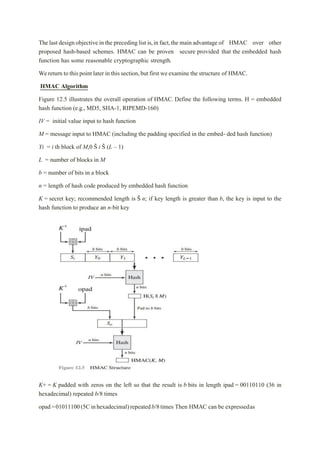
![HMAC(K, M) = H[(K+ Ⓧ opad) || H[(K+ Ⓧ ipad) || M]]
We can describe the algorithm as follows.
1. Append zeros to the left end of K to create a b-bit string K+ (e.g., if K is of
length 160 bitsand b = 512,then K will beappended with 44 zeroes).
2. XOR(bitwiseexclusive-OR)K+ withipadtoproducetheb-bitblockSi.
3. Append M to Si.
4. ApplyH to the streamgenerated in step3.
5. XOR K+ withopad to producethe b-bit block So.
6. Append the hashresultfrom step 4 to So.
7. Apply H to the stream generated in step 6 and output theresult.
Note that the XOR with ipad results in flipping one-half of the bits of K.
Similarly,theXORwithopadresultsinflippingonehalfofthebitsofK,usingadifferent set of bits.
In effect,by passing Si and So through the compression function ofthe hash algorithm,we have pseud
orandomly generated two keys from K.
HMAC should execute in approximately the same time as the embedded hashfunction for long messa
ges.HMAC adds three executions of the hash compressionfunction (for Si,So,and the block produce
d from the inner hash).
A more efficient implementation is possible, as shown in Figure 12.6. Two quantities
are precomputed:
f(IV, (K + Ⓧ ipad))
f(IV, (K + Ⓧ opad))
where f(cv, block) is the compression function for thehash function,which takesas
argumentsachainingvariableof nbitsandablockof bbits andproducesachaining
variableofnbits.Thesequantities onlyneedtobecomputedinitiallyandeverytime
the keychanges.In effect,the precomputedquantitiessubstitute for theinitial value
(IV) in the hash function.With this implementation,only one additional instance of
the compression function is added to the processing normally produced by the hash
function.Thismoreefficientimplementationisespeciallyworthwhileifmostofthe
messages for whicha MACis computed areshort.
Security of HMAC
The security of any MAC function based on an embedded hash function depends in some way on
the cryptographic strength of the underlying hash function. The
appeal of HMAC is that its designers have been able to prove an exact relationship between the
strength of the embedded hash function and the strength of HMAC.](https://image.slidesharecdn.com/7mce3c1-cryptographyandnetworksecurity-250401150745-92e9a590/85/Cryptography-and-Network-Security-ppt-pdf-122-320.jpg)
![The security of a MAC function is generally expressed in terms of the probability of successful
forgery with a given amount of time spent by the forger and a given number of message–tag pairs
created with the same key. In essence, it is proved in [BELL96a] that for a given level of effort
(time, message–tag pairs) on messages generated by a legitimate user and seen by the attacker,
the probability of successful attack on HMAC is equivalent to one of the following attacks
on the embedded hashfunction.
1. The attacker is able to compute an output of the compression function even
with an IV that is random,secret, and unknown to the attacker.
2. The attacker finds collisions in the hash function even when the IV is random and secret.
In the first attack, we can view the compression function as equivalent tothe
hashfunctionappliedtoamessage consisting ofasingle bbit block.Forthisattack, the IV of the
hash function is replaced by a secret,random value of n bits.An attack
on this hash function requires either a brute-force attack on the key,which is a level
of effort ontheorder of 2n,or abirthdayattack,whichisaspecialcase ofthesecond
attack,discussednext.
In the second attack, the attacker is looking for two messages M and M¿ that produce the same ha
sh: H(M) = H(M¿). This is the birthday attack discussed in Chapter 11. We have shown that this
requires a level of effort of 2n/2 for a hash length of n. On this basis, the security of MD5 is called
into question, because a level of effort of 264 looks feasible with today’s technology. Does this](https://image.slidesharecdn.com/7mce3c1-cryptographyandnetworksecurity-250401150745-92e9a590/85/Cryptography-and-Network-Security-ppt-pdf-123-320.jpg)
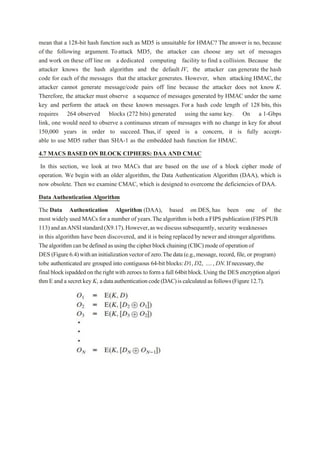
![The DAC consists of either the entire block ON or the leftmost M bits of the block, with
16 <= M <= 64.
Cipher-Based Message Authentication Code (CMAC)
As was mentioned, DAA has been widely adopted in government and industry.
[BELL00] demonstrated that this MAC is secure under a reasonable set of security criteria,
with thefollowing restriction.Onlymessagesof one fixed length of mnbits are processed,
where n isthecipher blocksize and m isa fixedpositive integer.Asa simple example, notice that
given the CBC MAC of a one-block message X, say T = MAC(K, X), the adversary immediately
knows the CBC MAC for the two- block message X || (X {T) since this is once again T.
Black and Rogaway [BLAC00] demonstrated that this limitation could be overcome using three
keys: one key of length K to be used at each step of the cipher block chaining and two keys of
length n, where k is the key length and n is the cipher block length. This proposed
construction was refined by Iwata and Kurosawa so that the two n-bit keys could be derived
from the encryption key, rather than being provided separately [IWAT03]. This refinement,
adopted by NIST,istheCipher-basedMessageAuthenticationCode(CMAC)modeofoperation
for use with AES and triple DES. It is specified in NIST Special Publication 800-38B.
First, let us define the operation of CMAC when the message is an integer multiple n of the cipher
block length b. For AES, b = 128, and for triple DES, b = 64. The message is divided
into n blocks (M1, M2, . . . , Mn). The algorithm makes use of a k-bit encryption key K and an n-bit
constant, K1. For AES, the key
sizekis128,192,or256bits;fortripleDES,thekeysizeis112or168bits.CMACis
calculatedasfollows(Figure12.8).](https://image.slidesharecdn.com/7mce3c1-cryptographyandnetworksecurity-250401150745-92e9a590/85/Cryptography-and-Network-Security-ppt-pdf-125-320.jpg)
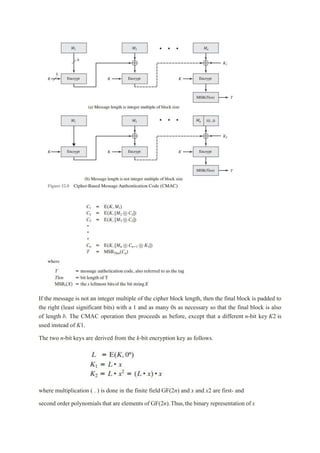
![consistsof n - 2 zeros followed by 10;the binary representation of x2 consists of n - 3 zeros followed
by 100. The finite field is defined with respect to an irreducible polynomial that is lexicographically
first among all such polynomials with the minimum possible number of nonzero terms. For the two
approved block sizes, the polynomials are x64 + x4 + x3 + x + 1 and x128 + x7 + x2 + x + 1.
Togenerate K1 and K2, the block cipher is applied to the block that consists entirely of 0 bits.
The first subkey is derived from the resulting ciphertext by aleft
shift of one bit and,conditionally,by XORing a constant that depends on the block size. The second
subkey is derived in the same manner from the first subkey. This property of finite
fields of the form GF(2n) was explained in the discussion of MixColumnsinChapter5.
4.8 AUTHENTICATED ENCRYPTION: CCM AND GCM
Authenticated encryption (AE) is a term used to describe encryption systems that simultaneously
protect confidentiality and authenticity (integrity) of communications. Many applications and
protocols require both forms of security, but until recently the two services have been designed
separately.
HtE:Hash-then-encrypt.Firstcomputethecryptographichashfunctionover
M as h = H(M). Then encrypt the message plus hash function: E(K, (M||h)).
MtE: MAC-then-encrypt. Use two keys. First authenticate the plaintext by computing
the MAC value as T = MAC(K1, M). Then encrypt the message plus tag: E(K2, (M || T).
This approach is taken by the SSL/TLS protocols (Chapter 16).
EtM: Encrypt-then-MAC. Use two keys. First encrypt the message to yieldthe
ciphertext C = E(K2, M). Then authenticate the ciphertext with T = MAC(
K1, C) to yield the pair (C, T). This approach is used in the IPsec protocol (Chapter 19).
E&M: Encrypt-and-MAC.
Use two keys. Encrypt the message to yield the ciphertext C = E(K2, M). Authenticate the plaintext
with T = MAC(K1, M) to yield the pair (C, T). These operations can be performed in either order.
This approach is used by the SSH protocol (Chapter 16).
Both decryption and verification are straightforward for each approach. For HtE, MtE, and E&M,
decrypt first, then verify. For EtM, verify first, then decrypt. There are security vulnerabilities with
all of these approaches.The HtE approach isusedin theWiredEquivalentPrivacy(WEP) protocoltop
rotectWiFinetworks.This approachhadfundamentalweaknessesandledtothereplacementoftheWE
Pproto- col. [BLAC05] and [BELL00] point out that there security concerns in each of the
threeencryption/MACapproacheslistedabove.Nevertheless,withproperdesign,any of these approach
es can provide a high level of security.This is the goal of the two approachesdiscussedinthissection,
bothofwhichhavebeenstandardizedbyNIST.](https://image.slidesharecdn.com/7mce3c1-cryptographyandnetworksecurity-250401150745-92e9a590/85/Cryptography-and-Network-Security-ppt-pdf-127-320.jpg)
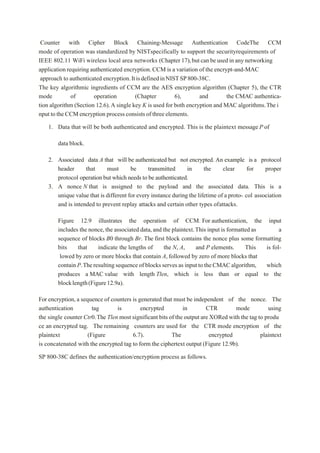
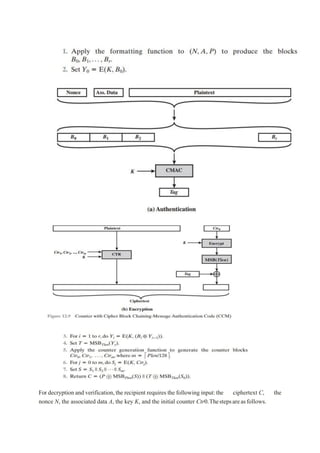
![1. If Clen £ Tlen, then returnINVALID.
2. Apply the counter generation function to generate the counter blocks
Ctr0, Ctr1, Á, Ctrm, where m = < Clen/128 >.
3. For j = 0 to m, do Sj = E(K, Ctrj).
4. Set S = S1 || S2 || Á || Sm.
5. SetP =MSBClen-Tlen(C){MSBClen-Tlen(S).
6. SetT = LSBTlen(C) NOR MSBTlen(S0).
7. Apply the formatting function to (N, A,P) to produce the blocks B0, B1, Á , Br.
8. Set Y0 = E(K, B0).
9. Fori = 1tor,doYi = E(K,(Bi NOR Yi-1)).
10. If T |=MSBTlen (Yr), then return INVALID, else returnP
CCM is a relatively complex algorithm. Note that it requires two complete
passes through the plaintext,once to generate the MAC value,and once for encryp-
tion.Further,the details of the specification require a tradeoff between the length of
thenonceandthelengthofthetag,whichisanunnecessaryrestriction.Alsonotethat
theencryptionkeyisusedtwicewiththeCTRencryptionmode:oncetogeneratethe tag and once to en
crypt the plaintext plus tag.Whetherthese complexities add to the security of the algorithm is not
clear. In any case, two analyses of the algorithm
([JONS02]and[ROGA03])concludethatCCMprovidesahighlevelofsecurity.
Galois/Counter Mode
The GCM mode of operation, standardized by NIST in NIST SP 800-38D, is designed to be
parallelizable so that it can provide high throughput with low cost
and low latency.In essence, the message is encrypted in variant of CTR mode.The resulting cipherte
xt is multiplied with key material and message length informationover GF(2128) to generate the auth
enticator tag.The standard also specifies a modeof operation that supplies the MAC only,known as
GMAC.
The GCM mode makes use of two functions: GHASH, which is a keyed hash function, and GCTR,
which is essentially the CTR mode with the counters deter- mined by a simple increment by
one operation.
GHASHH(X) takes a input the hash key H and a bit string X such that len(X) = 128m bits forsome
positiveinteger m andproduces a128bitMACvalue. Thefunctionmaybespecifiedasfollows(Figur
e12.10a).](https://image.slidesharecdn.com/7mce3c1-cryptographyandnetworksecurity-250401150745-92e9a590/85/Cryptography-and-Network-Security-ppt-pdf-130-320.jpg)
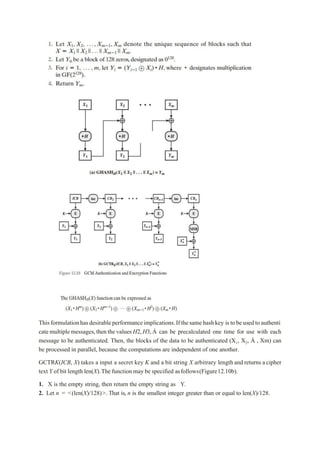
![Note that the counter values can be quickly generated and that the encryption operations can be
performed in parallel.
We can now define the overall authenticated encryption function (Figure 12.11). The input consists
of a secret key K, an initialization vector IV, a plaintext P, and
additional authenticated data A.Thenotation [x]s means the s-bit binary representationofthe
nonnegativeintegerx.Thestepsareasfollows.
1. Let H = E(K, 0128).
2. Define a block, J0, as If len(IV) = 96, then let J0 = IV || 031 ||
1.If len (IV) |=96, then let s = 128 < len(IV)/128 = -len(IV), and let
J0 = GHASHH(IV || 0s + 64 || [len(IV)]64).
3. Let C = GCTRK(inc32(J0), P).](https://image.slidesharecdn.com/7mce3c1-cryptographyandnetworksecurity-250401150745-92e9a590/85/Cryptography-and-Network-Security-ppt-pdf-132-320.jpg)
![4. Let u = 128 <len(C)/128> - len(C) and let v = 128 <len(A)/128> -len(A).
5. Define a block, S, asS = GHASHH(A || 0v || C || 0u || [len(A)]64 || [len(C)]64)
6. Let T = MSBt(GCTRK1J0, S)), where t is the supported tag length.
7. Return (C, T).
In step 1,the hash key is generated by encrypting a block of all zeros with the secret key K. In step 2,
the pre-counter block (J0) is generated from the IV. In par- ticular, when the length of the IV is
96 bits, then the padding string 031 || 1 is appended to the IV to form the pre-counter block.
Otherwise,
the IV is padded with the minimum number of 0 bits, possibly none, so that the length of the result-
ing string is a multiple of 128 bits (the block size); this string in turn is appended
with 64 additional 0 bits, followed by the 64-bit representation of the length of the IV, and
the GHASH function is applied to the resulting string to form the pre- counter block.
Thus, GCM is based on the CTR mode of operation and adds a MAC that authenticates both the
message and additional data that requires only authentica-
tion.The function that computes the hash uses only multiplication in a Galois field. This choice was
made because the operation of multiplication is easy to perform
withinaGaloisfieldandiseasilyimplementedinhardware[MCGR05].
[MCGR04] examines the available block cipher modes of operation and shows that a CTR-based
authenticated encryption approach is the most efficient mode of operation for high-
speed packet networks.The paper further demonstrates
that GCM meets a high level of security requirements.
4.9 DIGITAL SIGNATURES
o Digital Signatures
· Properties
· Attacks and Forgeries
· Digital Signature Requirements Direct Digital Signature
o ElGamal Digital Signature Scheme
o Schnorr Digital Signature Scheme
o Digital SignatureStandard
· The DSS Approach
· The Digital Signature Algorithm
4.10 ELGAMAL DIGITAL SIGNATURE SCHEME
Before examining the NIST Digital Signature standard, it will be helpful to under-
stand the ElGamal and Schnorr signature schemes.Recall from Chapter 10,that the
ElGamalencryptionscheme is designed to enableencryption by auser’spublic key with decryption](https://image.slidesharecdn.com/7mce3c1-cryptographyandnetworksecurity-250401150745-92e9a590/85/Cryptography-and-Network-Security-ppt-pdf-133-320.jpg)
![by the user’s private key.The ElGamal signature scheme involves the use of the private key
for encryption and the public key for decryption [ELGA84,ELGA85].
Beforeproceeding,weneedaresultfromnumbertheory.RecallfromChapter8
thatforaprimenumberq,if aisaprimitiverootof q,then
are distinct (mod q). It can be shown that, if a is a primitive root of q, then
AswithElGamalencryption,theglobalelementsofElGamaldigitalsignature are a prime number
q and a, which is a primitive root of q. User A generates a private/publickey pairasfollows.
1.Generate a random integer XA, such that 1 6 XA<q - 1.
2.Compute YA = aXA modq.
3.A’sprivate key is XA; A’spubic key is {q, a,YA}.
To sign a message M, user A first computes the hash m = H(M), such that m is an integer in the
range 0 <= m <= q - 1. A then forms a digital signature as follows.
1. Choose a random integer K such that 1 <= K <= q - 1 and gcd(K, q -
1) = 1. Thatis,K isrelatively prime to q - 1.
2. Compute S1 = aKmod q. Note that this is the same as the computation ofC1for
ElGamal encryption.
3. ComputeK-1mod(q-1).Thatis,computetheinverseofKmoduloq-1.
4. ComputeS2 = K-1(m -XAS1)mod(q -1).
Thesignatureconsistsofthepair(S1,S2). AnyuserBcanverifythesignatureasfollows.
Compute V1 = am mod q.
S1 S2
Compute V2 = (YA) 1(S1) mod q.
The signature is valid if V1 = V2. Let us demonstrate that this is so. Assume that the equality is true.
Then we have](https://image.slidesharecdn.com/7mce3c1-cryptographyandnetworksecurity-250401150745-92e9a590/85/Cryptography-and-Network-Security-ppt-pdf-134-320.jpg)
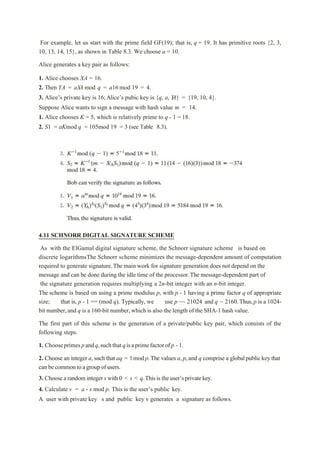
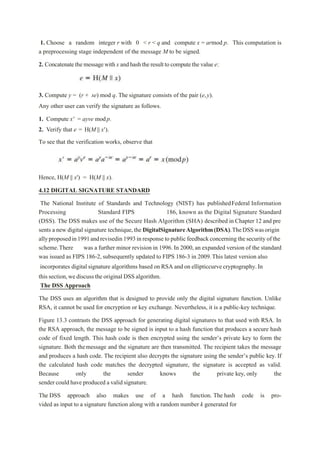
![thisparticularsignature.Thesignaturefunctionalsodependsonthesender’sprivate key (PRa) and a
set of parameters known to a group of communicating principals.
Wecanconsider thissettoconstitute aglobalpublic key (PUG).1Theresultisa signature consisting
of two components, labeled s and r.
Atthereceivingend,thehashcodeoftheincomingmessage isgenerated.This plus the signature is
input to a verification function. The verification function also
depends on the global public key as well as the sender’s public key (PUa),which is paired with the
sender’s private key. The output of the verification function is a
value that is equal to the signature component r if the signature is valid.The signature function is suc
h that only the sender, with knowledge of the private key,could have produced the valid signature.
The Digital Signature Algorithm
TheDSAisbasedonthedifficultyofcomputingdiscretelogarithms(seeChapter8) and is based on
schemes originally presented by ElGamal [ELGA85] and Schnorr [SCHN91].
Figure13.4summarizesthealgorithm.Therearethreeparametersthatarepublicandcanbecommonto
agroupofusers.A160-bitprimenumberqischosen.Next, a prime number p is selected with a
length between 512 and 1024 bits such that qdivides (p -
1).Finally,g is chosento beof the form h(p-1)/qmodp, where h isan integer between 1 and (p - 1)
with the restriction that g must be greater than 1.2 Thus,the global public-
key components ofDSA have thesamefor asin theSchnorr signature scheme.
With these numbers in hand, each user selects a private key and generates a
public key.Theprivate keyx mustbea numberfrom 1to (q - 1) and should bechosen randomly or
pseudorandomly.The public key is calculated from the private key as y = gx modp.Thecalculation
of y givenx is relativelystraightforward.However,giventhepublickeyy,itisbelievedtobecomputat
ionallyinfeasibletodetermine x,whichisthediscretelogarithm of y tothebase g,modp(seeChapter8
).](https://image.slidesharecdn.com/7mce3c1-cryptographyandnetworksecurity-250401150745-92e9a590/85/Cryptography-and-Network-Security-ppt-pdf-137-320.jpg)
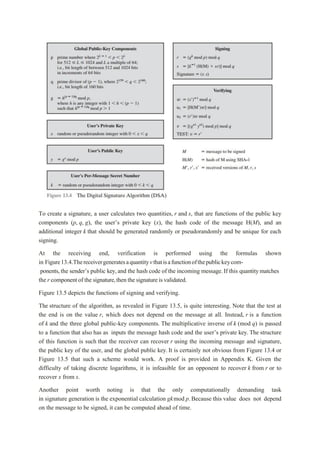
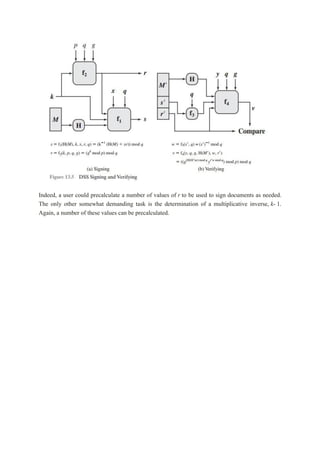
![TheWorldWideWeb is fundamentally a client/server application running over the Internet and
TCP/IP intranets.As such,the security tools and approaches discussed so far in this book are
relevant to the issue of Web security. But, as pointed out in [GARF02], theWeb presents new
challenges not generally appreciated in the context of computer and networksecurity.
The Internet is two-way. Unlike traditional publishing environments—even
electronicpublishingsystemsinvolvingteletext,voiceresponse,orfax-back— theWeb is
vulnerable to attacks on theWeb servers over the Internet.
The Web is increasingly serving as a highly visible outlet for
corporate and productinformationandastheplatformforbusinesstransactions.Reputations
can bedamaged and moneycan be lostif theWebservers aresubverted.
Although Web browsers are very easy to use,Web servers are relatively easy
to configure and manage,andWebcontent is increasingly easy to develop,the underlying
software is extraordinarily complex. This complex software may
hide many potential security flaws.The short history of the Web is filled with
examplesofnewandupgradedsystems,properlyinstalled,thatarevulnerable
to avarietyofsecurityattacks.
A Web server can be exploited as a launching pad into the corporation’s or agency’s entire
computer complex. Once the Web server is subverted, an attacker may be able to gain
access to data and systems not part of
the Web itself but connected to the server at the local site.
Casual and untrained (in security matters) users are common clients for Web-
based services. Such users are not necessarily aware of the security risks that
exist and do not have the tools or knowledge to take effective countermeasures.
Web Security Threats
Table16.1 provides asummary of the types ofsecurity threats facedwhen using the Web. One
way to group these threats is in terms of passive and active attacks. Passive attacks include
eavesdropping on network traffic between browser and server and gaining
access to information on a Web site that is supposed to be restricted. Active attacks include
impersonating another user, altering messagesin
transit between client and server,and altering information on aWebsite.
Another way to classifyWeb security threats is in terms of the location of the threat: Web server,
Web browser, and network traffic between browser and server.
Issuesofserverandbrowsersecurityfallintothecategoryofcomputersystemsecurity; Part Four of
this book addresses the issue of system security in general but is
alsoapplicabletoWebsystemsecurity.Issuesoftrafficsecurityfallintothecategory
of network security and are addressed in this chapter.
Web Traffic Security Approaches](https://image.slidesharecdn.com/7mce3c1-cryptographyandnetworksecurity-250401150745-92e9a590/85/Cryptography-and-Network-Security-ppt-pdf-141-320.jpg)
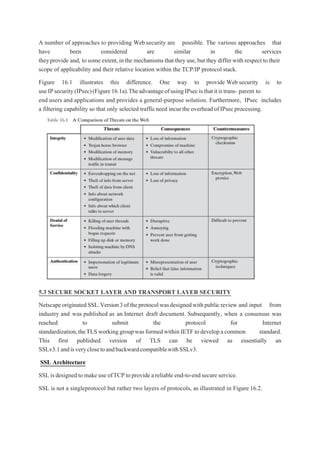
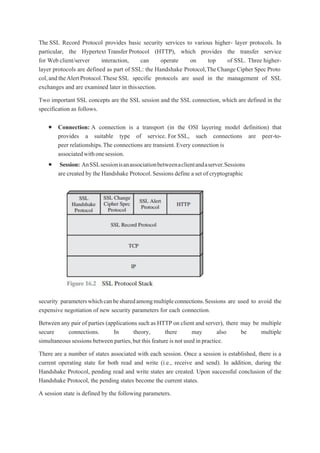
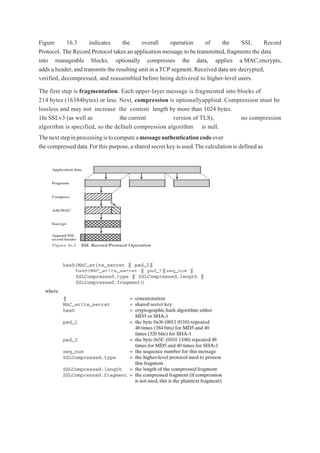
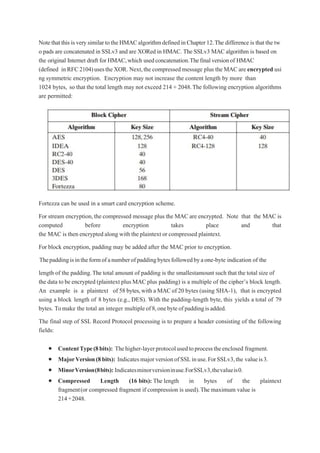
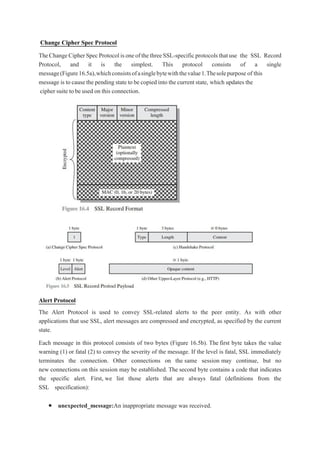
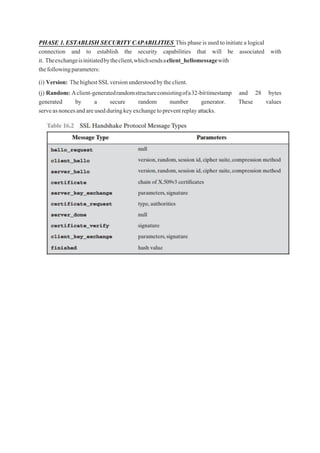
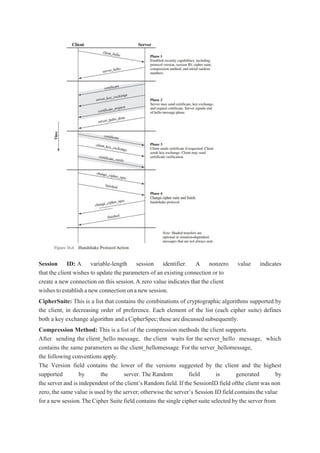
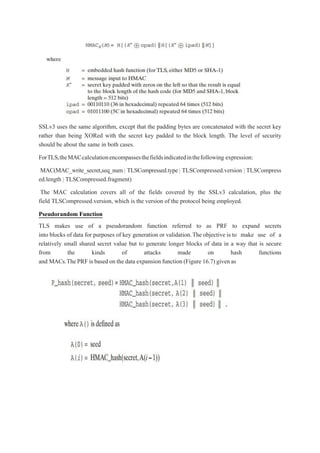
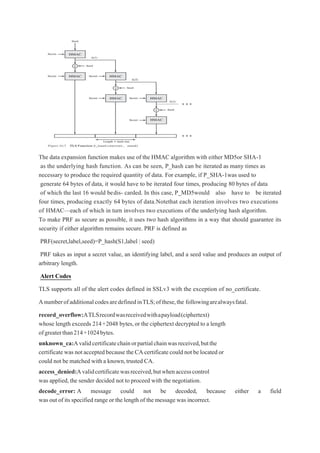
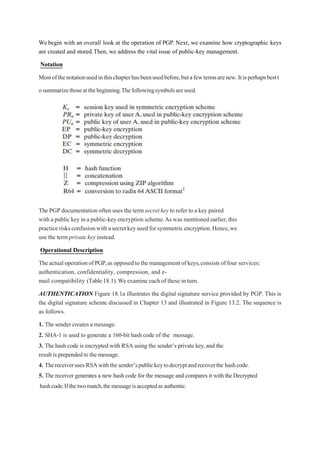
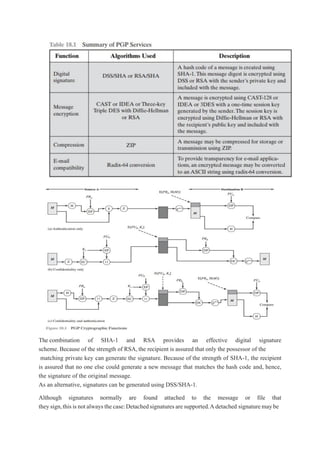
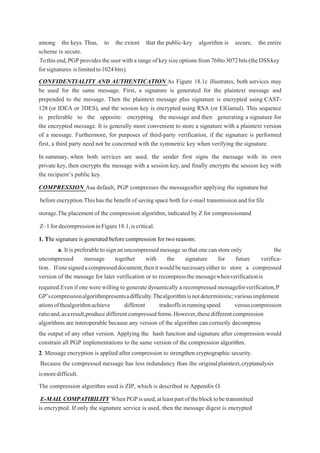
![(with the sender’s private key).
If the confidentiality service is used, themessage plus signature (if present) are encrypted
(With a one-time symmetric key). Thus, part or all of the resulting block consists of a stream of
arbitrary8-bit octets. However,many electronic mail systems only permit the use of blocks consisting
of ASCIItext.Toaccommodatethisrestriction,PGPprovidestheserviceofconverting the raw8-
bit binarystreamtoastream of printableASCIIcharacters.
The scheme used for this purpose is radix-64 conversion.
Each group of three octets of binary data is mapped into four ASCII characters.
This format also appends a CRC to detect transmission errors. See Appendix 18A for a description.
The use of radix 64 expands a message by 33%. Fortunately, the session key
andsignatureportionsofthemessagearerelativelycompact,andtheplaintextmes-
sage has been compressed.In fact,the compression should be more than enough to
compensate for theradix-64 expansion.Forexample,[HELD96] reportsan average
compression ratio of about 2.0 using ZIP.If we ignore the relatively small signature and key
components, the typical overall effect of compression and expansion of a file of length X would be
1.33 * 0.5 * X = 0.665 * X. Thus, there is still an overall compression of aboutone-third.
One noteworthy aspect of the radix-64 algorithm is that it blindly converts the input stream to radix-
64 format regardless of content, even if the input happens to
be ASCII text.Thus,if a message is signed but not encrypted and the conversion is applied to the
entire block, the output will be unreadable to the casual observer,
which provides a certain level of confidentiality.As an option, PGP can be configured to convert to
radix-64 format only the signature portion of signed plaintext
messages.This enables thehuman recipient to read the message without using PGP.PGP would still h
ave to be used to verify the signature.
Figure 18.2 shows the relationship among the four services so far discussed.
On transmission (if it is required), a signature is generated using a hash code of the uncompressed
plaintext. Then the plaintext(plussignature if present) is com- pressed.Next,ifconfidentialityis
required,theblock(compressedplaintextorcom- pressed signature plus plaintext) is encrypted and
prepended with the public-key- encrypted symmetric encryption key. Finally, the entire
block is converted to radix-64 format.
On reception,theincomingblock is firstconvertedback from radix-64 format to binary. Then, if the
message is encrypted, the recipient recovers the session key
and decrypts the message.The resulting block is thendecompressed.If the message is signed, the
recipient recovers the transmitted hash code and compares it to its own calculationofthehashcode.](https://image.slidesharecdn.com/7mce3c1-cryptographyandnetworksecurity-250401150745-92e9a590/85/Cryptography-and-Network-Security-ppt-pdf-165-320.jpg)
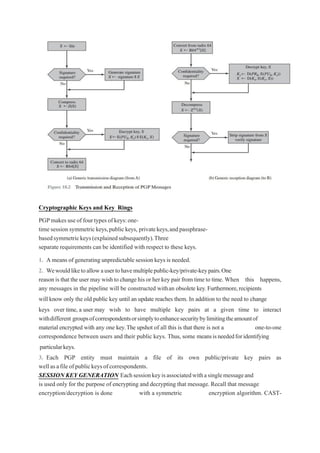
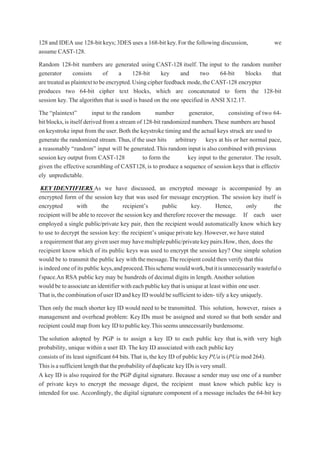
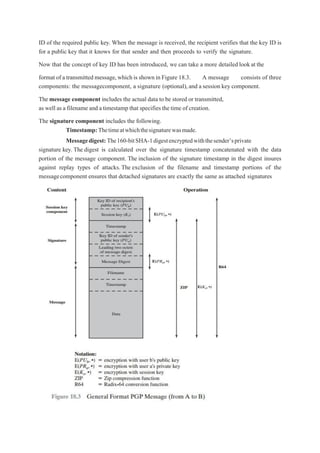
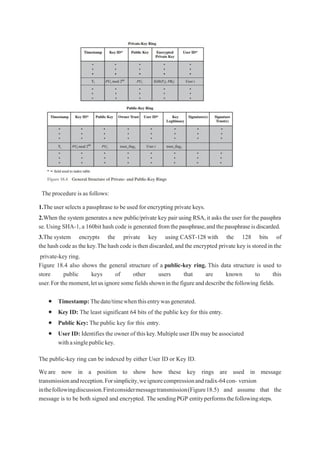
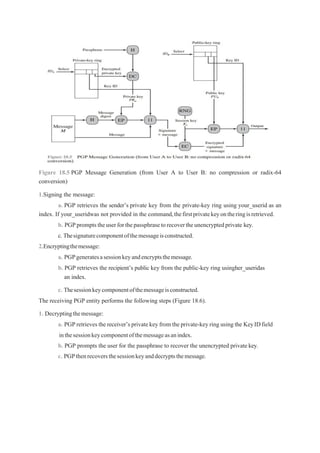
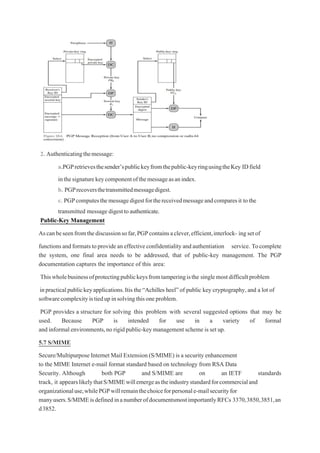
![Tounderstand S/MIME, we need first to have a general understanding of the underlying e-
mail format that it uses,namely MIME.But to understand the significance of MIME,we need to go
back to the traditional e-mail format standard,RFC 822,which is still in common use.
RFC 5322
RFC 5322definesa formatfor textmessagesthataresentusingelectronicmail.It has
been the standard for Internet-
based text mail messages and remains in common use. IntheRFC5322context,messagesareviewedas
havinganenvelopeandcontents.The envelope contains whatever information is needed to accomplish
transmission and delivery. The contents compose the object to be delivered to the recipient. The RFC
5322 standard applies only to the contents. However, the content standard includes a
setofheaderfieldsthatmaybeusedbythemailsystemtocreatetheenvelope,andthe
standardisintendedtofacilitatetheacquisitionofsuchinformationbyprograms.
The overall structure of a message that conforms to RFC 5322 is very simple.
A message consists of some number of header lines (the header) followed by unrestricted text (the
body). The header is separated from the body by a blank line.Put differently, a message is ASCII
text, and all lines up to the first blank line are assumed to be header lines used by the user agent
part of the mail system.A header line usually consists of a keyword,followed bya colon,followed by
the keyword’s arguments;the format allows a long line to be broken up into several lines.Themost
frequentlyusedkeywordsareFrom,To,Subject,andDate.Hereisan example message:
Date: October 8, 2009 2:15:49 PM EDT
From: "William Stallings"<ws@shore.net>
Subject: The Syntax in RFC 5322 To: Smith@Other-host.com
Cc: Jones@Yet-Another-Host.com
Multipurpose Internet Mail Extensions
Multipurpose Internet Mail Extension (MIME) is an extension to the RFC 5322 framework that is
intended to address some of the problems and limitations of the use of Simple
Mail Transfer Protocol (SMTP), defined in RFC 821, or some other
mail transfer protocolandRFC 5322 forelectronic mail.[PARZ06]lists the follow-
inglimitationsoftheSMTP/5322scheme.
1. SMTP cannot transmit executable files or other binary objects. A number of
schemes are in use for converting binary files into a text form that can be used by SMTP mail
systems,including the popular UNIX UUencode/UUdecode scheme.
However,none of these is a standard or even a de facto standard.
2. SMTP cannot transmit text data that includes national language characters, because these are
represented by 8-bit codes with values of 128 decimal or higher,andSMTPislimitedto7-bitASCII.
3. SMTP servers may reject mail message over a certain size.](https://image.slidesharecdn.com/7mce3c1-cryptographyandnetworksecurity-250401150745-92e9a590/85/Cryptography-and-Network-Security-ppt-pdf-173-320.jpg)
![In essence,it represents nonsafe characters by the hexadecimal representation of their code andi
ntroduces reversible (soft) line breaks to limit message lines to 76 characters.
Thebase64transferencoding,alsoknownasradix-64encoding,isacommon one for encoding
arbitrary binary data in such a way as to be invulnerable to the processing by mail-transport
programs. It is also used in PGP and is described in Appendix18A.
CANONICAL FORM An important concept in MIME and S/MIME is that of canonical form.
Canonical form is a format, appropriate to the content type, that isstandardized for use between syste
ms.This is in contrast to native form, which is a format that may be peculiar to a particular
system. Table 18.5, from RFC 2049, shouldhelpclarifythis matter.
S/MIME Functionality
In terms of general functionality, S/MIME is very similar to PGP. Both offer the ability to sign
and/or encrypt messages. In this subsection, we briefly summarize
S/MIMEcapability.Wethenlookinmoredetailatthiscapabilitybyexaminingmes-
sage formats and message preparation.
MIME-Version: 1.0
From: Nathaniel Borenstein <nsb@bellcore.com> To: Ned Freed <ned@innosoft.com>
Subject: A multipart example Content-Type: multipart/mixed;
boundary=unique-boundary-1
This is the preamble area of a multipart message. Mail readers that understand multipart format
should ignore this preamble. If you are reading this text, you might want to consider changing to a
mail reader that understands how to properly display multipart messages.
--unique-boundary-1
...Some text appears here...
[Note that the preceding blank line means no header fields were given and this is text, with charset
US ASCII. It could have been done with explicit typing as in the next part.]
From: (mailbox in US-ASCII) To: (address in US-ASCII) Subject: (subject in US-ASCII)
Content-Type: Text/plain; charset=ISO-8859-1 Content-Transfer-Encoding: Quoted-printable
... Additional text in ISO-8859-1 goes here ...
--unique-boundary-1--](https://image.slidesharecdn.com/7mce3c1-cryptographyandnetworksecurity-250401150745-92e9a590/85/Cryptography-and-Network-Security-ppt-pdf-178-320.jpg)
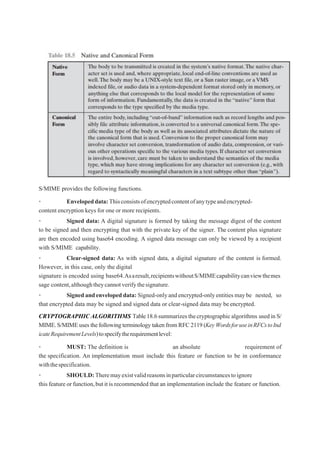
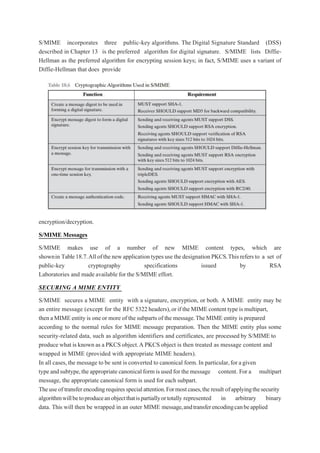
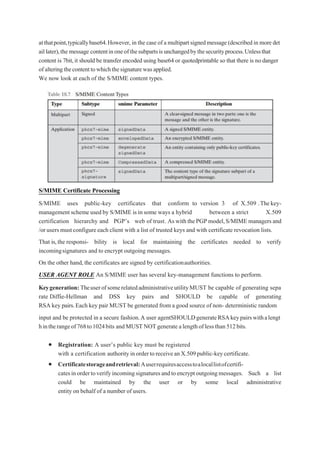
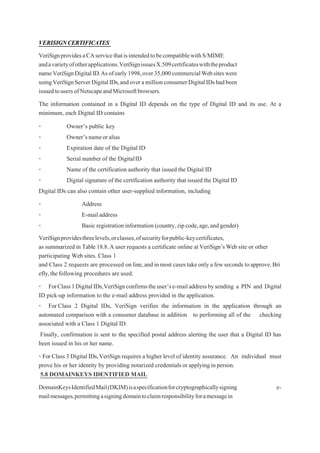
![the mail stream.Message recipients (or agents acting in their behalf) can verify the
signaturebyqueryingthesigner’s domaindirectlytoretrievetheappropriatepublic key and
thereby can confirm that the message was attested to by a party in possession of the private key for
the signing domain. DKIM is a proposed Internet Standard
(RFC 4871:DomainKeys Identified Mail (DKIM) Signatures).DKIM has beenwidelyadopted
byarangeofe-mailproviders,includingcorporations,governmentagencies,gmail,yahoo,
andmanyInternetServiceProviders(ISPs).
Thissectionprovidesan overview of DKIM.Beforebeginning our discussion
of DKIM,we introduce the standard Internet mail architecture.Then we look at the
threat that DKIM is intended to address,and finally provide an overview of DKIM operation.
Internet Mail Architecture
Tounderstand the operation of DKIM, it is useful to have a basic grasp of the Internet mail
architecture,which is currently defined in [CROC09].Thissubsectionprovidesanoverviewof the
basicconcepts.At its most fundamental level,the Internet mail architecture consists of a user world
in the form of Message User Agents (MUA), and the transfer world, in the form of the Message
Handling Service (MHS), which is composed of Message TransferAgents (MTA).
The MHS accepts a message from one user and delivers it to one or more other users, creating a
virtual MUA-to-MUA exchange environment. This architecture involves three
types of interoperability. One is directly between users: messages must be formatted by
the MUA on behalf of themessage author so that themessage can be displayed to the message
recipient by the destination MUA. There are also interoperability requirements between
the MUA andthe MHS—first when a message is posted from an MUA to the MHS and later when it
is delivered from the MHS to the destination MUA. Interoperability is required
among the MTA components along the transfer path through the MHS.
Figure 18.9 illustrates the key components of the Internet mail architecture, which include the
following.
• MessageUserAgent(MUA):Worksonbehalfofuseractorsanduserapplica-
tions.Itistheirrepresentativewithinthee-mailservice.Typically,thisfunctionis housed inthe
user’scomputer and is referred to asaclient e-mail program or a localnetworke-mailserver.
TheauthorMUAformatsamessage andperforms initial submission into the MHS via a MSA. The
recipient MUA processes receivedmailforstorageand/ordisplaytotherecipientuser.
• MailSubmissionAgent(MSA): Accepts themessagesubmittedbyanMUA and enforces the poli
cies of the hosting domain and the requirements of Internet standards.
This function may be located together with the MUA or as a separate functional
model. In the latter case, the Simple Mail Transfer Protocol (SMTP) is used betweenthe MUA
and the MSA.
• MessageTransferAgent(MTA): Relays mail for one application-level hop. It is like a packet
switch or IP router in that its job is to make routing assess-
mentsandtomovethemessageclosertotherecipients.Relayingisperformed by a sequence of
MTAs until the message reaches a destination MDA. An MTA also adds trace](https://image.slidesharecdn.com/7mce3c1-cryptographyandnetworksecurity-250401150745-92e9a590/85/Cryptography-and-Network-Security-ppt-pdf-183-320.jpg)
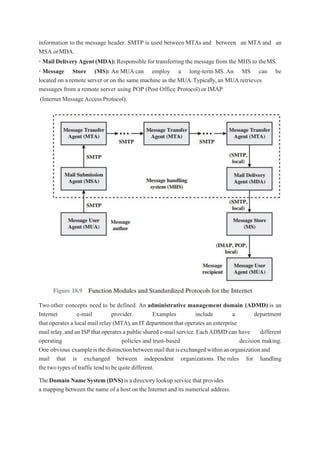

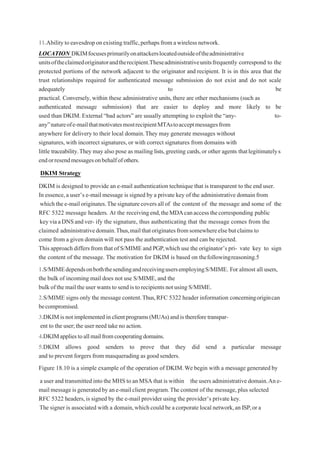
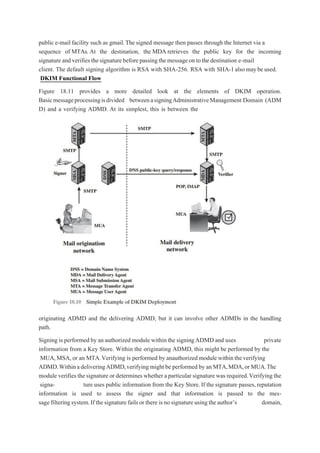
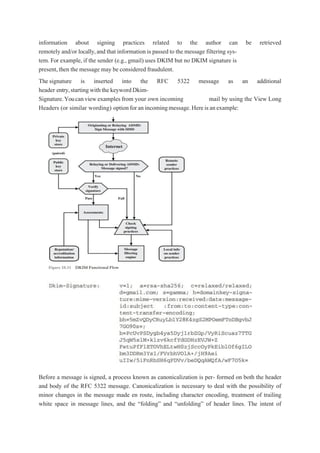
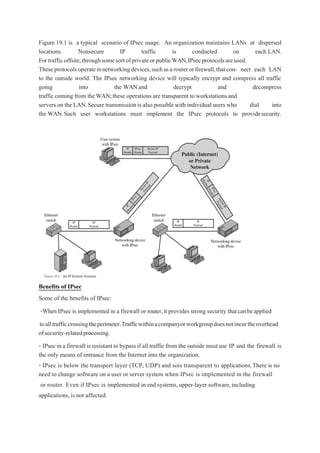
![• IPseccanbetransparenttoendusers.Thereisnoneedtotrainusersonsecurity mechanisms,issueke
yingmaterialonaper-userbasis,orrevokekeyingmaterial whenusersleavetheorganization.
• IPseccanprovidesecurityforindividualusersifneeded.Thisisusefulforoffsite
workers and for setting up a secure virtual subnetwork within an organization for
sensitive applications.
Routing Applications
In addition to supporting end users and protecting premises systems and networks, IPsec can play a
vital role in the routing architecture required for internetworking.
[HUIT98]liststhefollowingexamplesoftheuseofIPsec.IPseccanassurethat
• A router advertisement (a new router advertises its presence) comes from an authorized router.
• A neighbor advertisement (a router seeks to establish or maintain a neighbor relationship with a
router in another routing domain) comes from an authorized router.
•AredirectmessagecomesfromtheroutertowhichtheinitialIPpacketwassent.
•A routing update is notforged.
Without such security measures, an opponent can disrupt communications or divert some traffic.
Routing protocols such as Open Shortest Path First (OSPF) should be run on top of security
associations between routers that are defined byIPsec.
IPsec Documents
IPsec encompasses three functional areas: authentication, confidentiality, and key management.
The totality of the IPsec specification is scattered across dozens of
RFCsanddraftIETFdocuments,makingthisthemostcomplexanddifficulttograsp of all IETF
specifications.The best way to grasp the scope of IPsec is to consult the latestversionoftheIPsec
documentroadmap,whichasofthiswritingis[FRAN09]. Thedocumentscanbecategorizedintothef
ollowinggroups.
•Architecture: Covers the general concepts, security requirements, definitions, and mechanisms
defining IPsec technology.
• AuthenticationHeader(AH): AHisanextensionheadertoprovidemessage authentication. The c
urrent specification is RFC 4302, IP Authentication Header.Because message authentication is
provided by ESP,the use ofAH is deprecated. It is included in IPsecv3 for backward compatibility
but should not be used in new applications.Wedo not discussAH in this chapter.
• EncapsulatingSecurityPayload(ESP):ESPconsistsofanencapsulatingheader and trailer
used to provide encryption or combined encryption/authentication. Thecurrentspecificationis
RFC4303,IPEncapsulatingSecurityPayload(ESP).
• Internet Key Exchange (IKE): This is a collection of documents describing the key management
schemes for use with IPsec. The main specification is RFC 4306, Internet Key Exchange (IKEv2)
Protocol, but there are a number of related RFCs.](https://image.slidesharecdn.com/7mce3c1-cryptographyandnetworksecurity-250401150745-92e9a590/85/Cryptography-and-Network-Security-ppt-pdf-192-320.jpg)