BK
TP.HCM
Outline
Cryptographic Attacks
ā–« Frequency analysis
ā–« Brute force attack
ā–« Meet-in-the-middle attack
ā–« Birthday attack
Network Attacks
ā–« Replay attack
ā–« Man-in-the-middle attack
ā–« Denial-of-service attack
BK
TP.HCM
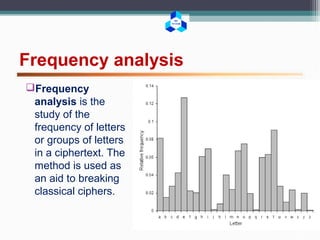
Frequency analysis
Frequency
analysis is the
study of the
frequency of letters
or groups of letters
in a ciphertext. The
method is used as
an aid to breaking
classical ciphers.
BK
TP.HCM
Brute force attack
brute force attack is a strategy used to break the
encryption of data. It involves traversing the search
space of possible keys until the correct key is found.
The amount of time required to break a 128-bit key is
also daunting. Each of the 2128
possibilities must be
checked. A device that could check a billion billion keys
(1018
) per second would still require about 1013
years to
exhaust the key space.
This is a thousand times longer than the age of the
universe, which is about 13,000,000,000 (1.3Ɨ1010
)
years.
BK
TP.HCM
Meet-in-the-middle attack (1/3)
for small x, we have (1 x) ex
.for small x, we have (1 x)
ex
.
for small x, we have (1 x)
ex
.
The attack works by encrypting from one end
and decrypting from the other end, thus meeting
in the middle.
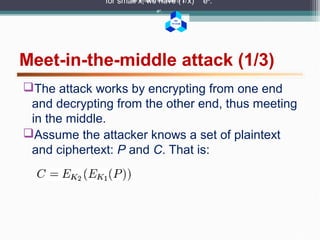
Assume the attacker knows a set of plaintext
and ciphertext: P and C. That is:
BK
TP.HCM
Meet-in-the-middle attack (2/3)
for small x, we have (1 x) ex
.for small x, we have (1 x)
ex
.
for small x, we have (1 x)
ex
.
The attacker can then compute EK(P) for all
possible keys K and store the results in memory.
Afterwards he can decrypt the ciphertext by
computing DK(C) for each K.
Any matches between these two resulting sets
are likely to reveal the correct keys. (To speed
up the comparison, the EK(P) set is stored in an
in-memory lookup table, then each DK(C) can be
matched against the values in the lookup table
to find the candidate keys.)
BK
TP.HCM
Meet-in-the-middle attack (3/3)
for small x, we have (1 x) ex
.for small x, we have (1 x)
ex
.
for small x, we have (1 x)
ex
.
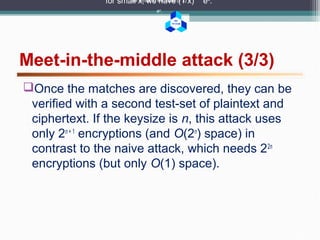
Once the matches are discovered, they can be
verified with a second test-set of plaintext and
ciphertext. If the keysize is n, this attack uses
only 2n + 1
encryptions (and O(2n
) space) in
contrast to the naive attack, which needs 22n
encryptions (but only O(1) space).
BK
TP.HCM
Birthday attack (1/6)
exploits the mathematics behind the birthday problem in
probability theory.
What is the minimum value of k such that the probability
is greater than 0.5 that at least two people in a group of
k people have the same birthday?
P(n, k) = Pr[at least one duplicate in k items, with each
item able to take on one of n equally likely values
between 1 and n]
we are looking for the smallest value of k such that
P(365, k) 0.5
BK
TP.HCM
Birthday attack (2/6)
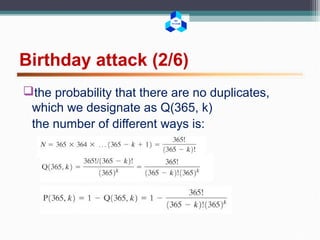
the probability that there are no duplicates,
which we designate as Q(365, k)
the number of different ways is:
BK
TP.HCM
Birthday attack (3/6)
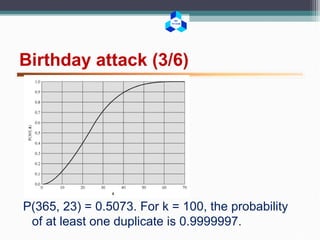
P(365, 23) = 0.5073. For k = 100, the probability
of at least one duplicate is 0.9999997.
BK
TP.HCM
Birthday attack (4/6)
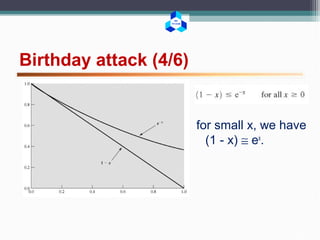
for small x, we have
(1 - x) ≅ ex
.
BK
TP.HCM
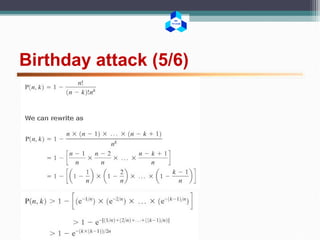
Birthday attack (5/6)
BK
TP.HCM
Birthday attack (6/6)
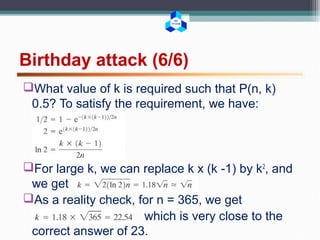
What value of k is required such that P(n, k)
0.5? To satisfy the requirement, we have:
For large k, we can replace k x (k -1) by k2
, and
we get
As a reality check, for n = 365, we get
which is very close to the
correct answer of 23.
BK
TP.HCM
Replay attack (1/2)
Use a simple method of exploiting a captured packet or
packets, and resend that traffic to cause unexpected
results.
Suppose Alice wants to prove her identity to Bob. Bob
requests her password as proof of identity, which Alice
dutifully provides (possibly after some transformation like
a hash function); meanwhile, Mallory is eavesdropping
the conversation and keeps the password. After the
interchange is over, Mallory connects to Bob posing as
Alice; when asked for a proof of identity, Mallory sends
Alice's password read from the last session, which Bob
accepts.
BK
TP.HCM
Replay attack (2/2)
A way to avoid replay attacks is using session tokens,
session tokens should be chosen by a (pseudo-) random
process.
Timestamping is another way of preventing a replay
attack. The advantage of this scheme is that does not
need to generate (pseudo-) random numbers.
BK
TP.HCM
Man-in-the-middle attack
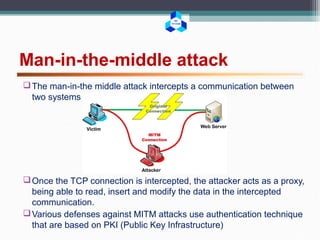
The man-in-the middle attack intercepts a communication between
two systems
Once the TCP connection is intercepted, the attacker acts as a proxy,
being able to read, insert and modify the data in the intercepted
communication.
Various defenses against MITM attacks use authentication technique
that are based on PKI (Public Key Infrastructure)
BK
TP.HCM
Denial-of-service attack
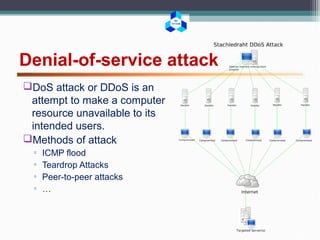
DoS attack or DDoS is an
attempt to make a computer
resource unavailable to its
intended users.
Methods of attack
ā–« ICMP flood
ā–« Teardrop Attacks
ā–« Peer-to-peer attacks
ā–« …

Network security attacks

  • 1.
    BK TP.HCM Outline Cryptographic Attacks ā–« Frequencyanalysis ā–« Brute force attack ā–« Meet-in-the-middle attack ā–« Birthday attack Network Attacks ā–« Replay attack ā–« Man-in-the-middle attack ā–« Denial-of-service attack
  • 2.
    BK TP.HCM Frequency analysis Frequency analysis isthe study of the frequency of letters or groups of letters in a ciphertext. The method is used as an aid to breaking classical ciphers.
  • 3.
    BK TP.HCM Brute force attack bruteforce attack is a strategy used to break the encryption of data. It involves traversing the search space of possible keys until the correct key is found. The amount of time required to break a 128-bit key is also daunting. Each of the 2128 possibilities must be checked. A device that could check a billion billion keys (1018 ) per second would still require about 1013 years to exhaust the key space. This is a thousand times longer than the age of the universe, which is about 13,000,000,000 (1.3Ɨ1010 ) years.
  • 4.
    BK TP.HCM Meet-in-the-middle attack (1/3) forsmall x, we have (1 x) ex .for small x, we have (1 x) ex . for small x, we have (1 x) ex . The attack works by encrypting from one end and decrypting from the other end, thus meeting in the middle. Assume the attacker knows a set of plaintext and ciphertext: P and C. That is:
  • 5.
    BK TP.HCM Meet-in-the-middle attack (2/3) forsmall x, we have (1 x) ex .for small x, we have (1 x) ex . for small x, we have (1 x) ex . The attacker can then compute EK(P) for all possible keys K and store the results in memory. Afterwards he can decrypt the ciphertext by computing DK(C) for each K. Any matches between these two resulting sets are likely to reveal the correct keys. (To speed up the comparison, the EK(P) set is stored in an in-memory lookup table, then each DK(C) can be matched against the values in the lookup table to find the candidate keys.)
  • 6.
    BK TP.HCM Meet-in-the-middle attack (3/3) forsmall x, we have (1 x) ex .for small x, we have (1 x) ex . for small x, we have (1 x) ex . Once the matches are discovered, they can be verified with a second test-set of plaintext and ciphertext. If the keysize is n, this attack uses only 2n + 1 encryptions (and O(2n ) space) in contrast to the naive attack, which needs 22n encryptions (but only O(1) space).
  • 7.
    BK TP.HCM Birthday attack (1/6) exploitsthe mathematics behind the birthday problem in probability theory. What is the minimum value of k such that the probability is greater than 0.5 that at least two people in a group of k people have the same birthday? P(n, k) = Pr[at least one duplicate in k items, with each item able to take on one of n equally likely values between 1 and n] we are looking for the smallest value of k such that P(365, k) 0.5
  • 8.
    BK TP.HCM Birthday attack (2/6) theprobability that there are no duplicates, which we designate as Q(365, k) the number of different ways is:
  • 9.
    BK TP.HCM Birthday attack (3/6) P(365,23) = 0.5073. For k = 100, the probability of at least one duplicate is 0.9999997.
  • 10.
    BK TP.HCM Birthday attack (4/6) forsmall x, we have (1 - x) ≅ ex .
  • 11.
  • 12.
    BK TP.HCM Birthday attack (6/6) Whatvalue of k is required such that P(n, k) 0.5? To satisfy the requirement, we have: For large k, we can replace k x (k -1) by k2 , and we get As a reality check, for n = 365, we get which is very close to the correct answer of 23.
  • 13.
    BK TP.HCM Replay attack (1/2) Usea simple method of exploiting a captured packet or packets, and resend that traffic to cause unexpected results. Suppose Alice wants to prove her identity to Bob. Bob requests her password as proof of identity, which Alice dutifully provides (possibly after some transformation like a hash function); meanwhile, Mallory is eavesdropping the conversation and keeps the password. After the interchange is over, Mallory connects to Bob posing as Alice; when asked for a proof of identity, Mallory sends Alice's password read from the last session, which Bob accepts.
  • 14.
    BK TP.HCM Replay attack (2/2) Away to avoid replay attacks is using session tokens, session tokens should be chosen by a (pseudo-) random process. Timestamping is another way of preventing a replay attack. The advantage of this scheme is that does not need to generate (pseudo-) random numbers.
  • 15.
    BK TP.HCM Man-in-the-middle attack The man-in-themiddle attack intercepts a communication between two systems Once the TCP connection is intercepted, the attacker acts as a proxy, being able to read, insert and modify the data in the intercepted communication. Various defenses against MITM attacks use authentication technique that are based on PKI (Public Key Infrastructure)
  • 16.
    BK TP.HCM Denial-of-service attack DoS attackor DDoS is an attempt to make a computer resource unavailable to its intended users. Methods of attack ā–« ICMP flood ā–« Teardrop Attacks ā–« Peer-to-peer attacks ā–« …