



COMPUTER NETWORK
A presentation by Rishu Raj
Computer Network
A Computer Network is a type of network in which two or more
nodes or workstations are connected in order to share resources
and to communicate with each other.
Types of Computer Network
Depending on their size, capabilities and the geographical area they
cover, a computer network can be classified into following types :
• PAN (Personal Area Network)
• LAN (Local Area Network)
• MAN (Metropolitan Area Network)
• WAN (Wide Area Network)
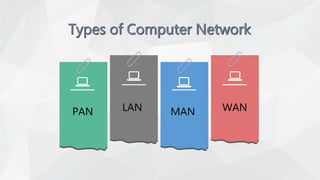
PAN LAN MAN WAN
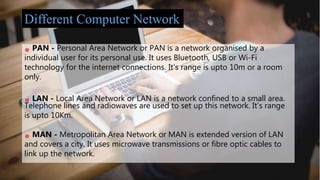
PAN - Personal Area Network or PAN is a network organised by a
individual user for its personal use. It uses Bluetooth, USB or Wi-Fi
technology for the internet connections. It's range is upto 10m or a room
only.
LAN - Local Area Network or LAN is a network confined to a small area.
Telephone lines and radiowaves are used to set up this network. It's range
is upto 10Km.
MAN - Metropolitan Area Network or MAN is extended version of LAN
and covers a city. It uses microwave transmissions or fibre optic cables to
link up the network.
Different Computer Network
WAN - Wide Area Network or WAN is a network that covers a broad
area. It is comparatively more expensive computer network and is very hard
to design and maintain. It contains multiple LANs and MANs. Routers are
used to link up the network. Fibre Optic Cables, Microwave and Satellites
are used to transmit the data over the network. It's range is upto 1000Km.
The largest WAN in existence is Internet.
Different Computer Network
Networking Devices
There are different types of networking devices used in a computer
network :
• Hub
• Switch
• Bridge
• Router
• Gateway
Network Architecture
Network Architecture can be classified into following types :
• Peer-to-Peer Network
• Server-Client Network
Peer-to-Peer Network - In peer-to-peer network, all computer act as
both supplier as well as consumer of the resources. It has no central
It offers almost no security and is very cost efficient.
Server-Client Network - In client-server network, client sends the
request according which server sends the response. It has one or more
central servers. It offers elaborate security and is very expensive.
Different Network Architecture
Switching Techniques
In large networks, there can be multiple paths linking the sender
and receiver. Information can be switched as it travels through
various channels in a digital traffic. This is known as switching
technique.
Following are the different types of switching techniques:-
• Circuit Switching
• Message Switching
• Packet Switching
Circuit Switching - In circuit switching technique, sender and receiver
are connected in an unbroken path.
Message Switching - In message switching, the message is send
through a series of nodes. Each node receives the message, stores it on the
disc and then transmit the message to the next.
Packet Switching - In this technique, the message is broken into a
series of packets. Each packet has a header which has information about
the address of the destination. The TCP/IP uses the packet switching
technique.
Different Switching Technique
Network Topology
Network Topology can be classified into following types :
• Bus Topology
• Ring Topology
• Star Topology
• Tree Topology
• Mesh Topology
• Hybrid Topology
THANK YOU FOR
WATCHING
NAHT K S

Network And Its Types

  • 1.
  • 2.
    Computer Network A ComputerNetwork is a type of network in which two or more nodes or workstations are connected in order to share resources and to communicate with each other.
  • 3.
    Types of ComputerNetwork Depending on their size, capabilities and the geographical area they cover, a computer network can be classified into following types : • PAN (Personal Area Network) • LAN (Local Area Network) • MAN (Metropolitan Area Network) • WAN (Wide Area Network)
  • 4.
  • 5.
    PAN - PersonalArea Network or PAN is a network organised by a individual user for its personal use. It uses Bluetooth, USB or Wi-Fi technology for the internet connections. It's range is upto 10m or a room only. LAN - Local Area Network or LAN is a network confined to a small area. Telephone lines and radiowaves are used to set up this network. It's range is upto 10Km. MAN - Metropolitan Area Network or MAN is extended version of LAN and covers a city. It uses microwave transmissions or fibre optic cables to link up the network. Different Computer Network
  • 6.
    WAN - WideArea Network or WAN is a network that covers a broad area. It is comparatively more expensive computer network and is very hard to design and maintain. It contains multiple LANs and MANs. Routers are used to link up the network. Fibre Optic Cables, Microwave and Satellites are used to transmit the data over the network. It's range is upto 1000Km. The largest WAN in existence is Internet. Different Computer Network
  • 7.
    Networking Devices There aredifferent types of networking devices used in a computer network : • Hub • Switch • Bridge • Router • Gateway
  • 8.
    Network Architecture Network Architecturecan be classified into following types : • Peer-to-Peer Network • Server-Client Network
  • 9.
    Peer-to-Peer Network -In peer-to-peer network, all computer act as both supplier as well as consumer of the resources. It has no central It offers almost no security and is very cost efficient. Server-Client Network - In client-server network, client sends the request according which server sends the response. It has one or more central servers. It offers elaborate security and is very expensive. Different Network Architecture
  • 10.
    Switching Techniques In largenetworks, there can be multiple paths linking the sender and receiver. Information can be switched as it travels through various channels in a digital traffic. This is known as switching technique. Following are the different types of switching techniques:- • Circuit Switching • Message Switching • Packet Switching
  • 11.
    Circuit Switching -In circuit switching technique, sender and receiver are connected in an unbroken path. Message Switching - In message switching, the message is send through a series of nodes. Each node receives the message, stores it on the disc and then transmit the message to the next. Packet Switching - In this technique, the message is broken into a series of packets. Each packet has a header which has information about the address of the destination. The TCP/IP uses the packet switching technique. Different Switching Technique
  • 12.
    Network Topology Network Topologycan be classified into following types : • Bus Topology • Ring Topology • Star Topology • Tree Topology • Mesh Topology • Hybrid Topology
  • 13.