www.oeclib.in
Submitted By:
Odisha Electronic Control
Library
Seminar
On
Computer Networks
Content
 Introduction
 Types of Network
 Classification of Network Architecture
 Network Topology
 Conclusion
 References
A computer network is a telecommunications
network that allows computers to exchange data.
The physical connection between networked
computing devices is established using either
cable media or wireless media.
The best-known computer network is the
internet.
Based on the size and the coverage area, networks are
categorized into the following types:
Personal Area Networks (PANs)
Local Area Networks (LANs)
Metropolitan Area Networks (MANs)
Wide Area Networks (WANs)
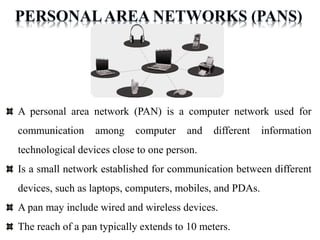
A personal area network (PAN) is a computer network used for
communication among computer and different information
technological devices close to one person.
Is a small network established for communication between different
devices, such as laptops, computers, mobiles, and PDAs.
A pan may include wired and wireless devices.
The reach of a pan typically extends to 10 meters.
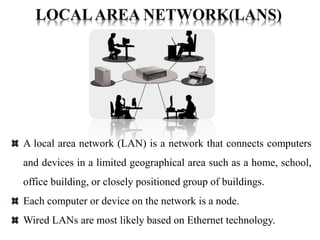
A local area network (LAN) is a network that connects computers
and devices in a limited geographical area such as a home, school,
office building, or closely positioned group of buildings.
Each computer or device on the network is a node.
Wired LANs are most likely based on Ethernet technology.
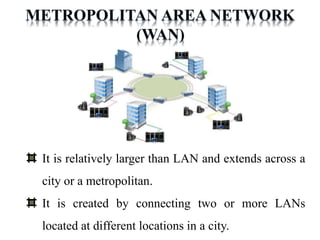
It is relatively larger than LAN and extends across a
city or a metropolitan.
It is created by connecting two or more LANs
located at different locations in a city.
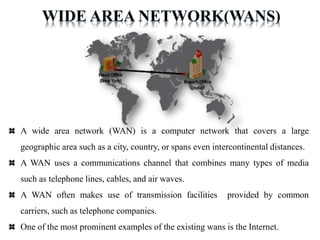
A wide area network (WAN) is a computer network that covers a large
geographic area such as a city, country, or spans even intercontinental distances.
A WAN uses a communications channel that combines many types of media
such as telephone lines, cables, and air waves.
A WAN often makes use of transmission facilities provided by common
carriers, such as telephone companies.
One of the most prominent examples of the existing wans is the Internet.
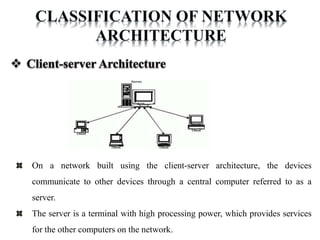
On a network built using the client-server architecture, the devices
communicate to other devices through a central computer referred to as a
server.
The server is a terminal with high processing power, which provides services
for the other computers on the network.
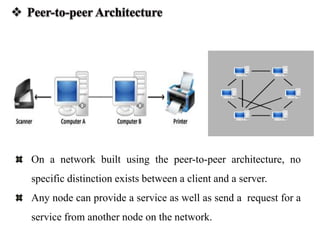
On a network built using the peer-to-peer architecture, no
specific distinction exists between a client and a server.
Any node can provide a service as well as send a request for a
service from another node on the network.
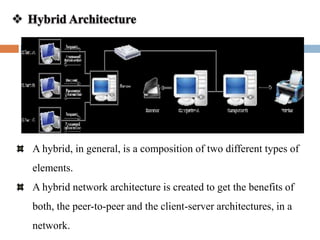
A hybrid, in general, is a composition of two different types of
elements.
A hybrid network architecture is created to get the benefits of
both, the peer-to-peer and the client-server architectures, in a
network.
The pattern of interconnection of nodes in a network is
called the Topology.
This layout also determines the manner in which
information is exchanged within the network.
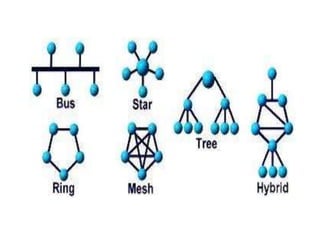
The different types of network topologies that can be
used to set up a network are:
 Bus Topology
 Star Topology
 Ring Topology
 Mesh Topology
 Tree Topology
 Hybrid Topology
Conclusion
 Described how to get connected to the Internet
 Talked about the related network technologies
and components
References
 www.google.com
 www.wikipedia.com
 www.oeclib.in
Thanks

Computer-Networks

  • 1.
    www.oeclib.in Submitted By: Odisha ElectronicControl Library Seminar On Computer Networks
  • 2.
    Content  Introduction  Typesof Network  Classification of Network Architecture  Network Topology  Conclusion  References
  • 3.
    A computer networkis a telecommunications network that allows computers to exchange data. The physical connection between networked computing devices is established using either cable media or wireless media. The best-known computer network is the internet.
  • 4.
    Based on thesize and the coverage area, networks are categorized into the following types: Personal Area Networks (PANs) Local Area Networks (LANs) Metropolitan Area Networks (MANs) Wide Area Networks (WANs)
  • 5.
    A personal areanetwork (PAN) is a computer network used for communication among computer and different information technological devices close to one person. Is a small network established for communication between different devices, such as laptops, computers, mobiles, and PDAs. A pan may include wired and wireless devices. The reach of a pan typically extends to 10 meters.
  • 6.
    A local areanetwork (LAN) is a network that connects computers and devices in a limited geographical area such as a home, school, office building, or closely positioned group of buildings. Each computer or device on the network is a node. Wired LANs are most likely based on Ethernet technology.
  • 7.
    It is relativelylarger than LAN and extends across a city or a metropolitan. It is created by connecting two or more LANs located at different locations in a city.
  • 8.
    A wide areanetwork (WAN) is a computer network that covers a large geographic area such as a city, country, or spans even intercontinental distances. A WAN uses a communications channel that combines many types of media such as telephone lines, cables, and air waves. A WAN often makes use of transmission facilities provided by common carriers, such as telephone companies. One of the most prominent examples of the existing wans is the Internet.
  • 9.
    On a networkbuilt using the client-server architecture, the devices communicate to other devices through a central computer referred to as a server. The server is a terminal with high processing power, which provides services for the other computers on the network.
  • 10.
    On a networkbuilt using the peer-to-peer architecture, no specific distinction exists between a client and a server. Any node can provide a service as well as send a request for a service from another node on the network.
  • 11.
    A hybrid, ingeneral, is a composition of two different types of elements. A hybrid network architecture is created to get the benefits of both, the peer-to-peer and the client-server architectures, in a network.
  • 12.
    The pattern ofinterconnection of nodes in a network is called the Topology. This layout also determines the manner in which information is exchanged within the network. The different types of network topologies that can be used to set up a network are:  Bus Topology  Star Topology  Ring Topology  Mesh Topology  Tree Topology  Hybrid Topology
  • 14.
    Conclusion  Described howto get connected to the Internet  Talked about the related network technologies and components
  • 15.
  • 16.

Editor's Notes