S
Wide Area Networks
WAN
by Jamie Reece Moore
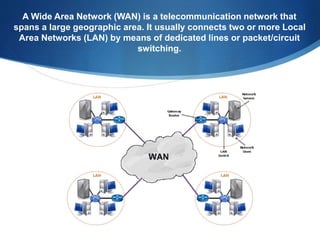
A Wide Area Network (WAN) is a telecommunication network that
spans a large geographic area. It usually connects two or more Local
Area Networks (LAN) by means of dedicated lines or packet/circuit
switching.
Characteristics of a WAN
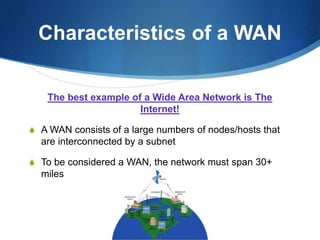
The best example of a Wide Area Network is The
Internet!
S A WAN consists of a large numbers of nodes/hosts that
are interconnected by a subnet
S To be considered a WAN, the network must span 30+
miles
WAN Applications
S Wide Area Networks can be used in most any application
of transmitting voice, video, or data across long distances
S Voice: most phone service providers merge hundreds &
thousands of analog phone calls onto a single digital
medium for transmission across town or across the country
S Video: dedicated WAN systems, such as ATM (explained
later) allow for high-quality video stream with low latency
S Data: the creation of a direct connection between two nodes
on a private WAN is much more efficient & secure that
sending data across with general Internet traffic
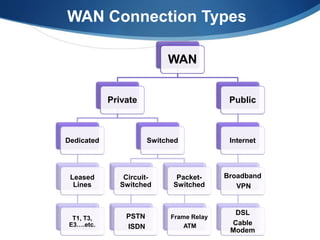
WAN Connection Types
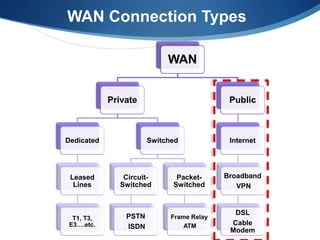
WAN
Private
Dedicated
Leased
Lines
T1, T3,
E3….etc.
Switched
Circuit-
Switched
PSTN
ISDN
Packet-
Switched
Frame Relay
ATM
Public
Internet
Broadband
VPN
DSL
Cable
Modem
WAN Technologies
S A WAN can use multiple types of telecommunication mediums…
S Copper Wire
S Fiber Optic Cabling
S Radio Links
S Satellite Links
S The Data Link Layer (OSI layer 2) uses various protocols along these
mediums to describe how frames are encapsulated & transmitted.
Some common ones are…
S Public Switched Telephone Network (PSTN)
S Integrated Service Digital Network (ISDN)
S Frame Relay
S Asynchronous Transfer Mode (ATM)
Leased Lines
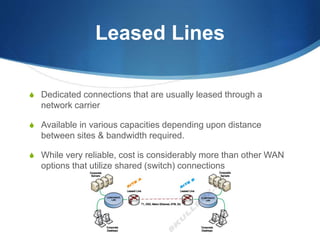
S Dedicated connections that are usually leased through a
network carrier
S Available in various capacities depending upon distance
between sites & bandwidth required.
S While very reliable, cost is considerably more than other WAN
options that utilize shared (switch) connections
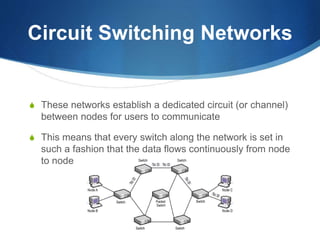
Circuit Switching Networks
S These networks establish a dedicated circuit (or channel)
between nodes for users to communicate
S This means that every switch along the network is set in
such a fashion that the data flows continuously from node
to node
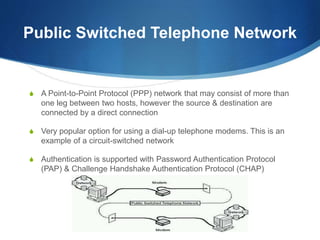
Public Switched Telephone Network
S A Point-to-Point Protocol (PPP) network that may consist of more than
one leg between two hosts, however the source & destination are
connected by a direct connection
S Very popular option for using a dial-up telephone modems. This is an
example of a circuit-switched network
S Authentication is supported with Password Authentication Protocol
(PAP) & Challenge Handshake Authentication Protocol (CHAP)
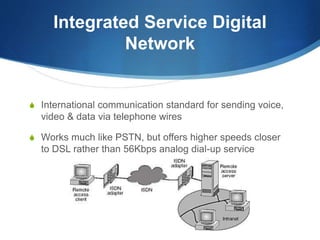
Integrated Service Digital
Network
S International communication standard for sending voice,
video & data via telephone wires
S Works much like PSTN, but offers higher speeds closer
to DSL rather than 56Kbps analog dial-up service
Packet Switching Networks
S In contrast to circuit switching, packet switching splits
traffic into packets that are individually routed over a
shared network
S DO NOT require a dedicated circuit to be established;
allows many pairs of nodes to communicate over the
same channel
S Each switch in the network routes a packet based upon
the addressing information in the header frame
Packet Switching Networks
(cont.)
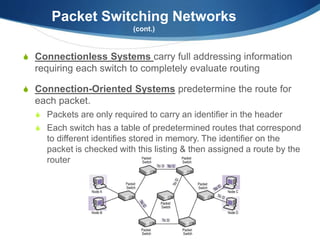
S Connectionless Systems carry full addressing information
requiring each switch to completely evaluate routing
S Connection-Oriented Systems predetermine the route for
each packet.
S Packets are only required to carry an identifier in the header
S Each switch has a table of predetermined routes that correspond
to different identifies stored in memory. The identifier on the
packet is checked with this listing & then assigned a route by the
router
Frame Relay
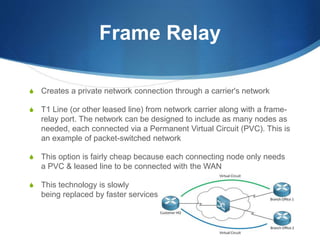
S Creates a private network connection through a carrier's network
S T1 Line (or other leased line) from network carrier along with a frame-
relay port. The network can be designed to include as many nodes as
needed, each connected via a Permanent Virtual Circuit (PVC). This is
an example of packet-switched network
S This option is fairly cheap because each connecting node only needs
a PVC & leased line to be connected with the WAN
S This technology is slowly
being replaced by faster services
Asynchronous Transfer
Mode
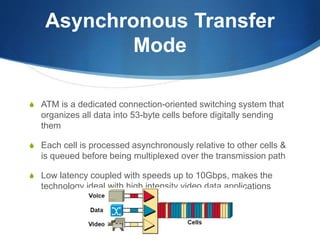
S ATM is a dedicated connection-oriented switching system that
organizes all data into 53-byte cells before digitally sending
them
S Each cell is processed asynchronously relative to other cells &
is queued before being multiplexed over the transmission path
S Low latency coupled with speeds up to 10Gbps, makes the
technology ideal with high intensity video data applications
WAN Connection Types
WAN
Private
Dedicated
Leased
Lines
T1, T3,
E3….etc.
Switched
Circuit-
Switched
PSTN
ISDN
Packet-
Switched
Frame Relay
ATM
Public
Internet
Broadband
VPN
DSL
Cable
Modem
Public WAN’s
The Internet
S In contrary to private WAN’s, public WAN’s have no isolation between
users/customers
S Cheaper, greater bandwidth (usually gigabit or higher)
S DSL, Cable Modem, Fiber Optic, etc.
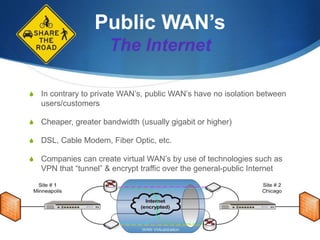
S Companies can create virtual WAN’s by use of technologies such as
VPN that “tunnel” & encrypt traffic over the general-public Internet
Public WAN’s Threat
to Private WAN’s
S Virtual Private Networks (VPN) allows the creation a of
virtual point-to-point connection means of dedicated
connections, tunneling protocols, or traffic encryption.
These networks are much cheaper than WAN’s & allow
more flexibility as they only need an Internet connection
to operate.
S Cloud computing is more cheaper & simple to utilize in
most applications today.
In 2014, one survey of IT professionals indicated that nearly 50%
of those currently using WAN technologies were in the process of
implementing new Cloud technologies to replace them.
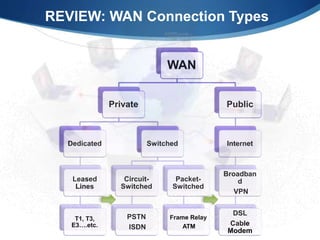
REVIEW: WAN Connection Types
WAN
Private
Dedicated
Leased
Lines
T1, T3,
E3….etc.
Switched
Circuit-
Switched
PSTN
ISDN
Packet-
Switched
Frame Relay
ATM
Public
Internet
Broadban
d
VPN
DSL
Cable
Modem

Wide Area Networks - Jamie Reece Moore

  • 1.
    S Wide Area Networks WAN byJamie Reece Moore
  • 2.
    A Wide AreaNetwork (WAN) is a telecommunication network that spans a large geographic area. It usually connects two or more Local Area Networks (LAN) by means of dedicated lines or packet/circuit switching.
  • 3.
    Characteristics of aWAN The best example of a Wide Area Network is The Internet! S A WAN consists of a large numbers of nodes/hosts that are interconnected by a subnet S To be considered a WAN, the network must span 30+ miles
  • 4.
    WAN Applications S WideArea Networks can be used in most any application of transmitting voice, video, or data across long distances S Voice: most phone service providers merge hundreds & thousands of analog phone calls onto a single digital medium for transmission across town or across the country S Video: dedicated WAN systems, such as ATM (explained later) allow for high-quality video stream with low latency S Data: the creation of a direct connection between two nodes on a private WAN is much more efficient & secure that sending data across with general Internet traffic
  • 5.
    WAN Connection Types WAN Private Dedicated Leased Lines T1,T3, E3….etc. Switched Circuit- Switched PSTN ISDN Packet- Switched Frame Relay ATM Public Internet Broadband VPN DSL Cable Modem
  • 6.
    WAN Technologies S AWAN can use multiple types of telecommunication mediums… S Copper Wire S Fiber Optic Cabling S Radio Links S Satellite Links S The Data Link Layer (OSI layer 2) uses various protocols along these mediums to describe how frames are encapsulated & transmitted. Some common ones are… S Public Switched Telephone Network (PSTN) S Integrated Service Digital Network (ISDN) S Frame Relay S Asynchronous Transfer Mode (ATM)
  • 7.
    Leased Lines S Dedicatedconnections that are usually leased through a network carrier S Available in various capacities depending upon distance between sites & bandwidth required. S While very reliable, cost is considerably more than other WAN options that utilize shared (switch) connections
  • 8.
    Circuit Switching Networks SThese networks establish a dedicated circuit (or channel) between nodes for users to communicate S This means that every switch along the network is set in such a fashion that the data flows continuously from node to node
  • 9.
    Public Switched TelephoneNetwork S A Point-to-Point Protocol (PPP) network that may consist of more than one leg between two hosts, however the source & destination are connected by a direct connection S Very popular option for using a dial-up telephone modems. This is an example of a circuit-switched network S Authentication is supported with Password Authentication Protocol (PAP) & Challenge Handshake Authentication Protocol (CHAP)
  • 10.
    Integrated Service Digital Network SInternational communication standard for sending voice, video & data via telephone wires S Works much like PSTN, but offers higher speeds closer to DSL rather than 56Kbps analog dial-up service
  • 11.
    Packet Switching Networks SIn contrast to circuit switching, packet switching splits traffic into packets that are individually routed over a shared network S DO NOT require a dedicated circuit to be established; allows many pairs of nodes to communicate over the same channel S Each switch in the network routes a packet based upon the addressing information in the header frame
  • 12.
    Packet Switching Networks (cont.) SConnectionless Systems carry full addressing information requiring each switch to completely evaluate routing S Connection-Oriented Systems predetermine the route for each packet. S Packets are only required to carry an identifier in the header S Each switch has a table of predetermined routes that correspond to different identifies stored in memory. The identifier on the packet is checked with this listing & then assigned a route by the router
  • 13.
    Frame Relay S Createsa private network connection through a carrier's network S T1 Line (or other leased line) from network carrier along with a frame- relay port. The network can be designed to include as many nodes as needed, each connected via a Permanent Virtual Circuit (PVC). This is an example of packet-switched network S This option is fairly cheap because each connecting node only needs a PVC & leased line to be connected with the WAN S This technology is slowly being replaced by faster services
  • 14.
    Asynchronous Transfer Mode S ATMis a dedicated connection-oriented switching system that organizes all data into 53-byte cells before digitally sending them S Each cell is processed asynchronously relative to other cells & is queued before being multiplexed over the transmission path S Low latency coupled with speeds up to 10Gbps, makes the technology ideal with high intensity video data applications
  • 15.
    WAN Connection Types WAN Private Dedicated Leased Lines T1,T3, E3….etc. Switched Circuit- Switched PSTN ISDN Packet- Switched Frame Relay ATM Public Internet Broadband VPN DSL Cable Modem
  • 16.
    Public WAN’s The Internet SIn contrary to private WAN’s, public WAN’s have no isolation between users/customers S Cheaper, greater bandwidth (usually gigabit or higher) S DSL, Cable Modem, Fiber Optic, etc. S Companies can create virtual WAN’s by use of technologies such as VPN that “tunnel” & encrypt traffic over the general-public Internet
  • 17.
    Public WAN’s Threat toPrivate WAN’s S Virtual Private Networks (VPN) allows the creation a of virtual point-to-point connection means of dedicated connections, tunneling protocols, or traffic encryption. These networks are much cheaper than WAN’s & allow more flexibility as they only need an Internet connection to operate. S Cloud computing is more cheaper & simple to utilize in most applications today. In 2014, one survey of IT professionals indicated that nearly 50% of those currently using WAN technologies were in the process of implementing new Cloud technologies to replace them.
  • 19.
    REVIEW: WAN ConnectionTypes WAN Private Dedicated Leased Lines T1, T3, E3….etc. Switched Circuit- Switched PSTN ISDN Packet- Switched Frame Relay ATM Public Internet Broadban d VPN DSL Cable Modem

Editor's Notes

  • #4 LAN vs. CAN vs. MAN vs. WAN
  • #12 Circuit networks allow only one path, whereas Packet networks allow more than one path
  • #17 Taking bus to school (public) vs. driving car to school (private)
  • #20 Traditional private WAN networks are beginning to downsize as more cost-efficient options become available, such as VPN or Cloud computing. Many end users can now utilize the public WAN (The Internet) along with these technologies to conduct secure activities that once required private WAN’s.