Control and Co-ordination
Animals : Nervous System
The nervous system is the part of an animal's body that coordinates its voluntary
and involuntary actions and transmits signals between different parts of its body.
Nervous tissue first arose in wormlike organisms about 550 to 600 million years ago.
In most animal species it consists of two main parts, the central nervous system
(CNS) and the peripheral nervous system (PNS). The CNS contains the brain and
spinal cord. The PNS consists mainly of nerves, which are enclosed bundles of the
long fibers or axons, that connect the CNS to every other part of the body. The PNS
includes motor neurons, mediating voluntary movement; the autonomic nervous
system, comprising the sympathetic nervous system and the parasympathetic
nervous system, which regulate involuntary functions, and the enteric nervous
system, which functions to control the gastrointestinal system.
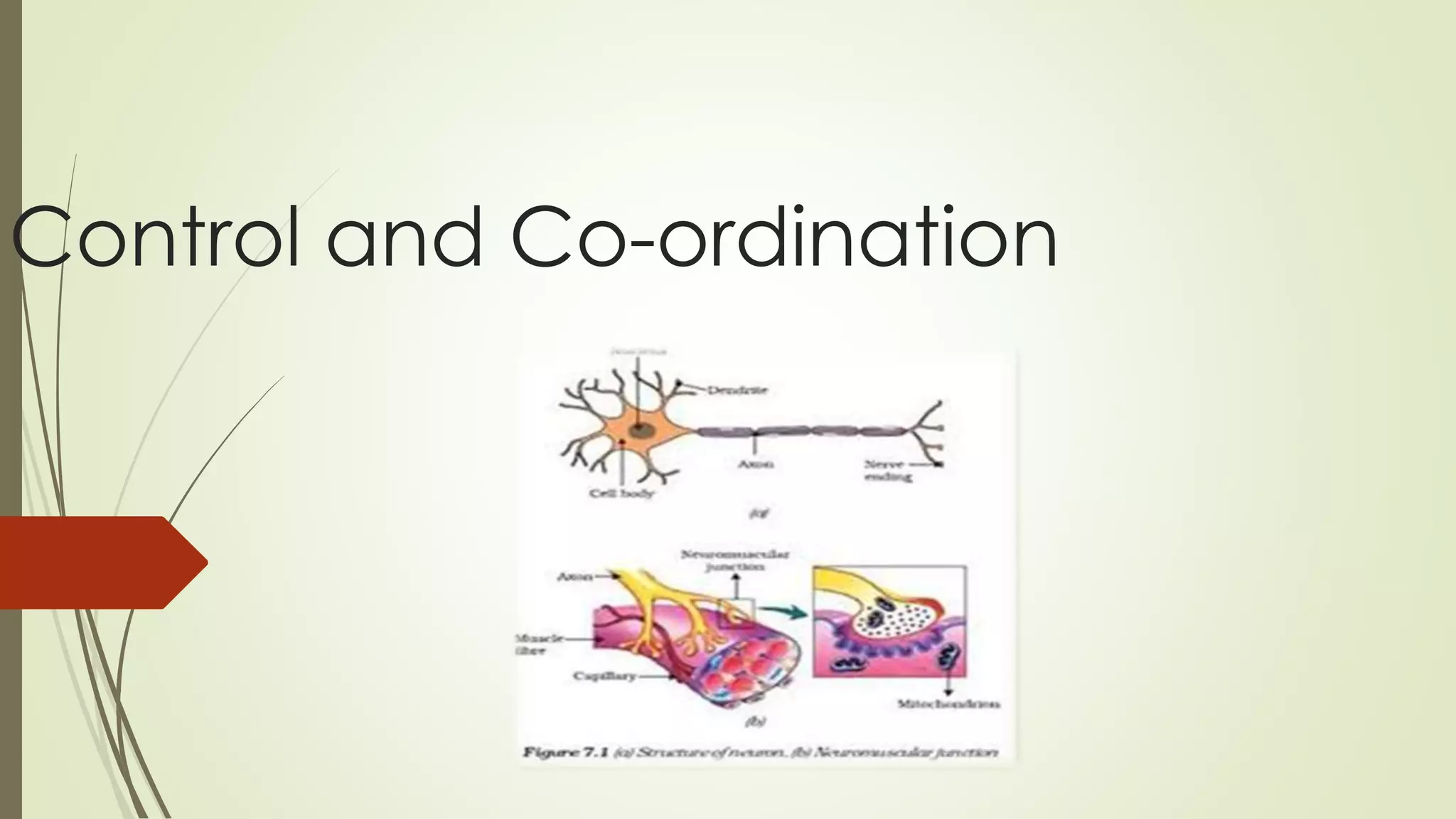
At the cellular level, the nervous system is defined by the presence of a special type of cell, called the neuron,
also known as a "nerve cell". Neurons have special structures that allow them to send signals rapidly and
precisely to other cells. They send these signals in the form of electrochemical waves traveling along thin fibers
called axons, which cause chemicals called neurotransmitters to be released at junctions called synapses. A cell
that receives a synaptic signal from a neuron may be excited, inhibited, or otherwise modulated. The
connections between neurons can form neural circuits and also neural networks that generate an organism's
perception of the world and determine its behavior. Along with neurons, the nervous system contains other
specialized cells called glial cells (or simply glia), which provide structural and metabolic support.
Nervous systems are found in most multicellular animals, but vary greatly in complexity.[1] The only
multicellular animals that have no nervous system at all are sponges, placozoans and mesozoans, which have
very simple body plans. The nervous systems of the radially symmetric organisms the ctenophores (comb
jellies) and cnidarians (which include anemones, hydras, corals and jellyfish) consist of a diffuse nerve net. All
other animal species, with the exception of a few types of worm, have a nervous system containing a brain, a
central cord (or two cords running in parallel), and nerves radiating from the brain and central cord. The size of
the nervous system ranges from a few hundred cells in the simplest worms, to around 100 billion cells in
humans.
The central nervous system functions to send signals from one cell to others, or from one part of the body to
others and to receive feedback. Malfunction of the nervous system can occur as a result of genetic defects,
physical damage due to trauma or toxicity, infection or simply of ageing. The medical specialty of neurology
studies disorders of the nervous system and looks for interventions that can prevent or treat them. In the
peripheral nervous system, the most common problem is the failure of nerve conduction, which can be due to
different causes including diabetic neuropathy and demyelinating disorders such as multiple sclerosis and
amyotrophic lateral sclerosis.
Reflex Action
Of the many kinds of neural activity, there is one simple kind in which a
stimulus leads to an immediate action. This is reflex activity. The word reflex
(from Latin reflexus, “reflection”) was introduced into biology by a 19th-
century English neurologist, Marshall Hall, who fashioned the word because
he thought of the muscles as reflecting a stimulus much as a wall reflects a
ball thrown against it. By reflex, Hall meant the automatic response of a
muscle or several muscles to a stimulus that excites an afferent nerve. The
term is now used to describe an action that is an inborn central nervous
system activity, not involving consciousness, in which a particular stimulus,
by exciting an afferent nerve, produces a stereotyped, immediate response
of muscle or gland.
The anatomical pathway of a reflex is called the reflex arc. It consists of an afferent (or
sensory) nerve, usually one or more interneurons within the central nervous system, and
an efferent (motor, secretory, or secreto-motor) nerve.
Most reflexes have several synapses in the reflex arc. The stretch reflex is exceptional in
that, with no interneuron in the arc, it has only one synapse between the afferent nerve
fibre and the motor neuron (see below Movement: The regulation of muscular
contraction). The flexor reflex, which removes a limb from a noxious stimulus, has a
minimum of two interneurons and three synapses.
Probably the best-known reflex is the pupillary light reflex. If a light is flashed near one eye,
the pupils of both eyes contract. Light is the stimulus; impulses reach the brain via the
optic nerve; and the response is conveyed to the pupillary musculature by autonomic
nerves that supply the eye. Another reflex involving the eye is known as the lacrimal reflex.
When something irritates the conjunctiva or cornea of the eye, the lacrimal reflex causes
nerve impulses to pass along the fifth cranial nerve (trigeminal) and reach the midbrain.
The efferent limb of this reflex arc is autonomic and mainly parasympathetic. These nerve
fibres stimulate the lacrimal glands of the orbit, causing the outpouring of tears. Other
reflexes of the midbrain and medulla oblongata are the cough and sneeze reflexes. The
cough reflex is caused by an irritant in the trachea and the sneeze reflex by one in the nose.
In both, the reflex response involves many muscles; this includes a temporary lapse of
respiration in order to expel the irritant.
Human Brain
The human brain has the same general structure as the brains of other mammals, but has a more
developed cortex than any other. Large animals such as whales and elephants have larger brains in
absolute terms, but when measured using the encephalization quotient which compensates for body
size, the human brain is almost twice as large as the brain of the bottlenose dolphin, and three times as
large as the brain of a chimpanzee. Much of the expansion comes from the part of the brain called the
cerebral cortex, especially the frontal lobes, which are associated with executive functions such as self-
control, planning, reasoning, and abstract thought. The portion of the cerebral cortex devoted to vision is
also greatly enlarged in humans.
The human cerebral cortex is a thick layer of neural tissue that covers most of the brain. This layer is
folded in a way that increases the amount of surface that can fit into the volume available. The pattern of
folds is similar across individuals, although there are many small variations. The cortex is divided into four
"lobes", called the frontal lobe, parietal lobe, temporal lobe, and occipital lobe. (Some classification
systems also include a limbic lobe and treat the insular cortex as a lobe.) Within each lobe are numerous
cortical areas, each associated with a particular function such as vision, motor control, language, etc. The
left and right sides of the cortex are broadly similar in shape, and most cortical areas are replicated on
both sides. Some areas, though, show strong lateralization, particularly areas that are involved in
language. In most people, the left hemisphere is "dominant" for language, with the right hemisphere
playing only a minor role. There are other functions, such as spatiotemporal reasoning, for which the
right hemisphere is usually dominant.
Despite being protected by the thick bones of the skull, suspended in cerebrospinal fluid, and
isolated from the bloodstream by the blood–brain barrier, the human brain is susceptible to
damage and disease. The most common forms of physical damage are closed head injuries such as a
blow to the head, a stroke, or poisoning by a variety of chemicals that can act as neurotoxins.
Infection of the brain, though serious, is rare due to the biological barriers which protect it. The
human brain is also suceptible to degenerative disorders, such as Parkinson's disease, multiple
sclerosis, and Alzheimer's disease. A number of psychiatric conditions, such as schizophrenia and
depression, are thought to be associated with brain dysfunctions, although the nature of such brain
anomalies is not well understood.
Scientifically, the techniques that are used to study the human brain differ in important ways from
those that are used to study the brains of other mammals. On the one hand, invasive techniques
such as inserting electrodes into the brain, or disabling parts of the brain in order to examine the
effect on behavior, are used with non-human species, but for ethical reasons, are generally not
performed with humans. On the other hand, humans are the only subjects who can respond to
complex verbal instructions. Thus, it is often possible to use non-invasive techniques such as
functional neuroimaging or EEG recording more productively with humans than with non-humans.
Furthermore, some of the most important topics, such as language, can hardly be studied at all
except in humans. In many cases, human and non-human studies form essential complements to
each other. Individual brain cells (except where tissue samples are taken for biopsy for suspected
brain tumors) can only be studied in non-humans; complex cognitive tasks can only be studied in
humans. Combining the two sources of information to yield a complete functional understanding of
the human brain is an ongoing challenge for neuroscience.
Co-ordination in Plants
In botany, plant perception is the ability of plants to sense the
environment and adjust their morphology, physiology and phenotype
accordingly. Research draws on the fields of plant physiology, ecology
and molecular biology. Examples of stimuli which plants perceive and
can react to include chemicals, gravity, light, moisture, infections,
temperature, oxygen and carbon dioxide concentrations, parasite
infestation, physical disruption, and touch. Plants have a variety of
means to detect such stimuli and a variety of reaction responses or
behaviors.
Processes
Detection
Plant perception occurs on a cellular level. Research published in September 2006 has shown, certainly in the case of Arabidopsis thaliana, the role of cryptochromes in the
perception of magnetic fields by plants. Mechanical perturbation can also be detected by plants. Poplar stems can detect reorientation and inclination (equilibrioception).Plant
response strategies depend on quick and reliable recognition-systems.
Pathway signals
Wounded tomatoes are known to produce the volatile odour methyl-jasmonate as an alarm-signal. Plants in the neighbourhood can then detect the chemical and prepare for the
attack by producing chemicals that defend against insects or attract predators.Plants systematically use hormonal signallingpathways to coordinate their own development and
morphology.
Neurochemicals
Plants produce several proteins found in the animal neuron systems such as acetylcholine esterase, glutamate receptors, GABA receptors, and endocannabinoid signaling
components. They also use ATP, NO, and ROS like animals for signaling.
Electrophysiology
Plant cells can be electrically excitable and can display rapid electrical responses (action potentials) to environmental stimuli. These action potentials can influence processes such as
actin-based cytoplasmic streaming, plant organ movements, wound responses, respiration, photosynthesis and flowering.
These electrical responses can cause the synthesis of numerous organic molecules including ones that act as neuroactive substances in other organisms.[citation needed] Thus, plants
accomplish behavioural responses to environmental, communicative, and ecological contexts.While many cells in nearly all living organisms can be electrically excitable, this is not
evidence of neurons, or of intelligence.[citation needed]
Signal response
Further information: Plant hormone, Thigmotropism and Thigmomorphogenesis
Electrophysiology
Plant cells can be electrically excitable and can display rapid electrical responses (action potentials) to environmental stimuli. These
action potentials can influence processes such as actin-based cytoplasmic streaming, plant organ movements, wound responses,
respiration, photosynthesis and flowering.These electrical responses can cause the synthesis of numerous organic molecules including
ones that act as neuroactive substances in other organisms.[citation needed] Thus, plants accomplish behavioural responses to
environmental, communicative, and ecological contexts.While many cells in nearly all living organisms can be electrically excitable,
this is not evidence of neurons, or of intelligence.[citation needed]
Signal response
A plant's concomitant reactive behavior is mediated by phytochromes, kinins, hormones, antibiotic or other chemical release,
changes of water and chemical transport, and other means. These responses are generally slow, taking at minimum a number of
hours to accomplish, and can best be observed with time-lapse cinematography, but rapid movements can occur as well. Plants
respond to volatile signals produced by other plants. Jasmonate levels also increase rapidly in response to mechanical perturbations
such as tendril coiling.Plants have many strategies to fight off pests. For example, they can produce different toxins (phytoalexins)
against invaders or they can induce rapid cell death in invading cells to hinder the pests from spreading out.Some plants arecapable
of rapid movement: the mimosa plant (Mimosa pudica) makes its thin leaves point down at the slightest touch and carnivorous plants
such as the Venus flytrap snap shut by the touch of insects.[citation needed]
In plants, the mechanism responsible for adaptation is signal transduction.
Adaptive responses include:
 Active foraging for light and nutrients. They do this by changing their architecture[vague], physiology and phenotype.
 Leaves and branches are positioned and oriented in response to light source.
 Ability to detect soil volume and adapt growth accordingly independently of nutrient availability.
 Adaptively defend against herbivores.
Hormones in Animals
How are such chemical, or hormonal, means of information transmission used in animals? What do
some animals, for instance squirrels, experience when they are in a scary situation? Their bodies
have to prepare for either fighting or running away. Both are very complicated activities that will
use a great deal of energy in controlled ways. Many different tissue types will be used and their
activities integrated together in these actions. However, the two alternate activities, fighting or
running, are also quite different! So here is a situation in which some common preparations can be
usefully made in the body. These preparations should ideally make it easier to do either activity in
the near future. How would this be achieved?
If the body design in the squirrel relied only on electrical impulses via nerve cells, the range of
tissues instructed to prepare for the coming activity would be limited. On the other hand, if a
chemical signal were to be sent as well, it would reach all cells of the body and provide the
wideranging changes needed. This is done in many animals, including human beings, using a
hormone called adrenaline that is secreted from the adrenaline gland.
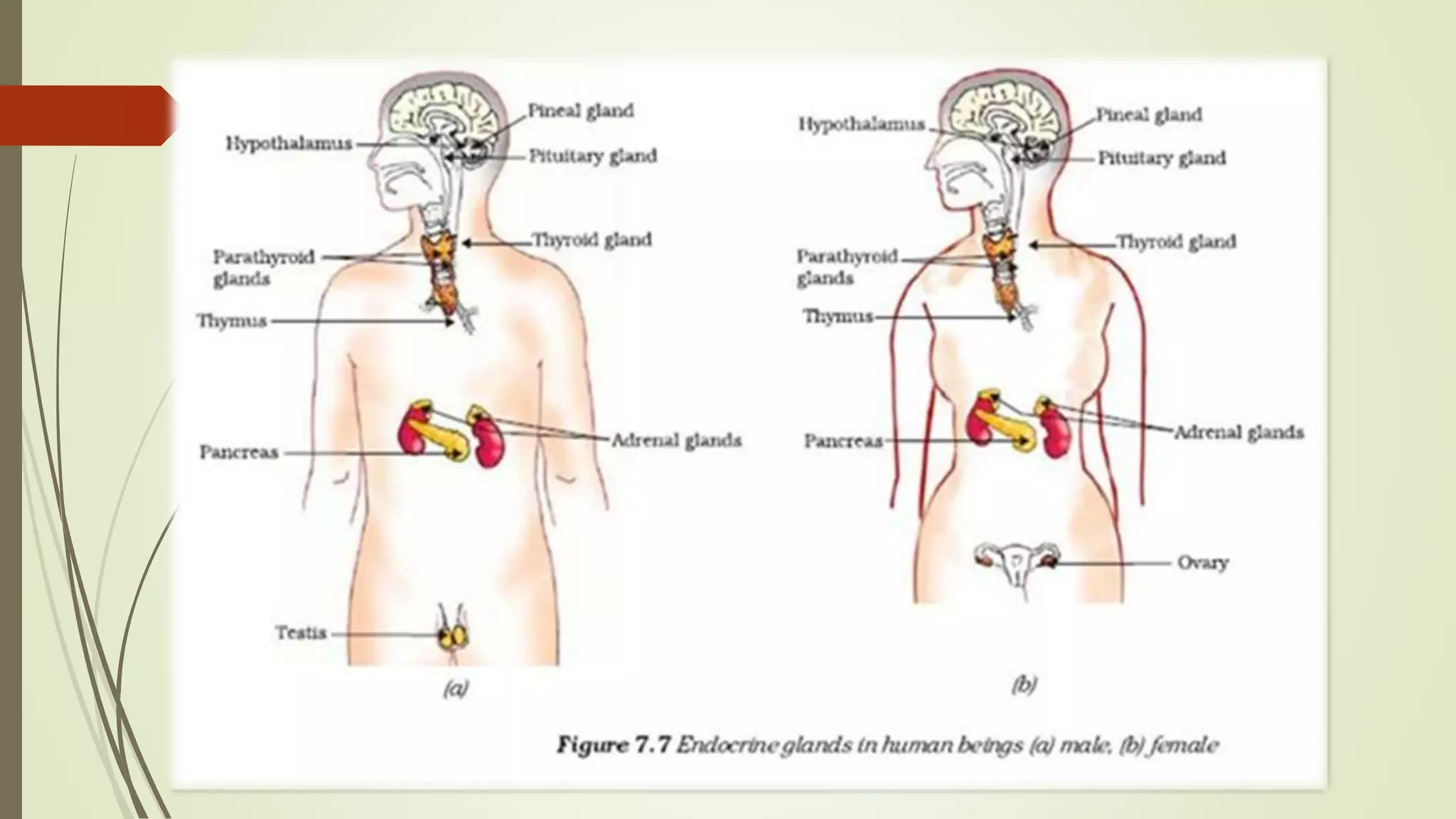
Adrenaline is secreted directly into the blood and carried to different
parts of the body. The target organs or the specific tissues on which it
acts include the heart. As a result, the heart beats faster, resulting in
supply of more oxygen to our muscles. The blood to the digestive
system and skin is reduced due to contraction of muscles around small
arteries in these organs. This diverts the blood to our skeletal muscles.
The breathing rate also increases because of the contractions of the
diaphragm and the rib muscles. All these responses together enable
the animal body to be ready to deal with the situation. Such animal
hormones are part of the endocrine system which constitutes a second
way of control and coordination in our body.
Sometimes we come across people who are either very short (dwarfs) or extremely tall (giants).
Have you ever wondered how this happens? Growth hormone is one of the hormones secreted by
the pituitary. As its name indicates, growth hormone regulates growth and development of the
body. If there is a deficiency of this hormone in childhood, it leads to dwarfism.
You must have noticed many dramatic changes in your appearance as well as that of your friends as
you approached 10–12 years of age. These changes associated with puberty are because of the
secretion of testosterone in males and oestrogen in females.
Do you know anyone in your family or friends who has been advised by the doctor to take less sugar
in their diet because they are suffering from diabetes? As a treatment, they might be taking
injections of insulin. This is a hormone which is produced by the pancreas and helps in regulating
blood sugar levels. If it is not secreted in proper amounts, the sugar level in the blood rises causing
many harmful effects.
If it is so important that hormones should be secreted in precise quantities, we need a mechanism
through which this is done. The timing and amount of hormone released are regulated by feedback
mechanisms. For example, if the sugar levels in blood rise, they are detected by the cells of the
pancreas which respond by producing more insulin. As the blood sugar level falls, insulin secretion is
reduced.
Thank you
Prepared By :Dheeraj Daga
5
X-B

CONTROL AND CO-DINATION

  • 1.
  • 2.
    Animals : NervousSystem The nervous system is the part of an animal's body that coordinates its voluntary and involuntary actions and transmits signals between different parts of its body. Nervous tissue first arose in wormlike organisms about 550 to 600 million years ago. In most animal species it consists of two main parts, the central nervous system (CNS) and the peripheral nervous system (PNS). The CNS contains the brain and spinal cord. The PNS consists mainly of nerves, which are enclosed bundles of the long fibers or axons, that connect the CNS to every other part of the body. The PNS includes motor neurons, mediating voluntary movement; the autonomic nervous system, comprising the sympathetic nervous system and the parasympathetic nervous system, which regulate involuntary functions, and the enteric nervous system, which functions to control the gastrointestinal system.
  • 3.
    At the cellularlevel, the nervous system is defined by the presence of a special type of cell, called the neuron, also known as a "nerve cell". Neurons have special structures that allow them to send signals rapidly and precisely to other cells. They send these signals in the form of electrochemical waves traveling along thin fibers called axons, which cause chemicals called neurotransmitters to be released at junctions called synapses. A cell that receives a synaptic signal from a neuron may be excited, inhibited, or otherwise modulated. The connections between neurons can form neural circuits and also neural networks that generate an organism's perception of the world and determine its behavior. Along with neurons, the nervous system contains other specialized cells called glial cells (or simply glia), which provide structural and metabolic support. Nervous systems are found in most multicellular animals, but vary greatly in complexity.[1] The only multicellular animals that have no nervous system at all are sponges, placozoans and mesozoans, which have very simple body plans. The nervous systems of the radially symmetric organisms the ctenophores (comb jellies) and cnidarians (which include anemones, hydras, corals and jellyfish) consist of a diffuse nerve net. All other animal species, with the exception of a few types of worm, have a nervous system containing a brain, a central cord (or two cords running in parallel), and nerves radiating from the brain and central cord. The size of the nervous system ranges from a few hundred cells in the simplest worms, to around 100 billion cells in humans. The central nervous system functions to send signals from one cell to others, or from one part of the body to others and to receive feedback. Malfunction of the nervous system can occur as a result of genetic defects, physical damage due to trauma or toxicity, infection or simply of ageing. The medical specialty of neurology studies disorders of the nervous system and looks for interventions that can prevent or treat them. In the peripheral nervous system, the most common problem is the failure of nerve conduction, which can be due to different causes including diabetic neuropathy and demyelinating disorders such as multiple sclerosis and amyotrophic lateral sclerosis.
  • 4.
    Reflex Action Of themany kinds of neural activity, there is one simple kind in which a stimulus leads to an immediate action. This is reflex activity. The word reflex (from Latin reflexus, “reflection”) was introduced into biology by a 19th- century English neurologist, Marshall Hall, who fashioned the word because he thought of the muscles as reflecting a stimulus much as a wall reflects a ball thrown against it. By reflex, Hall meant the automatic response of a muscle or several muscles to a stimulus that excites an afferent nerve. The term is now used to describe an action that is an inborn central nervous system activity, not involving consciousness, in which a particular stimulus, by exciting an afferent nerve, produces a stereotyped, immediate response of muscle or gland.
  • 5.
    The anatomical pathwayof a reflex is called the reflex arc. It consists of an afferent (or sensory) nerve, usually one or more interneurons within the central nervous system, and an efferent (motor, secretory, or secreto-motor) nerve. Most reflexes have several synapses in the reflex arc. The stretch reflex is exceptional in that, with no interneuron in the arc, it has only one synapse between the afferent nerve fibre and the motor neuron (see below Movement: The regulation of muscular contraction). The flexor reflex, which removes a limb from a noxious stimulus, has a minimum of two interneurons and three synapses. Probably the best-known reflex is the pupillary light reflex. If a light is flashed near one eye, the pupils of both eyes contract. Light is the stimulus; impulses reach the brain via the optic nerve; and the response is conveyed to the pupillary musculature by autonomic nerves that supply the eye. Another reflex involving the eye is known as the lacrimal reflex. When something irritates the conjunctiva or cornea of the eye, the lacrimal reflex causes nerve impulses to pass along the fifth cranial nerve (trigeminal) and reach the midbrain. The efferent limb of this reflex arc is autonomic and mainly parasympathetic. These nerve fibres stimulate the lacrimal glands of the orbit, causing the outpouring of tears. Other reflexes of the midbrain and medulla oblongata are the cough and sneeze reflexes. The cough reflex is caused by an irritant in the trachea and the sneeze reflex by one in the nose. In both, the reflex response involves many muscles; this includes a temporary lapse of respiration in order to expel the irritant.
  • 6.
    Human Brain The humanbrain has the same general structure as the brains of other mammals, but has a more developed cortex than any other. Large animals such as whales and elephants have larger brains in absolute terms, but when measured using the encephalization quotient which compensates for body size, the human brain is almost twice as large as the brain of the bottlenose dolphin, and three times as large as the brain of a chimpanzee. Much of the expansion comes from the part of the brain called the cerebral cortex, especially the frontal lobes, which are associated with executive functions such as self- control, planning, reasoning, and abstract thought. The portion of the cerebral cortex devoted to vision is also greatly enlarged in humans. The human cerebral cortex is a thick layer of neural tissue that covers most of the brain. This layer is folded in a way that increases the amount of surface that can fit into the volume available. The pattern of folds is similar across individuals, although there are many small variations. The cortex is divided into four "lobes", called the frontal lobe, parietal lobe, temporal lobe, and occipital lobe. (Some classification systems also include a limbic lobe and treat the insular cortex as a lobe.) Within each lobe are numerous cortical areas, each associated with a particular function such as vision, motor control, language, etc. The left and right sides of the cortex are broadly similar in shape, and most cortical areas are replicated on both sides. Some areas, though, show strong lateralization, particularly areas that are involved in language. In most people, the left hemisphere is "dominant" for language, with the right hemisphere playing only a minor role. There are other functions, such as spatiotemporal reasoning, for which the right hemisphere is usually dominant.
  • 7.
    Despite being protectedby the thick bones of the skull, suspended in cerebrospinal fluid, and isolated from the bloodstream by the blood–brain barrier, the human brain is susceptible to damage and disease. The most common forms of physical damage are closed head injuries such as a blow to the head, a stroke, or poisoning by a variety of chemicals that can act as neurotoxins. Infection of the brain, though serious, is rare due to the biological barriers which protect it. The human brain is also suceptible to degenerative disorders, such as Parkinson's disease, multiple sclerosis, and Alzheimer's disease. A number of psychiatric conditions, such as schizophrenia and depression, are thought to be associated with brain dysfunctions, although the nature of such brain anomalies is not well understood. Scientifically, the techniques that are used to study the human brain differ in important ways from those that are used to study the brains of other mammals. On the one hand, invasive techniques such as inserting electrodes into the brain, or disabling parts of the brain in order to examine the effect on behavior, are used with non-human species, but for ethical reasons, are generally not performed with humans. On the other hand, humans are the only subjects who can respond to complex verbal instructions. Thus, it is often possible to use non-invasive techniques such as functional neuroimaging or EEG recording more productively with humans than with non-humans. Furthermore, some of the most important topics, such as language, can hardly be studied at all except in humans. In many cases, human and non-human studies form essential complements to each other. Individual brain cells (except where tissue samples are taken for biopsy for suspected brain tumors) can only be studied in non-humans; complex cognitive tasks can only be studied in humans. Combining the two sources of information to yield a complete functional understanding of the human brain is an ongoing challenge for neuroscience.
  • 8.
    Co-ordination in Plants Inbotany, plant perception is the ability of plants to sense the environment and adjust their morphology, physiology and phenotype accordingly. Research draws on the fields of plant physiology, ecology and molecular biology. Examples of stimuli which plants perceive and can react to include chemicals, gravity, light, moisture, infections, temperature, oxygen and carbon dioxide concentrations, parasite infestation, physical disruption, and touch. Plants have a variety of means to detect such stimuli and a variety of reaction responses or behaviors.
  • 9.
    Processes Detection Plant perception occurson a cellular level. Research published in September 2006 has shown, certainly in the case of Arabidopsis thaliana, the role of cryptochromes in the perception of magnetic fields by plants. Mechanical perturbation can also be detected by plants. Poplar stems can detect reorientation and inclination (equilibrioception).Plant response strategies depend on quick and reliable recognition-systems. Pathway signals Wounded tomatoes are known to produce the volatile odour methyl-jasmonate as an alarm-signal. Plants in the neighbourhood can then detect the chemical and prepare for the attack by producing chemicals that defend against insects or attract predators.Plants systematically use hormonal signallingpathways to coordinate their own development and morphology. Neurochemicals Plants produce several proteins found in the animal neuron systems such as acetylcholine esterase, glutamate receptors, GABA receptors, and endocannabinoid signaling components. They also use ATP, NO, and ROS like animals for signaling. Electrophysiology Plant cells can be electrically excitable and can display rapid electrical responses (action potentials) to environmental stimuli. These action potentials can influence processes such as actin-based cytoplasmic streaming, plant organ movements, wound responses, respiration, photosynthesis and flowering. These electrical responses can cause the synthesis of numerous organic molecules including ones that act as neuroactive substances in other organisms.[citation needed] Thus, plants accomplish behavioural responses to environmental, communicative, and ecological contexts.While many cells in nearly all living organisms can be electrically excitable, this is not evidence of neurons, or of intelligence.[citation needed] Signal response Further information: Plant hormone, Thigmotropism and Thigmomorphogenesis
  • 10.
    Electrophysiology Plant cells canbe electrically excitable and can display rapid electrical responses (action potentials) to environmental stimuli. These action potentials can influence processes such as actin-based cytoplasmic streaming, plant organ movements, wound responses, respiration, photosynthesis and flowering.These electrical responses can cause the synthesis of numerous organic molecules including ones that act as neuroactive substances in other organisms.[citation needed] Thus, plants accomplish behavioural responses to environmental, communicative, and ecological contexts.While many cells in nearly all living organisms can be electrically excitable, this is not evidence of neurons, or of intelligence.[citation needed] Signal response A plant's concomitant reactive behavior is mediated by phytochromes, kinins, hormones, antibiotic or other chemical release, changes of water and chemical transport, and other means. These responses are generally slow, taking at minimum a number of hours to accomplish, and can best be observed with time-lapse cinematography, but rapid movements can occur as well. Plants respond to volatile signals produced by other plants. Jasmonate levels also increase rapidly in response to mechanical perturbations such as tendril coiling.Plants have many strategies to fight off pests. For example, they can produce different toxins (phytoalexins) against invaders or they can induce rapid cell death in invading cells to hinder the pests from spreading out.Some plants arecapable of rapid movement: the mimosa plant (Mimosa pudica) makes its thin leaves point down at the slightest touch and carnivorous plants such as the Venus flytrap snap shut by the touch of insects.[citation needed] In plants, the mechanism responsible for adaptation is signal transduction. Adaptive responses include:  Active foraging for light and nutrients. They do this by changing their architecture[vague], physiology and phenotype.  Leaves and branches are positioned and oriented in response to light source.  Ability to detect soil volume and adapt growth accordingly independently of nutrient availability.  Adaptively defend against herbivores.
  • 11.
    Hormones in Animals Howare such chemical, or hormonal, means of information transmission used in animals? What do some animals, for instance squirrels, experience when they are in a scary situation? Their bodies have to prepare for either fighting or running away. Both are very complicated activities that will use a great deal of energy in controlled ways. Many different tissue types will be used and their activities integrated together in these actions. However, the two alternate activities, fighting or running, are also quite different! So here is a situation in which some common preparations can be usefully made in the body. These preparations should ideally make it easier to do either activity in the near future. How would this be achieved? If the body design in the squirrel relied only on electrical impulses via nerve cells, the range of tissues instructed to prepare for the coming activity would be limited. On the other hand, if a chemical signal were to be sent as well, it would reach all cells of the body and provide the wideranging changes needed. This is done in many animals, including human beings, using a hormone called adrenaline that is secreted from the adrenaline gland.
  • 12.
    Adrenaline is secreteddirectly into the blood and carried to different parts of the body. The target organs or the specific tissues on which it acts include the heart. As a result, the heart beats faster, resulting in supply of more oxygen to our muscles. The blood to the digestive system and skin is reduced due to contraction of muscles around small arteries in these organs. This diverts the blood to our skeletal muscles. The breathing rate also increases because of the contractions of the diaphragm and the rib muscles. All these responses together enable the animal body to be ready to deal with the situation. Such animal hormones are part of the endocrine system which constitutes a second way of control and coordination in our body.
  • 14.
    Sometimes we comeacross people who are either very short (dwarfs) or extremely tall (giants). Have you ever wondered how this happens? Growth hormone is one of the hormones secreted by the pituitary. As its name indicates, growth hormone regulates growth and development of the body. If there is a deficiency of this hormone in childhood, it leads to dwarfism. You must have noticed many dramatic changes in your appearance as well as that of your friends as you approached 10–12 years of age. These changes associated with puberty are because of the secretion of testosterone in males and oestrogen in females. Do you know anyone in your family or friends who has been advised by the doctor to take less sugar in their diet because they are suffering from diabetes? As a treatment, they might be taking injections of insulin. This is a hormone which is produced by the pancreas and helps in regulating blood sugar levels. If it is not secreted in proper amounts, the sugar level in the blood rises causing many harmful effects. If it is so important that hormones should be secreted in precise quantities, we need a mechanism through which this is done. The timing and amount of hormone released are regulated by feedback mechanisms. For example, if the sugar levels in blood rise, they are detected by the cells of the pancreas which respond by producing more insulin. As the blood sugar level falls, insulin secretion is reduced.
  • 15.
    Thank you Prepared By:Dheeraj Daga 5 X-B