Excitable Tissue
Excitable Tissue
Muscle and Nerve
Muscle and Nerve
Assistant Prof.
Assistant Prof.
Dr. Abbas Al-Hashimi
PHYSIOLOGY OF NERVE AND MUSCLE
CELLS
Electrical potentials exist across the
membranes of almost all cells of the body.
However, nerve and muscle cells are
referred to as “excitable” because they are
capable of generating rapidly changing
electrochemical impulses at their
membranes, which are used to transmit
signals along the nerve or muscle
membranes. Excitation of the nerve will
cause propagation of the nerve impulse
whereas muscle excitation would produce
contraction.
Genesis of the Membrane Potential
The distribution of ions “electrolytes”
across the cell membrane and the nature
of this membrane provide the explanation
for the membrane potential. Sodium,
potassium and chloride ions are the most
important ions involved in the
development of membrane potentials in
nerves and muscles. The concentration
gradient of each of these ions across the
membrane helps determine the voltage of
the membrane potential.
Resting Membrane Potential
•
•
•
Cells under resting conditions have an electrical
potential difference across their plasma
membrane. This potential is the Resting
Membrane Potential (RMP)
The cytoplasm is electrically (-) relative to the
ECF
The RMP plays a vital role in the excitability of
nerve and muscle cells and in other cellular
responses
Genesis of the RMP
•
a.
b.
•
–
–
–
–
2
3
•
–
–
1.Distribution of ions
movement of ions depend on:
Concentration
Electrical potential difference
if forces are equal = no movement
Nernst equation
Nernst equilibrium
Gibbs-Donnan equilibrium
Goldman-Hodgkin-Katz
Selective Permeability of the Membrane
Na+ - K+ pump
RMP
skeletal muscle (-)90mV
nerve (-) 70 mV
Nernst Equation:
Equilibrium Potential (E):
E = + 61 X log
Ion concentration inside
Ion concentration outside
- 61
EK
+ = X log
[ K+ ] inside
[ K+ ] outside
= - 94 mV
X log [ Na+ ] inside
[ Na+ ] outside
= + 61 mV
ENa
+ = - 61
•
•
•
The potential level across the membrane that opposes the
net diffusion of any particular ion through the membrane
(down its concentration and electrical gradients) is called
the equilibrium potential and is calculated by the Nernst
equation. Because the membrane is permeable to several
ions, the diffusion potential that develops is calculated
using the Goldman equation, which computes the
membrane potential utilizing the three main ions (sodium
Na+, potassium K+ and chloride Cl−) and considering the
following three factors:
The polarity of the electrical charge of each ion.
Permeability of the membrane for each ion.
The concentration difference of the respective ion across
the membrane.
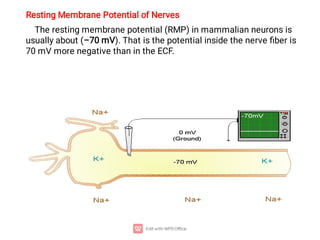
Resting Membrane Potential of Nerves
The resting membrane potential (RMP) in mammalian neurons is
usually about (–70 mV). That is the potential inside the nerve fiber is
70 mV more negative than in the ECF.
The cell membranes of nerves contain many different
types of ion channels.
Some of these are passive (opened continually), whereas
others are voltage-gated. It is the behavior of these
channels, particularly sodium and potassium channels
that explains the electrical events in nerves. The nerve
cell membrane contains special channels called (K+-Na+)
leak channels where both ions leak through the cell
membrane down their concentration and electrical
gradient.
The channels are far more permeable to K+ than Na+,
about 100 times as permeable. The equilibrium potential
for K+ is (–94 mV) (as calculated by Nernst equation),
and that of Na+ is (+61 mV). However, the diffusion of K+
contributes far more to the membrane potential than that
of Na+.
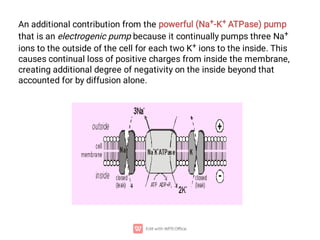
An additional contribution from the powerful (Na+-K+ ATPase) pump
that is an electrogenic pump because it continually pumps three Na+
ions to the outside of the cell for each two K+ ions to the inside. This
causes continual loss of positive charges from inside the membrane,
creating additional degree of negativity on the inside beyond that
accounted for by diffusion alone.
Summary
Na+ ions diffuse in of cells and K+ ions diffuse
out down their concentration gradients; but
because of K+ leak channels, K+ permeability is
greater than Na+ permeability. The
concentration gradient for K+ facilitates its
movement out of the cell via K+ leak channels,
but its electrical gradient is in the opposite
(inward) direction. Consequently, an equilibrium
is reached in which the tendency of K+ to move
out of the cell is balanced by its tendency to
move into the cell, and at that equilibrium there
is an excess of cations (positively charged ions)
on the outside and anions (negatively charged
Because since the membrane is impermeable
to most of the anions in the cell, K+ efflux is
not accompanied by an equal efflux of anions
and the membrane is maintained in a
polarized state, with the outside is positive
relative to the inside. This condition is
maintained by the (Na+- K+ ATPase) pump
which is an electrogenic pump, contributing to
the membrane potential by itself. The effect of
all of the above gives a net resting membrane
potential of about (–70 mV).
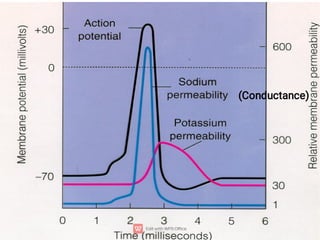
Nerve Action Potential:
Nerve signals are transmitted by action
potentials, which are rapid changes in the
membrane potential that spread rapidly
along the nerve fiber membrane. During
the action potential, changes in
membrane conductance (a measure of
membrane permeability to an ion) of Na+
and K+ occur.
(Conductance)
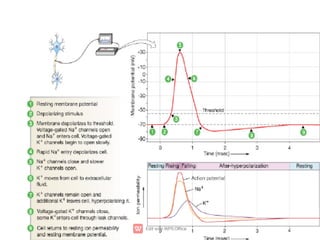
Ionic Fluxes during the Action Potential:
In a neuron, a slight decrease in resting membrane
potential (decrease in negativity or polarity; i.e.
depolarization) leads to increased K+ efflux and chloride
ion (Cl–) influx; restoring the resting membrane potential
(RMP) back to its polarized state. However, when the
depolarization exceeds (7 mV), the voltage-gated Na+
channels start to open at an increased rate (Na+ channel
activation), so that when the firing level is reached (–55
mV), Na+ conductance increases 5000 folds and the
influx of Na+ along its inwardly directed concentration
and electrical gradients is so great that it temporarily
overwhelms the repolarizing forces, producing the action
potential.
The onset of action potential also causes voltage-
gated K+ channels to open but more slowly than the
voltage-gated Na+ channels. This delay causes them
to open just at the time Na+ channels are beginning
to close (Na+ channel inactivation). Therefore, the
ratio of conductance shifts far in favor of high K+
and low Na+ conductance, allowing very rapid loss
of K+ ions to the exterior. Consequently, the action
potential quickly returns to its baseline level
(repolarization).
•
•
•
During the action potential, the membrane potential moves
towards the equilibrium potential for Na+ (+61 mV) in
mammalian neurons, but does not reach it and stops at about
(+35 mV), because:
Short-lived decrease in Na+ conductance due to rapid entry
of Na+ channels into the closed (inactivation) state, remaining
their for a few milliseconds before returning to the resting state.
The direction of the electrical gradient for Na+ is reversed
during the overshoot of the action potential; because the
membrane potential is reversed, limiting Na+ influx.
Opening of the voltage-gated K+ channels, which is slower
and more prolonged than the opening of the Na+ channels; thus,
much of the increase in K+ conductance comes after the
increase in Na+ conductance.
The net movement of positive charges out of the cell due to
K+ efflux at this time helps complete the process of
Nerve Cells:
The human CNS contains about 100 billion (1011) neurons,
and about 10-50 times that number of supportive glial cells.
The neurons are the basic building block of the nervous
system. Most neurons have the same parts as the typical
spinal motor neuron.
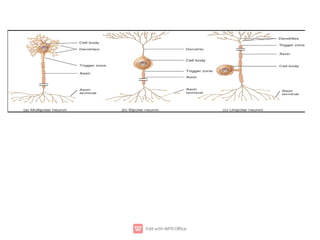
The typical neuron has 5-7 processes called dendrites that
extend outward from the cell body and arborize extensively.
A typical neuron has also a long fibrous axon that originates
from a thickened area of the cell body, the axon hillock. The
first portion of the axon is called the initial segment. The
axon divides into a number of terminal branches, ending in a
number of synaptic knobs (terminal buttons), where the
synaptic neurotransmitters secreted by the nerve are stored.
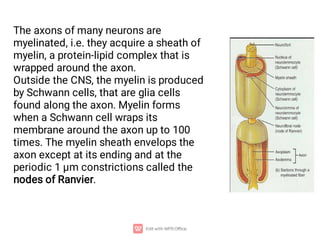
The axons of many neurons are
myelinated, i.e. they acquire a sheath of
myelin, a protein-lipid complex that is
wrapped around the axon.
Outside the CNS, the myelin is produced
by Schwann cells, that are glia cells
found along the axon. Myelin forms
when a Schwann cell wraps its
membrane around the axon up to 100
times. The myelin sheath envelops the
axon except at its ending and at the
periodic 1 µm constrictions called the
nodes of Ranvier.
•
•
•
•
•
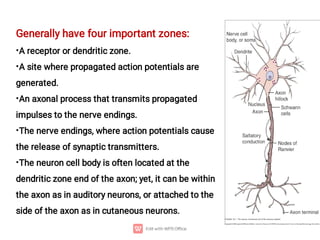
Generally have four important zones:
A receptor or dendritic zone.
A site where propagated action potentials are
generated.
An axonal process that transmits propagated
impulses to the nerve endings.
The nerve endings, where action potentials cause
the release of synaptic transmitters.
The neuron cell body is often located at the
dendritic zone end of the axon; yet, it can be within
the axon as in auditory neurons, or attached to the
side of the axon as in cutaneous neurons.
•
•
•
•
Protein Synthesis and Axoplasmic Transport:
Nerve cells are secretory cells, but differ in that the
secretory zone is far removed from the cell body at the
end of the axons.
Therefore, all the necessary proteins are transported to
the synaptic knobs by the process of Axoplasmic flow,
with anterograde transport occurs at about (400 mm/day).
The cell body maintains the functional and anatomic
integrity of the axon.
If the axon is cut, the part distal to the cut degenerates
(wallerian degeneration).
•
•
•
•
Excitation and Conduction:
Nerve cells have a low threshold for excitation. The stimulus may
be electrical, chemical or mechanical.
Two types of physicochemical disturbances are produced: Local
non-propagated potentials called electrotonic potentials and
propagated disturbances; action potentials or nerve impulse.
These are caused by changes in the conduction of ions across the
cell membrane that are produced by alterations in ion channels.
The electrical events in neurons are rapid; being measured in
milliseconds (ms), and the potential changes are small; being
measured in millivolts (mV).
•
•
•
Retrograde transport also occurs at about 200 mm/day,
where some used synaptic vesicles are carried back to
the cell body and deposited in the lysosomes.
About 70% of the energy requirement of the nerve is
used to maintain the membrane potential by the action
of the Na+- K+ ATPase.
During maximal activity, the metabolic rate of nerve
only doubles, as compared to the metabolic rate of the
skeletal muscle that increases as much as 100-fold.
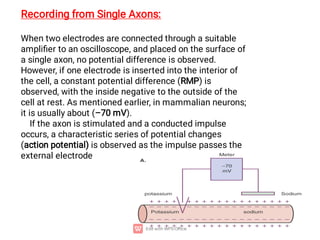
Recording from Single Axons:
When two electrodes are connected through a suitable
amplifier to an oscilloscope, and placed on the surface of
a single axon, no potential difference is observed.
However, if one electrode is inserted into the interior of
the cell, a constant potential difference (RMP) is
observed, with the inside negative to the outside of the
cell at rest. As mentioned earlier, in mammalian neurons;
it is usually about (–70 mV).
If the axon is stimulated and a conducted impulse
occurs, a characteristic series of potential changes
(action potential) is observed as the impulse passes the
external electrode
Latent Period:
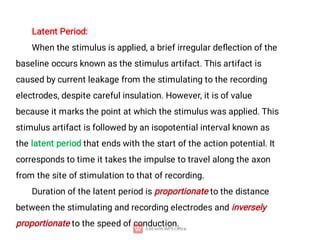
When the stimulus is applied, a brief irregular deflection of the
baseline occurs known as the stimulus artifact. This artifact is
caused by current leakage from the stimulating to the recording
electrodes, despite careful insulation. However, it is of value
because it marks the point at which the stimulus was applied. This
stimulus artifact is followed by an isopotential interval known as
the latent period that ends with the start of the action potential. It
corresponds to time it takes the impulse to travel along the axon
from the site of stimulation to that of recording.
Duration of the latent period is proportionate to the distance
between the stimulating and recording electrodes and inversely
proportionate to the speed of conduction.
Action Potential:
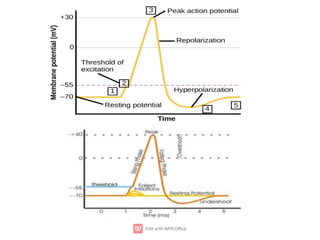
When recorded with one electrode in the cell, the action potential is
called monophasic action potential; being primarily in one direction. A
beginning depolarization of the membrane (i.e. decrease in negativity
towards the zero level) is the first sign of an approaching action
potential. After the initial 15 mV of depolarization, the rate of
depolarization increases and the tracing rapidly reaches and overshoots
the isopotential (zero potential) line to approximately +35 mV. It then
reverses and falls rapidly towards the resting level. When the
repolarization is about 70% completed, its rate decreases and the
tracing approaches the resting level more slowly. The sharp rise and the
rapid fall are the spike potential of the axon, and the slow fall at the end
of the process is the after-depolarization.
After reaching the previous resting level, the
tracing overshoots slightly in the hyperpolarizing
(more negative) direction to form the small but
prolonged after-hyperpolarization. The slow
return of the voltage-gated K+ channels to the
closed state explains this after-hyperpolarization,
Because the loss of more positive electrical
charges from inside of the nerve cell after
reaching the RMP causes a (more negative-
hyperpolarizing) potential.
Although subthreshold stimuli do not produce an
action potential, they do have an effect on the
membrane potential. Application of such currents
leads to a localized potential changes that decays
with time. These potential changes are called
electrotonic potentials, those produced at a cathode
being catelectrotonic and those at an anode
anelectrotonic. They are passive changes in
membrane polarization caused by addition or
subtraction of charge by the particular electrode. At
low current intensities producing up to 7 mV of
depolarization, their size is proportionate to the
magnitude of the stimulus. With stronger stimuli,
cathodal responses are greater than would be
expected from the current magnitude, and when the
cathodal stimulation is great enough to produce
about 15 mV of depolarization (i.e. at the membrane
potential of –55 mV), the membrane potential begins
The disproportionately greater response at
the cathode to stimuli that cause 7-15 mV of
depolarization is produced when voltage-
gated Na+ channels begin to open and is
called local response. The point at which a
runaway spike potential is initiated at 15 mV
of depolarization is the firing level (threshold).
Thus, up to 15 mV of depolarization, the
repolarizing forces are still stronger than the
depolarizing forces and the potential decays.
At 15 mV of depolarization, the depolarizing
forces are strong enough to overwhelm the
repolarizing processes, and an action
potential results.
Biphasic Action Potential:
If both recording electrodes were placed on the
surface of the axon, there is no potential difference
between them at rest. When the nerve is stimulated and
an impulse is conducted, a characteristic sequence of
potential changes results.
When the impulse reaches to the electrode nearest to
the stimulator, it becomes negative relative to the other
electrode and a downward deflection is recorded. Then,
the impulse passes between the two electrodes and the
potential becomes zero and the record returns to the
isoelectric line. After that, as the impulse passes the
second electrode, the first electrode becomes positive
relative to the second one and an upward deflection is
recorded, and finally, the record returns to the base line
when the conducted
•
•
•
Changes in Excitability during Electrotonic
Potentials and Action Potential:
Excitability is the reciprocal of the threshold.
Hyperpolarizing anelectrotonic responses elevate the
threshold of the neuron to stimulation, and depolarizing
catelectrotonic potentials lower it.
During the local response, the threshold is lowered, but
during the rising and much of the falling phases of the
spike potential, the neuron is refractory to stimulation.
•
•
Absolute refractory period, corresponding to the time
from the firing level until repolarization is about one
third complete. During this period, no stimulus, no
matter how strong, will excite the nerve.
Relative refractory period, lasting from the above
period up to the start of after-depolarization. stronger
than normal stimuli can cause excitation.
•
•
The reason for this could be due to the fact that at first
all the voltage-gated Na+ channels are opened (Na+
channel activation), and no more channels to be
activated. Also, shortly after, they become inactivated
and no amount of excitatory signals applied will open
the inactivation gates, unless by a strong stimulus at the
lower thirds of the action potential.
During after-depolarization, the threshold is again
decreased, and during after-hyperpolarization, it is
increased.
•
•
•
•
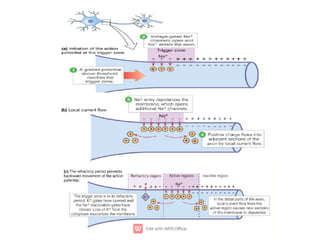
Electrogenesis and Propagation of Action Potential:
During the action potential in an unmyelinated nerve, the
polarity of the cell membrane is abolished and for a brief
period is actually reversed.
Positive charges from the membrane ahead of and behind
the action potential flow to the area of negativity presented
by the action potential (current sink).
This flow decreases the polarity of the membrane ahead,
and when the firing level is reached, a propagated response
occurs.
Thus, self-propagating nature of nerve impulse along an
unmyelinated axon is due to circular current flow, with
successive depolarization to the firing level of the membrane
ahead of the action potential.
•
•
N.B. Notice that a moving impulse does not depolarize the
area behind to the firing level.
However, in myelinated axons, depolarization jumps from
one node of Ranvier to the next, with the current sink at
the active node serves to electrotonically depolarize to the
firing level the node ahead.
This jumping of depolarization from node to node is called
salutatory conduction.
It is a rapid process, and myelinated axons conduct
impulses up to 50 times faster than the fastest
unmyelinated fibers.
Orthodromic and Antidromic Conduction:
An axon can conduct in either direction when
an action potential is initiated in the middle of it.
Nevertheless, in a living animal, impulses normally
pass in one direction only (as we have learned), i.e.
from synaptic junctions or receptors along axons
down to their termination. Such conduction is
referred to as orthodromic conduction.
Conduction in the opposite direction is called
antidromic conduction. If an axon was stimulated
at its middle during an experiment on a living
animal, any antidromic impulses that are set up
fail to pass the first synapse they encounter and
die out at that point, since synapses permit
conduction in one direction only.
1.
2.
Accommodation and Types of Electrical
Stimulation:
Electrical stimulation involves two types of
impulse:
Square impulse.
Slowly rising impulse.
However, slowly rising impulses are not preferred
in experiments on living tissues, because the
tissue will adapt to the applied stimulus and
resist it, a process called accommodation.
Consequently, slowly rising impulses fail to fire
the nerve; while in square impulse, the abrupt
(sudden) change in membrane potential gives no
time for the nerve tissue to accommodate it and
accommodation again can be explained by the
slower opening and the delayed closure of the
slow voltage-gated K+ channels. In square
impulses, the rapid opening of the fast voltage-
gated Na+ channels overwhelms (overcomes)
the repolarizing forces; producing an action
potential, but, if depolarization is slowly
produced, the gradual opening of voltage-gated
Na+ channels is balanced by the gradual opening
of the slow voltage-gated K+ channels; hence, an
Threshold Intensity and Strength-Duration Curve:
In any nerve cell, it is possible to determine the
threshold intensity of stimulation that is the
minimal intensity of stimulating current that,
acting for a given duration, will just produce an
action potential. Therefore, threshold intensity
depends on the strength (intensity- amplitude) of
the electrical stimulation and the duration of its
application; with weak stimuli it is of long
duration and with strong stimuli it is of short
duration.
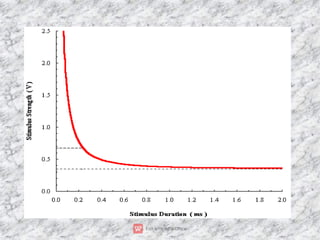
The relation between the strength and the
duration of a threshold stimulus is called the
strength-duration curve
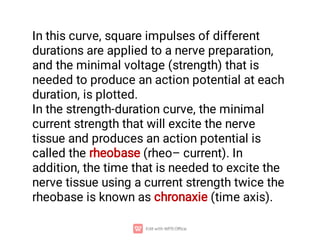
In this curve, square impulses of different
durations are applied to a nerve preparation,
and the minimal voltage (strength) that is
needed to produce an action potential at each
duration, is plotted.
In the strength-duration curve, the minimal
current strength that will excite the nerve
tissue and produces an action potential is
called the rheobase (rheo– current). In
addition, the time that is needed to excite the
nerve tissue using a current strength twice the
rheobase is known as chronaxie (time axis).
“All-or-None” Low
Once threshold intensity is reached, a
full action potential is produced. Further
increases in the intensity of a stimulus
produce no increment in the action
potential as long as other experimental
conditions remain constant. Hence, the
action potential fails to occur if the
stimulus is subthreshold in magnitude,
and it occurs in a constant amplitude and
form if the stimulus is at or above the
threshold intensity. For that reason, the
action potential is said to obey the all-or-
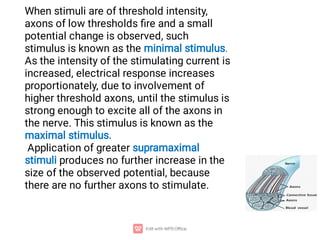
Properties of Mixed Nerves:
Peripheral nerves in mammals are made up
of many axons bound together in a fibrous
envelope called the epineurium. Therefore,
potential changes recorded extracellularly from
mammalian peripheral nerves represent an
algebraic summation of the all-or-none action
potentials of many axons, due to the variation
in the thresholds of individual axons in the
nerve, as follows;
With subthreshold stimuli, none of the axons
are stimulated and no response occurs.
When stimuli are of threshold intensity,
axons of low thresholds fire and a small
potential change is observed, such
stimulus is known as the minimal stimulus.
As the intensity of the stimulating current is
increased, electrical response increases
proportionately, due to involvement of
higher threshold axons, until the stimulus is
strong enough to excite all of the axons in
the nerve. This stimulus is known as the
maximal stimulus.
Application of greater supramaximal
stimuli produces no further increase in the
size of the observed potential, because
there are no further axons to stimulate.
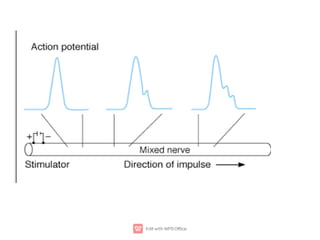
Compound Action Potentials:
Another property of mixed nerves, as opposed
to single axons, is the appearance of multipeaked
action potential called the compound action
potential. It has a unique shape because a mixed
nerve is made up of families of fibers with various
speeds of conduction, so that when all the fibers
are stimulated (maximal stimulus), the activity in
fast-conducting fibers arrives sooner than that in
slower fibers at the recording electrodes. Here,
the farther away the action potential is recorded
from the stimulating electrodes, the greater is the
separation between the fast and slow fiber peaks.
Nerve Fiber types and Function:
Mammalian nerve fibers are divided into A, B and C;
then, further subdividing group A into α, β, γ and δ fibers.
The classification was according to the functions and
histologic characteristics of each of the families of
axons that are responsible for the various peaks of the
compound action potential.
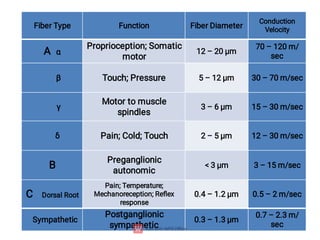
As a general rule: the greater the diameter of a given
nerve fiber, the greater its speed of conduction. The
large axons are concerned primarily with proprioceptive
sensation, somatic motor function, conscious touch
and pressure; while smaller axons subserve pain and
temperature sensations and autonomic function. An
example of small nerve fibers is the dorsal root C fibers
which conduct most impulses generated by cutaneous
receptors, such as pain and temperature sensation and
mechanoreceptors, in addition to reflex responses.
Fiber Type Function Fiber Diameter
Conduction
Velocity
A α
Proprioception; Somatic
motor
12 – 20 µm
70 – 120 m/
sec
β Touch; Pressure 5 – 12 µm 30 – 70 m/sec
γ
Motor to muscle
spindles
3 – 6 µm 15 – 30 m/sec
δ Pain; Cold; Touch 2 – 5 µm 12 – 30 m/sec
B
Preganglionic
autonomic
< 3 µm 3 – 15 m/sec
C Dorsal Root
Pain; Temperature;
Mechanoreception; Reflex
response
0.4 – 1.2 µm 0.5 – 2 m/sec
Sympathetic
Postganglionic
sympathetic
0.3 – 1.3 µm
0.7 – 2.3 m/
sec
•
•
In addition to variations in speed of conduction
and fiber diameter, the various classes of fibers
in peripheral nerves differ in their sensitivity to
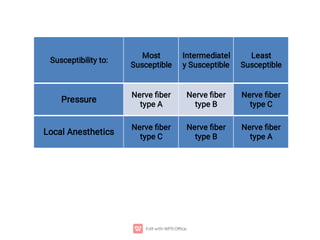
pressure and anesthetics (see the table below).
This has a clinical as well as physiological
significance:
Local anesthetics depress the transmission in
group C fibers before they affect the somatic
motor and touch fibers in the A group.
pressure on a nerve can cause loss of
conduction in large-diameter (type A) somatic
motor fibers, while pain and temperature
sensation (type C) remains relatively intact.
Clinically, such pattern can be seen in
individuals who sleep deeply with their
arms under their heads for long
periods, causing compression of the
nerves in the arms and paralysis (loss
of motor function- type A fibers).
The syndrome has acquired the
interesting name of Saturday night or
Sunday morning paralysis, due to
association with alcoholic intoxication
on weekends.
Susceptibility to:
Most
Susceptible
Intermediatel
y Susceptible
Least
Susceptible
Pressure
Nerve fiber
type A
Nerve fiber
type B
Nerve fiber
type C
Local Anesthetics
Nerve fiber
type C
Nerve fiber
type B
Nerve fiber
type A
Nerve and Muscle 1.pdf

Nerve and Muscle 1.pdf

  • 1.
    Excitable Tissue Excitable Tissue Muscleand Nerve Muscle and Nerve Assistant Prof. Assistant Prof. Dr. Abbas Al-Hashimi Dr. Abbas Al-Hashimi
  • 2.
    PHYSIOLOGY OF NERVEAND MUSCLE CELLS Electrical potentials exist across the membranes of almost all cells of the body. However, nerve and muscle cells are referred to as “excitable” because they are capable of generating rapidly changing electrochemical impulses at their membranes, which are used to transmit signals along the nerve or muscle membranes. Excitation of the nerve will cause propagation of the nerve impulse whereas muscle excitation would produce contraction.
  • 3.
    Genesis of theMembrane Potential The distribution of ions “electrolytes” across the cell membrane and the nature of this membrane provide the explanation for the membrane potential. Sodium, potassium and chloride ions are the most important ions involved in the development of membrane potentials in nerves and muscles. The concentration gradient of each of these ions across the membrane helps determine the voltage of the membrane potential.
  • 4.
    Resting Membrane Potential • • • Cellsunder resting conditions have an electrical potential difference across their plasma membrane. This potential is the Resting Membrane Potential (RMP) The cytoplasm is electrically (-) relative to the ECF The RMP plays a vital role in the excitability of nerve and muscle cells and in other cellular responses
  • 5.
    Genesis of theRMP • a. b. • – – – – 2 3 • – – 1.Distribution of ions movement of ions depend on: Concentration Electrical potential difference if forces are equal = no movement Nernst equation Nernst equilibrium Gibbs-Donnan equilibrium Goldman-Hodgkin-Katz Selective Permeability of the Membrane Na+ - K+ pump RMP skeletal muscle (-)90mV nerve (-) 70 mV
  • 6.
    Nernst Equation: Equilibrium Potential(E): E = + 61 X log Ion concentration inside Ion concentration outside - 61 EK + = X log [ K+ ] inside [ K+ ] outside = - 94 mV X log [ Na+ ] inside [ Na+ ] outside = + 61 mV ENa + = - 61
  • 7.
    • • • The potential levelacross the membrane that opposes the net diffusion of any particular ion through the membrane (down its concentration and electrical gradients) is called the equilibrium potential and is calculated by the Nernst equation. Because the membrane is permeable to several ions, the diffusion potential that develops is calculated using the Goldman equation, which computes the membrane potential utilizing the three main ions (sodium Na+, potassium K+ and chloride Cl−) and considering the following three factors: The polarity of the electrical charge of each ion. Permeability of the membrane for each ion. The concentration difference of the respective ion across the membrane.
  • 8.
    Resting Membrane Potentialof Nerves The resting membrane potential (RMP) in mammalian neurons is usually about (–70 mV). That is the potential inside the nerve fiber is 70 mV more negative than in the ECF.
  • 9.
    The cell membranesof nerves contain many different types of ion channels. Some of these are passive (opened continually), whereas others are voltage-gated. It is the behavior of these channels, particularly sodium and potassium channels that explains the electrical events in nerves. The nerve cell membrane contains special channels called (K+-Na+) leak channels where both ions leak through the cell membrane down their concentration and electrical gradient. The channels are far more permeable to K+ than Na+, about 100 times as permeable. The equilibrium potential for K+ is (–94 mV) (as calculated by Nernst equation), and that of Na+ is (+61 mV). However, the diffusion of K+ contributes far more to the membrane potential than that of Na+.
  • 10.
    An additional contributionfrom the powerful (Na+-K+ ATPase) pump that is an electrogenic pump because it continually pumps three Na+ ions to the outside of the cell for each two K+ ions to the inside. This causes continual loss of positive charges from inside the membrane, creating additional degree of negativity on the inside beyond that accounted for by diffusion alone.
  • 11.
    Summary Na+ ions diffusein of cells and K+ ions diffuse out down their concentration gradients; but because of K+ leak channels, K+ permeability is greater than Na+ permeability. The concentration gradient for K+ facilitates its movement out of the cell via K+ leak channels, but its electrical gradient is in the opposite (inward) direction. Consequently, an equilibrium is reached in which the tendency of K+ to move out of the cell is balanced by its tendency to move into the cell, and at that equilibrium there is an excess of cations (positively charged ions) on the outside and anions (negatively charged
  • 12.
    Because since themembrane is impermeable to most of the anions in the cell, K+ efflux is not accompanied by an equal efflux of anions and the membrane is maintained in a polarized state, with the outside is positive relative to the inside. This condition is maintained by the (Na+- K+ ATPase) pump which is an electrogenic pump, contributing to the membrane potential by itself. The effect of all of the above gives a net resting membrane potential of about (–70 mV).
  • 13.
    Nerve Action Potential: Nervesignals are transmitted by action potentials, which are rapid changes in the membrane potential that spread rapidly along the nerve fiber membrane. During the action potential, changes in membrane conductance (a measure of membrane permeability to an ion) of Na+ and K+ occur.
  • 14.
  • 15.
    Ionic Fluxes duringthe Action Potential: In a neuron, a slight decrease in resting membrane potential (decrease in negativity or polarity; i.e. depolarization) leads to increased K+ efflux and chloride ion (Cl–) influx; restoring the resting membrane potential (RMP) back to its polarized state. However, when the depolarization exceeds (7 mV), the voltage-gated Na+ channels start to open at an increased rate (Na+ channel activation), so that when the firing level is reached (–55 mV), Na+ conductance increases 5000 folds and the influx of Na+ along its inwardly directed concentration and electrical gradients is so great that it temporarily overwhelms the repolarizing forces, producing the action potential.
  • 16.
    The onset ofaction potential also causes voltage- gated K+ channels to open but more slowly than the voltage-gated Na+ channels. This delay causes them to open just at the time Na+ channels are beginning to close (Na+ channel inactivation). Therefore, the ratio of conductance shifts far in favor of high K+ and low Na+ conductance, allowing very rapid loss of K+ ions to the exterior. Consequently, the action potential quickly returns to its baseline level (repolarization).
  • 18.
    • • • During the actionpotential, the membrane potential moves towards the equilibrium potential for Na+ (+61 mV) in mammalian neurons, but does not reach it and stops at about (+35 mV), because: Short-lived decrease in Na+ conductance due to rapid entry of Na+ channels into the closed (inactivation) state, remaining their for a few milliseconds before returning to the resting state. The direction of the electrical gradient for Na+ is reversed during the overshoot of the action potential; because the membrane potential is reversed, limiting Na+ influx. Opening of the voltage-gated K+ channels, which is slower and more prolonged than the opening of the Na+ channels; thus, much of the increase in K+ conductance comes after the increase in Na+ conductance. The net movement of positive charges out of the cell due to K+ efflux at this time helps complete the process of
  • 19.
    Nerve Cells: The humanCNS contains about 100 billion (1011) neurons, and about 10-50 times that number of supportive glial cells. The neurons are the basic building block of the nervous system. Most neurons have the same parts as the typical spinal motor neuron. The typical neuron has 5-7 processes called dendrites that extend outward from the cell body and arborize extensively. A typical neuron has also a long fibrous axon that originates from a thickened area of the cell body, the axon hillock. The first portion of the axon is called the initial segment. The axon divides into a number of terminal branches, ending in a number of synaptic knobs (terminal buttons), where the synaptic neurotransmitters secreted by the nerve are stored.
  • 20.
    The axons ofmany neurons are myelinated, i.e. they acquire a sheath of myelin, a protein-lipid complex that is wrapped around the axon. Outside the CNS, the myelin is produced by Schwann cells, that are glia cells found along the axon. Myelin forms when a Schwann cell wraps its membrane around the axon up to 100 times. The myelin sheath envelops the axon except at its ending and at the periodic 1 µm constrictions called the nodes of Ranvier.
  • 21.
    • • • • • Generally have fourimportant zones: A receptor or dendritic zone. A site where propagated action potentials are generated. An axonal process that transmits propagated impulses to the nerve endings. The nerve endings, where action potentials cause the release of synaptic transmitters. The neuron cell body is often located at the dendritic zone end of the axon; yet, it can be within the axon as in auditory neurons, or attached to the side of the axon as in cutaneous neurons.
  • 23.
    • • • • Protein Synthesis andAxoplasmic Transport: Nerve cells are secretory cells, but differ in that the secretory zone is far removed from the cell body at the end of the axons. Therefore, all the necessary proteins are transported to the synaptic knobs by the process of Axoplasmic flow, with anterograde transport occurs at about (400 mm/day). The cell body maintains the functional and anatomic integrity of the axon. If the axon is cut, the part distal to the cut degenerates (wallerian degeneration).
  • 24.
    • • • • Excitation and Conduction: Nervecells have a low threshold for excitation. The stimulus may be electrical, chemical or mechanical. Two types of physicochemical disturbances are produced: Local non-propagated potentials called electrotonic potentials and propagated disturbances; action potentials or nerve impulse. These are caused by changes in the conduction of ions across the cell membrane that are produced by alterations in ion channels. The electrical events in neurons are rapid; being measured in milliseconds (ms), and the potential changes are small; being measured in millivolts (mV).
  • 25.
    • • • Retrograde transport alsooccurs at about 200 mm/day, where some used synaptic vesicles are carried back to the cell body and deposited in the lysosomes. About 70% of the energy requirement of the nerve is used to maintain the membrane potential by the action of the Na+- K+ ATPase. During maximal activity, the metabolic rate of nerve only doubles, as compared to the metabolic rate of the skeletal muscle that increases as much as 100-fold.
  • 26.
    Recording from SingleAxons: When two electrodes are connected through a suitable amplifier to an oscilloscope, and placed on the surface of a single axon, no potential difference is observed. However, if one electrode is inserted into the interior of the cell, a constant potential difference (RMP) is observed, with the inside negative to the outside of the cell at rest. As mentioned earlier, in mammalian neurons; it is usually about (–70 mV). If the axon is stimulated and a conducted impulse occurs, a characteristic series of potential changes (action potential) is observed as the impulse passes the external electrode
  • 28.
    Latent Period: When thestimulus is applied, a brief irregular deflection of the baseline occurs known as the stimulus artifact. This artifact is caused by current leakage from the stimulating to the recording electrodes, despite careful insulation. However, it is of value because it marks the point at which the stimulus was applied. This stimulus artifact is followed by an isopotential interval known as the latent period that ends with the start of the action potential. It corresponds to time it takes the impulse to travel along the axon from the site of stimulation to that of recording. Duration of the latent period is proportionate to the distance between the stimulating and recording electrodes and inversely proportionate to the speed of conduction.
  • 29.
    Action Potential: When recordedwith one electrode in the cell, the action potential is called monophasic action potential; being primarily in one direction. A beginning depolarization of the membrane (i.e. decrease in negativity towards the zero level) is the first sign of an approaching action potential. After the initial 15 mV of depolarization, the rate of depolarization increases and the tracing rapidly reaches and overshoots the isopotential (zero potential) line to approximately +35 mV. It then reverses and falls rapidly towards the resting level. When the repolarization is about 70% completed, its rate decreases and the tracing approaches the resting level more slowly. The sharp rise and the rapid fall are the spike potential of the axon, and the slow fall at the end of the process is the after-depolarization.
  • 30.
    After reaching theprevious resting level, the tracing overshoots slightly in the hyperpolarizing (more negative) direction to form the small but prolonged after-hyperpolarization. The slow return of the voltage-gated K+ channels to the closed state explains this after-hyperpolarization, Because the loss of more positive electrical charges from inside of the nerve cell after reaching the RMP causes a (more negative- hyperpolarizing) potential.
  • 31.
    Although subthreshold stimulido not produce an action potential, they do have an effect on the membrane potential. Application of such currents leads to a localized potential changes that decays with time. These potential changes are called electrotonic potentials, those produced at a cathode being catelectrotonic and those at an anode anelectrotonic. They are passive changes in membrane polarization caused by addition or subtraction of charge by the particular electrode. At low current intensities producing up to 7 mV of depolarization, their size is proportionate to the magnitude of the stimulus. With stronger stimuli, cathodal responses are greater than would be expected from the current magnitude, and when the cathodal stimulation is great enough to produce about 15 mV of depolarization (i.e. at the membrane potential of –55 mV), the membrane potential begins
  • 32.
    The disproportionately greaterresponse at the cathode to stimuli that cause 7-15 mV of depolarization is produced when voltage- gated Na+ channels begin to open and is called local response. The point at which a runaway spike potential is initiated at 15 mV of depolarization is the firing level (threshold). Thus, up to 15 mV of depolarization, the repolarizing forces are still stronger than the depolarizing forces and the potential decays. At 15 mV of depolarization, the depolarizing forces are strong enough to overwhelm the repolarizing processes, and an action potential results.
  • 33.
    Biphasic Action Potential: Ifboth recording electrodes were placed on the surface of the axon, there is no potential difference between them at rest. When the nerve is stimulated and an impulse is conducted, a characteristic sequence of potential changes results. When the impulse reaches to the electrode nearest to the stimulator, it becomes negative relative to the other electrode and a downward deflection is recorded. Then, the impulse passes between the two electrodes and the potential becomes zero and the record returns to the isoelectric line. After that, as the impulse passes the second electrode, the first electrode becomes positive relative to the second one and an upward deflection is recorded, and finally, the record returns to the base line when the conducted
  • 34.
    • • • Changes in Excitabilityduring Electrotonic Potentials and Action Potential: Excitability is the reciprocal of the threshold. Hyperpolarizing anelectrotonic responses elevate the threshold of the neuron to stimulation, and depolarizing catelectrotonic potentials lower it. During the local response, the threshold is lowered, but during the rising and much of the falling phases of the spike potential, the neuron is refractory to stimulation.
  • 35.
    • • Absolute refractory period,corresponding to the time from the firing level until repolarization is about one third complete. During this period, no stimulus, no matter how strong, will excite the nerve. Relative refractory period, lasting from the above period up to the start of after-depolarization. stronger than normal stimuli can cause excitation.
  • 36.
    • • The reason forthis could be due to the fact that at first all the voltage-gated Na+ channels are opened (Na+ channel activation), and no more channels to be activated. Also, shortly after, they become inactivated and no amount of excitatory signals applied will open the inactivation gates, unless by a strong stimulus at the lower thirds of the action potential. During after-depolarization, the threshold is again decreased, and during after-hyperpolarization, it is increased.
  • 38.
    • • • • Electrogenesis and Propagationof Action Potential: During the action potential in an unmyelinated nerve, the polarity of the cell membrane is abolished and for a brief period is actually reversed. Positive charges from the membrane ahead of and behind the action potential flow to the area of negativity presented by the action potential (current sink). This flow decreases the polarity of the membrane ahead, and when the firing level is reached, a propagated response occurs. Thus, self-propagating nature of nerve impulse along an unmyelinated axon is due to circular current flow, with successive depolarization to the firing level of the membrane ahead of the action potential.
  • 39.
    • • N.B. Notice thata moving impulse does not depolarize the area behind to the firing level. However, in myelinated axons, depolarization jumps from one node of Ranvier to the next, with the current sink at the active node serves to electrotonically depolarize to the firing level the node ahead. This jumping of depolarization from node to node is called salutatory conduction. It is a rapid process, and myelinated axons conduct impulses up to 50 times faster than the fastest unmyelinated fibers.
  • 40.
    Orthodromic and AntidromicConduction: An axon can conduct in either direction when an action potential is initiated in the middle of it. Nevertheless, in a living animal, impulses normally pass in one direction only (as we have learned), i.e. from synaptic junctions or receptors along axons down to their termination. Such conduction is referred to as orthodromic conduction. Conduction in the opposite direction is called antidromic conduction. If an axon was stimulated at its middle during an experiment on a living animal, any antidromic impulses that are set up fail to pass the first synapse they encounter and die out at that point, since synapses permit conduction in one direction only.
  • 41.
    1. 2. Accommodation and Typesof Electrical Stimulation: Electrical stimulation involves two types of impulse: Square impulse. Slowly rising impulse. However, slowly rising impulses are not preferred in experiments on living tissues, because the tissue will adapt to the applied stimulus and resist it, a process called accommodation. Consequently, slowly rising impulses fail to fire the nerve; while in square impulse, the abrupt (sudden) change in membrane potential gives no time for the nerve tissue to accommodate it and
  • 42.
    accommodation again canbe explained by the slower opening and the delayed closure of the slow voltage-gated K+ channels. In square impulses, the rapid opening of the fast voltage- gated Na+ channels overwhelms (overcomes) the repolarizing forces; producing an action potential, but, if depolarization is slowly produced, the gradual opening of voltage-gated Na+ channels is balanced by the gradual opening of the slow voltage-gated K+ channels; hence, an
  • 43.
    Threshold Intensity andStrength-Duration Curve: In any nerve cell, it is possible to determine the threshold intensity of stimulation that is the minimal intensity of stimulating current that, acting for a given duration, will just produce an action potential. Therefore, threshold intensity depends on the strength (intensity- amplitude) of the electrical stimulation and the duration of its application; with weak stimuli it is of long duration and with strong stimuli it is of short duration. The relation between the strength and the duration of a threshold stimulus is called the strength-duration curve
  • 45.
    In this curve,square impulses of different durations are applied to a nerve preparation, and the minimal voltage (strength) that is needed to produce an action potential at each duration, is plotted. In the strength-duration curve, the minimal current strength that will excite the nerve tissue and produces an action potential is called the rheobase (rheo– current). In addition, the time that is needed to excite the nerve tissue using a current strength twice the rheobase is known as chronaxie (time axis).
  • 46.
    “All-or-None” Low Once thresholdintensity is reached, a full action potential is produced. Further increases in the intensity of a stimulus produce no increment in the action potential as long as other experimental conditions remain constant. Hence, the action potential fails to occur if the stimulus is subthreshold in magnitude, and it occurs in a constant amplitude and form if the stimulus is at or above the threshold intensity. For that reason, the action potential is said to obey the all-or-
  • 47.
    Properties of MixedNerves: Peripheral nerves in mammals are made up of many axons bound together in a fibrous envelope called the epineurium. Therefore, potential changes recorded extracellularly from mammalian peripheral nerves represent an algebraic summation of the all-or-none action potentials of many axons, due to the variation in the thresholds of individual axons in the nerve, as follows; With subthreshold stimuli, none of the axons are stimulated and no response occurs.
  • 48.
    When stimuli areof threshold intensity, axons of low thresholds fire and a small potential change is observed, such stimulus is known as the minimal stimulus. As the intensity of the stimulating current is increased, electrical response increases proportionately, due to involvement of higher threshold axons, until the stimulus is strong enough to excite all of the axons in the nerve. This stimulus is known as the maximal stimulus. Application of greater supramaximal stimuli produces no further increase in the size of the observed potential, because there are no further axons to stimulate.
  • 49.
    Compound Action Potentials: Anotherproperty of mixed nerves, as opposed to single axons, is the appearance of multipeaked action potential called the compound action potential. It has a unique shape because a mixed nerve is made up of families of fibers with various speeds of conduction, so that when all the fibers are stimulated (maximal stimulus), the activity in fast-conducting fibers arrives sooner than that in slower fibers at the recording electrodes. Here, the farther away the action potential is recorded from the stimulating electrodes, the greater is the separation between the fast and slow fiber peaks.
  • 51.
    Nerve Fiber typesand Function: Mammalian nerve fibers are divided into A, B and C; then, further subdividing group A into α, β, γ and δ fibers. The classification was according to the functions and histologic characteristics of each of the families of axons that are responsible for the various peaks of the compound action potential. As a general rule: the greater the diameter of a given nerve fiber, the greater its speed of conduction. The large axons are concerned primarily with proprioceptive sensation, somatic motor function, conscious touch and pressure; while smaller axons subserve pain and temperature sensations and autonomic function. An example of small nerve fibers is the dorsal root C fibers which conduct most impulses generated by cutaneous receptors, such as pain and temperature sensation and mechanoreceptors, in addition to reflex responses.
  • 52.
    Fiber Type FunctionFiber Diameter Conduction Velocity A α Proprioception; Somatic motor 12 – 20 µm 70 – 120 m/ sec β Touch; Pressure 5 – 12 µm 30 – 70 m/sec γ Motor to muscle spindles 3 – 6 µm 15 – 30 m/sec δ Pain; Cold; Touch 2 – 5 µm 12 – 30 m/sec B Preganglionic autonomic < 3 µm 3 – 15 m/sec C Dorsal Root Pain; Temperature; Mechanoreception; Reflex response 0.4 – 1.2 µm 0.5 – 2 m/sec Sympathetic Postganglionic sympathetic 0.3 – 1.3 µm 0.7 – 2.3 m/ sec
  • 53.
    • • In addition tovariations in speed of conduction and fiber diameter, the various classes of fibers in peripheral nerves differ in their sensitivity to pressure and anesthetics (see the table below). This has a clinical as well as physiological significance: Local anesthetics depress the transmission in group C fibers before they affect the somatic motor and touch fibers in the A group. pressure on a nerve can cause loss of conduction in large-diameter (type A) somatic motor fibers, while pain and temperature sensation (type C) remains relatively intact.
  • 54.
    Clinically, such patterncan be seen in individuals who sleep deeply with their arms under their heads for long periods, causing compression of the nerves in the arms and paralysis (loss of motor function- type A fibers). The syndrome has acquired the interesting name of Saturday night or Sunday morning paralysis, due to association with alcoholic intoxication on weekends.
  • 55.
    Susceptibility to: Most Susceptible Intermediatel y Susceptible Least Susceptible Pressure Nervefiber type A Nerve fiber type B Nerve fiber type C Local Anesthetics Nerve fiber type C Nerve fiber type B Nerve fiber type A