

ACase ofStudy
Lyndon Woytuck
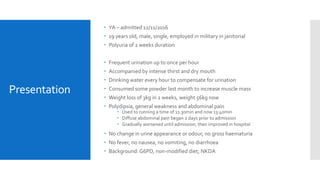
Presentation
 YA – admitted 12/11/2016
 19 years old, male, single, employed in military in janitorial
 Polyuria of 2 weeks duration
 Frequent urination up to once per hour
 Accompanied by intense thirst and dry mouth
 Drinking water every hour to compensate for urination
 Consumed some powder last month to increase muscle mass
 Weight loss of 3kg in 2 weeks, weight 56kg now
 Polydipsia, general weakness and abdominal pain
 Used to running a time of 11:30min and now 13:40min
 Diffuse abdominal pain began 2 days prior to admission
 Gradually worsened until admission, then improved in hospital
 No change in urine appearance or odour, no gross haematuria
 No fever, no nausea, no vomiting, no diarrhoea
 Background: G6PD, non-modified diet; NKDA
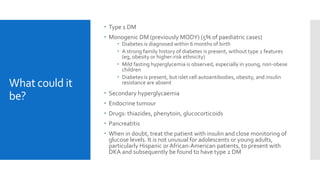
What could it
be?
 Type 1 DM
 Monogenic DM (previously MODY) (5% of paediatric cases)
 Diabetes is diagnosed within 6 months of birth
 A strong family history of diabetes is present, without type 2 features
(eg, obesity or higher-risk ethnicity)
 Mild fasting hyperglycemia is observed, especially in young, non-obese
children
 Diabetes is present, but islet cell autoantibodies, obesity, and insulin
resistance are absent
 Secondary hyperglycaemia
 Endocrine tumour
 Drugs: thiazides, phenytoin, glucocorticoids
 Pancreatitis
 When in doubt, treat the patient with insulin and close monitoring of
glucose levels. It is not unusual for adolescents or young adults,
particularly Hispanic or African-American patients, to present with
DKA and subsequently be found to have type 2 DM
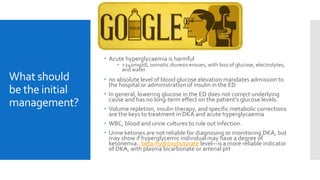
What should
be the initial
management?
 Acute hyperglycaemia is harmful
 >240mg/dL osmotic diuresis ensues, with loss of glucose, electrolytes,
and water
 no absolute level of blood glucose elevation mandates admission to
the hospital or administration of insulin in the ED
 In general, lowering glucose in the ED does not correct underlying
cause and has no long-term effect on the patient’s glucose levels.
 Volume repletion, insulin therapy, and specific metabolic corrections
are the keys to treatment in DKA and acute hyperglycaemia
 WBC, blood and urine cultures to rule out infection.
 Urine ketones are not reliable for diagnosing or monitoring DKA, but
may show if hyperglycemic individual may have a degree of
ketonemia.. beta-hydroxybutyrate level—is a more reliable indicator
of DKA, with plasma bicarbonate or arterial pH
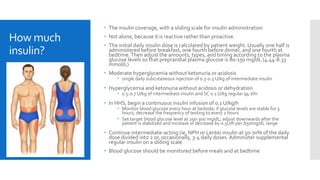
How much
insulin?
 The insulin coverage, with a sliding scale for insulin administration
 Not alone, because it is reactive rather than proactive.
 The initial daily insulin dose is calculated by patient weight. Usually one half is
administered before breakfast, one fourth before dinner, and one fourth at
bedtime.Then adjust the amounts, types, and timing according to the plasma
glucose levels so that preprandial plasma glucose is 80-150 mg/dL (4.44-8.33
mmol/L)
 Moderate hyperglycemia without ketonuria or acidosis
 single daily subcutaneous injection of 0.3-0.5 U/kg of intermediate insulin
 Hyperglycemia and ketonuria without acidosis or dehydration
 0.5-0.7 U/kg of intermediate insulin and SC 0.1 U/kg regular q4-6hr
 In HHS, begin a continuous insulin infusion of 0.1 U/kg/h
 Monitor blood glucose every hour at bedside; if glucose levels are stable for 3
hours, decrease the frequency of testing to every 2 hours
 Set target blood glucose level at 250-300 mg/dL; adjust downwards after the
patient is stabilized and increase or decrease by 0.5U/h per ∆50mg/dL range
 Continue intermediate-acting (ie, NPH or Lente) insulin at 50-70% of the daily
dose divided into 2 or, occasionally, 3-4 daily doses. Administer supplemental
regular insulin on a sliding scale
 Blood glucose should be monitored before meals and at bedtime
Immediate
Management
 Attended clinic at the military base and referred to ER
 In ER, blood glucose was found to be >600mg/dL on fingerstick
test and insulin was administered
 Actrapid 10IU SC and Actrapid 7IU IV and 1000mL 0.9% NaCl given
 Metoclopramide 10mg IV
 KCl administration initiated
 No blood gas disturbance, acidaemia or ketoacidosis
 Glycosuria ++++ Ketonuria ++++
 Glucose confirmed in serum 722mg/dL
 ECG Sinus rhythm and regular
 Chest X Ray clear and symmetric bilaterally
Diagnosis
 Type 1 Diabetes mellitus is characterised by the inability of beta
islet cells to produce insulin due to autoimmune destruction
 Classic symptoms are Polydipsia, Polyuria, Polyphagia, and
Unexplained weight loss
 Onset of symptoms may be sudden and may present with DKA
 American DiabeticAssociationCriteria
 A fasting plasma glucose (FPG) level ≥126 mg/dL (7.0 mmol/L), or
 A 2-hour plasma glucose level ≥200 mg/dL (11.1 mmol/L) during a
75-g oral glucose tolerance test (OGTT), or
 A random plasma glucose ≥200 mg/dL (11.1 mmol/L) in a patient
with classic symptoms of hyperglycemia or hyperglycemic crisis
 HbA1c assay for diagnosing type 1 diabetes only when the
condition is suspected but the classic symptoms are absent.
Why did he
present with
this episode
now?
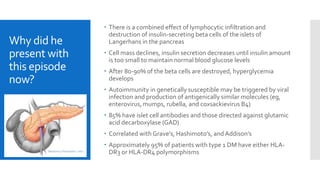
 There is a combined effect of lymphocytic infiltration and
destruction of insulin-secreting beta cells of the islets of
Langerhans in the pancreas
 Cell mass declines, insulin secretion decreases until insulin amount
is too small to maintain normal blood glucose levels
 After 80-90% of the beta cells are destroyed, hyperglycemia
develops
 Autoimmunity in genetically susceptible may be triggered by viral
infection and production of antigenically similar molecules (eg,
enterovirus,mumps, rubella, and coxsackievirus B4)
 85% have islet cell antibodies and those directed against glutamic
acid decarboxylase (GAD)
 Correlated with Grave’s, Hashimoto’s, and Addison’s
 Approximately 95% of patients with type 1 DM have either HLA-
DR3 or HLA-DR4 polymorphisms
What are the
next steps?
 Patients need exogenous insulin to reverse this catabolic
condition, prevent ketosis, decrease hyperglucagonemia, and
normalize lipid and protein metabolism.
 Prevent hypoglycaemia due to management errors
 Prevent or delay microvascular and macrovascular complications
by maintaining good glycaemic control
 Sensory and autonomic neuropathy
 Angiopathy
 Nephropathy
 Infection
 Double diabetes
In hospital
Management
 Hyperglycaemia due toType I DM (new diagnosis)
 Insulin therapy continued
 Apidra 8U SC once daily (fast)
 Lantus 16U SC once daily (long)
 Investigations
 Urine output 1000mL overnight
 HbA1c - 11.0% 13/11
 CRP andWBC - normal
 LFTs - ALP 153
 Us and Es - normal
 Mg 1.80
 Glucose 291mg/dL on 13/11
 Gluc 283 per urine
What should
happen for
discharge and
follow-up?
 Consider patient age for glycemic goals, with different targets for preprandial,
bedtime/overnight, and HbA1c levels in patients aged 0-6, 6-12, and 13-19
 Benefits of tight glycemic control include continued reductions in the rate of
microvascular complications and significant differences in cardiovascular
events and overall mortality
 Self-monitoring
 Optimal control requires frequent blood glucose measurement, which allows
rational adjustments in insulin doses.
 Record blood glucose levels at home and adjust accordingly (CGMs)
 Insulin therapy
 lifelong insulin therapy
 Usually 2 or more injections of insulin daily
 basal insulin and a preprandial (premeal) insulin.The basal insulin is either long-
acting (glargine or detemir) or intermediate-acting (NPH). The preprandial insulin
is either rapid-acting (lispro, aspart, insulin inhaled, or glulisine) or short-acting
(regular).
 Diet and activity
 comprehensive diet plan, with a professional dietitian
 A daily caloric intake prescription
 Recommendations for amounts of dietary carbohydrate, fat, and protein
 Instructions on how to divide calories between meals and snacks
 Patients should be encouraged to exercise regularly.
Discharge
Management
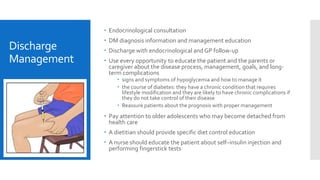
 Endocrinological consultation
 DM diagnosis information and management education
 Discharge with endocrinological and GP follow-up
 Use every opportunity to educate the patient and the parents or
caregiver about the disease process, management, goals, and long-
term complications
 signs and symptoms of hypoglycemia and how to manage it
 the course of diabetes: they have a chronic condition that requires
lifestyle modification and they are likely to have chronic complications if
they do not take control of their disease
 Reassure patients about the prognosis with proper management
 Pay attention to older adolescents who may become detached from
health care
 A dietitian should provide specific diet control education
 A nurse should educate the patient about self–insulin injection and
performing fingerstick tests
References
 MedScape www.Medscape.com
 UpToDate www.uptodate.com

Diabetic ketoacidosis: a case study

  • 1.
  • 2.
    Presentation  YA –admitted 12/11/2016  19 years old, male, single, employed in military in janitorial  Polyuria of 2 weeks duration  Frequent urination up to once per hour  Accompanied by intense thirst and dry mouth  Drinking water every hour to compensate for urination  Consumed some powder last month to increase muscle mass  Weight loss of 3kg in 2 weeks, weight 56kg now  Polydipsia, general weakness and abdominal pain  Used to running a time of 11:30min and now 13:40min  Diffuse abdominal pain began 2 days prior to admission  Gradually worsened until admission, then improved in hospital  No change in urine appearance or odour, no gross haematuria  No fever, no nausea, no vomiting, no diarrhoea  Background: G6PD, non-modified diet; NKDA
  • 3.
    What could it be? Type 1 DM  Monogenic DM (previously MODY) (5% of paediatric cases)  Diabetes is diagnosed within 6 months of birth  A strong family history of diabetes is present, without type 2 features (eg, obesity or higher-risk ethnicity)  Mild fasting hyperglycemia is observed, especially in young, non-obese children  Diabetes is present, but islet cell autoantibodies, obesity, and insulin resistance are absent  Secondary hyperglycaemia  Endocrine tumour  Drugs: thiazides, phenytoin, glucocorticoids  Pancreatitis  When in doubt, treat the patient with insulin and close monitoring of glucose levels. It is not unusual for adolescents or young adults, particularly Hispanic or African-American patients, to present with DKA and subsequently be found to have type 2 DM
  • 4.
    What should be theinitial management?  Acute hyperglycaemia is harmful  >240mg/dL osmotic diuresis ensues, with loss of glucose, electrolytes, and water  no absolute level of blood glucose elevation mandates admission to the hospital or administration of insulin in the ED  In general, lowering glucose in the ED does not correct underlying cause and has no long-term effect on the patient’s glucose levels.  Volume repletion, insulin therapy, and specific metabolic corrections are the keys to treatment in DKA and acute hyperglycaemia  WBC, blood and urine cultures to rule out infection.  Urine ketones are not reliable for diagnosing or monitoring DKA, but may show if hyperglycemic individual may have a degree of ketonemia.. beta-hydroxybutyrate level—is a more reliable indicator of DKA, with plasma bicarbonate or arterial pH
  • 5.
    How much insulin?  Theinsulin coverage, with a sliding scale for insulin administration  Not alone, because it is reactive rather than proactive.  The initial daily insulin dose is calculated by patient weight. Usually one half is administered before breakfast, one fourth before dinner, and one fourth at bedtime.Then adjust the amounts, types, and timing according to the plasma glucose levels so that preprandial plasma glucose is 80-150 mg/dL (4.44-8.33 mmol/L)  Moderate hyperglycemia without ketonuria or acidosis  single daily subcutaneous injection of 0.3-0.5 U/kg of intermediate insulin  Hyperglycemia and ketonuria without acidosis or dehydration  0.5-0.7 U/kg of intermediate insulin and SC 0.1 U/kg regular q4-6hr  In HHS, begin a continuous insulin infusion of 0.1 U/kg/h  Monitor blood glucose every hour at bedside; if glucose levels are stable for 3 hours, decrease the frequency of testing to every 2 hours  Set target blood glucose level at 250-300 mg/dL; adjust downwards after the patient is stabilized and increase or decrease by 0.5U/h per ∆50mg/dL range  Continue intermediate-acting (ie, NPH or Lente) insulin at 50-70% of the daily dose divided into 2 or, occasionally, 3-4 daily doses. Administer supplemental regular insulin on a sliding scale  Blood glucose should be monitored before meals and at bedtime
  • 6.
    Immediate Management  Attended clinicat the military base and referred to ER  In ER, blood glucose was found to be >600mg/dL on fingerstick test and insulin was administered  Actrapid 10IU SC and Actrapid 7IU IV and 1000mL 0.9% NaCl given  Metoclopramide 10mg IV  KCl administration initiated  No blood gas disturbance, acidaemia or ketoacidosis  Glycosuria ++++ Ketonuria ++++  Glucose confirmed in serum 722mg/dL  ECG Sinus rhythm and regular  Chest X Ray clear and symmetric bilaterally
  • 7.
    Diagnosis  Type 1Diabetes mellitus is characterised by the inability of beta islet cells to produce insulin due to autoimmune destruction  Classic symptoms are Polydipsia, Polyuria, Polyphagia, and Unexplained weight loss  Onset of symptoms may be sudden and may present with DKA  American DiabeticAssociationCriteria  A fasting plasma glucose (FPG) level ≥126 mg/dL (7.0 mmol/L), or  A 2-hour plasma glucose level ≥200 mg/dL (11.1 mmol/L) during a 75-g oral glucose tolerance test (OGTT), or  A random plasma glucose ≥200 mg/dL (11.1 mmol/L) in a patient with classic symptoms of hyperglycemia or hyperglycemic crisis  HbA1c assay for diagnosing type 1 diabetes only when the condition is suspected but the classic symptoms are absent.
  • 8.
    Why did he presentwith this episode now?  There is a combined effect of lymphocytic infiltration and destruction of insulin-secreting beta cells of the islets of Langerhans in the pancreas  Cell mass declines, insulin secretion decreases until insulin amount is too small to maintain normal blood glucose levels  After 80-90% of the beta cells are destroyed, hyperglycemia develops  Autoimmunity in genetically susceptible may be triggered by viral infection and production of antigenically similar molecules (eg, enterovirus,mumps, rubella, and coxsackievirus B4)  85% have islet cell antibodies and those directed against glutamic acid decarboxylase (GAD)  Correlated with Grave’s, Hashimoto’s, and Addison’s  Approximately 95% of patients with type 1 DM have either HLA- DR3 or HLA-DR4 polymorphisms
  • 9.
    What are the nextsteps?  Patients need exogenous insulin to reverse this catabolic condition, prevent ketosis, decrease hyperglucagonemia, and normalize lipid and protein metabolism.  Prevent hypoglycaemia due to management errors  Prevent or delay microvascular and macrovascular complications by maintaining good glycaemic control  Sensory and autonomic neuropathy  Angiopathy  Nephropathy  Infection  Double diabetes
  • 10.
    In hospital Management  Hyperglycaemiadue toType I DM (new diagnosis)  Insulin therapy continued  Apidra 8U SC once daily (fast)  Lantus 16U SC once daily (long)  Investigations  Urine output 1000mL overnight  HbA1c - 11.0% 13/11  CRP andWBC - normal  LFTs - ALP 153  Us and Es - normal  Mg 1.80  Glucose 291mg/dL on 13/11  Gluc 283 per urine
  • 11.
    What should happen for dischargeand follow-up?  Consider patient age for glycemic goals, with different targets for preprandial, bedtime/overnight, and HbA1c levels in patients aged 0-6, 6-12, and 13-19  Benefits of tight glycemic control include continued reductions in the rate of microvascular complications and significant differences in cardiovascular events and overall mortality  Self-monitoring  Optimal control requires frequent blood glucose measurement, which allows rational adjustments in insulin doses.  Record blood glucose levels at home and adjust accordingly (CGMs)  Insulin therapy  lifelong insulin therapy  Usually 2 or more injections of insulin daily  basal insulin and a preprandial (premeal) insulin.The basal insulin is either long- acting (glargine or detemir) or intermediate-acting (NPH). The preprandial insulin is either rapid-acting (lispro, aspart, insulin inhaled, or glulisine) or short-acting (regular).  Diet and activity  comprehensive diet plan, with a professional dietitian  A daily caloric intake prescription  Recommendations for amounts of dietary carbohydrate, fat, and protein  Instructions on how to divide calories between meals and snacks  Patients should be encouraged to exercise regularly.
  • 12.
    Discharge Management  Endocrinological consultation DM diagnosis information and management education  Discharge with endocrinological and GP follow-up  Use every opportunity to educate the patient and the parents or caregiver about the disease process, management, goals, and long- term complications  signs and symptoms of hypoglycemia and how to manage it  the course of diabetes: they have a chronic condition that requires lifestyle modification and they are likely to have chronic complications if they do not take control of their disease  Reassure patients about the prognosis with proper management  Pay attention to older adolescents who may become detached from health care  A dietitian should provide specific diet control education  A nurse should educate the patient about self–insulin injection and performing fingerstick tests
  • 13.