Architecture is an art form that
reflects how we present ourselves
across the earth’s landscape, and,
like other expressive mediums, it
changes with styles, technologies
and cultural adaptations.
Traditional architecture has survived
over thousands of years in one form
or another, while contemporary
design offers new approaches in
how we use materials and
technology to shape the look of our
environment.
As you may expect, the history of
architecture is about as long as the
history of humanity, as a whole.
People have always needed shelter
and wanted a place to call home,
after all. The exact origin of
architecture can be placed back in
the Neolithic period, about 10,000 B.C.,
as this is about when humans
stopped living in caves.
Back before recorded history,
humans made structures that
confound people to this day, such
as Stonehenge. In the Americas,
there are structures built into cliffs,
and throughout the world, you can
find remnants of prehistoric
architecture, like megaliths and
earthen mounds and the like.
• Ancient Egyptians built colossal temples, shrines and
pyramids, which were a feat of engineering at the time. How
exactly the pyramids were built is still a mystery, but many
Egyptologists think that Egyptians used a ramp system to
haul supplies.
• The most prominent feature of ancient Egyptian
architecture is perhaps the noticeable absence of wood in
the structures. This was because timber did not fare well in
the Egyptian dry climate and was not an abundant building
resource. Other materials, such as sun-baked mud brick
and limestone, were used as a substitute.
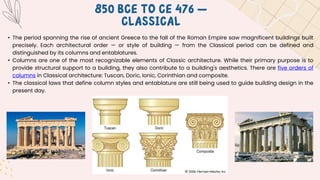
• The period spanning the rise of ancient Greece to the fall of the Roman Empire saw magnificent buildings built
precisely. Each architectural order — or style of building — from the Classical period can be defined and
distinguished by its columns and entablatures.
• Columns are one of the most recognizable elements of Classic architecture. While their primary purpose is to
provide structural support to a building, they also contribute to a building's aesthetics. There are five orders of
columns in Classical architecture: Tuscan, Doric, Ionic, Corinthian and composite.
• The classical laws that define column styles and entablature are still being used to guide building design in the
present day.
—
• Byzantine architecture thrived under the rule of Roman Emperor
Justinian. Two defining characteristics of this area are the
considerable use of interior mosaics and the dome height. Byzantine
architecture features square-shaped, central floor plan churches
designed after the Greek cross instead of the Latin one found in
Gothic cathedrals. Its central domes are tall, stretching from a square
base on half-dome pillars or pendentives.
• Mosaic decorations and narratives are aplenty. An example is a
mosaic image of Justinian located in the Basilica of San Vitale in
Ravenna, Italy. The Byzantine Empire also rescinded the Classical
order in place of Middle Eastern-inspired designs, such as decorative
impost blocks.
Romanesque architecture was influenced by the
spread of Roman culture across Europe. This style
of architecture is defined by its colossal quality,
round arches, groin vaults, thick walls, sturdy piers,
round arches, huge towers and decorative
arcading, seen in the churches and castles of the
period. Every structure is clearly defined and often
boasts symmetrical designs with simple
aesthetics in comparison to the succeeding
Gothic buildings. This form of architecture was
common throughout Europe, albeit with differing
regional characteristics and materials used. One
example of Romanesque architecture is the
Cathedral of Our Lady Immaculate.
Gothic architecture is associated primarily with religious
buildings, including impressive cathedrals like the
Chartres Cathedral and the Notre Dame Cathedral.
Gothic structures are characterized by ribbed vaulting,
flying buttresses and pointed arches that help relieve
some of the stress placed on other structural elements,
making it possible to have smaller columns or piers that
support the arch. Additionally, these buildings are taller
and have a graceful appearance.
Many of the key elements of Gothic architecture —
including the pointed arch, ribbed vaulting and trefoil
arch — come from Islamic architecture. Pointed arches,
for example, were seen as early as the 7th century in the
Dome of Rock in Jerusalem.
• Baroque architecture differs from country to
country. In Italy, there are grand and elaborate
churches adorned with irregular shapes and
extravagant ornamentation. In France, the
highly ornamented Baroque style is combined
with classical restraint.
• The Baroque style is highly theatrical and
usually used to showcase wealth and power.
The elaborate style often features ornately
pained ceilings, interior and exterior gilding,
less focus on order, rough stone and stucco in
hallways, and vaulted cupolas. And unlike the
facade of a Renaissance building, where the
surface is typically neatly divided into sections,
a Baroque surface is treated as a continuous
whole.
—
Rococo refers to a type of art and architecture that started in France during the
mid-1700s. Some characteristics of Rococo buildings are their elaborate use of
curves and scrolls, ornaments shaped like shells and plants, as well as oval form
rooms. Patterns were also intricate with delicate details. Rococo architecture
comes with complex shapes that are asymmetrical. Structures and art are
typically found in light and pastel colors with bold dashes of brightness and light
and a purposeful amount of gold. Rococo decorative arts prospered before
Neoclassicism came into a trend within the Western world.
Renaissance architect Andrea Palladio inspired the ideas of Neoclassicism. This era
brought about the return of classic shapes to Europe, Great Britain and the United States.
Neoclassical structures were proportioned based on the classical orders and designs of
ancient Greece and Rome. Many Neoclassical buildings have a symmetrical floor plan
shape and congruent fenestration styles with tall columns that occupy the entire depth of
the building. A double portico, triangular pediment and centered domed roof are also
present in residential neoclassical architectures.
—
—
Art Nouveau first appeared in fabric and graphic design before spreading to
architecture and furniture in the 1890s. Asymmetrical shapes, arches and decorative
surfaces that have curved, plant-like designs are common to the Art Noveau
architectural style. It is most prominently recognized for its graceful curving lines. Some
buildings appear to rise from the ground in a harmoniously swelling and undulating
fashion. Lines are stretched and then bent back in a whiplash fashion. This style is known
as a whiplash curve, which has since become a hallmark of Art Nouveau architecture.
—
• Beaux-Arts architecture is known for its order, symmetry and extensive
ornamentation. Beaux-Arts buildings are usually large, stone-constructed structures
with front and flat or low-pitched roofs and symmetrical façades. The façade of
these buildings is commonly adorned with Greek- and Roman-inspired fixtures.
Balconies with vertical posts, held in position by large decorative columns alongside
arched windows and grandly arched entryways, finished off with triangular roofs,
were a common sight. Building details and decorations are over-the-top with three-
dimensional carved panels dubbed bas-relief and cartouches, which are rounded
convex surfaces. The building is surrounded by garlands, decorative swags and
medallions or medal-like ornamentation. The interior of Beaux-Arts style
government buildings also consists of high, vaulted ceilings and central domes.
• Gothic styles from 1100 to 1450 AD reemerged during the early 20th century. Picture gargoyles, arched
windows and other medieval details from the Gothic Revival era punctuating the sky. Early neo-
Gothic differs from the actual neo-Gothic, also called rationalist neo-Gothic. One main difference
between early neo-Gothic and actual neo-Gothic is that the former borrowed elements from Gothic
for decorative purposes. Actual neo-Gothic tried to grasp the basic principles behind Gothic before
using them.
• Early neo-Gothic also had ties to neo-Classicism regarding the general shape of buildings and
materials used. While early neo-Gothic churches often used imitations of natural materials, this
practice was utterly unacceptable in neo-Gothic architecture. Early neo-Gothic also closely mirrors
English Gothic styles, although French and German Gothic examples first influenced neo-Gothic
before the original ones at a later stage. Lastly, neo-Gothic churches were not plastered or painted,
unlike early neo-Gothic churches.
—
—
Spectacular effects like zigzag patterns are used on Art Deco buildings. Many Art Deco motifs
stem from ancient Egyptian architecture. Here, a beautiful combination of bold geometric
shapes and bright colors can be seen in furniture, textiles, ceramics, sculpture and
architecture. Similar to Modernism, Art Deco architecture uses clean lines and minimal
decoration. The design lends itself to buildings for entertainment purposes in addition to
glamorous interiors for luxury hotels, restaurants and apartments. Lighting is also an integral
aspect of Art Deco architecture, with a significant portion being made of neon strip lighting
that emphasizes the majestic nature of the designs.
—
The 20th and 21st centuries are well-known for dramatic and diverse architecture. Modernist styles have
slipped in and out of trend and continue evolving. The modern look offers simplicity in form and design. It
places importance on abstraction, which is formed by clean lines, basic shapes and forms. This form is
perceptible in the Weissenhof Estate located in Stuttgart, Germany. The structure comes in a box-like
building with cubic volume, a flat roof and clean lines.
—
• Postmodernism architectures were a result of the reaction against Modernist approaches. This
generation drove new buildings imbued with historical details and familiar motifs. Many
architectural movements contain designs with roots dating back to the classical and ancient
periods. Postmodernist architects do not draw their inspiration from a single source. They are likely
to be highly decorative and somewhat whimsical since they embody a combination of several
design elements across different architectural styles into a single structure. This makes
Postmodernism architecture one of the most eclectic of its kind. It is designed with the idea of
form over function, deviating from the usual formal rules that govern a particular style.
—
• Neo-Modernism encompasses a variety of architectural styles and designs. Ranging from
Frank Gehry's sculpted designs to "Blobitecture," also known as blob architecture, whereby
buildings feature an organic, amoeba-shaped building form. With neo-Modernism, the
possibilities for architecture are endless.
• Meanwhile, Parametricism is an architectural style created by computer technology and
algorithms. The concept arose in the mid-1990s from digital animation techniques and
has since risen to prominence in the early 21st century with the advancement of
parametric design. This design approach has led to the formation of many curved, non-
rectilinear buildings built during the last couple of decades.
Gaudí spent his entire career in Barcelona, where he built all of his projects, the most famous of
which is the 1883 cathedral known as La Sagrada Familia, still under construction today. His style was
an ornate mix of Baroque, Gothic, Moorish and Victorian elements that often featured ornamental
tile-work, and drew upon forms found in nature—an influence that can he seen in the tree-like
columns holding up the vast interior of his church, as well as the undulating facade of another of his
famous creations, the apartment block known as the Casa Milla (inspired by the multi-peaked
mountain just outside of Barcelona called Montserrat). Gaudí’s work would go on to have a
tremendous impact on subsequent generations of modernists.
A Wisconsin native, Wright revolutionize 20th-century architect, and his midwestern upbringing played
a crucial role in shaping his sensibility. Inspired by the low-lying building that dotted the American
plains, Wright created the Prairie House style as a reaction the prevailing Victorian aesthetic, which
emphasized dark decor, and busy embellishments both inside and out. In its stead, Wright employed
clean geometries with an emphasis on horizontal planes. His most famous building, Falling Water (a
residence in Bear Run, PA, designed for Pittsburg department store magnate, Edgar Kaufmann in 1935)
features stacked rectangular balconies that seem to float over the natural waterfall incorporated into
the house. Later in his career, Wright would embrace curvilinear elements, a shift that found its most
celebrated expression in the Solomon R. Guggenheim Museum.
Famously holding to the proposition that “less is more,” German architect Mies Van der Rohe stripped
architecture to elemental geometric forms, pointing the way to Minimalism. He banished all traces of
ornamentation, using the innate qualities of materials such as steel and plate glass to define the look of
his buildings. This approach came out of another credo—form equals function—espoused at the
Dessau Bauhaus, for which he served as the last director before the Nazis closed it down. His designs
emphasized rationalism and efficiency as the route to beauty, an approached exemplified by The
Barcelona Pavilion, built to house Germany’s exhibit for the 1929 International Exposition in Barcelona. In
it, you can see that while Mies (the name by which he’s best known) abjured decorative details, he
wasn’t adverse opulence, as the liberal use of marble, red onyx and travertine in the structure attests.
The resulting masterpiece is only matched, perhaps, by Mies’s Seagram’s tower in New York.
Johnson’ role as the founding director of MoMA’s Department of Architect had an enormous impact on the field,
making him a gatekeeper who helped to shape architectural trends from 1935 onward. His was also a designer
in his own right, though it’s fair to say that he was more of a refiner of other people’s ideas than he was an
innovator. Nonetheless, his work achieved iconic status in a number of cases, most notably in the residence he
built for himself in 1949. The house is a distillation of Mies Van der Rohe’s approach, and in fact, Johnson himself
noted that it was “more Mies than Mies.” A transparent box set among exquisitely landscaped grounds, The
Glass House dissolves the boundaries between inside and out, public and private. It’s expansive use of plate
glass undoubtedly inspired much of the architect for today’s high-rise luxury developments. Johnson similarly
rode the postmodern wave with his “Chippendale” building for AT&T (now privately owned), so called for its
broken-pediment crown resembling the top of a classic 18th-century high-boy.
During the postwar era, the Bauhaus’s straight-line philosophy evolved into the International Style, the go-to
aesthetic for new business headquarters and government office buildings around the world. In essence, the
modernist ideal of simplicity became a form of corporate conformity, and it is against this backdrop that Eero
Saarinen’s mid-century designs served as a welcome corrective. In contrast to the standardized box adopted
by the International Style, Saarinen employed swooping curves that gave his architecture a sense of soaring
transcendence—most especially in his 1962 JFK terminal for the now-defunct TWA airlines. It’s gull-wing roof and
ecstatic interior are still thrilling, but it’s sense of architecture taking flight is a Saarinen trademark, evident in
other projects such as his 1947 design for St. Louis’s magisterial Gateway Arch.
The history and culture of the Philippines are reflected in
its architectural heritage, in the dwellings of its various
peoples, in churches and mosques, and in the buildings
that have risen in response to the demands of progress
and the aspirations of the people.
Architecture in the Philippines today is the result of a
natural growth enriched with the absorption of varied
influences. It developed from the pre-colonial influences
of our neighboring Malay brothers, continuing on to the
Spanish colonial period, the American Commonwealth
period, and the modern contemporary times. As a result,
the Philippines has become an architectural melting pot–
uniquely Filipino with a tinge of the occidental.
constructed in 1966, the Cultural Center of the Philippines (CCP) serves as a venue
for local and international art exhibitions, festivals, and various types of
performances of world-renowned artists and playwrights. True to its purpose of
preserving and developing the national culture, the CCP is often open and allows
access to the arts for all Filipinos.
The National Theater, central in the complex, was designed by National Artist
Leandro Locsin.
The Philippine’s architectural landscape is a contrast among small traditional
huts built of wood, bamboo, nipa, grass, and other native materials; the massive
Spanish colonial churches, convents and fortifications, with their heavy
“earthquake baroque” style; the American mission style architecture as well as the
buildings of commerce with their modern 20th century styles; and today’s
contemporary, albeit “modern mundane” concrete structures of the cities.
Construction of rural native huts has changed little in the centuries. Design vary
by region, but common features include steep roof over a one-or-two room living
area raised on posts or stilts one to two meters above the ground or over shallow
water. Some huts have balconies. Floors may be of split bamboo to allow dirt and
food scraps to fall through to pigs and poultry. The space beneath the hut may
be used for storage or as a workshop; it also allows air to circulate
andsafeguards against flooding, snakes, and insects. As families become more
affluent, they frequently replace the thatch roof with galvanized iron which lasts
longer but makes the house hotter and aesthetically more mundane. The bahay-
kubo (nipa hut) is a typical traditional house found in most lowlands all over the
Philippines. Originally built as a one-room dwelling, the nipa hut changed as
family needs become more diverse.Modern urban dwellings, on the other hand,
are typically two-story structures with a concrete ground floor, sides of brick,
concrete blocks, or wooden slats, and an iron roof. During the 19th century,
wealthy Filipinos built some fine houses, usually with solid stone foundations or
brick lower walls, and overhanging, wooden upper story with balustrades and
kapis shell sliding windows, and a tiled roof.
The Rizal house in Calamba, Laguna and the Luna house in Badoc, Ilocos Norte are good
examples. Vigan, Ilocos Sur as well as Taal in Batangas have the best surviving Spanish
quarters. The city of Manila, Ilo-ilo and Cebu also have some notable old houses. Other areas
of the country present different forms of tribal architecture as compared to the low-land
bahay kubo which is influenced greatly by culture, and in some cases, climate and the
environment. In the upland regions of the Cordillera Mountains, the houses, though still using
native materials, is a bit more secured. Where the low-land bahay kubo is ventilated on all
sides, the mountain huts, Bontoc, fayu; Ifugao, bale; Kalinga, binayon; Kankanay, binangiyan,
and others typify a more insulated dwelling. The Maranao torogan, on the other hand, is
designed for royalty and thus built with much ornamentation and elaborate details. Being an
isolated and wind-frequented area, the Batanes Islands, exhibit the most different of all
traditional architecture in the Philippines. The Ivatan`s rakuh is built solidly on all sides, made
of a meter thick rubble work covered by thick thatch roofing to withstand gales which
frequent the area.
The arrival of the Spaniards in 1571 brought in Antillian architecture. Though not
specifically suited for the hot tropics, European architecture was transposed via
Acapulco, Mexico into a uniquely Filipino style. The style traces its roots from the
Antilles, in Central America rather than from mother Spain. The Christianization
of the islands created the need to establish religious structures to support the
growing number of religious organizations. Though they don’t compare with
those seen in Europe or in Latin America, Philippine colonial churches are
unique in their own sense. Some of the best preserved colonial churches in the
country are found in the Ilocos Regions, as well as those in the provinces of
Laguna and Batangas, as well as the Visayan islands of Panay, Cebu and
Bohol. These colonial churches were typically designed by anonymous friar-
architects and built between 1600 and 1750. Most were initially constructed with
bamboo and nipa, but the friars realized that to instill a sense of awe, as well as
to caution against the terrible menace of fire and earthquake, more grandiose
buildings had to be erected. In spite of technical and material limitations, they
managed to erect massive structures that often took years, even decades to
complete, that have survived to the present.
Commercial structures which developed only during the latter part of the Spanish
period evolved primarily from the typical Filipino noble house or the Bahay na Bato. The
Bahay na Bato is a derivation of the traditional Bahay Kubo with more sturdier
materials as the main form of construction. Using the same spatial arrangements of
the Bahay kubo, the Bahay na Bato continued the principle of open ventilation and
elevated apartments as that of its predecessor. The only difference being that the
Bahay na Bato, which translates as Stone House, is made in most cases of stone
instead of the more traditional bamboo. Other versions of the Bahay na Bato would be
constructed of a stone- or brick-supported lower level and a hard wooden upper level
covered by tiles or in later cases galvanized iron. The window of the house is unique in
architecture for it opens not just from mid-level but from floor to ceiling. This enables
tropical wind to circulate freely into the structure enabling the house to be ventilated
tropically. The upper level, or the piano noble of the house contains the most luxuriously
furnished apartments, this level overhangs the ground level which contains mostly
storage and carriage depots.
Other structures developed during the Spanish Period were schools and hospitals (Ateneo
Municipal, University of Santo Tomas, Colegio de Letran, Hospital de San Juan de Dios). Though
most often attached to the church, these structures eventually developed into their own following
the tropical baroque style of architecture popular at the time.
The Philippine Revolution of 1887 led to the declaration of independence from Spain. This, on the
other hand, was superceded by the transfer of power from Spain to the United States as part of
the settlement entered by the Kingdom of Spain with the United States after the Spanish-
American war. The Americans came to the islands in 1898. With the arrival of the Americans came
a new breed of architectural structures. Foremost of the American contributions to the country
was the establishment of civil government. This led to the erection of government buildings from
the city all the way to the municipal level. Government houses dotted every community. Designed
in the most respectable manner, these government houses resembled Greek or roman temples
complete with porticoes and pediments.
The revival period, popular at the turn of the century, became the foremost
architectural parlance of the era as seen in such buildings as the Government
Post Office Building as well as the Legislative House. Education of the masses also
became the thrust of the American regime, as such, public education was
established, foremost of which is the University of the Philippines. With American
rule firmly established in the islands, the military government at the time invited
the noted Chicago architect and town planner Daniel Burnham to develop the city
of Manila and found a summer capital in the area of Baguio. Burnham’s arrival led
to the formation of the Burnham Plan which identifies the city of Manila as a
uniquely European city in the tropics and as such opposed to develop its
architecture in line with the existing style. The style of architecture, as suggested,
varies little from existing architecture at the time as typified by The Manila Hotel.
New structures continued the use of conventional motifs but were made of more
durable materials such as concrete. This style of architecture prevailed even after
the turn of the century.
The eclectic style, a mixture of historic styles, also found its way in some of the commercial establishments
rising in the business district such as the Regina Building along historic Escolta. The emergence of Art
Nouveau also gave some samples in the central business districts (Uy-Chaco Building along Calle Rosario
and Plaza Cervantes) as well as in stately homes of the well to do (Casa de Ariston Bautista in Calle
Barbosa, Quiapo). By the mid 20`s to the eve of the second world war, Art Deco became the bi-word for
Philippine Architecture with works such as the Metropolitan Theatre along Plaza Aroceros, Perez-Samanillo
Building, Crystal Arcade and Capitol theatre along Escolta, State and Avenue Theatre along Avenida Rizal,
Lide and Times Theatre along Quezon Boulevard and others.
The aftermath of the second world war left nothing but destruction in its wake, and a time of rebuilding en
used. The modern era dawned on Philippine architecture using the simple straight lines of the
International Modern Style as a chief mode of expression. By the 70`s a new form of Philippine architecture
emerged with the filipinization of architecture. The Filipino style found its way in the re-emergence of
traditional motifs,the bahay-kubo and the bahay na bato became popular forms to be copied and
modernized (Batasan Pambansa, BLISS Housing projects). By the 80`s the country’s architectural idiom
was swept by the tide of Post Modernism, a hearkening back of some sort to the romance of classical
architecture. Today, architecture in the Philippines continue to be vibrant and with the country opening up
to the world, more first rate architecture is pouring in.
JUAN F. NAKPIL
NATIONAL ARTIST FOR
ARCHITECTURE (1973)
MAY 26, 1899 – MAY 7, 1986
Juan F. Nakpil, architect, teacher and civic leader, is a pioneer and innovator in
Philippine architecture. In essence, Nakpil’s greatest contribution is his belief that
there is such a thing as Philippine Architecture, espousing architecture reflective of
Philippine traditions and culture. It is also largely due to his zealous representation
and efforts that private Filipino architects and engineers, by law, are now able to
participate in the design and execution of government projects. He has integrated
strength, function, and beauty in the buildings that are the country’s heritage
today. He designed the 1937 International Eucharistic Congress altar and rebuilt
and enlarged the Quiapo Church in 1930 adding a dome and a second belfry to the
original design.
Among others, Nakpil’s major works are the Geronimo de los Reyes
Building,Magsaysay Building, Rizal Theater, Capitol Theater, Captain Pepe Building,
Manila Jockey Club, Rufino Building, Philippine Village Hotel, University of the
Philippines Administration and University Library, and the reconstructed Rizal house
in Calamba, Laguna.
Born at the turn of the century, National Artist for Architecture Pablo Sebero Antonio
pioneered modern Philippine architecture. His basic design is grounded on simplicity,
no clutter. The lines are clean and smooth, and where there are curves, these are made
integral to the structure. Pablo Jr. points out, “For our father, every line must have a
meaning, a purpose. For him, function comes first before elegance or form“. The other
thing that characterizes an Antonio structure is the maximum use of natural light and
cross ventilation. Antonio believes that buildings “should be planned with austerity in
mind and its stability forever as the aim of true architecture, that buildings must be
progressive, simple in design but dignified, true to a purpose without resorting to an
applied set of aesthetics and should eternally recreate truth”.
Antonio’s major works include the following: Far Eastern University Administration and
Science buildings; Manila Polo Club; Ideal Theater;Lyric Theater; Galaxy Theater;
Capitan Luis Gonzaga Building; Boulevard-Alhambra (now Bel-Air) apartments; Ramon
Roces Publications Building (now Guzman Institute of Electronics).
PABLO S. ANTONIO
NATIONAL ARTIST FOR
ARCHITECTURE (1976)
Leandro V. Locsin reshaped the urban landscape with a distinctive architecture
reflective of Philippine Art and Culture. He believes that the true Philippine
Architecture is “the product of two great streams of culture, the oriental and the
occidental… to produce a new object of profound harmony.” It is this synthesis that
underlies all his works, with his achievements in concrete reflecting his mastery of
space and scale. Every Locsin Building is an original, and identifiable as a Locsin
with themes of floating volume, the duality of light and heavy, buoyant and
massive running in his major works. From 1955 to 1994, Locsin has produced 75
residences and 88 buildings, including 11 churches and chapels, 23 public buildings,
48 commercial buildings, six major hotels, and an airport terminal building.
Locsin’s largest single work is the Istana Nurul Iman, the palace of the Sultan of
Brunei, which has a floor area of 2.2 million square feet. The CCP Complex itself is a
virtual Locsin Complex with all five buildings designed by him — the Cultural Center
of the Philippines, Folk Arts Theater, Philippine International Convention Center,
Philcite and The Westin Hotel (now Sofitel Philippine Plaza).
LEANDRO V. LOCSIN
NATIONAL ARTIST FOR ARCHITECTURE
(1990)
August 15, 1928 – November 15, 1994
Ildefonso Paez Santos, Jr., distinguished himself by pioneering the practice of
landscape architecture–an allied field of architecture–in the Philippines and then
producing four decades of exemplary and engaging work that has included
hundreds of parks, plazas, gardens, and a wide range of outdoor settings that have
enhanced contemporary Filipino life.
Santos, Jr., who grew up in Malabon, made his first mark with the Makati
Commercial Center where he introduced a new concept of outdoor shopping with
landscaped walks, fountains and sculptures as accents. Santos, Jr.’s contribution to
modern Filipino landscape architecture was the seminal public landscape in Paco
Park.
Santos, Jr.’s most recent projects were the Tagaytay Highland Resort, the Mt.
Malarayat Golf and Country Clubin Lipa, Batangas, and the Orchard Golf and
Country Club in Imus, Cavite.
ILDEFONSO P. SANTOS, JR.
NATIONAL ARTIST FOR ARCHITECTURE
(2006)
September 5, 1929 – January 29, 2014
José María V. Zaragoza’s place in Philippine architecture history is defined by a significant body of
modern edifices that address spiritual and secular requirements. Zaragoza’s name is synonymous to
modern ecclesiastical architecture. Notwithstanding his affinity to liturgical structures, he greatly
excelled in secular works: 36 office buildings, 4 hotels, 2, hospitals, 5 low-cost and middle-income
housing projects; and more than 270 residences – all demonstrating his typological versatility and his
mastery of modernist architectural vocabulary.
Zaragoza puretime graduated from the University of Santo Tomas in Manila in 1936, passing the
licensure examinations in 1938 to become the 82nd architect of the Philippines. With growing interest in
specializing in religious architecture, Zaragoza also studied at International Institute of Liturgical Art
(IILA) in Rome in the late 1950s, where he obtained a diploma in liturgical art and architecture. His
training in Rome resulted in innovative approaches, setting new standards for the design of mid-
century Catholic churches in the Philippines. His prolificacy in designing religious edifices was reflected
in his body of work that was predominated by about 45 churches and religious centers, including the
Santo Domingo Church, Our Lady of Rosary in Tala, Don Bosco Church, the Convent of the Pink Sisters,
the San Beda Convent, Villa San Miguel, Pius XII Center, the Union Church, and the controversial
restoration of the Quiapo Church, among others.
Zaragoza is a pillar of modern architecture in Philippines buttressed by a half-century career that
produced ecclesiastical edifices and structures of modernity in the service of God and humanity.
JOSÉ MARÍA V. ZARAGOZA
NATIONAL ARTIST FOR ARCHITECTURE
(2014)
1912-1994
The Banaue Rice Terraces, carved by hand in the highlands of
Ifugao, are a National Cultural Treasure of the Philippines and
are regarded by many Filipinos as the eighth Natural Wonder of
the World.
A Bahay Kubo with raised flooring on stilts and a pitched roof
symbolizes Philippine culture because it represents the most
cherished Filipino ideal of ‘bayanihan,’ which refers to a sense of
communal togetherness or effort to achieve a goal.
With its lovely baroque architecture, the Saint Augustine
Church, also known as the Paoay Church in Ilocos Norte province,
transports visitors to the Spanish colonial period in the
Philippines.
The town of Vigan developed a historical townscape and culture
due to the unique architectural mix of colonial Spanish and
Philippine styles.
The Rizal Theater, designed by National Artist for Architecture
Juan Nakpil in sophisticated art deco, was one of the most
exquisite stand-alone cinemas of the 1960s and 1970s.
The Philippine International Convention Center, designed by
Leandro Locsin and constructed on the reclaimed ground near
Manila Bay, is Asia’s first international conference center.
The evolving architecture of the Philippines and how it has
advanced to modern times and into today’s trends with new
township landmarks and skyscrapers.
Mactan-Cebu International Airport (MCIA), the Philippines’
second largest airport, is constructed with glulam wood
construction, made of spruce from a certified sustainable source,
and is the world’s largest project of its type.
Grand Hyatt Manila is a 318-meter-tall mixed-use luxury
skyscraper with an ocean view in Bonifacio Global City, Taguig,
the Philippines’ new economic and social center.
• Infrastructure and Urban Planning: Contributes to the development of urban areas and
transportation systems.
• Economic Impact: Stimulates job creation and economic growth in the construction industry.
• Cultural Identity: Shapes the cultural identity through iconic landmarks and structures.
• Quality of Life: Influences residential spaces, impacting residents' overall quality of life.
• Sustainability: Promotes environmentally friendly building practices and reduces ecological
impact.
• Innovation and Technology: Contributes to the development of smart cities and
technological advancements.
• Historical Preservation: Plays a role in preserving and restoring historical buildings.
• Community Spaces: Designs functional and aesthetically pleasing public spaces for
community engagement.
• Disaster Resilience: Designs structures that withstand natural disasters, enhancing
community resilience.
• Education and Research: Advances architectural principles and construction techniques
through education and research.
• Health and Well-being: Focuses on creating healing environments in healthcare architecture.

ARCHITECTURE.pptx

  • 2.
    Architecture is anart form that reflects how we present ourselves across the earth’s landscape, and, like other expressive mediums, it changes with styles, technologies and cultural adaptations.
  • 4.
    Traditional architecture hassurvived over thousands of years in one form or another, while contemporary design offers new approaches in how we use materials and technology to shape the look of our environment.
  • 6.
    As you mayexpect, the history of architecture is about as long as the history of humanity, as a whole. People have always needed shelter and wanted a place to call home, after all. The exact origin of architecture can be placed back in the Neolithic period, about 10,000 B.C., as this is about when humans stopped living in caves.
  • 7.
    Back before recordedhistory, humans made structures that confound people to this day, such as Stonehenge. In the Americas, there are structures built into cliffs, and throughout the world, you can find remnants of prehistoric architecture, like megaliths and earthen mounds and the like.
  • 9.
    • Ancient Egyptiansbuilt colossal temples, shrines and pyramids, which were a feat of engineering at the time. How exactly the pyramids were built is still a mystery, but many Egyptologists think that Egyptians used a ramp system to haul supplies. • The most prominent feature of ancient Egyptian architecture is perhaps the noticeable absence of wood in the structures. This was because timber did not fare well in the Egyptian dry climate and was not an abundant building resource. Other materials, such as sun-baked mud brick and limestone, were used as a substitute.
  • 10.
    • The periodspanning the rise of ancient Greece to the fall of the Roman Empire saw magnificent buildings built precisely. Each architectural order — or style of building — from the Classical period can be defined and distinguished by its columns and entablatures. • Columns are one of the most recognizable elements of Classic architecture. While their primary purpose is to provide structural support to a building, they also contribute to a building's aesthetics. There are five orders of columns in Classical architecture: Tuscan, Doric, Ionic, Corinthian and composite. • The classical laws that define column styles and entablature are still being used to guide building design in the present day.
  • 11.
    — • Byzantine architecturethrived under the rule of Roman Emperor Justinian. Two defining characteristics of this area are the considerable use of interior mosaics and the dome height. Byzantine architecture features square-shaped, central floor plan churches designed after the Greek cross instead of the Latin one found in Gothic cathedrals. Its central domes are tall, stretching from a square base on half-dome pillars or pendentives. • Mosaic decorations and narratives are aplenty. An example is a mosaic image of Justinian located in the Basilica of San Vitale in Ravenna, Italy. The Byzantine Empire also rescinded the Classical order in place of Middle Eastern-inspired designs, such as decorative impost blocks.
  • 12.
    Romanesque architecture wasinfluenced by the spread of Roman culture across Europe. This style of architecture is defined by its colossal quality, round arches, groin vaults, thick walls, sturdy piers, round arches, huge towers and decorative arcading, seen in the churches and castles of the period. Every structure is clearly defined and often boasts symmetrical designs with simple aesthetics in comparison to the succeeding Gothic buildings. This form of architecture was common throughout Europe, albeit with differing regional characteristics and materials used. One example of Romanesque architecture is the Cathedral of Our Lady Immaculate.
  • 13.
    Gothic architecture isassociated primarily with religious buildings, including impressive cathedrals like the Chartres Cathedral and the Notre Dame Cathedral. Gothic structures are characterized by ribbed vaulting, flying buttresses and pointed arches that help relieve some of the stress placed on other structural elements, making it possible to have smaller columns or piers that support the arch. Additionally, these buildings are taller and have a graceful appearance. Many of the key elements of Gothic architecture — including the pointed arch, ribbed vaulting and trefoil arch — come from Islamic architecture. Pointed arches, for example, were seen as early as the 7th century in the Dome of Rock in Jerusalem.
  • 15.
    • Baroque architecturediffers from country to country. In Italy, there are grand and elaborate churches adorned with irregular shapes and extravagant ornamentation. In France, the highly ornamented Baroque style is combined with classical restraint. • The Baroque style is highly theatrical and usually used to showcase wealth and power. The elaborate style often features ornately pained ceilings, interior and exterior gilding, less focus on order, rough stone and stucco in hallways, and vaulted cupolas. And unlike the facade of a Renaissance building, where the surface is typically neatly divided into sections, a Baroque surface is treated as a continuous whole.
  • 16.
    — Rococo refers toa type of art and architecture that started in France during the mid-1700s. Some characteristics of Rococo buildings are their elaborate use of curves and scrolls, ornaments shaped like shells and plants, as well as oval form rooms. Patterns were also intricate with delicate details. Rococo architecture comes with complex shapes that are asymmetrical. Structures and art are typically found in light and pastel colors with bold dashes of brightness and light and a purposeful amount of gold. Rococo decorative arts prospered before Neoclassicism came into a trend within the Western world.
  • 17.
    Renaissance architect AndreaPalladio inspired the ideas of Neoclassicism. This era brought about the return of classic shapes to Europe, Great Britain and the United States. Neoclassical structures were proportioned based on the classical orders and designs of ancient Greece and Rome. Many Neoclassical buildings have a symmetrical floor plan shape and congruent fenestration styles with tall columns that occupy the entire depth of the building. A double portico, triangular pediment and centered domed roof are also present in residential neoclassical architectures. —
  • 18.
    — Art Nouveau firstappeared in fabric and graphic design before spreading to architecture and furniture in the 1890s. Asymmetrical shapes, arches and decorative surfaces that have curved, plant-like designs are common to the Art Noveau architectural style. It is most prominently recognized for its graceful curving lines. Some buildings appear to rise from the ground in a harmoniously swelling and undulating fashion. Lines are stretched and then bent back in a whiplash fashion. This style is known as a whiplash curve, which has since become a hallmark of Art Nouveau architecture.
  • 19.
    — • Beaux-Arts architectureis known for its order, symmetry and extensive ornamentation. Beaux-Arts buildings are usually large, stone-constructed structures with front and flat or low-pitched roofs and symmetrical façades. The façade of these buildings is commonly adorned with Greek- and Roman-inspired fixtures. Balconies with vertical posts, held in position by large decorative columns alongside arched windows and grandly arched entryways, finished off with triangular roofs, were a common sight. Building details and decorations are over-the-top with three- dimensional carved panels dubbed bas-relief and cartouches, which are rounded convex surfaces. The building is surrounded by garlands, decorative swags and medallions or medal-like ornamentation. The interior of Beaux-Arts style government buildings also consists of high, vaulted ceilings and central domes.
  • 20.
    • Gothic stylesfrom 1100 to 1450 AD reemerged during the early 20th century. Picture gargoyles, arched windows and other medieval details from the Gothic Revival era punctuating the sky. Early neo- Gothic differs from the actual neo-Gothic, also called rationalist neo-Gothic. One main difference between early neo-Gothic and actual neo-Gothic is that the former borrowed elements from Gothic for decorative purposes. Actual neo-Gothic tried to grasp the basic principles behind Gothic before using them. • Early neo-Gothic also had ties to neo-Classicism regarding the general shape of buildings and materials used. While early neo-Gothic churches often used imitations of natural materials, this practice was utterly unacceptable in neo-Gothic architecture. Early neo-Gothic also closely mirrors English Gothic styles, although French and German Gothic examples first influenced neo-Gothic before the original ones at a later stage. Lastly, neo-Gothic churches were not plastered or painted, unlike early neo-Gothic churches. —
  • 21.
    — Spectacular effects likezigzag patterns are used on Art Deco buildings. Many Art Deco motifs stem from ancient Egyptian architecture. Here, a beautiful combination of bold geometric shapes and bright colors can be seen in furniture, textiles, ceramics, sculpture and architecture. Similar to Modernism, Art Deco architecture uses clean lines and minimal decoration. The design lends itself to buildings for entertainment purposes in addition to glamorous interiors for luxury hotels, restaurants and apartments. Lighting is also an integral aspect of Art Deco architecture, with a significant portion being made of neon strip lighting that emphasizes the majestic nature of the designs.
  • 22.
    — The 20th and21st centuries are well-known for dramatic and diverse architecture. Modernist styles have slipped in and out of trend and continue evolving. The modern look offers simplicity in form and design. It places importance on abstraction, which is formed by clean lines, basic shapes and forms. This form is perceptible in the Weissenhof Estate located in Stuttgart, Germany. The structure comes in a box-like building with cubic volume, a flat roof and clean lines.
  • 23.
    — • Postmodernism architectureswere a result of the reaction against Modernist approaches. This generation drove new buildings imbued with historical details and familiar motifs. Many architectural movements contain designs with roots dating back to the classical and ancient periods. Postmodernist architects do not draw their inspiration from a single source. They are likely to be highly decorative and somewhat whimsical since they embody a combination of several design elements across different architectural styles into a single structure. This makes Postmodernism architecture one of the most eclectic of its kind. It is designed with the idea of form over function, deviating from the usual formal rules that govern a particular style.
  • 24.
    — • Neo-Modernism encompassesa variety of architectural styles and designs. Ranging from Frank Gehry's sculpted designs to "Blobitecture," also known as blob architecture, whereby buildings feature an organic, amoeba-shaped building form. With neo-Modernism, the possibilities for architecture are endless. • Meanwhile, Parametricism is an architectural style created by computer technology and algorithms. The concept arose in the mid-1990s from digital animation techniques and has since risen to prominence in the early 21st century with the advancement of parametric design. This design approach has led to the formation of many curved, non- rectilinear buildings built during the last couple of decades.
  • 26.
    Gaudí spent hisentire career in Barcelona, where he built all of his projects, the most famous of which is the 1883 cathedral known as La Sagrada Familia, still under construction today. His style was an ornate mix of Baroque, Gothic, Moorish and Victorian elements that often featured ornamental tile-work, and drew upon forms found in nature—an influence that can he seen in the tree-like columns holding up the vast interior of his church, as well as the undulating facade of another of his famous creations, the apartment block known as the Casa Milla (inspired by the multi-peaked mountain just outside of Barcelona called Montserrat). Gaudí’s work would go on to have a tremendous impact on subsequent generations of modernists.
  • 27.
    A Wisconsin native,Wright revolutionize 20th-century architect, and his midwestern upbringing played a crucial role in shaping his sensibility. Inspired by the low-lying building that dotted the American plains, Wright created the Prairie House style as a reaction the prevailing Victorian aesthetic, which emphasized dark decor, and busy embellishments both inside and out. In its stead, Wright employed clean geometries with an emphasis on horizontal planes. His most famous building, Falling Water (a residence in Bear Run, PA, designed for Pittsburg department store magnate, Edgar Kaufmann in 1935) features stacked rectangular balconies that seem to float over the natural waterfall incorporated into the house. Later in his career, Wright would embrace curvilinear elements, a shift that found its most celebrated expression in the Solomon R. Guggenheim Museum.
  • 28.
    Famously holding tothe proposition that “less is more,” German architect Mies Van der Rohe stripped architecture to elemental geometric forms, pointing the way to Minimalism. He banished all traces of ornamentation, using the innate qualities of materials such as steel and plate glass to define the look of his buildings. This approach came out of another credo—form equals function—espoused at the Dessau Bauhaus, for which he served as the last director before the Nazis closed it down. His designs emphasized rationalism and efficiency as the route to beauty, an approached exemplified by The Barcelona Pavilion, built to house Germany’s exhibit for the 1929 International Exposition in Barcelona. In it, you can see that while Mies (the name by which he’s best known) abjured decorative details, he wasn’t adverse opulence, as the liberal use of marble, red onyx and travertine in the structure attests. The resulting masterpiece is only matched, perhaps, by Mies’s Seagram’s tower in New York.
  • 29.
    Johnson’ role asthe founding director of MoMA’s Department of Architect had an enormous impact on the field, making him a gatekeeper who helped to shape architectural trends from 1935 onward. His was also a designer in his own right, though it’s fair to say that he was more of a refiner of other people’s ideas than he was an innovator. Nonetheless, his work achieved iconic status in a number of cases, most notably in the residence he built for himself in 1949. The house is a distillation of Mies Van der Rohe’s approach, and in fact, Johnson himself noted that it was “more Mies than Mies.” A transparent box set among exquisitely landscaped grounds, The Glass House dissolves the boundaries between inside and out, public and private. It’s expansive use of plate glass undoubtedly inspired much of the architect for today’s high-rise luxury developments. Johnson similarly rode the postmodern wave with his “Chippendale” building for AT&T (now privately owned), so called for its broken-pediment crown resembling the top of a classic 18th-century high-boy.
  • 30.
    During the postwarera, the Bauhaus’s straight-line philosophy evolved into the International Style, the go-to aesthetic for new business headquarters and government office buildings around the world. In essence, the modernist ideal of simplicity became a form of corporate conformity, and it is against this backdrop that Eero Saarinen’s mid-century designs served as a welcome corrective. In contrast to the standardized box adopted by the International Style, Saarinen employed swooping curves that gave his architecture a sense of soaring transcendence—most especially in his 1962 JFK terminal for the now-defunct TWA airlines. It’s gull-wing roof and ecstatic interior are still thrilling, but it’s sense of architecture taking flight is a Saarinen trademark, evident in other projects such as his 1947 design for St. Louis’s magisterial Gateway Arch.
  • 32.
    The history andculture of the Philippines are reflected in its architectural heritage, in the dwellings of its various peoples, in churches and mosques, and in the buildings that have risen in response to the demands of progress and the aspirations of the people. Architecture in the Philippines today is the result of a natural growth enriched with the absorption of varied influences. It developed from the pre-colonial influences of our neighboring Malay brothers, continuing on to the Spanish colonial period, the American Commonwealth period, and the modern contemporary times. As a result, the Philippines has become an architectural melting pot– uniquely Filipino with a tinge of the occidental.
  • 33.
    constructed in 1966,the Cultural Center of the Philippines (CCP) serves as a venue for local and international art exhibitions, festivals, and various types of performances of world-renowned artists and playwrights. True to its purpose of preserving and developing the national culture, the CCP is often open and allows access to the arts for all Filipinos. The National Theater, central in the complex, was designed by National Artist Leandro Locsin. The Philippine’s architectural landscape is a contrast among small traditional huts built of wood, bamboo, nipa, grass, and other native materials; the massive Spanish colonial churches, convents and fortifications, with their heavy “earthquake baroque” style; the American mission style architecture as well as the buildings of commerce with their modern 20th century styles; and today’s contemporary, albeit “modern mundane” concrete structures of the cities.
  • 34.
    Construction of ruralnative huts has changed little in the centuries. Design vary by region, but common features include steep roof over a one-or-two room living area raised on posts or stilts one to two meters above the ground or over shallow water. Some huts have balconies. Floors may be of split bamboo to allow dirt and food scraps to fall through to pigs and poultry. The space beneath the hut may be used for storage or as a workshop; it also allows air to circulate andsafeguards against flooding, snakes, and insects. As families become more affluent, they frequently replace the thatch roof with galvanized iron which lasts longer but makes the house hotter and aesthetically more mundane. The bahay- kubo (nipa hut) is a typical traditional house found in most lowlands all over the Philippines. Originally built as a one-room dwelling, the nipa hut changed as family needs become more diverse.Modern urban dwellings, on the other hand, are typically two-story structures with a concrete ground floor, sides of brick, concrete blocks, or wooden slats, and an iron roof. During the 19th century, wealthy Filipinos built some fine houses, usually with solid stone foundations or brick lower walls, and overhanging, wooden upper story with balustrades and kapis shell sliding windows, and a tiled roof.
  • 35.
    The Rizal housein Calamba, Laguna and the Luna house in Badoc, Ilocos Norte are good examples. Vigan, Ilocos Sur as well as Taal in Batangas have the best surviving Spanish quarters. The city of Manila, Ilo-ilo and Cebu also have some notable old houses. Other areas of the country present different forms of tribal architecture as compared to the low-land bahay kubo which is influenced greatly by culture, and in some cases, climate and the environment. In the upland regions of the Cordillera Mountains, the houses, though still using native materials, is a bit more secured. Where the low-land bahay kubo is ventilated on all sides, the mountain huts, Bontoc, fayu; Ifugao, bale; Kalinga, binayon; Kankanay, binangiyan, and others typify a more insulated dwelling. The Maranao torogan, on the other hand, is designed for royalty and thus built with much ornamentation and elaborate details. Being an isolated and wind-frequented area, the Batanes Islands, exhibit the most different of all traditional architecture in the Philippines. The Ivatan`s rakuh is built solidly on all sides, made of a meter thick rubble work covered by thick thatch roofing to withstand gales which frequent the area.
  • 36.
    The arrival ofthe Spaniards in 1571 brought in Antillian architecture. Though not specifically suited for the hot tropics, European architecture was transposed via Acapulco, Mexico into a uniquely Filipino style. The style traces its roots from the Antilles, in Central America rather than from mother Spain. The Christianization of the islands created the need to establish religious structures to support the growing number of religious organizations. Though they don’t compare with those seen in Europe or in Latin America, Philippine colonial churches are unique in their own sense. Some of the best preserved colonial churches in the country are found in the Ilocos Regions, as well as those in the provinces of Laguna and Batangas, as well as the Visayan islands of Panay, Cebu and Bohol. These colonial churches were typically designed by anonymous friar- architects and built between 1600 and 1750. Most were initially constructed with bamboo and nipa, but the friars realized that to instill a sense of awe, as well as to caution against the terrible menace of fire and earthquake, more grandiose buildings had to be erected. In spite of technical and material limitations, they managed to erect massive structures that often took years, even decades to complete, that have survived to the present.
  • 37.
    Commercial structures whichdeveloped only during the latter part of the Spanish period evolved primarily from the typical Filipino noble house or the Bahay na Bato. The Bahay na Bato is a derivation of the traditional Bahay Kubo with more sturdier materials as the main form of construction. Using the same spatial arrangements of the Bahay kubo, the Bahay na Bato continued the principle of open ventilation and elevated apartments as that of its predecessor. The only difference being that the Bahay na Bato, which translates as Stone House, is made in most cases of stone instead of the more traditional bamboo. Other versions of the Bahay na Bato would be constructed of a stone- or brick-supported lower level and a hard wooden upper level covered by tiles or in later cases galvanized iron. The window of the house is unique in architecture for it opens not just from mid-level but from floor to ceiling. This enables tropical wind to circulate freely into the structure enabling the house to be ventilated tropically. The upper level, or the piano noble of the house contains the most luxuriously furnished apartments, this level overhangs the ground level which contains mostly storage and carriage depots.
  • 38.
    Other structures developedduring the Spanish Period were schools and hospitals (Ateneo Municipal, University of Santo Tomas, Colegio de Letran, Hospital de San Juan de Dios). Though most often attached to the church, these structures eventually developed into their own following the tropical baroque style of architecture popular at the time. The Philippine Revolution of 1887 led to the declaration of independence from Spain. This, on the other hand, was superceded by the transfer of power from Spain to the United States as part of the settlement entered by the Kingdom of Spain with the United States after the Spanish- American war. The Americans came to the islands in 1898. With the arrival of the Americans came a new breed of architectural structures. Foremost of the American contributions to the country was the establishment of civil government. This led to the erection of government buildings from the city all the way to the municipal level. Government houses dotted every community. Designed in the most respectable manner, these government houses resembled Greek or roman temples complete with porticoes and pediments.
  • 39.
    The revival period,popular at the turn of the century, became the foremost architectural parlance of the era as seen in such buildings as the Government Post Office Building as well as the Legislative House. Education of the masses also became the thrust of the American regime, as such, public education was established, foremost of which is the University of the Philippines. With American rule firmly established in the islands, the military government at the time invited the noted Chicago architect and town planner Daniel Burnham to develop the city of Manila and found a summer capital in the area of Baguio. Burnham’s arrival led to the formation of the Burnham Plan which identifies the city of Manila as a uniquely European city in the tropics and as such opposed to develop its architecture in line with the existing style. The style of architecture, as suggested, varies little from existing architecture at the time as typified by The Manila Hotel. New structures continued the use of conventional motifs but were made of more durable materials such as concrete. This style of architecture prevailed even after the turn of the century.
  • 40.
    The eclectic style,a mixture of historic styles, also found its way in some of the commercial establishments rising in the business district such as the Regina Building along historic Escolta. The emergence of Art Nouveau also gave some samples in the central business districts (Uy-Chaco Building along Calle Rosario and Plaza Cervantes) as well as in stately homes of the well to do (Casa de Ariston Bautista in Calle Barbosa, Quiapo). By the mid 20`s to the eve of the second world war, Art Deco became the bi-word for Philippine Architecture with works such as the Metropolitan Theatre along Plaza Aroceros, Perez-Samanillo Building, Crystal Arcade and Capitol theatre along Escolta, State and Avenue Theatre along Avenida Rizal, Lide and Times Theatre along Quezon Boulevard and others. The aftermath of the second world war left nothing but destruction in its wake, and a time of rebuilding en used. The modern era dawned on Philippine architecture using the simple straight lines of the International Modern Style as a chief mode of expression. By the 70`s a new form of Philippine architecture emerged with the filipinization of architecture. The Filipino style found its way in the re-emergence of traditional motifs,the bahay-kubo and the bahay na bato became popular forms to be copied and modernized (Batasan Pambansa, BLISS Housing projects). By the 80`s the country’s architectural idiom was swept by the tide of Post Modernism, a hearkening back of some sort to the romance of classical architecture. Today, architecture in the Philippines continue to be vibrant and with the country opening up to the world, more first rate architecture is pouring in.
  • 42.
    JUAN F. NAKPIL NATIONALARTIST FOR ARCHITECTURE (1973) MAY 26, 1899 – MAY 7, 1986 Juan F. Nakpil, architect, teacher and civic leader, is a pioneer and innovator in Philippine architecture. In essence, Nakpil’s greatest contribution is his belief that there is such a thing as Philippine Architecture, espousing architecture reflective of Philippine traditions and culture. It is also largely due to his zealous representation and efforts that private Filipino architects and engineers, by law, are now able to participate in the design and execution of government projects. He has integrated strength, function, and beauty in the buildings that are the country’s heritage today. He designed the 1937 International Eucharistic Congress altar and rebuilt and enlarged the Quiapo Church in 1930 adding a dome and a second belfry to the original design. Among others, Nakpil’s major works are the Geronimo de los Reyes Building,Magsaysay Building, Rizal Theater, Capitol Theater, Captain Pepe Building, Manila Jockey Club, Rufino Building, Philippine Village Hotel, University of the Philippines Administration and University Library, and the reconstructed Rizal house in Calamba, Laguna.
  • 43.
    Born at theturn of the century, National Artist for Architecture Pablo Sebero Antonio pioneered modern Philippine architecture. His basic design is grounded on simplicity, no clutter. The lines are clean and smooth, and where there are curves, these are made integral to the structure. Pablo Jr. points out, “For our father, every line must have a meaning, a purpose. For him, function comes first before elegance or form“. The other thing that characterizes an Antonio structure is the maximum use of natural light and cross ventilation. Antonio believes that buildings “should be planned with austerity in mind and its stability forever as the aim of true architecture, that buildings must be progressive, simple in design but dignified, true to a purpose without resorting to an applied set of aesthetics and should eternally recreate truth”. Antonio’s major works include the following: Far Eastern University Administration and Science buildings; Manila Polo Club; Ideal Theater;Lyric Theater; Galaxy Theater; Capitan Luis Gonzaga Building; Boulevard-Alhambra (now Bel-Air) apartments; Ramon Roces Publications Building (now Guzman Institute of Electronics). PABLO S. ANTONIO NATIONAL ARTIST FOR ARCHITECTURE (1976)
  • 44.
    Leandro V. Locsinreshaped the urban landscape with a distinctive architecture reflective of Philippine Art and Culture. He believes that the true Philippine Architecture is “the product of two great streams of culture, the oriental and the occidental… to produce a new object of profound harmony.” It is this synthesis that underlies all his works, with his achievements in concrete reflecting his mastery of space and scale. Every Locsin Building is an original, and identifiable as a Locsin with themes of floating volume, the duality of light and heavy, buoyant and massive running in his major works. From 1955 to 1994, Locsin has produced 75 residences and 88 buildings, including 11 churches and chapels, 23 public buildings, 48 commercial buildings, six major hotels, and an airport terminal building. Locsin’s largest single work is the Istana Nurul Iman, the palace of the Sultan of Brunei, which has a floor area of 2.2 million square feet. The CCP Complex itself is a virtual Locsin Complex with all five buildings designed by him — the Cultural Center of the Philippines, Folk Arts Theater, Philippine International Convention Center, Philcite and The Westin Hotel (now Sofitel Philippine Plaza). LEANDRO V. LOCSIN NATIONAL ARTIST FOR ARCHITECTURE (1990) August 15, 1928 – November 15, 1994
  • 45.
    Ildefonso Paez Santos,Jr., distinguished himself by pioneering the practice of landscape architecture–an allied field of architecture–in the Philippines and then producing four decades of exemplary and engaging work that has included hundreds of parks, plazas, gardens, and a wide range of outdoor settings that have enhanced contemporary Filipino life. Santos, Jr., who grew up in Malabon, made his first mark with the Makati Commercial Center where he introduced a new concept of outdoor shopping with landscaped walks, fountains and sculptures as accents. Santos, Jr.’s contribution to modern Filipino landscape architecture was the seminal public landscape in Paco Park. Santos, Jr.’s most recent projects were the Tagaytay Highland Resort, the Mt. Malarayat Golf and Country Clubin Lipa, Batangas, and the Orchard Golf and Country Club in Imus, Cavite. ILDEFONSO P. SANTOS, JR. NATIONAL ARTIST FOR ARCHITECTURE (2006) September 5, 1929 – January 29, 2014
  • 46.
    José María V.Zaragoza’s place in Philippine architecture history is defined by a significant body of modern edifices that address spiritual and secular requirements. Zaragoza’s name is synonymous to modern ecclesiastical architecture. Notwithstanding his affinity to liturgical structures, he greatly excelled in secular works: 36 office buildings, 4 hotels, 2, hospitals, 5 low-cost and middle-income housing projects; and more than 270 residences – all demonstrating his typological versatility and his mastery of modernist architectural vocabulary. Zaragoza puretime graduated from the University of Santo Tomas in Manila in 1936, passing the licensure examinations in 1938 to become the 82nd architect of the Philippines. With growing interest in specializing in religious architecture, Zaragoza also studied at International Institute of Liturgical Art (IILA) in Rome in the late 1950s, where he obtained a diploma in liturgical art and architecture. His training in Rome resulted in innovative approaches, setting new standards for the design of mid- century Catholic churches in the Philippines. His prolificacy in designing religious edifices was reflected in his body of work that was predominated by about 45 churches and religious centers, including the Santo Domingo Church, Our Lady of Rosary in Tala, Don Bosco Church, the Convent of the Pink Sisters, the San Beda Convent, Villa San Miguel, Pius XII Center, the Union Church, and the controversial restoration of the Quiapo Church, among others. Zaragoza is a pillar of modern architecture in Philippines buttressed by a half-century career that produced ecclesiastical edifices and structures of modernity in the service of God and humanity. JOSÉ MARÍA V. ZARAGOZA NATIONAL ARTIST FOR ARCHITECTURE (2014) 1912-1994
  • 48.
    The Banaue RiceTerraces, carved by hand in the highlands of Ifugao, are a National Cultural Treasure of the Philippines and are regarded by many Filipinos as the eighth Natural Wonder of the World.
  • 49.
    A Bahay Kubowith raised flooring on stilts and a pitched roof symbolizes Philippine culture because it represents the most cherished Filipino ideal of ‘bayanihan,’ which refers to a sense of communal togetherness or effort to achieve a goal.
  • 50.
    With its lovelybaroque architecture, the Saint Augustine Church, also known as the Paoay Church in Ilocos Norte province, transports visitors to the Spanish colonial period in the Philippines.
  • 51.
    The town ofVigan developed a historical townscape and culture due to the unique architectural mix of colonial Spanish and Philippine styles.
  • 52.
    The Rizal Theater,designed by National Artist for Architecture Juan Nakpil in sophisticated art deco, was one of the most exquisite stand-alone cinemas of the 1960s and 1970s.
  • 53.
    The Philippine InternationalConvention Center, designed by Leandro Locsin and constructed on the reclaimed ground near Manila Bay, is Asia’s first international conference center.
  • 54.
    The evolving architectureof the Philippines and how it has advanced to modern times and into today’s trends with new township landmarks and skyscrapers.
  • 55.
    Mactan-Cebu International Airport(MCIA), the Philippines’ second largest airport, is constructed with glulam wood construction, made of spruce from a certified sustainable source, and is the world’s largest project of its type.
  • 56.
    Grand Hyatt Manilais a 318-meter-tall mixed-use luxury skyscraper with an ocean view in Bonifacio Global City, Taguig, the Philippines’ new economic and social center.
  • 58.
    • Infrastructure andUrban Planning: Contributes to the development of urban areas and transportation systems. • Economic Impact: Stimulates job creation and economic growth in the construction industry. • Cultural Identity: Shapes the cultural identity through iconic landmarks and structures. • Quality of Life: Influences residential spaces, impacting residents' overall quality of life. • Sustainability: Promotes environmentally friendly building practices and reduces ecological impact. • Innovation and Technology: Contributes to the development of smart cities and technological advancements. • Historical Preservation: Plays a role in preserving and restoring historical buildings. • Community Spaces: Designs functional and aesthetically pleasing public spaces for community engagement. • Disaster Resilience: Designs structures that withstand natural disasters, enhancing community resilience. • Education and Research: Advances architectural principles and construction techniques through education and research. • Health and Well-being: Focuses on creating healing environments in healthcare architecture.