UNIVERSIDAD
TÉCNICA DE AMBATO
C.L.T. METHODS
• Barona David
CLASSROOM ACTIVITIES IN
COMMUNICATIVE
LANGUAGE TEACHING
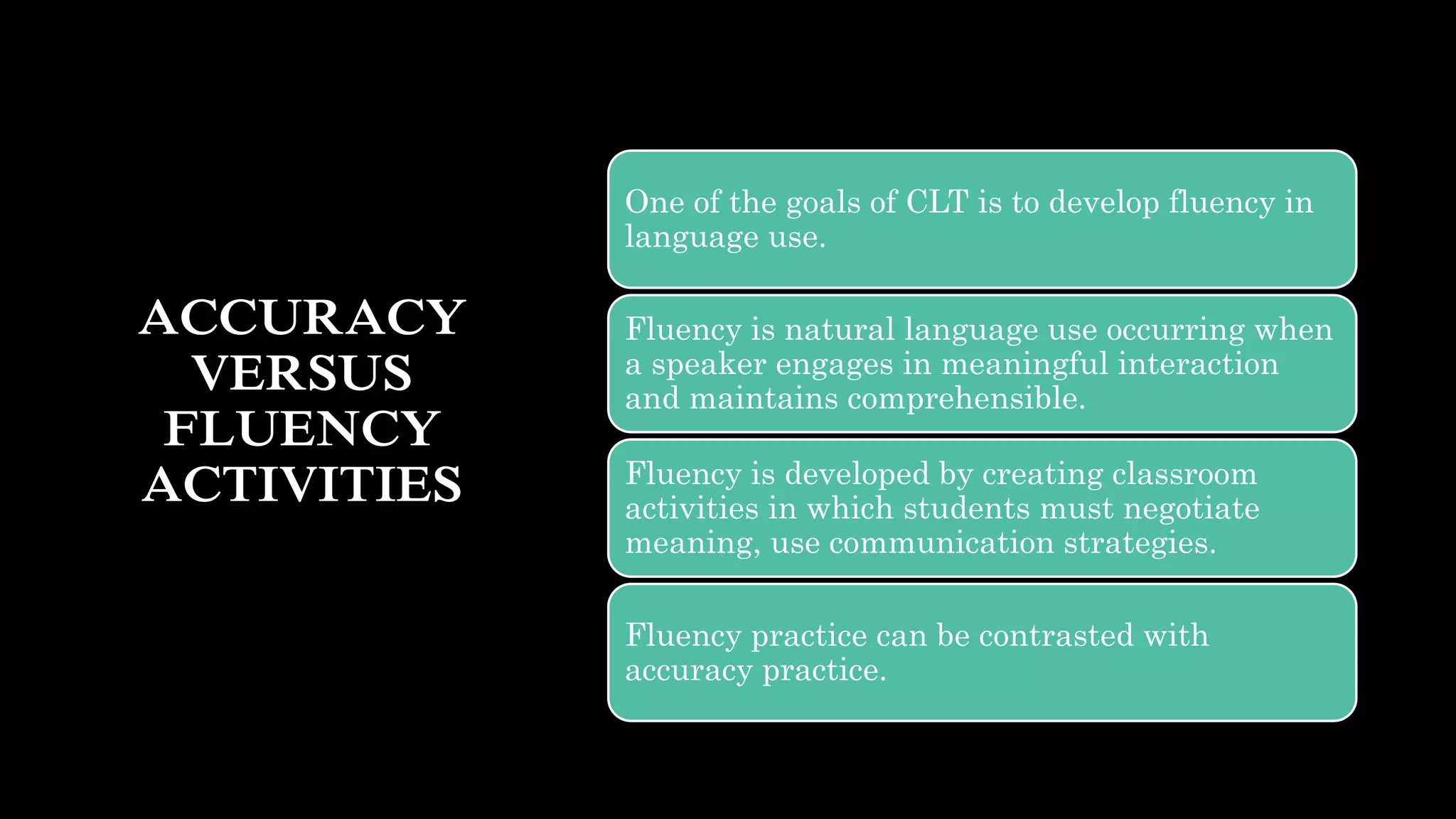
ACCURACY
VERSUS
FLUENCY
ACTIVITIES
One of the goals of CLT is to develop fluency in
language use.
Fluency is natural language use occurring when
a speaker engages in meaningful interaction
and maintains comprehensible.
Fluency is developed by creating classroom
activities in which students must negotiate
meaning, use communication strategies.
Fluency practice can be contrasted with
accuracy practice.
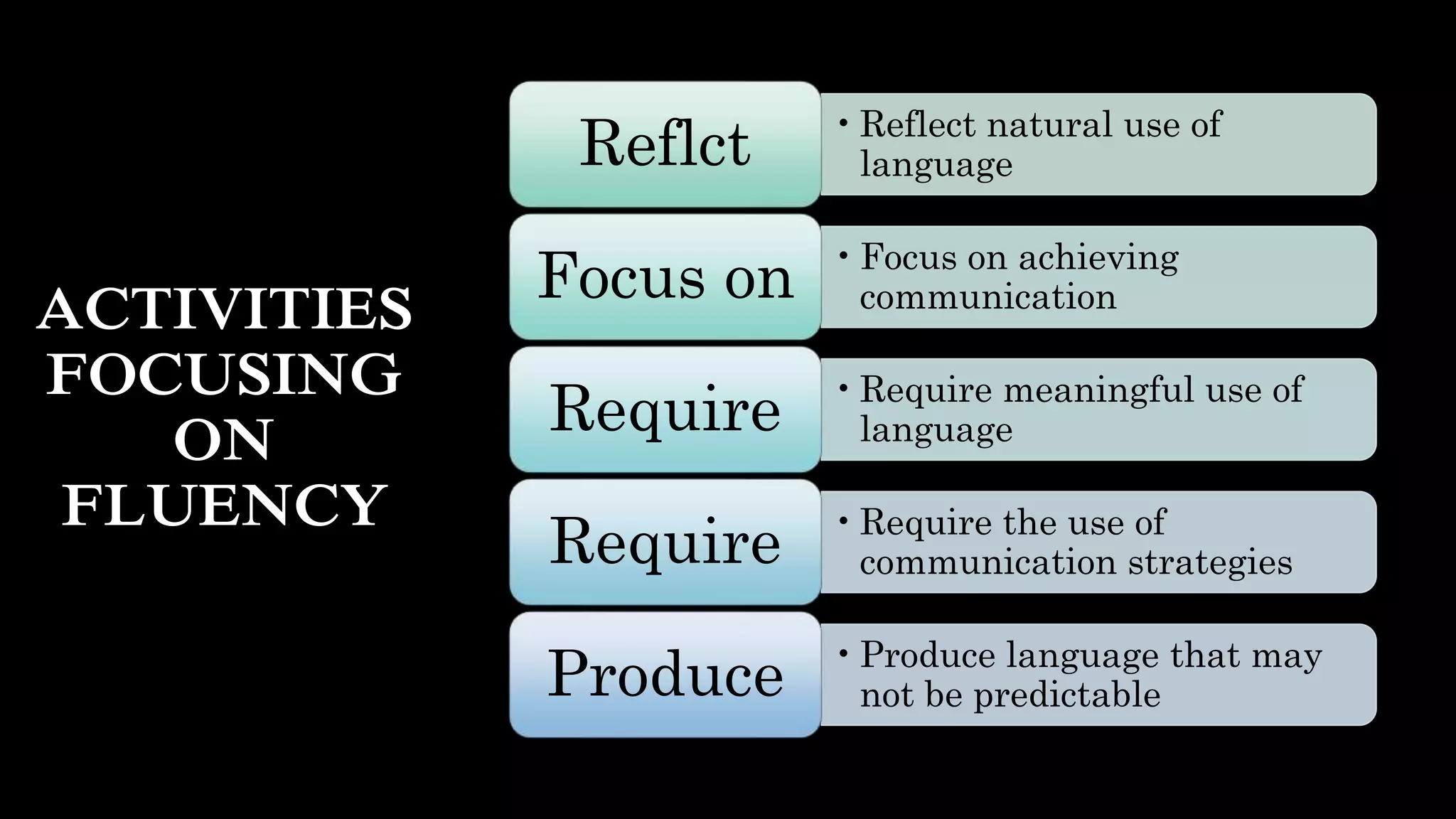
ACTIVITIES
FOCUSING
ON
FLUENCY
•Reflect natural use of
languageReflct
•Focus on achieving
communicationFocus on
•Require meaningful use of
languageRequire
•Require the use of
communication strategiesRequire
•Produce language that may
not be predictableProduce
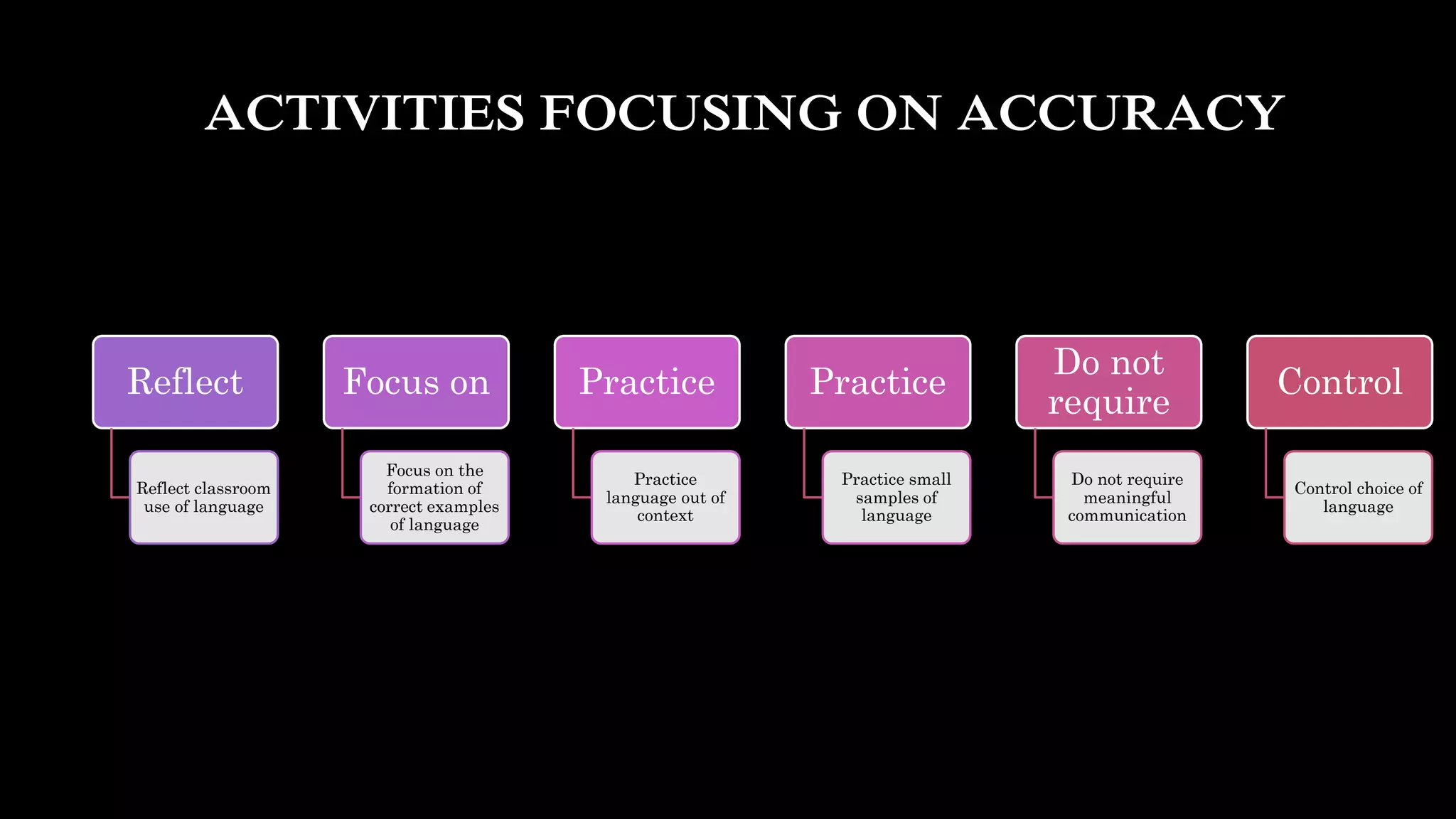
ACTIVITIES FOCUSING ON ACCURACY
Reflect
Reflect classroom
use of language
Focus on
Focus on the
formation of
correct examples
of language
Practice
Practice
language out of
context
Practice
Practice small
samples of
language
Do not
require
Do not require
meaningful
communication
Control
Control choice of
language
Mechanical, Meaningful, and
Communicative Practice
Mechanical practice:
 It refers to a guided practice exercise that students may conduct.
 Act effectively without actually knowing the language they are use.
Meaningful practice:
 This applies to an operation under which language regulation is still established
 Nonetheless, where students are expected to make concrete choices while
performing practice.
Communicative practice:
 This applies to practices in which the usage of expression is done
 The emphasis is on a particular communicative sense, where actual knowledge is
accessible.
 Exchanged, even where the vocabulary used is not completely straightforward.
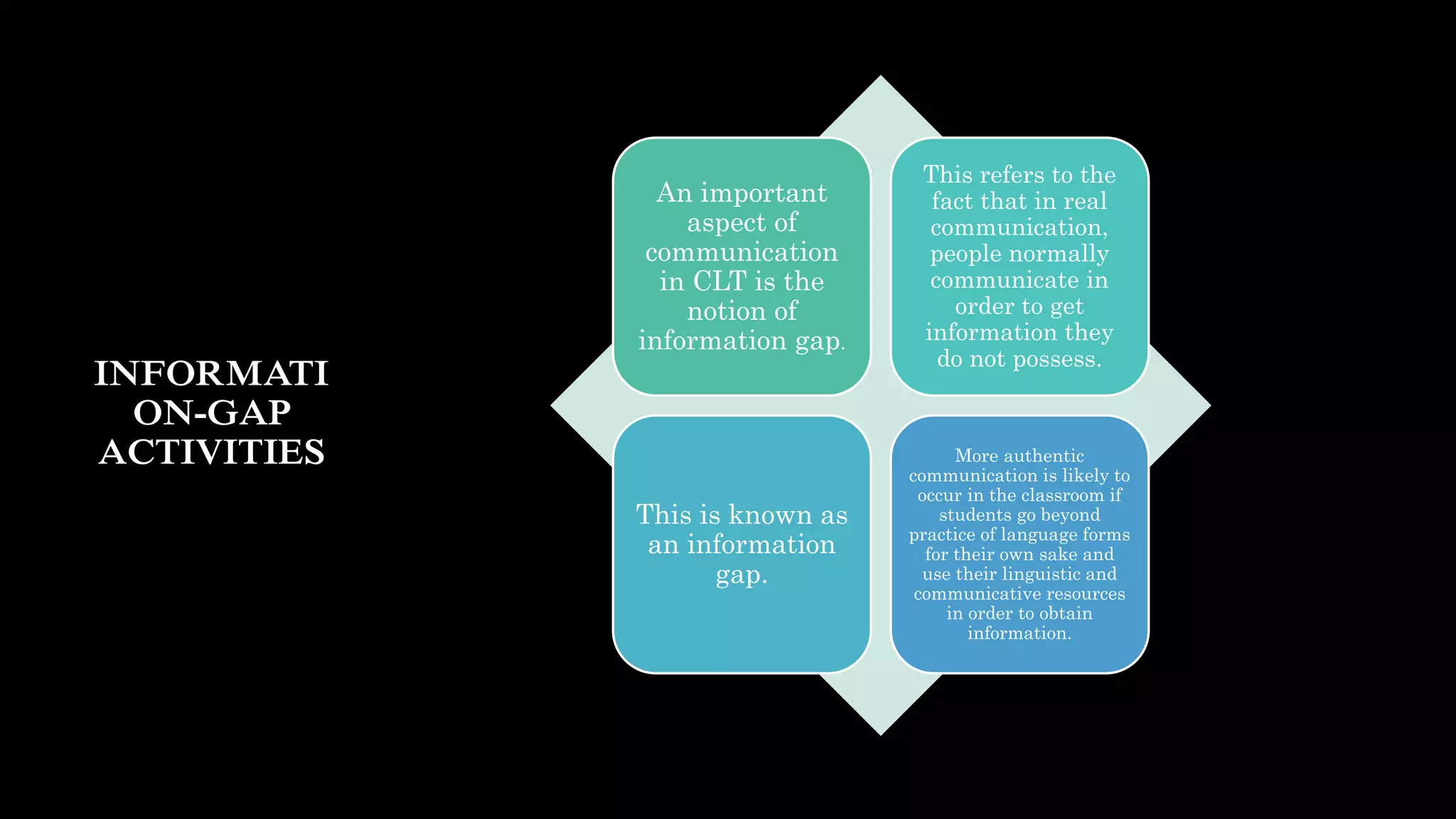
INFORMATI
ON-GAP
ACTIVITIES
An important
aspect of
communication
in CLT is the
notion of
information gap.
This refers to the
fact that in real
communication,
people normally
communicate in
order to get
information they
do not possess.
This is known as
an information
gap.
More authentic
communication is likely to
occur in the classroom if
students go beyond
practice of language forms
for their own sake and
use their linguistic and
communicative resources
in order to obtain
information.
Information-Gap Activities
 Information gap activity is an activity in which learners lack the information they need to
complete a task and need to talk to each other to find it.
Jigsaw activities
Jigsaw (teaching technique) The jigsaw technique is a method of organizing
classroom activity that makes students dependent on each other to succeed
Learners in three groups hear different versions of an encounter with aliens. Together with
other learners, they complete comprehension questions based on all three descriptions of the
encounter.
In the classroom
Jigsaw tasks are an excellent way to integrate the skills, as learners read or listen to a text,
and speak and listen to others to reconstruct the information in the text. Most written texts
can be made into a jigsaw activity easily. Managing a jigsaw listening exercise is more
challenging as it requires multiple tape recorders, enough space to listen without disturbing
other groups, and time.
EMPHASIS ON
PAIR AND
GROUP WORK
Most of the activities discussed above reflect
an important aspect of classroom tasks in
CLT.
• They can learn from hearing the language
used by other members of the group.
• They will produce a greater amount of
language than they would use in teacher-
fronted activities.
• Their motivational level is likely to increase.
• They will have the chance to develop
fluency.
THE PUSH FOR
AUTHENTICITY
Since the language classroom is intended as a
preparation for survival in the real world and
since real communication is a defining
characteristic of CLT.
Arguments in favor of the use of authentic
materials include:
 They provide cultural information about the
target language.
 They provide exposure to real language.
 They relate more closely to learners’ needs.
 They support a more creative approach to
teaching
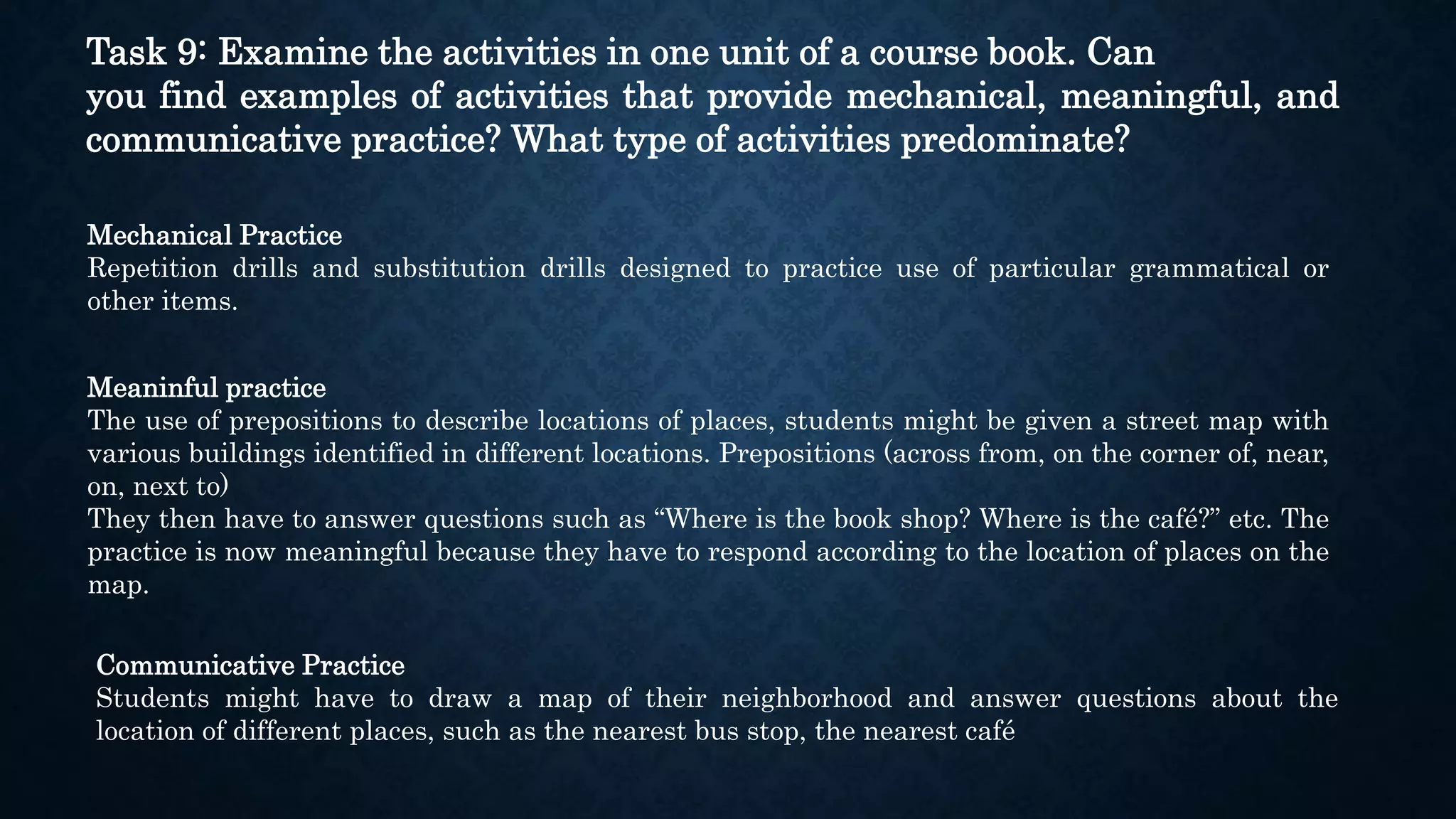
Task 9: Examine the activities in one unit of a course book. Can
you find examples of activities that provide mechanical, meaningful, and
communicative practice? What type of activities predominate?
Meaninful practice
The use of prepositions to describe locations of places, students might be given a street map with
various buildings identified in different locations. Prepositions (across from, on the corner of, near,
on, next to)
They then have to answer questions such as “Where is the book shop? Where is the café?” etc. The
practice is now meaningful because they have to respond according to the location of places on the
map.
Mechanical Practice
Repetition drills and substitution drills designed to practice use of particular grammatical or
other items.
Communicative Practice
Students might have to draw a map of their neighborhood and answer questions about the
location of different places, such as the nearest bus stop, the nearest café
Task 10: What are some advantages and limitations of pair and
group work in the language classroom
Advantag
es Gives learners more speaking time
 Changes the pace of the lesson
 Takes the spotlight off you and puts it onto the children
 Allows them to mix with everyone in the group
 Gives them a sense of achievement when reaching a team goal
 Teaches them how to lead and be led by someone other than the teacher
 Allows you to monitor, move around the class and really listen to the
language they are producing.
Limitations
 One of the main disadvantages for the learners is that shy or weak students can
be eliminated from the practice, because of individuals who always tend to
dominate. It is not a problem when they work in pairs, but as far as the groups
are concerned, the teacher should assign roles to avoid one or two learners
taking over the activity and others becoming passive observers. The assignment
of roles (for example "a secretary" who notes down what the group members
say; "a leader" who governs the conversation; "a presenter" who reports on the
final conclusions reached by the group, etc.) is often enough to act as a catalyst
to get the group speaking.
 Another problem of pair work and group work is connected with noise and
indiscipline, but it usually is more troublesome for the teacher than it is for the
learners. Participants in a pair-work or group-work activity are normally
unaware of the noise and of what other pairs or groups are doing. The only
possible problem here could be if the classroom had particularly thin walls. If
the activity is organized well and the learners are all actively speaking, then a
teacher should let them make noise, because it is "productive" noise.
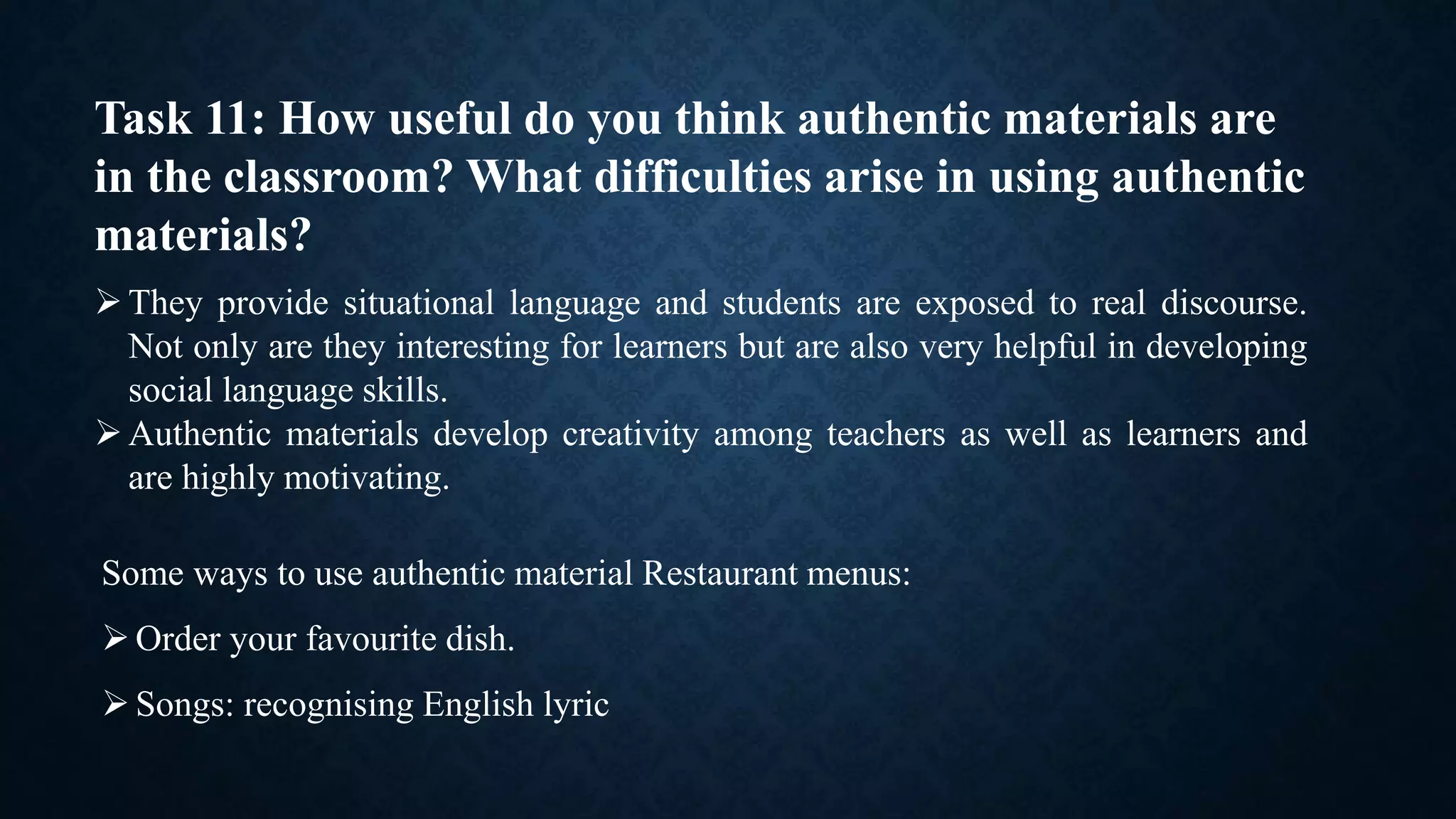
Task 11: How useful do you think authentic materials are
in the classroom? What difficulties arise in using authentic
materials?
They provide situational language and students are exposed to real discourse.
Not only are they interesting for learners but are also very helpful in developing
social language skills.
Authentic materials develop creativity among teachers as well as learners and
are highly motivating.
Some ways to use authentic material Restaurant menus:
Order your favourite dish.
Songs: recognising English lyric
BIBLIOGRAPHY
RICHARDS, JACK C. 2006. COMMUNICATIVE LANGUAGE
TEACHING PARADIGM. VOL. 1.

CLASSROOM ACTIVITIES IN COMMUNICATIVE LANGUAGE TEACHING

  • 1.
    UNIVERSIDAD TÉCNICA DE AMBATO C.L.T.METHODS • Barona David
  • 2.
  • 3.
    ACCURACY VERSUS FLUENCY ACTIVITIES One of thegoals of CLT is to develop fluency in language use. Fluency is natural language use occurring when a speaker engages in meaningful interaction and maintains comprehensible. Fluency is developed by creating classroom activities in which students must negotiate meaning, use communication strategies. Fluency practice can be contrasted with accuracy practice.
  • 4.
    ACTIVITIES FOCUSING ON FLUENCY •Reflect natural useof languageReflct •Focus on achieving communicationFocus on •Require meaningful use of languageRequire •Require the use of communication strategiesRequire •Produce language that may not be predictableProduce
  • 5.
    ACTIVITIES FOCUSING ONACCURACY Reflect Reflect classroom use of language Focus on Focus on the formation of correct examples of language Practice Practice language out of context Practice Practice small samples of language Do not require Do not require meaningful communication Control Control choice of language
  • 6.
    Mechanical, Meaningful, and CommunicativePractice Mechanical practice:  It refers to a guided practice exercise that students may conduct.  Act effectively without actually knowing the language they are use. Meaningful practice:  This applies to an operation under which language regulation is still established  Nonetheless, where students are expected to make concrete choices while performing practice. Communicative practice:  This applies to practices in which the usage of expression is done  The emphasis is on a particular communicative sense, where actual knowledge is accessible.  Exchanged, even where the vocabulary used is not completely straightforward.
  • 7.
    INFORMATI ON-GAP ACTIVITIES An important aspect of communication inCLT is the notion of information gap. This refers to the fact that in real communication, people normally communicate in order to get information they do not possess. This is known as an information gap. More authentic communication is likely to occur in the classroom if students go beyond practice of language forms for their own sake and use their linguistic and communicative resources in order to obtain information.
  • 8.
    Information-Gap Activities  Informationgap activity is an activity in which learners lack the information they need to complete a task and need to talk to each other to find it. Jigsaw activities Jigsaw (teaching technique) The jigsaw technique is a method of organizing classroom activity that makes students dependent on each other to succeed Learners in three groups hear different versions of an encounter with aliens. Together with other learners, they complete comprehension questions based on all three descriptions of the encounter. In the classroom Jigsaw tasks are an excellent way to integrate the skills, as learners read or listen to a text, and speak and listen to others to reconstruct the information in the text. Most written texts can be made into a jigsaw activity easily. Managing a jigsaw listening exercise is more challenging as it requires multiple tape recorders, enough space to listen without disturbing other groups, and time.
  • 9.
    EMPHASIS ON PAIR AND GROUPWORK Most of the activities discussed above reflect an important aspect of classroom tasks in CLT. • They can learn from hearing the language used by other members of the group. • They will produce a greater amount of language than they would use in teacher- fronted activities. • Their motivational level is likely to increase. • They will have the chance to develop fluency.
  • 10.
    THE PUSH FOR AUTHENTICITY Sincethe language classroom is intended as a preparation for survival in the real world and since real communication is a defining characteristic of CLT. Arguments in favor of the use of authentic materials include:  They provide cultural information about the target language.  They provide exposure to real language.  They relate more closely to learners’ needs.  They support a more creative approach to teaching
  • 11.
    Task 9: Examinethe activities in one unit of a course book. Can you find examples of activities that provide mechanical, meaningful, and communicative practice? What type of activities predominate? Meaninful practice The use of prepositions to describe locations of places, students might be given a street map with various buildings identified in different locations. Prepositions (across from, on the corner of, near, on, next to) They then have to answer questions such as “Where is the book shop? Where is the café?” etc. The practice is now meaningful because they have to respond according to the location of places on the map. Mechanical Practice Repetition drills and substitution drills designed to practice use of particular grammatical or other items. Communicative Practice Students might have to draw a map of their neighborhood and answer questions about the location of different places, such as the nearest bus stop, the nearest café
  • 12.
    Task 10: Whatare some advantages and limitations of pair and group work in the language classroom Advantag es Gives learners more speaking time  Changes the pace of the lesson  Takes the spotlight off you and puts it onto the children  Allows them to mix with everyone in the group  Gives them a sense of achievement when reaching a team goal  Teaches them how to lead and be led by someone other than the teacher  Allows you to monitor, move around the class and really listen to the language they are producing.
  • 13.
    Limitations  One ofthe main disadvantages for the learners is that shy or weak students can be eliminated from the practice, because of individuals who always tend to dominate. It is not a problem when they work in pairs, but as far as the groups are concerned, the teacher should assign roles to avoid one or two learners taking over the activity and others becoming passive observers. The assignment of roles (for example "a secretary" who notes down what the group members say; "a leader" who governs the conversation; "a presenter" who reports on the final conclusions reached by the group, etc.) is often enough to act as a catalyst to get the group speaking.  Another problem of pair work and group work is connected with noise and indiscipline, but it usually is more troublesome for the teacher than it is for the learners. Participants in a pair-work or group-work activity are normally unaware of the noise and of what other pairs or groups are doing. The only possible problem here could be if the classroom had particularly thin walls. If the activity is organized well and the learners are all actively speaking, then a teacher should let them make noise, because it is "productive" noise.
  • 14.
    Task 11: Howuseful do you think authentic materials are in the classroom? What difficulties arise in using authentic materials? They provide situational language and students are exposed to real discourse. Not only are they interesting for learners but are also very helpful in developing social language skills. Authentic materials develop creativity among teachers as well as learners and are highly motivating. Some ways to use authentic material Restaurant menus: Order your favourite dish. Songs: recognising English lyric
  • 15.
    BIBLIOGRAPHY RICHARDS, JACK C.2006. COMMUNICATIVE LANGUAGE TEACHING PARADIGM. VOL. 1.