Helmut Satzinger 
Open questions concerning 
verb forms connected with 
the negation n 
Workshop ‘Negation in Ancient Egyptian’ 
Paris, December 11–13, 2014
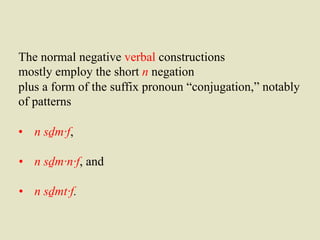
The normal negative verbal constructions 
mostly employ the short n negation 
plus a form of the suffix pronoun “conjugation,” notably 
of patterns 
• n sḏm·f, 
• n sḏm·n·f, and 
• n sḏmt·f.
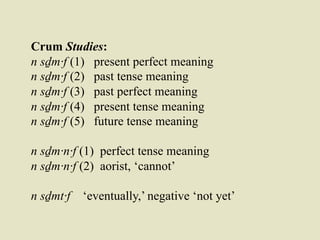
Crum Studies: 
n sḏm·f (1) present perfect meaning 
n sḏm·f (2) past tense meaning 
n sḏm·f (3) past perfect meaning 
n sḏm·f (4) present tense meaning 
n sḏm·f (5) future tense meaning 
n sḏm·n·f (1) perfect tense meaning 
n sḏm·n·f (2) aorist, ‘cannot’ 
n sḏmt·f ‘eventually,’ negative ‘not yet’
n plus suffix conjugation (Allen [2nd ed.], 413–4 / § 26.29/1) 
• the perfect (§ 18.14) nj sḏm·n·f “he does not hear, he cannot hear” 
[+ nj sḏm.n.f “he has not heard, he did not hear”] 
• the passive (§ 21.13) nj sḏm·f “he is not heard, he cannot be heard 
• the perfective (§ 20.5) nj sḏm·f “he did not hear, he has not heard” 
• the imperfective (§ 20.15), rare and uncertain 
nj sḏm·f “he does not hear” 
• the prospective, active and passive (§ 21.15, 21.7) 
nj sḏm·f “he will not hear,” nj sḏmm·f “he will not be heard” 
• the sḏmt·f (§ 22.13): nj sḏmt·f “before he heard/has heard, 
he has not yet heard”
Syntactic status of n constructions: 
n + verb is attested 
• in initial main sentences, 
• in sequential (continuing) sentences, and 
• in clauses of circumstance. 
It obviously belongs to the “rhematic 
constructions”; it is not a nominal (substantival) 
construction. 
BTW—this is true of all n constructions.
What is responsible for the rhematic status of 
n + verb ? 
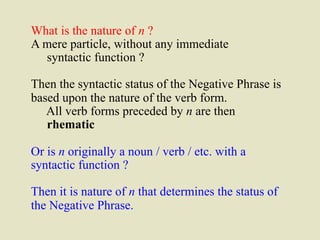
What is the nature of n ? 
A mere particle, without any immediate 
syntactic function ? 
Then the syntactic status of the Negative Phrase is 
based upon the nature of the verb form. 
All verb forms preceded by n are then 
rhematic
What is the nature of n ? 
A mere particle, without any immediate 
syntactic function ? 
Then the syntactic status of the Negative Phrase is 
based upon the nature of the verb form. 
All verb forms preceded by n are then 
rhematic 
Or is n originally a noun / verb / etc. with a 
syntactic function ? 
Then it is nature of n that determines the status of 
the Negative Phrase.
Traditional opinion: 
The negation n : a mere particle— 
an element that does not exert any syntactic function 
The n constructions are all rhematic 
(initial main sentences, sequential, or clauses of 
circumstance). 
Responsible for this: the verb forms involved ?
n sḏm·f, past tense meaning 
n sḏm·f, present tense meaning 
The verb form involved is obviously the 
perfective sḏm·f— 
But is it the rhematic or the nominal form ?
n sḏmt·f : 
Main sentence, “he did not yet hear,” 
Clause of circumstance, “before he heard.” 
(he did not yet end up hearing) 
sḏmt·f “that he eventually heard, 
that he ended up hearing” 
is only attested as a nominal form
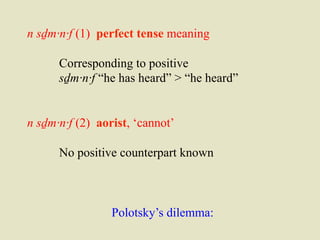
n sḏm·n·f (1) perfect tense meaning 
Corresponding to positive 
sḏm·n·f “he has heard” > “he heard” 
n sḏm·n·f (2) aorist, ‘cannot’ 
No positive counterpart known 
Polotsky’s dilemma:
It is to be expected that all verb forms with preceding n 
are of the same syntactic status category: 
• either rhematic, 
• or nominal. 
Polotsky: n sḏm·n·f is used of all verbs, including the 
intransitive verbs of motion — 
the formal characteristic of the nominal sḏm·n·f, 
the “abstract (or non-attributive) relative form” of 
the perfect/preterite, “that he heard.”
n sḏm·n·f is a self-sufficient construction, hence 
rhematic. Since he regarded the negation n as a particle 
—comme tout le monde—, Polotsky had obviously a 
problem with attributing nominal nature to sḏm·n·f in 
this case. 
The sḏm.f form of n sḏm·f, however, seemed to be a 
rhematic form allright, judging from the forms of 
irregular verbs. 
Not a satisfactory result indeed.
« Niée par n, chacune des deux formes [sḏm·f and 
sḏm·n·f, HS] ressortit à une catégorie différente. Tandis 
qu’on reconnaît sans difficulté dans n sḏm.n=f la forme 
substantive, n sḏm=f est moin aisé à identifier 
positivement. Ses caractères sont surtout négatifs : il est 
décidément tout autre chose que la forme substantive, et 
il s’écarte en deux points de la forme circonstantielle, à 
savoir dans les formes caractéristiques des deux verbes 
“donner” et “voir” : 
“DONNER” “VOIR” 
CIRCONSTANTIEL dj.f m33.f 
NÉGATIF n rdj.f n m3.f
(When negated, each of the two forms 
[sḏm·f and sḏm·n·f, HS] will belong to a different 
category. Whereas one will discern without difficulty in 
n sḏm.n=f the nominal form, n sḏm=f is less easy to be 
positively identified. Its characteristics are particularly 
negative: it is decidedly anything else but the noun form, 
and it departs in two points from the circumstantial 
form, namely in the characteristic forms of the two verbs 
"to give" and "to see":) : 
“DONNER” “VOIR” 
CIRCONSTANTIEL dj.f m33.f 
NÉGATIF n rdj.f n m3.f
On connaît deux cas où “donner” et “voir” revêtent 
précisément les formes rdj.f et m3.f : l’un, en ancien 
égyptien (avec des survivances), en fonction de passé 
narratif (Edel § 470) ; l’autre, en égyptien classique, se 
rapportant à l’avenir, dans l’apodose d’une phrase 
introduite par jr, soit que jr amène un substantif (CT II 
205a rdj-, Ptahh. 577 m3.f) ou un sḏm.f (Naufragé 72 
rdj.j, ibid. 134 m3.k). Ces formes représentent, en toute 
probabilité, la catégorie proprement verbale 
(“factive”). » 
(Polotsky Les transpositions, 46)
(Two cases are known in which “to give” and “to see” 
show precisely the forms rdj.f et m3.f: one, in Old 
Egyptian (with survivals), in the function of narrative 
past (Edel § 470); the other, in Classical Egyptian, 
referring to the future, in the apodosis of a phrase 
introduced by jr, whether jr takes a noun (CT II 205a 
rdj-, Ptahh. 577 m3.f) or a sḏm.f (Shipwr. S. 72 rdj.j, 
ibid. 134 m3.k). These forms represent in all probability 
the proper verbal (“factitive”) category.) 
(Polotsky Les transpositions, 46)
The only motive which Polotsky could think of, both for 
“Gunn’s Rule” and the difference in the structure of the 
two constructions mentioned, is the obscure concept of 
polarity: 
Die einzige Erklärung für das „auffällige“ Fehlen der 
„emphatischen“ Bedeutung und überhaupt für die 
Verbindung der substantivischen Form mit der Negation 
n ist wohl doch die „Polarität“[H. Brunner, ZÄS 72 
(1936) 139–141]. Die „Polarität“ ist zwiefach: Tempus 
(sḏm·f : sḏm·n·f) und Wortklasse (Umstand, d.h. Adverb : 
Substantiv). 
(Polotsky „Randbemerkungen,“ FS Westendorf (1984), 
117 n. 6.)
The only motive which Polotsky could think of, both for 
“Gunn’s Rule” and the difference in the structure of the 
two constructions mentioned, is the obscure concept of 
polarity: 
(The only explanation for the conspicuous lack of any 
“emphatic” meaning, or more generally speaking, the 
connection of the nominal form (sḏm·n·f) with the 
negation n is probably, nevertheless, “polarity” [H. 
Brunner, ZÄS 72 (1936) 139–141]. This “polarity” is 
twofold: it is polarity both in respect to tense (sḏm·f : 
sḏm·n·f) and to parts of speach (circumstance, i.e. 
adverb : substantive).) 
(Polotsky „Randbemerkungen,“ FS Westendorf (1984), 
117 n. 6.)
There is no Law of Polarity— 
nor did Gunn ever phrase “Gunn’s Rule” 
Gardiner’s (1962:33) memoirs: “Sethe never tired of 
referring in his lectures to die Gunnsche Regel!”). 
(quoting from Hannig 1984:63). So it’s a German 
invention, after all? 
Situations of polarity may arise in a language, 
but more as a chance result, like the two forms with 
waw-consecutive in Hebrew 
(qāṭal : yiqṭōl versus way-yiqṭōl : wǝ-qāṭal). 
But yiqṭōl after waw is not imperfect, but rather an 
ancient Semitic preterite form.
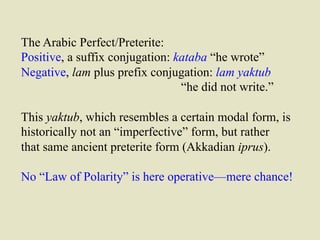
The Arabic Perfect/Preterite: 
Positive, a suffix conjugation: kataba “he wrote” 
Negative, lam plus prefix conjugation: lam yaktub 
“he did not write.” 
This yaktub, which resembles a certain modal form, is 
historically not an “imperfective” form, but rather 
that same ancient preterite form (Akkadian iprus). 
No “Law of Polarity” is here operative—mere chance!
nn—a thetic negation, “there is no …,” “… does 
not exist” 
Predicate — Subject 
nn sw “he does not exist” 
nn m3ˁtyw “There are no righteous” 
nn sḏm·f “*that he shall hear does not exist” 
(FIP, with voluntary meaning: nn ḏj·f “he is not to give”; 
MK, neutral: “he will not give”) 
The grammaticalization of nn sḏm.f is obviously 
quite recent.
n is probably a mere graphic variant of “nn,” at 
least originally (Edel); anyway, both negations may be 
properly reading nj (Westendorf). 
n + verb forms are probably grammaticalizations that are 
more ancient than nn sḏm.f. 
Originally of the same structure, “it does not exist that 
he (has) heard / that he will hear etc.” 
With this in mind — verb forms after n having subject 
function, hence being nominal (an abstract, or non-attributive, 
relative form) — we may try to identify these 
verb forms.
n sḏmt·f 
sḏmt·f is a nominal form: 
Complement of prepositions, 
r sḏmt·f “until he at last hears” 
ḏr sḏmt·f “before he at last heard” 
(Zonhoven, Satzinger) 
n sḏmt·f 
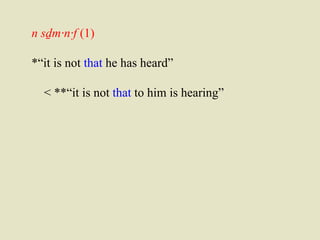
*“it is not that he has ended up hearing”
n sḏm·n·f (1) 
*“it is not that he has heard” 
< **“it is not that to him is hearing”
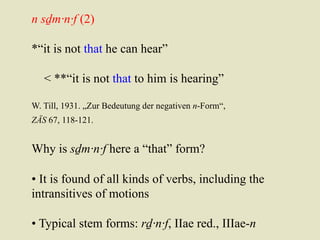
n sḏm·n·f (2) 
*“it is not that he can hear” 
< **“it is not that to him is hearing” 
W. Till, 1931. „Zur Bedeutung der negativen n-Form“, 
ZÄS 67, 118-121. 
Why is sḏm·n·f here a “that” form? 
• It is found of all kinds of verbs, including the 
intransitives of motions 
• Typical stem forms: rḏ·n·f, IIae red., IIIae-n
There is no Law of Polarity. 
What about “Gunn’s Rule”? 
n sḏm·f can have various time reference. 
There are two different uses of n sḏm·n·f: 
• Perfect tense (OK; later not many attestations) 
• Aorist (“cannot”); no positive counterpart. 
n sḏmt·f has no positive (rhematic!) counterpart. 
Characteristic dissymmetry

Negations

  • 1.
    Helmut Satzinger Openquestions concerning verb forms connected with the negation n Workshop ‘Negation in Ancient Egyptian’ Paris, December 11–13, 2014
  • 2.
    The normal negativeverbal constructions mostly employ the short n negation plus a form of the suffix pronoun “conjugation,” notably of patterns • n sḏm·f, • n sḏm·n·f, and • n sḏmt·f.
  • 3.
    Crum Studies: nsḏm·f (1) present perfect meaning n sḏm·f (2) past tense meaning n sḏm·f (3) past perfect meaning n sḏm·f (4) present tense meaning n sḏm·f (5) future tense meaning n sḏm·n·f (1) perfect tense meaning n sḏm·n·f (2) aorist, ‘cannot’ n sḏmt·f ‘eventually,’ negative ‘not yet’
  • 4.
    n plus suffixconjugation (Allen [2nd ed.], 413–4 / § 26.29/1) • the perfect (§ 18.14) nj sḏm·n·f “he does not hear, he cannot hear” [+ nj sḏm.n.f “he has not heard, he did not hear”] • the passive (§ 21.13) nj sḏm·f “he is not heard, he cannot be heard • the perfective (§ 20.5) nj sḏm·f “he did not hear, he has not heard” • the imperfective (§ 20.15), rare and uncertain nj sḏm·f “he does not hear” • the prospective, active and passive (§ 21.15, 21.7) nj sḏm·f “he will not hear,” nj sḏmm·f “he will not be heard” • the sḏmt·f (§ 22.13): nj sḏmt·f “before he heard/has heard, he has not yet heard”
  • 5.
    Syntactic status ofn constructions: n + verb is attested • in initial main sentences, • in sequential (continuing) sentences, and • in clauses of circumstance. It obviously belongs to the “rhematic constructions”; it is not a nominal (substantival) construction. BTW—this is true of all n constructions.
  • 6.
    What is responsiblefor the rhematic status of n + verb ? What is the nature of n ? A mere particle, without any immediate syntactic function ? Then the syntactic status of the Negative Phrase is based upon the nature of the verb form. All verb forms preceded by n are then rhematic
  • 7.
    What is thenature of n ? A mere particle, without any immediate syntactic function ? Then the syntactic status of the Negative Phrase is based upon the nature of the verb form. All verb forms preceded by n are then rhematic Or is n originally a noun / verb / etc. with a syntactic function ? Then it is nature of n that determines the status of the Negative Phrase.
  • 8.
    Traditional opinion: Thenegation n : a mere particle— an element that does not exert any syntactic function The n constructions are all rhematic (initial main sentences, sequential, or clauses of circumstance). Responsible for this: the verb forms involved ?
  • 9.
    n sḏm·f, pasttense meaning n sḏm·f, present tense meaning The verb form involved is obviously the perfective sḏm·f— But is it the rhematic or the nominal form ?
  • 10.
    n sḏmt·f : Main sentence, “he did not yet hear,” Clause of circumstance, “before he heard.” (he did not yet end up hearing) sḏmt·f “that he eventually heard, that he ended up hearing” is only attested as a nominal form
  • 11.
    n sḏm·n·f (1)perfect tense meaning Corresponding to positive sḏm·n·f “he has heard” > “he heard” n sḏm·n·f (2) aorist, ‘cannot’ No positive counterpart known Polotsky’s dilemma:
  • 12.
    It is tobe expected that all verb forms with preceding n are of the same syntactic status category: • either rhematic, • or nominal. Polotsky: n sḏm·n·f is used of all verbs, including the intransitive verbs of motion — the formal characteristic of the nominal sḏm·n·f, the “abstract (or non-attributive) relative form” of the perfect/preterite, “that he heard.”
  • 13.
    n sḏm·n·f isa self-sufficient construction, hence rhematic. Since he regarded the negation n as a particle —comme tout le monde—, Polotsky had obviously a problem with attributing nominal nature to sḏm·n·f in this case. The sḏm.f form of n sḏm·f, however, seemed to be a rhematic form allright, judging from the forms of irregular verbs. Not a satisfactory result indeed.
  • 14.
    « Niée parn, chacune des deux formes [sḏm·f and sḏm·n·f, HS] ressortit à une catégorie différente. Tandis qu’on reconnaît sans difficulté dans n sḏm.n=f la forme substantive, n sḏm=f est moin aisé à identifier positivement. Ses caractères sont surtout négatifs : il est décidément tout autre chose que la forme substantive, et il s’écarte en deux points de la forme circonstantielle, à savoir dans les formes caractéristiques des deux verbes “donner” et “voir” : “DONNER” “VOIR” CIRCONSTANTIEL dj.f m33.f NÉGATIF n rdj.f n m3.f
  • 15.
    (When negated, eachof the two forms [sḏm·f and sḏm·n·f, HS] will belong to a different category. Whereas one will discern without difficulty in n sḏm.n=f the nominal form, n sḏm=f is less easy to be positively identified. Its characteristics are particularly negative: it is decidedly anything else but the noun form, and it departs in two points from the circumstantial form, namely in the characteristic forms of the two verbs "to give" and "to see":) : “DONNER” “VOIR” CIRCONSTANTIEL dj.f m33.f NÉGATIF n rdj.f n m3.f
  • 16.
    On connaît deuxcas où “donner” et “voir” revêtent précisément les formes rdj.f et m3.f : l’un, en ancien égyptien (avec des survivances), en fonction de passé narratif (Edel § 470) ; l’autre, en égyptien classique, se rapportant à l’avenir, dans l’apodose d’une phrase introduite par jr, soit que jr amène un substantif (CT II 205a rdj-, Ptahh. 577 m3.f) ou un sḏm.f (Naufragé 72 rdj.j, ibid. 134 m3.k). Ces formes représentent, en toute probabilité, la catégorie proprement verbale (“factive”). » (Polotsky Les transpositions, 46)
  • 17.
    (Two cases areknown in which “to give” and “to see” show precisely the forms rdj.f et m3.f: one, in Old Egyptian (with survivals), in the function of narrative past (Edel § 470); the other, in Classical Egyptian, referring to the future, in the apodosis of a phrase introduced by jr, whether jr takes a noun (CT II 205a rdj-, Ptahh. 577 m3.f) or a sḏm.f (Shipwr. S. 72 rdj.j, ibid. 134 m3.k). These forms represent in all probability the proper verbal (“factitive”) category.) (Polotsky Les transpositions, 46)
  • 18.
    The only motivewhich Polotsky could think of, both for “Gunn’s Rule” and the difference in the structure of the two constructions mentioned, is the obscure concept of polarity: Die einzige Erklärung für das „auffällige“ Fehlen der „emphatischen“ Bedeutung und überhaupt für die Verbindung der substantivischen Form mit der Negation n ist wohl doch die „Polarität“[H. Brunner, ZÄS 72 (1936) 139–141]. Die „Polarität“ ist zwiefach: Tempus (sḏm·f : sḏm·n·f) und Wortklasse (Umstand, d.h. Adverb : Substantiv). (Polotsky „Randbemerkungen,“ FS Westendorf (1984), 117 n. 6.)
  • 19.
    The only motivewhich Polotsky could think of, both for “Gunn’s Rule” and the difference in the structure of the two constructions mentioned, is the obscure concept of polarity: (The only explanation for the conspicuous lack of any “emphatic” meaning, or more generally speaking, the connection of the nominal form (sḏm·n·f) with the negation n is probably, nevertheless, “polarity” [H. Brunner, ZÄS 72 (1936) 139–141]. This “polarity” is twofold: it is polarity both in respect to tense (sḏm·f : sḏm·n·f) and to parts of speach (circumstance, i.e. adverb : substantive).) (Polotsky „Randbemerkungen,“ FS Westendorf (1984), 117 n. 6.)
  • 20.
    There is noLaw of Polarity— nor did Gunn ever phrase “Gunn’s Rule” Gardiner’s (1962:33) memoirs: “Sethe never tired of referring in his lectures to die Gunnsche Regel!”). (quoting from Hannig 1984:63). So it’s a German invention, after all? Situations of polarity may arise in a language, but more as a chance result, like the two forms with waw-consecutive in Hebrew (qāṭal : yiqṭōl versus way-yiqṭōl : wǝ-qāṭal). But yiqṭōl after waw is not imperfect, but rather an ancient Semitic preterite form.
  • 21.
    The Arabic Perfect/Preterite: Positive, a suffix conjugation: kataba “he wrote” Negative, lam plus prefix conjugation: lam yaktub “he did not write.” This yaktub, which resembles a certain modal form, is historically not an “imperfective” form, but rather that same ancient preterite form (Akkadian iprus). No “Law of Polarity” is here operative—mere chance!
  • 22.
    nn—a thetic negation,“there is no …,” “… does not exist” Predicate — Subject nn sw “he does not exist” nn m3ˁtyw “There are no righteous” nn sḏm·f “*that he shall hear does not exist” (FIP, with voluntary meaning: nn ḏj·f “he is not to give”; MK, neutral: “he will not give”) The grammaticalization of nn sḏm.f is obviously quite recent.
  • 23.
    n is probablya mere graphic variant of “nn,” at least originally (Edel); anyway, both negations may be properly reading nj (Westendorf). n + verb forms are probably grammaticalizations that are more ancient than nn sḏm.f. Originally of the same structure, “it does not exist that he (has) heard / that he will hear etc.” With this in mind — verb forms after n having subject function, hence being nominal (an abstract, or non-attributive, relative form) — we may try to identify these verb forms.
  • 24.
    n sḏmt·f sḏmt·fis a nominal form: Complement of prepositions, r sḏmt·f “until he at last hears” ḏr sḏmt·f “before he at last heard” (Zonhoven, Satzinger) n sḏmt·f *“it is not that he has ended up hearing”
  • 25.
    n sḏm·n·f (1) *“it is not that he has heard” < **“it is not that to him is hearing”
  • 26.
    n sḏm·n·f (2) *“it is not that he can hear” < **“it is not that to him is hearing” W. Till, 1931. „Zur Bedeutung der negativen n-Form“, ZÄS 67, 118-121. Why is sḏm·n·f here a “that” form? • It is found of all kinds of verbs, including the intransitives of motions • Typical stem forms: rḏ·n·f, IIae red., IIIae-n
  • 27.
    There is noLaw of Polarity. What about “Gunn’s Rule”? n sḏm·f can have various time reference. There are two different uses of n sḏm·n·f: • Perfect tense (OK; later not many attestations) • Aorist (“cannot”); no positive counterpart. n sḏmt·f has no positive (rhematic!) counterpart. Characteristic dissymmetry