by Hemilyc Reyes
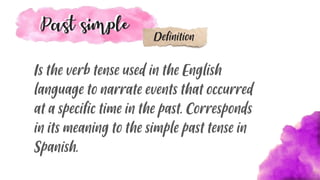
Is the verb tense used in the English
language to narrate events that occurred
at a specific time in the past. Corresponds
in its meaning to the simple past tense in
Spanish.
Definition
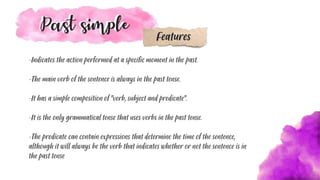
-Indicates the action performed at a specific moment in the past.
-The main verb of the sentence is always in the past tense.
-It has a simple composition of "verb, subject and predicate".
-It is the only grammatical tense that uses verbs in the past tense.
-The predicate can contain expressions that determine the time of the sentence,
although it will always be the verb that indicates whether or not the sentence is in
the past tense
Features
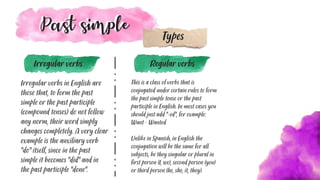
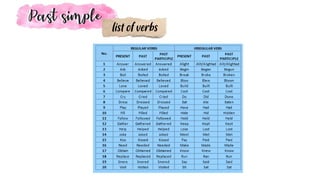
Irregular verbs in English are
those that, to form the past
simple or the past participle
(compound tenses) do not follow
any norm, their word simply
changes completely. A very clear
example is the auxiliary verb
"do" itself, since in the past
simple it becomes "did" and in
the past participle "done".
Types
This is a class of verbs that is
conjugated under certain rules to form
the past simple tense or the past
participle in English. In most cases you
should just add "-ed", for example:
Want - Wanted
Unlike in Spanish, in English the
conjugation will be the same for all
subjects, be they singular or plural in
first person (I, we), second person (you)
or third person (he, she, it, they).
Irregular verbs Regular verbs
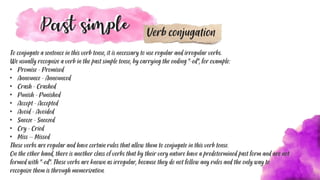
Verb conjugation
To conjugate a sentence in this verb tense, it is necessary to use regular and irregular verbs.
We usually recognize a verb in the past simple tense, by carrying the ending "-ed", for example:
• Promise - Promised
• Announce - Announced
• Crash - Crashed
• Punish - Punished
• Accept - Accepted
• Avoid - Avoided
• Sneeze - Sneezed
• Cry - Cried
• Miss – Missed
These verbs are regular and have certain rules that allow them to conjugate in this verb tense.
On the other hand, there is another class of verbs that by their very nature have a predetermined past form and are not
formed with "-ed". These verbs are known as irregular, because they do not follow any rules and the only way to
recognize them is through memorization.
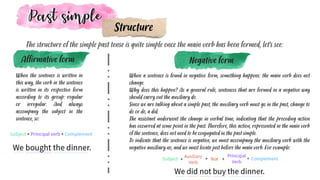
The structure of the simple past tense is quite simple once the main verb has been formed, let's see:
Structure
Affirmative form
When the sentence is written in
this way, the verb in the sentence
is written in its respective form
according to its group: regular
or irregular. And always
accompany the subject in the
sentence, so:
Negative form
When a sentence is found in negative form, something happens: the main verb does not
change.
Why does this happen? As a general rule, sentences that are formed in a negative way
should carry out the auxiliary do.
Since we are talking about a simple past, the auxiliary verb must go in the past, change to
do or do, a did.
The assistant underwent the change in verbal time, indicating that the preceding action
has occurred at some point in the past. Therefore, this action, represented in the main verb
of the sentence, does not need to be conjugated in the past simple.
To indicate that the sentence is negative, we must accompany the auxiliary verb with the
negative auxiliary no, and we must locate just before the main verb. For example:
Structure
Interrogative form
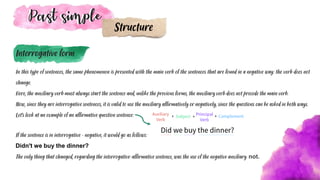
In this type of sentences, the same phenomenon is presented with the main verb of the sentences that are found in a negative way: the verb does not
change.
Here, the auxiliary verb must always start the sentence and, unlike the previous forms, the auxiliary verb does not precede the main verb.
Now, since they are interrogative sentences, it is valid to use the auxiliary affirmatively or negatively, since the questions can be asked in both ways.
Let's look at an example of an affirmative question sentence:
If the sentence is in interrogative - negative, it would go as follows:
Didn't we buy the dinner?
The only thing that changed, regarding the interrogative-affirmative sentence, was the use of the negative auxiliary not.
solved exercises
1. I am not a teacher.
2. They are having a
party.
3. We are delighted to see
him.
4. He is still sleeping.
5. She is a bit scared.
6. You are not on the list.
7. This/that is not a cat.
8. You are all at school.
1. I was not a teacher.
2. They were having a
party.
3. We were delighted to see
him.
4. He was still sleeping.
5. She was a bit scared.
6. You were not in the list.
7. It was not a cat.
8. You were all at school
Pass the sentences to the past:
solved exercises
1. We ______________ in Canberra last spring.
2. Jamie ______________ 25 last June.
3. You ______________ very busy on Friday.
4. I ______________ at home yesterday.
5. ______________ you at work this morning?
6. He ______________ not surprised by the
present.
7. It ______________ not very dangerous.
8. She ______________ interested in science.
1. We were in Canberra last spring.
2. Jamie was 25 last June.
3. You were very busy on Friday.
4. I was at home yesterday.
5. Were you at work this morning?
6. He was not surprised by the present.
7. It was not very dangerous.
8. She was interested in science.
Fill in the blanks:
list of verbs

Past simple

  • 1.
  • 2.
    Is the verbtense used in the English language to narrate events that occurred at a specific time in the past. Corresponds in its meaning to the simple past tense in Spanish. Definition
  • 3.
    -Indicates the actionperformed at a specific moment in the past. -The main verb of the sentence is always in the past tense. -It has a simple composition of "verb, subject and predicate". -It is the only grammatical tense that uses verbs in the past tense. -The predicate can contain expressions that determine the time of the sentence, although it will always be the verb that indicates whether or not the sentence is in the past tense Features
  • 4.
    Irregular verbs inEnglish are those that, to form the past simple or the past participle (compound tenses) do not follow any norm, their word simply changes completely. A very clear example is the auxiliary verb "do" itself, since in the past simple it becomes "did" and in the past participle "done". Types This is a class of verbs that is conjugated under certain rules to form the past simple tense or the past participle in English. In most cases you should just add "-ed", for example: Want - Wanted Unlike in Spanish, in English the conjugation will be the same for all subjects, be they singular or plural in first person (I, we), second person (you) or third person (he, she, it, they). Irregular verbs Regular verbs
  • 5.
    Verb conjugation To conjugatea sentence in this verb tense, it is necessary to use regular and irregular verbs. We usually recognize a verb in the past simple tense, by carrying the ending "-ed", for example: • Promise - Promised • Announce - Announced • Crash - Crashed • Punish - Punished • Accept - Accepted • Avoid - Avoided • Sneeze - Sneezed • Cry - Cried • Miss – Missed These verbs are regular and have certain rules that allow them to conjugate in this verb tense. On the other hand, there is another class of verbs that by their very nature have a predetermined past form and are not formed with "-ed". These verbs are known as irregular, because they do not follow any rules and the only way to recognize them is through memorization.
  • 6.
    The structure ofthe simple past tense is quite simple once the main verb has been formed, let's see: Structure Affirmative form When the sentence is written in this way, the verb in the sentence is written in its respective form according to its group: regular or irregular. And always accompany the subject in the sentence, so: Negative form When a sentence is found in negative form, something happens: the main verb does not change. Why does this happen? As a general rule, sentences that are formed in a negative way should carry out the auxiliary do. Since we are talking about a simple past, the auxiliary verb must go in the past, change to do or do, a did. The assistant underwent the change in verbal time, indicating that the preceding action has occurred at some point in the past. Therefore, this action, represented in the main verb of the sentence, does not need to be conjugated in the past simple. To indicate that the sentence is negative, we must accompany the auxiliary verb with the negative auxiliary no, and we must locate just before the main verb. For example:
  • 7.
    Structure Interrogative form In thistype of sentences, the same phenomenon is presented with the main verb of the sentences that are found in a negative way: the verb does not change. Here, the auxiliary verb must always start the sentence and, unlike the previous forms, the auxiliary verb does not precede the main verb. Now, since they are interrogative sentences, it is valid to use the auxiliary affirmatively or negatively, since the questions can be asked in both ways. Let's look at an example of an affirmative question sentence: If the sentence is in interrogative - negative, it would go as follows: Didn't we buy the dinner? The only thing that changed, regarding the interrogative-affirmative sentence, was the use of the negative auxiliary not.
  • 8.
    solved exercises 1. Iam not a teacher. 2. They are having a party. 3. We are delighted to see him. 4. He is still sleeping. 5. She is a bit scared. 6. You are not on the list. 7. This/that is not a cat. 8. You are all at school. 1. I was not a teacher. 2. They were having a party. 3. We were delighted to see him. 4. He was still sleeping. 5. She was a bit scared. 6. You were not in the list. 7. It was not a cat. 8. You were all at school Pass the sentences to the past:
  • 9.
    solved exercises 1. We______________ in Canberra last spring. 2. Jamie ______________ 25 last June. 3. You ______________ very busy on Friday. 4. I ______________ at home yesterday. 5. ______________ you at work this morning? 6. He ______________ not surprised by the present. 7. It ______________ not very dangerous. 8. She ______________ interested in science. 1. We were in Canberra last spring. 2. Jamie was 25 last June. 3. You were very busy on Friday. 4. I was at home yesterday. 5. Were you at work this morning? 6. He was not surprised by the present. 7. It was not very dangerous. 8. She was interested in science. Fill in the blanks:
  • 10.