







Need for Data Protection Training
How E-learning Can Help?
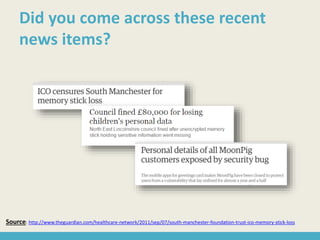
Did you come across these recent
news items?
Source: http://www.theguardian.com/healthcare-network/2011/sep/07/south-manchester-foundation-trust-ico-memory-stick-loss
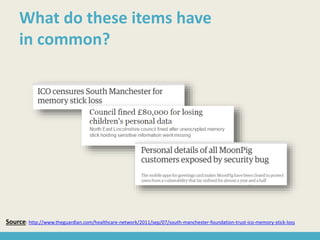
What do these items have
in common?
Source: http://www.theguardian.com/healthcare-network/2011/sep/07/south-manchester-foundation-trust-ico-memory-stick-loss
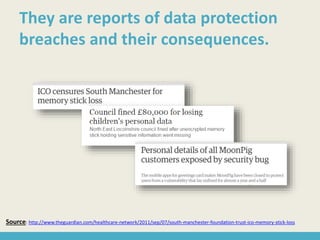
They are reports of data protection
breaches and their consequences.
What is Data Protection?
Data protection refers to the process of
ensuring that individual data is safe and
protected by 'data-controllers'.
Data controllers are those entities or
individuals who handle individual information.
Currently, each country in the European Union has its own
Data Protection Authority such as the Information
Commissioner's Office (ICO) in the United Kingdom.
However, a draft General Data Protection Regulation
(GDPR) has been passed by the European Parliament, and
this unified and simplified data protection mechanisms
across 28 member states of the European Union (EU).
The draft regulation is likely to come into
effect in 2015.
Once the GDPR has been finalized and
becomes a law, all European as well as
non-European organizations functioning
in the EU region will need to adhere to its
guidelines.
What does
this mean to organizations?
It becomes imperative for organizations to review their
data processing policies & practices and align them with
the new regulation.
What are the measures that
organizations need to take to ensure
compliance to GDPR?
Organizations need to have
transparent and well laid out processes
to handle data protection.
Good information governance should be adopted that will
enable organizations to answer questions pertaining to data
protection such as data classification scheme, ownership of
company data, data controllers within the organization.
If organizations work with Cloud Service Providers
and Data Processors, they need to review the
contracts to incorporate the new guidelines.
Companies need to be mindful of the location of
their cloud data and measures taken for
Data Backup and encryption.
Organizations need to set up systems and
procedures to secure consent before collecting
and processing personal data.
Companies need to ensure that all employees
handling individual data are trained effectively so that
they conform to the norms laid down in the EU Data
Protection regulation.
What happens in case
of non-compliance?
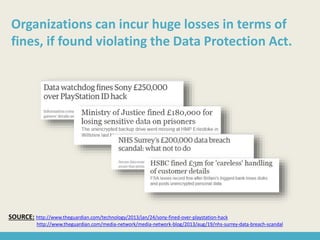
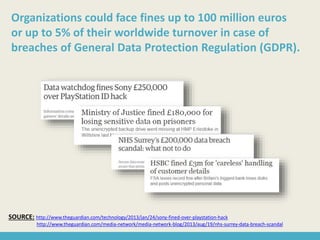
Organizations can incur huge losses in terms of
fines, if found violating the Data Protection Act.
SOURCE: http://www.theguardian.com/technology/2013/jan/24/sony-fined-over-playstation-hack
http://www.theguardian.com/media-network/media-network-blog/2013/aug/19/nhs-surrey-data-breach-scandal
Organizations could face fines up to 100 million euros
or up to 5% of their worldwide turnover in case of
breaches of General Data Protection Regulation (GDPR).
SOURCE: http://www.theguardian.com/technology/2013/jan/24/sony-fined-over-playstation-hack
http://www.theguardian.com/media-network/media-network-blog/2013/aug/19/nhs-surrey-data-breach-scandal
What are the Key Principles
of General Data Protection
Regulation (GDPR)
Processing of personal data is lawful if it is in accordance
with the law and pursues a legitimate purpose
The principle of lawful processing
Need for data processing should be visibly defined and
adhered to. Deviations require additional legal basis.
The principle of purpose specification
and limitation
Provides guidelines on how data is to be handled and include
the data relevance principle, data accuracy principle and
limited retention of data principle.
Data quality principles
Provides guidelines for transparency of processing. It also
makes it mandatory to seek consent from individuals and
provides rights to individuals to access their data.
The fair processing principle
Spells out the need to implement measures by organizations
to promote and safeguard data protection and can be
subjected to audit by supervisory authorities
The principle of accountability
It needs an elaborate study and training to ensure that
employees understand and enforce the new regulations.
How can organizations prepare their
employees for the new data protection
regulation?
Employees are often found to be the weakest
connection in the data protection process.
This is not usually because they are
unaware of the rules and their
responsibilities in the regard.
Very often employees
Do not understand the implications
of data breach.
Employees need to be motivated and educated
to reinforce the data protection process and
procedures of the organization.
This can be done through effective training that
is directed towards providing information and
creating awareness of data breach implications.
What are the different types of data security
that employees need to be aware?
Physical Security
Information pertaining to workplace security such
as the desks, rooms, hard copies of data as in file
cabinets etc.
Desktop Security
Focus on protecting computers from unauthorized
access.
Password Security
Advice and training to set up a strong password
and adopt secure practices.
Wireless Network Security
Security threats and safety mechanisms when
using unsecured wireless networks.
Phishing
Deals with safeguarding personal information from
unsafe network communications.
File Sharing
Responsibilities when handling internal data
and sharing information to external personnel,
temporary workers, etc.
What is the best method to train
employees on data protection regulation ?
What is the best method to train
employees on data protection regulation
All employees need to understand the importance
of data protection to a certain extent.
?
What is the best method to train
employees on data protection regulation
There are many methods that one can adopt to
provide data protection training.
Organizations follow one or a combination of the
following methods.
?
Face to face classroom training
It may not be viable in case the number of
employees to be trained is large but can be used
for orientation or introduction by line managers.
E-learning
E-learning is a cost-effective and useful method to
roll-out enterprise-wide data protection security
within a short duration.
Security awareness information
posted on the intranet
While having this information is useful, it cannot
function as a stand-alone method as you cannot
be sure that employees have visited the site and
understood their responsibilities correctly.
Pushing helpful hints onto
computers when they start up
This is a very helpful reinforcement strategy
to enforce best practices.
E-mailing helpful hints on a
weekly or monthly basis
This too is excellent reinforcement strategy
post training.
Using visual aids like posters,
banners and info-graphics
Can be used as reminders and checklists at strategic
locations in the organization.
How E-learning Provides Effective Data
Protection Training to Your Employees?
Provides flexibility and choice
Ensures employees complete the course at their
convenience when they are more receptive to the
knowledge.
Ensures wider reach
Organizations can train more employees within less
time as courses can be developed and hosted on
the LMS, which can be accessed by anyone.
Scenarios and Case studies can be used to make
the content relevant to on the job situation.
Assessments help to ensure
accurate understanding
Employees can evaluate and test their understanding
with formative and summative assessments.
Assessments help to ensure
accurate understanding
Employees can evaluate and test their understanding
with formative and summative assessments.
Tracking and Record keeping of
trainings administered is easy
Records of training can be made available to
regulatory authorities easily with courses deployed
via LMS.
Data Protection Training is important and
eLearning could be a viable, cost-effective
method to ensure employees are trained
smoothly and quickly.
Summ
ary
Need for Data Protection Training - How E-learning Can Help?

Need for Data Protection Training - How E-learning Can Help?

  • 1.
    Need for DataProtection Training How E-learning Can Help?
  • 2.
    Did you comeacross these recent news items? Source: http://www.theguardian.com/healthcare-network/2011/sep/07/south-manchester-foundation-trust-ico-memory-stick-loss
  • 3.
  • 4.
  • 5.
    What is DataProtection?
  • 6.
    What is DataProtection? Data protection refers to the process of ensuring that individual data is safe and protected by 'data-controllers'. Data controllers are those entities or individuals who handle individual information.
  • 7.
    Currently, each countryin the European Union has its own Data Protection Authority such as the Information Commissioner's Office (ICO) in the United Kingdom.
  • 8.
    However, a draftGeneral Data Protection Regulation (GDPR) has been passed by the European Parliament, and this unified and simplified data protection mechanisms across 28 member states of the European Union (EU).
  • 9.
    The draft regulationis likely to come into effect in 2015.
  • 10.
    Once the GDPRhas been finalized and becomes a law, all European as well as non-European organizations functioning in the EU region will need to adhere to its guidelines.
  • 11.
    What does this meanto organizations?
  • 12.
    It becomes imperativefor organizations to review their data processing policies & practices and align them with the new regulation.
  • 13.
    What are themeasures that organizations need to take to ensure compliance to GDPR?
  • 14.
    Organizations need tohave transparent and well laid out processes to handle data protection.
  • 15.
    Good information governanceshould be adopted that will enable organizations to answer questions pertaining to data protection such as data classification scheme, ownership of company data, data controllers within the organization.
  • 16.
    If organizations workwith Cloud Service Providers and Data Processors, they need to review the contracts to incorporate the new guidelines.
  • 17.
    Companies need tobe mindful of the location of their cloud data and measures taken for Data Backup and encryption.
  • 18.
    Organizations need toset up systems and procedures to secure consent before collecting and processing personal data.
  • 19.
    Companies need toensure that all employees handling individual data are trained effectively so that they conform to the norms laid down in the EU Data Protection regulation.
  • 20.
    What happens incase of non-compliance?
  • 21.
    Organizations can incurhuge losses in terms of fines, if found violating the Data Protection Act. SOURCE: http://www.theguardian.com/technology/2013/jan/24/sony-fined-over-playstation-hack http://www.theguardian.com/media-network/media-network-blog/2013/aug/19/nhs-surrey-data-breach-scandal
  • 22.
    Organizations could facefines up to 100 million euros or up to 5% of their worldwide turnover in case of breaches of General Data Protection Regulation (GDPR). SOURCE: http://www.theguardian.com/technology/2013/jan/24/sony-fined-over-playstation-hack http://www.theguardian.com/media-network/media-network-blog/2013/aug/19/nhs-surrey-data-breach-scandal
  • 23.
    What are theKey Principles of General Data Protection Regulation (GDPR)
  • 24.
    Processing of personaldata is lawful if it is in accordance with the law and pursues a legitimate purpose The principle of lawful processing
  • 25.
    Need for dataprocessing should be visibly defined and adhered to. Deviations require additional legal basis. The principle of purpose specification and limitation
  • 26.
    Provides guidelines onhow data is to be handled and include the data relevance principle, data accuracy principle and limited retention of data principle. Data quality principles
  • 27.
    Provides guidelines fortransparency of processing. It also makes it mandatory to seek consent from individuals and provides rights to individuals to access their data. The fair processing principle
  • 28.
    Spells out theneed to implement measures by organizations to promote and safeguard data protection and can be subjected to audit by supervisory authorities The principle of accountability
  • 29.
    It needs anelaborate study and training to ensure that employees understand and enforce the new regulations.
  • 30.
    How can organizationsprepare their employees for the new data protection regulation?
  • 31.
    Employees are oftenfound to be the weakest connection in the data protection process.
  • 32.
    This is notusually because they are unaware of the rules and their responsibilities in the regard.
  • 33.
    Very often employees Donot understand the implications of data breach.
  • 34.
    Employees need tobe motivated and educated to reinforce the data protection process and procedures of the organization.
  • 35.
    This can bedone through effective training that is directed towards providing information and creating awareness of data breach implications.
  • 36.
    What are thedifferent types of data security that employees need to be aware?
  • 37.
    Physical Security Information pertainingto workplace security such as the desks, rooms, hard copies of data as in file cabinets etc.
  • 38.
    Desktop Security Focus onprotecting computers from unauthorized access.
  • 39.
    Password Security Advice andtraining to set up a strong password and adopt secure practices.
  • 40.
    Wireless Network Security Securitythreats and safety mechanisms when using unsecured wireless networks.
  • 41.
    Phishing Deals with safeguardingpersonal information from unsafe network communications.
  • 42.
    File Sharing Responsibilities whenhandling internal data and sharing information to external personnel, temporary workers, etc.
  • 43.
    What is thebest method to train employees on data protection regulation ?
  • 44.
    What is thebest method to train employees on data protection regulation All employees need to understand the importance of data protection to a certain extent. ?
  • 45.
    What is thebest method to train employees on data protection regulation There are many methods that one can adopt to provide data protection training. Organizations follow one or a combination of the following methods. ?
  • 46.
    Face to faceclassroom training It may not be viable in case the number of employees to be trained is large but can be used for orientation or introduction by line managers.
  • 47.
    E-learning E-learning is acost-effective and useful method to roll-out enterprise-wide data protection security within a short duration.
  • 48.
    Security awareness information postedon the intranet While having this information is useful, it cannot function as a stand-alone method as you cannot be sure that employees have visited the site and understood their responsibilities correctly.
  • 49.
    Pushing helpful hintsonto computers when they start up This is a very helpful reinforcement strategy to enforce best practices.
  • 50.
    E-mailing helpful hintson a weekly or monthly basis This too is excellent reinforcement strategy post training.
  • 51.
    Using visual aidslike posters, banners and info-graphics Can be used as reminders and checklists at strategic locations in the organization.
  • 52.
    How E-learning ProvidesEffective Data Protection Training to Your Employees?
  • 53.
    Provides flexibility andchoice Ensures employees complete the course at their convenience when they are more receptive to the knowledge.
  • 54.
    Ensures wider reach Organizationscan train more employees within less time as courses can be developed and hosted on the LMS, which can be accessed by anyone.
  • 55.
    Scenarios and Casestudies can be used to make the content relevant to on the job situation.
  • 56.
    Assessments help toensure accurate understanding Employees can evaluate and test their understanding with formative and summative assessments.
  • 57.
    Assessments help toensure accurate understanding Employees can evaluate and test their understanding with formative and summative assessments.
  • 58.
    Tracking and Recordkeeping of trainings administered is easy Records of training can be made available to regulatory authorities easily with courses deployed via LMS.
  • 59.
    Data Protection Trainingis important and eLearning could be a viable, cost-effective method to ensure employees are trained smoothly and quickly. Summ ary