Click to edit Master title style Click to edit Master subtitle style   |  slide  Kevin Campbell-Wright Ken Scot   Kathy Boyer E-Learning Advisor (ACL) E-Learning Advisor (Technical)   E-Learning Advisor (FE & ITT) www.rsc-yh.ac.uk RSCs – Stimulating and supporting innovation in learning RSC YH E-Safety & Security The issues & the debates Chris Barber Senior E-Learning Advisor
E-Safety Today Why do we need e-safety?  The Case for being safe (Chris Barber) What’s so dangerous?  The E-Safety Issues (Kevin Campbell-Wright & Ken Scott) Am I Accountable?  OFSTED and E-Safety (Kathy Boyer) Your Thoughts .  Group Disscussion (All)
E-Safety A case for being safer The case for e-safety is simple - just as we don't send children out onto the roads without lessons in road safety, so we shouldn't send people out onto the information highways of the internet without giving them some guidance as to how to stay safe,  both personally and financially. This is a green cross code for internet and PC use. Squirrels are optional .
E-Safety A case for being safer Well, yes, it’s obvious, but it hasn’t been done consistently so far in education establishments. Becta are now pushing for e-safety to be a part of every child’s curriculum. See “Safeguarding children in a digital world” This is because information technology is becoming a large part of every learner’s learning experience, from pre-school through university to lifelong learners.
E-Safety A case for being safer Quote from “Safeguarding Children” “ With the launch in 2005 of the Government’s e-strategy, ‘ Harnessing technology: Transforming learning and children’s services ’, the prospects for children and learners of all ages to embrace the new opportunities offered by ICT are set to grow. What we must ensure, however, is that the e-safety aspects are not left to chance. Children and indeed learners of all ages need to develop digital literacy skills that help them to become safe and responsible users of new technologies, and allow them to be discriminating users of both the content they discover and the contacts they make when online.”
E-Safety A Case for being safer Becta’s main concern is with young people, although in their  literature they do say that the principles can be extended to  lifelong learners.  Given that many people of all ages are now using IT for  educational purposes, it is clear that they too need to develop  digital literacy skills so that they can become ‘safe and responsible  users’. Also many adults not in lifelong learning will be parents and need to  be aware of the issues in relation to their children’s safety.
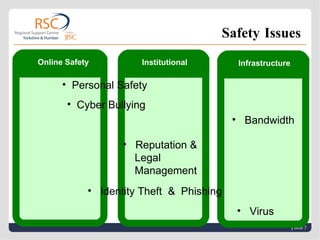
Safety Issues Personal Safety Cyber Bullying Bandwidth Reputation &  Legal  Management Identity Theft  &  Phishing Virus Online Safety Infrastructure Institutional
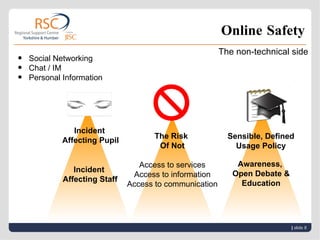
Online Safety The non-technical side Social Networking Chat / IM Personal Information Incident  Affecting Pupil Incident  Affecting Staff The Risk  Of Not Access to services Access to information Access to communication Sensible, Defined Usage Policy Awareness,  Open Debate & Education
Institutional The non technical side Reputation Management Legal Implications Financial Loss Press Scandal Lawsuit Use in “ Private Time” Lack of Governance Clear Staff / Student  Use Procedure Competition Communications Monitoring & reaction Financial Damage Legal Guidance
Infrastructure The technical bit Availability Legal & Regulatory Breach Criminal Liability Loss of Service Data Vulnerability Spammer Lists Increased  Workload Complexity Traffic Shaping Time Slots White / Black Lists Reverse Firewall Backups Desktop Monitoring
Emerging Issues The Future Students / Staff Own Devices using WiFi Students / Staff Devices using 3G USB Sticks Use of preferred web tools Peer Networks Home Use Changing face of the college Ofsted
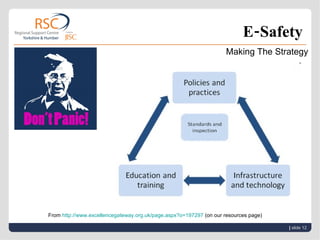
E-Safety Making The Strategy From  http://www.excellencegateway.org.uk/page.aspx?o=197297  (on our resources page)
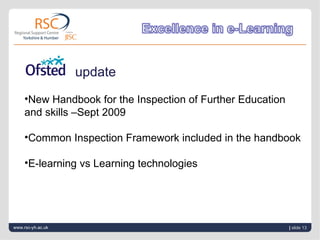
www.rsc-yh.ac.uk update New Handbook for the Inspection of Further Education and skills –Sept 2009 Common Inspection Framework included in the handbook E-learning vs Learning technologies
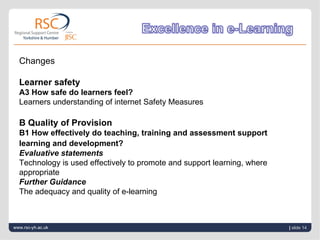
www.rsc-yh.ac.uk Changes Learner safety A3 How safe do learners feel? Learners understanding of internet Safety Measures B Quality of Provision B1 How effectively do teaching, training and assessment support learning and development? Evaluative statements Technology is used effectively to promote and support learning, where appropriate Further Guidance The adequacy and quality of e-learning
www.rsc-yh.ac.uk Grade Criteria Satisfactory Good Outstanding “… .. Appropriate use is made of technology to support and promote learning…… Get your  copy here
Click to edit Master title style Click to edit Master subtitle style   |  slide  DISSCUSSION & NOTES: http://etherpad.com/RSCYHe-safety RESOURCES & LINKS: http://delicious.com/tag/eielsafe www.rsc-yh.ac.uk RSCs – Stimulating and supporting innovation in learning RSC YH E-Safety & Security + OFSTED Update

E-Safety

  • 1.
    Click to editMaster title style Click to edit Master subtitle style | slide Kevin Campbell-Wright Ken Scot Kathy Boyer E-Learning Advisor (ACL) E-Learning Advisor (Technical) E-Learning Advisor (FE & ITT) www.rsc-yh.ac.uk RSCs – Stimulating and supporting innovation in learning RSC YH E-Safety & Security The issues & the debates Chris Barber Senior E-Learning Advisor
  • 2.
    E-Safety Today Whydo we need e-safety? The Case for being safe (Chris Barber) What’s so dangerous? The E-Safety Issues (Kevin Campbell-Wright & Ken Scott) Am I Accountable? OFSTED and E-Safety (Kathy Boyer) Your Thoughts . Group Disscussion (All)
  • 3.
    E-Safety A casefor being safer The case for e-safety is simple - just as we don't send children out onto the roads without lessons in road safety, so we shouldn't send people out onto the information highways of the internet without giving them some guidance as to how to stay safe, both personally and financially. This is a green cross code for internet and PC use. Squirrels are optional .
  • 4.
    E-Safety A casefor being safer Well, yes, it’s obvious, but it hasn’t been done consistently so far in education establishments. Becta are now pushing for e-safety to be a part of every child’s curriculum. See “Safeguarding children in a digital world” This is because information technology is becoming a large part of every learner’s learning experience, from pre-school through university to lifelong learners.
  • 5.
    E-Safety A casefor being safer Quote from “Safeguarding Children” “ With the launch in 2005 of the Government’s e-strategy, ‘ Harnessing technology: Transforming learning and children’s services ’, the prospects for children and learners of all ages to embrace the new opportunities offered by ICT are set to grow. What we must ensure, however, is that the e-safety aspects are not left to chance. Children and indeed learners of all ages need to develop digital literacy skills that help them to become safe and responsible users of new technologies, and allow them to be discriminating users of both the content they discover and the contacts they make when online.”
  • 6.
    E-Safety A Casefor being safer Becta’s main concern is with young people, although in their literature they do say that the principles can be extended to lifelong learners. Given that many people of all ages are now using IT for educational purposes, it is clear that they too need to develop digital literacy skills so that they can become ‘safe and responsible users’. Also many adults not in lifelong learning will be parents and need to be aware of the issues in relation to their children’s safety.
  • 7.
    Safety Issues PersonalSafety Cyber Bullying Bandwidth Reputation & Legal Management Identity Theft & Phishing Virus Online Safety Infrastructure Institutional
  • 8.
    Online Safety Thenon-technical side Social Networking Chat / IM Personal Information Incident Affecting Pupil Incident Affecting Staff The Risk Of Not Access to services Access to information Access to communication Sensible, Defined Usage Policy Awareness, Open Debate & Education
  • 9.
    Institutional The nontechnical side Reputation Management Legal Implications Financial Loss Press Scandal Lawsuit Use in “ Private Time” Lack of Governance Clear Staff / Student Use Procedure Competition Communications Monitoring & reaction Financial Damage Legal Guidance
  • 10.
    Infrastructure The technicalbit Availability Legal & Regulatory Breach Criminal Liability Loss of Service Data Vulnerability Spammer Lists Increased Workload Complexity Traffic Shaping Time Slots White / Black Lists Reverse Firewall Backups Desktop Monitoring
  • 11.
    Emerging Issues TheFuture Students / Staff Own Devices using WiFi Students / Staff Devices using 3G USB Sticks Use of preferred web tools Peer Networks Home Use Changing face of the college Ofsted
  • 12.
    E-Safety Making TheStrategy From http://www.excellencegateway.org.uk/page.aspx?o=197297 (on our resources page)
  • 13.
    www.rsc-yh.ac.uk update NewHandbook for the Inspection of Further Education and skills –Sept 2009 Common Inspection Framework included in the handbook E-learning vs Learning technologies
  • 14.
    www.rsc-yh.ac.uk Changes Learnersafety A3 How safe do learners feel? Learners understanding of internet Safety Measures B Quality of Provision B1 How effectively do teaching, training and assessment support learning and development? Evaluative statements Technology is used effectively to promote and support learning, where appropriate Further Guidance The adequacy and quality of e-learning
  • 15.
    www.rsc-yh.ac.uk Grade CriteriaSatisfactory Good Outstanding “… .. Appropriate use is made of technology to support and promote learning…… Get your copy here
  • 16.
    Click to editMaster title style Click to edit Master subtitle style | slide DISSCUSSION & NOTES: http://etherpad.com/RSCYHe-safety RESOURCES & LINKS: http://delicious.com/tag/eielsafe www.rsc-yh.ac.uk RSCs – Stimulating and supporting innovation in learning RSC YH E-Safety & Security + OFSTED Update

Editor's Notes