OUR INFORMATION MATTERS
How to ensure we
are working safely
with data
Content of this training
• What is meant by data protection?
• The risks of breaking data protection regulations.
• Guidance on how to identify different types of information.
• Practical tips on effective safe practices.
• Where to go for support and how to report a breach.
Outcomes of this training
• You will feel confident in your role and handling different types of
data.
• You will understand the boundaries on using data.
• You will be able to implement measures to ensure the security of the
data you hold.
• You will know where to get support around data protection.
Module 1
WE ARE LIVING
IN DATA TIMES
1
3
We are living in data times
It’s almost impossible to get up in the morning without generating some kind
of data. Whether we are working or socialising – with friends, colleagues or
family – we generate data. And that is not a bad thing.
It means we’re able to benefit from better services, an improved user
experience and more suitable support, based on who we are and what we
need. However, we have a right to understand how our data is being used,
take an active role in giving consent for our information to be collected and
guarantee that anything gathered will be treated with respect and discretion.
Within the UK, rights over data protection were enforced by the Data
Protection Act 1998. But the world has changed since 1998, when the
legislation came into force. This was a world where we couldn’t book cheap
holidays by using a search engine or connect with forgotten school
friends via social media. So, we need a modern law for a modern era.
General Data Protection Regulation (GDPR)
What changes with GDPR?
Essentially, GDPR increases the standards organisations are held to when
collecting data. The legislation increases standards for how we confirm people’s
consent for us to collect their data, and how we make sure people understand
what we do with their information.
Will this EU regulation still be relevant post Brexit?
The GDPR has been enshrined in UK law through the Data Protection Act 2018.
This means it is not dependent on the UK’s membership of the EU and will
therefore still be relevant following the UK’s departure from the EU.
On 25 May 2018 new, stronger, data protection laws came into force across the
European Union (EU). These new laws affect any organisation operating within
the EU, or holding information on citizens of the EU.
What type of information is relevant?
When considering data protection, our main concern is information which
specifically identifies an individual. As soon as you start being aware of
gathering or receiving data that might identify an individual - digitally, over the
phone, or in person – you need to start considering your legal responsibilities.
Who is responsible?
Ultimately, Parkinson’s UK is responsible. However, as part of Parkinson’s UK,
we all have a role to play. We all need to act in line with Parkinson’s UK policies,
training and procedures to make sure we act fairly and legally.
When there is ‘demonstrable malice’ when using or handling data, i.e. when
someone deliberately does something against data protection law, the person
who committed the crime will be held personally responsible.
However, even in these situations, we still have important responsibilities under
the law. These are explained later in this training.
What are the consequences of not complying?
Within the UK, data protection is enforced by the Information Commissioner’s
Office (ICO), who support and monitor organisations to make sure they are
complying with legislation. If they decide that an organisation is not following the
law, then they can issue fines into the millions of pounds, and impose measures
to make sure improvements are made.
Any financial penalty would mean we have less money available to achieve our
mission – funding research and support for those affected by Parkinson’s.
Reputational damage to our fundraising and wider public trust could also be a
potentially serious issue.
We are committed to ensuring our practice and processes are the best they can
be, and that we all take our responsibilities seriously.
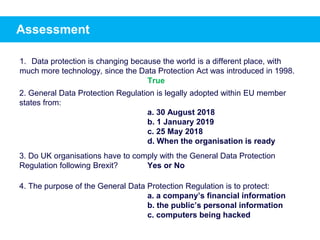
Assessment
1. Data protection is changing because the world is a different place, with
much more technology, since the Data Protection Act was introduced in 1998.
True or False
2. General Data Protection Regulation is legally adopted within EU member
states from:
a. 30 August 2018
b. 1 January 2019
c. 25 May 2018
d. When the organisation is ready
3. Do UK organisations have to comply with the General Data Protection
Regulation following Brexit? Yes or No
4. The purpose of the General Data Protection Regulation is to protect:
a. a company’s financial information
b. the public’s personal information
c. computers being hacked
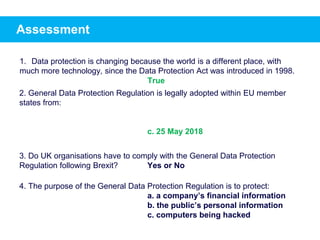
Assessment
1. Data protection is changing because the world is a different place, with
much more technology, since the Data Protection Act was introduced in 1998.
2. General Data Protection Regulation is legally adopted within EU member
states from:
a. 30 August 2018
b. 1 January 2019
c. 25 May 2018
d. When the organisation is ready
3. Do UK organisations have to comply with the General Data Protection
Regulation following Brexit? Yes or No
4. The purpose of the General Data Protection Regulation is to protect:
a. a company’s financial information
b. the public’s personal information
c. computers being hacked
True
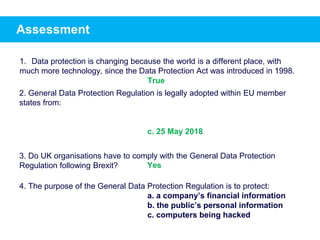
Assessment
1. Data protection is changing because the world is a different place, with
much more technology, since the Data Protection Act was introduced in 1998.
2. General Data Protection Regulation is legally adopted within EU member
states from:
c. 25 May 2018
3. Do UK organisations have to comply with the General Data Protection
Regulation following Brexit? Yes or No
4. The purpose of the General Data Protection Regulation is to protect:
a. a company’s financial information
b. the public’s personal information
c. computers being hacked
True
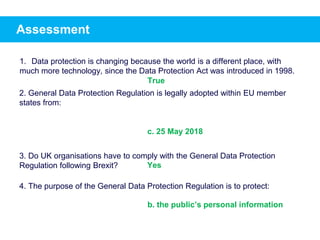
Assessment
1. Data protection is changing because the world is a different place, with
much more technology, since the Data Protection Act was introduced in 1998.
2. General Data Protection Regulation is legally adopted within EU member
states from:
c. 25 May 2018
3. Do UK organisations have to comply with the General Data Protection
Regulation following Brexit?
4. The purpose of the General Data Protection Regulation is to protect:
a. a company’s financial information
b. the public’s personal information
c. computers being hacked
True
Yes
Assessment
1. Data protection is changing because the world is a different place, with
much more technology, since the Data Protection Act was introduced in 1998.
2. General Data Protection Regulation is legally adopted within EU member
states from:
c. 25 May 2018
3. Do UK organisations have to comply with the General Data Protection
Regulation following Brexit?
4. The purpose of the General Data Protection Regulation is to protect:
True
Yes
b. the public’s personal information
Assessment
5. The General Data Protection Regulation:
a. is the law setting out how data must be handled
b. is a set of guidelines suggesting how data should be handled
c. doesn’t apply to charities
6. General Data Protection Regulation only applies to data held on computers.
True or False
Assessment
5. The General Data Protection Regulation:
a. is the law setting out how data must be handled
6. General Data Protection Regulation only applies to data held on computers.
True or False
Assessment
5. The General Data Protection Regulation:
a. is the law setting out how data must be handled
6. General Data Protection Regulation only applies to data held on computers.
False
Assessment
5. The General Data Protection Regulation:
a. is the law setting out how data must be handled
6. General Data Protection Regulation only applies to data held on computers.
False
You have completed module one of your training.
Module 2
TYPES OF DATA
AND HOW TO
RECOGNISE
THEM
2
17
Types of information
Under the GDPR there are certain types of information which are considered
particularly sensitive, that need to be considered in a slightly different way.
This doesn’t mean other personal information isn’t important, but we need to
be especially mindful when collecting, managing and storing sensitive
information.
Personal information
Personal information is information which might help identify a specific person,
especially when used in conjunction with other bits of personal information you
hold.
Sensitive personal information
Sensitive personal information is information which might help someone form
a biased opinion or be used to discriminate against somebody.
Types of information
When working with different types of information we need to consider what can
be interpreted or inferred when we combine them.
For example, the names John or Jane Smith might not be all that sensitive in
isolation, after all there are many people in the world with that name.
However, if you receive a newsletter from your Parkinson’s UK local group and
you can see John or Jane Smith’s email address copied in you can begin to
make some assumptions, including where they might live, that they have a
close connection to Parkinson’s and you now have their email address to
contact them.
We can quickly begin to build a picture of people based on any information we
receive about them.
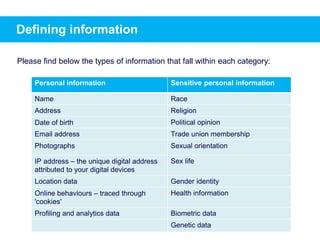
Personal information Sensitive personal information
Name Race
Address Religion
Date of birth Political opinion
Email address Trade union membership
Photographs Sexual orientation
IP address – the unique digital address
attributed to your digital devices
Sex life
Location data Gender identity
Online behaviours – traced through
'cookies'
Health information
Profiling and analytics data Biometric data
Genetic data
Defining information
Please find below the types of information that fall within each category:
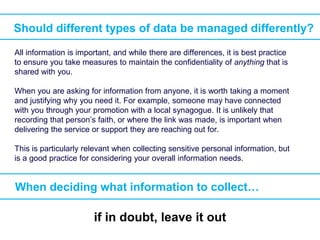
Should different types of data be managed differently?
When deciding what information to collect…
All information is important, and while there are differences, it is best practice
to ensure you take measures to maintain the confidentiality of anything that is
shared with you.
When you are asking for information from anyone, it is worth taking a moment
and justifying why you need it. For example, someone may have connected
with you through your promotion with a local synagogue. It is unlikely that
recording that person’s faith, or where the link was made, is important when
delivering the service or support they are reaching out for.
This is particularly relevant when collecting sensitive personal information, but
is a good practice for considering your overall information needs.
if in doubt, leave it out
Defining data – an activity
Now, it’s time to put some of that theory into practice. On the next screen
we’ve given you a passage of text containing both personal information
and the sensitive personal information. Once you have read it, we’re
going to ask you to pick out which is which.
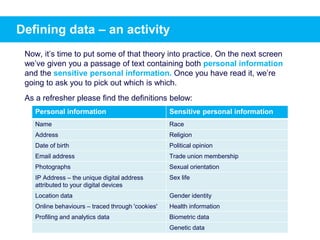
As a refresher please find the definitions below:
Personal information Sensitive personal information
Name Race
Address Religion
Date of birth Political opinion
Email address Trade union membership
Photographs Sexual orientation
IP Address – the unique digital address
attributed to your digital devices
Sex life
Location data Gender identity
Online behaviours – traced through 'cookies' Health information
Profiling and analytics data Biometric data
Genetic data
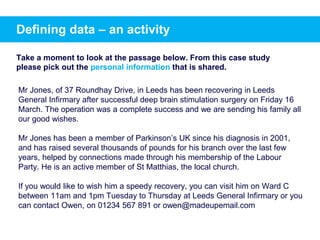
Mr Jones, of 37 Roundhay Drive, in Leeds has been recovering in Leeds
General Infirmary after successful deep brain stimulation surgery on Friday 16
March. The operation was a complete success and we are sending his family all
our good wishes.
Mr Jones has been a member of Parkinson’s UK since his diagnosis in 2001,
and has raised several thousands of pounds for his branch over the last few
years, helped by connections made through his membership of the Labour
Party. He is an active member of St Matthias, the local church.
If you would like to wish him a speedy recovery, you can visit him on Ward C
between 11am and 1pm Tuesday to Thursday at Leeds General Infirmary or you
can contact Owen, on 01234 567 891 or owen@madeupemail.com
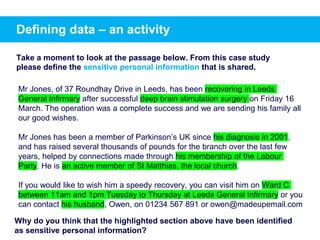
Take a moment to look at the passage below. From this case study
please pick out the personal information that is shared.
Defining data – an activity
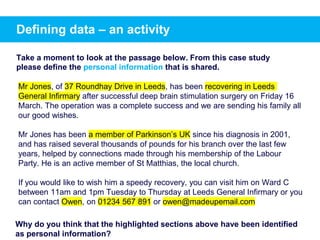
Mr Jones, of 37 Roundhay Drive in Leeds, has been recovering in Leeds
General Infirmary after successful deep brain stimulation surgery on Friday 16
March. The operation was a complete success and we are sending his family all
our good wishes.
Mr Jones has been a member of Parkinson’s UK since his diagnosis in 2001,
and has raised several thousands of pounds for his branch over the last few
years, helped by connections made through his membership of the Labour
Party. He is an active member of St Matthias, the local church.
If you would like to wish him a speedy recovery, you can visit him on Ward C
between 11am and 1pm Tuesday to Thursday at Leeds General Infirmary or you
can contact Owen, on 01234 567 891 or owen@madeupemail.com
Why do you think that the highlighted sections above have been identified
as personal information?
Take a moment to look at the passage below. From this case study
please define the personal information that is shared.
Defining data – an activity
Why is this considered personal information?
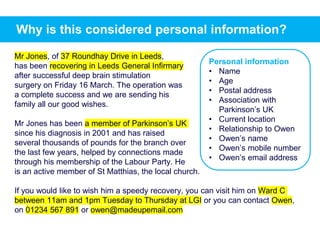
Mr Jones, of 37 Roundhay Drive in Leeds,
has been recovering in Leeds General Infirmary
after successful deep brain stimulation
surgery on Friday 16 March. The operation was
a complete success and we are sending his
family all our good wishes.
Mr Jones has been a member of Parkinson’s UK
since his diagnosis in 2001 and has raised
several thousands of pounds for the branch over
the last few years, helped by connections made
through his membership of the Labour Party. He
is an active member of St Matthias, the local church.
If you would like to wish him a speedy recovery, you can visit him on Ward C
between 11am and 1pm Tuesday to Thursday at LGI or you can contact Owen,
on 01234 567 891 or owen@madeupemail.com
Personal information
• Name
• Age
• Postal address
• Association with
Parkinson’s UK
• Current location
• Relationship to Owen
• Owen’s name
• Owen’s mobile number
• Owen’s email address
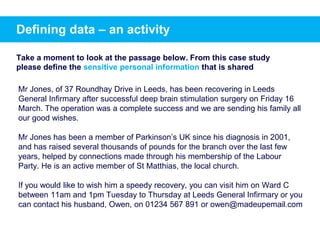
Mr Jones, of 37 Roundhay Drive in Leeds, has been recovering in Leeds
General Infirmary after successful deep brain stimulation surgery on Friday 16
March. The operation was a complete success and we are sending his family all
our good wishes.
Mr Jones has been a member of Parkinson’s UK since his diagnosis in 2001,
and has raised several thousands of pounds for the branch over the last few
years, helped by connections made through his membership of the Labour
Party. He is an active member of St Matthias, the local church.
If you would like to wish him a speedy recovery, you can visit him on Ward C
between 11am and 1pm Tuesday to Thursday at Leeds General Infirmary or you
can contact his husband, Owen, on 01234 567 891 or owen@madeupemail.com
Take a moment to look at the passage below. From this case study
please define the sensitive personal information that is shared
Defining data – an activity
Mr Jones, of 37 Roundhay Drive in Leeds, has been recovering in Leeds
General Infirmary after successful deep brain stimulation surgery on Friday 16
March. The operation was a complete success and we are sending his family all
our good wishes.
Mr Jones has been a member of Parkinson’s UK since his diagnosis in 2001,
and has raised several thousands of pounds for the branch over the last few
years, helped by connections made through his membership of the Labour
Party. He is an active member of St Matthias, the local church.
If you would like to wish him a speedy recovery, you can visit him on Ward C
between 11am and 1pm Tuesday to Thursday at Leeds General Infirmary or you
can contact his husband, Owen, on 01234 567 891 or owen@madeupemail.com
Why do you think that the highlighted section above have been identified
as sensitive personal information?
Take a moment to look at the passage below. From this case study
please define the sensitive personal information that is shared.
Defining data – an activity
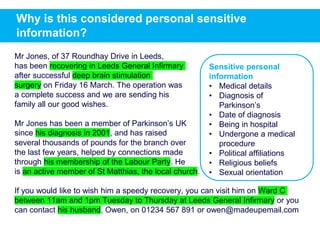
Why is this considered personal sensitive
information?
Mr Jones, of 37 Roundhay Drive in Leeds,
has been recovering in Leeds General Infirmary
after successful deep brain stimulation
surgery on Friday 16 March. The operation was
a complete success and we are sending his
family all our good wishes.
Mr Jones has been a member of Parkinson’s UK
since his diagnosis in 2001, and has raised
several thousands of pounds for the branch over
the last few years, helped by connections made
through his membership of the Labour Party. He
is an active member of St Matthias, the local church.
If you would like to wish him a speedy recovery, you can visit him on Ward C
between 11am and 1pm Tuesday to Thursday at Leeds General Infirmary or you
can contact his husband, Owen, on 01234 567 891 or owen@madeupemail.com
Sensitive personal
information
• Medical details
• Diagnosis of
Parkinson’s
• Date of diagnosis
• Being in hospital
• Undergone a medical
procedure
• Political affiliations
• Religious beliefs
• Sexual orientation
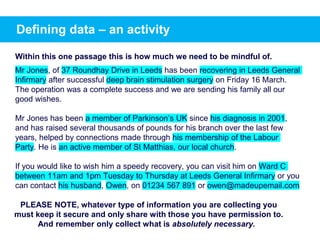
Mr Jones, of 37 Roundhay Drive in Leeds has been recovering in Leeds General
Infirmary after successful deep brain stimulation surgery on Friday 16 March.
The operation was a complete success and we are sending his family all our
good wishes.
Mr Jones has been a member of Parkinson’s UK since his diagnosis in 2001,
and has raised several thousands of pounds for his branch over the last few
years, helped by connections made through his membership of the Labour
Party. He is an active member of St Matthias, our local church.
If you would like to wish him a speedy recovery, you can visit him on Ward C
between 11am and 1pm Tuesday to Thursday at Leeds General Infirmary or you
can contact his husband, Owen, on 01234 567 891 or owen@madeupemail.com
Within this one passage this is how much we need to be mindful of.
PLEASE NOTE, whatever type of information you are collecting you
must keep it secure and only share with those you have permission to.
And remember only collect what is absolutely necessary.
Defining data – an activity
Defining data – reflections on impact
Just take some time to consider what you now know about Mr Jones. You have
been put in a position of trust with his information.
What could be the consequences of this information being shared
• for Mr Jones?
• for Mr Jones’ friends and family?
• for you?
• for Parkinson’s UK?
Ultimately ask yourself “if this was your information how might I
feel if it wasn’t handled appropriately?”
You have completed the second
module of your training.
Module 3
HOW TO HANDLE
DATA SAFELY
3
31
Storing and working with data safely
Before you work with any data it is important that you take a moment to ask
yourself: can I manage this information securely?
The second you receive information, whether digitally or on paper, you need to
be able to store it securely.
Your relationship with data needs to start before you receive anything. Taking
time early on to think about how you will process data will make your
relationship with it much easier, and your processes much more secure.
Or put it another way…
Would you be happy sharing your personal information with somebody who
wasn’t prepared to store it safely?
Privacy Notice
Like all organisations Parkinson’s UK has a Privacy Notice, which outlines how
we use personal data, keeps people informed about the data we hold, and
provides assurances that we work with data in a legal and ethical way.
You may get asked about our Privacy Notice and where people can see it.
All we ask is that you simply signpost enquirers to one of the following:
• www.parkinsons.org.uk/privacy
• DataProtection@parkinsons.org.uk
Whenever you collect data of any type from any individual, please make sure
you are signposting towards the Privacy Notice by quoting the weblink provided
above, for example on any form you ask someone to fill out.
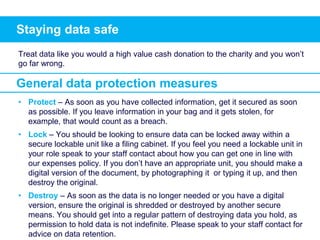
Staying data safe
Treat data like you would a high value cash donation to the charity and you won’t
go far wrong.
• Protect – As soon as you have collected information, get it secured as soon
as possible. If you leave information in your bag and it gets stolen, for
example, that would count as a breach.
• Lock – You should be looking to ensure data can be locked away within a
secure lockable unit like a filing cabinet. If you feel you need a lockable unit in
your role speak to your staff contact about how you can get one in line with
our expenses policy. If you don’t have an appropriate unit, you should make a
digital version of the document, by photographing it or typing it up, and then
destroy the original.
• Destroy – As soon as the data is no longer needed or you have a digital
version, ensure the original is shredded or destroyed by another secure
means. You should get into a regular pattern of destroying data you hold, as
permission to hold data is not indefinite. Please speak to your staff contact for
advice on data retention.
General data protection measures
Staying data safe
• Passwords A simple step to secure the data you hold is to set passwords on
your computers, documents and other devices (tablets and mobile phones, for
example). You should set up a separate account on your computer for your
volunteering role with a confidential password to ensure you have complete
control over the information you hold.
• Memory sticks Memory sticks While it can be convenient to transfer, store
and collect data on a memory stick, they pose a big risk as they are so easy to
lose or steal. If you can avoid using memory sticks then it is best to do so,
however if it is unavoidable then do remember to password protect any
documents it contains and avoid carrying it around everywhere with you. If you
want to use any online data sharing tools or sites, for example DropBox then
speak to the Data Protection Officer (DPO) first to ensure we have appropriate
reassurances over the transfer of data to such facilities. You can contact the
Data Protection Officer by emailing dataprotection@parkinsons.org.uk or call
020 7963 9388.
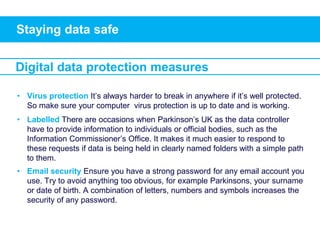
Digital data protection measures
Staying data safe
• Virus protection It’s always harder to break in anywhere if it’s well protected.
So make sure your computer virus protection is up to date and is working.
• Labelled There are occasions when Parkinson’s UK as the data controller
have to provide information to individuals or official bodies, such as the
Information Commissioner’s Office. It makes it much easier to respond to
these requests if data is being held in clearly named folders with a simple path
to them.
• Email security Ensure you have a strong password for any email account you
use. Try to avoid anything too obvious, for example Parkinsons, your surname
or date of birth. A combination of letters, numbers and symbols increases the
security of any password.
Digital data protection measures
Staying data safe
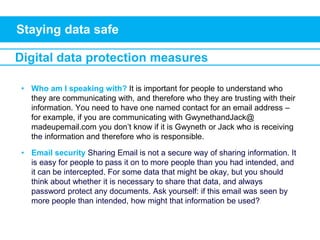
Digital data protection measures
• Who am I speaking with? It is important for people to understand who
they are communicating with, and therefore who they are trusting with their
information. You need to have one named contact for an email address –
for example, if you are communicating with GwynethandJack@
madeupemail.com you don’t know if it is Gwyneth or Jack who is receiving
the information and therefore who is responsible.
• Email security Sharing Email is not a secure way of sharing information. It
is easy for people to pass it on to more people than you had intended, and
it can be intercepted. For some data that might be okay, but you should
think about whether it is necessary to share that data, and always
password protect any documents. Ask yourself: if this email was seen by
more people than intended, how might that information be used?
Staying data safe
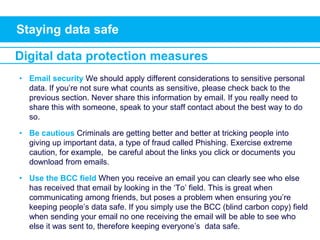
• Email security We should apply different considerations to sensitive personal
data. If you’re not sure what counts as sensitive, please check back to the
previous section. Never share this information by email. If you really need to
share this with someone, speak to your staff contact about the best way to do
so.
• Be cautious Criminals are getting better and better at tricking people into
giving up important data, a type of fraud called Phishing. Exercise extreme
caution, for example, be careful about the links you click or documents you
download from emails.
• Use the BCC field When you receive an email you can clearly see who else
has received that email by looking in the ‘To’ field. This is great when
communicating among friends, but poses a problem when ensuring you’re
keeping people’s data safe. If you simply use the BCC (blind carbon copy) field
when sending your email no one receiving the email will be able to see who
else it was sent to, therefore keeping everyone’s data safe.
Digital data protection measures
Staying data safe
• Collecting data about under 18 year olds The GDPR does not represent
a fundamental change to many of the rights that children have over their
personal data. When we refer to a child we mean anyone under the age of
18. Children have the same rights as adults over their personal data so if
you receive a subject access request for example then please notify the
DPO. If you are processing any children’s personal data, please notify the
DPO and a Privacy Impact Assessment will be undertaken.
We have a growing range of ‘How to…’ guides to support you with
the things raised in this section. You can download our guides from
parkinsons.org.uk/dataprotectionresources or speak to your staff
contact.
Gaining consent
Under data protection regulations, it is vital that anyone sharing their data
understands for what purpose they are giving their information and how it will be
handled.
Gaining this permission is known as consent and is a cornerstone of data
protection regulations.
This means that individuals are informed about how their information is handled.
Consent also gives a clear indication of whether people wish to be
communicated with, and also what they want to know about, for example
fundraising, marketing or opportunities to hear about the work of the charity.
How you use the data is directly linked to the permission, or consent, that you
got when you originally collected it.
Data should not be shared outside of Parkinson’s UK. If you are asked to do this,
speak to your staff contact for guidance before sending or sharing any
information.
How we use information
Sharing of information beyond the permission you’ve been given is not always a
deliberate act. Sometimes we reveal things accidentally or by not taking appropriate
measures, for example losing a sign-in sheet or leaving a laptop on a bus.
We might also be trying to do the best by someone, for example connecting them to a
local service or support. However, even making these connections needs explicit
documented consent. Instead of you making the connection, you should encourage
that person to approach the organisation directly, and allow them to share information
with them if they want to.
However we use data, if it’s outside the consent we have gained from that individual
then it is considered a breach and will need to be investigated.
Individuals have the right to withdraw their consent from you contacting them at any
time and without needing to give a reason, for example this can be unsubscribing
from an email newsletter. If someone asks for you not to contact them anymore, then
you have to immediately remove their details from your distribution lists to stop any
further contact being made. You also need to let the Data Protection Officer know so
that other teams or areas of the charity are aware of that individual’s wishes. You can
get in touch at dataprotection@parkinsons.org.uk.
Breach
A data breach is when data that we have been entrusted with gets lost, destroyed,
or seen by an unauthorised third party. This can be accidental, for example leaving
information on a train or accidentally shredding the wrong piece of paper. It can
also be malicious, for example if information was stolen. We have a responsibility
to report this to the Information Commissioner’s Office (ICO) within 72 hours. You
can therefore see how crucial it is that you report the breach to the Parkinson’s UK
Data Protection team immediately, so we can make decisions and compile a full
briefing within the legal timeframe.
The DPO will consider the likelihood and severity of any risk to people’s rights and
freedoms, following the breach. When this assessment has been made, if it’s likely
there will be a risk then the DPO must notify the ICO; if it’s unlikely then the DPO
doesn’t have to report it. We do not need to report every incident to the ICO but
every incident does need to be reported to us.
Following any referral an investigation will take place, led by the Parkinson’s UK
Data Protection Officer. This will look to understand the scale of the issue, any
actions that may need to be taken, and to inform those who might be affected.
Breach
In brief, when reporting a breach:
Be quick
Be open
Be vigilant
If you are ever aware of, or concerned
about, a data breach
please email dataprotection@parkinsons.org.uk
or call 020 7963 9388 immediately.
The priority is to raise the alarm!
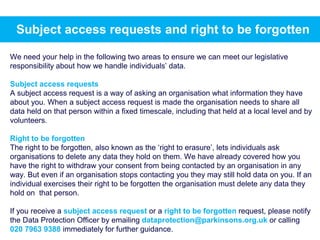
We need your help in the following two areas to ensure we can meet our legislative
responsibility about how we handle individuals’ data.
Subject access requests
A subject access request is a way of asking an organisation what information they have
about you. When a subject access request is made the organisation needs to share all
data held on that person within a fixed timescale, including that held at a local level and by
volunteers.
Right to be forgotten
The right to be forgotten, also known as the ‘right to erasure’, lets individuals ask
organisations to delete any data they hold on them. We have already covered how you
have the right to withdraw your consent from being contacted by an organisation in any
way. But even if an organisation stops contacting you they may still hold data on you. If an
individual exercises their right to be forgotten the organisation must delete any data they
hold on that person.
If you receive a subject access request or a right to be forgotten request, please notify
the Data Protection Officer by emailing dataprotection@parkinsons.org.uk or calling
020 7963 9388 immediately for further guidance.
Subject access requests and right to be forgotten
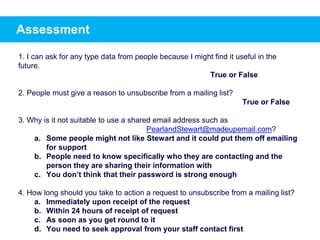
Assessment
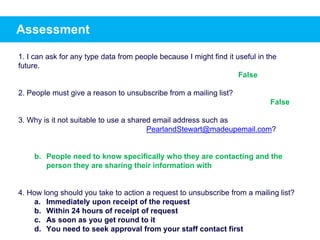
1. I can ask for any type data from people because I might find it useful in the
future.
True or False
2. People must give a reason to unsubscribe from a mailing list?
True or False
3. Why is it not suitable to use a shared email address such as
PearlandStewart@madeupemail.com?
a. Some people might not like Stewart and it could put them off emailing
for support
b. People need to know specifically who they are contacting and the
person they are sharing their information with
c. You don’t think that their password is strong enough
4. How long should you take to action a request to unsubscribe from a mailing list?
a. Immediately upon receipt of the request
b. Within 24 hours of receipt of request
c. As soon as you get round to it
d. You need to seek approval from your staff contact first
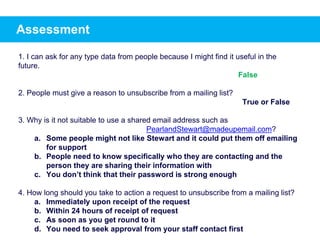
Assessment
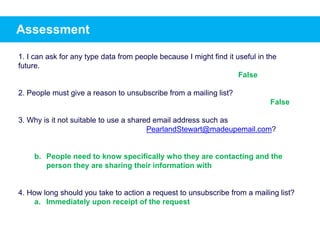
1. I can ask for any type data from people because I might find it useful in the
future.
2. People must give a reason to unsubscribe from a mailing list?
True or False
3. Why is it not suitable to use a shared email address such as
PearlandStewart@madeupemail.com?
a. Some people might not like Stewart and it could put them off emailing
for support
b. People need to know specifically who they are contacting and the
person they are sharing their information with
c. You don’t think that their password is strong enough
4. How long should you take to action a request to unsubscribe from a mailing list?
a. Immediately upon receipt of the request
b. Within 24 hours of receipt of request
c. As soon as you get round to it
d. You need to seek approval from your staff contact first
False
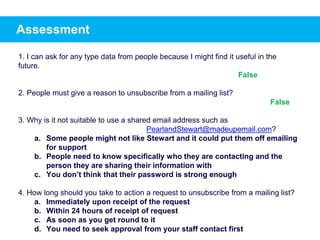
Assessment
1. I can ask for any type data from people because I might find it useful in the
future.
2. People must give a reason to unsubscribe from a mailing list?
3. Why is it not suitable to use a shared email address such as
PearlandStewart@madeupemail.com?
a. Some people might not like Stewart and it could put them off emailing
for support
b. People need to know specifically who they are contacting and the
person they are sharing their information with
c. You don’t think that their password is strong enough
4. How long should you take to action a request to unsubscribe from a mailing list?
a. Immediately upon receipt of the request
b. Within 24 hours of receipt of request
c. As soon as you get round to it
d. You need to seek approval from your staff contact first
False
False
Assessment
1. I can ask for any type data from people because I might find it useful in the
future.
2. People must give a reason to unsubscribe from a mailing list?
3. Why is it not suitable to use a shared email address such as
PearlandStewart@madeupemail.com?
b. People need to know specifically who they are contacting and the
person they are sharing their information with
4. How long should you take to action a request to unsubscribe from a mailing list?
a. Immediately upon receipt of the request
b. Within 24 hours of receipt of request
c. As soon as you get round to it
d. You need to seek approval from your staff contact first
False
False
Assessment
1. I can ask for any type data from people because I might find it useful in the
future.
2. People must give a reason to unsubscribe from a mailing list?
3. Why is it not suitable to use a shared email address such as
PearlandStewart@madeupemail.com?
b. People need to know specifically who they are contacting and the
person they are sharing their information with
4. How long should you take to action a request to unsubscribe from a mailing list?
a. Immediately upon receipt of the request
False
False
Assessment
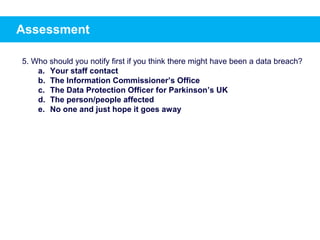
5. Who should you notify first if you think there might have been a data breach?
a. Your staff contact
b. The Information Commissioner’s Office
c. The Data Protection Officer for Parkinson’s UK
d. The person/people affected
e. No one and just hope it goes away
Assessment
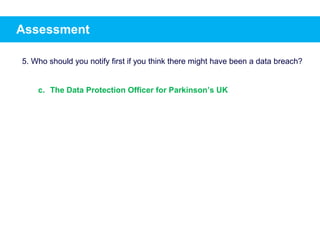
5. Who should you notify first if you think there might have been a data breach?
c. The Data Protection Officer for Parkinson’s UK
Assessment
5. Who should you notify first if you think there might have been a data breach?
c. The Data Protection Officer for Parkinson’s UK
Congratulations
You have almost completed your Data Protection training.
Please click through for the final few pointers
and one last important action.
Support and guidance
This training has been designed to support you in your crucial role helping
those affected by Parkinson’s, but our support doesn’t end there…
We are here for you and we will continue to roll out further resources, support and
tools so you can spend more of your time doing what you do best - changing the
lives of people affected by Parkinson’s.
If you have any questions about data protection or want further support to
implement some of what you have learnt in this booklet speak to your staff
contact.
If you have any concerns relating to data protection please email:
dataprotection@parkinsons.org.uk or call 020 7963 9388.
ACTION:
Please tell your Parkinson’s UK staff contact
you have completed your data protection training.
THANK YOU
Contact:
dataprotection@parkinsons.org.uk

Advanced Data Protection training for volunteers

  • 1.
    OUR INFORMATION MATTERS Howto ensure we are working safely with data
  • 2.
    Content of thistraining • What is meant by data protection? • The risks of breaking data protection regulations. • Guidance on how to identify different types of information. • Practical tips on effective safe practices. • Where to go for support and how to report a breach. Outcomes of this training • You will feel confident in your role and handling different types of data. • You will understand the boundaries on using data. • You will be able to implement measures to ensure the security of the data you hold. • You will know where to get support around data protection.
  • 3.
    Module 1 WE ARELIVING IN DATA TIMES 1 3
  • 4.
    We are livingin data times It’s almost impossible to get up in the morning without generating some kind of data. Whether we are working or socialising – with friends, colleagues or family – we generate data. And that is not a bad thing. It means we’re able to benefit from better services, an improved user experience and more suitable support, based on who we are and what we need. However, we have a right to understand how our data is being used, take an active role in giving consent for our information to be collected and guarantee that anything gathered will be treated with respect and discretion. Within the UK, rights over data protection were enforced by the Data Protection Act 1998. But the world has changed since 1998, when the legislation came into force. This was a world where we couldn’t book cheap holidays by using a search engine or connect with forgotten school friends via social media. So, we need a modern law for a modern era.
  • 5.
    General Data ProtectionRegulation (GDPR) What changes with GDPR? Essentially, GDPR increases the standards organisations are held to when collecting data. The legislation increases standards for how we confirm people’s consent for us to collect their data, and how we make sure people understand what we do with their information. Will this EU regulation still be relevant post Brexit? The GDPR has been enshrined in UK law through the Data Protection Act 2018. This means it is not dependent on the UK’s membership of the EU and will therefore still be relevant following the UK’s departure from the EU. On 25 May 2018 new, stronger, data protection laws came into force across the European Union (EU). These new laws affect any organisation operating within the EU, or holding information on citizens of the EU.
  • 6.
    What type ofinformation is relevant? When considering data protection, our main concern is information which specifically identifies an individual. As soon as you start being aware of gathering or receiving data that might identify an individual - digitally, over the phone, or in person – you need to start considering your legal responsibilities. Who is responsible? Ultimately, Parkinson’s UK is responsible. However, as part of Parkinson’s UK, we all have a role to play. We all need to act in line with Parkinson’s UK policies, training and procedures to make sure we act fairly and legally. When there is ‘demonstrable malice’ when using or handling data, i.e. when someone deliberately does something against data protection law, the person who committed the crime will be held personally responsible. However, even in these situations, we still have important responsibilities under the law. These are explained later in this training.
  • 7.
    What are theconsequences of not complying? Within the UK, data protection is enforced by the Information Commissioner’s Office (ICO), who support and monitor organisations to make sure they are complying with legislation. If they decide that an organisation is not following the law, then they can issue fines into the millions of pounds, and impose measures to make sure improvements are made. Any financial penalty would mean we have less money available to achieve our mission – funding research and support for those affected by Parkinson’s. Reputational damage to our fundraising and wider public trust could also be a potentially serious issue. We are committed to ensuring our practice and processes are the best they can be, and that we all take our responsibilities seriously.
  • 8.
    Assessment 1. Data protectionis changing because the world is a different place, with much more technology, since the Data Protection Act was introduced in 1998. True or False 2. General Data Protection Regulation is legally adopted within EU member states from: a. 30 August 2018 b. 1 January 2019 c. 25 May 2018 d. When the organisation is ready 3. Do UK organisations have to comply with the General Data Protection Regulation following Brexit? Yes or No 4. The purpose of the General Data Protection Regulation is to protect: a. a company’s financial information b. the public’s personal information c. computers being hacked
  • 9.
    Assessment 1. Data protectionis changing because the world is a different place, with much more technology, since the Data Protection Act was introduced in 1998. 2. General Data Protection Regulation is legally adopted within EU member states from: a. 30 August 2018 b. 1 January 2019 c. 25 May 2018 d. When the organisation is ready 3. Do UK organisations have to comply with the General Data Protection Regulation following Brexit? Yes or No 4. The purpose of the General Data Protection Regulation is to protect: a. a company’s financial information b. the public’s personal information c. computers being hacked True
  • 10.
    Assessment 1. Data protectionis changing because the world is a different place, with much more technology, since the Data Protection Act was introduced in 1998. 2. General Data Protection Regulation is legally adopted within EU member states from: c. 25 May 2018 3. Do UK organisations have to comply with the General Data Protection Regulation following Brexit? Yes or No 4. The purpose of the General Data Protection Regulation is to protect: a. a company’s financial information b. the public’s personal information c. computers being hacked True
  • 11.
    Assessment 1. Data protectionis changing because the world is a different place, with much more technology, since the Data Protection Act was introduced in 1998. 2. General Data Protection Regulation is legally adopted within EU member states from: c. 25 May 2018 3. Do UK organisations have to comply with the General Data Protection Regulation following Brexit? 4. The purpose of the General Data Protection Regulation is to protect: a. a company’s financial information b. the public’s personal information c. computers being hacked True Yes
  • 12.
    Assessment 1. Data protectionis changing because the world is a different place, with much more technology, since the Data Protection Act was introduced in 1998. 2. General Data Protection Regulation is legally adopted within EU member states from: c. 25 May 2018 3. Do UK organisations have to comply with the General Data Protection Regulation following Brexit? 4. The purpose of the General Data Protection Regulation is to protect: True Yes b. the public’s personal information
  • 13.
    Assessment 5. The GeneralData Protection Regulation: a. is the law setting out how data must be handled b. is a set of guidelines suggesting how data should be handled c. doesn’t apply to charities 6. General Data Protection Regulation only applies to data held on computers. True or False
  • 14.
    Assessment 5. The GeneralData Protection Regulation: a. is the law setting out how data must be handled 6. General Data Protection Regulation only applies to data held on computers. True or False
  • 15.
    Assessment 5. The GeneralData Protection Regulation: a. is the law setting out how data must be handled 6. General Data Protection Regulation only applies to data held on computers. False
  • 16.
    Assessment 5. The GeneralData Protection Regulation: a. is the law setting out how data must be handled 6. General Data Protection Regulation only applies to data held on computers. False You have completed module one of your training.
  • 17.
    Module 2 TYPES OFDATA AND HOW TO RECOGNISE THEM 2 17
  • 18.
    Types of information Underthe GDPR there are certain types of information which are considered particularly sensitive, that need to be considered in a slightly different way. This doesn’t mean other personal information isn’t important, but we need to be especially mindful when collecting, managing and storing sensitive information. Personal information Personal information is information which might help identify a specific person, especially when used in conjunction with other bits of personal information you hold. Sensitive personal information Sensitive personal information is information which might help someone form a biased opinion or be used to discriminate against somebody.
  • 19.
    Types of information Whenworking with different types of information we need to consider what can be interpreted or inferred when we combine them. For example, the names John or Jane Smith might not be all that sensitive in isolation, after all there are many people in the world with that name. However, if you receive a newsletter from your Parkinson’s UK local group and you can see John or Jane Smith’s email address copied in you can begin to make some assumptions, including where they might live, that they have a close connection to Parkinson’s and you now have their email address to contact them. We can quickly begin to build a picture of people based on any information we receive about them.
  • 20.
    Personal information Sensitivepersonal information Name Race Address Religion Date of birth Political opinion Email address Trade union membership Photographs Sexual orientation IP address – the unique digital address attributed to your digital devices Sex life Location data Gender identity Online behaviours – traced through 'cookies' Health information Profiling and analytics data Biometric data Genetic data Defining information Please find below the types of information that fall within each category:
  • 21.
    Should different typesof data be managed differently? When deciding what information to collect… All information is important, and while there are differences, it is best practice to ensure you take measures to maintain the confidentiality of anything that is shared with you. When you are asking for information from anyone, it is worth taking a moment and justifying why you need it. For example, someone may have connected with you through your promotion with a local synagogue. It is unlikely that recording that person’s faith, or where the link was made, is important when delivering the service or support they are reaching out for. This is particularly relevant when collecting sensitive personal information, but is a good practice for considering your overall information needs. if in doubt, leave it out
  • 22.
    Defining data –an activity Now, it’s time to put some of that theory into practice. On the next screen we’ve given you a passage of text containing both personal information and the sensitive personal information. Once you have read it, we’re going to ask you to pick out which is which. As a refresher please find the definitions below: Personal information Sensitive personal information Name Race Address Religion Date of birth Political opinion Email address Trade union membership Photographs Sexual orientation IP Address – the unique digital address attributed to your digital devices Sex life Location data Gender identity Online behaviours – traced through 'cookies' Health information Profiling and analytics data Biometric data Genetic data
  • 23.
    Mr Jones, of37 Roundhay Drive, in Leeds has been recovering in Leeds General Infirmary after successful deep brain stimulation surgery on Friday 16 March. The operation was a complete success and we are sending his family all our good wishes. Mr Jones has been a member of Parkinson’s UK since his diagnosis in 2001, and has raised several thousands of pounds for his branch over the last few years, helped by connections made through his membership of the Labour Party. He is an active member of St Matthias, the local church. If you would like to wish him a speedy recovery, you can visit him on Ward C between 11am and 1pm Tuesday to Thursday at Leeds General Infirmary or you can contact Owen, on 01234 567 891 or owen@madeupemail.com Take a moment to look at the passage below. From this case study please pick out the personal information that is shared. Defining data – an activity
  • 24.
    Mr Jones, of37 Roundhay Drive in Leeds, has been recovering in Leeds General Infirmary after successful deep brain stimulation surgery on Friday 16 March. The operation was a complete success and we are sending his family all our good wishes. Mr Jones has been a member of Parkinson’s UK since his diagnosis in 2001, and has raised several thousands of pounds for his branch over the last few years, helped by connections made through his membership of the Labour Party. He is an active member of St Matthias, the local church. If you would like to wish him a speedy recovery, you can visit him on Ward C between 11am and 1pm Tuesday to Thursday at Leeds General Infirmary or you can contact Owen, on 01234 567 891 or owen@madeupemail.com Why do you think that the highlighted sections above have been identified as personal information? Take a moment to look at the passage below. From this case study please define the personal information that is shared. Defining data – an activity
  • 25.
    Why is thisconsidered personal information? Mr Jones, of 37 Roundhay Drive in Leeds, has been recovering in Leeds General Infirmary after successful deep brain stimulation surgery on Friday 16 March. The operation was a complete success and we are sending his family all our good wishes. Mr Jones has been a member of Parkinson’s UK since his diagnosis in 2001 and has raised several thousands of pounds for the branch over the last few years, helped by connections made through his membership of the Labour Party. He is an active member of St Matthias, the local church. If you would like to wish him a speedy recovery, you can visit him on Ward C between 11am and 1pm Tuesday to Thursday at LGI or you can contact Owen, on 01234 567 891 or owen@madeupemail.com Personal information • Name • Age • Postal address • Association with Parkinson’s UK • Current location • Relationship to Owen • Owen’s name • Owen’s mobile number • Owen’s email address
  • 26.
    Mr Jones, of37 Roundhay Drive in Leeds, has been recovering in Leeds General Infirmary after successful deep brain stimulation surgery on Friday 16 March. The operation was a complete success and we are sending his family all our good wishes. Mr Jones has been a member of Parkinson’s UK since his diagnosis in 2001, and has raised several thousands of pounds for the branch over the last few years, helped by connections made through his membership of the Labour Party. He is an active member of St Matthias, the local church. If you would like to wish him a speedy recovery, you can visit him on Ward C between 11am and 1pm Tuesday to Thursday at Leeds General Infirmary or you can contact his husband, Owen, on 01234 567 891 or owen@madeupemail.com Take a moment to look at the passage below. From this case study please define the sensitive personal information that is shared Defining data – an activity
  • 27.
    Mr Jones, of37 Roundhay Drive in Leeds, has been recovering in Leeds General Infirmary after successful deep brain stimulation surgery on Friday 16 March. The operation was a complete success and we are sending his family all our good wishes. Mr Jones has been a member of Parkinson’s UK since his diagnosis in 2001, and has raised several thousands of pounds for the branch over the last few years, helped by connections made through his membership of the Labour Party. He is an active member of St Matthias, the local church. If you would like to wish him a speedy recovery, you can visit him on Ward C between 11am and 1pm Tuesday to Thursday at Leeds General Infirmary or you can contact his husband, Owen, on 01234 567 891 or owen@madeupemail.com Why do you think that the highlighted section above have been identified as sensitive personal information? Take a moment to look at the passage below. From this case study please define the sensitive personal information that is shared. Defining data – an activity
  • 28.
    Why is thisconsidered personal sensitive information? Mr Jones, of 37 Roundhay Drive in Leeds, has been recovering in Leeds General Infirmary after successful deep brain stimulation surgery on Friday 16 March. The operation was a complete success and we are sending his family all our good wishes. Mr Jones has been a member of Parkinson’s UK since his diagnosis in 2001, and has raised several thousands of pounds for the branch over the last few years, helped by connections made through his membership of the Labour Party. He is an active member of St Matthias, the local church. If you would like to wish him a speedy recovery, you can visit him on Ward C between 11am and 1pm Tuesday to Thursday at Leeds General Infirmary or you can contact his husband, Owen, on 01234 567 891 or owen@madeupemail.com Sensitive personal information • Medical details • Diagnosis of Parkinson’s • Date of diagnosis • Being in hospital • Undergone a medical procedure • Political affiliations • Religious beliefs • Sexual orientation
  • 29.
    Mr Jones, of37 Roundhay Drive in Leeds has been recovering in Leeds General Infirmary after successful deep brain stimulation surgery on Friday 16 March. The operation was a complete success and we are sending his family all our good wishes. Mr Jones has been a member of Parkinson’s UK since his diagnosis in 2001, and has raised several thousands of pounds for his branch over the last few years, helped by connections made through his membership of the Labour Party. He is an active member of St Matthias, our local church. If you would like to wish him a speedy recovery, you can visit him on Ward C between 11am and 1pm Tuesday to Thursday at Leeds General Infirmary or you can contact his husband, Owen, on 01234 567 891 or owen@madeupemail.com Within this one passage this is how much we need to be mindful of. PLEASE NOTE, whatever type of information you are collecting you must keep it secure and only share with those you have permission to. And remember only collect what is absolutely necessary. Defining data – an activity
  • 30.
    Defining data –reflections on impact Just take some time to consider what you now know about Mr Jones. You have been put in a position of trust with his information. What could be the consequences of this information being shared • for Mr Jones? • for Mr Jones’ friends and family? • for you? • for Parkinson’s UK? Ultimately ask yourself “if this was your information how might I feel if it wasn’t handled appropriately?” You have completed the second module of your training.
  • 31.
    Module 3 HOW TOHANDLE DATA SAFELY 3 31
  • 32.
    Storing and workingwith data safely Before you work with any data it is important that you take a moment to ask yourself: can I manage this information securely? The second you receive information, whether digitally or on paper, you need to be able to store it securely. Your relationship with data needs to start before you receive anything. Taking time early on to think about how you will process data will make your relationship with it much easier, and your processes much more secure. Or put it another way… Would you be happy sharing your personal information with somebody who wasn’t prepared to store it safely?
  • 33.
    Privacy Notice Like allorganisations Parkinson’s UK has a Privacy Notice, which outlines how we use personal data, keeps people informed about the data we hold, and provides assurances that we work with data in a legal and ethical way. You may get asked about our Privacy Notice and where people can see it. All we ask is that you simply signpost enquirers to one of the following: • www.parkinsons.org.uk/privacy • DataProtection@parkinsons.org.uk Whenever you collect data of any type from any individual, please make sure you are signposting towards the Privacy Notice by quoting the weblink provided above, for example on any form you ask someone to fill out.
  • 34.
    Staying data safe Treatdata like you would a high value cash donation to the charity and you won’t go far wrong. • Protect – As soon as you have collected information, get it secured as soon as possible. If you leave information in your bag and it gets stolen, for example, that would count as a breach. • Lock – You should be looking to ensure data can be locked away within a secure lockable unit like a filing cabinet. If you feel you need a lockable unit in your role speak to your staff contact about how you can get one in line with our expenses policy. If you don’t have an appropriate unit, you should make a digital version of the document, by photographing it or typing it up, and then destroy the original. • Destroy – As soon as the data is no longer needed or you have a digital version, ensure the original is shredded or destroyed by another secure means. You should get into a regular pattern of destroying data you hold, as permission to hold data is not indefinite. Please speak to your staff contact for advice on data retention. General data protection measures
  • 35.
    Staying data safe •Passwords A simple step to secure the data you hold is to set passwords on your computers, documents and other devices (tablets and mobile phones, for example). You should set up a separate account on your computer for your volunteering role with a confidential password to ensure you have complete control over the information you hold. • Memory sticks Memory sticks While it can be convenient to transfer, store and collect data on a memory stick, they pose a big risk as they are so easy to lose or steal. If you can avoid using memory sticks then it is best to do so, however if it is unavoidable then do remember to password protect any documents it contains and avoid carrying it around everywhere with you. If you want to use any online data sharing tools or sites, for example DropBox then speak to the Data Protection Officer (DPO) first to ensure we have appropriate reassurances over the transfer of data to such facilities. You can contact the Data Protection Officer by emailing dataprotection@parkinsons.org.uk or call 020 7963 9388. Digital data protection measures
  • 36.
    Staying data safe •Virus protection It’s always harder to break in anywhere if it’s well protected. So make sure your computer virus protection is up to date and is working. • Labelled There are occasions when Parkinson’s UK as the data controller have to provide information to individuals or official bodies, such as the Information Commissioner’s Office. It makes it much easier to respond to these requests if data is being held in clearly named folders with a simple path to them. • Email security Ensure you have a strong password for any email account you use. Try to avoid anything too obvious, for example Parkinsons, your surname or date of birth. A combination of letters, numbers and symbols increases the security of any password. Digital data protection measures
  • 37.
    Staying data safe Digitaldata protection measures • Who am I speaking with? It is important for people to understand who they are communicating with, and therefore who they are trusting with their information. You need to have one named contact for an email address – for example, if you are communicating with GwynethandJack@ madeupemail.com you don’t know if it is Gwyneth or Jack who is receiving the information and therefore who is responsible. • Email security Sharing Email is not a secure way of sharing information. It is easy for people to pass it on to more people than you had intended, and it can be intercepted. For some data that might be okay, but you should think about whether it is necessary to share that data, and always password protect any documents. Ask yourself: if this email was seen by more people than intended, how might that information be used?
  • 38.
    Staying data safe •Email security We should apply different considerations to sensitive personal data. If you’re not sure what counts as sensitive, please check back to the previous section. Never share this information by email. If you really need to share this with someone, speak to your staff contact about the best way to do so. • Be cautious Criminals are getting better and better at tricking people into giving up important data, a type of fraud called Phishing. Exercise extreme caution, for example, be careful about the links you click or documents you download from emails. • Use the BCC field When you receive an email you can clearly see who else has received that email by looking in the ‘To’ field. This is great when communicating among friends, but poses a problem when ensuring you’re keeping people’s data safe. If you simply use the BCC (blind carbon copy) field when sending your email no one receiving the email will be able to see who else it was sent to, therefore keeping everyone’s data safe. Digital data protection measures
  • 39.
    Staying data safe •Collecting data about under 18 year olds The GDPR does not represent a fundamental change to many of the rights that children have over their personal data. When we refer to a child we mean anyone under the age of 18. Children have the same rights as adults over their personal data so if you receive a subject access request for example then please notify the DPO. If you are processing any children’s personal data, please notify the DPO and a Privacy Impact Assessment will be undertaken. We have a growing range of ‘How to…’ guides to support you with the things raised in this section. You can download our guides from parkinsons.org.uk/dataprotectionresources or speak to your staff contact.
  • 40.
    Gaining consent Under dataprotection regulations, it is vital that anyone sharing their data understands for what purpose they are giving their information and how it will be handled. Gaining this permission is known as consent and is a cornerstone of data protection regulations. This means that individuals are informed about how their information is handled. Consent also gives a clear indication of whether people wish to be communicated with, and also what they want to know about, for example fundraising, marketing or opportunities to hear about the work of the charity. How you use the data is directly linked to the permission, or consent, that you got when you originally collected it. Data should not be shared outside of Parkinson’s UK. If you are asked to do this, speak to your staff contact for guidance before sending or sharing any information.
  • 41.
    How we useinformation Sharing of information beyond the permission you’ve been given is not always a deliberate act. Sometimes we reveal things accidentally or by not taking appropriate measures, for example losing a sign-in sheet or leaving a laptop on a bus. We might also be trying to do the best by someone, for example connecting them to a local service or support. However, even making these connections needs explicit documented consent. Instead of you making the connection, you should encourage that person to approach the organisation directly, and allow them to share information with them if they want to. However we use data, if it’s outside the consent we have gained from that individual then it is considered a breach and will need to be investigated. Individuals have the right to withdraw their consent from you contacting them at any time and without needing to give a reason, for example this can be unsubscribing from an email newsletter. If someone asks for you not to contact them anymore, then you have to immediately remove their details from your distribution lists to stop any further contact being made. You also need to let the Data Protection Officer know so that other teams or areas of the charity are aware of that individual’s wishes. You can get in touch at dataprotection@parkinsons.org.uk.
  • 42.
    Breach A data breachis when data that we have been entrusted with gets lost, destroyed, or seen by an unauthorised third party. This can be accidental, for example leaving information on a train or accidentally shredding the wrong piece of paper. It can also be malicious, for example if information was stolen. We have a responsibility to report this to the Information Commissioner’s Office (ICO) within 72 hours. You can therefore see how crucial it is that you report the breach to the Parkinson’s UK Data Protection team immediately, so we can make decisions and compile a full briefing within the legal timeframe. The DPO will consider the likelihood and severity of any risk to people’s rights and freedoms, following the breach. When this assessment has been made, if it’s likely there will be a risk then the DPO must notify the ICO; if it’s unlikely then the DPO doesn’t have to report it. We do not need to report every incident to the ICO but every incident does need to be reported to us. Following any referral an investigation will take place, led by the Parkinson’s UK Data Protection Officer. This will look to understand the scale of the issue, any actions that may need to be taken, and to inform those who might be affected.
  • 43.
    Breach In brief, whenreporting a breach: Be quick Be open Be vigilant If you are ever aware of, or concerned about, a data breach please email dataprotection@parkinsons.org.uk or call 020 7963 9388 immediately. The priority is to raise the alarm!
  • 44.
    We need yourhelp in the following two areas to ensure we can meet our legislative responsibility about how we handle individuals’ data. Subject access requests A subject access request is a way of asking an organisation what information they have about you. When a subject access request is made the organisation needs to share all data held on that person within a fixed timescale, including that held at a local level and by volunteers. Right to be forgotten The right to be forgotten, also known as the ‘right to erasure’, lets individuals ask organisations to delete any data they hold on them. We have already covered how you have the right to withdraw your consent from being contacted by an organisation in any way. But even if an organisation stops contacting you they may still hold data on you. If an individual exercises their right to be forgotten the organisation must delete any data they hold on that person. If you receive a subject access request or a right to be forgotten request, please notify the Data Protection Officer by emailing dataprotection@parkinsons.org.uk or calling 020 7963 9388 immediately for further guidance. Subject access requests and right to be forgotten
  • 45.
    Assessment 1. I canask for any type data from people because I might find it useful in the future. True or False 2. People must give a reason to unsubscribe from a mailing list? True or False 3. Why is it not suitable to use a shared email address such as PearlandStewart@madeupemail.com? a. Some people might not like Stewart and it could put them off emailing for support b. People need to know specifically who they are contacting and the person they are sharing their information with c. You don’t think that their password is strong enough 4. How long should you take to action a request to unsubscribe from a mailing list? a. Immediately upon receipt of the request b. Within 24 hours of receipt of request c. As soon as you get round to it d. You need to seek approval from your staff contact first
  • 46.
    Assessment 1. I canask for any type data from people because I might find it useful in the future. 2. People must give a reason to unsubscribe from a mailing list? True or False 3. Why is it not suitable to use a shared email address such as PearlandStewart@madeupemail.com? a. Some people might not like Stewart and it could put them off emailing for support b. People need to know specifically who they are contacting and the person they are sharing their information with c. You don’t think that their password is strong enough 4. How long should you take to action a request to unsubscribe from a mailing list? a. Immediately upon receipt of the request b. Within 24 hours of receipt of request c. As soon as you get round to it d. You need to seek approval from your staff contact first False
  • 47.
    Assessment 1. I canask for any type data from people because I might find it useful in the future. 2. People must give a reason to unsubscribe from a mailing list? 3. Why is it not suitable to use a shared email address such as PearlandStewart@madeupemail.com? a. Some people might not like Stewart and it could put them off emailing for support b. People need to know specifically who they are contacting and the person they are sharing their information with c. You don’t think that their password is strong enough 4. How long should you take to action a request to unsubscribe from a mailing list? a. Immediately upon receipt of the request b. Within 24 hours of receipt of request c. As soon as you get round to it d. You need to seek approval from your staff contact first False False
  • 48.
    Assessment 1. I canask for any type data from people because I might find it useful in the future. 2. People must give a reason to unsubscribe from a mailing list? 3. Why is it not suitable to use a shared email address such as PearlandStewart@madeupemail.com? b. People need to know specifically who they are contacting and the person they are sharing their information with 4. How long should you take to action a request to unsubscribe from a mailing list? a. Immediately upon receipt of the request b. Within 24 hours of receipt of request c. As soon as you get round to it d. You need to seek approval from your staff contact first False False
  • 49.
    Assessment 1. I canask for any type data from people because I might find it useful in the future. 2. People must give a reason to unsubscribe from a mailing list? 3. Why is it not suitable to use a shared email address such as PearlandStewart@madeupemail.com? b. People need to know specifically who they are contacting and the person they are sharing their information with 4. How long should you take to action a request to unsubscribe from a mailing list? a. Immediately upon receipt of the request False False
  • 50.
    Assessment 5. Who shouldyou notify first if you think there might have been a data breach? a. Your staff contact b. The Information Commissioner’s Office c. The Data Protection Officer for Parkinson’s UK d. The person/people affected e. No one and just hope it goes away
  • 51.
    Assessment 5. Who shouldyou notify first if you think there might have been a data breach? c. The Data Protection Officer for Parkinson’s UK
  • 52.
    Assessment 5. Who shouldyou notify first if you think there might have been a data breach? c. The Data Protection Officer for Parkinson’s UK Congratulations You have almost completed your Data Protection training. Please click through for the final few pointers and one last important action.
  • 53.
    Support and guidance Thistraining has been designed to support you in your crucial role helping those affected by Parkinson’s, but our support doesn’t end there… We are here for you and we will continue to roll out further resources, support and tools so you can spend more of your time doing what you do best - changing the lives of people affected by Parkinson’s. If you have any questions about data protection or want further support to implement some of what you have learnt in this booklet speak to your staff contact. If you have any concerns relating to data protection please email: dataprotection@parkinsons.org.uk or call 020 7963 9388. ACTION: Please tell your Parkinson’s UK staff contact you have completed your data protection training.
  • 54.