An Examination of the
 future of Near Field
   Communication
                Abdul Khader
CONTENTS

   What is NFC?

   How does it operates?

   What are the current capabilities?

   What is its future?

   Conclusion
Introduction
Near Field Communication (NFC)
refers to:
   Short-range wireless connection (a
few centimetres).
Frequency         : 13.56 MHz
Max. Bandwidth : 424Kbits/sec
Simple and safe.
Operation
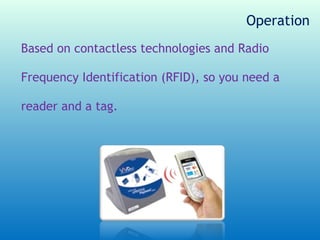
Based on contactless technologies and Radio

Frequency Identification (RFID), so you need a

reader and a tag.
NFC TAG
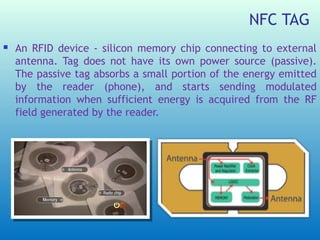
   An RFID device - silicon memory chip connecting to external
    antenna. Tag does not have its own power source (passive).
    The passive tag absorbs a small portion of the energy emitted
    by the reader (phone), and starts sending modulated
    information when sufficient energy is acquired from the RF
    field generated by the reader.
Operation Of NFC
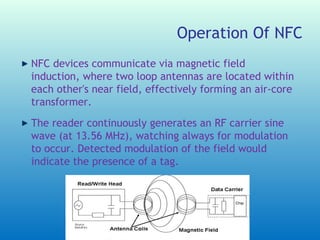
NFC devices communicate via magnetic field
induction, where two loop antennas are located within
each other's near field, effectively forming an air-core
transformer.
The reader continuously generates an RF carrier sine
wave (at 13.56 MHz), watching always for modulation
to occur. Detected modulation of the field would
indicate the presence of a tag.
Active vs Passive Device

Devices containing power sources are called as
active
      Mobile phone
      NFC reader

Devices without any available power sources are
called as passive
     RFID tag
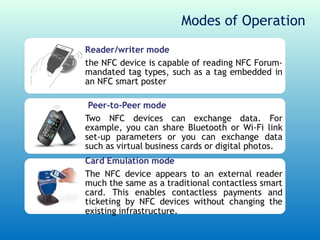
Modes of Operation 
APPLICATION OF NFC 

   NFC applications can be split into the
    following three basic categories:

   Touch and Go

   Touch and Connect

   Touch and Confirm
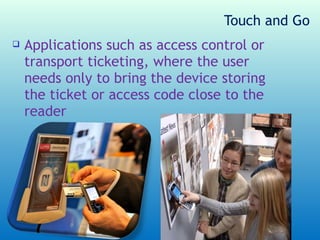
Touch and Go
   Applications such as access control or
    transport ticketing, where the user
    needs only to bring the device storing
    the ticket or access code close to the
    reader
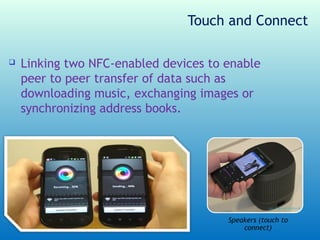
Touch and Connect

   Linking two NFC-enabled devices to enable
    peer to peer transfer of data such as
    downloading music, exchanging images or
    synchronizing address books.


                                       Speakers (touch to
                                           connect)
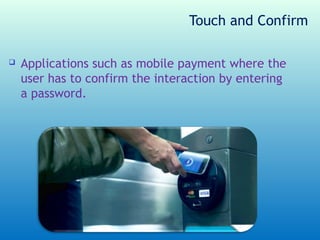
Touch and Confirm

   Applications such as mobile payment where the
    user has to confirm the interaction by entering
    a password.
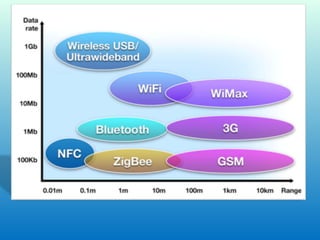
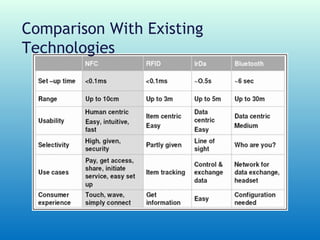
Comparison With Existing
Technologies
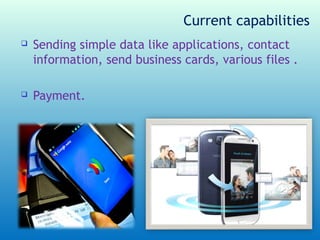
Current capabilities
   Sending simple data like applications, contact
    information, send business cards, various files .

   Payment.
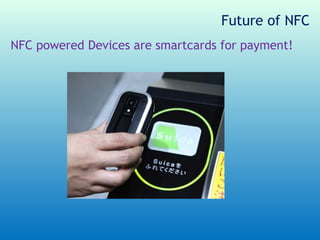
Future of NFC
NFC powered Devices are smartcards for payment!
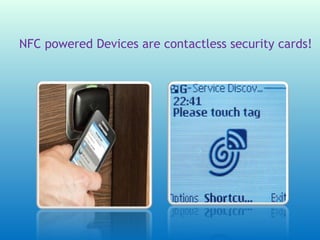
NFC powered Devices are contactless security cards!
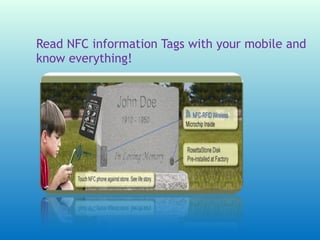
Read NFC information Tags with your mobile and
know everything!
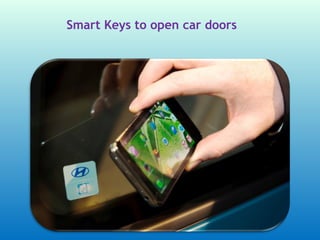
Smart Keys to open car doors
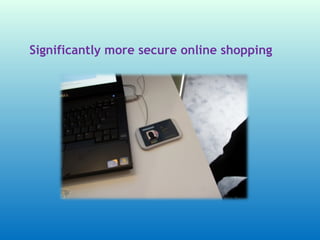
Significantly more secure online shopping
Benefits of NFC

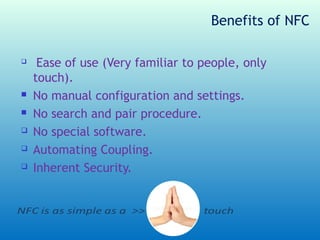
    Ease of use (Very familiar to people, only
    touch).
   No manual configuration and settings.
   No search and pair procedure.
   No special software.
   Automating Coupling.
   Inherent Security.
Disadvantages of NFC


   The system has the limitation that it can be
    operated only with devices under a short range.

   The data transfer rate is very less.
Conclusion


   NFC will provide convenience and added
    benefit for both the consumer and retailer.
THANK YOU
    

Nfc kdr

  • 1.
    An Examination ofthe future of Near Field Communication Abdul Khader
  • 2.
    CONTENTS  What is NFC?  How does it operates?  What are the current capabilities?  What is its future?  Conclusion
  • 3.
    Introduction Near Field Communication (NFC) refers to:  Short-range wireless connection (a few centimetres). Frequency : 13.56 MHz Max. Bandwidth : 424Kbits/sec Simple and safe.
  • 5.
    Operation Based on contactless technologies and Radio FrequencyIdentification (RFID), so you need a reader and a tag.
  • 6.
    NFC TAG  An RFID device - silicon memory chip connecting to external antenna. Tag does not have its own power source (passive). The passive tag absorbs a small portion of the energy emitted by the reader (phone), and starts sending modulated information when sufficient energy is acquired from the RF field generated by the reader.
  • 7.
    Operation Of NFC NFCdevices communicate via magnetic field induction, where two loop antennas are located within each other's near field, effectively forming an air-core transformer. The reader continuously generates an RF carrier sine wave (at 13.56 MHz), watching always for modulation to occur. Detected modulation of the field would indicate the presence of a tag.
  • 8.
    Active vs PassiveDevice Devices containing power sources are called as active Mobile phone NFC reader Devices without any available power sources are called as passive RFID tag
  • 9.
  • 10.
    APPLICATION OF NFC   NFC applications can be split into the following three basic categories:  Touch and Go  Touch and Connect  Touch and Confirm
  • 11.
    Touch and Go  Applications such as access control or transport ticketing, where the user needs only to bring the device storing the ticket or access code close to the reader
  • 12.
    Touch and Connect  Linking two NFC-enabled devices to enable peer to peer transfer of data such as downloading music, exchanging images or synchronizing address books. Speakers (touch to connect)
  • 13.
    Touch and Confirm  Applications such as mobile payment where the user has to confirm the interaction by entering a password.
  • 14.
  • 15.
    Current capabilities  Sending simple data like applications, contact information, send business cards, various files .  Payment.
  • 16.
    Future of NFC NFCpowered Devices are smartcards for payment!
  • 17.
    NFC powered Devicesare contactless security cards!
  • 18.
    Read NFC informationTags with your mobile and know everything!
  • 19.
    Smart Keys toopen car doors
  • 20.
  • 21.
    Benefits of NFC  Ease of use (Very familiar to people, only touch).  No manual configuration and settings.  No search and pair procedure.  No special software.  Automating Coupling.  Inherent Security.
  • 22.
    Disadvantages of NFC  The system has the limitation that it can be operated only with devices under a short range.  The data transfer rate is very less.
  • 23.
    Conclusion  NFC will provide convenience and added benefit for both the consumer and retailer.
  • 24.

Editor's Notes

  • #4 Antes de ponernos a explicar nada, hemos de definir lo que es NFC. NFC o Near Field Communication hace referencia a una conexión inalámbrica de corto alcance, hablaríamos de unos pocos centímetros que está basada en estándares y que de una forma simple y segura nos proporciona una interacción bi-direccional entre varios dispositivos electrónicos.
  • #6 El funcionamiento de NFC es muy sencillo. Al estar basado en tecnologías de contacto, especialmente en RFID, simplemente hace falta un lector y una tarjeta. El lector al encenderse empezaría a emitir una señal de radio de corto alcance, que al alcanzar el microchip de la etiqueta se encendería y se podría recoger los datos que contiene. Esta imagen representa un poco por encima como sería.
  • #9 Primero vamos a explicar el modo de funcionamiento pasivo. En este modo, como podemos ver en la imagen, el dispositivo iniciador genera el campo electromagnético que al llegar a su objetivo sirve para alimentarlo y encenderlo. Ambos dispositivos aprovechan el campo generado para transmitirse los datos, pero el objetivo al ser alimentado por le propio campo electromagnético no necesita alimentación auxiliar. Este sería el modo usado para leer y escribir en etiquetas NFC.
  • #10 En el protocolo NFC siempre es uno de los dispositivos el que comienza la conversación, a este dispositivo se le conoce como “iniciador” y será el encargado de monitorizarla. Aunque en ciertos casos, como puede ser en las comunicaciones peer-to-peer, este rol puede ser intercambiado. En el estándar NFC se han definido 2 modos de funcionamiento, el funcionamiento activo y el pasivo. Cabe mencionar que todos los dispositivos que implementen el estándar NFCIP-1 deben soportar ambos modos.
  • #11 Independientemente del modo de funcionamiento, toda comunicación NFC consta de 5 fases. Descubrimiento: Es la fase en la que los dispositivos se detectan entre sí. Autenticación: La fase en la que los dispositivos se identifican. Negociación: En esta fase deciden que tipo de conexión van a establecer, el modo de funcionamiento, la velocidad de transferencia, etc. Transferencia: Es la fase en la que se intercambian los datos. Reconocimiento: En esta fase comprueban que toda la información ha llegado correctamente y se cierra la conexión. Para asegurarse de que todo funciona correctamente, NFC también incluye un procedimiento de autenticación seguro y un mecanismo anti-colisiones de datos.
  • #22 Ahora que ya conocemos un poco mejor en que consiste NFC, nos surge la duda de que beneficios nos puede ofrecer NFC sobre las demás tecnologías ya existentes. NFC mejora la usabilidad y la experiencia del usuario, ya que la forma en la que NFC funciona es mas natural e intuitiva que el resto de tecnologías disponibles. Además, nos proporciona un fácil acceso a los servicios y contenidos que se nos ofrecen, puesto que para compartir información basta con acercar nuestro dispositivo NFC a otro, para que este lo detecte y se comunique con el. Y por ultimo NFC nos ofrece seguridad en la comunicación ya que nos proporciona un canal seguro por el que hacer el intercambio de datos, además de tener la capacidad de evitar ataques como puede ser el Man in the middle.
  • #23 Ahora que ya conocemos un poco mejor en que consiste NFC, nos surge la duda de que beneficios nos puede ofrecer NFC sobre las demás tecnologías ya existentes. NFC mejora la usabilidad y la experiencia del usuario, ya que la forma en la que NFC funciona es mas natural e intuitiva que el resto de tecnologías disponibles. Además, nos proporciona un fácil acceso a los servicios y contenidos que se nos ofrecen, puesto que para compartir información basta con acercar nuestro dispositivo NFC a otro, para que este lo detecte y se comunique con el. Y por ultimo NFC nos ofrece seguridad en la comunicación ya que nos proporciona un canal seguro por el que hacer el intercambio de datos, además de tener la capacidad de evitar ataques como puede ser el Man in the middle.