Global Education:
Preparing 21st Century Citizens
for a 21st Century World
Moving towards Global Competency
JASMYN WRIGHT
EASTSIDE CHARTER SCHOOL
DELAWARE, USA
The….of global education
need
definition
goals
values
strategies
The 21st century student,
needs 21st century skills.
 “….(our schools) are insufficient to create the citizens, workers and
leaders our nation needs in the 21st century. Missing in this formula for a
world class education is an urgent call for schools to produce students
that actually know something about the world—its cultures, languages
and how its economic, environmental and social systems work.” - Anthony
Jackson “Asia Society”
https://www.youtube.com/watch?v=nA1Aqp0sPQo
Potential Barriers in
Education?
 “Promoting respect and responsibility across cultures,
countries and regions has not been at the centre of
education. Global citizenship is just taking root and
changing traditional ways of doing things always brings
about resistance. This entails changing the way
education is organized— making content more relevant
to contemporary life and global challenges, introducing
innovative and participatory teaching and learning
styles. We must rethink the purpose of education and
prepare students for life, not exams alone.” - UN Global
Leadership First Initiative
We need global education!
A globally competent student possesses the knowledge, skills, and
disposition to understand and act creatively on issues of global
significance.
Source: Asia Society
We are interdependent.
Why should we foster global citizenship?
“The world faces global challenges, which require global solutions. These
interconnected global challenges call for far-reaching changes in how we
think and act for the dignity of fellow human beings. It is not enough for
education to produce individuals who can read, write and count. Education
must be transformative and bring shared values to life. It must cultivate an
active care for the world and for those with whom we share it. Education
must also be relevant in answering the big questions of the day.
Technological solutions, political regulation or financial instruments alone
cannot achieve sustainable development. It requires transforming the way
people think and act. Education must fully assume its central role in helping
people to forge more just, peaceful, tolerant and inclusive societies. It must
give people the understanding, skills and values they need to cooperate in
resolving the interconnected challenges of the 21st century.” -Global UN
Issues in the world.
What is global citizenship?
“A global citizen is someone who identifies with being part of
an emerging world community and whose actions contribute
to building this community’s values and practices.” - Kosmos
Journal for Global Transformation
And it starts with education.
The Global Education Advisory
Council
from “Global Education: What Does It Look Like in Schools?”
(2011)
“Global education must prepare students to understand
perspectives of other peoples and cultures across all
grade levels and disciplines so as to be able to solve
common problems and develop better working
relationships.”
It isn’t just learning about
culture and diversity
The limitations of a “single story”
https://www.ted.com/talks/chimamanda_adichie_the_dang
er_of_a_single_story?language=en#t-388825
Global education students
know how to
think critically
problem solve
collaborate with peers
lead others
adapt to changes
from “Rigor Redefined” by Tony
Wagner
It is not simply about what is taught,
but how the curriculum is taught.
Global Education vs Expeditionary
Learning
 Global Education
Investigate their world
Recognize perspectives
Communicate ideas
Take action
Asia Society, Educating for Global Competence
Expeditionary Learning
Design Principles
Primacy of self-discovery
Responsibility for learning
Collaboration and competition
The natural world
Diversity and inclusion
Service and compassion
Solitude and reflection
The natural world
EL.org
It also includes
 COMBINE EXPEDITIONARY LEARNING WITH GLOBAL EDUCATION
 Technology literacy and skills
 Interdisciplinary connections
 Fluency in another language
 Creating and innovating
 Active, participation in society
 Understanding of global issues
Global Students will..
 Investigate the world beyond one’s own immediate
environment, framing significant problems and
conducting well-crafted and age-appropriate research
 Recognize perspectives, others’ and one’s own, while
articulating and explaining such perspectives
thoughtfully and respectfully.
 Communicate ideas effectively with diverse audiences,
bridging geographic, linguistic, ideological and cultural
barriers.
 Take action to improve conditions viewing oneself as a
player in the world and participating reflectively.
Global education prepares
students for this
……just like Expeditionary Learning
and this
“Census Officials, Citing Increasing Diversity,
Say U.S. Will Be a ‘Plurality Nation’”
The New York Times
December 12, 2012
“…BY THE END OF THIS DECADE, ACCORDING TO
CENSUS BUREAU PROJECTIONS RELEASED
WEDNESDAY, NO SINGLE RACIAL OR ETHNIC
GROUP WILL CONSTITUTE A MAJORITY OF
CHILDREN UNDER 18.”
MICHAEL COOPER
We know it is important, we
know what it is, we know
what the goals and values
are, but how do we
implement it? How do we
globalize our classrooms?
Start Small
It is not about re-writing everything
you do,
just add, enhance, innovate!
Have staff share their own cultural stories. Learn about
different people and places from students, parents, and
community members. Plan an outing to an ethnic
restaurant. Invite guest speakers. Host an international
night. Begin an “ePal” project with another school.
- Skype children in other countries
- International service projects
We need to do what we global
education teachers encourage
our students to do:
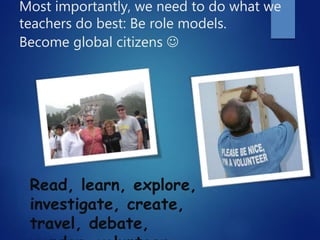
Most importantly, we need to do what we
teachers do best: Be role models.
Become global citizens 
Read, learn, explore,
investigate, create,
travel, debate,
Explore Global Education
Resources
 The Global Education Advisory Council
 UNESCO and Teach UNICEF resources
 The Asia Society’s Educating for Global Competence:
Preparing our Youth to Engage in the World (Mansilla
and Jackson, 2011)
 “Rigor Redefined” by Tony Wagner (2008)
 Oxfam’s Education for Global Citizenship: A Guide for
Schools (2006)
 Peace Corps school projects
Districts can support staff in globalizing
their classrooms by offering…
 Professional development related to global education
topics. For example, check out Primary Source.org for
online webinars
 Time for review of currently taught units to implement
global education skills. Consider using the Global
Education Checklist by Fred Czarra.
 Host teacher exchanges and speakers- help staff gain a
more global perspective.
 Provide collaboration time for staff to share what they
are learning and implementing.
Critical Thinking, Communication,
Collaboration, & Creativity
 “Using the ‘Four Cs’ to engage students is imperative. As
educators prepare students for this new global society,
teaching the core content subjects—math, social studies, the
arts— must be enhanced by incorporating critical thinking,
communication, collaboration, and creativity. We need new
tools to support classroom teachers and education support
professionals in their profession, even as they implement new
strategies in their classrooms.”
 John Stocks
Nea.org

Jasmyn wright global education

  • 1.
    Global Education: Preparing 21stCentury Citizens for a 21st Century World Moving towards Global Competency JASMYN WRIGHT EASTSIDE CHARTER SCHOOL DELAWARE, USA
  • 2.
  • 3.
    The 21st centurystudent, needs 21st century skills.  “….(our schools) are insufficient to create the citizens, workers and leaders our nation needs in the 21st century. Missing in this formula for a world class education is an urgent call for schools to produce students that actually know something about the world—its cultures, languages and how its economic, environmental and social systems work.” - Anthony Jackson “Asia Society” https://www.youtube.com/watch?v=nA1Aqp0sPQo
  • 4.
    Potential Barriers in Education? “Promoting respect and responsibility across cultures, countries and regions has not been at the centre of education. Global citizenship is just taking root and changing traditional ways of doing things always brings about resistance. This entails changing the way education is organized— making content more relevant to contemporary life and global challenges, introducing innovative and participatory teaching and learning styles. We must rethink the purpose of education and prepare students for life, not exams alone.” - UN Global Leadership First Initiative
  • 5.
    We need globaleducation! A globally competent student possesses the knowledge, skills, and disposition to understand and act creatively on issues of global significance. Source: Asia Society
  • 6.
  • 7.
    Why should wefoster global citizenship? “The world faces global challenges, which require global solutions. These interconnected global challenges call for far-reaching changes in how we think and act for the dignity of fellow human beings. It is not enough for education to produce individuals who can read, write and count. Education must be transformative and bring shared values to life. It must cultivate an active care for the world and for those with whom we share it. Education must also be relevant in answering the big questions of the day. Technological solutions, political regulation or financial instruments alone cannot achieve sustainable development. It requires transforming the way people think and act. Education must fully assume its central role in helping people to forge more just, peaceful, tolerant and inclusive societies. It must give people the understanding, skills and values they need to cooperate in resolving the interconnected challenges of the 21st century.” -Global UN
  • 8.
  • 9.
    What is globalcitizenship? “A global citizen is someone who identifies with being part of an emerging world community and whose actions contribute to building this community’s values and practices.” - Kosmos Journal for Global Transformation
  • 10.
    And it startswith education.
  • 11.
    The Global EducationAdvisory Council from “Global Education: What Does It Look Like in Schools?” (2011) “Global education must prepare students to understand perspectives of other peoples and cultures across all grade levels and disciplines so as to be able to solve common problems and develop better working relationships.”
  • 12.
    It isn’t justlearning about culture and diversity The limitations of a “single story” https://www.ted.com/talks/chimamanda_adichie_the_dang er_of_a_single_story?language=en#t-388825
  • 13.
    Global education students knowhow to think critically problem solve collaborate with peers lead others adapt to changes from “Rigor Redefined” by Tony Wagner
  • 14.
    It is notsimply about what is taught, but how the curriculum is taught.
  • 15.
    Global Education vsExpeditionary Learning  Global Education Investigate their world Recognize perspectives Communicate ideas Take action Asia Society, Educating for Global Competence Expeditionary Learning Design Principles Primacy of self-discovery Responsibility for learning Collaboration and competition The natural world Diversity and inclusion Service and compassion Solitude and reflection The natural world EL.org
  • 16.
    It also includes COMBINE EXPEDITIONARY LEARNING WITH GLOBAL EDUCATION  Technology literacy and skills  Interdisciplinary connections  Fluency in another language  Creating and innovating  Active, participation in society  Understanding of global issues
  • 17.
    Global Students will.. Investigate the world beyond one’s own immediate environment, framing significant problems and conducting well-crafted and age-appropriate research  Recognize perspectives, others’ and one’s own, while articulating and explaining such perspectives thoughtfully and respectfully.  Communicate ideas effectively with diverse audiences, bridging geographic, linguistic, ideological and cultural barriers.  Take action to improve conditions viewing oneself as a player in the world and participating reflectively.
  • 18.
    Global education prepares studentsfor this ……just like Expeditionary Learning
  • 19.
  • 20.
    “Census Officials, CitingIncreasing Diversity, Say U.S. Will Be a ‘Plurality Nation’” The New York Times December 12, 2012 “…BY THE END OF THIS DECADE, ACCORDING TO CENSUS BUREAU PROJECTIONS RELEASED WEDNESDAY, NO SINGLE RACIAL OR ETHNIC GROUP WILL CONSTITUTE A MAJORITY OF CHILDREN UNDER 18.” MICHAEL COOPER
  • 21.
    We know itis important, we know what it is, we know what the goals and values are, but how do we implement it? How do we globalize our classrooms?
  • 22.
    Start Small It isnot about re-writing everything you do, just add, enhance, innovate! Have staff share their own cultural stories. Learn about different people and places from students, parents, and community members. Plan an outing to an ethnic restaurant. Invite guest speakers. Host an international night. Begin an “ePal” project with another school. - Skype children in other countries - International service projects
  • 23.
    We need todo what we global education teachers encourage our students to do:
  • 24.
    Most importantly, weneed to do what we teachers do best: Be role models. Become global citizens  Read, learn, explore, investigate, create, travel, debate,
  • 25.
    Explore Global Education Resources The Global Education Advisory Council  UNESCO and Teach UNICEF resources  The Asia Society’s Educating for Global Competence: Preparing our Youth to Engage in the World (Mansilla and Jackson, 2011)  “Rigor Redefined” by Tony Wagner (2008)  Oxfam’s Education for Global Citizenship: A Guide for Schools (2006)  Peace Corps school projects
  • 26.
    Districts can supportstaff in globalizing their classrooms by offering…  Professional development related to global education topics. For example, check out Primary Source.org for online webinars  Time for review of currently taught units to implement global education skills. Consider using the Global Education Checklist by Fred Czarra.  Host teacher exchanges and speakers- help staff gain a more global perspective.  Provide collaboration time for staff to share what they are learning and implementing.
  • 27.
    Critical Thinking, Communication, Collaboration,& Creativity  “Using the ‘Four Cs’ to engage students is imperative. As educators prepare students for this new global society, teaching the core content subjects—math, social studies, the arts— must be enhanced by incorporating critical thinking, communication, collaboration, and creativity. We need new tools to support classroom teachers and education support professionals in their profession, even as they implement new strategies in their classrooms.”  John Stocks Nea.org